


Reprinted fromBiofuelwatch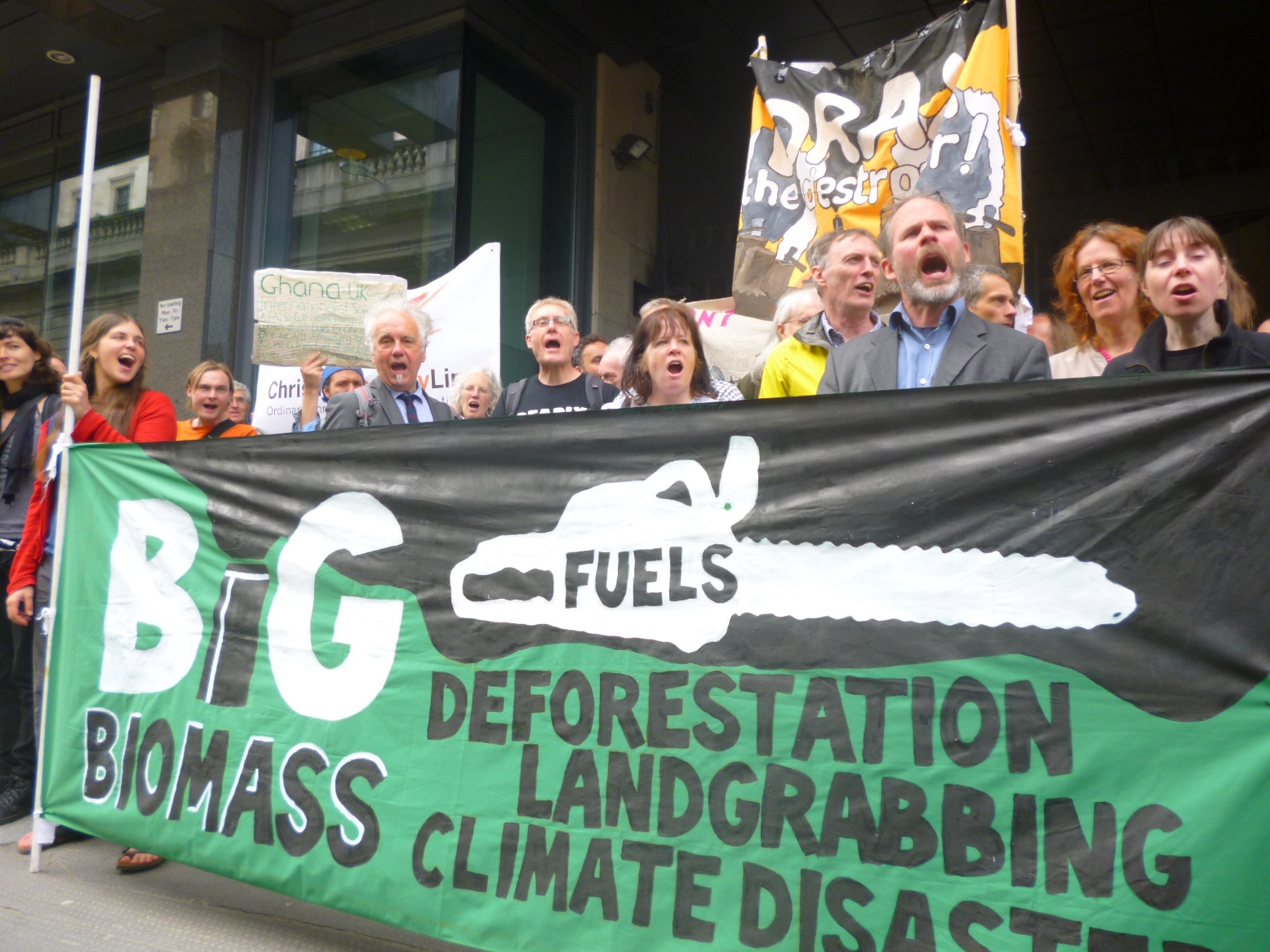 50 people took part in a demonstration and rally outside the annual general meeting of Drax Plc, at the Grocers’ Hall in London, organized by Biofuelwatch [1] and supported by 16 other groups [2]. Demonstrators chant3e “Drax Drax, what do you say? How many trees have you killed today?” and holding banners reading “Big Biomass: Fuelling Deforestation, Land-grabbing and Climate Disaster”, “Big Biomass is Greenwash not Renewable Energy” and “Drax the Destroyer!”. Biofuelwatch called the demonstration to oppose Drax power station’s plans to convert half of its generating capacity to biomass, and to highlight the impacts that this will have in terms of increased deforestation, land-grabbing and carbon emissions.
Natalie Bennet, Leader of the Green Party in England and Wales attended the demonstration and addressed the crowd. She said: “I made the time to come today as this is a really important issue. We absolutely must stand against big biomass. We need to write “decarbonisation by 2030″ into the Energy Bill and provide for the investment in solar, wind energy and energy conservation, which are the only answers for Britain.” Oliver Munnion from Biofuelwatch who took part in today’s protest said: “I’m here today to dispel a modern myth that big biomass is sustainable, low-carbon energy. Drax isn’t going green – it’s cashing in on massive subsidies to the tune of half a billion pounds a year and trying to keep its old, dirty power station going for as long as possible. You can’t paint a green façade onto the UK’s most polluting power station. Big biomass and coal spell disaster for communities and the climate – it’s time these dinosaurs closed.”
Sophie Bastable, also in attendance at the demonstration said: “In order for governments to meet renewable energy targets and to make dirty companies look green there is a massive push for biomass in the UK right now. But the fuel that Drax currently uses and will use much more of directly contributes to the destruction of biodiverse forests in North America. There is nothing sustainable about burning 1.6 times as much as the UK’s total annual wood supply in one power station every year. Creating such a vast new demand for wood will lead to more destruction of biodiverse forests and, whether directly or indirectly, more land-grabbing for tree plantations in the global South.”
Today’s protest coincides with the publication of an open letter to Drax Plc signed by 49 different organisations and networks worldwide, including Friends of the Earth International, the Global Forest Coalition and World Rainforest Movement [3]. The letter concludes: “We oppose commercial and industrial scale bioenergy, and demand that the UK halt coal conversion plans and force these coal plants to shut down. Meanwhile focus must be redirected towards a serious reduction of energy consumption and dramatic measures to protect and restore forests and other ecosystems.”
 Drax’s biomass plans will require pellets made from 15.8 million tonnes of wood each year, making it the biggest biomass-burning power station in the world. By comparison, the UK’s total annual wood production is only 10 million tonnes. Overall, energy companies in the UK are planning to burn up to 10 times as much wood as the UK produces ever year. Wood burned by Drax increasingly comes from whole trees felled for this purpose [4].
In addition to issues of deforestation and land-grabbing, recent scientific studies have shown that biomass used for electricity generation is actually more carbon intensive than burning coal [5]. Duncan Law from Biofuelwatch said: “Burning biomass on the scale proposed will be even more carbon intensive than the coal it will replace, and result in a massive carbon debt stored just where we don’t want it, in the atmosphere. Far from being a low-carbon fuel, it’s a total climate disaster!”.
For local communities, coal to biomass conversions will mean decades more of high levels of pollution, since the conversions allow power stations to continue operating when they may otherwise have to close down [6]. Reverend Paul Cawthorne, Environmental Officer for the Lichfield Diocese and a near-by resident to Ironbridge, another coal-fired power station converting to biomass said: “After the dash for gas comes the dash for wood and with similar uncertainties about how noxious emissions will affect our local air. Why do some people think cutting down forests in other countries is somehow better for the planet than using our local resources and putting effort into becoming more efficient in our domestic use of energy. This is absurd and culpable short-termism. Even the wood trade is warning ministers this is a disaster in the making.”Notes
[1] Biofuelwatch is a not-for-profit grassroots organisation set up to raise awareness of the negative impacts of industrial biofuels and bioenergy.
[2] The following organisations are formally supporting Taking DRAXtic Action: Campaign Against Climate Change; Carbon Trade Watch; Christian Ecology Link; Climate Justice Collective; Coal Action Network; Coal Action Scotland; Colombia Solidarity Campaign; Corporate Watch; Frack Free Somerset; Fuel Poverty Action; Gaia Foundation; London Mining Network; London Rising Tide; Occupy London Energy, Equity and Environment Group; Rising Tide UK; World Development Movement.
[3] The Open Letter to Drax can be found here.[4] The Dogwood Alliance, a nonprofit organization working to protect forests in the Southern US, released a report entitled “The Use of Whole Trees in Wood Pellet Manufacturing,” in November 2012 documenting the fact that the top exporters of wood pellets in the region rely heavily on cutting down whole trees to satisfy demand from European power stations. Scot Quaranda, Campaign Director for Dogwood Alliance said “Energy companies in the UK, including Drax, RWE and E.On are converting large, old, dirty and inefficient coal power stations to biomass all in the name of reducing carbon emissions, but the reality is that this shift will accelerate climate change while also driving destructive industrial logging in the world’s most biologically diverse temperate forests.” Through direct investigation and research, the report documents the use of whole trees from Southern forests by the largest wood pellet manufacturers and exporters in the Southern US. Pellet manufacturers such as Georgia Biomass, a wholly owned subsidiary of RWE, and Enviva, a major supplier of Drax and E.On are highlighted in the report as using or if not open, planning to use, whole trees. The report can be found here.
[5] For a list of studies into the carbon impacts of biomass electricity, see www.biofuelwatch.org.uk/resources-on-biomass. In addition, the report “Dirtier than coal?” published by RSPB, Friends of the Earth and Greenpeace can be found here.
[6] According to a briefing by Department for Energy and Climate for the House of Lords on 14th February 2013, “the conversion of existing coal generating plant to biomass or higher levels of biomass co-firing is a way of keeping open some existing coal plant that would otherwise close before 2016 under environmental legislation, and therefore improve capacity margins over this decade.”
Today marks a pinnacle moment in Dogwood’s campaign to protect Southern forests from the impacts of industrial forestry for paper production. Since our humble beginnings in 1996, Dogwood Alliance has been openly critical of the paper industry’s impact on Southern forests. After all, the South is the world’s largest paper-producing region. And at the forefront of all of our campaigns over the past twelve years has been International Paper (IP). As the largest paper producer in the world’s largest paper-producing region, IP has had a significant footprint in our forests. And we’ve known for many years now that if we wanted to halt the conversion of natural forests to industrial pine plantations and the loss of unique forested ecosystems we would need to need to win over the Southern forest industry’s most influential player.
To take on IP seemed like a monumental task over a decade ago. But, we had a long-term vision, and we believed we could achieve it. We were going to convince IP’s biggest customers to join us in our fight to protect Southern forests. And once we had some big customers on our side, we were going to convince IP’s competitors to respond to those customers who were asking the right questions. We believed that this would create a new context where paper companies would have to compete for business not just on the price and quality of paper, but also on their commitments to forest conservation. Our strategy was perhaps part theory and part dream. Some doubted that it would work, but we didn’t let it stop us.
Over the years, one by one we convinced major customers of IP including Staples, Office Depot, OfficeMax, FedEx Office, Johnson & Johnson, GlaxoSmithKline, Universal Music Group and McDonald’s to embrace new environmental standards for their paper suppliers. That paved the way for three of the South’s largest paper producers, Domtar, Georgia-Pacific and Resolute Forest Products to begin working with Dogwood Alliance to improve forestry practices by embracing Forest Stewardship Council (FSC) certification and/or committing not to purchase any wood from endangered forests or from plantations established at the expense of natural forests.
And then, about a year ago, in the midst of a campaign targeting another one of IP’s customers, Yum! Brands/KFC, I got a call from IP’s new VP of Sustainability, Teri Shanahan. Fast forward to today and IP has developed the most comprehensive approach to addressing long-standing concerns about the impacts of industrial logging in the US South. Not only are they working to aggressively expand the acreage of FSC certified forests across the South (by 2014 they expect to be one of the world’s largest users of FSC certified fiber in the world), but they have also committed to invest $7.5 million to help conserve forests in the ecoregions that have been the focus of our campaigns. Beyond that, they have agreed to work with Dogwood Alliance to map endangered and other high conservation value forests and to discourage the future conversion of natural hardwood forests to pine plantations.
This is a big shift from business as usual in the Southern forest industry, and IP deserves credit for embracing new approaches and beginning to create a new paradigm for their industry. They also deserve a lot of credit for seeking out Dogwood Alliance, one of their biggest critics, as a partner on their path of continuous improvement. That takes courage and a bit of a leap of faith.
We still have a long way to go to ensure our forests have the protection they so deserve. And there is still need for even greater improvement in the paper industry. But, today is a day to celebrate and to feel hopeful about what’s possible in the future. This has been a long road. It has been hard work involving the time, energy and support of many people over the years. Together we dreamed a big dream and it came true…at least in part… giving rise to an even greater confidence in our ability to manifest even bigger dreams for Southern forests in the future.


 Donate