


PHILADELPHIA, PENN. (Nov. 20, 2013) – Today at the 2013 Greenbuild Conference in Philadelphia, Dogwood Alliance, in partnership with Forest Stewardship Council-US, Interface, Inc. and Staples announced commitments by Interface and Staples to purchase forest carbon offsets from two projects in the Southern Appalachian region of the US South developed by the Carbon Canopy. These major US companies have agreed to buy forest carbon from landowners who have committed to protect forest carbon stocks over the next 100 years and certify their forests to the rigorous standards of the Forest Stewardship Council (FSC) certification system.
“Standing forests play a vital role in the fight against climate change. While today these projects define the new progressive–edge in forestry, we fully expect this concept to become mainstream within a decade,” said Andrew Goldberg, Director of Corporate Engagement at Dogwood Alliance. “Today’s announcement represents a future where the climate benefits of trees left standing actually have a market value, where long-term conservation of forests is profitable for landowners and where the forest products that we all use originate from management practices that conserve and restore, rather than degrade forests.”
The two projects announced today are the first for the Carbon Canopy and cover a combined 14,000 acres of forests in the Southern Appalachian region of North Carolina and Virginia.

Balsam Mountain Preserve, one of the Carbon Canopy forest carbon projects announced today.
“Staples is proud to be a founding member of the Carbon Canopy. In addition to building green facilities, fleets and the purchase of renewable energy, credible, high-quality forest carbon offsets offer additional opportunities for companies like Staples to reduce the impacts to climate change of their operations and supply chains,” said Mark F Buckley, Vice President of Environmental Affairs at Staples Inc. “The ability to conserve forests while also creating future FSC-certified wood supply for products that we depend upon is a win for Staples, a win for our customers and a win for the planet.”
As the largest source of forest products in the US, the logging of Southern forests has long been a revenue mainstay for landowners and lumber and paper companies. But the forests’ ecological assets, which have had no corresponding market value, have often suffered. Considered the world’s most bio-diverse temperate forests, the region has lost critical habitat through unsustainable forestry practices. With the passage of California’s Global Warming Solutions Act in 2006, the door opened for the development of forest carbon as a sellable asset. Increasingly, companies are looking for ways to reduce carbon emissions through investments in climate change solutions, Carbon Canopy projects not only meet the high forest management standards of the FSC, but also the rigorous forest carbon accounting standards adopted by the Air Resources Board of the State of California.
“We’re excited about our role as one of the first partners to purchase offsets from these projects,” said Erin Meezan, Vice President of Sustainability at Interface. “We’ve watched the project evolve from concept to working model and are excited about the prospect of Carbon Canopy to provide a high quality offset that will allow us to expand our carbon neutral product offerings.”
The Carbon Canopy was initiated in 2007 by Staples and Dogwood Alliance who teamed up with other conservation groups, wood products companies and landowners to protect Southern forests, combat climate change and develop sources of paper and wood products certified to the high standards of the FSC, globally recognized as the gold standard in forest certification.
“As a partner in the Carbon Canopy initiative, Domtar is proud to support this innovative approach to expanded FSC forest management certification and enhanced return to landowners. We congratulate Dogwood Alliance, Staples and other key partners for their commitment to unlocking the value of forests,” said Paige Goff, Domtar’s Vice President of Sustainability and Business Communications.
The Carbon Canopy partners include: Staples, Columbia Forest Products, Domtar, The Coca-Cola Company, The Home Depot, Interface, Inc., The Forestland Group, Rainforest Alliance, Pacific Forest Trust, the National Woodland Owners Association, FSCUS, and Forest Stewards.
Dogwood Alliance is increasing protection for millions of acres of Southern forests by transforming the way corporations, landowners and communities value them for their climate, wildlife and water benefits. Dogwood Alliance has revolutionized the environmental practices of some of the world’s largest corporations. For more information on Dogwood or the Carbon Canopy Project, please visit dogwoodalliance.org.
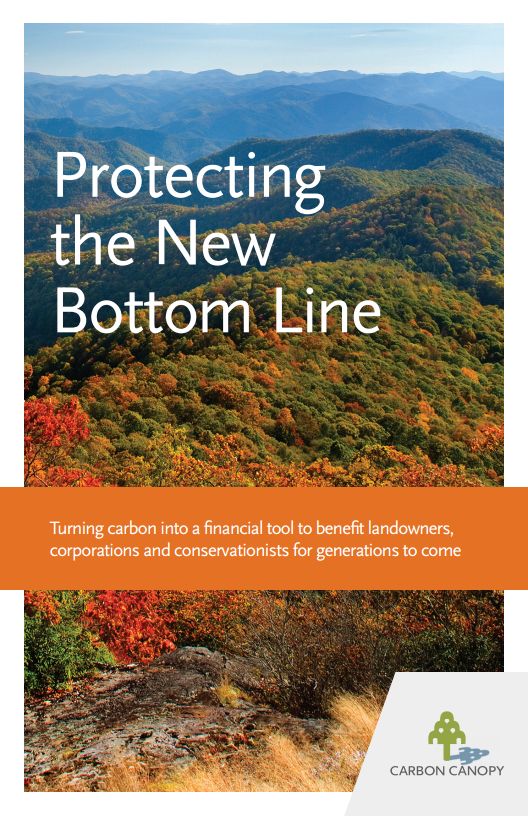
Read about Dogwood’s exciting Carbon Canopy projects
Today, the Carbon Canopy partnership announces the sale of its carbon offsets from its first forest carbon pilot projects, covering more than 12,000 acres on properties located in Western North Carolina and Southwestern Virginia. These projects result in over 100,000 carbon offsets which will reduce greenhouse gas emission in year one and complement the property owners’ commitments to long-term forest stewardship. What a success! Carbon offsets from these initial projects are being purchased by Staples and Interface, longtime supporters of the Carbon Canopy’s work to build an ecosystem services marketplace that supports the conservation of Southern Forests.
Balsam Mountain Preserve, one of the Carbon Canopy forest carbon projects announced today.
But that’s not all. In addition to the offsets, the landowners are committed to responsible management under the Forest Stewardship Council (FSC) certification system – the highest certification standard in the land. As an additional benefit, the FSC-certified wood coming from their forest management plan helps support the greening of the forest products industry. The FSC-certified wood ultimately flows into the supply chain of Carbon Canopy partners Domtar and Columbia Forest Products, allowing them to meet their procurement goals and helping them produce FSC-certified products. If we all act now, we might create a new leading-edge type of forestry, one in which landowners actually get paid to leave trees standing. That’s right: for the first time, you can get paid to leave trees standing.
In true Dogwood Alliance fashion, this project has both deep local connections in the Southern Appalachians and clear global implications, as at this week’s UN COP 19 Global Climate Talks in Warsaw, Poland, nations from around the world struggle to address climate change together. Landowners in Western North Carolina and Southwest Virginia are committing to conserve and enhance the carbon stocks held in their forests for 100 years through responsible forest management. The Columbia Forest Products mill is located in Old Fort, North Carolina and the Domtar paper mill is in Kingsport, Tennessee, so these projects are also supporting our local economy. The carbon accounting protocol is set out under the California Global Warming Solutions Act, The carbon offsets are to be purchased by Staples and Interface, companies that play on a global level. We are building something real and important here in the world’s largest forest products producing region while the world works to address climate change with talks in Northern Europe.
These are just the first two Carbon Canopy projects to come online. We are proud to have achieved this important milestone and we have big plans to conserve 100,000 acres in the next five years through similar projects. For 2014, we have tee’d up projects in North Carolina and West Virginia, so be on the lookout for more projects from across the region!
Read about Dogwood’s exciting Carbon Canopy projects
The NC Exports Wood Conference (NCEW), has convened in New Bern, North Carolina with the goal of highlighting the port response to increasing exports and also to explore the challenges, opportunities, and requirements of this industry as it continues to explode in the Southern US.
In the last year, the South has become the largest exporter of wood pellets in the world, and North Carolina has been at the center of that exponential expansion. In order for the growth of this industry to continue, the ports of both Morehead City and Wilmington, NC are planning large port expansions funded in part by our tax dollars. Local residents will be impacted by increased traffic from wood pellet deliveries and other industry-related transportation. The local environment will feel the brunt of the plans to deepen up to 20 miles of the Cape Fear River to accommodate larger ships into the port.
Behind closed doors, the NC Exports Wood Conference has brought together foresters, consultants, economic developers and commissioners, private forest industry executives, USDA representatives, port managers and major investment banks with a goal of expanding all aspects of the bioenergy production and export industry.
Enviva, the main target of the Our Forests Aren’t Fuel campaign, stands to gain from these port expansions.
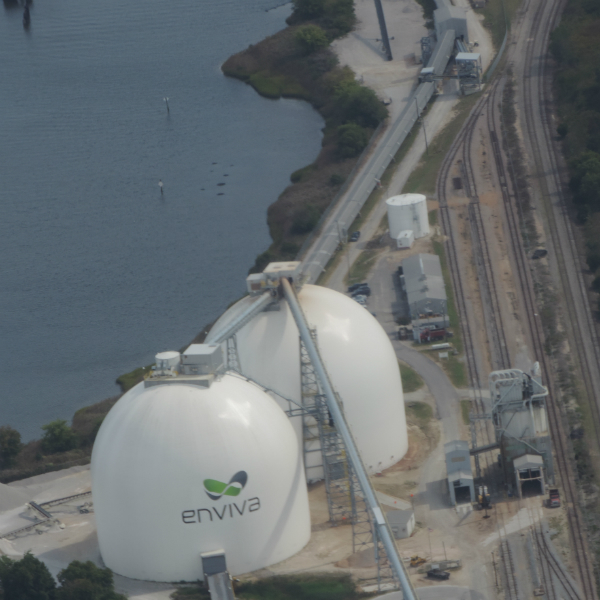
Enviva is the South’s largest exporter of wood pellets and Dogwood’s campaign target
Enviva is currently operating two wood pellet mills in North Carolina and plans to build four more in the coming years; impacting a region whose native forests have already been nearly logged to extinction. Enviva is well-represented this week with Edward Sontag, Enviva’s director of fiber procurement. Edward Sontag is presenting today along with other directors participating in the conference.
While economic development is the main justification for ramping up pellet exports from North Carolina and other Southern states, this idea is fundamentally flawed as it doesn’t take into consideration the vastly important services that these, often bottomland hardwood wetland, forests provide.
This week Dogwood Alliance’s Campaign Director, Scot Quaranda, is meeting with EU and UK Members of Parliament, regulators and utilities to educate them about the negative effects posed to the Southern US by the international biomass industry. So far his trip has been very successful with strategic meetings with members of the Department of Energy and Climate Change (DECC) as well as the Committee on Climate Change where he has been able to present the concerns of over 60 top US scientists and the nearly 20,000 citizens, like yourself, who have signed the Our Forests Aren’t Fuel petition.
While the industry gathers to plot a course for an ill-advised, short-sighted expansion in North Carolina, we will continue to work with our partners in Europe to change the government policy that’s driving the incineration of our Southern forests.
Visiting both London and Brussels, Dogwood Alliance and our partners at NRDC and SELC got the opportunity to meet with the largest companies in Europe importing wood pellets from the Southern US to burn for electricity in the UK, Brussels, Netherlands, Denmark, Poland and more. The meetings were an excellent opportunity to not only better understand the marketplace and decisions driving this destructive practice, but were also a great opportunity to carry the spirit and voice of communities across the South to let these companies know we will not stand idle and let this madness continue.
Our first meeting was with Drax, one of the oldest and largest utilities in the UK, and a huge investor in biomass. Drax is solely reliant on coal for producing electricity, so in order to extend the life of very old coal burning power plants they are utilizing a loophole that allows them keep the power stations open if they co-fire wood with coal. They are being handed millions of dollars in subsidies to burn wood from our forests.
The meeting was with high level executives including the CEO. It was tense at times though cordial and we had the opportunity to hear their perspective, plans and stated intention to be sustainable. Unfortunately our views on sustainability do not match up – they seem to use sustainable to mean a sustainable supply whereas we want to see forests, biodiversity, wildlife, and communities protected from the destructive industrial scale logging used to make most wood pellets.
While in Brussels, the European Climate Foundation graciously invited us to attend a roundtable group working on forest and climate issues. The group included a number of other utilities that use wood pellets from the South including Vatenfall, E.ON, and RWE. In addition to the utilities there were a number of European NGOs. We had the opportunity to listen in their discussion and then hear a presentation from an industry consulting group that advises utilities and wood pellet companies around their markets, supply chain, and feasibility.
Following their presentation, I gave a presentation so the participants could understand the real, on the ground impacts of this industry on our forests, wildlife and communities. There was a vigorous and very stimulating debate which will hopefully support the ENGOs working to ensure that the EU does not give a free pass to biomass and does real and accurate carbon accounting.
Our last meeting was with representatives of Electrabeland its parent company GDF Suez. The meeting was essentially a debate between belief systems and an opportunity to get to know one another. We appreciated the opportunity to meet and hope the company begins to better understand what their practices are destroying and moves away from this ridiculous fuel source to cleaner, greener energy.
 Yesterday I was accompanied by my colleagues from the US – Debbie Hammel from NRDC and Derb Carter from the Southern Environmental Law Center – to two important meetings in London with the Department of Energy and Climate Change (DECC) as well as the Committee on Climate Change. The meetings were arranged by our allies at the Royal Society for the Protection of Birds (RSPB) and Friends of the Earth UK. RSPB’s Director of Climate Change, Harry Huyton, joined us as well as Kenneth Richter from Friends of the Earth.
Our first meeting was with Caroline Season, a senior policy adviser on renewable energy, Dr. Elizabeth McDonnell, the head of bioenergy policy, and Dr. Anna Stephenson, technical advisor at the DECC. DECC released seemingly weak sustainability criteria on wood pellet imports that rely heavily on the misleading certification scheme, SFI, and allows for a pretty massive build-out of new wood burning energy facilities in the UK between now and 2027. Our job was to counter industry’s claims of sustainability, debunk the SFI, and provide guidance on how they should adjust their standards in order to help end the destruction of Southern forests for the development of wood pellets. Overall, the meeting was a great opportunity to make our case on all of these issues and provide opportunities for future engagement that will allow us to make an impact in the UK.
Today we met with officials from the UK Committee on Climate Change, including Dr. Ute Collier, Team Leader, who is in charge of following the issue of the bioenergy build out in the UK. Ute and her team were quite knowledgeable on the issue, and hopefully we provided them with evidence that will help them further explore the disastrous carbon implications of a growing bioenergy industry in the UK.
All in all, I think our team made an impact, built stronger ties with these important agencies, and better positioned ourselves to challenge future growth in the UK. Many thanks to our partners for helping arrange these meetings, and I am looking forward to engaging with officials in the EU in coming days.
Cheers from this side of the pond.
Biofuelwatch has launched a new report, Biomass: the Chain of Destruction, focusing on the human and environmental costs of biomass-focused UK renewable energy policy. The report includes the first ever study of a land-grab in Brazil for eucalyptus plantations directly linked to UK demand for wood pellets. The report also documents the impacts of Drax power station’s pellet demand, sourced from the destruction of ancient forests in the southern U.S. and Canada. The report goes on to document the impacts suffered by communities in the UK living next to biomass infrastructure.
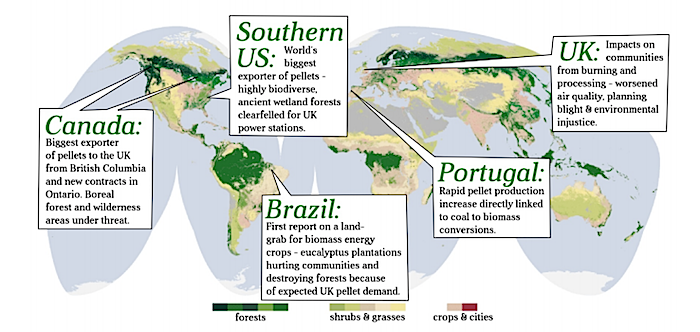
“The Chain of Destruction highlights the impacts of UK support for biomass electricity, from the clear-felled forests of the Americas to the communities in the UK living in the shadow of the industry,” said Biofuelwatch member Oliver Munnion. “But this is just the tip of the iceberg, and what we’re seeing is the impacts of a rapidly growing industry and the speculative investments of irresponsible companies, spurred on by generous subsidies and non-existent sustainability standards.”
Biofuewatch launched this report at a public meeting held in London last night.
Speaking at the meeting, co-author of the report into recent land-grabs in Brazil for biomass and World Rainforest Movement campaigner Winnie Overbeek said: “Planting eucalyptus in Brazil to be able to sell wood to the UK and other European countries is a substantially irrational thing to do. To fuel all of the UK’s electricity requirements through eucalyptus-based biomass would require some 55 million hectares of plantation in Brazil, an unthinkable amount of land, but an attractive prospect for companies like Suzano [plantation owners] and their shareholders.”

The report also documents the impacts of pellet demand, sourced from the destruction of ancient forests in the southern U.S. and Canada. Old growth forest clearcut in BC. Photo credit: TJ Watt
Also speaking at the event, Scot Quaranda of the Dogwood Alliance, described the impacts on diverse wetland forests of Drax’s pellet suppliers: “These are the world’s most biodiverse temperate forests, and they’re being cut to turn into pellets for companies like Drax.”
“They’re not thinnings, branches, tops or twigs—they’re whole trees that are being turned into pellets,” Quaranda continued.
“We undertook a door-to-door survey in 2011,” said Donna Liley of the Mossley Environmental Action Group, who also spoke at last night’s meeting describing her community’s experiences of living next to the UK’s largest waste wood processing facility. “Residents reported symptoms including nasal erosion, hay fever/flu type symptoms, runny or irritated nose, sore or stinging eyes, nosebleeds, chest infections, headaches, fatigue and respiratory problems. Since the survey, there have been several deaths from cancer and high incidences of Alzheimer’s on one street back-to-back with the site.”
Finally, Sophie Bastable, a Biofuelwatch campaigner, presented a study conducted for the report looking into the link between social deprivation and biomass power station location in the UK.
“The study has uncovered significant environmental injustice, in that power stations are more likely to be located in more deprived communities,” concluded Bastable.
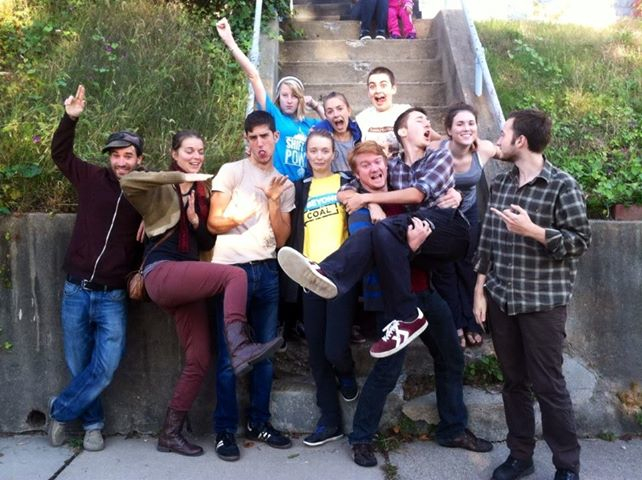
With the call to action of THIS IS OUR POWER SHIFT, over 6,000 youth climate activists made the trek to Pittsburgh, PA from all corners of the United States and even a few other countries. This was the 4th installment of the semi-annual Power Shift conference and the first time it has occurred outside of Washington, DC.
As consensus has become clear that the burning of fossil fuels such as coal, gas, oil and other carbon intense fuels like trees are having an unprecedented effect on global climate, it has become clear that truly renewable energy sources and conservation throughout all aspects of life are necessary. This is why we were at Power Shift, because the evidence is far too striking and the incredible damage that could be done to the planet from false solutions like biomass power generation from whole trees are not an option.
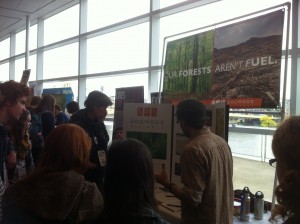 There was a strong interest and concern shown by attendees in Bioenergy and the Our Forests Aren’t Fuel campaign as groups of more than 20 gathered again and again throughout the day to hear short presentations and learn how they can educate their communities and campuses back home and across the country on this issue. We’re looking forward to further engaging student bodies throughout the Southeastern US to stand up to the wood pellet producers and state-subsidized utilities who are driving the destruction of our few remaining native bottomland hardwood wetland forests. Engaging more than 1,000 people throughout the event, we also collected nearly 200 signatures on our petition to Enviva LP, Drax Group and Dominion Power.
In addition to educating conference participants about the Our Forests Aren’t Fuel Campaign and the growing threat that the industrial biomass industry poses to our nation’s forests, we also supported Active Students for a Healthy Environment (ASHE), an environmental club from the University of North Carolina Asheville with free transportation for some of their members to and from the event.
In years past, much of Power Shift’s focus has been directed into legislative action and to lobbying congressional legislators in Washington, DC. This year things were different, with the impacts of climate change stronger. There were more instances of thousands of people taking to the streets, rallying for an end to ‘natural gas’ fracking (another false solution) and engaging in civil disobedience.
Taking a stand and refusing to get pushed aside by the massive carbon polluters will only strengthen our position when our representatives come to the table.
For the forests,

Tom Llewellyn Campaign Organizer Dogwood Alliance
As you may remember, this past spring International Paper (IP) made a game-changing agreement with Dogwood Alliance to increase protection of Southern forests. This week they announced more details on their $7.5 million commitment to fund a five-year effort with National Fish and Wildlife Foundation (NFWF) to restore 200,000 acres of forestland in the Southeast. This effort has formed the Forestland Stewards Initiative to restore and maintain forestlands in eight southeastern states from the Carolinas to Texas.
Making good on their commitment to Dogwood and Southern forests, IP announced that $350,000 will go to conservation groups and federal partners in the Carolinas. Those projects include:
Over the five years, the grants will go to maintaining forests in three areas, including the coastal plain of the Carolinas, the southern Cumberland Plateau running from Kentucky through Tennessee and into northern Alabama and Georgia, and, finally, the piney woodlands in Louisiana and east Texas. Projects will manage forestlands with controlled burns and purchase seedlings for planting.
John Faraci, the chairman and CEO of International Paper, the largest forest products company in the world, says, “Although we don’t own forests in North America any longer, forest lands have been part of our DNA for the last 115 years and we’re not in business without them.” He added that the $7.5 million provided by IP is expected to generate another $22.5 million through matches and contributions from government agencies and conservation groups.
This is huge for Southern forests! Though there are more threats in the works for Southern forests (like bioenergy: the burning of forests for electricity), today let’s savor the fact that with our collective effort, more forests are being preserved, restored, and respected for all their values: economic, habitat, climate, and recreation alike.


 Donate