


Andrew Goldberg, excited to be a Kinship Fellow
Dogwood Alliance staff member Andrew Goldberg has been selected as a 2014 Kinship Conservation Fellow, one of only 16 environmentalists chosen from around the world. Goldberg directs the Carbon Canopy Project for Asheville’s Dogwood Alliance, a ground-breaking initiative that incorporates the preservation of ecosystem services into forest management in the Southern U.S.
As a Kinship Fellow, From June 29 to July 30, the 2014 cohort of Fellows will take part in an exceptional learning community that prepares them to successfully implement innovative strategies in the field. The 18 Fellows will travel from 10 countries including Belgium, Canada, China, Ecuador, Kenya, Madagascar, Mexico, South Africa, the United Kingdom, and the United States to attend the month-long program in Bellingham, Washington.
“The Kinship Fellowship is an exciting opportunity to learn from leaders from around the world who have been developing tools to address the most pressing environmental problems,” said Goldberg, the Corporate Engagement Director at Dogwood Alliance. “I am proud to selected and look forward to bringing this knowledge home to continue to develop innovative market solutions to help protect Southern Forests.”
The fellowship will be an opportunity for Goldberg to strengthen his expertise on ecosystem services and develop creative pathways forward to expand the forest carbon and ecosystem service markets in the Southern U.S.
Southern forests are at the forefront of supply chain innovation and also comprise the largest carbon sink in the U.S. Annually forests in this region absorb approximately 12% of U.S. carbon emissions. This region is also the world’s leading source of pulp, paper, and timber and home to the most biodiverse temperate forests in the world, making it the ideal testing ground for innovation.
Dogwood Alliance is increasing protection for millions of acres of Southern forests by transforming the way corporations, landowners and communities value them for their climate, wildlife and water benefits. Dogwood Alliance has revolutionized the environmental practices of some of the world’s largest corporations.
Kinship Conservation Fellows is a ground-breaking environmental leadership program that emphasizes market-based solutions to environmental problems. Kinship’s dynamic global network of 191 Fellows in 47 countries and 6 continents is collaborative, entrepreneurial, and dedicated to effective conservation.
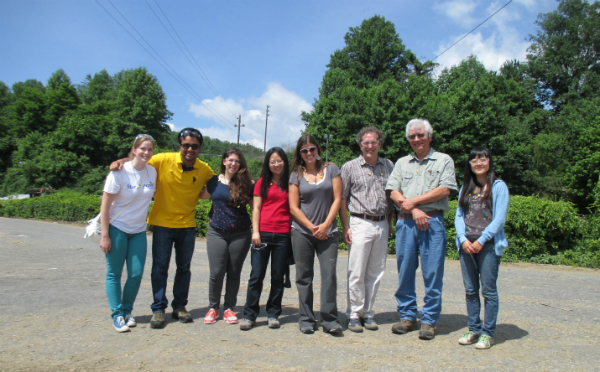
Dogwood staff and interns with Jim Sitts – our tour guide for the day. From Left to Right: Jenny, Arjun, Rachel, Siyu, Suzanna, Andrew, Jim, Yimeng
“Nobody goes out and seeks to do things better if there’s no incentive. Our incentive was to stay in business,” said Jim Sitts of Columbia Forest Products, in regards to Columbia’s continually increasing commitment to sustainable forestry. Columbia Forest Products is the largest decorative hardwood plant in the United States. They consist of approximately 300 employees and are entirely employee-owned. Jim Sitts has worked at Columbia for 44 years and currently serves as the Appalachian Timber Manager. When Dogwood Alliance staff and interns visited the company’s mill, he showed the group how the company incorporates sustainability into its lumber practices.
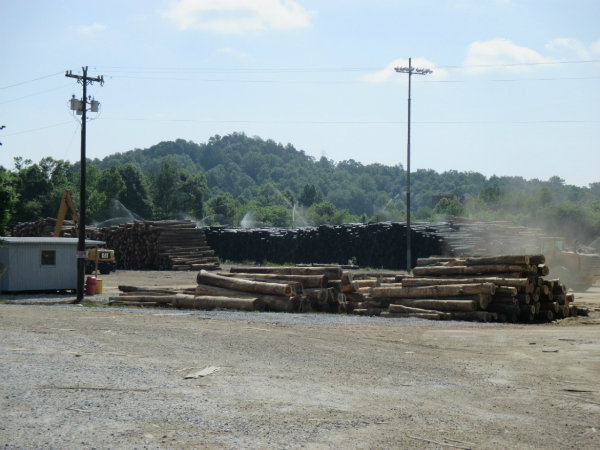
Unprocessed lumber piles, kept soft by sprinklers.
“Columbia is an environmentally conscious company. People pay attention to that,” Jim explained as he detailed how they incorporate Forest Stewardship Council standards into their production processes. The Forest Stewardship Council is an organization that has created a set of standards which, when met, allow lumber companies to label their products with the highly-respected FSC label. FSC standards require lumber to be produced in environmentally, socially and economically sustainable ways.
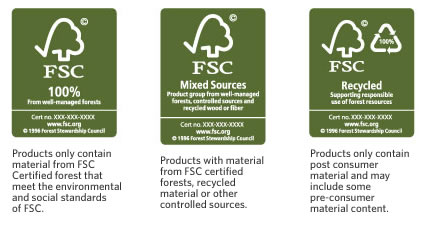
Forest Stewardship Council Labels
FSC offers both a “pure” label and a “mixed” label. The pure label can be applied to wood products produced completely in accordance to FSC standards. The mixed label applies to products comprising no less than 70% pure FSC wood, and the remainder “controlled” wood. Controlled wood must also meet certain sustainability standards, but these are less rigorous. Columbia is able to put a mixed label on 15% of the products that they sell.
In order to apply the FSC label to their products, lumber mills are required to be audited yearly. These audits happen through third party organizations that are contracted by FSC. Columbia is audited by the Rainforest Alliance. They are audited once yearly on their mills and on their forest management, as these two aspects of production must be checked by different parties with expertise in each area. If auditors find that a lumber mill is doing something noncompliant with FSC standards, the breach is labeled as either minor or major. Minor breaches may be fixed any time within the following year, but major breaches must be fixed within thirty days. Failure to fix a non-compliant practice within the designated timeframe will render the mill ineligible to use the FSC label.

Standardizing the harvested logs; removing irregularities.
While pure FSC products can be sold at higher prices than uncertified lumber, mixed-label products cannot. When asked how Columbia benefits from selling mixed products despite this, Jim explained, “It’s market access….I don’t think we make any more money in the end on FSC.” Essentially, the FSC label adds brand value. Jim, and likely everyone at Columbia, gets satisfaction in their commitment to sustainability. “To my knowledge…we may be the only FSC certified plywood in North America,” he proudly stated.

The final plywood product; checking for consistency and quality.
Columbia Forest Products and Dogwood Alliance have had a positive working relationship in recent years, as Columbia is collaborating on the Carbon Canopy Project, further demonstrating their commitment to sustainability.
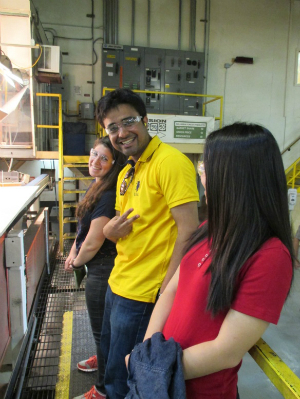
Dogwood’s lovely interns enjoying the field trip. From left to Right: Rachel, Arjun, Siyu
This was an eye-opening trip for Dogwood’s five summer interns. Although it was difficult for the environmentalists among us to see the industrial processing of trees on such a large scale, it’s reassuring to know that Columbia Forest Products puts so much effort into sustainability and is a leader in the field. We enjoyed the chance to get out of the office for a day and see first-hand why Dogwood does what it does!
As a founding member of the EPN, Dogwood Alliance is proud to endorse this important vision for a more responsible forest products industry and to stand with our colleagues from the environmental movement across the world.
#whatsinyourpaper
The signatories of the Vision are NGO member organizations of the Environmental Paper Network, including longtime Dogwood friends and partners like NRDC, ForestEthics and the Rainforest Action Network who have all helped us in moving the marketplace to more sustainable products, securing improved forestry practices by the world’s largest paper companies and accelerating the transformation of the entire industry over the past decade.
This blueprint for change addresses the priorities for social responsibility and environmental conservation in response to a projected doubling of global paper consumption in the next thirty years and the industry’s influence on biodiversity, forest health, global warming, air and water quality, and local communities. Dogwood has long relied on the EPN and the Global Paper Vision as a core resource in our own Paper Campaign to transform the paper industry here in the US South wherein we’ve secured commitments from some of the largest paper producers and consumers in the world, including Staples, McDonalds, Georgia-Pacific and International Paper.
The new Global Paper Vision identifies seven common goals among the organizations that are key objectives for change: reducing consumption; maximizing recycled content; ensuring social responsibility; sourcing fiber responsibly; reducing greenhouse gas emissions; ensuring clean production; and ensuring transparency. In fact, look for us to build off some of these goals moving forward as we continue our own Paper Campaign.
Longtime friend of Dogwood, Joshua Martin, the Director of the Environmental Paper Network says,
“The Global Paper Vision is the unification of an influential global movement. From today forward, we are all going to be asking at every level, all over the world, ‘What’s in your paper?’ and challenging the industry and consumers to commit to ambitious and bold actions that protect people and the planet.”
Thanks to Joshua and EPN, and a big thanks to Dogwood’s members and supporters. It’s an exciting time when we can join with these environmental champions to launch this new and important global vision. Please help us achieve this change by showing your support:
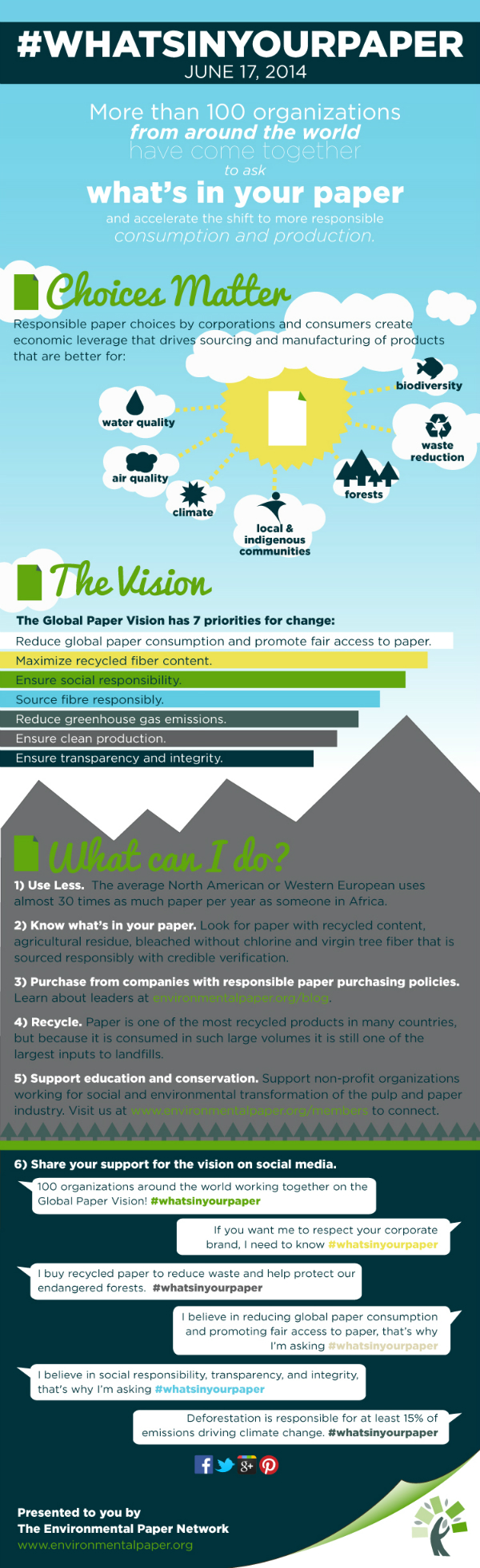
Global Paper Vision Infographic
Georgia Tech’s Center for Paper Business and Industry Studies has recently released their enhanced Paper Mills Online Database. The data once again shows the US South is by far heart of the US industry.
Specifically, the South is home to:

Pulping capacities in the South far outpace those of other regions
Our work directly with pulp and paper industry players like International Paper and Georgia-Pacific to improve their performance in the woods is the leading edge of a greener, more responsible industry beginning here in the South.
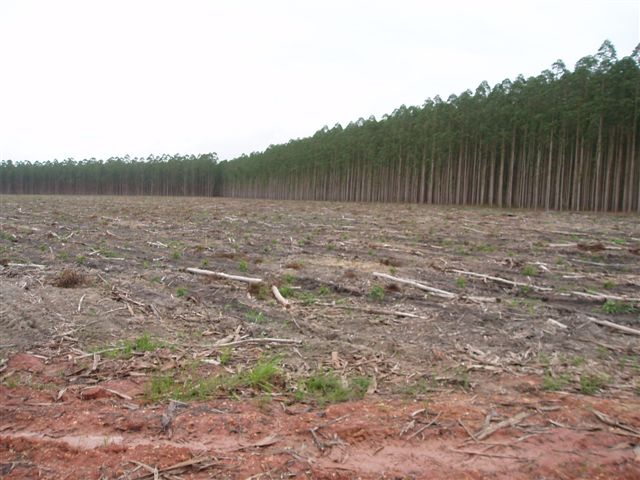
This is what a eucalyptus plantation looks like
Dear friends,
FuturaGene, a biotechnology firm owned by Brazilian pulp and paper company Suzano, has requested authorization from the Brazilian Biosafety Commission (CTNBio) for the commercial release of its genetically engineered eucalyptus trees in Brazil.
A letter has been issued by Brazilian and Latin American organizations (including CEPEDES; Terra de Direitos and the Latin American Network against Plantations) to CTNBio to urge them to deny this approval. As the Brazilian Open Letter (attached below) explains, if approved, use of GE eucalyptus trees will aggravate the already well-known negative impacts that non-GE industrial eucalyptus tree plantations already pose to communities´ livelihoods.
We ask your organization to sign on to the statement below in support of this Brazilian letter, which will be sent to CTNBio, the Brazilian governmental institution in charge of authorizing the release of GMOs. Their letter expresses deep concern and urges the CTNBio not to authorize the commercial release of GE eucalyptus by Suzano/FuturaGene.
To sign on in support of this letter protesting the legalization of genetically engineered trees, please send us your name, organization and country to the following address [email protected] before June 15th.
Thank you,The Campaign to STOP GE Treesincluding Biofuelwatch, Canadian Biotechnology Action Network, Dogwood Alliance, Global Justice Ecology Project, Indigenous Environmental Network, World Rainforest Movement
The Campaign to Stop GE Trees, an international coalition of 248 groups from 49 countries, founded in 2004, supports a global ban on commercial deregulation of genetically engineered trees (also known as genetically modified trees) based on serious concerns about their impacts on biodiversity and human rights. The Campaign supports the position expressed herein, in solidarity with Brazilian and Latin American groups, calling upon CTNBio to pay heed to public resistance to GE trees and reject Futuragene’s request for commercial approval of GE trees.
The Campaign is joined by the undersigned organizations from around the world that endorse the call for a global ban on the release of genetically engineered trees into the environment, as well as those scientists and organizations that are calling for a moratorium on the release of GE trees until they are proven to have no damaging social or ecological impacts. As no such proof of safety currently exists, but there is significant evidence to the contrary, the release of GE trees must be stopped.
See FuturaGene web site at http://www.futuragene.comhttp://wrm.org.uy/pt/livros-e-relatorios/plantacoes-de-eucalipto-para-energia-o-caso-da-suzano-no-baixo-parnaiba-maranhao-brasil/http://www.gmwatch.org/files/GMsoy_Sust_Respons_SUMMARY_SPA_v1.pdfhttp://www.theguardian.com/environment/2012/nov/15/gm-trees-bred-world-energy
Fast food giant McDonald’s recently released its 2012-2013 Corporate Social Responsibility & Sustainability Report, and Dogwood is pleased to see the company emphasize its clear commitment to give buying preference to Forest Stewardship Council (FSC) certified paper products. In giving preference to FSC, McDonald’s recognizes FSC as providing the best assurance of meeting its new forestry standards. FSC is the only forest certification system in the world supported by conservation groups because it prohibits bad forestry practices, such as large-scale clearcutting, conversion of natural forests to plantations, logging of endangered forests, and widespread use of toxic chemicals in forest management practices. McDonald’s recent announcement follows their 2011 Sustainable Land Management Commitment, setting out goals to improve how they source everything from beef and chicken to paper packaging. McDonald’s now pledges to “More Sustainable Packaging from the Start”. Including FSC and recycled fiber.The company’s FSC buying power has helped drive the increase in FSC certified forestland in the US South, which now extends over 4 million acres.

McDonald’s commits to using more recycled & FSC certified paper
In addition, the McDonald’s publication recognized International Paper (IP) with a “Best of Sustainable Supply” nod for IP’s work expanding their FSC certified fiber procurement. This work has resulted in group certification of landowners to the FSC standard. The growth of IP’s FSC certified fiber supply comes as a part of IP’s commitments memorialized in the Dogwood IP agreement to be the largest user of FSC wood in the world.
We all know McDonald’s has a long road ahead in becoming a sustainable business – if that is really even possible in any honest sense of the word. In 2013, only 14% of their paper was either certified or recycled, but the company itself has acknowledged that it can and plans to do better. So here’s to it, Golden Arches.
June 19th and 20th marked the Spring 2014 meeting for Carbon Canopy, Dogwood Alliance’s forest carbon offsets initiative. Carbon Canopy is an innovative project that incentivizes forest conservation to create lucrative carbon sinks for landowners and valuable offsets for environmentally conscious businesses looking to reduce their footprint. Partners and stakeholders convened to discuss the state of Carbon Canopy’s mission and goals and to refocus the project’s direction. Many of the meeting attendees have been involved in the project since its conception. But for myself and two other interns at the meeting, we’re new to the team. Along with Arjun Wadwalkar and Yimeng Wang, I’m a summer intern at Dogwood Alliance, working on the business development plan for Carbon Canopy under the guidance of Andrew Goldberg, Dogwood’s Director of Corporate Engagement.
Carbon Canopy Project
Gathered at the table, we all asked ourselves: since we first came together, what has changed? What has stayed the same? And what does it mean going forward? It’s clear that one important thing hasn’t changed—Carbon Canopy’s commitment to its core values. Discussing the main goals of the project, we affirmed that they were the same ones that inspired partners to come together in 2007:
In addition to Carbon Canopy’s core values holding true, we noted another similarity from the onset of the project. In early 2007, Senators Lieberman (D-CT) and McCain (R-AZ) introduced a piece of legislation that would have established a market-driven solution to reducing greenhouse gas emissions. A nationwide carbon market seemed promising—but the bill never made it through Congress. Now, we’re experiencing another moment of political inflection. In its recently proposed rule, the EPA plans to cut carbon pollution from the power sector by 30% from the levels of 2005. It calls for states to develop their own plans for how to meet those goals. That could potentially call for the expansion of carbon markets beyond California’s existing Global Warming Solutions Act cap-and-trade system. Under the rule, states may adopt cap-and-trade systems that could lead to growth in demand for offsets from newly regulated utility companies. That’s where Carbon Canopy’s high quality, authentic credits come in. To prepare for the meeting in the month leading up to it, the other Carbon Canopy interns and I familiarized ourselves with the ins and outs of the carbon market and developed a stronger grasp on the mission of the forest carbon venture. We put together a presentation that digests the executive summary of the State of the Voluntary Carbon Markets 2014 (check back here for more information when the full report comes out in a few weeks!), provided our analysis of the market forces and competitive radar, and explained our take on the non-profit business model. We offered strategic recommendations for Carbon Canopy going forward, focusing on how it can strengthen its brand, provide more services, and further its overall mission. I’m looking forward to continuing to work on the project for the remainder of the summer, developing a more thorough business plan.
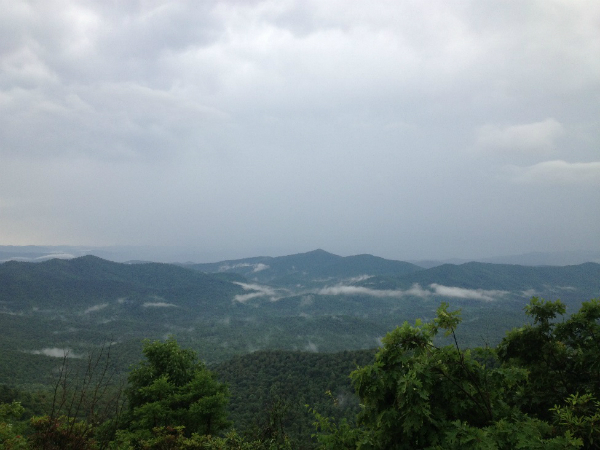
Blue Ridge Mountains. Photo credit: Yimeng Wang
Marking a first for Carbon Canopy, continuing forestry education credits were approved for those foresters in attendance. Before the discussion and presentation on Friday, the group visited the Pisgah Mountain Tract, a piece of land that is managed by Columbia Forest Products. This is one of the key strengths of the Carbon Canopy Project—the ability and desire to connect stakeholders directly with the land. Out in the field on Thursday and at the conference discussion the next day, the dedication was evident. The field visit and meeting served to remind us all what we’re fighting for, and I’m expecting some exciting next steps for the Carbon Canopy.


 Donate