


To be a champion for communities and the climate, a leader must stand up and make tough decisions when it really matters. For too many years, Enviva has been allowed to expand unchecked in North Carolina, with three existing wood pellet facilities and one on the way.
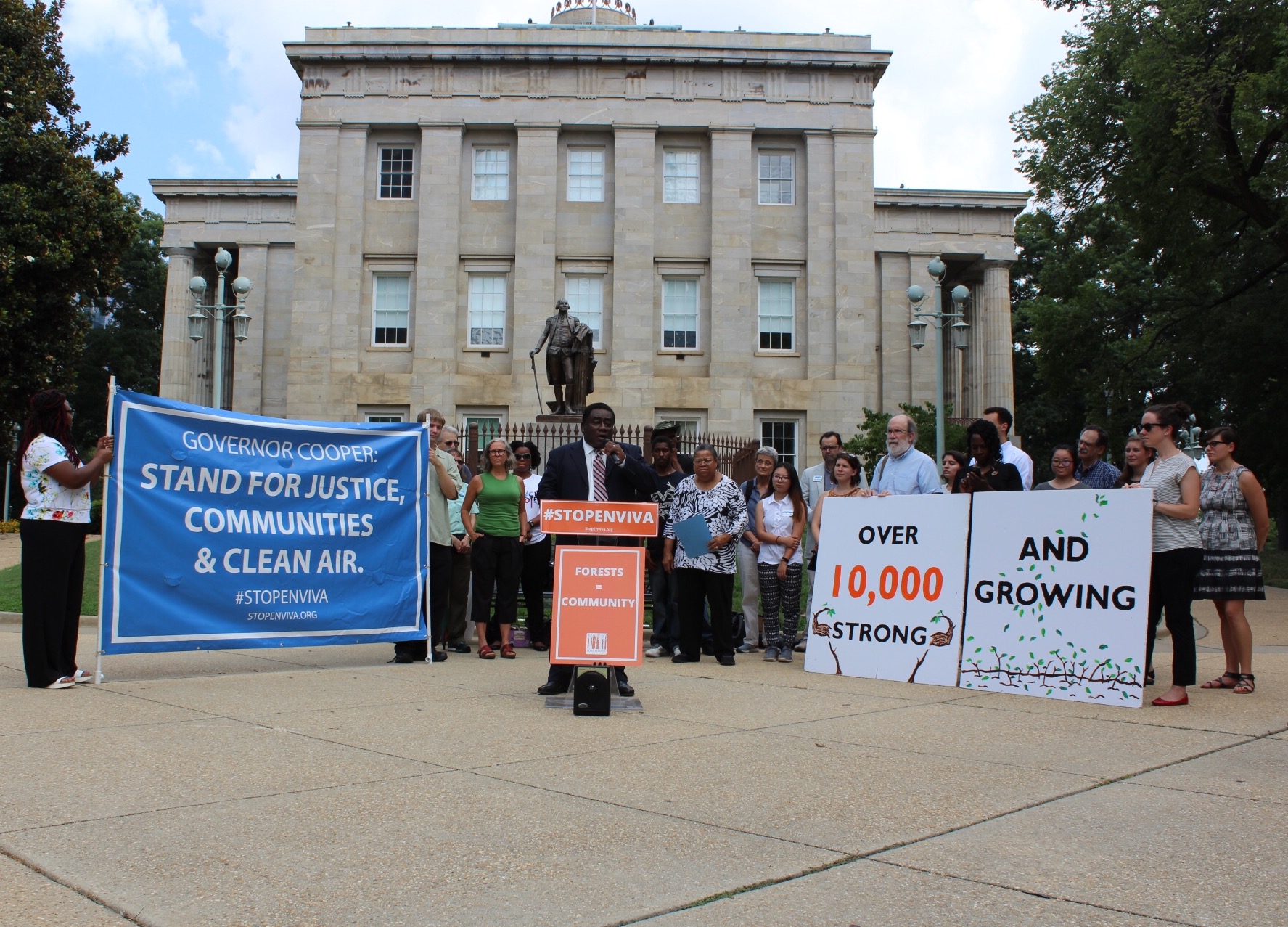
In the past few years, North Carolina has been hit by floods, wildfires, and droughts.
False solutions, like the industrial-scale wood pellet industry, are taking North Carolina further down a path of destruction and vulnerability.
The wood pellet industry, led by Enviva, has a proven record of sourcing in precious bottomland hardwood forests, increasing carbon emissions, and polluting communities. Yet this industry continues to expand unchecked. In just a few years, North Carolina has become ground zero for forest destruction at the hands of the wood pellet industry.
Standing forests are the only proven system that can remove and store vast amounts of carbon from the atmosphere at the scale necessary to keep our planet livable. It is essential to not only prevent further emissions from fossil fuels, deforestation, forest degradation, and bioenergy, but also to expand our forests’ capacity to remove carbon from the atmosphere and store it long-term.
We’re counting on Governor Cooper to understand the gravity of these issues. We urge the Governor to develop a comprehensive climate strategy that includes clean energy and protection for North Carolina’s forests.
Specifically, we call on Governor Cooper to:
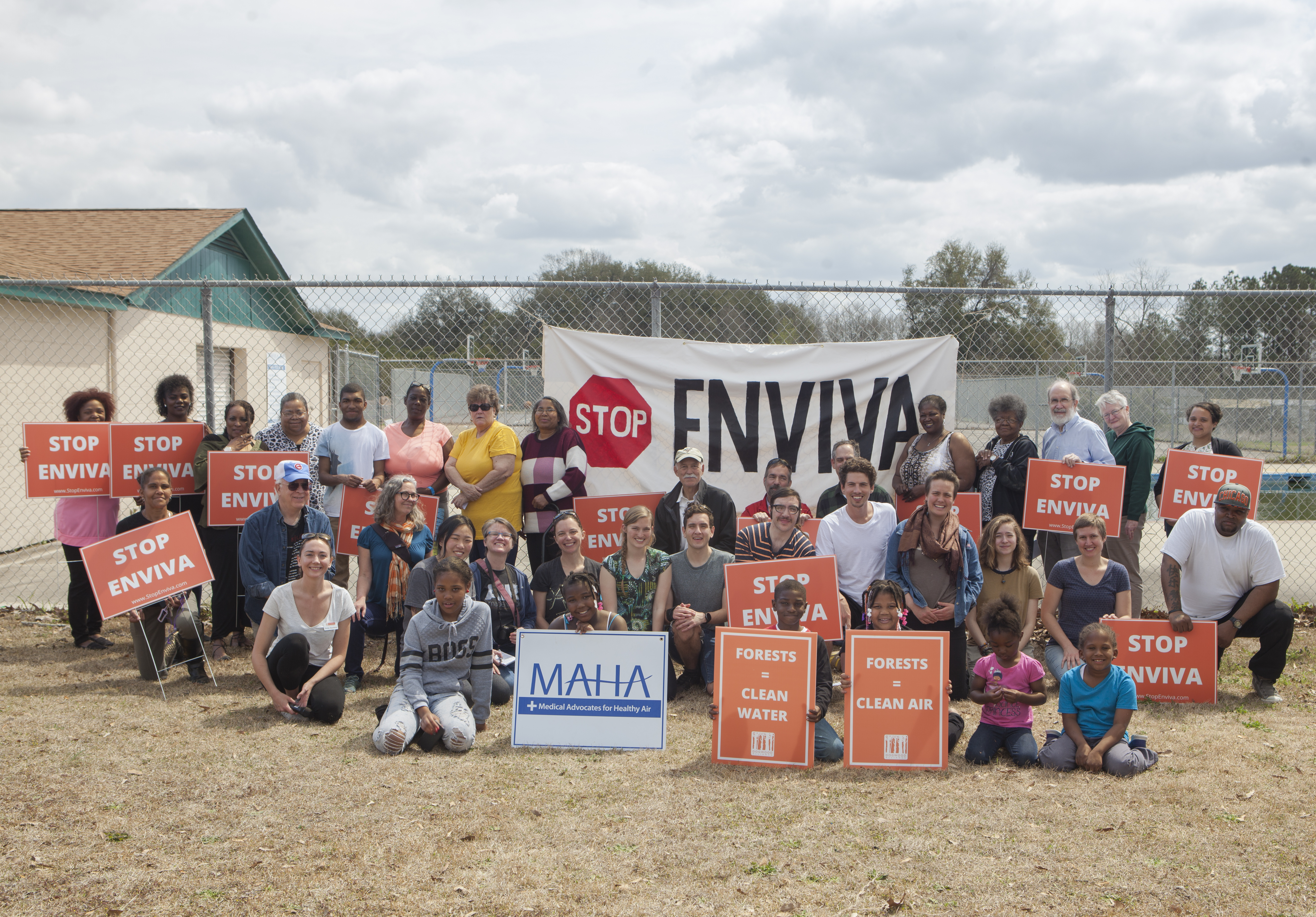
Forests need to be at the forefront of the agenda on climate action, community resilience, flood mitigation, water quality, and alternative rural economic development.
Governor Cooper, we believe in your vision for a strong and healthy state. North Carolina can lead the way in creating innovative solutions that uplift communities, create new markets, and remove vast amounts of carbon from the atmosphere. But it will mean taking a stand. We are eager to work with you to put North Carolina back on the path of leading the way for a prosperous and just future.

Due to the incredible opportunity posed by the U.S. State Department, in a handful of days I get to embark on a trip-of-a-lifetime and take what I know about forest protection and conservation in the U.S. Southeast to the communities and forests of Laos. I work for Dogwood Alliance, an organization that works on protecting the forests of the Southeastern United States.
While Dogwood Alliance and WWF Laos may be on opposite sides of the world, may be defending two very different kinds of forests, and may be operating under different rules, regulations, and cultures, the similarity in the challenges we face means that my opportunity for growth and skill-sharing cannot be understated.
For over 20 years, Dogwood Alliance has defended the forests in this region because the Southeastern United States is the largest wood basket in the world. More paper, pulp, and wood pellets come out of our 14 state region than anywhere else in the world.
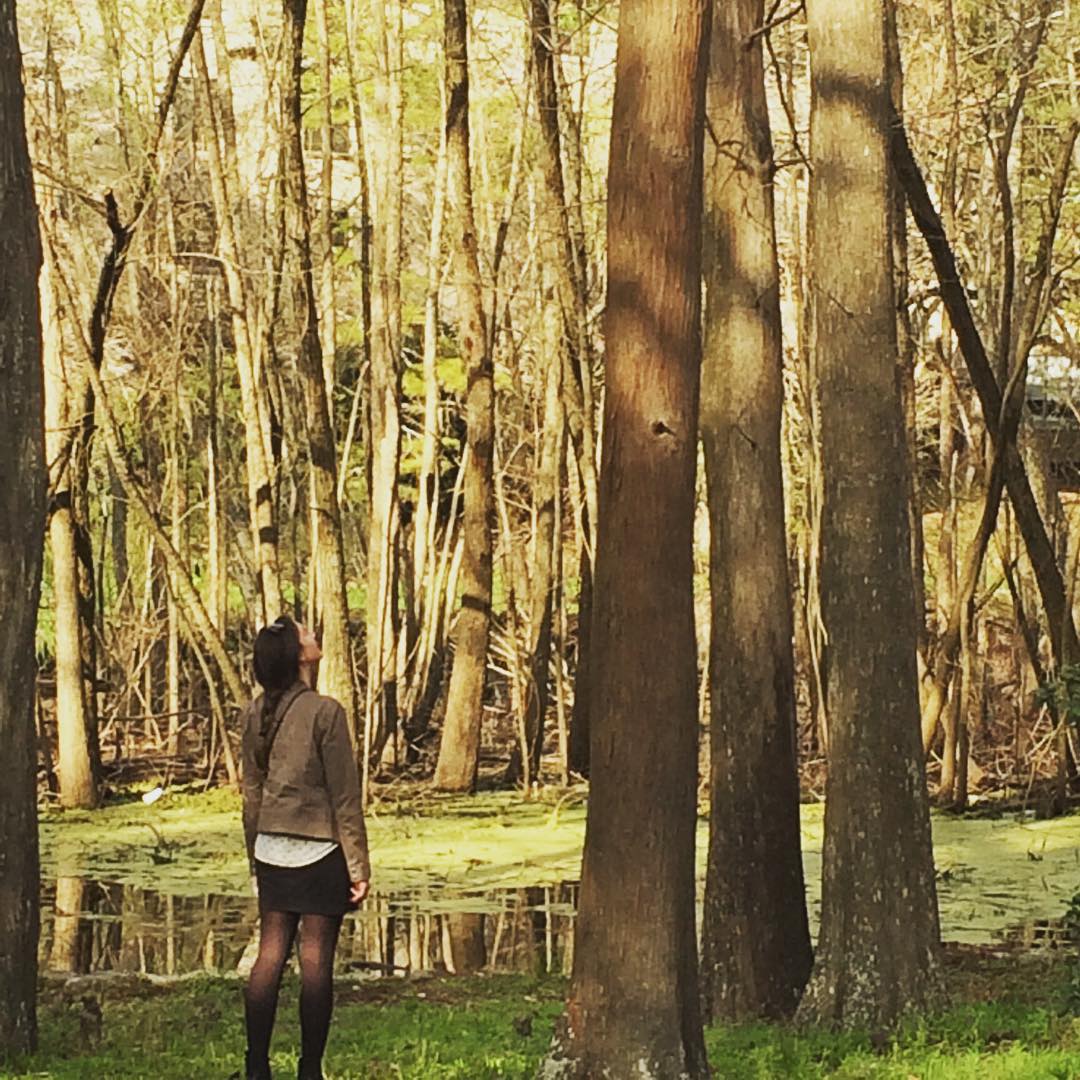
Towering tupelos, majestic cypress, black bears, alligators, and countless other forms of biodiversity are threatened every day from industrial logging— and that’s where we come in. We mobilize diverse voices to protect Southern forests and communities from destructive industrial logging.

Wetland Forests that Dogwood Alliance works to protect. Photo credit: Mac Stone
I’ve learned that Laos’ biodiversity faces numerous threats including wildlife crime, development, and habitat loss— and that’s where WWF Laos finds their role. For nearly 40 years, WWF Laos has worked on species protection and forest governance, amongst other priorities, and working toward their goal of building a future in which the people of Laos live in harmony with nature is something I am lucky to be part of, even if for a brief time.

© Somphavanh Seukpanya / WWF-Laos
Being able to take my skills and background to Laos and the WWF offices there feels like an incredible way to spread my roots.
As I intimately know from my familiarity with the beautiful forests of this region, our great, tall, sturdy, and strong oaks were once acorns that can fit in the palm of my hand. I have a genuine desire to embrace the humble beginnings of my journey: to recognize that I am now a novice and can learn much from the WWF Laos staff I’ll be working with. Like trees, I must indulge in the quest for wisdom and have the courage to be resilient. I have a chance to deepen my roots with this opportunity, and I’m excited to grasp it!

Soaking up the Blue Ridge Mountains before heading to Laos!
The award-winning documentary BURNED: Are Trees the New Coal?made its Southern debut in an eight city Barnstorming Tour! Nearly 500 people gathered to watch the film in North Carolina, Virginia, and Georgia.The filmmakers of BURNED — Lisa Merton, Alan Dater, and Chris Hardee — teamed up with Dogwood Alliance and our partners at the Southern Environmental Law Center, the Cape Fear Sierra Club, Clean Air Carolina, the Georgia Climate Change Coalition, the Georgia Southern University Green Ambassadors, and the Climate Reality Project Campus Corps at NCSU to make the barnstorming tour a success.
BURNED has been selected by a number of film festivals, including the Wild and Scenic Film Festival, and the Cinema on the Bayou Film Festival. It even won the Audience Choice Award at the American Conservation Film Festival.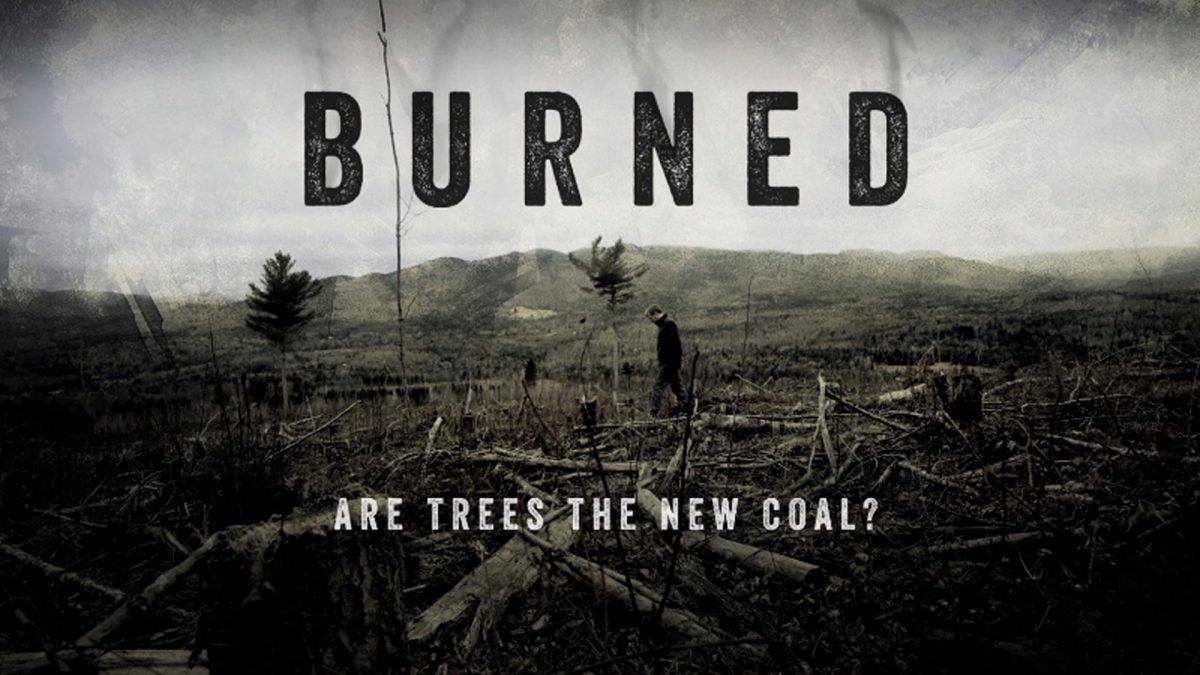 The film follows a dedicated group of forest activists, ecologists, climate scientists, and concerned citizens who are fighting to establish the enormous value of our forests, protect their communities, debunk this false solution to climate change, and change energy policy both in the US and abroad. The film features interviews and stories from Dogwood Alliance and our partners — with footage from investigations, the SOS Tour to Save Our Southern Forests, and rallying against forest destruction in Charlotte.Chris Hardee, an associate producer on the film said:
“After every screening to date, we have heard a chorus of incredulous comments from people who had no idea that Southern forests are being burned to turn the lights on in Europe.”
The tour kicked off in Wilmington with an overflow crowd at the Jengo Playhouse, before heading to Durham for another packed room at the Center for Documentary Studies at Duke.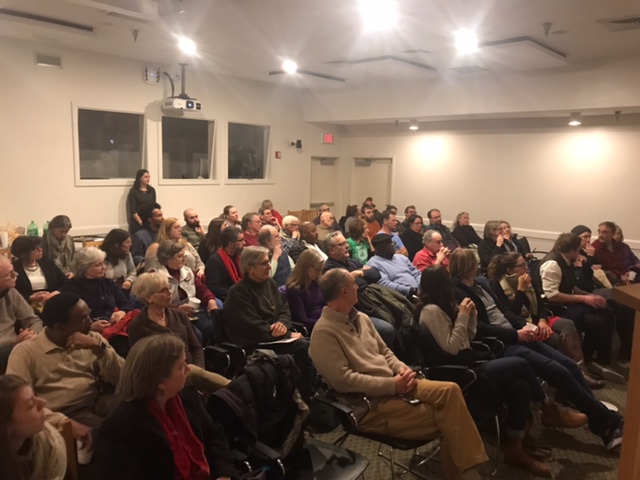 Then the tour had a screening in Charlotte hosted by Clean Air Carolina, and we met up with local community members in Danville, VA for an intimate screening at the public library.
Lisa Merton and Alan Dater then headed to Georgia for three packed screenings in Athens, Savannah, and Statesboro.Vicki Weeks, Dogwood Alliance’s Georgia State Coordinator, said that the film inspired many attendees to sign the #Stand4Forests Pledge and sign up to volunteer on the campaign. Vicki will be coordinating meet and greet events to engage new volunteers in the coming months.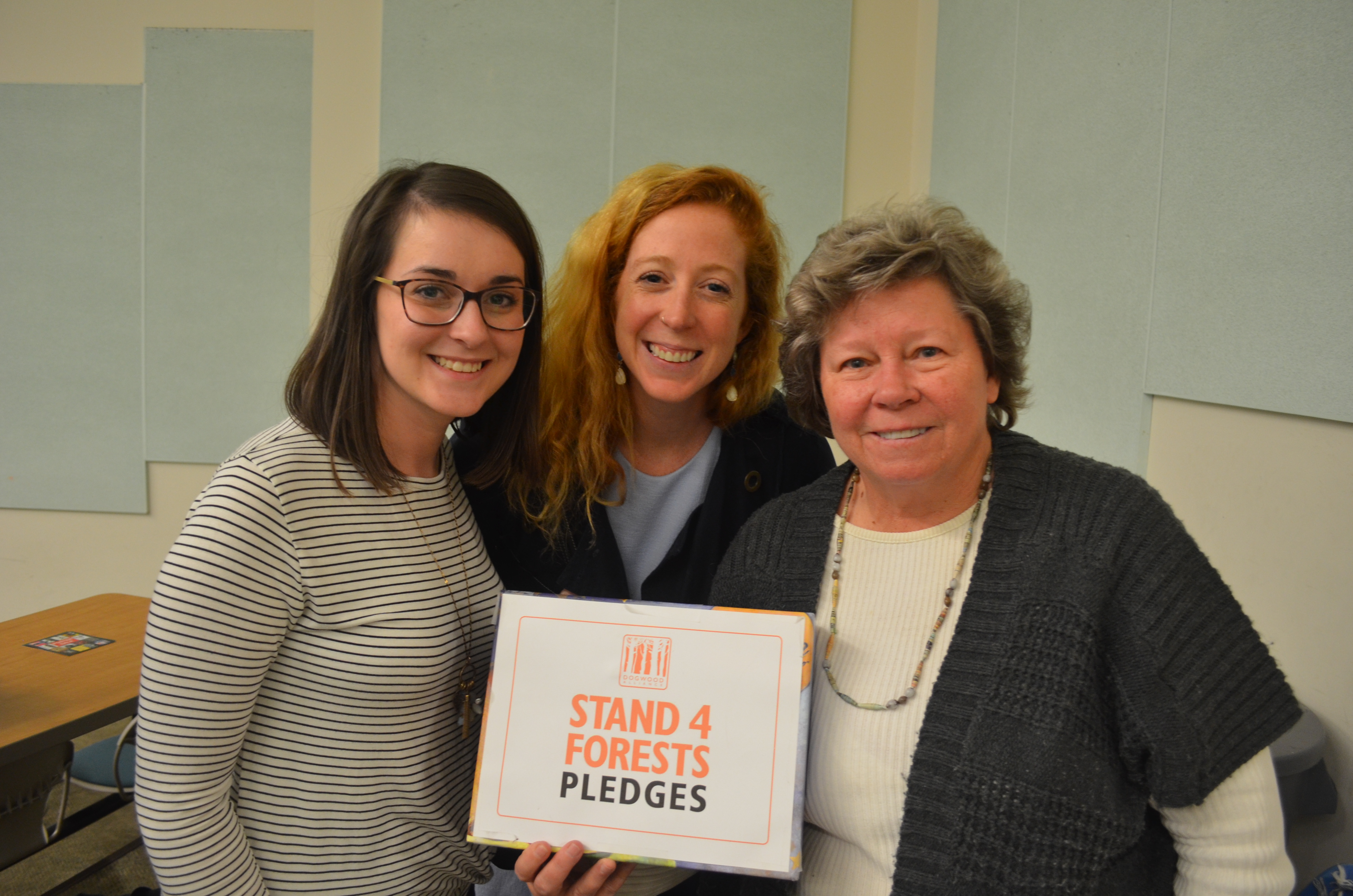 Then we had a Raleigh event with climate activists at North Carolina State University. The tour was so popular that we had an encore showing in Wilmington, NC.
Lisa Merton, a director of BURNED said:
“Showing a film followed by a Q&A is a great way to extend the conversation while they’re already connected and inspired to take action. This was the case with the tour. It has already spurred multiple other screenings and will continue to do so. The tour started a small but fierce swell and the ripples are widening!”
The excitement around BURNED shows the growing movement across the Southern US to stop the expansion of dirty biomass and protect our forests.
Special thanks to all who attended, all of the partners and sponsors, and especially the filmmakers for their powerful film.
On January 17th, the European Union Parliament voted on the Renewable Energy Directive (RED II) which will guide policy for reductions in carbon emissions and investments in renewable energy from 2020 onward. For those of you who’ve taken action or followed our efforts and those of our partners, you know that the outcome of this vote is a critical moment in the ongoing effort to ensure protection of Southern forests and communities from the dangers of industrial scale bioenergy (the burning of wood for energy).
Since 2010, the growth of bioenergy– much of it sourced from Southern US forests– has provided more than half the expansion of “renewable energy” in the EU.
At the same time, with your support, its emergence has sparked organizations like Dogwood Alliance to lead a global movement to end this destruction and recognize real forest protection as a solution to the climate crisis.
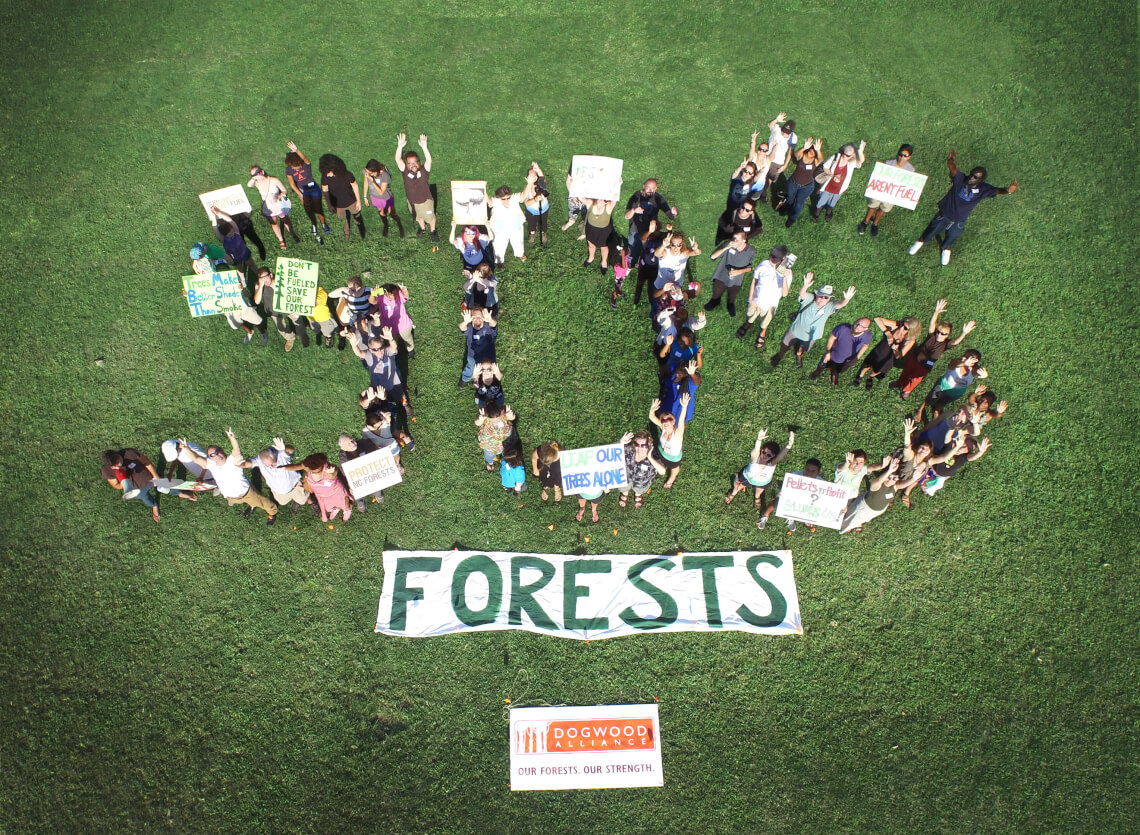
Forest Defenders in Savannah, GA sending an SOS Save Our Southern Forests message to Europe.
Instead of listening to the protests of folks like you, the EU Parliament was taken in by influential pro-logging lobbies from Finland and Sweden. They didn’t listen to the overwhelming outcry from climate champions in the European parliament, affected communities from across the world, leading conservation organizations, hundreds of thousands of individuals, and a remarkable letter from over 800 scientists (including IPCC lead authors and winners of the US medal of science and Nobel prize).
The good news is that the new EU RED policy is only a directive to EU countries like Germany, Denmark, and The Netherlands. Now it’s up to these countries, and us, to take this policy and improve it.
In fact, together we’ve already achieved some huge victories: Belgium was once a huge expansion market for biomass, but now that honeymoon is over!

Dogwood Alliance staff members Rita Frost and Adam Colette coming out of a meeting with top officials in Belgium concerning their biomass policy.
The future EU energy system, and even more, the future world energy system, needs to be based on truly renewable technologies such as wind, solar, heat and electricity storage, demand response, geothermal and other emerging technologies. While we must completely revolutionize our energy system, the only way to fully reverse climate change is to massively scale up the protection and restoration of our forests.
The Paris Climate Agreement gave the world a charge: we must turn the tide of climate change before it’s too late. Our best and most cost-effective technology lies in the power of forests.
Standing forests are critical for community resilience, flood protection, air and water quality, our health and well-being. Forests are the only proven system that can remove and store vast amounts of carbon from the atmosphere to keep Earth a livable planet.
Forest defenders, climate hawks, and community leaders will not let biomass threaten the future of our very existence because short-term fiction peddlers got their way in this vote. We will respond to this reckless EU decision by showing up with even more people power across Europe as we fight to stop these facilities in our own backyard.
2017 was a year of optimism for many in the North Carolina climate justice movement. We had a new governor in office who offered greater support for environmental issues and a new Secretary of the NC Department of Environmental Quality with an agenda to prioritize the voices of rural and frontline communities at the table.
Your activism and support brought critical attention to the many threats of the industrial-scale wood pellet industry.
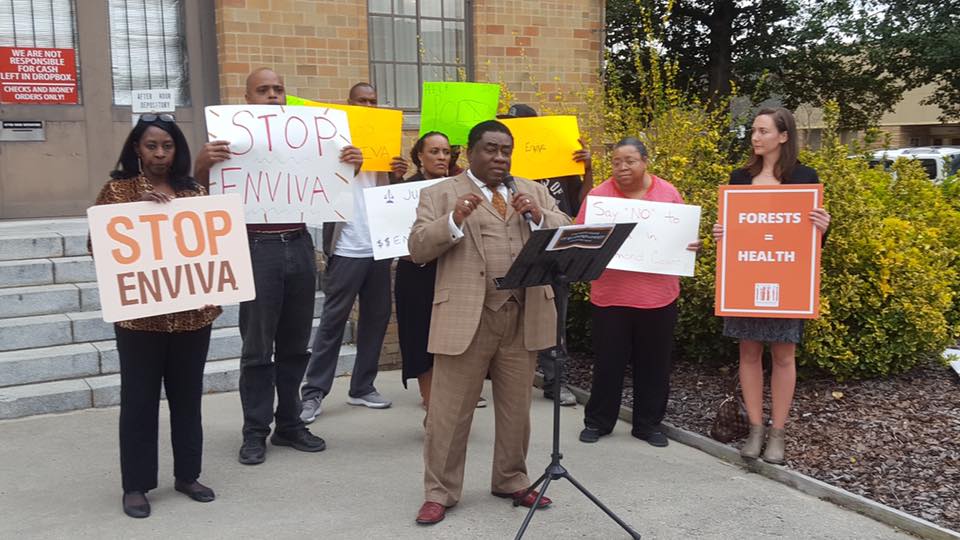
We are greatly disappointed that despite widespread backing from his constituents to take action on Enviva, Governor Cooper chose to remain silent. Enviva is moving forward with construction in Richmond County, putting at risk the health and quality of life of neighboring residents and taking North Carolina further down a path of false solutions.
Shortly after taking office, Governor Cooper announced that North Carolina would join the US Climate Alliance and would remain committed to reducing pollution and protecting our environment. Environmental groups across the state, including Dogwood Alliance, applauded Cooper for this action. We agreed with him when he said,
“Clean air and a healthy environment are vital for a strong economy and a healthier future. So much of North Carolina’s economy relies on protecting our treasured natural resources, and I’m committed to maintaining the quality of their air we breathe for generations to come.”
We know that investing in truly clean energy and promoting businesses that support healthy communities and protect our state’s forests is the path to a prosperous and just future, and we continue to stand with Governor Cooper in this vision.
In Richmond County, NC, the Governor’s constituents are fighting the legacy of his predecessor, opposing an Enviva wood pellet facility that was brought in without proper public notice, will disproportionately impact the local Black community, and will take our state and country backwards on climate. Governor Cooper had full authority and the backing of his constituents to stop this plant. But the Governor remained silent on this issue.
A few months later, the Governor once more had an opportunity to stand by his vision, and once more, he fell short. The Atlantic Coast Pipeline was recently granted its water quality permit, paving the way for countless acres of destruction and hitting our most vulnerable communities with a dangerous and unwanted role to play in energy production.

In the face of big money and corporations, Governor Cooper was silent when his constituents’ clean air and clean water was at stake. It’s time that Governor Cooper break the silence. Do you stand for forest destruction and pipelines, or do you stand for innovative solutions that will take our state forward?
Across the state, the voices of Governor Cooper’s constituents have been clear. In 2017, North Carolinians called on Governor Cooper to stop Enviva in Richmond County.
In 2018, Dogwood Alliance is asking Governor Cooper to stand for the environment, stand for justice, and stand for forests.
You can’t put a price tag on clean air and water, protection from storms and flooding, or the way you feel when you’re in a wetland forest. But we knew that there was a real dollar value to all the services our forests provide, so we started digging. We considered things like water filtration, tourism, protection from extreme weather events, wood products, and food. Through exhaustive research, we found startling truths about how much our standing wetland forests are worth to Southern states and communities.

CLICK TO ENLARGE
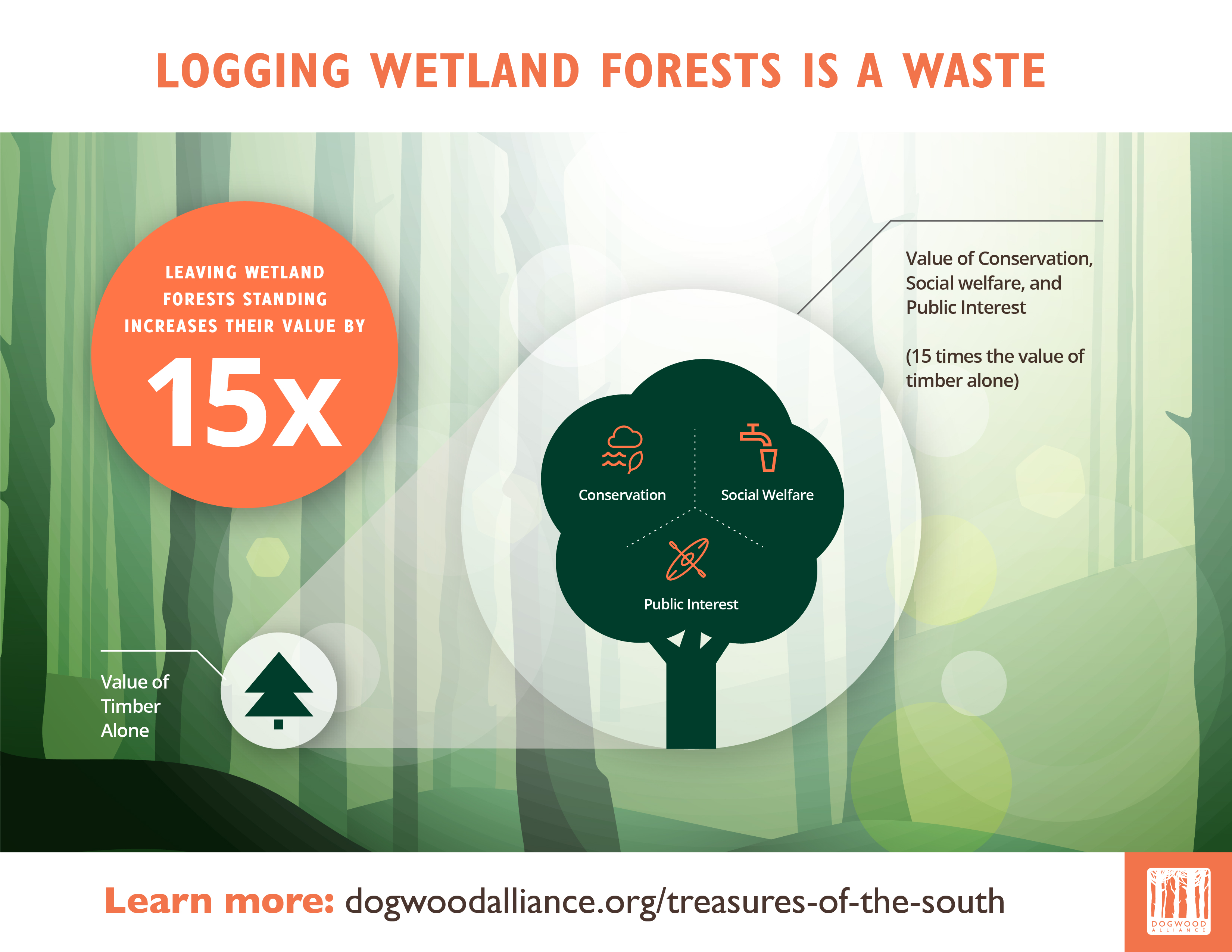
Logging contributes just 0.3% to that $500 billion. In fact, we discovered that wetland forests are worth FIFTEEN TIMES MORE standing than logged.
CLICK TO ENLARGE
No matter what the logging industry says, we’ve proven that standing wetland forests keep jobs and wealth in their states and communities in a way logging never will.
Despite their life-changing and life-saving qualities, fewer than 10% of wetland forests in the US South are protected from logging, agriculture, and development. Sadly, up to 80% of these forests have disappeared across the South.
By the time recovery efforts are complete for 2017’s hurricanes Harvey and Irma, each are expected to cost over $100 billion in damages. Imagine how much worse those damages would have been without those wetland forests absorbing and slowing the flood tides. Imagine how much more these amazing forests could do for us if there were more of them.
If we don’t choose to invest in Southern wetland forests, we are hurting Southern families and communities. We’d be taking away their ability to thrive economically in a changing climate.
We need to make a commitment to restore these forests. We need to put people to work on restoration, management, and ecotourism. When we change the way we value Southern wetland forests, only then will we be able to see all the true benefits and wealth they provide us.
Asheville, North Carolina – On World Wetlands Day, a new report from Dogwood Alliance, “Treasures of the South: The True Value of Wetland Forests,” highlights and places values on the important services that forested wetlands provide to protect and build communities across the Southern US. Conservative estimates place the value at over $500 billion in the 14 state region stretching from Virginia to Texas.
Examining the important services that wetlands provide to the people of the region including protection from flooding and extreme weather events, clean drinking water, recreation, tourism and many more, researchers were able to determine the overall value including a state by state breakdown.
Since colonial times, over 80% of forested wetlands in the region have been lost, and now only 35 million acres remain with only a strikingly inadequate 10% protected. Climate change, continued conversion to agriculture and tree plantations, logging, and other damaging impacts threaten the future of these vital places.
“Our wetland forests are truly priceless and should be protected and restored,” said Dr. Sam Davis, Research Director at Dogwood Alliance. “We hope that placing a price tag on all of their values will help local, state, and national politicians find the will to preserve these national treasures rather than continuing to blindly support their destruction.”
Investing in wetland forest conservation and restoration, rather than logging for short-term profit, would dramatically increase all of the important services that wetlands provide. By shifting the focus of management from timber production to native ecosystem health, wetland forests increase over 15 fifteen times in value from about $1,200 per acre to $18,600 per acre. And more acres protected, expanded riparian buffers, and improving forest management practices could add nearly $50 billion in value to our region.
Two of the world’s most expensive natural disasters in 2016 occurred in the South. Hurricanes Harvey and Irma, in late 2017, are both expected to cost over $100 billion in damages each by the time recovery efforts are complete. Without investing in our wetland forests, the result may be reducing our communities’ abilities to flourish economically and thrive in a changing climate.
“From Houston, Baton Rouge, the Florida Keys, the Upstate of South Carolina and the North Carolina coast, communities have been inundated by extreme weather event,” continued Davis.
“The huge price tag associated with disaster recovery after major hurricanes and flooding over the last several years should be reason enough to rally for greater protection.”
To download a pdf of the full report, go here.
To view new, interactive webpages with information on wetlands across the South, including a state by state breakdown, go here.
# # #
Based in Asheville, NC, Dogwood Alliance mobilizes diverse voices to protect Southern forests and communities from destructive industrial logging. One of the founders of the Wetland Forest Initiative, whose mission is to conserve, restore, and improve Southern wetland forests to strengthen our communities through science-backed actions, diverse partnerships, and citizen and landowner engagement. Follow Dogwood Alliance on Twitter – @DogwoodAlliance


 Donate