Donate


This past week and a half I’ve had a whirlwind tour through Dogwood’s new focal area, the unique swamps and forests of coastal North Carolina and southeast Virginia.
I’m here doing a listening project, speaking with folks about life in this neck of the woods, their experiences with the land, the area’s diverse ecosystems, and local struggles to protect threatened areas.
My journeys began in the Great Dismal Swamp outside Suffolk, Virgina, which was quite striking despite the drought. I walked the 4.5 mile Washington Ditch trail to Lake Drummond, one of just two natural lakes in the state of Virginia, located in the middle of the swamp. The trail follows an old cart road with a canal dug along side it that George Washington had built by slave labor in the mid-1700s.Washington built the canal to transport timber out of the swamp, beginning a long saga of European pillaging that continues to this day.As I walked along the grassy trail beside the canal, I watched red-headed woodpeckers fly from tree to tree and tried to wrap my head around the mind-boggling amount of labor that must have gone into the construction of such a massive canal by hand.
In colonial days, the swamp was regarded as an almost insurmountable obstacle to the white settlers (thus the desire for a canal).As such, it also provided a safe haven for runaway slaves on the underground railroad.Historians actually regard the Dismal Swamp as one of the largest maroon colonies (hidden communities of escaped slaves) in the US.
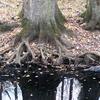 Today, the swamp is a sanctuary for over 200 species of birds
and other wildlife such as bobcats, deer, bears, otters, foxes and snakes,
whose habitat has largely been subdivided by sprawl, agriculture and
monoculture pine plantations that feed the paper industry.For part of my hike I was accompanied by a
great blue heron, who would land on the trail a few dozen feet up from me, and
fly a bit further down each time I approached.
I’ll be returning to the Dismal Swamp
again next week, hoping to talk more with the park biologist and education
coordinator.
Today, the swamp is a sanctuary for over 200 species of birds
and other wildlife such as bobcats, deer, bears, otters, foxes and snakes,
whose habitat has largely been subdivided by sprawl, agriculture and
monoculture pine plantations that feed the paper industry.For part of my hike I was accompanied by a
great blue heron, who would land on the trail a few dozen feet up from me, and
fly a bit further down each time I approached.
I’ll be returning to the Dismal Swamp
again next week, hoping to talk more with the park biologist and education
coordinator.
Check out the next update from the Zuni Pine Barrens…
Amanda Rodriguez