


This morning, North Carolina Governor Roy Cooper testified on Capitol Hill before the House Committee on Natural Resources. Dogwood Alliance continues to be encouraged by the growing national attention on the urgency of the climate crisis, as well as the elevation of North Carolinians’ experiences facing harsh climate impacts from storms like Hurricane Matthew and Florence. However, we are disappointed by the sharp contrast between Governor Cooper’s positive rhetoric on climate action versus the continuous approval of destructive projects in North Carolina that take our state backward and not forward on climate change, like the further expansion of wood pellet production.
In his testimony, Governor Cooper responded to a question on the wood pellet industry in North Carolina from Representative Westerman (AR-4) that “there’s a concern about the increase of the use of wood pellets in North Carolina.” Additionally, in his written statement, he highlighted that we do need “federal legislation and regulations that promote emission reductions and the preservation of forests” and other natural infrastructure like wetlands. His words underscored the need to pump the brakes on the destructive wood pellet biomass industry in our state. Now, real climate leadership and action is needed from Cooper’s administration to protect the forests and communities who are threatened by the wood pellet industry, led by Enviva, the world’s largest wood pellet producer.
“While we recognize the steps that Governor Cooper has taken to address climate change through Executive Order 80, his administration continues to back some of the most destructive and carbon-emitting projects in the nation,” stated Danna Smith, Executive Director of Dogwood Alliance. “North Carolina is now a world leader — if not the world leader — in the production and export of wood pellets, one of the greatest climate scams to threaten our planet’s health.”
Every year, tens of thousands of acres of North Carolina’s forests from the coastal plain are cut down, turned into wood pellets, and shipped overseas to be burned for electricity. Wood pellet biomass facilities in the state are projected to consume over 4 million tons of wood in 2019 and plans for further expansion are underway. That is equivalent to clearcutting an area greater than the size of Washington, DC — 45,840 acres of forests every year — all for a product that will be exported and burned. Scientists have made it abundantly clear that using forests for energy is not a solution to the climate crisis. Each step of the process harms North Carolina’s forests and communities, releasing carbon into the atmosphere that would otherwise be stored and further degrading the natural flood control for communities experiencing the serious impacts of extreme flooding due to climate change.
Governor Cooper has had multiple opportunities to pump the brakes on the wood pellet industry in North Carolina since he took office in 2017, and each time his administration has failed to take the necessary action. Despite his welcomed acknowledgement at today’s hearing of growing concern from North Carolina residents, scientists, and organizations, the actions of his administration continue to roll out the red carpet for Enviva, having approved another expansion just last month. These actions simply don’t match his rhetoric when it comes to committing to greenhouse gas emissions reductions or protecting forests in his own state.
North Carolina — and the planet — need more than just lip service when it comes to addressing the climate crisis. Dogwood Alliance stands in solidarity with our partners calling for a just transition to a truly clean energy economy, and we are united in our opposition to false solutions that put more greenhouse gas emissions in the atmosphere, threaten the health and quality of life of surrounding communities, and place the burden of clean up on residents. We would be proud to stand behind Governor Cooper taking necessary action to halt the further expansion of the wood pellet industry in the state for the benefit of all North Carolinians.
Our wetlands are one of the best safeguards against natural disasters. They help us cope with extreme weather events. They ensure communities are resilient and can bounce back from disasters. They provide millions of people with clean drinking water.
This World Wetlands Day, we’re excited to share the premiere of our Wetland Wanderer video series! Our “Wetland Wanderer”, Lucia Ibarra, will explore wetland forests across the US South. The series will highlight the interconnection of wetland forest protection, climate change, and community justice.
Our wetlands are so incredibly important. By visiting, exploring, and understanding the many values of wetlands, we can help shine a spotlight on this incredibly misunderstood national treasure.
 Watch and share the video with all your friends!
Protecting wetlands is an investment that will help us build a clean energy future that rewards communities for the clean water, flood control, recreation and more that their healthy wetlands provide.
Stayed tuned for more from Lucia! She’ll be getting in touch soon to share her Wetland Wanderer Episode 2 with you!
FOR IMMEDIATE RELEASE: January 31, 2019, 12:01pm
(January 31, 2019)–
An Open Letter signed by 33 environmental NGOs objecting to biomass burning in Irish peat power stations and calling for those plants’ closure1 has been submitted as part of an objection to ESB’s West Offaly planning application. 2 Dogwood Alliance3 in the USA and Biofuelwatch in the UK and USA4 slam ESB’s application for a post-2020 consent for the power station and its gradual conversion to biomass.
The groups object on the grounds that burning peat in power stations for another seven years and then converting to yet another high-carbon-emitting form of energy is incompatible with Ireland’s Paris Climate Agreement commitments, and puts an undue burden on forests that serve as carbon sinks and habitat for precious biodiversity.
ESB’s claims that they will be increasingly reliant on indigenous biomass flatly contradicts evidence given by Bord na Móna to the Joint Committee on Climate Action last November, the objection letter points out. The evidence by Bord na Móna, who intend to supply the biomass for the West Offaly Power Station if planning consent is granted, makes it clear that they see no prospect of sourcing more than 400,000 tonnes of indigenous biomass without significant further plantings, and that those 400,000 tonnes would go to their Edenderry plant.5 Bord na Móna has acknowledged that attempts to persuade farmers to plant willow had failed, that miscanthus and other grasses cannot be burned because they would corrode the power station boilers, and that tree planting rates across Ireland have been declining. This means that the biomass for West Offaly Power Station will have to be imported. A pellet storage silo is included in ESB’s planning application, yet another confirmation that the company intends to burn wood pellets from overseas.
The southern US is the world’s largest pellet exporter and currently best positioned to meet the demand for burning large-scale biomass at West Offaly.6 Wood pellet production increases pressures on one of the most biodiverse and unique hardwood forest and wetland ecosystems in the world.7 According to a recent report by the IPCC, mitigating climate change requires forests to be protected and allowed to expand, not cutting them down to burn for electricity.
Rita Frost from Dogwood Alliance states: “If Ireland wants to make real emissions cuts, they must heed scientists’ overwhelming conclusion that burning biomass will worsen climate change and increase emissions in the atmosphere for decades. Forests in the southern U.S. have been destroyed in the name of ‘green energy’ for far too long. Local communities facing forest destruction for biomass production will tell you that our forests need to be left standing for carbon sequestration, clean air and water, habitat, and to protect our communities from flooding and storms.”
Almuth Ernsting from Biofuelwatch adds: “The science clearly shows that burning either peat or forest wood is not compatible with the Paris Climate Agreement’s aim to keep warming to within 1.5 degrees. Avoiding the worst impacts of climate change requires a rapid phase-out of high carbon fuels. Both peat and forest wood result in carbon emissions no lower than those from coal.”
###
Contacts: Rita Frost, Dogwood Alliance, ++1 – 828-251-2525 ext 26 (USA), [email protected] Almuth Ernsting, Biofuelwatch, ++44-131-6232600 (UK), [email protected]
—————– Notes:
This month, Dogwood Alliance joined Reverend Leo Woodberry and 20 justice leaders and activists from the Justice First Campaign to bring our shared vision of forest protection, clean energy, and climate justice to our nation’s capital.
Last year, many of you joined us along the way when the Justice First Tour traveled to 12 states to build solidarity across the South around climate justice. Dogwood Alliance partnered with Reverend Leo Woodberry of the New Alpha CDC and the Sierra Club Ready for 100 Campaign, along with dozens of local partners, to share our unified call for 100% clean energy for all, forest protection, and a just transition to a new green economy.
As I rode the train from Raleigh to DC and watched the landscape get snowier, I knew the time was ripe for the DC edition of the Justice First Tour.
That’s why we stormed Congress with our calls for leaders to put Justice First. Even when (and especially when) the government is in dysfunction — when disaster relief programs are running out of funds, when immigration courts are closed, when wildfire planning is on hold and remediation of Superfund sites is halted, Dr. Martin Luther King, Jr.’s 90th birthday reminded us that we need to hold leaders accountable to climate action and environmental justice.
Our first stop was the National Press Club, where Dogwood’s Danna Smith spoke at a press conference hosted by Congressman McEachin (Virginia’s 4th district), alongside our climate champion friends at Hip Hop Caucus, WE ACT for Environmental Justice, Sierra Club, Mom’s Clean Air Force, US Climate Action Network and New Alpha CDC.
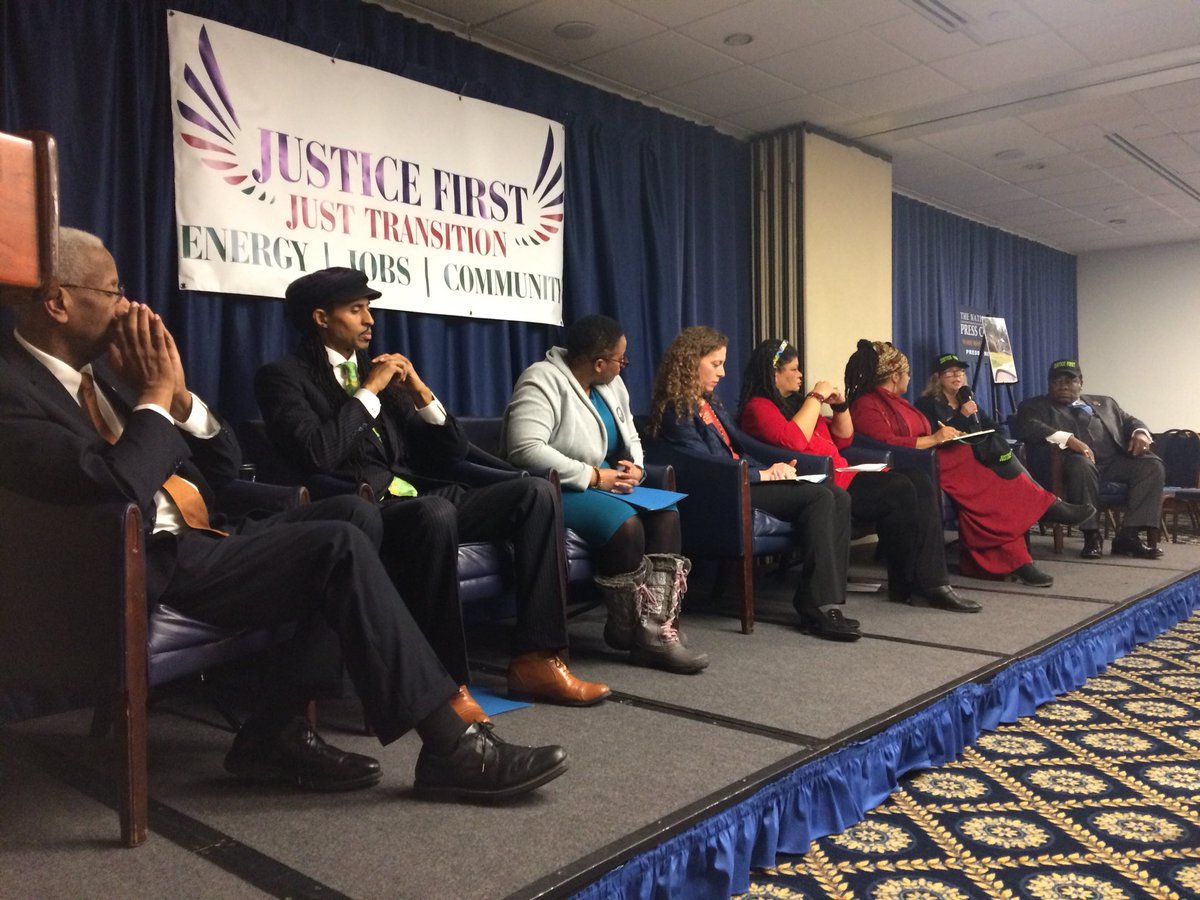
A powerful lineup for the Justice First Press Conference on January 15th. From left to right: Congressman McEachin (VA-04), Mustafa Santiago Ali of the Hip Hop Caucus, Kerene Tayloe of WE ACT for Environmental Justice, Molly Rauch of Mom’s Clean Air Force, Leslie Fields of Sierra Club, Ife Kilimanjaro of USCAN, Danna Smith of Dogwood Alliance, and Reverend Leo Woodberry of New Alpha CDC.
Danna Smith said,
“We must be united behind a bold vision for solving the climate crisis. A vision that includes not only a transition to 100% clean affordable energy for all but also one where our forests are protected for their climate, wildlife and community benefits. We urge our elected officials to join hundreds of organizations, scientists and policymakers who recognize biomass energy as a false climate solution, and instead embrace forest protection as a climate justice imperative.”
As he often did across the South at Justice First Tour stops, Reverend Woodberry closed out the press conference with a call and response with the audience. The room reverberated with calls for “Justice First!” — which probably doesn’t happen too often at the National Press Club (but it should).
I listened to these leaders’ powerful message as I sat in the audience snapping photos and joining in the calls for Justice First, inspired by the moment we are in.
And even more powerfully, Dogwood Alliance and our partners are demanding action that is just and that centers communities.
There’s no time for false solutions or policies that replicate systems of oppression.
After the press conference and briefings, Danna, Rita, and I made our way Capitol Hill to meet with congressional offices and continue to spread the message of Stand4Forests and the Justice First Campaign.
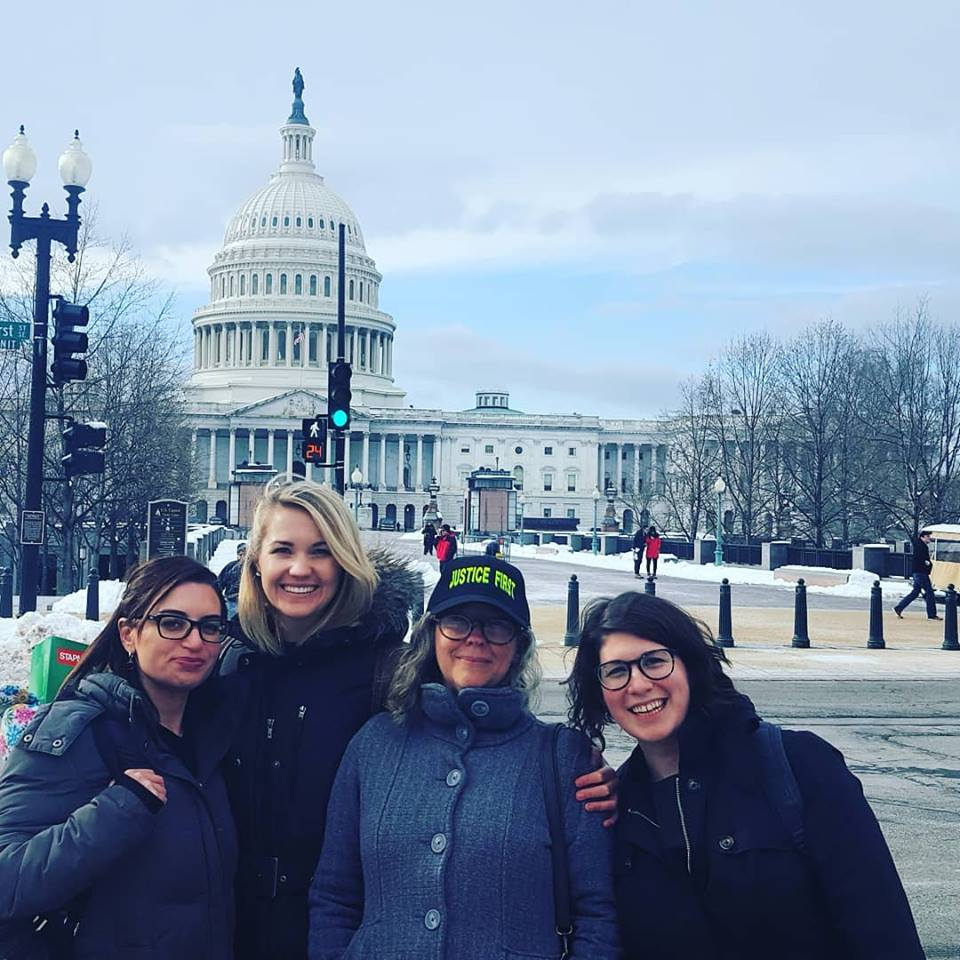
Dogwood Alliance’s Rita Frost, Danna Smith, and Rachel Weber in front of the Capitol, along with Carina Daniels, Co-Founder of Story & Reach
We put the Stand4Forests platform in the hands of several congressional offices — climate leaders in the South who want to see ambitious climate legislation at the federal level, including the office of my own representative, Congressman David Price.
From long-time congressional leaders like Congressman Price (NC-04) to brand new leaders like Congresswoman Jennifer Wexton (VA-10), there was a buzz around climate action in all of the offices we visited. Congressman Don Beyer (VA-08), who has been the top leader in the house when it comes it opposing biomass, is one example: his aide made the point that champions like Beyer’s top issue has been the environment for years, and it’s about time that everyone else is talking about it.
Here’s the point we drove home at each meeting:
Forests and wetlands are an integral part of solving the climate crisis and making our communities more resilient to the effects of climate change we’re already experiencing. As the world’s largest producer and consumer of wood products, the US has the serious opportunity — and responsibility — to protect, restore, and enhance natural forests.
We made this point especially clear at Congresswoman Kathy Castor’s (FL-14) office. If you’ve been following the national headlines on climate lately, you might recognize her name — she’s the Chairwoman of the newly formed Select Committee on the Climate Crisis. We know many partners and grassroots activists will be watching closely what comes out of this committee, and we’ll be joining them in calling for the boldest, most ambitious, and most equitable solutions to the climate emergency we’re in.
Regardless of committee, there’s not one representative in Congress whose constituents aren’t being affected by climate change right now — and that’s why we’re going to continue to lift up the intersection of forests, climate, and justice on the national stage.
With your support, we are making major progress elevating the critical role of US forests in the global effort to meet the goals of the Paris Agreement, shore up natural protection for those most directly and profoundly impacted by extreme weather events, and ensure justice and equity in the new green economy.
Whether we’re in the halls of Congress, in statehouses across the South, or at the next public hearing to stop Enviva’s expansion, you can be sure we’re making our message loud and clear. It’s time to Stand4Forests and put Justice First.
The Dogwood Alliance family is mourning the loss of one of our greatest heroes and a champion of Southern forests, Lloyd Clayton, who passed away on January 14th in his hometown of Birmingham, Alabama.
In 1996, forest protection activists from around the United States converged on the Bankhead National Forest in Alabama to discuss campaigns, issues, and strategies for stopping logging on national forests around the country. The Southern contingent at the event had more than national forests on their mind — 90% of the forests in the region are privately owned and over the previous five or so years there had been an invasion of chip mills springing up around the South that were devastating them.
Local communities and concerned environmentalists were watching an ever-expanding wave of destruction consuming forests in the South. Our forests were being chopped down, chipped up and either sent on barges to Japan or were being consumed at a faster rate by paper mills across the South. Something had to be done and quickly.
From the crowd, a sweet cherub of a man with the most jovial laugh and an undying love for Mother Earth emerged and pledged to fund a new organization to fight forest destruction across the South. That sweet man was Lloyd Clayton, and with his generous support, Danna Smith and Cielo Sand were hired as co-directors of the newly founded Dogwood Alliance.
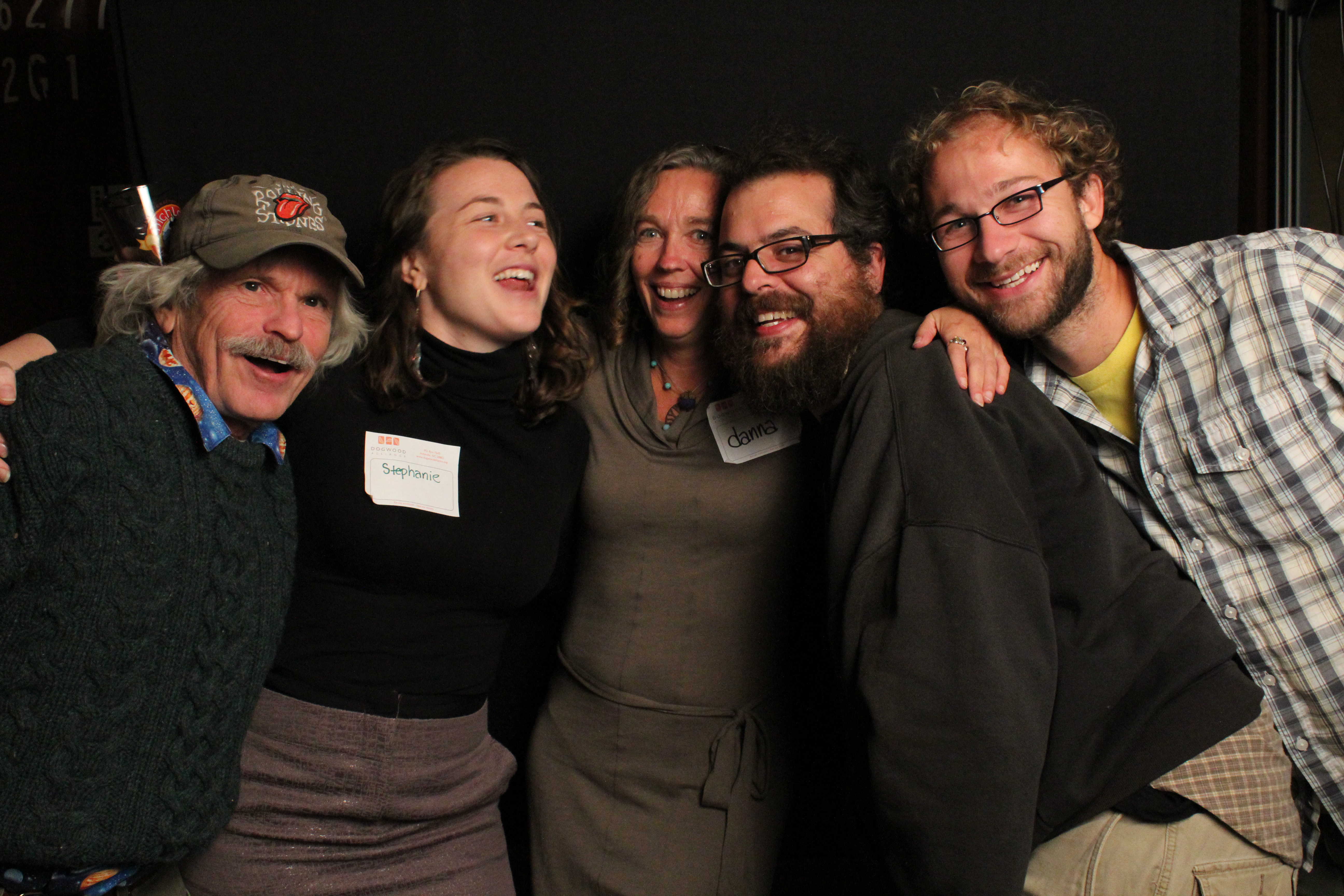
Lloyd Clayton (left) with Dogwood Alliance board and staff members at the organization’s 15th anniversary party in 2011.
In 2000, when I joined the staff of Dogwood Alliance, Lloyd was one of the first people to greet me. His playful demeanor, deep admiration for people who put their bodies on the line for nature, and willingness to do anything for the people he loves, immediately endeared him to me. Over the last 18 years we have spent many hours together in the Bankhead, our respective hometowns of Asheville and Birmingham, at Heartwood gatherings, and many places in between sharing a laugh or having a deep conversation about the state of the world.
Lloyd was one of my greatest friends, inspirations, and in many ways my muse. He reminded me to laugh at the bastards trying to hold me down, to fight like hell for the people and planet I love, and could always find a way to break tension or confusion with a mesmerizing story. I have so many special memories with Lloyd. Here are but a few.
After September 11th, funding for non-profit environmental organizations crashed dramatically, and many people had to leave the movement to be able to pay the bills. I made it my mission to go out and visit as many of the groups, activists, and communities in our network over a year to listen and see how we could support their work, putting more than 20,000 miles on my car. There were a lot of gloomy stories at that time, and I had hit rock bottom, really questioning whether any of us could make a difference. I was down in Gainesville, Florida on the tour and got a call from Lloyd. He instantly heard the sadness in my voice and invited me to meet him in Destin, Florida.
Lloyd made me feel like the center of the world – sharing meals, stories, and quiet time until it was clear my morass had passed. I am quite sure that if Lloyd had not done that, I would not still be here at Dogwood Alliance writing this today. Over the years, Lloyd had a knack for timing, knowing just when to pop back into my life. In conversations with many of Lloyd’s friends through the years, most shared the same insight.
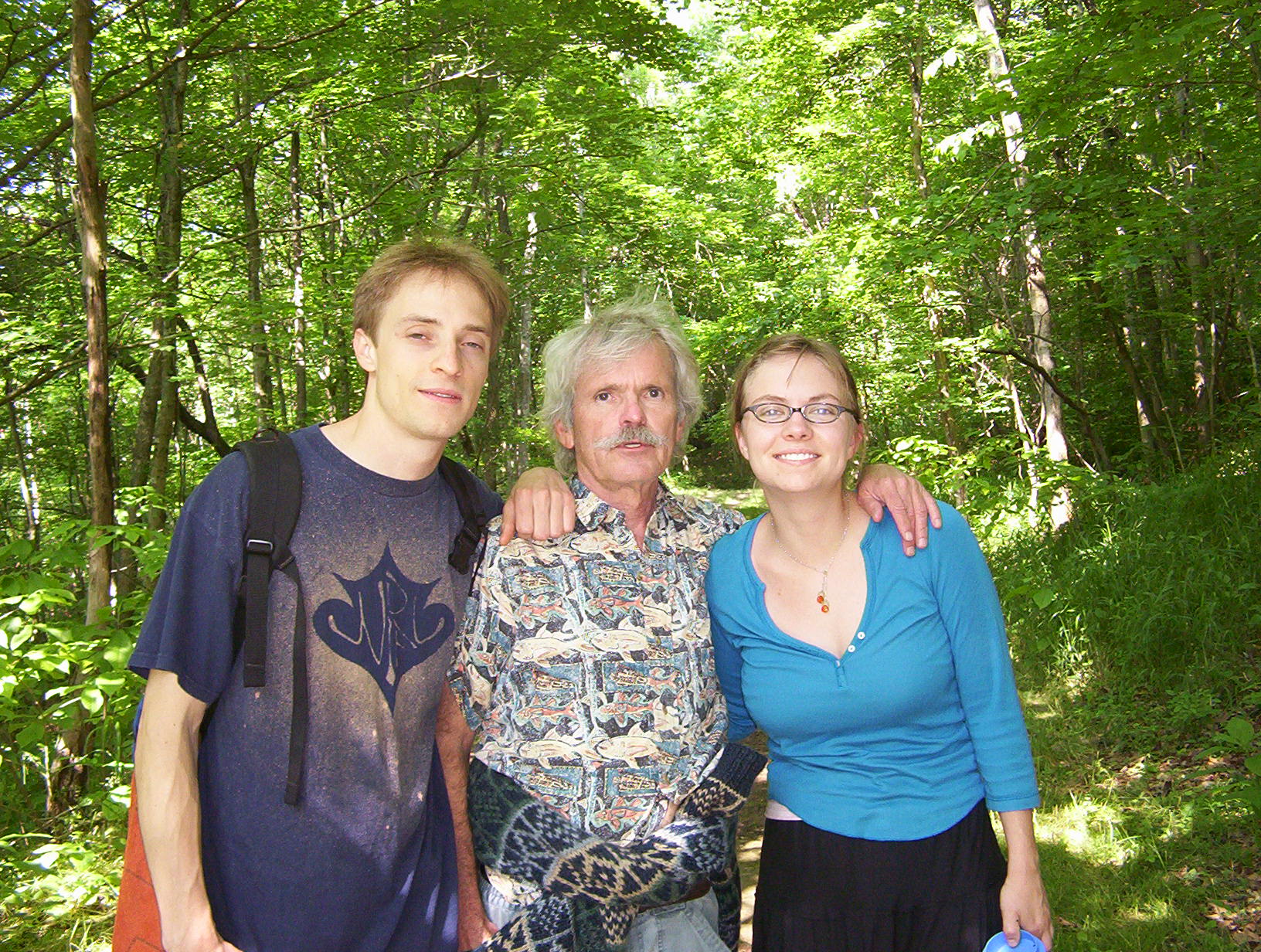
Lloyd and friends at a wedding on the Cumberland Plateau in Tennessee.
A few years back Lloyd had a stroke. Doctors did not give him much chance for a full recovery. This could have easily been a moment where he could have given up. But Lloyd, who some of us nicknamed Lloyd the Cat, took it all in stride. Despite the weakness in his body, he slowly but surely pushed on, showing up at Heartwood gatherings, popping up randomly in Asheville for a visit, or venturing far afield to places like Cuba.
A couple years back, after several conversations, Lloyd and I decided to meet at his special spot in Alabama for a week-long retreat together. He was still struggling to walk, but we knew that if we went slow and steady and took lots of breaks to enjoy the majesty of the forest, we could visit some of his favorite places together. Arm in arm we made our way through his special paradise – hugging trees, listening to the babbling brook, and enjoying each others company. I can say in all honesty, that it was one of the most special weeks of my life.
I am mourning the loss of my sweet friend, but he will always serve as a beacon of hope, an inspiration to keep fighting the good fight, and bring a smile to my face and a big ole laugh to my belly.
Rest in Peace Lloyd Clayton! The forests, rivers, and mountains of the Southern US will sing your name, mourn your passing, and be better off thanks to all you have done in their service.

Lloyd Clayton at his special spot in Alabama.
The climate crisis demands that we act now. False solutions, like biomass energy, continue to expand. They target forests: our best defense against climate change, pollute our communities, and leave degraded forests that make people more vulnerable to floods, hurricanes, and other natural disasters. False solutions like the wood pellet industry aren’t clean or green and aren’t the energy future we need.
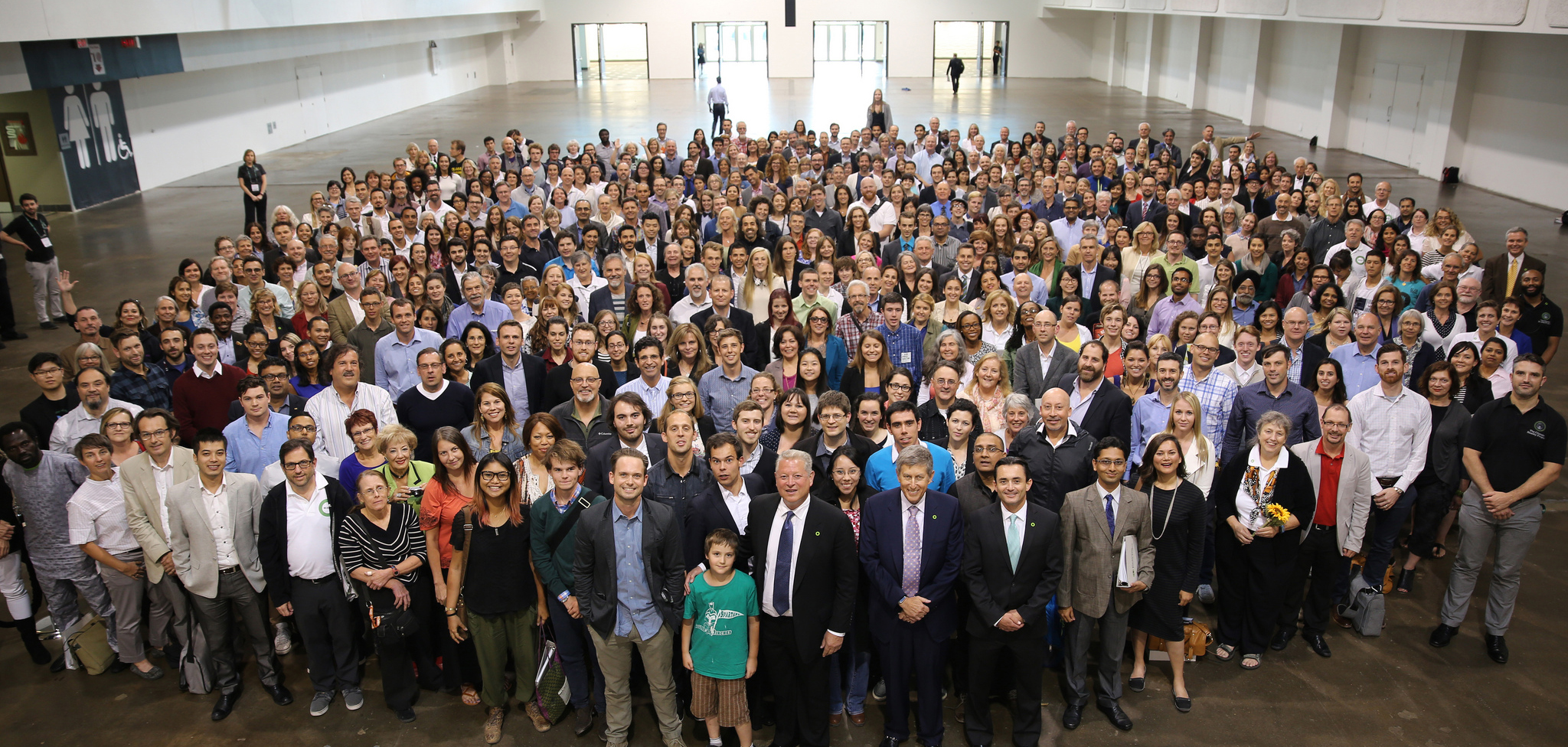
“The reality we now face implores us to act.” – Al Gore, Founder & Chairman, The Climate Reality Project
We’re not just fighting for a clean energy future, we’re fighting for a fair energy future. That’s why Dogwood Alliance is joining the Climate Reality Project and Poor People’s Campaign: A National Call for Moral Revival at the Climate Reality Leadership Corps activist training in Atlanta, Georgia this March. Former Vice President and climate visionary Al Gore along with an all-star lineup of environmental justice leaders, faith voices, business innovators, and other experts will lead trainings and workshops to build a network of climate leaders capable of pushing back on false solutions and building the clean and fair energy future we need. Dogwood Alliance is honored to be a partner on this important training.
This will be a powerful opportunity to focus on connecting climate advocacy to social justice and on the important role the Southeastern United States plays in addressing the climate crisis. The training will connect environmental justice and climate justice and will center frontline communities, low-income communities, and communities of color. In addition to other topics, we’ll also explore biomass as a false solution to climate change.
Limited scholarship funds are available to assist with transportation and/or housing for people in need of financial assistance. If you’d like more information, please email me directly.
Keeping our forests standing, natural, diverse, and healthy is a critical defense against climate change. To push back on threats like biomass and to build solutions that will solve the climate crisis, all of us need to act together.
 Faith and Forests is a special monthly series by Joseph Frankovic. In the series, Joseph will explore how his deep connection to spirituality and faith intersects with our forests and the work of Dogwood Alliance. The views and opinions expressed are those of the author(s) and do not imply endorsement by Dogwood Alliance.This blog installment is dedicated to straight talkers—to the youth and to Aspies of all ages.
Last month, we celebrated Jane Goodall’s book Reason for Hope.1 Much of Goodall’s optimism centers on a specific demographic, namely young people. To them, she attributes boundless energy and enthusiasm, as well as the release of a powerful force when they resolve to effect change.2 We also met Michel de Montaigne, who lived in France during the 16th century. He affirmed young people, in a roundabout way, by rejecting the assumption that age and wisdom correlate directly and proportionally.3
With each passing year, my skepticism about the age-wisdom correlation grows. I have cited below evidence that nourishes that spreading skepticism, using the recent remarks of a former world leader who spoke of hope and change. Before discussing his remarks, allow me to say more in favor of the youth.
In the Synoptic Tradition, each of the Gospel writers—Matthew, Mark, and Luke—repeated a story about Jesus and children. Parents were bringing their children to Jesus, whom they considered to be a saintly man, so that he could touch them. On one occasion, for an unknown reason, Jesus’s disciples discouraged this activity. Objecting to their interference, Jesus transformed an awkward moment into a teaching opportunity:
ἄφετε τὰ παιδία ἔρχεσθαι πρός με καὶ μὴ κωλύετε αὐτά, τῶν γὰρ τοιούτων ἐστὶν ἡ βασιλεία τοῦ θεοῦ. ἀμὴν λέγω ὑμῖν, ὅς ἂν μὴ δέξηται τὴν βασιλείαν τοῦ θεοῦ ὡς παιδίον, οὐ μὴ εἰσέλθῃ εἰς αὐτήν. Allow the children to come to me and do not hinder them because from such as these, the kingdom of God is [constituted]. Amen—I say to you, whoever does not accept the kingdom of God like a child will never enter it.4

Jesus blessing little children
Children inherently possesses a character trait that Jesus regarded as indispensable for entering his movement. Former Professor David Flusser of the Hebrew University explained Jesus’s sublime remark to mean, “one has to accept the kingdom of God [i.e., of heaven] simply and without mental reservation.”5 In previous blog posts, we met Brother Bill of Chicago, Mother Teresa of Calcutta, and Mother Antonia of Tijuana, each of whom had this childlike quality of accepting a big, comprehensive truth without requiring qualification or seeking a limiting condition.6
Before the time of Jesus, at various moments in Judaism’s long history, shifts occurred in perception regarding how God communicated the unknown to the Jewish people. A common new way involved the Bath Kol (i.e., בת קול)—literally, the daughter voice. Professor Saul Lieberman, who taught Talmud and Rabbinics for many years at the Jewish Theological Seminary of America, gave a fuller definition of the term. “Bath Kol very often means simply vox,verbum, a voice or a word heard without seeing the person who uttered it, or a word heard from a person who was not conscious of the import of his [or her] saying.”7 This definition can accommodate a range of variables regarding experiencing the daughter voice. The rabbis associated the Bath Kol with the activity of the Holy Spirit. When hearing a child’s voice, particularly when Scripture was being read or recited, the rabbis viewed this moment as favorable for experiencing the daughter voice. The rabbis also emphasized that when the daughter voice disclosed the unknown to a Jewish auditor or audience, she communicated in plain language that contained no ambiguities. Straight talk—this distinguished the Bath Kol, for example, from the utterances of Apollo and Dionysus when one or the other god spoke through the Pythia at Delphi, the ancient religious sanctuary on the slopes of Mount Parnassus.8
In one paragraph, I will assemble a distinctive set of assets that young people, including schoolchildren, bring to the contemporary struggle for inclusive justice and their right to defend the biosphere for posterity. From Goodall, we learnt that energy, enthusiasm, and commitment define young people. They release a powerful force when they commit to making change happen. Jesus attributed to children the ability to accept a comprehensive, existential truth simply and at its face value. People who need ifs and buts clarified do not enter the kingdom of heaven. The rabbis also had a few relevant details to add. First, they portrayed the daughter voice as straight talk from heaven. Secondly, they associated the daughter voice with the speech of schoolchildren, usually when they were vocalizing Scripture. Thirdly, these children were unaware when their utterances were part of the Bath Kol.
Eligible for characterization by these youthful qualifications is Greta Thunberg, the 15-year-old daughter of Swedish actor Svante Thunberg and Swedish opera singer Malena Ernman. A student and young climate activist, Thunberg brings another asset to the struggle: She benefits from Asperger’s Syndrome, an autism spectrum disorder (ASD).9 In short, Thunberg inhabits a conceptual world that is mostly dichromatic—black and white with few shades of grey intervening. When the distance between reality and the narrative, between actions and the explanations for them, becomes too far-fetched, a person with Asperger’s Syndrome is likely to protest against the distortion, irrespective of the social context and cost. Think of the child character who exposed the weavers’ fabrication in Hans Christian Andersen’s fairy tale The Emperor’s New Clothes.10 Furthermore, the two hemispheres of the Aspie brain typically clamp down on a narrow bundle of interconnected issues, interests, and subjects with the tenacity of a pit bull terrier. Thunberg’s targets are climate justice and biosphere protection. Her mind has a firm grip on the need for action to deaccelerate climate change. She recommends pulling the emergency brake, now.11

Greta Thunberg in 2018
Near the beginning of this post, I briefly mentioned a former world leader who held high the banner of hope and change while on the campaign trail. I am referring to former President Barak Obama. On November 27, 2018, President Obama participated in a conversation with former Secretary of State James A. Baker III at the Baker Institute for Public Policy in Houston, Texas. Presidential historian Jon Meacham moderated the event, an anniversary gala to raise money for Secretary Baker’s public policy think tank. The President delivered the desired results: Over 1,000 guests attended and 5.4 million dollars were raised.12 Fifteen days later and over 5,600 miles away in Katowice, Poland, Thunberg addressed world leaders in a plenary session of the United Nations Climate Change Conference, otherwise known as COP24–Katowice.13
Although President Obama and Ms. Thunberg’s speaking events were separated by time and geography, I will arrange another gala and replace Secretary Baker with Ms. Thunberg. I also will dismiss moderator Meacham and replace him with me, an adult who was diagnosed with ASD by a medical professional. Ms. Thunberg and I have something in common, so the reader can expect the wind to be at her back throughout this imaginary event. I did not ghostwrite the sentences for either participant, but I did create the context in which they are now presented.
Moderator: Mr. President, thank you for joining us. We are honored by your participation. President Obama: It’s good to be back. Moderator: Is there a particular achievement of your administration that you feel has been undervalued, perhaps even overlooked? President Obama: Sometimes [I] go to Wall Street and folks [are] grumbling about anti-business. And I said, “Have you checked where your stocks were when I came into office and where they are now? What are you talking about? What are you complaining about? Just say, thank you.” Moderator: Disappointing and frustrating—you helped those folks earn good money and were not properly acknowledged for the role that you played. Ms. Thunberg, is there something you would like to say. Ms. Thunberg: Our civilization is being sacrificed for the opportunity of a very small number of people to continue making enormous amounts of money. Our biosphere is being sacrificed so that rich people in countries like mine can live in luxury. It is the sufferings of the many which pay for the luxuries of the few. Moderator: Yes, corporate magnates and politicians sacrificing life to enlarge private fortunes—that is a theme known to us from the past. During the Great Depression, Brigadier General Smedley Butler wrote War Is A Racket. An excellent antiwar booklet by our Nation’s most decorated general, I recommend it. He spoke about war—who benefits and who pays. He basically said that war is conducted at the expense of the very many, for the benefit of a few people who make huge fortunes from it.14 Ms. Thunberg: Change is coming. The real power belongs to the people. Moderator: Mr. President, you earned Ivy League degrees, taught constitutional law at the University of Chicago, served terms in the U.S. Senate, obviously, you were well-informed before entering the Oval Office. Once you were there, you had expanded access to scientific data and analyses from experts working in Government, at agencies like the National Oceanic and Atmospheric Administration, National Aeronautics and Space Administration, U.S. Forest Service, and so on. Based on your assessment of the information that you had available, tell us something about your domestic energy policy. President Obama: American energy production—you would not always know it, but it went up every year I was President. And that whole suddenly, America is like the biggest oil producer and the biggest gas producer, that was me people. Moderator: Change you are proud of—helping America become the biggest producer of petroleum and natural gas hydrocarbons in the world. Some may bristle at your personal satisfaction with such an achievement because more production means graver environmental consequences. Ms. Thunberg, do you approve of this approach to energy production? Please, address your response to the President. Ms. Thunberg: You say you love your children above all else, and yet you are stealing their future in front of their very eyes. We need to keep the fossil fuels in the ground. Until you start focusing on what needs to be done rather than what is politically possible, there is no hope. Moderator: Mr. President, you campaigned on the promises of hope and change. Yet Ms. Thunberg is characterizing your domestic energy policy as depressing for young people. Certain things that you say, the underlying rationale eludes me. Is there a particular ideological system that you embrace, a school of thought with which you identify? President Obama: [The Washington] consensus, of which I consider myself to be a part of and still believe in. Moderator: Ms. Thunberg, give us a final comment and, again, please speak directly to our special guest. Ms. Thunberg: You only talk about moving forward with the same bad ideas that got us into this mess. If solutions within this system are so impossible to find, then maybe we should change the system itself. Moderator: I see, the Washington consensus seems adept at keeping failed ideas on life support when they should have died in hospice long ago. [—Applause—]15
In the real conversation with Secretary Baker, President Obama exposed himself as a deadwood leadership booster. With the wealth gap so wide, and growing steadily, only a sympathizer would relish helping Wall Street folks increase the value of their portfolios.16 Being the father of two young adults, Malia and Sasha, he even took pride in making America the world’s biggest producer of petroleum and natural gas hydrocarbons.17 How will he explain that achievement to his grandchildren? Montaigne shared an insight long ago that may shed light on the former President’s economic and energy policies: “In old age our souls are subject to more troublesome ailments and imperfections than in our youth.”18

Obama family portrait from 2011
The Swedish daughter’s voice sounded altogether different from that of the presidential father. Her intellectual and moral launch pad stands on the simple acceptance of a new reality. Without mental reservation—with neither a nuanced qualification nor a neat limiting condition—she accepts that we live in a time of existential crisis on a planetary scale. At COP24–Katowice, Thunberg spoke truth to power, describing world leaders as so immature and insecure that they have foisted the responsibility of educating people about climate justice and Earth’s biosphere on children. She also implied that our leaders are unfit to lead: They repeat bad ideas that contributed to the crisis and continue pointing to them as the way forward. These leaders act for the sake of political expediency, ignoring the warnings from scientists.
She also spoke about mankind’s most adored idol: mammon. Acting like an iconoclast, Thunberg hammered neoliberal mammonism for undermining civilization and ruining the biosphere. For what purpose? To give a very small group of elites the privilege of making obscene sums of money; to ensure that rich citizens in affluent Western countries enjoy pampered lives. This arrangement, in which the many pay while the few play, contrasts violently with Jesus’s proclamation of the kingdom of heaven.19 The evangelists of neoliberal capitalism—which include the Washington consensus, an identifier President Obama used—preach a sweet-sounding, but divisive gospel.
The defiant part of her statement came toward the end when Thunberg raised the possibility of replacing the current system. I heard a revolutionary refrain in that option. Then, she added that the youth did not come to COP24—Katowice to beg world leaders to care. On the contrary, the youth did not attend to extend an olive branch, but to deliver their declaration of independence: “You have ignored us in the past, and you will ignore us again.” These world-class ignorers will reap the consequence of their inaction: change. Irrespective of their preferences and timetables, Thunberg informed world leaders that change is headed their way. Moreover, they are powerless to alter what is in motion because “the real power belongs to the people.” Whether or not the Swedish daughter spoke presciently, we will know before the end of the next decade. And at that time, we can listen, again, to Thunberg’s COP24—Katowice statement and recognize whose voice we heard.

Youth supporting forest protection at an Our Forests Aren’t Fuel rally in Charlotte, North Carolina
Endnotes
Faith and Forests is a special monthly series by Joseph Frankovic. In the series, Joseph will explore how his deep connection to spirituality and faith intersects with our forests and the work of Dogwood Alliance. The views and opinions expressed are those of the author(s) and do not imply endorsement by Dogwood Alliance.This is dedicated to Dr. Jane Goodall to mark the 20th anniversary of her book Reason for Hope: A Spiritual Journey.
“Yes, we are destroying our planet.” The celebrated ethologist Jane Goodall, who studied chimpanzee behavior in Tanzania, affirmed the destruction, years ago, in Reason for Hope: A Spiritual Journey (1999).1 In her book, Goodall made an appeal for investing maxim effort in our moral and spiritual development. Several years earlier, the irreverent comedian George Carlin also had addressed the seriousness of the destruction, but using a sharper barb. Readers who saw Jamming in New York (1992) at the Paramount Theater will remember how Carlin leveraged nuance to impale us with a painful point: “The planet is fine; the people are . . . it will shake us off like a bad case of fleas—a surface nuisance.” 2 Profane and correct, he was: A destroyed biosphere will not impinge on Earth’s planethood. The audience applauded his attempt to upend us as we shuffled along, sleepwalking.
Carlin failed, and we went on threatening the planet superficially and accelerating the human biosphere project. He probably expected unresponsiveness: Before his death in 2008, he had concluded that we lacked the capacity to effect behavioral changes quickly and globally.3 Since writing Reason for Hope, Goodall has carried on with a spirit of optimism. Our intelligence, our indomitable spirit, and the energy and enthusiasm of young people, these human assets give her hope, as well as the biosphere’s resilience.4
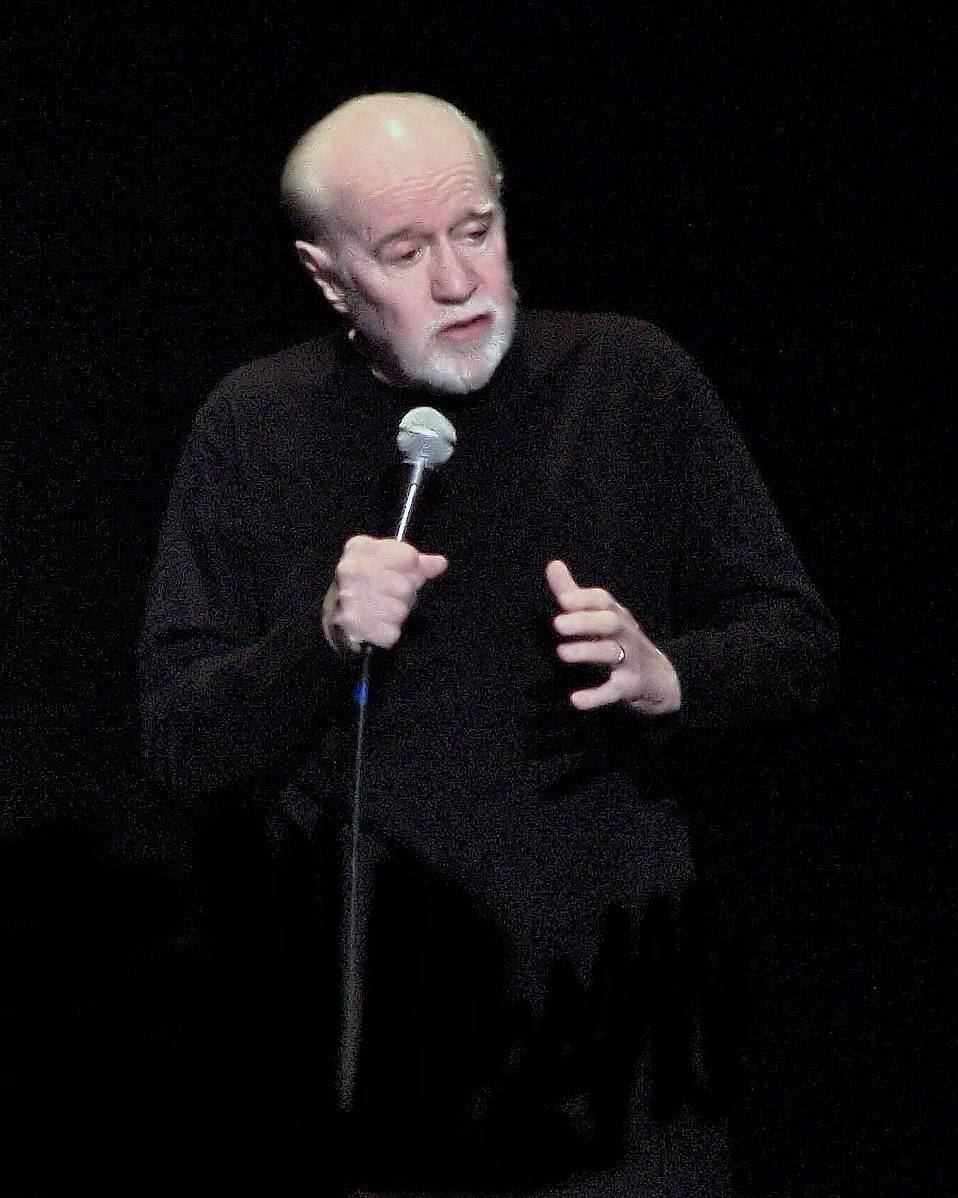
George Carlin was a stand-up comedian who often reminded us of the absurdity of being human.
As a young Baby Boomer, when I read her reasons for hope, I noticed that she singled out one demographic: the youth. She passed over the older generations silently—and fairly, in my opinion—even though many of us have silver and ivory crowns of hair and craniums packed with experience and knowledge. With older Traditionalists standing at our side, too many of us spectated as today’s crises—the congressionally superfunded military-industrial nightmare, climate change and mass extinction, uncaged neoliberal capitalism, and the chasmic divide in wealth between billionaires and ordinary workers—slowly heated up from a simmer in the 1980s to an excited boil in the 21st century.
“There is a powerful force unleashed,” Goodall wrote, “when young people resolve to make a change.” 5 When I survey the American landscape, I see too many old snags with roots wrapped around the sources of power and money. I am thinking of public figures like Rex Tillerson, Chuck Schumer, Mitch McConnell, Nancy Pelosi, Mike Pence, and others. Deadwood has neither the energy nor enthusiasm that the youth possess; nor can it come close to matching young people’s creativity, imagination, and pursuit of inclusive justice. Moreover, deadwood policies for managing the crises of our day cast doubt on a direct and proportional relationship between age and wisdom. Bargaining away the future of our children in exchange for more power and extra money is a rare cocktail of tomfoolery, self-absorption, and greed.6
Michel de Montaigne, who died in 1592, and before doing so, wrote three books of essays, rejected the age-wisdom correlation. In his third book, this French son of minor nobility wrote:
Mais il me semble qu’en la vieillesse nos ames sont subjectes à des maladies et imperfections plus importunes qu’en la jeunesse. . . . Mais, à la verité, nous ne quittons pas tant les vices, comme nous les changeons, et, à mon opinion, en pis. Outre une sotte et caduque fierté . . . . et un soin ridicule des richesses lors que l’usage en est perdu, j’y trouve plus d’envie, d’injustice et de malignité.7 But it seems to me that in old age our souls are subject to more troublesome ailments and imperfections than in our youth. . . . But in truth we do not so much abandon our vices as change them, and, in my opinion, for the worse. Besides a silly and decrepit pride . . . and a ridiculous concern for riches when we have lost the use of them, I find there more envy, injustice, and malice.8
In addition to pride, a concern for riches, and a few other repellant habits, Montaigne accentuated envy, injustice, and malice. He made this comparison of the condition of our souls in old age with their youthful state during the last decade of his 59 years of life. Perhaps unaware of its enduring applicability at the time, Montaigne’s piquant remark has retained its fizz for centuries. These age-related traits aptly characterize senior representatives of America’s corporate-political leadership class of 2018.
Back to Goodall—in her book, she aimed to do more than disclose four reasons for hope. She also wrote to convey a message, which she discussed on various pages and occasionally in different chapters. Let us take a look at that message, starting with a conversation that she had with a young man working as a bellhop at a large hotel in Dallas, Texas:
It honestly didn’t matter how we humans got to be the way we are . . . . What mattered and mattered desperately was our future development. Were we going to go on destroying God’s creation, fighting each other, hurting the other creatures of His planet? Or were we going to find ways to live in greater harmony with each other and with the natural world? [That was important] not only for the future of the human species, but also for him, personally. [The young man] would have to make his own decision.9
Her retelling of the story accentuates two intertwined themes: focusing on our future development as a species and aligning individually with a new trajectory of development by taking personal responsibility for changing one’s own destructive habits.
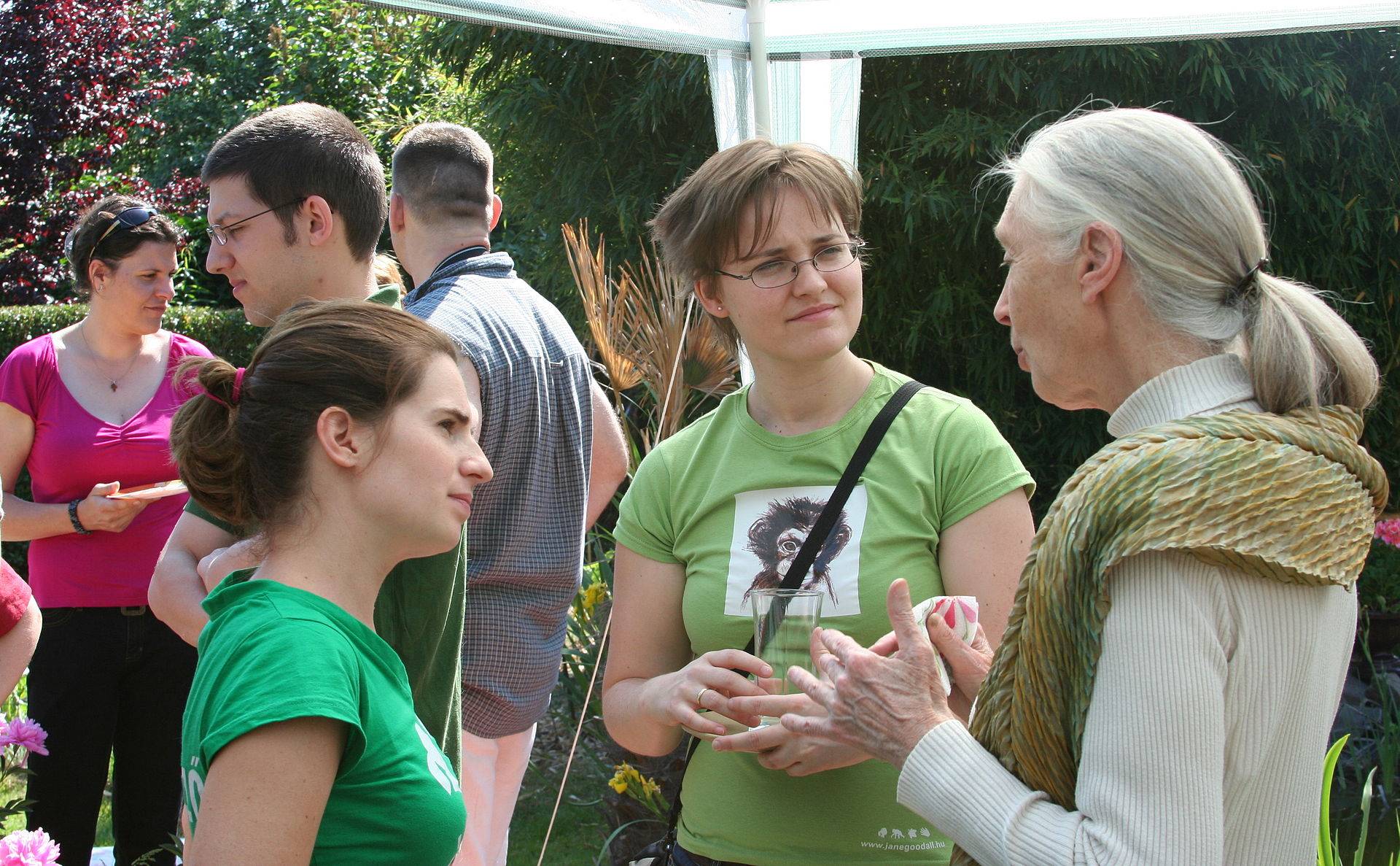
Jane Goodall meets with student leaders in Eastern Europe.
Having been trained as a scientist by the legendary paleontologist and anthropologist Louis Leakey, this ethologist understands extinction. Goodall could be described as a realistic idealist. She knows that a long timeline favors biological evolution, but time now works against the moral and spiritual development of our species because we face an approaching deadline.
I do have hope for the future—for our future. But only if changes are made in the way we live—and made quickly. We do not, I think, have much time. And these changes must be made by us, you and me. If we go on leaving it to others, shipwreck [of Spaceship Earth] is inevitable.10
Again, she emphasized the need for each person to take personal responsibility for changing his or her way of life. The agents of change are you and I—not others. Furthermore, in her opinion, time was short—20 years ago!
In another chapter, Goodall explained more about accelerating our moral and spiritual evolution.
We had to learn to understand and love this Spirit within [i.e., the flame of pure spirit in each of us] in order to find peace within. And only then could we reach out beyond the narrow prison of our own lives, seeking reunion with the Spiritual Power that we call God, or Allah, the Tao, Brahma, the Creator, or whatever our personal belief prescribes. Once we had attained that goal, our power to connect with others, so that together we could create a better world, would be immeasurably greater. The ability to reach beyond their upbringing, their culture, and their immediate surroundings has always, I realized, been a characteristic of the greatest spiritual leaders and saints. Our task, then, if we would hasten our moral evolution, progress a little more quickly toward our human destiny, is obvious—formidable, but in the long run not impossible. We will have to evolve, all of us, from ordinary, everyday human beings—into saints! Ordinary people, like you and me, will have to become saints, or at least mini-saints. The great saints and the Masters were not supernatural beings; they were mortals like us . . . . And they all believed in a Spiritual Power, in God. That enabled them to tap in to the great spiritual energy “in which we live and move and have our being.” [They breathed this energy] into their lungs so that it ran in the blood, giving them strength. We must strive, each of us, to join them.11
And a few pages later, she returned to the theme of saintliness:
I had no doubt that, given time, we humans were capable of creating a moral society. The trouble was, as I knew only too well, time was running out. . . . And I knew the direction in which we were headed. But we did not have the luxury of millions of years for all humans to become true saints. Not if we continued destroying our environment at the present rate. . . . we would simply have to try, each and every one of us, to become just a little bit more saintlike.12
Two key religious themes run through these paragraphs.
First, to seek “reunion with the Spiritual Power” reminds me of repentance as it is expressed in the Hebrew language and understood within Judaism. The word for repentance teshuvah (i.e., תשובה) literally suggests turning around or a reversal. The core sense of the word is to return; the desired destination, namely, to God, is implied. For those who are familiar with Jesus’s parables, the return of the prodigal son to his father (i.e., to God) metaphorically captures the idea.13 Goodall opted for similar language: reuniting with God. Once a person returns—to Allah, God, the Great Mystery, the Name, Mother Earth, or perhaps merely to common sense—that person becomes more effective at coordinating, cooperating, and working with others to create a better world. In other words, repentance enhances fraternity and solidarity.
Secondly, she is calling on ordinary people—you, me, and other regulars—to reach higher, toward the likeness of a saint. She urges each of us to become, at the very least, a mini-saint. One characteristic that saints have in common is a highly developed sense of self-awareness. We sorely need more awareness of this type. The full weight of the fate of Homo sapiens and many other species collectively hangs on all of us as heavily as it individually hangs on each of us. A person whose self-awareness is high can accept this assertion.
When reading biography, memoir, and other historical genres, I am struck by the number of highly self-aware people who heard the Voice. Socrates and Jesus’s disciples—Peter, James, and John—heard the Voice; Gandhi and Mother Teresa also heard.14 The Voice spoke to Mother Teresa on a train in September of 1948, when she was traveling to Darjeeling, India, where she had been sent to recover from tuberculosis.15 To each of these hearers, the Voice conveyed an instructional message.
Goodall also wrote about the Voice and the message that she received. In essence, that original message—or urmessage—which she associates with the Voice, underlies and supports the more public reiteration that we discussed at length above.16 In 1974, she visited Notre Dame de Paris not long after her first marriage had ended in divorce. While gazing at the cathedral’s Rose Window and listening to Johann Sebastian Bach’s Toccata and Fugue in D Minor, she had an ecstatic, mystical experience that renewed her contemplative life.17 Listen to her describe, over two decades after the event, her reflections on what had happened:
[That experience] was a sort of call to action. I think I heard, in a form suitable for mortal ears, the voice of God . . . . And I did not hear any words, only the sound. Words or not, the experience was powerful, and served to jolt me back into the world into which I had been born, the twentieth century with all its problems. It helped me to realize that the spiritual power that I felt so strongly in the wild and beautiful world of the forest was one and the same with that which I had known in my childhood . . . in the days when I used to spend long hours in ancient cathedrals. Indeed, as I look back, my visit to Notre Dame was a milestone along my path. Eventually, when the time was right, I would remember that glorious experience and the words would be revealed. But that would not be for some time to come.18

The Rose Window at Notre Dame Cathedral in Paris.
Since the publication of Reason for Hope, she has done many lecture tours to share the message—the essence of which “comes to [her] from outside; as if [she were] an eolian harp with strings vibrating to an invisible wind.” 19 The message that Goodall shares publicly has its origins in the urmessage that she received while gazing at the window and listening to Bach inside Notre Dame.
Only quite recently did I begin to wonder whether there had been some specific message for me, wordlessly conveyed by the powerful music, a message that I absorbed, but was not yet ready or able to interpret. And now, through experience and reflection, I believe that there was indeed a message. A very simple one: Each one of us matters, has a role to play, and makes a difference. . . . We all [hear the Voice of God]—that ‘still, small voice’ that we speak of, telling us what we ought to do. That, I think, is the Voice of God. . . . Whatever we call it, the important thing, I think, is to try to do what the voice tells us. My experience in the cathedral of Notre Dame was dramatic, awakening. It is the still, small voice that I hear now—and it bids me to share.20
The action that the Voice bade her to take has been difficult. Through her 70s and into her 80s, she has lived an itinerant life with an exhausting tempo. As a scientist, she was one of the earlier ones to grasp the scale and scope of the harm that humans are doing. She also carried the burden of prescience: She envisioned the ultimate consequences of our behavior. These challenges, Goodall accepted to remain faithful to the Voice.
Yet the Voice may ask more—sometimes a person receives instructions that involve high levels of risk, as well as big personal sacrifices. Socrates understood that, by remaining silent the morning of his trial, the Voice had sanctioned the verdict before it would be given later that day. The men of Athens returned a verdict of guilty, and Socrates received the death penalty. Mother Teresa understood that she must enter the slums of Calcutta to live among that city’s poorest and sickest residents. And consider the lesser known William Wylie Tomes, Jr., whom gang members from Chicago housing projects called Brother Bill. The Voice spoke to him, repeating the same instruction three times: “I will lead, you follow; I will lead, you follow; I will lead, you follow.” Brother Bill then heard: “Do not be afraid; give all your trust.” The message proved to be applicable, particularly the fear and trust part. Fifty-three times, Brother Bill walked into the crossfire of gang warfare; fifty-three times, the shooters stopped shooting, and he returned neither punctured nor grazed.21
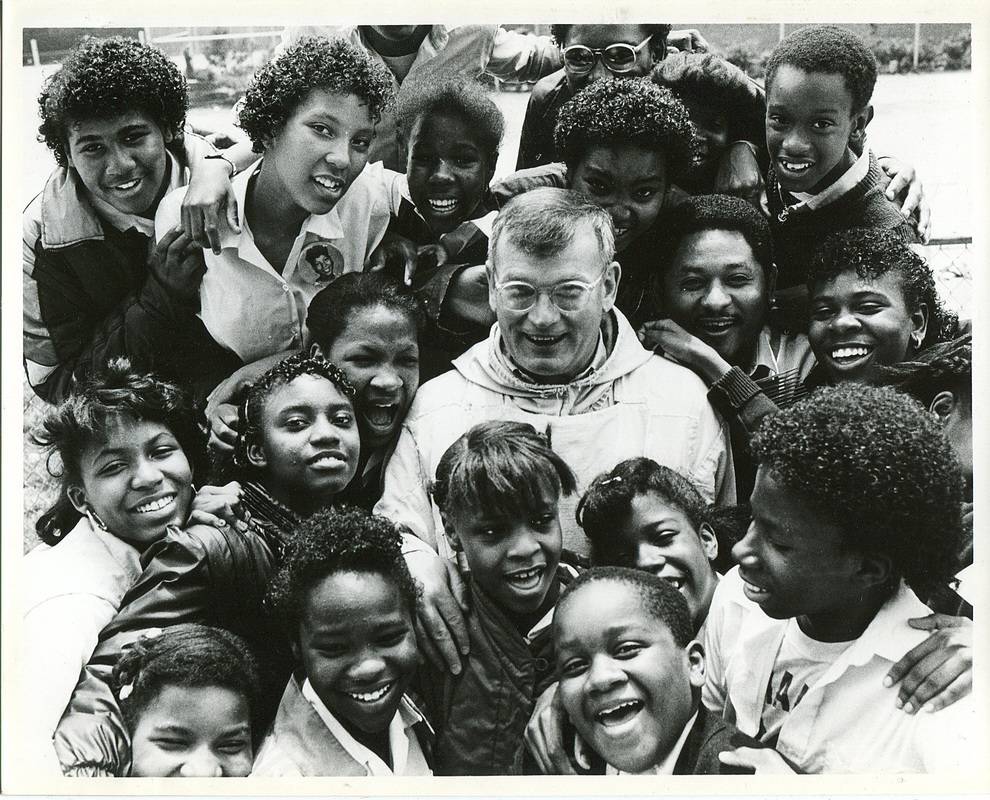
Brother Bill posing with youth for a group photo in Chicago.
As we move into the third decade of the 21st century—inhabiting a compromised biosphere, dependent on a precarious economic system, governed by political leaders with vision dimmer than that of a rhinoceros, and praying that nuclear weaponry is never used, on purpose or by accident—the next decision each person makes, the next action each one takes, and every decision and action thereafter, carries escalating consequences. Recognition of this reality requires high self-awareness. Listening is one way of elevating self-awareness. What would happen if the Voice were to broadcast the message: “Be still”? A global and massive response to that simple instruction could create an existential opportunity. I also wonder if the Voice may be bidding listeners of all ages to act benevolently, nonviolently, peacefully—and more creatively, more extraordinarily, and more radically. Even with the stakes so high and with relatively little time to effect sweeping change, I keep a tenacious grip on hope, holding on largely because of the energy and enthusiasm of young people and the Voice who speaks—in the past, to Socrates, to Jesus’s disciples, to Gandhi, to Mother Teresa, and more recently to Brother Bill and Dr. Jane Goodall.
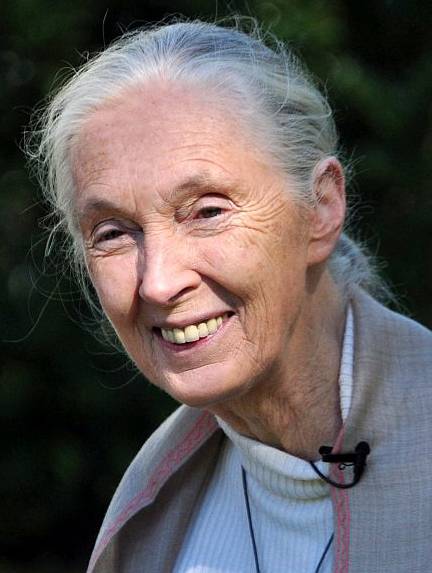
Dr. Jane Goodall on her 80th birthday.
Endnotes
https://scrapsfromtheloft.com/2017/04/06/george-carlin-jamming-new-york-1992-full-transcript/
https://www.youtube.com/watch?v=i9CjBtv7j78
https://www.youtube.com/watch?v=USo8sHqfEHo
https://artflsrv03.uchicago.edu/philologic4/montessaisvilley/navigate/1/5/3/
https://content.time.com/time/magazine/article/0,9171,138995,00.html
In the last two years across the US, extreme weather linked to climate change has left thousands dead and cost tens of billions of dollars, disproportionately impacting the elderly, children, the poor, and people of color. By all scientific accounts, it’s going to get worse. How much worse depends entirely on the rate and extent to which we are willing to embrace rapid and far-reaching changes across society.
Global leaders are meeting in Poland this week to resume climate negotiations. The 24th Council of the Parties (COP24) comes less than two weeks after the release of the US Government’s Fourth National Climate Assessment — ironically released on Black Friday, a day when American overconsumption is at an all-time high. The report issued some harsh news about the extent to which Americans are already experiencing devastating human, ecological, and economic impacts of climate change, It warns of more devastating health impacts and catastrophic economic losses to come if action is not taken.
The Southeastern region of the US — the world’s largest wood-producing region where logging rates are four times greater than South American rainforests — is expected to be among the hardest hit by climate change in the coming years. Yet, as climate science points to an urgent need to protect more forests, the US forest industry — the largest in the world — and government are promoting more, not less, destructive industrial logging and consumption of wood products.
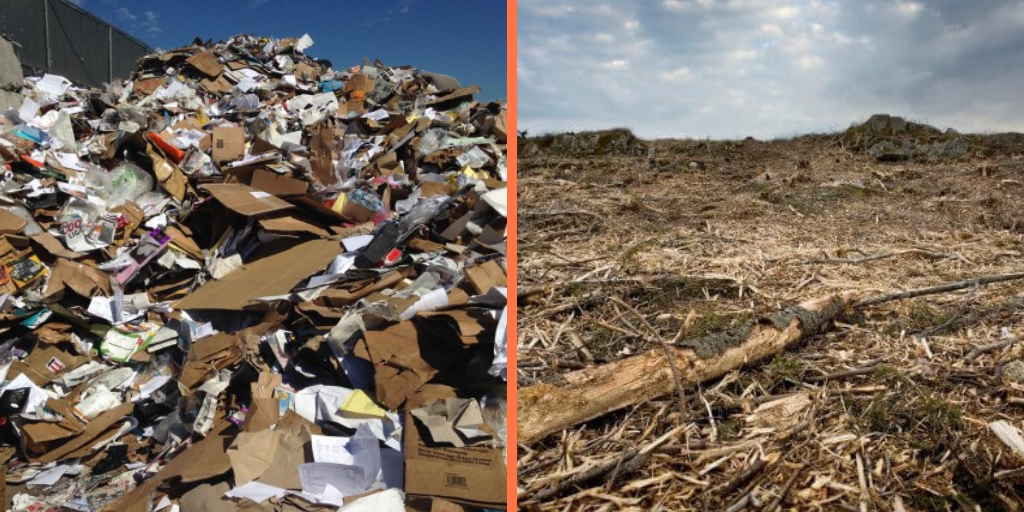
A mountain of paper waste (left), a clearcut southern forest (right).
In October, an IPCC report was released detailing the latest analysis of what can be done to limit temperature increases to 1.5 degrees by the end of the century and calling for “rapid and far-reaching transitions” across all industrial sectors, including the land sector. Forests, which release carbon when cleared but actively absorb carbon as they grow, have become central in the global conversations about climate solutions. In fact, forests are expected to be a major topic of conversation at COP24 in Poland this month.
Some will debate whether or not forest protection should be used to offset fossil fuel emissions. But that is a red herring. We must both rapidly reduce emissions from fossil fuels AND protect forests. One without the other is a recipe for failure.
With the latest IPCC report underscoring the critical role forests must play as a solution, we can no longer avoid confronting and addressing the climate impacts of the US forest industry. Though US forests often get sidestepped in the global discussion about climate action, it’s vital that the world’s largest wood-producing and consuming nation be held accountable for its climate impacts. It’s as important to transform forest management in the US as it is elsewhere in the world.
The IPCC report sets forth three major strategies that underscore the urgent need to keep vastly more of America’s forests standing:
First, we must drastically cut carbon emissions. Yet, when forests are logged, carbon that would otherwise be stored in the forest is emitted into the atmosphere instead. Though these emissions are significant, they remain largely unreported. Recent scientific reports are shedding a light on this problem, including an Oregon State University analysis documenting that emissions from the forestry sector in their state exceed that of the fossil fuel industry. The US Forest Service has also acknowledged that “timber harvesting, and not land use change or fire, was the largest source of gross emissions from US forests between 2006 and 2010.” The US must account and set targets for reducing emissions from logging.
Second, we must actively remove carbon dioxide from the atmosphere. The IPCC report highlights significant risks and land impacts associated with Bioenergy Carbon Capture and Storage (BECCS) — a technology that relies on burning trees for electricity and capturing the carbon emissions. Attempts to develop this kind of carbon capture and storage technology have thus far been too costly and failed to work effectively. We don’t need this expensive, unproven technology to solve the problem. Instead we can let forests grow, storing carbon currently in the atmosphere back on the land.

Mature wetland forests like this one are best at storing carbon and protecting local communities from flooding.
As forests grow, their capacity to capture and store carbon accelerates. The older a tree, the better job it does at absorbing carbon. Rather than planting new forests, we can remove far more carbon from the atmosphere over the next decade by allowing degraded natural forests to grow older. With a short window to affect change, letting existing natural forests grow must become a top priority. We must both stop the loss of and curtail industrial logging in natural forests.
Due to a combination of forest loss and industrial logging practices that have replaced old, intact forests with a patchwork of industrial pine plantations, clearcuts, and degraded natural forests, US forests currently store only 40% of the carbon they once did. Forest carbon stocks in the Southeastern region are currently among the lowest in the world. However, a new report published in Nature in 2017 documents that this region’s forest carbon stocks could be among the highest in the world if forests were allowed to grow.
Third, by protecting and restoring the connectivity and intactness of natural forests, we can optimize natural flood control, stabilize fresh water supplies, and turn up the Earth’s natural air conditioning system. At a time when floods, droughts, and heat waves are getting more intense, we need to be doing everything we can to restore intactness and connectivity across natural forests to protect human life and mitigate economic losses.
According to recent maps produced by the World Resources Institute, most major watersheds across the coastal plain of the US South are at “high risk” due to “recent forest cover loss.” Satellite imagery analysis conducted by the University of Maryland documents that”intensive forest management” aka logging is driving this forest cover loss.
Too few realize the persistent and pervasive poverty that exists in many of the most heavily logged areas of the US. Logging has not created sustainable or equitable economic conditions in rural communities.
As the IPCC report points out, strategies that focus on restoring degraded forests and the natural benefits they provide are also the most consistent with considering ethics and equity in helping the low income and vulnerable better cope with a changing climate. As we transition the economy to build resilient natural landscapes through forest protection and restoration, we can and must create a more diversified economy that works for more people. Creating equity in the economy improves poor and marginalized communities’ ability to withstand the harsh impacts of climate change.
Instead of embracing innovative transformation, the US continues to deflect attention away from logging as a climate problem, insisting that the biggest threat to forests is “deforestation” — the loss to urban development and agriculture — and that markets for wood help ensure that we “keep forests in forests.” Over a hundred wood product companies, forestry schools, forestry agencies and associations recently joined forces to deliver this decades-old message in a communications effort branded #forestproud. They assert that the production and consumption of wood is not a climate problem but rather a solution, so it’s best for everyone if we keep on consuming more and more wood products.
This old narrative comes in the wake of recent data documenting that logging is the single largest driver of forest carbon loss from US forests, releasing five times the annual amount of carbon loss from development or agriculture and fire combined. Yet, industry continues to perpetuate the misleading idea that forests are a “renewable resource” and that as long as we can continue to have forests that produce consumer products (regardless of the condition of the forests), our forests are “sustainable.” A case in point is the emergence of a rapidly expanding new wood pellet export market, guised as “renewable energy.”
Hundreds of scientists have warned that burning wood to generate electricity releases more carbon than coal per unit of electricity generated and further degrades forest carbon sinks, but the expansion of wood pellet production across the Southern US continues. Enviva, the world’s largest wood pellet exporter is currently planning ongoing expansions in poor, rural communities of color in North Carolina. These communities already live among the highest logging rates in the world, suffer some of the highest poverty rates in the nation, and are now suffering from some of the worst flooding from climate change.

A wetland clearcut traced directly to Enviva (left) and Enviva’s wood pellet manufacturing facility in Ahoskie, NC (right).
Meanwhile independent science is increasingly clear. Industrial logging has significantly compromised US forests’ ability to provide critical life-supporting services and to remove carbon from the atmosphere and store it on the land. Policy makers must acknowledge the big financial stake that the US forest industry has in protecting the status quo and must embrace leading-edge, independent forest and climate change science. New policies must be enacted that drive rapid and far-reaching transformation in the forestry sector of the US economy.
We must limit (not expand) the industrial-scale logging of forests so that we can expand forest carbon sinks while restoring natural protections against extreme weather events. While we do need some wood products, we can no longer afford wasteful, one-time use forest products any more than we can afford to continue to consume wasteful, one-time use plastics. Turning forests into fuel is a false solution that must be stopped. While ambitious, if we work together, we can expand the protection and restoration of natural forests in the US.
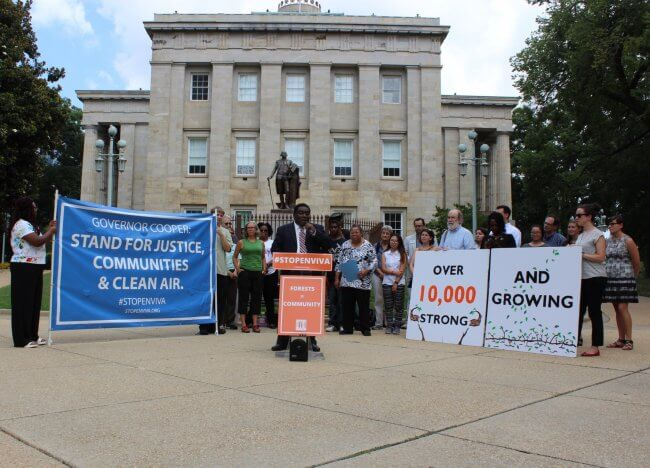
A growing, diverse movement is calling for forest protection across the US.
The IPCC report warns of challenging times ahead, an immense amount of work to transition industry, and a short 12 year time-frame for achieving results. Transformation is possible, but it cannot happen in the timeframe necessary to avoid catastrophe if the forest industry continues to resist the need to let vastly more of America’s forests grow. But, the good news is that there is a strong, growing and diverse national movement working to protect US forests as a climate solution. From stopping the use of wood pellets for electricity to scaling up the protection of wetland forests for flood control, forest protection is becoming a central part of the climate conversation in the US. Here in the US we can adopt feasible forest-based climate strategies, such as those set forth in a recent Climate Land Ambition Rights Alliance report.
MEDIA RELEASE | For Immediate Release
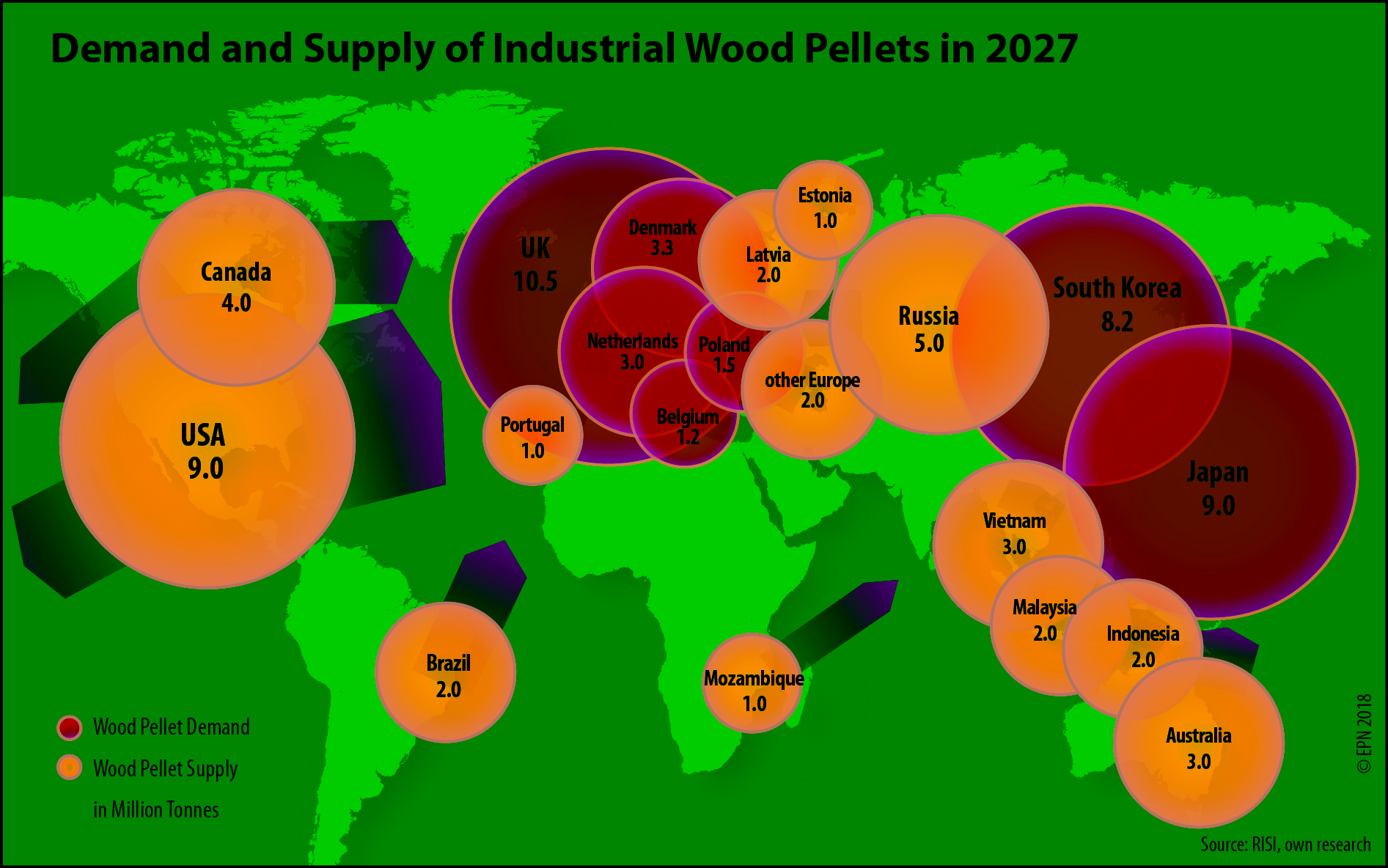
(November 29, 2018) – There is a new and growing threat to the world’s forests, people and climate: the biomass energy industry, touted as a ‘renewable’ energy. The use of forest biomass as a source of ‘green energy’ is set to increase by a staggering 250% over the next decade, having already doubled in the previous ten years, according to research published today by the Environmental Paper Network (EPN). The growth is being encouraged despite scientists discrediting the climate benefits and civil society raising alarms about the threat it poses to the world’s forests and their inhabitants.
The EPN’s new report “Are Forests the New Coal? A Global Threat Map of Biomass Energy Development” finds that Japan and South Korea are emerging centers for forest biomass energy consumption. They are emulating European policies which subsidize the burning of wood for energy, but fail to count the resulting smokestack carbon emissions.
“Countries at the upcoming UN Climate Conference need to urgently fix the broken policies which escalate logging and the burning of forests. They need to ensure that the Paris Agreement rule book closes the loopholes which allow the huge emissions from wood combustion to go unaccounted,” said Ms. Peg Putt, Coordinator of the EPN’s Working Group on Forests, Climate and Biomass.
Despite the controversies, bioenergy dominates ‘renewable’ energy production in the Organization for Economic Cooperation and Development (OECD), dwarfing wind and solar and soaking up subsidies that should be applied to these genuinely low emissions technologies. Although burning wood is more emissive than burning coal per unit of energy produced, flawed carbon accounting methods set the emissions from wood burning at zero in the energy sector. This has spurred massive expansion.
The majority of feedstock for the increasing wood pellet market will come direct from the tropical, temperate and boreal forests of developed and developing countries alike. That is, forests of South-East Asia and Africa, the US, Europe and Australia, plus Russia and Canada. It cannot and will not be predominantly supplied from sawmill residues, as frequently and misleadingly stated.
“Here in the US South, Enviva, the world largest producer of wood pellets, is aggressively attempting to expand at the expense of natural forests and the long-term economic health of our rural communities.” said Rita Frost, Campaigns Manager at Dogwood Alliance. “As the new EPN report details, the US South is already bearing an immense burden from the wood pellet industry. If companies like Enviva are allowed to continue to expand, global efforts to address climate change are put at serious risk.”
“The runaway expansion of wood-fired energy generation is already damaging natural forests, the climate, forest communities and those living near production facilities. We used published statistics and the industry’s own predictions to figure out how much bigger the threat is going to get. The research showed that the scale of the sector’s planned growth is genuinely frightening, expanding to two and a half times as big as it is now over the next ten years,” said Ms. Putt.
“At a time when protecting our forests and their vast stores of carbon is a global necessity, the biomass industry is relentlessly trying to expand. The European Union is embracing flawed policies that mistakenly class forest biomass as carbon neutral, and 22 million tonnes of wood pellets are consumed in the EU each year. The biomass boom has to stop before it’s too late for forests, people, and the climate”, said Katja Garson, Forest and Climate Campaigner at Fern.
The Threat Map report should be read together with ‘The Biomass Delusion”, a position statement by more than 130 non-government groups released last month, which highlights the delusions driving the exponential growth of bioenergy: the idea that forest biomass energy is carbon neutral, and that it can be supplied without tearing down more forests.
“We are witnessing a false solution that increases emissions and puts forests on the chopping block. Even the industry says they’re not sure where all the wood will come from” said Ms. Putt.
“The Intergovernmental Panel on Climate Change is clear that to tackle climate change we have to urgently protect and restore forests. Subsidizing bioenergy increases deforestation and forest degradation and takes money away from low emissions technology like wind and solar. Even if damaged forests are allowed to grow back, it will happen way too late to reduce the climate disaster”, added Ms. Garson.
“To effectively address climate change there is only one solution: go beyond the burning economy,” Ms. Putt concluded.
Contact:
Peg Putt, Environmental Paper Network: +61 418 127 580 / [email protected]
Katja Garson, Forest and Climate Campaigner, Fern: +32 (0)2 894 46 90 / [email protected]
Scot Quaranda, Dogwood Alliance: +1 828 242 3596 / [email protected]


 Donate