


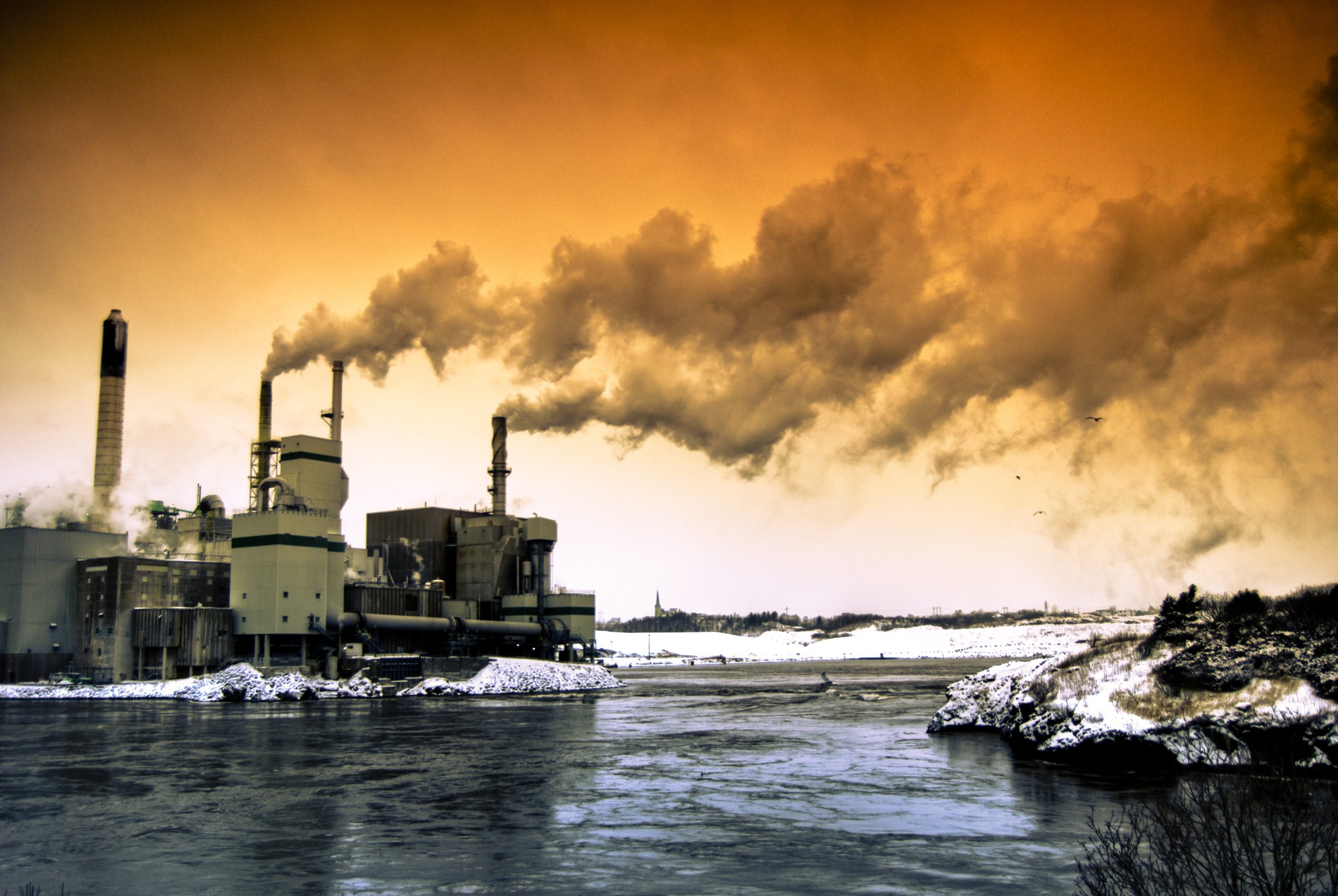
Yesterday, Chatham House, a well-respected research organization in the UK released a new report revealing that EU renewable energy policy is flawed when it comes the assumption that burning wood for electricity is carbon neutral. The report, Woody Biomass for Power and Heat: Impacts on the Global Climate, shows that in most cases producing power from trees is actually increasing carbon emissions instead of reducing emissions. The report also takes aim at the billions in subsidies that have been and are being provided to the biopower industry. Dogwood has been leading on this issue through the Our Forests Aren’t Fuel Campaign and is working with frontline communities, progressive elected officials, allies and concerned citizens like you to push back the growth of this industry.
While Dogwood Alliance and a range of environmental organizations in the US and the EU have been sounding the alarm on this issue for a number of years, it is heartening to see a credible and well-respected research institution make it plain. Let’s hope that policymakers listen to the science, focus on real solutions, and do more to protect forests globally as standing forests are one of the best solutions we have for addressing climate change.
“Most wood energy schemes are a disaster for climate change” (BBC)“The EUs Renewable Energy Policy is making global warming worse” (New Scientist)“UK Claim that burning biomass is clean seen as flawed” (Washington Post/Bloomberg)
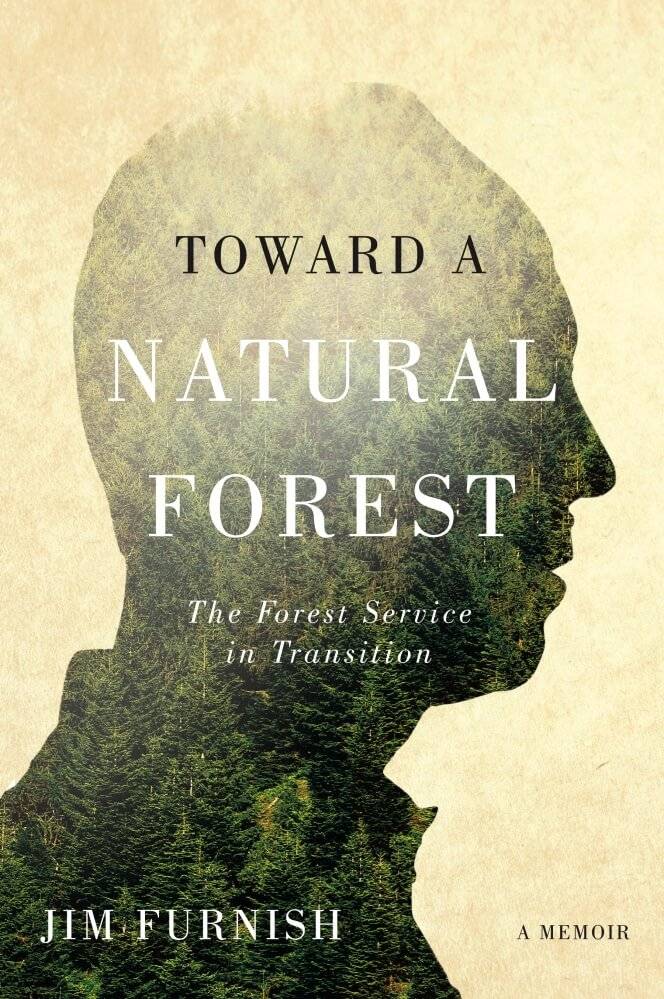
Recently, Dogwood Alliance, Defenders of Wildlife and MountainTrue hosted an event at The Collider in Asheville about the future of our forests. We were so lucky to have Jim Furnish, the former Deputy Chief of the US Forest Service, join us for that event. Jim Furnish is also the author of Toward a Natural Forest: The Forest Service in Transition, memoir of Jim’s time working for the National Forest Service.
One story is that of the Forest Service with the dawning of the environmental era along with their glacial response to change and the other is his own story, that of a dyed-in-the-wool logging forester transformed into an environmental agent of change within the agency.
After World War II, the Forest Service became a booming logging industry. Jim says that despite the rational and justifiable reasoning for the logging, “The consequences became more and more abundantly clear, and the push back from the environmental community began.” In response, the agency reared up, opposed, and defended their practices. He says, “They did not engage in a meaningful way with that opposition to craft a different future.” This inability to work together lead to a crashing halt in the early 90s with the Spotted Owl Controversy in the Pacific Northwest.
What Jim referred to as “friendly conversation” wasn’t working for the NGO communities, so they turned to the courts. Using a clause in the National Forest Management Act that made the Forest Service responsible for vertebrate mammals, the communities cited the continued clearcut logging of old-growth spotted owl habitat as directly causing the precipitous decline of spotted-owls and threatening their tenuous existence. This was a legal battle that went on for years until finally federal judge William Dwyer issued a scathing rebuke of the Forest Service, declaring that agency leaders had willfully violated the law. Jim says,
“That’s tough. When your duty as a public servant is to uphold the law, to be found guilty of violating the law. It was huge. So the judge halted all further logging of spotted owl habitat and the whole house of cards just came crashing down.”
Meanwhile, Jim had just been assigned to the Siuslaw National Forest on the Oregon coast. He says,
“The Siuslaw National Forest, which was a logging national forest, was like a popped balloon. We had to really start fresh. We stopped the old way of doing business, which was clearcutting old Douglas Fir and completely retooled our program to be more environmentally conscientious and friendly toward owls and salmon and other old growth associated species.”
After 8 years at the Siuslaw National Forest, Jim moved on to the Forest Service’s National Headquarters in Washington, DC where he served as Deputy Chief for all National Forests of the United States.
After Jim retired from the Forest Service, he worked in Forest Stewardship Council (FSC) certification and as a consultant for environmental NGO’s. Jim’s brother-in-law encouraged him to write about his time working as a National Forest Service employee. Toward a Natural Forest is dedicated to that same brother-in-law, Bill Ford, who believed in Jim’s writing and his story.
He loves events like the one put on by Dogwood Alliance, Defenders of Wildlife, and MountainTrue that give people an opportunity to think and talk about the future of our forests. Jim says,
“My thanks to Dogwood Alliance and the other sponsors for creating this event for people around the area to hear what I hope was a lively discussion. What does the future of our forest hold? In my view, forests are so important, not only for products, but also for the services, the environmental services they provide, and we need to be thoughtful about this.”
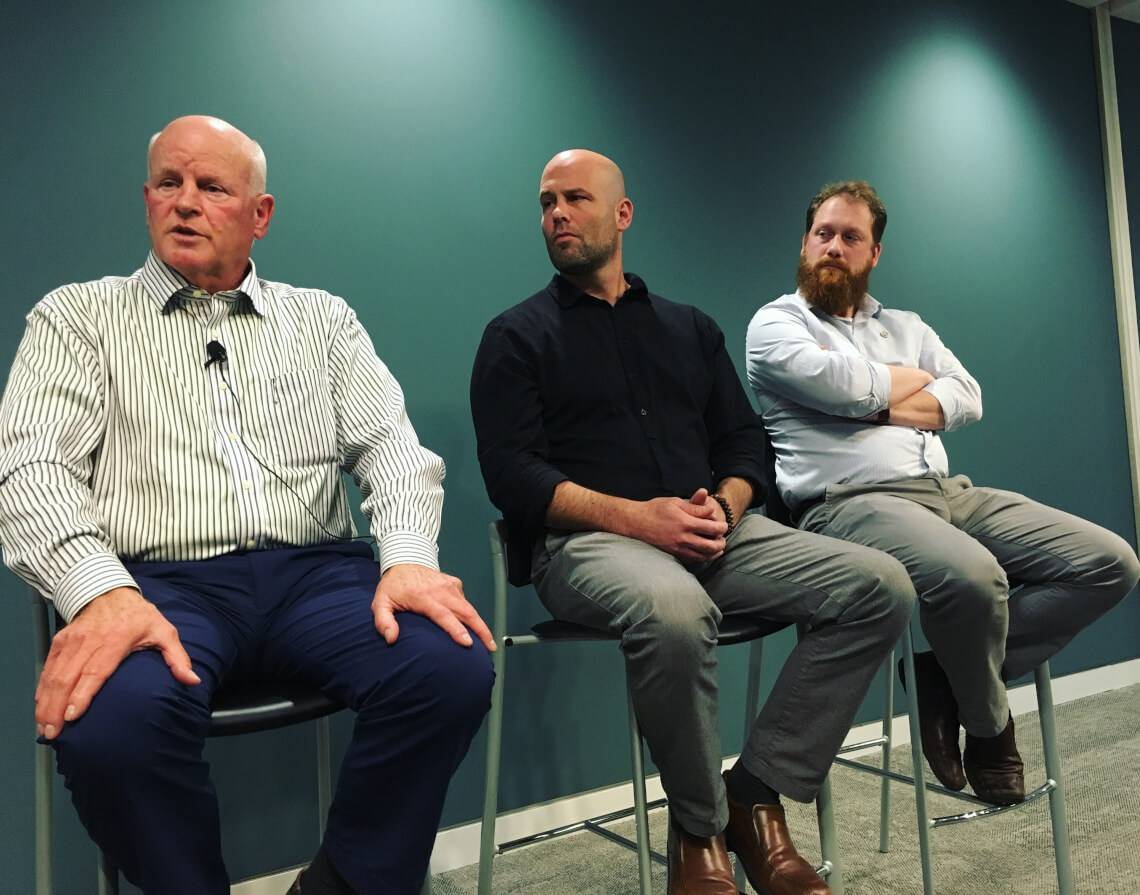
Jim Furnish, Tyson Miller from Dogwood Alliance and Ben Prater from Defenders of Wildlife.
At the closing of the year, as folks gathered around loved ones to sing carols and roast chestnuts, Enviva geared up to export more precious Southern Forests to burn in European smokestacks. On December 22, 2016, Enviva’s Wilmington Export Terminal sent their first shipment of wood pellets abroad. This news has been portrayed as purely a success for the environment, economy, and people of the region.
Captain John Wolfe, a writer, and activist in Wilmington, said most poignantly, “Forests give us scale, teach us we are finite. We scarcely realize how much we need wildness until we lose it. When that happens, we are truly lost.”
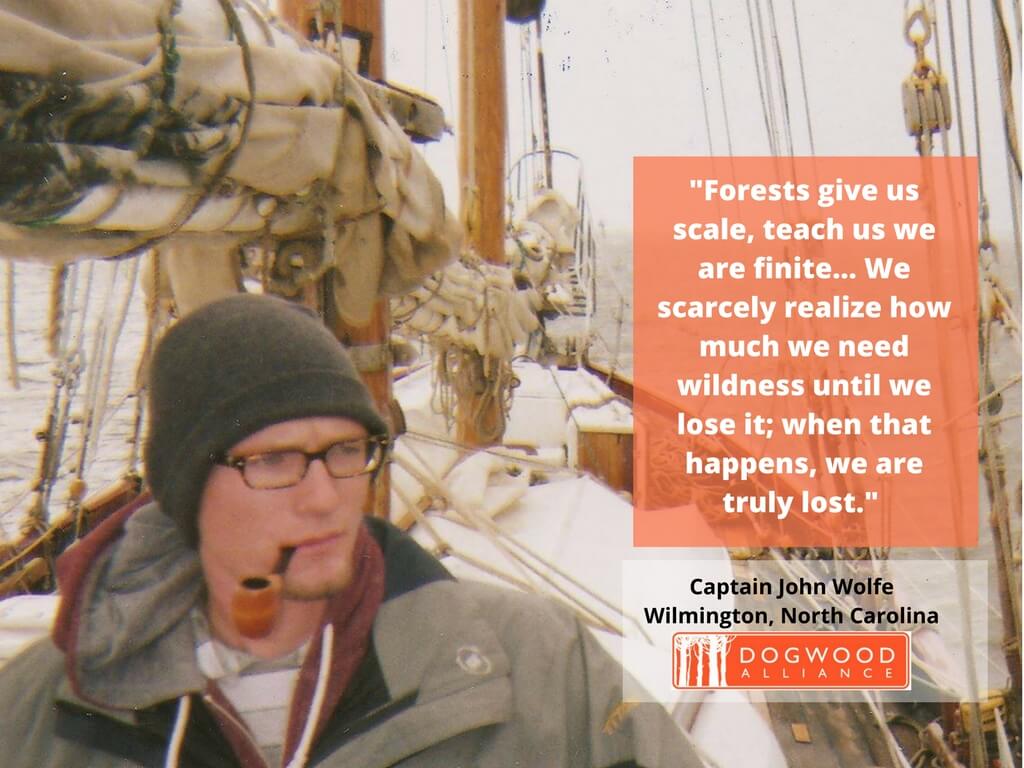
Captain John Wolfe
Right around the holidays, Enviva sent about 50,000 metric tons of wood pellets to the UK on the first shipload. Instead of celebrating this, Southerners like Ashli Thomas see these wood pellet ships not as a vessel but instead as “miles of clearcuts I know happened. It’s a feeling of loss.”
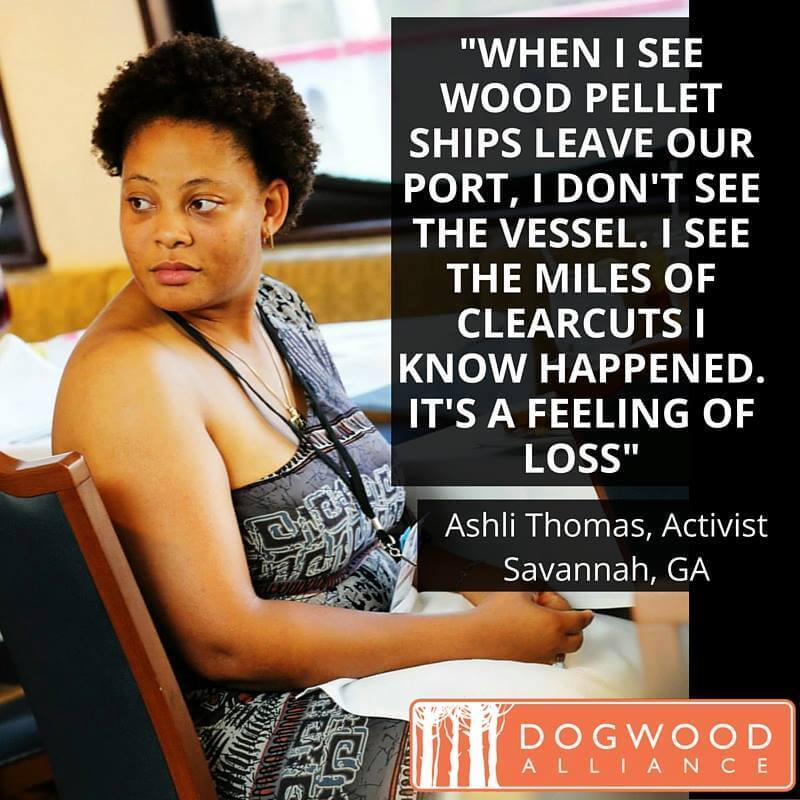
Southerners to Enviva: Stop Exporting our forests!
One Enviva shipload is nearly 850 acres of chopped down Southern forests. Those acres include critical habitat for species like migratory birds such as ducks, whitetail deer, rabbit, and diverse amphibian species. Without those forests standing, the species cannot live there. Without those forests standing, Southern outdoorsmen have less recreation areas where they can hunt, fish, explore, and hike. On a local level, Enviva claims that the wood pellet exports are safe: “It has very little dust.” However, we know both scientifically and anecdotally that wood pellets at export facilities are detrimental to the health of the surrounding community. Henry Lawrence, a Southerner who lives near Enviva’s Panama City export city told us, “When you sit down by the port and watch Enviva load its wood pellets, you notice wood dust flying everywhere. It gets in your nose, it gets in your eyes, it makes you start coughing. It’s not safe to breathe.”
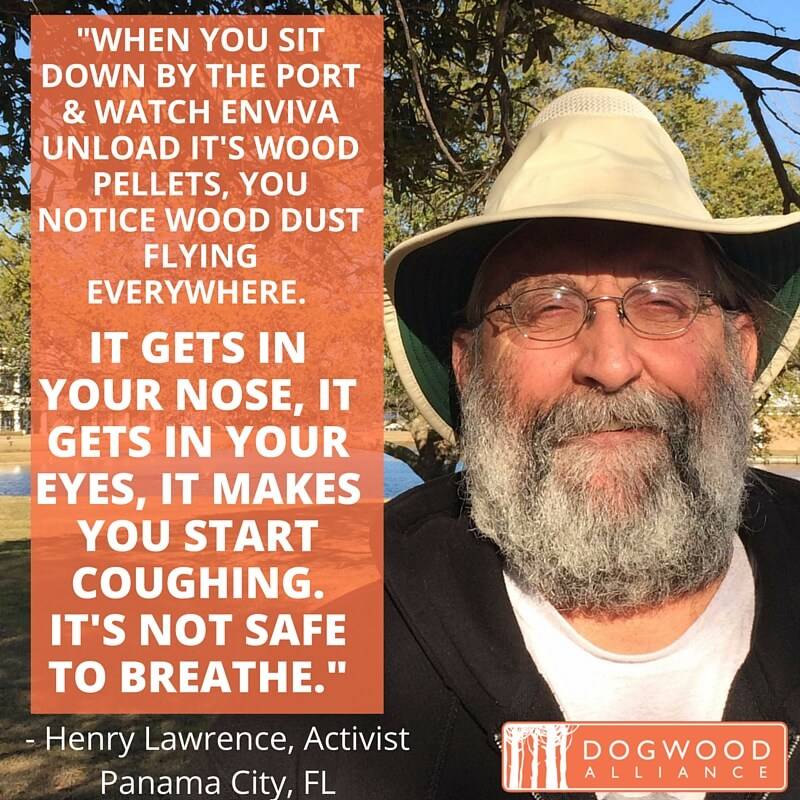
Henry Lawrence discusses wood dost
The American Heart Association warns, “Short-term exposure to small particulate matter can trigger cardiovascular-disease, mortality, and illness; long-term exposure reduces life expectancy up to a few years.” Churning Southern forests into wood pellets to be exported turns transforms from the lungs of the earth into breathing hazards.Shockingly, Enviva claims that the wood pellets shipped from Wilmington are “made from low-grade wood fiber, wood with size defects, disease or pest-infestation that would render it unusable by lumber industries.” Dogwood Alliance has documented Enviva clear-cutting whole trees and wetlands on several occasions– especially in this region of the South.
Whether it’s hurricanes, flooding, storm surges, or drought, forests play a vital role in the protection of lives and livelihoods. Given that continued unchecked logging and fossil fuel emissions are to blame for 2 out of the 5 world’s most expensive natural disasters in 2016, it’s time that Enviva stop this greenwashing.
Enviva and the biomass industry are just modern day examples of a wealthy interest taking as much and as often from the land as they want with little regard to economic development, long-term environmental sustainability, or representing communities’ interests. Reverend Leo Woodberry, a community member in Richmond County, NC, where Enviva hopes to build another wood pellet plant to help feed the Wilmington export terminal commented “Just as slaves in the South were exploited to meet the needs of European textiles mills and traders, the same monied interests are exploiting our forests to meet Europe’s energy needs hundreds of years later. And instead of suffering the slave masters lash, we all must suffer health risks, weather disasters, and the impacts of climate change.”
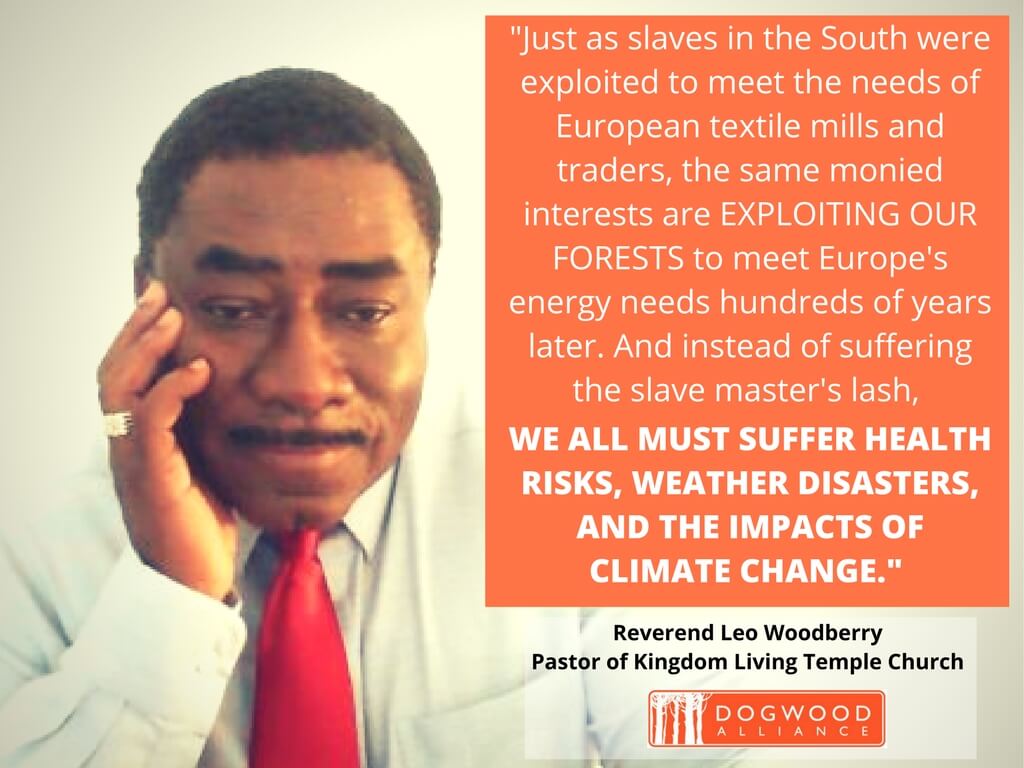
Reverend Leo Woodberry speaking on suffering
No matter what Enviva or the biomass industry report as a “positive” about the new export terminal, Dogwood Alliance stands by Southerners who believe that biomass harms their communities, the environment, public health, and the climate.
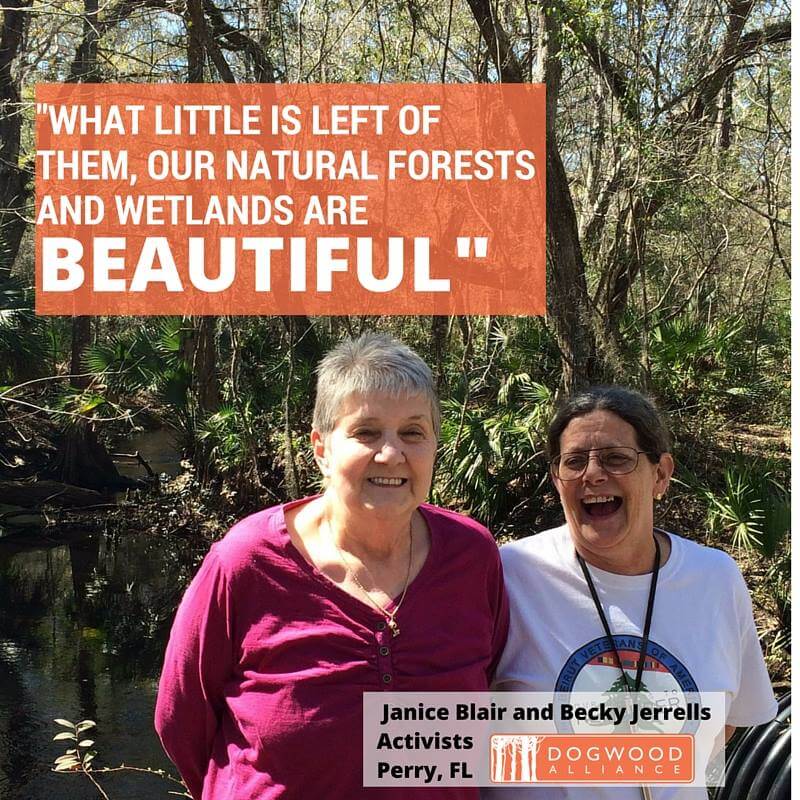
Becky And Janice Stand for Forests
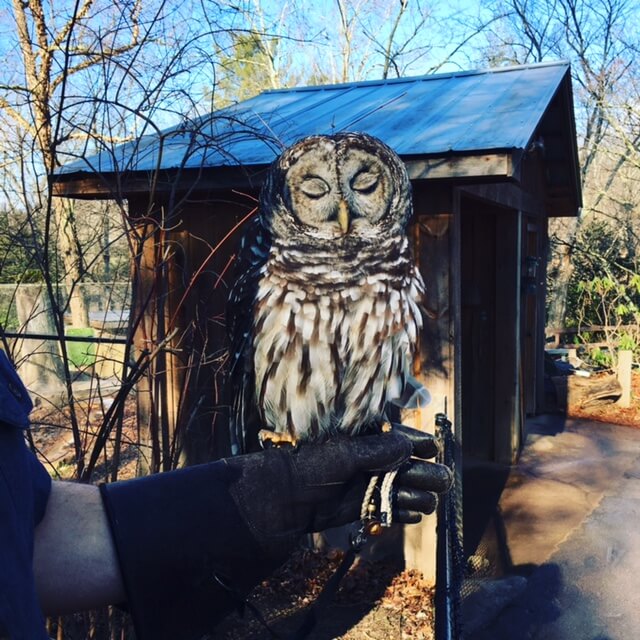
We have had some marvelous #ForestFriday guests so far, but Art is our very first Feathered Forest Friday Friend! We took a trip to the WNC Nature Center to visit this fine fellow. Pearson King, who you may remember from a previous #ForestFriday, is a volunteer at the WNC Nature Center and offered to facilitate the meeting. I was apprehensive about how the day was going to go because I had tried to get an audience with Art before, but during my last visit, he lost his balance and thus, his mood for visitors. You see, Art the Barred Owl was hit by a car and lost quite a bit of his left wing, which left him unable to fly. As a result, he’s been at the WNC Nature Center for the last 17 years.
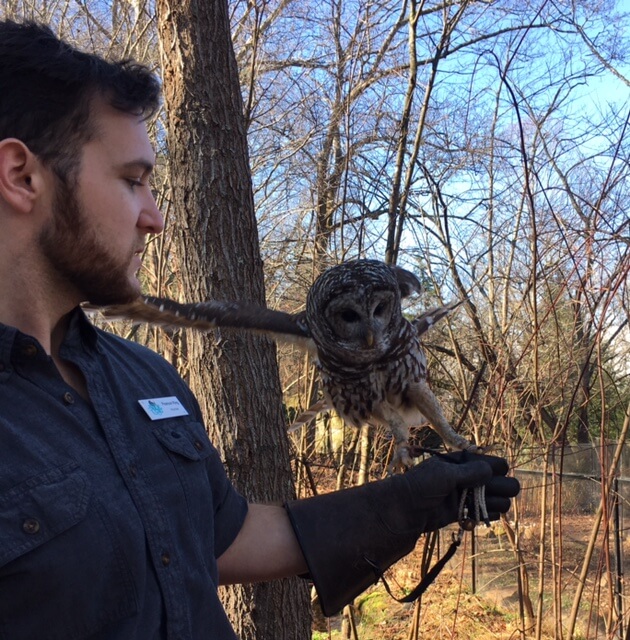
Art show us his current wingspan. As you can see, one side is much larger than the other.
Have you ever driven along the highway eating an apple and thought to yourself, “I’ll just toss this out the window; it’s biodegradable, so it will decompose”?
While it may be biodegradable, it is also a tasty, alluring treat for small prey like mice, who then attract larger prey like Art who don’t know the rules of the road and are only focused on their natural instinct to hunt their prey.
Art is quite a handsome guy, I was not ashamed to tell him at all! If Art’s wing wasn’t compromised, he would also fly soundlessly and gracefully through the air. True to his name, Art has what look like bars across his chest and his sweet owl call goes, “Who? Who cooks for you? Who cooks for you-all?” It is just the most charming owl call, don’t you think? He’s got deep, dark brown eyes that really size you up. Barred owls have nictitating membranes, which are translucent third eyelids that provide moisture and protection to their eyes from dust, debris, and retaliation from prey. Because they can see through the membrane, the membrane comes down when they are attacking their prey as a protective barrier. Otters also have nictitating membranes and so do sharks. Barred owls’ eyes are also immobile. To make up for this, owls can rotate their heads 270 degrees!
Art’s kind likes to nest in old-growth trees which have been disturbed a great deal in the last decade. However, a lot of old growth trees are left alongside the highway to act as a sound barrier for residents, putting Barred Owls like Art in a very vulnerable position.
The WNC Nature Center offers info on how to build your own owl home for friends like Art, but we also found some information here.
Also, it is very important that you never throw any food items out of your car onto the side of the road, not even that old french fry that is months old, covered in dog hair, and virtually petrified. Thank you so much for reading about our #ForestFriday adventure, and remember to tune in next week for more forest fun!
FOR IMMEDIATE RELEASE: February 2, 2017New Initiative to Conserve Southern Wetland Forests Launched on World Wetlands DayPowerful Collaboration Brings Together Conservation Organizations, Communities, Landowners and Government Agencies to Conserve One of the Region’s Most Precious Natural ResourcesAsheville, NC – On World Wetlands Day, a diverse group of stakeholders have joined together to announce a major multi-state effort to conserve one of America’s most precious natural resources, wetland forests of the South. The Wetland Forest Initiative is a new, collaborative effort dedicated to conserving, restoring, and improving the condition of Southern wetland forests.
The initiative will work with landowners, communities, conservation organizations, and government agencies to create a future where there are abundant and healthy wetland forests for the benefit of local communities and native wildlife. A majority of wetland forests have been lost due to conversion to agriculture and real estate development in the last 300 years.
“Today we are excited to join with communities, landowners, government agencies, and conservation partners to shine a spotlight on the role that our forested wetlands play in protecting our coastal communities from the worst impacts of climate change and as a treasure to our region’s natural heritage,” said Danna Smith, Executive Director at Dogwood Alliance. “We all share the common belief that working together we can make these forests the next great conservation priority in the United States.”
Historically, wetland forests blanketed much of the Southern US. However, as the region continued to grow, wetlands and wetland forests were converted for other uses. As a result, a majority of the original wetland forests in the region have been lost. The wetland forests that remain are sometimes degraded so much that there is a great need for restoration in these areas.
Southern wetland forests are home to many threatened and endangered species which rely on these unique habitats to survive and reproduce. Many of the region’s intact wetland forests occur in the coastal plain. A world biodiversity hotspot, the Southeastern and Gulf Coastal Plains have nearly 600 animal and over 1800 plant species found nowhere else on earth.
Wetland forests provide critical “ecosystem services” — benefits to human communities that go beyond monetary value. For example, wetland forests provide twice the value in endangered species and wildlife habitat, pollution control, flood control, and water treatment than upland forest habitat (e.g., mixed pine and hardwoods). They are also significantly better at storing carbon, which helps to offset manmade carbon emissions and mitigate climate change.
“Wetland forest conservation and restoration is a no-regrets investment,” said Maria Whitehead, Senior Project Manager at the Open Space Institute. “In communities across the Southeast, the benefits derived in protecting these forests are significant in both impact and effectiveness—providing abundant and clean drinking water, serving as storm and flood barriers, and increasing natural areas for people and wildlife.”
The Wetland Forest Initiative will elevate wetland forests as a national conservation and restoration priority. Additionally, the collaboration plans to work with landowners, foresters, and others to help implement sound management practices on “working lands” — lands used for timber production, while also working with nearby communities to increase resilience, diversify economic opportunities and enhance quality of life.
The Wetland Forest Initiative is currently composed of a steering committee and several working groups, which include members from these organizations (alphabetical): American Forest Foundation, National Audubon Society, Black Family Land Trust, Carolina Wetlands Association, Clemson University, Defenders of Wildlife, Dogwood Alliance, Forest Stewards Guild, Gulf Restoration Network, Hip-Hop Caucus, Louisiana Department of Wildlife & Fisheries, National Wildlife Federation, National Woodland Owners’ Association, Natural Resources Defense Council, One Hundred Miles, Open Space Institute, Poarch Band of Creek Indians, Public Lab, Southern Group of State Foresters, University of Georgia, Wildlands Network, Wild South, and Wild Virginia.
For more information, visit: www.wetlandforests.org# # #Supporting Quotes:
“The Southeastern US represents one of the most biodiverse regions in world. The wetland forest habitats in this region support a dizzying array of wildlife including birds, amphibians, fish and freshwater mussels. Many of these species are at-risk and protecting wetland forests is the best way to ensure these species thrive.” – Ben Prater, Defenders of Wildlife
“It is exciting to be a part of such a diverse group of interests, all working together to ensure our southern wetland forests, many of which are working forests owned by private citizens, can continue to be sustainably managed. Conversion to development is the biggest threat to our southern wetland forests today, so the work of the WFI is going to be critical in supporting forest landowners.” – Tim Foley, Southern Group of State Foresters
“Conserving, restoring, and improving wetland forests benefits us all. Future generations are relying on us to provide clean air, clean water, and the chance to grow up surrounded by healthy ecosystems.” – Sam Davis, Dogwood Alliance
“Many of our highest priority bird species depend on wetland forests for their survival. Because of that linkage, we are working with landowners to make sure that their goals and priorities can be met, and to provide technical support to make those decisions and actions as good for birds and system health as possible.” – Curtis Smalling, Audubon North Carolina
“Wetlands are a valuable treasure in the Southeastern US. They are critical to our water quality, protecting property against flooding, protecting our coastline and the banks of rivers and streams as well as providing habitat to many unique and endemic species. Our economic and social wellbeing are enhanced by Forested Wetlands.” Rick Savage, Carolina Wetlands Association
“In the Gulf of Mexico region, not only do we love our wetland forests for hunting, fishing and their natural beauty, wetland forests are a matter of life and death when it comes to protecting our communities from flooding and hurricanes,” said Raleigh Hoke, Campaign Director at Gulf Restoration Network.
“Wetland Forests are an integral part of the southeast regions’ cultural heritage, they deliver important ecosystem services to local communities, provide critical habitat to a host of rare and imperiled species and are our best defense against climate change. The fate of these unique forests lies in our hands and we must work together to protect them for future generations.” Debbie Hammel, Land Markets Initiative Director at NRDC.
Contacts: Scot Quaranda, Dogwood Alliance, 828.242.3596, [email protected]
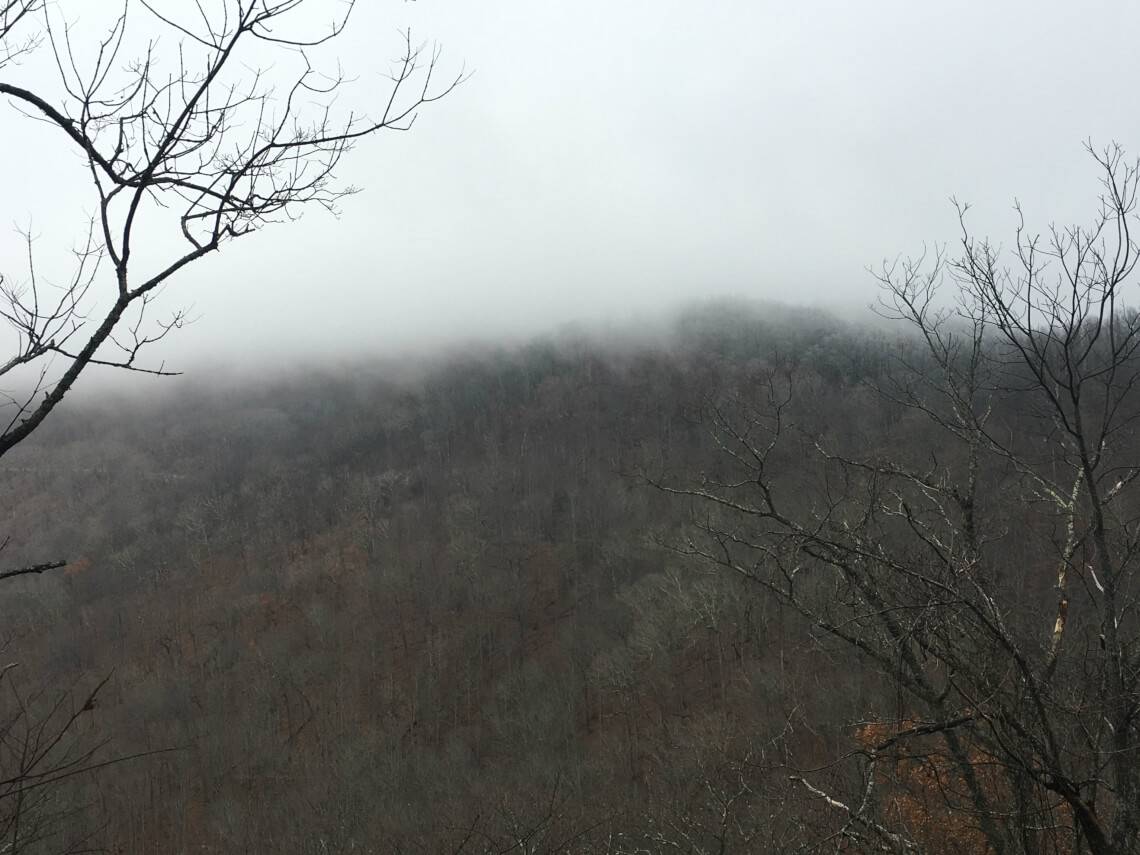
The air felt cold and sharp, and the sky was turning a milky white that blended into the fog, making the mountains vibrant with their red and brown leaves. This was my first time on this trail and my first time meeting Erin, a profound nature appreciator who embodies the practice of that appreciation at every level of her life. Erin also worked at Dogwood Alliance in its early days and created our first newsletter originally called, Understories.
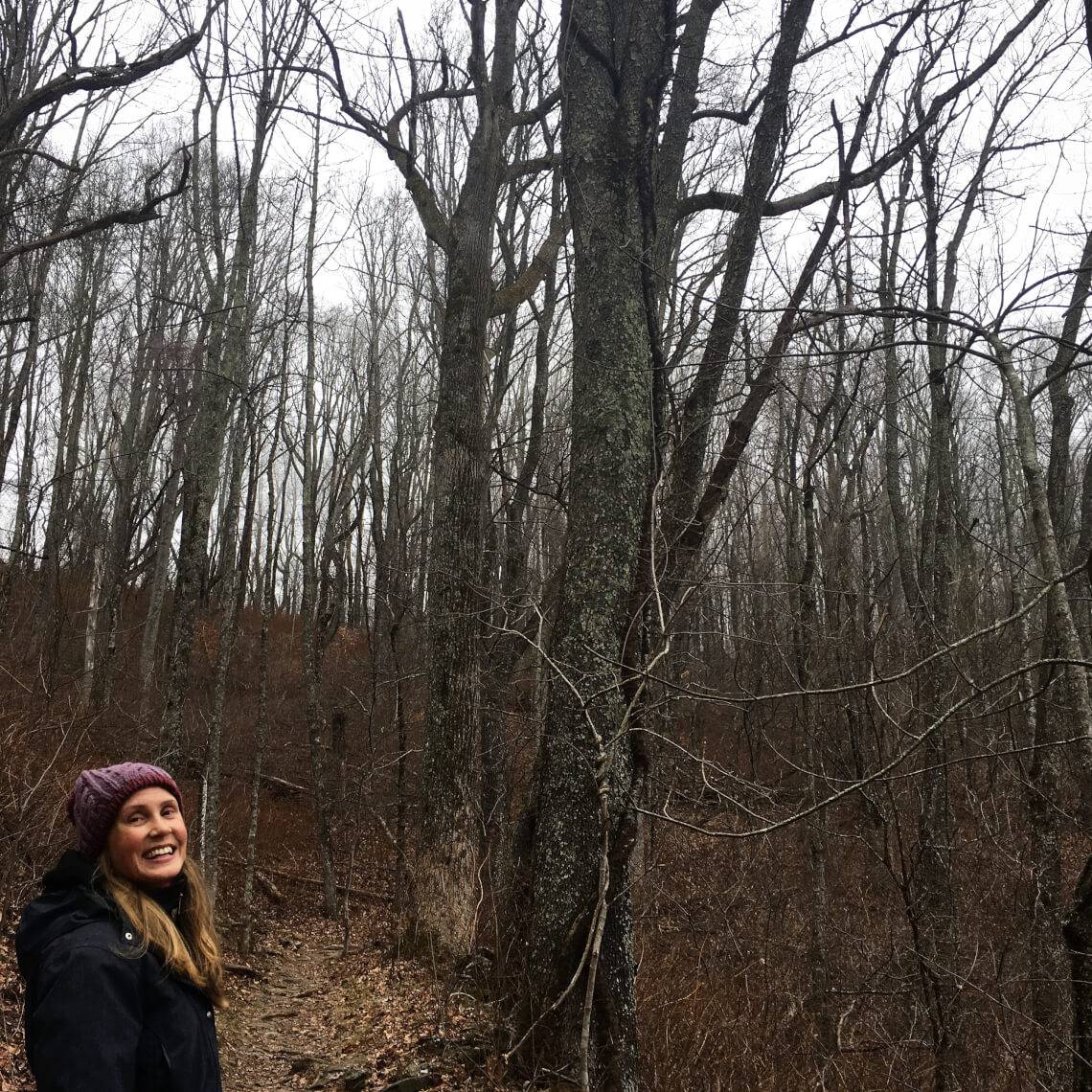
By the time we had set our feet on the trail, she had already told me how she originally became interested in aligning herself so intimately with the natural world. Erin went through a health crisis that she believes came from living near the paper mill in Canton, in Haywood County, NC, that, when she was growing up, was a major polluter in this region. The pollution caused her to become very sick. It got so bad that she was concerned she might become an invalid. She finally got better through natural medicine. During her recovery, she founded a publication called New Life Journal because she developed a real drive to have deep discussions with people about what we are doing to the world we live in and how to better live in good alignment with nature, the world, and each other.
Through her work with New Life Journal, Erin was able to focus on Indigenous wisdom and have conversations with Indigenous elders. In addition, she and her team published articles about about herbal healing, green building and community. She is currently part of the international Sacred Fire Community, a community that works with Indigenous elders to bring back some of the fundamental cultural principles, skills, and tools that all of our ancestors worked with and that modern humans have somewhat forgotten. Through this realignment with nature, Erin began to heal, going from barely walking and wearing a mask to reduce chemical exposure to returning to a normal, healthy state.
When we reached the top of our first ascent, there was a small parting of the trees through which we could see a mountain near us. The frost had advanced over the entire top of the mountain. The trees are blue and silver at their tops. We took a minute to breathe deep and appreciate it.
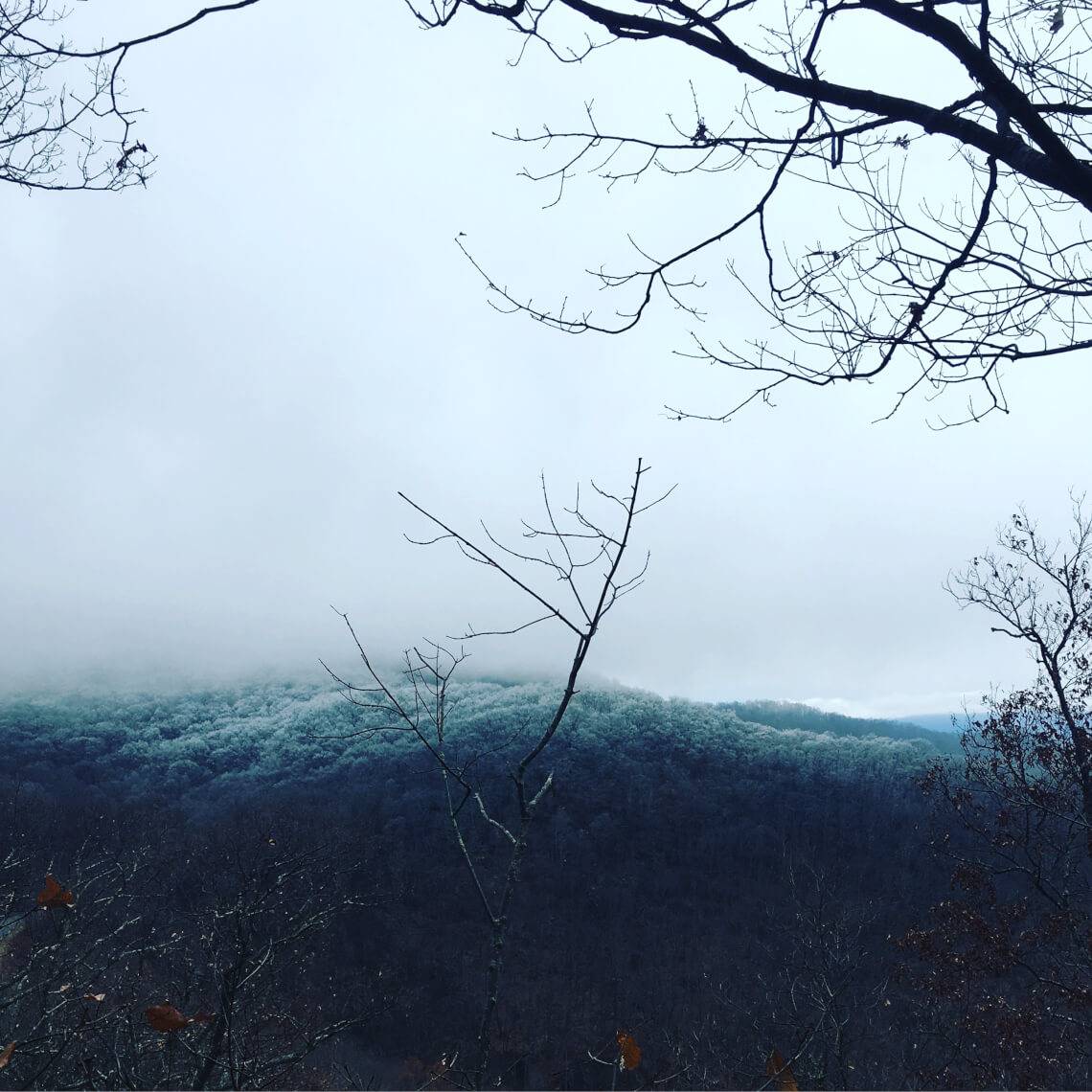
Erin showed me a tree near the ruins that was hit by lightning. It was massive, with a long coiling scar running the length of its trunk where the lightning struck it. There was a plaque and we read about Rattlesnake Lodge, which burned down in a fire alleged to be caused by lightning in 1926. I was struck by how much history was in these woods and how the fate of this great tree and this human lodge were the same.
We went a bit further than the ruins and found ourselves in the frostline. The forest was so magical! Every tree was coated with tiny, delicate ice crystals. Everything was sparkling and serene. We reached another small clearing, and Erin suggested we just take it in and stand silent for a moment. The wind was ripping through the trees in a soft whistle, and the branches of the trees were softly swaying and twinkling when they caught the light. I thought of something Erin had said on our hike,
“Standing Rock highlighted something about the aliveness of the world. The people at Standing Rock aren’t giving their lives for that land to be preserved just to help their people. They’re not doing it just because the land is a symbol. They’re also doing it because they really know and experience and feel in their bones that the land is alive and aware, and they have a relationship with it.”
I feel that aliveness and that relationship with these mountains in our beautiful North Carolina home, and in that moment standing and looking at the branches above me twisting around like arms draped in lace, I felt it for the forest and the trees.
For Immediate Release: December 21, 2016
Washington, D.C. – As the Obama Administration prepares to hand over the reins of the executive branch to President-elect Donald Trump, the DC-based Endangered Species Coalition released on Wednesday a “Top Ten” list of imperiled species in need of strong conservation measures. The report, “Removing the Walls to Recovery: Top 10 Species Priorities for a New Administration,” highlights some of the most significant threats to vanishing wildlife such as jaguars and elephants, and identifies important actions the next administration could take to slow their rates of extinction.
The report includes the rare bald-cypress which is threatened by logging, development, and conversion. Bald-cypress trees can live over a thousand years, yet many of the bald-cypress stands in the Southern US are less than fifty years old. Originally cleared for timber, cypress is now clearcut for mulch and wood pellets, the latter of which is driven by European demand.
Dogwood Alliance nominated bald-cypress for the report because preserving wetland forests in the South is essential for preserving communities in the region. Wetland forests containing bald-cypress provide nearly twice the value in flood control, species habitat, water quality, and pollution prevention than upland forests. Bald-cypress also creates essential habitat for migratory birds, songbirds, waterfowl, otters, alligators, fish, and invertebrates like crayfish and dragonflies.
“Bald-cypress is an iconic tree species whose future is threatened due to increased logging by the cypress mulch industry, and wood pellet companies that ship them overseas to be burned for electricity,” said Sam Davis, Research Director at Dogwood Alliance. “This species is incredibly valuable for the protection of our communities from the damaging impacts of climate change and as a last refuge for a large number of plants and animals. We hope the Trump administration will take action to protect them.”
Some of the species in the report, such as the Joshua tree and Elkhorn coral are foundational species, which play a critical role as building blocks for their ecosystems, but are threatened by global climate change.
Other critically important species in the report are keystone species, such as Hawaii’s yellow-faced bee, the jaguar, and the Snake River salmon. All keystone species have a disproportionately large impact on other species and ecosystems, relative to their abundance. For instance, Hawaii’s yellow-faced bee is a pollinator impacted by habitat loss.
The jaguar of the southwest United States is a keystone predator. It is particularly threatened by habitat fragmentation caused, in part, due to impenetrable immigration barriers along the U.S. – Mexican border. The report urges Mr. Trump to abandon plans to further fortify the southern border, and to make existing barriers more wildlife-friendly.
Snake River Chinook salmon, meanwhile, are among the longest and highest-migrating salmon on the planet – often swimming 1,000 miles upstream and climbing more than 6,000 feet in elevation to reach their spawning grounds. More than 130 other species depend upon salmon, including orcas, bears and eagles.
The U.S. Fish and Wildlife Service declined to list the greater sage grouse—an umbrella species—as endangered in 2014, citing an unprecedented region-wide habitat conservation effort, tied to state and federal conservation plans. However, several appropriations riders offered in Congress in 2016 would block implementation of these conservation plans, as well as any future Endangered Species Act protections for the imperiled bird. Meanwhile, grouse numbers have declined by 90 percent from historic levels. Protecting umbrella species like sage grouse conserves habitats on which many other species rely.
“Our native fish, plants and wildlife are critically valuable and part of the legacy we leave for future generations of Americans,” said Leda Huta, executive director of the Endangered Species Coalition. “We hope the next administration takes seriously its responsibility to protect endangered species and habitat. The fate of species is in their hands. Their actions could dictate whether species such as the vaquita, the red wolf, and others, become extinct in the wild.”
The remaining species featured in the Endangered Species Coalition’s report include the African elephant, the wolf, and the vaquita – a small endangered Mexican porpoise.
Endangered Species Coalition member groups nominated wildlife species for the report. A committee of distinguished scientists reviewed the nominations, and decided which species should be included in the final report. The full report, along with links to photos and additional species information can be viewed and downloaded from the website, http://
The Endangered Species Coalition produces a “Top 10” report annually, focusing on a different theme each year. Previous years’ reports are also available on the Coalition’s website.
###
Contact: Scot Quaranda, Dogwood Alliance, 828.242.3596, scot@
Recently, Dogwood Alliance launched #ForestFriday, where we go out into the woods with a guest and celebrate forests together. We have had some amazing guests for Forest Friday so far, including: Ritual Botanica’s founder Ashley Sierra, Dogwood’s Executive Director, Danna Smith, Dayna Reggero from Climate Listening Project, longtime Dogwood supporter Leila von Stein, and Fox and Fir Designs‘ Sam and Matt Kearney. Most recently, we had the privilege of venturing out with Bat Biologist, Drew Powell. Drew surveys bats in the summertime in West Virginia for Apogee Environmental.
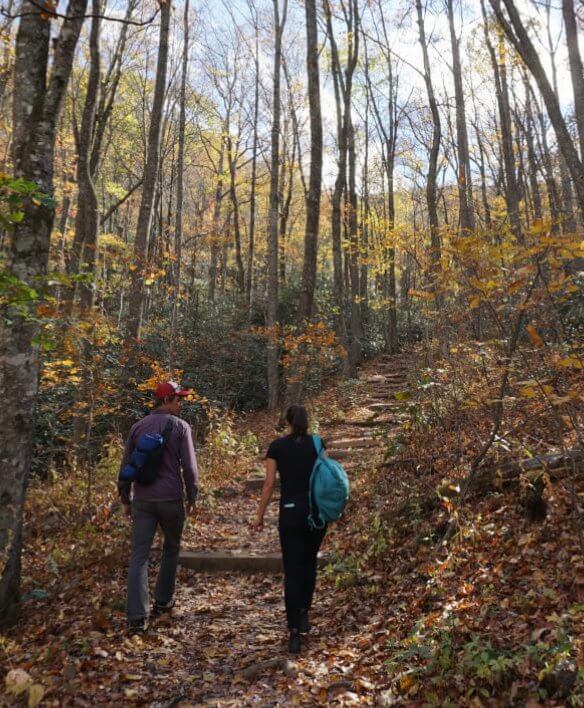
(Photo Cred: Billy Meeker) Drew Powell
and Kimala Luna walking up to
Lookout Mountain in Montreat, NC.
According to Drew, Apogee is usually contracted out through coal and natural gas companies to assess whether there are endangered species present where a pipeline is proposed. “I’d say the proposed pipelines are where we see the most degradation to forests,” he explains. Apogee Environmental looks for the Indiana Bat, specifically the miota species, which are a mouse-eared bat that use trees for roosting in the summertime.
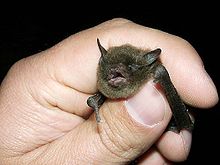
(Photo cred: Wikipedia) Indiana Bat.
Indiana Bats can roost in anything from any live tree to a dead snag, but they prefer exfoliating bark on a lot of the shag bark hickories and white oaks. If Apogee finds those specific trees on the property, then the company can’t cut those trees. “But there’s always loopholes with big companies, I mean money speaks a lot louder than we ever can, which is unfortunate,” he says.
Drew explains that the Indiana Bat is the only federally endangered bat that they look for, but they tag and keep track of all the bats that they catch.
They’re just incredible animals. They’re the only mammal fully capable of flight. They’re the slowest reproducing mammal in the world, and they can eat up to their own body weight in insects in one night foraging. A lot of people don’t get to see them up close or get to hold a bat in their hand unless it’s in their house, and then they’re terrified. A lot of people are afraid of bats. I think that a big movement right now is showing people that you don’t need to be afraid of bats; they’re very important to our eco-system. They’re the number one insect eater, they’re somewhat pollinators, and they help with seed dispersal as well.
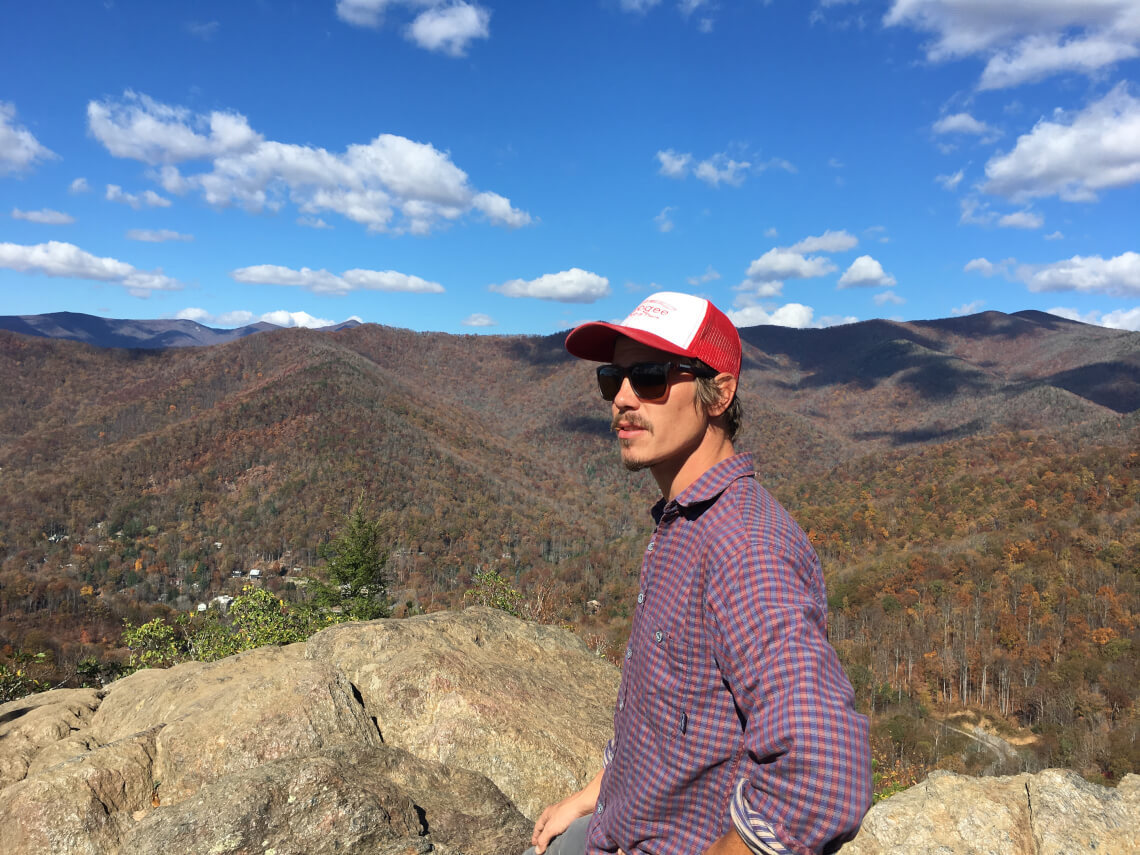
Drew Powell at the top of Lookout Mountain in Montreat, NC.
Drew mainly works in West Virginia in the summertime, but he has also worked in Pennsylvania, Ohio, Georgia, Kentucky, and North Carolina. In West Virginia he works on the consultant side of things. “What I did in NC was actual research for the U.S. Fish and Wildlife and NC Department of Transportation,” he explains.
Last year Drew was looking for the Northern Long-eared bat. “I’m pretty sure it will be federally endangered by the end of this year/beginning of next year,” he says. The U.S. Fish and Wildlife and Department of Transportation were trying to see if there was an isolated population of that species of bat staying out on the coast of NC – away from White-nose syndrome, which is a fungus that affects hibernating bats and has killed more than 5.7 million bats in the US since it was first documented in NY in 2006. Researchers found that a large population of Northern Long-eared bats stay in the swamps – primarily in bald cypress trees.
White-nose syndrome is changing bat behavior all over the US – it’s changing where bats are going, where they are roosting, and what kinds of trees they are choosing to roost in. This is what led Drew to study bats in the coastal wetlands.
According to Drew, one of the toughest aspects of his job is the cooperation with big companies that have hired Apogee to survey the area. “No matter what we do, we can work as hard as we want, but ultimately the companies can do whatever they want because they have the power and money to do that,” Drew explains.
However, the folks at Apogee find ways to work around big corporations, too. Drew told us that one time they lost several survey sites because the company that contracted them cut down all the trees on the top of the ridge where they were working, so they had to scramble to find new sites on the active mine. They had one day to find these sites. In four hours they found five new sites. “We went above and beyond, and that night, we caught a federally endangered bat on their property very close to where they mine. They were trying to stop us but they couldn’t. It was pretty gratifying,” Drew explains.
Drew verified that the quality of life for bats is higher in protected areas because there is less human disturbance. According to him, human disturbance is the number one cause for bats leaving caves and contributes to the deterioration of their population.
“There is a misconception that bats are scary, and they’re going to fly at your hair, and that’s not true…most of the time.”
Audrey Amir
I do not remember sweet tea, or biscuits. I do not remember the sound of my mother dropping beans into a bucket. I do not remember sticky summer sweat or the gift of a breeze. I do not remember fireflies or Georgia. But there is a drug in the telling of them.
I watch your mouth move as you teach me of myself. Your lip curves just so, and though I do not remember your name, each time you come I remember the shape of that lip and I know it must be you.
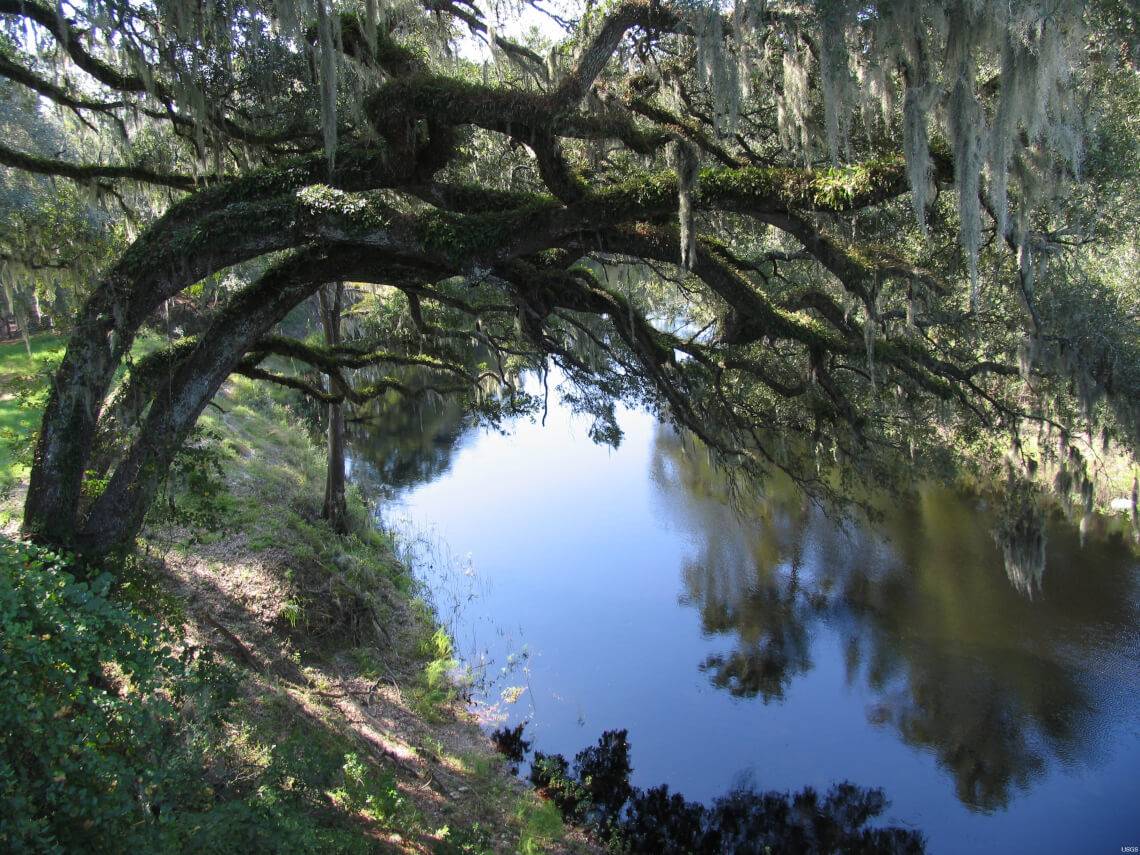
We take long walks. I move slowly, touching this leaf and that one. My head spins with the desire to know what to call them. You tell me Catalpa, Dogwood, Cypress, Live Oak. I press my palms to their trunks. Hold wide, flat leaves up to my face. I press their delicate stems between my fingers and watch the milk run over my nails. You tell me I lived here.
“When,” I ask.
“Always,” you say.
I nod. I am sure that must be right.
One afternoon there is a tree wider and taller than everything. I am sure it is a thousand years old.
“Perhaps,” you say.
I am glad to be right. Glad that trees can live a thousand years.
“Live oak,” you say. “Spanish moss”.
You are always doing that. Noticing my head tipping back, my mouth going slack. Telling me things, so I won’t have to ask. Some words you try to explain but can’t.
“Live oak. Spanish moss.”
I see them. Dripping, verdant things.
But remember when she came with you, and you told me her name (which I forgot) and after she left you said “love”, and it didn’t make any sense to me? She held your hand and smiled at you and you never stopped moving your littlest finger (pinky, I learned) across the back of her hand. Still it did not help me understand.
“Live oak. Spanish moss”.
I lay down in the soft peat, pressed my ear to the earth, ran my littlest finger (pinky) over a twisted root. Never stopped moving it. I looked up through the branches, wide like sky, spreading like synapses. Like the ones I have.
You lay down with me, touched your shoe to my shoe in the dirt. It did not surprise me. I think I remembered that you would. We breathed – ozone, mushrooms, heady and damp.
“Live oak,” I said.
“Mhm,” you said.
I watched your lip.
“Sam,” I said.
“Mhm,” you said.
“Love,” I said.
“Love,” you said.

Audrey Amir is a psychotherapist and poet living in Rochester, NY. She holds an MSW and an MA in Creative Writing. A nature enthusiast and amateur wood-carver, she derives much of her inspiration from the natural world. She uses narrative and creative approaches in her therapy practice and encourages self-expression as a means of meaning-making. She can often be found deep in the woods or playing with her kitten, Mercury.
Kathryn May Keeper
The ascending path is a fire escape bolted to the outside of the city. Down below the lowest clouds, builders clamber for a view of blue while the creation of new windows shrinks the sky. Walls extending endlessly into space crane discourteously towards the horizon in a world of squinting apertures recessed into cement, getting in the way of their own perspectives. The path leads out.
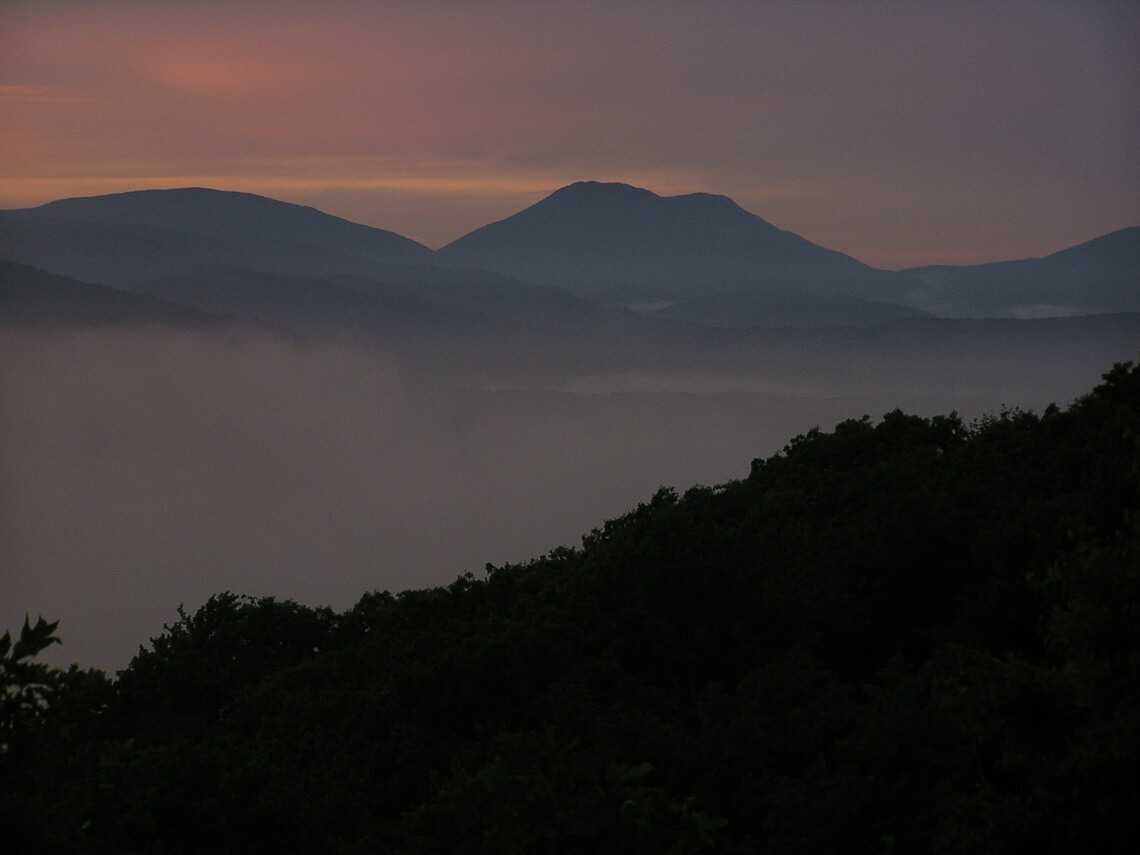
At the summit. Openness. Full breaths. A view.
Strange how quickly instincts adapt to circumstance. We measure time in seconds while dust settles patiently into the arms of aeons. Sound distorted by the abundance of flat planes bounces back unregistered. The horizon is an orange glow above the bruisey purples of architectural valleys. A few short human reproductive cycles pass and awe becomes ennui; genetic divisions sever us mercifully from the dread of our own creations.
They had trekked up the eastern slope on a narrow trail that wound snakily through miles of primeval rhododendron to join the humans who’d parked just below the summit. Some hunched, resting, on the simple weathered benches; others orchestratrated family members into poses with the vast rolling vista visible on either side of their groupings like a frame around their right to be at the top of something. With a snap, they are imprinted on a screen as brittle as memory. Red-faced children scowled.
Here in the clean air, human-smell is the foreign spoor. Chemical sun blockers. Perfume. Heavy metal deodorant tang. Meat. Salt. Starch. Seared lungs expelling desperate gasps of thin air. Loud talk about things that should have been left at their cars in the lot below. There is, it seems, a lot to be said for speaking.
He watched her stand on the bench against the eastern edge of the platform and shade her pale eyes with her hand as if she were saluting the curve of the horizon.
The summit platform was small and heavily graffitied. Names with dates. Hearts declaring immortal love at an elevation of 3500 feet..
Despite the weak struggle of the sun against the clouds, the rocks were warm. The rhododendron leaves lifted and flagged lethargically, scintillating gilded green like fish tilting as a single being in the current. Droning black flies settled on the nearest lump of skin when the air went slack. As a high gust pressed all the branches back away from their trunks the sound drowned out the exclamations of the tourists crowding the summit.
She was thinking, we must gain distance to see what is closest to us. We must get closer to learn what we can gain with distance.
They had ascended the eastern slope; they would wind their way back through the rhododendron in darkness. They would return to the city and their familiar squares of sky. On a clear day they could see the remote summit from their front porch, lost in a blue ether of similar peaks, softening the border between firm earth and firmament.

Kathryn Keeper
Kathryn Keeper is a writer, artist, observer and agent of fortune residing in Asheville. She aspires to great things while constantly reworking and evaluating her personal definition of greatness. She would like to thank Asheville Grit and the Dogwood Alliance for providing a forum for writers to present their interpretations of the deep beauty of the southern wilds.


 Donate
