


Big money corporations are extracting our natural resources in the South, making millions at the expense of hard-working Southerners with no lasting benefits to those of us who call this region home…

Wood pellet biomass has taken off in the past few years after being deemed “sustainable.”

This puts wood pellet biomass in the same category as true renewables like solar and wind. Because of this miscategorization, burning forests for fuel has received massive subsidies. The only sustainability big wood pellet biomass companies care about is their ability to “sustainably” clear-cut forests and make money.

It has been proven, through investigations, reporting and time in the communities, that biomass is negatively affecting wildlife and communities. Bambi is not pleased….

It’s also been proven that they are harvesting whole, hardwood trees and not just “wastewood”, like the industry claims.

The wood pellet biomass industry claims that clearcutting a native forest is “A-okay!” because that means more and more chemically-drenched pine plantations can be grown. Allowing them to turn our precious forests into actual money trees:

It’s like replacing your 30-year-old aged bourbon with Busch Light and trying to claim it’s the same thing!

The industry claims: “…clear cutting often results in greater biodiversity…”

Tell that to the animals who are being ripped away from their homes.

As long as these greedy corporations are running rampant destroying our beautiful world, we will be working hard to stop them.

FOR IMMEDIATE RELEASE: September 25, 2015Drax Cancels White Rose Carbon Capture and Storage Facility PlansPlan Would Have Been a Boondoggle For Taxpayers and a Disaster for Forests and ClimateAsheville, NC – This morning, Drax (LSE: DRX), one of the largest utilities in the UK, announced that it was pulling out of a plan to build a new coal burning power plant that would co-fire wood pellets and utilize untested Carbon Capture and Storage (CCS) technology. The conservation community welcomed the news that they hoped would mean the end of the controversial White Rose Project.“Today’s announcement from Drax is a win for our forests, communities, and the climate,” said Adam Macon, Campaign Director at Dogwood Alliance. “This not only keeps millions of tons of dirty coal in the ground, it also keeps millions of life saving trees from being clearcut and burned. This is another important signifier that burning forests for electricity is the wrong direction.”The White Rose Project would have been the first new coal burning power plant built in Europe since 1972 and the first CCS facility in Europe. It was extremely unpopular with British citizens and the new Conservative government. In June, over 110,000 signatures were delivered to the UK Department of Energy and Climate Change (DECC) asking them not subsidize the project. The Care2 petition was coordinated by BiofuelWatch with the support of the London Mining Project, Coal Action Network, and Dogwood Alliance.The new Conservative majority in the UK, led by David Cameron have not been publicly supportive of biomass and cancelled a climate change tax exemption that Drax was the beneficiary of. Though the previous administration was poised to invest over $1.3B in the facility, without those subsidies and government backing, this investment was a loser for DraxThis announcement will have ripples in the Southern US, where there are over 20 proposed new wood pellet manufacturing facilities in the region. Without a heavily subsidized biomass industry in Europe there will be no strong market for US produced wood pellets. “Communities considering investment and tax subsidies for wood pellet facilities should take note of today’s announcement,” continued Macon. “The future is in true renewables like wind and solar rather than in the boom-bust nature of this industry which leave them high and dry with destroyed forests, no jobs, and a lower quality of life.”Dogwood Alliance’s Our Forests Aren’t Fuel campaign will continue to push the UK and EU to end subsidies to the biomass industry in order to help protect the forests and communities of the Southern US. # # #About Dogwood AllianceDogwood Alliance is increasing protection for millions of acres of Southern forests by transforming the way corporations, landowners and communities value them for their climate, wildlife and water benefits. Dogwood Alliance has revolutionized the environmental practices of some of the world’s largest corporations. For more information on the organization please visit www.dogwoodalliance.org or follow on Twitter @DogwoodAlliance.Contact:Scot Quaranda, 828.242.3596, [email protected]

Drax the Destroyer
FOR IMMEDIATE RELEASE
Groups Organize GE Trees FallGenetically Engineered Trees Action Camp and Organizing Tour Target Key Regions Threatened by GE Trees in the USAsheville, NC (24 September 2015)–As part of “GE Trees Fall,” activists from across the United States are converging on two key regions involved in the genetic engineering of trees this fall, the US Southeast and the Pacific Northwest. Beginning today, activists are gathering near Asheville, NC for a Genetically Engineered Trees (GE trees) Action Training Camp, organized by Global Justice Ecology Project, and including the participation of Indigenous Environmental Network and Dogwood Alliance [1]. In October, GJEP and other groups are organizing an educational tour on the problem of GE trees in the Pacific Northwest.
The four-day action camp is being held in the US Southeast because the region is considered ground zero for GE trees in the US. Applications for GE eucalyptus plantations from South Carolina to Texas are pending with the US Department of Agriculture, and the USDA has given GE tree company ArborGen the green light to pursue genetically engineered loblolly pine trees there [2]. The USDA’s unprecedented decision allows for the development of GE pine plantations with no government oversight, no environmental or social risk assessments and no ability for the public to give input or obtain information–including neighboring landowners.
“Industry is ramming ahead with plans to commercialize GE trees with the collusion of the US government, which is ignoring its responsibility to protect the public and the environment from the threats of GE trees,” stated Anne Petermann, Executive Director of Global Justice Ecology Project and Coordinator of the international Campaign to STOP GE Trees. “This means if the average US citizen wants to be involved in decisions about GE trees that impact their forests or communities, they have to take matters into their own hands – to go back to the time honored traditions of civil disobedience and direct action. We are helping people do this with our GE trees action camp.” And we are in good company. Pope Francis, in his recent Encyclic on the Environment, came out strongly against GMOs due to their impacts on communities, land and the environment–the same impacts we would see from GE tree plantations,” she added. [3]
The USDA cited new technologies for engineering trees as the rationale for not regulating ArborGen’s GE loblolly pines, but a coalition of scientists explains that, “Most of these techniques are so new that there is not sufficient information to properly assess the risks. Some also allow more radical changes to plant genomes than genetic engineering methods currently used in commercialized products,” which “could threaten the environment and our health…” [4] This position was backed up by the release today of a legal dossier [5].
“The native forests of the Southern US, some internationally recognized as biodiversity hotspots [6], are already under dire threat,” explained Danna Smith, Executive Director of Asheville-based Dogwood Alliance. “Between the growing export of our forests as wood pellets to Europe to burn for electricity and the threat of an expanded domestic biomass industry, we are already losing our forests at an incredible rate. The absolute last thing our forests need are genetically engineered loblolly pine plantations.”
In October, GE tree organizers and scientists from several organizations [7] will tour the Pacific Northwest, another key region for GE trees development in the US. This tour will travel through the US states of Oregon and Washington and into British Columbia, Canada over the course of two weeks, stopping in more than a dozen locations to discuss the social and ecological dangers of genetically engineering trees. Several of these events will be held in locations where GE trees research is actively underway.
Scientists point out that the risks associated with genetically engineered trees are especially serious and almost impossible to properly assess [8]. The longevity of trees, the complex interactions of trees in forest ecosystems, and the large numbers of native wild relatives of trees like the loblolly pine that could be contaminated by long-ranging tree pollen create scenarios that are impossible to predict. Unanticipated and potentially damaging consequences of releasing GE trees into the environment in large numbers are virtually assured.
Contact:
Kip Doyle, Media Coordinator, Global Justice Ecology Project, Campaign to STOP GE Trees, +1.716.867.4080 [email protected]Notes to Editors
1] Global Justice Ecology Project, Indigenous Environmental Network, Dogwood Alliance
2] Center for Food Safety, “New Genetically Engineered Tree To Avoid Federal Oversight Completely”
3] The points on GMOs in the Pope’s Encyclic mirror many of the concerns about development of GE tree plantations: “In many areas, following the introduction of [GMOs], there has been a concentration of productive land in the hands of the few, due to the gradual disappearance of small producers, who, as a consequence of the loss of cultivated land, have been forced to retreat from direct production.
“The most fragile among them become temporary workers and many farm workers migrate to end up in miserable urban settlements. The spread of these (GM) crops destroys the complex web of ecosystems, decreases diversity in production and affects the present and the future of regional economies. In several countries there is a trend in the development of oligopolies in the production of seeds and other products needed for cultivation, and the dependence deepens when you consider the production of sterile seeds, which end up forcing farmers to buy (seeds) from producers. http://w2.vatican.va/content/francesco/en/encyclicals/documents/papa-francesco_20150524_enciclica-laudato-si.html
4] http://www.testbiotech.org/en/node/1344
5] “Any attempt to engineer genomes by invasive methods can cause unexpected and unpredictable effects. For example, “cisgenesis” – a genetic engineering technique that uses genes from the same species – is still genetic engineering and is therefore subject to unexpected and unpredictable effects caused by the genetic engineering process itself, and not by the trait or sequence inserted. New techniques to genetically engineer plants and animals, such as so-called DNA scissors (nucleases) and interventions in gene regulation, raise additional concerns.
http://econexus.info/publication/new-breeding-techniques
6] Maintaining species in the South http://www.seesouthernforests.org/discover-southern-forests/benefits/biodiversity
7] Global Justice Ecology Project, Canadian Biotechnology Action Network, Northwest Resistance Against Genetic Engineering, Cascadia Forest Defenders, GMO Free Josephine County
8] Genetically Engineered Trees and Risk Assessment: http://econexus.info/publication/genetically-engineered-trees-risk-assessment
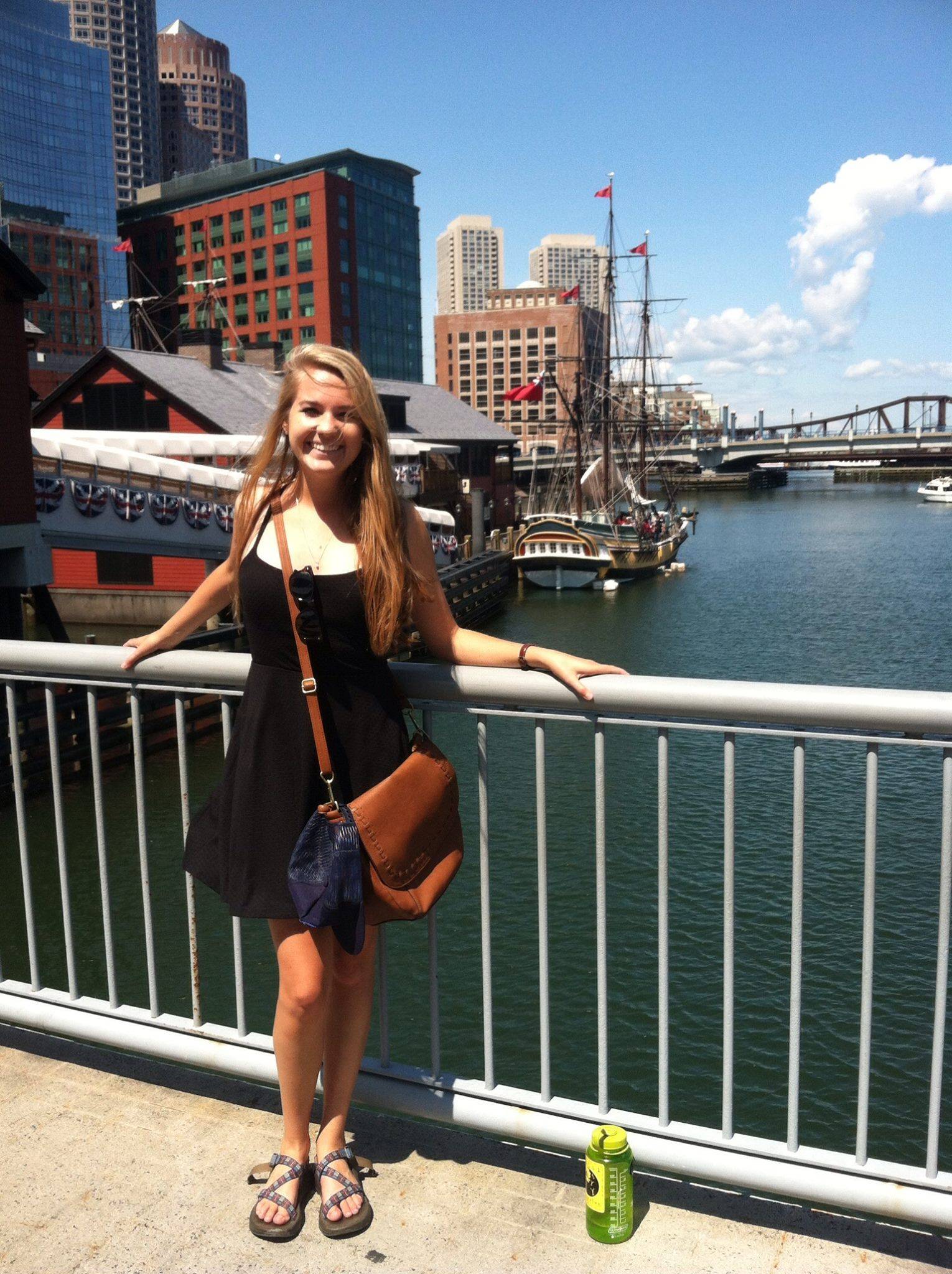
Rita Frost, Dogwood’s new Campaign Organizer.
Rita spent the last year in Green Corps where she worked in an environmental advocacy position gaining the skills and tools to become an organizer. Through Green Corps, Rita partnered with Dogwood Alliance on the Our Forests Aren’t Fuel campaign in Savannah, GA where she met Adam Macon, Dogwood’s Campaign Director, and Emily Zucchino, Dogwood’s Campaign Organizer.
Rita is originally from Austin, Texas. Growing up, her family would drive west every summer to Big Bend National Park where they would camp. Rita explains,
“During those drives as I was growing up, I noticed more and more that the 9 hour drive span was filled with cattle ranches, big confined animal feeding operations. and oil fields with just oil rigs dotted throughout the landscape. Then we would get to Big Bend National Park, and it would just be wilderness.”
Rita remembers the park ranger telling them to take nothing but photographs and leave nothing but footprints, and she couldn’t understand why this would be applicable for one part of Texas but not others. Rita says,
“Getting our country to a place where we respect all natural areas, like we respect national parks, is very important to me. I think that working with forest conservation is one of the frontline fights that we can do to face not only the problems of climate change, but also to get wilderness back into the ethos of American citizens.”
Rita loves running and runs every day. Her goal is to one day run an ultimate marathon (50 to 100 miles).

Rita Frost trail running.
Rita loves the mountains, local community and the “foodie movement.” She loves climbing, backpacking, camping, horseback riding and hiking as well as cooking, dancing and spending time with friends.
We are very excited to see the wonderful things Rita will bring to Dogwood!
Communities in the US South are no stranger to extractive industries that put profit over the health and prosperity of the people. We know too well the familiar story of corporations and politicians promising economic development and community care, but delivering low-paying jobs, environmental disasters and health consequences that reverberate for decades.

Residents of Savannah, GA join together to take a stand for their community and forests.
Stopping the destructive biomass industry is going to to be accomplished with grassroots power, and it will take all of us.
The wood pellet industry is disrupting the quality of life, health, environment and safety of residents across the South. In Eastern North Carolina, Jane Thornton and Deborah Kornegay dread the completion of the Enviva plant, whose industrial-scale logging and production of wood pellets is putting their rural community at risk. In an area where most of the residents make their living by farming, the threat of logging on air and water quality, flood plain protection and erosion is deeply felt. Additionally, the increased truck traffic from the facilities is clogging up the roads, damaging publicly funded roadways and posing a serious safety concern to local commuters.
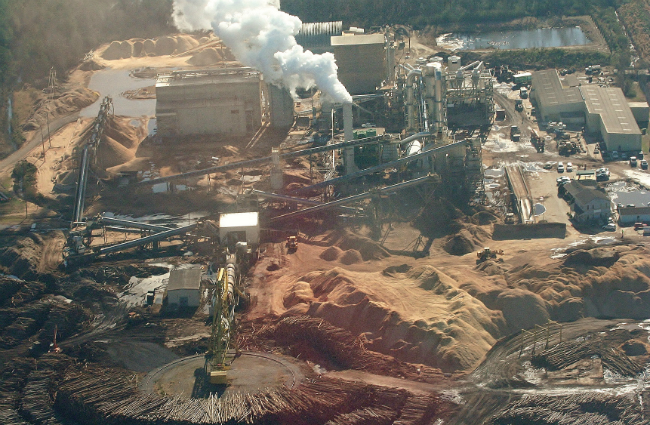
Overhead picture of the Enviva Ahoskie pellet manufacturing facility.
In Northampton County, NC and other communities across the South, the constant noise, at all hours, of wood pellet facilities disrupts the sleep of residents and quiet character of rural towns. The wood dust and fine particulate matter created in the production of wood pellets is leading to respiratory problems, creating a mess and disrupting residents living near the facilities. In just 2 hours spent at one of Enviva’s wood pellet facilities, I personally experienced the irritation caused by wood dust in my eyes and lungs.
Furthermore, this industry is being fueled by massive subsidies and incentives, all at the expense of local taxpayers. What few jobs the industry provides come at the expense of the forests, air, and water of communities.
[youtube]https://youtu.be/hoJH59AsfkI[/youtube]
Once more, it is up to us to take a stand to ensure our basic rights are maintained for generations to come.
The dirty biomass industry is not the future for our Southern communities or forests. We need long-term solutions that value the health and prosperity of people and the environment. And it is our right to demand this from policymakers and industry leaders. With organizing and action, we can pave the way for a future that puts the needs of the people before corporate profit and values our forests for the myriad of life-supporting services they provide just by standing. Our Southern communities and forests are not resources that can be taken advantage of for the personal gain of greedy industries. They are vital components of a vibrant global community and ecosystem, and we must take action to make sure they continue to be so.
This summer I had the opportunity to interning at Dogwood Alliance as Asheville’s Outreach Intern. I worked closely with Dogwood’s Campaign Organizer Emily Zucchino to organize events in Asheville and engage locals in meaningful discussion about biomass, the burning of wood for electricity, and how it affects our Southern forests. This summer we were fortunate enough to partner with The River Arts District Farmers Market, The French Broad Co-op as well as LEAF Downtown Festival. We collected lots of photo petitions and talked to many folks who were passionate about protecting our forests.
I had a great time talking with the various farmers and artists participating in the farmers market. While I learned about foraging for mushrooms and making goat cheese and balsamic vinegar, I was also able to share my knowledge about biomass and how it is destroying many ecologically significant forests. So many people who visited the farmers market came over to my booth with questions and concerns about the large clear-cut photos I was displaying.
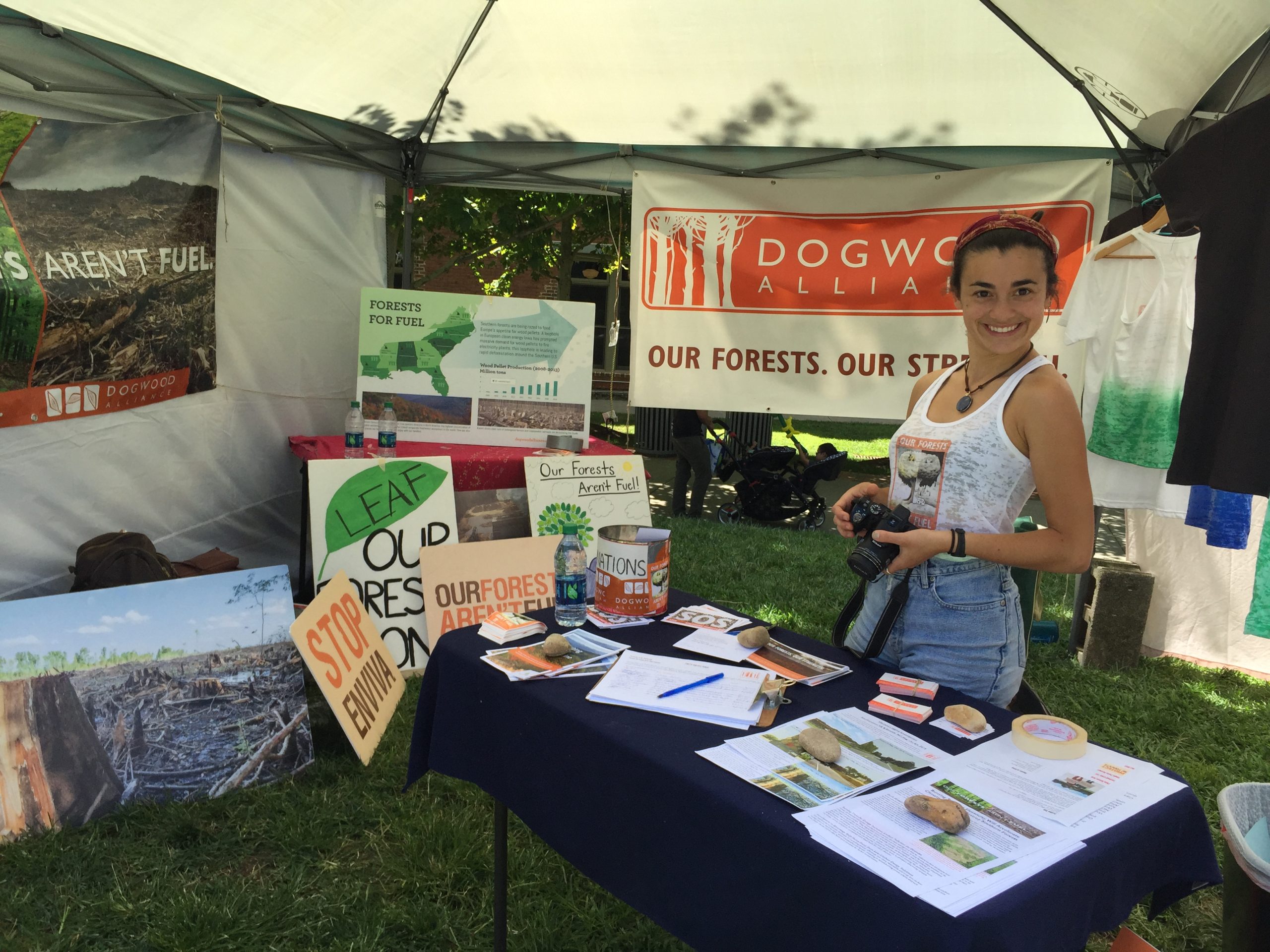
Audrey prepares for a day of outreach at LEAF downtown festival.
The LEAF Downtown Festival was another way Dogwood was able to reach out to the Asheville community. We set up a booth close to the main stage and outfitted it with signs, postcard petitions, banners, t-shirts as well as many wonderful Dogwood staff and volunteers. In between acts such as Bootsy Funk Dynasty and Sister Sparrow, Dogwood talked to hundreds of festival goers about the threats facing our Southern Forests.

Asheville residents come out to show their support for Southern forests!
I was able to learn more about how non-profits function as well as be an instrumental part in Dogwood’s local outreach. Through establishing a volunteer base here in Asheville, Dogwood will be able to more effectively advocate for our forests here in the South. As my final semester in college begins, I hope to stay in touch with the people here at Dogwood and continue protect our Southern Forests!
FOR IMMEDIATE RELEASE: August 26, 2015 Contact: Emily Zucchino, 828.301.9566, [email protected]New Video Exposes the Negative Impact of Wood Pellet Manufacturing on a Rural Community in North CarolinaAccompanying the Short Film is a Toolkit that Helps Communities Begin Organizing Opposition and Share ResourcesAsheville, NC – Communities across the Southern US are no stranger to extractive industries that threaten their health and quality of life. A new video, “Selling Out Sampson County” by Dogwood Alliance investigates the impact that the latest threat, wood pellet manufacturing, has on the rural South and inspires people around the region to organize to stop this growing threat.
It is an all too familiar story. New industries approach local governments promising jobs and assorted economic benefits; instead, they extract natural resources, damage the environment, bring just a handful of low-paying jobs, degrade the economic vitality of the area and impact public health and community well-being for decades.
“What the good people of Sampson County face with a new wood pellet mill to be operated by Enviva is destruction of their local forests, a degraded quality of life and increased health risks,” said Emily Zucchino of Dogwood Alliance. “We hope their story will inspire communities across the region to say ‘no’ to this industry and work together to create long-term economic solutions that benefit everyone.”
“Selling Out Sampson County,” takes a close look at Sampson County in North Carolina, where local residents are facing a new Enviva wood pellet mill. The mill is currently under construction and will send the pellets by truck to the Port of Wilmington, where they will be shipped to Europe to be burned for electricity.
Local residents fear the impact that industrial-scale logging and wood pellet production will have on their peaceful, rural community. Logging will impact their water quality, the ability for forests to protect their homes from flooding and destroy the places they have lived, worked and played in for generations.
On top of the forest impacts, quality of life in their small town will be harmed. Increased truck traffic to feed the mill will clog roads and make them more dangerous. An industrial facility running day and night will increase noise and air pollution. Children, elderly and those with weakened immune systems and lung problems will face more serious health concerns.
Furthermore, this industry is being fueled by massive subsidies and incentives, many at the expense of local taxpayers. What few jobs the industry provides come at the expense of the forests, air, water and sustained economic growth of communities. Development that destroys the environment and health of the people is not forward-thinking; it is a short-term profit grab for foreign companies at the expense of the long-term prosperity of a region.
“For other neighborhoods and communities that might be facing this same sort of plant, I would say do everything you can to keep it out,” said Deborah Kornegay of Citizens for a Safe Environment in Sampson County, NC.
In addition to the new video, Dogwood Alliance also released a community toolkit that helps concerned citizens organize to stop new wood pellet mills and biomass utilities from coming to their town. You can watch the video here and download the toolkit here.
# # #
About Dogwood Alliance
Dogwood Alliance is increasing protection for millions of acres of Southern forests by transforming the way corporations, landowners and communities value them for their climate, wildlife and water benefits. Dogwood Alliance has revolutionized the environmental practices of some of the world’s largest corporations. For more information on the organization please visit www.dogwoodalliance.org or follow on Twitter @DogwoodAlliance.
(This is Part 2 of a two-part series. exploring the impact the wood pellet industry is having on the rural communities of the Gulf coast. Part 1 looked at the wood pellet industry in Mississippi and the destructive impact it has on the forests and the rural local economy.)
Following a heart-warming visit to Mobile, Alabama, where the local community is rising up in opposition of the export of Alabama forests to Europe to burn for electricity, our crew headed to Panama City, Florida.
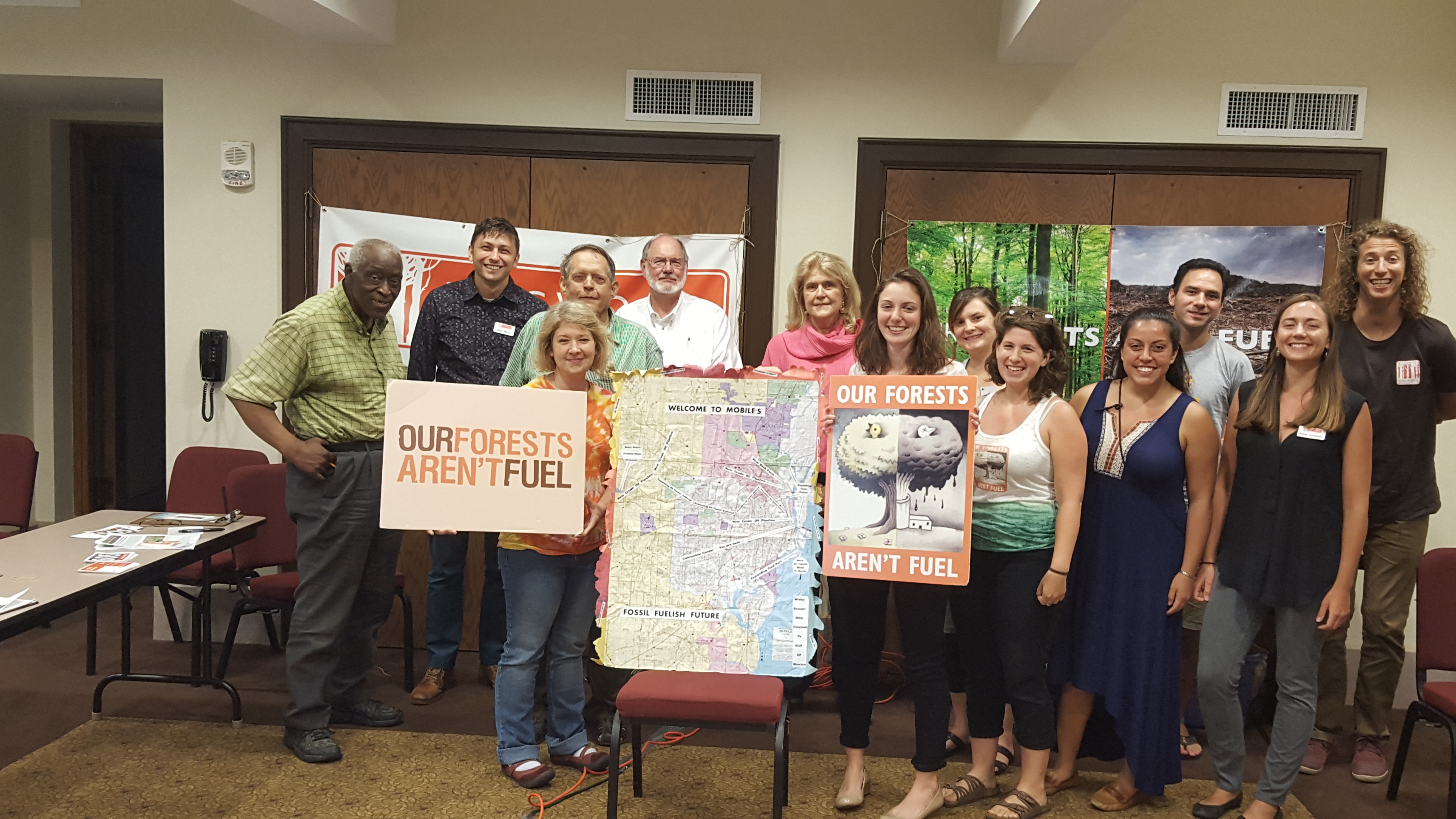
Old and new friends organizing to stop the export of wood pellets in Mobile, Alabama.
Panama City is the port where Enviva ships wood pellets from its Cottondale, Florida pellet mill to Europe. Enviva recently acquired this mill when it purchased it from Green Circle. It was the first industrial-scale pellet mill built in the South.
The forests of northwest Florida represent a strange dichotomy – on the one hand, you find some of the most unique and biodiverse areas left in the South, and on the other hand, surrounding all of that wild nature, you find one of the regions hardest hit by conversion of natural forests to pine plantations.
Following a series of events and meetings in Panama City that included some of the hardest working conservationists I have met in my career, Dogwood Alliance Our Forests Aren’t Fuel Campaign Director Adam Macon and I took a field trip to Cottondale to visit the Enviva wood pellet mill.
Adam also joined Kent Wimmer from Florida Defenders of Wildlife to get a bird’s eye view of the mill and the forests that are at stake. This gave us valuable information on what to expect in our investigation.
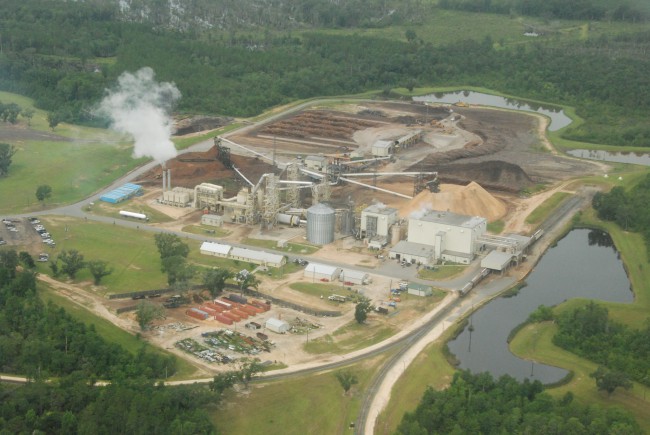
An aerial view of the Enviva Green Circle facility in Cottondale, Florida.
Additionally, we got out on the water to see the export facility and were lucky enough to see one of the container ships being loaded with pellets.
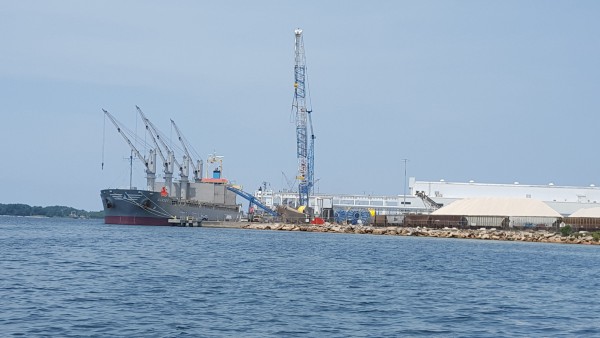
Enviva’s export terminal with wood pellets being loaded on a container ship in Panama City, Florida.
We drove to Cottondale straight into the heart of downtown Panama City. What we found is another once thriving Southern town that has become rundown as the local economy falters and the youth depart for big cities to seek new opportunities.
Leaving downtown we headed to the wood pellet mill. We parked outside the gate, and in 20 minutes watched 19 trucks loaded with logs and wood chips enter the facility.
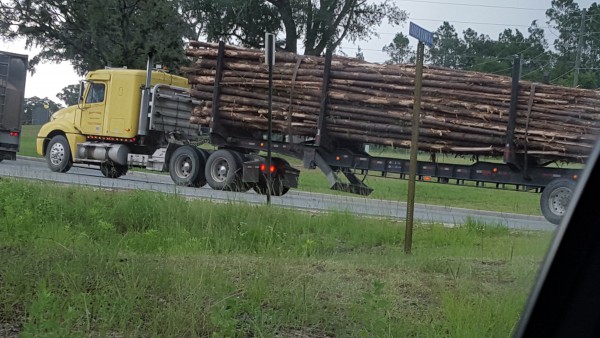
A truck loaded with logs lined up to enter the Enviva Green Circle facility in Cottondale, Florida.
The striking difference between this facility and the Drax facility in Mississippi was that these trees were all tiny, meaning they were cut down at an incredibly young age. So much for allowing forests to grow back for the 40+ years needed to soak back all of the carbon lost from burning them.
After watching trucks for a while, we headed to a hill to get a better view of the facility. From our vantage point, the log yard at the facility was nearly empty. Essentially, they were processing the trees as quickly as they came in the gate.
Taking this all in left the two of us feeling empty inside, so we headed back into Panama City to try and process all that we had seen.
Essentially, massive subsidies in Europe paired with well-intentioned but misguided subsidies from state, county and local governments have created a forest destroying industry that is leaving our rural communities high and dry so a few corporate executives can make a massive profit.
The pellet industry and their supporters constantly talk about the benefits of the industry, but what they fail to address are the true costs of this industry.
While we should be investing in protecting forests for the clean water, carbon storage, wildlife habitat and many other benefits they provide we are instead selling them off to the lowest bidder.
The future potential of local communities is based on their ability to attract high paying jobs, entrepreneurs and retirees. With the loss of all of their natural amenities, there is no reason for anyone to move to or invest in those communities.
Add to that, regions like the Florida panhandle have long supported higher paying and higher quality wood products industries that create valuable products and more jobs. As the demand from the wood pellet industry grows, these industries will be pushed out as they will no longer have high quality forests available to meet their needs.
And what happens when the subsidies end? Government officials and policy-makers in the UK and EU are already talking about reducing and ending many of the subsidies necessary to support this industry.
Is this the kind of industry we want to see expand on the Gulf coast? We think not and hope that more folks of that region will join us in fighting the further expansion of this industry. Let’s embrace a sustainable energy future and one where we invest in conserving and restoring our forests for all of the amazing benefits they provide us.
(This is Part 1 of a 2 part series exploring the impact the wood pellet industry is having on the rural communities of the Gulf coast. Part 2 looks at the wood pellet industry in the Florida panhandle and more deeply explore the economics of the industry. Read Part 2 here.)
In June, Dogwood Alliance hit the road for a 2 week SOS Forest Tour across the South. We spent a significant portion of time on the Gulf coast exploring the impact the rapidly expanding wood pellet industry is having on the forests and communities of that region. What we found was, quite frankly, disturbing.
Our first stop was Baton Rouge, Louisiana. While most of our team was preparing for an incredibly inspiring event there that featured passionate activists and amazing speakers like Shamaka Schumake and General Honore, my co-worker Kimala and I rented a car and drove two hours north to see the recently opened Drax wood pellet mill in Gloster, Mississippi that ships its pellets out of a new port facility in Baton Rouge.
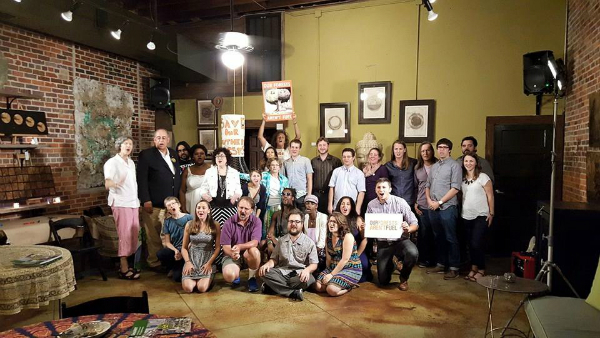
Concerned citizens, conservationists and local heroes in Baton Rouge, Louisiana say “Save Our Southern Forests!”
Gloster is right near the Louisiana and Mississippi border. Forestry is not new to the area. In fact, the Drax pellet mill was built on the site of a former Georgia-Pacific paper mill. We hoped to:
We drove by the mill and saw piles of pine logs as far as the eye could see. These piles were loaded by crane into the de-barker and the pelletizer so they could be sent by rail to Baton Rouge, where they will be loaded on a container ship bound for the UK. Truck after truck pulled into the facility and unloaded giving us a plethora of options of who to follow.
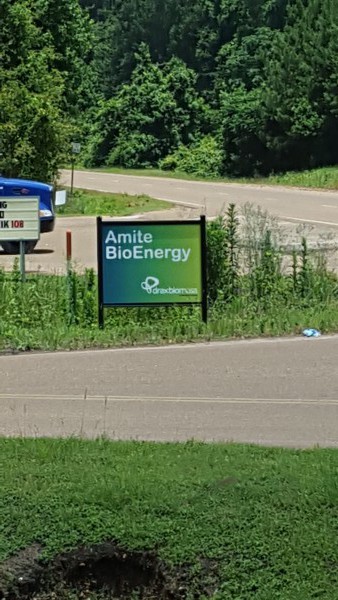
The entrance to the Drax wood pellet facility in Gloster,
MS where Southern forests are turned into wood pellets
to be burned in the UK.
We waited for a truck to unload, and we followed it out of town and through the Homochito National Forest to a gated pine plantation just outside of the National Forest border. Having seen countless clearcuts in pine plantations in my career with Dogwood, we decided to just observe the size of the trees coming out, which varied from 6 to 20 inches in diameter.
Our observations of the log piles back at the facility and the outgoing trucks led us to the conclusion that these are not just plantation thinnings.
With the paper mill now closed, Drax is the main buyer of pine trees.
It is hard to describe to someone who has not witnessed it themselves the pain of seeing trees grown in plantations. Orderly rows as far as they eye can see like a cornfield, regular spraying of fertilizers and herbicides, and plantations are so quiet because they’re almost devoid of wildlife.
Before they can grow into majestic trees, the heavy machinery chops them down like mowing a lawn.
This is the commodification of nature and our forests. We chop down our native forests (in this case likely natural pine or mixed pine/hardwood forests) and destroy all the value these forests contained, replacing them with rows and rows of monoculture tree crops. Loblolly, slash and sand pine have replaced the dozens of species that used to call this region home.
Thoroughly depressed, we ventured into town for a bite to eat and the opportunity to speak with some locals. It was a ghost town, almost devoid of people besides a few friendly folks at a local lunch counter. I took the opportunity to chat with them to get their impression of the pellet mill.
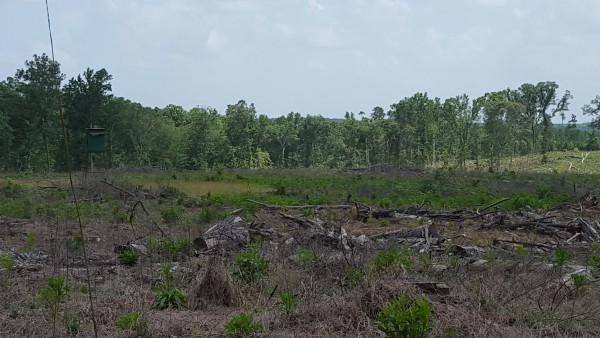
A clearcut just a few miles from the Drax wood pellet facility in Gloster, Mississippi.
As far as bringing jobs to the local community, that seemed like laughable. The Georgia-Pacific paper mill that burned down had employed nearly 250 people, many of them from the local community. The Drax pellet mill employed only 45 people and basically no one from the local community. People left town for work, which explained the ghost town feeling there.
This visit hit me really hard. I just could not get over the senseless waste of our forests being burned for electricity in European power plants.
Our recently released report on the detrimental impact the wood pellet industry is having on rural economies shows how this rapidly expanding industry is harming the long-term economic viability of rural communities. For short-term gains, industry is stripping away all of the natural resources that could have become the centerpiece of future economic growth. I am sad to say that Gloster, Mississippi is a living example of this.
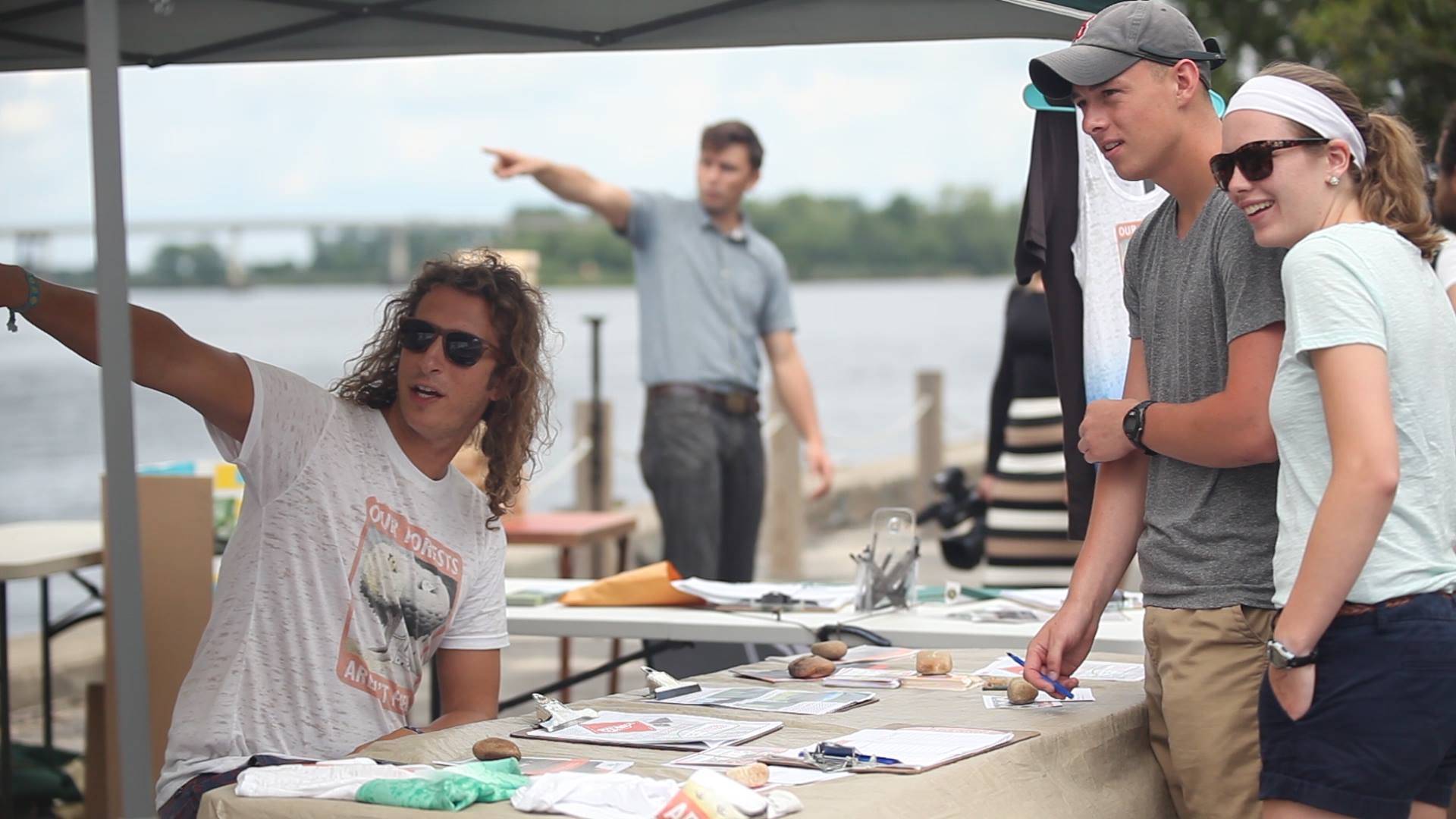
Rowdy on the SOSForests Tour pointing out a new biomass dome in Wilmington, NC.
Meet Rowdy Keelor; his amazing spirit and compassion for all living creatures is inspirational. We’ve been so luck that Rowdy became our part-time, temporary Campaign Organizer this summer and is a big reason why our SOS Tour was such a success. Before we met Rowdy, he was a touring musician in a band called Jahman Brahman. Rowdy explains, “I found Dogwood when I first started to pursue environmentalism instead of rock n roll; it happened very organically.” He soon began tabling at places around town like the CO-OP and local events. Rowdy also began cross-promoting Dogwood among the bands he’d worked with, and when Dogwood began looking for a temporary organizer, he was ready to meet the challenge.
“It’s my first time actually getting to work for an environmental non-profit. It’s been a great learning experience, and there’s just something about a local, environmental, non-profit that’s special. It’s great to be here in Asheville and work for local causes and for local forests.”
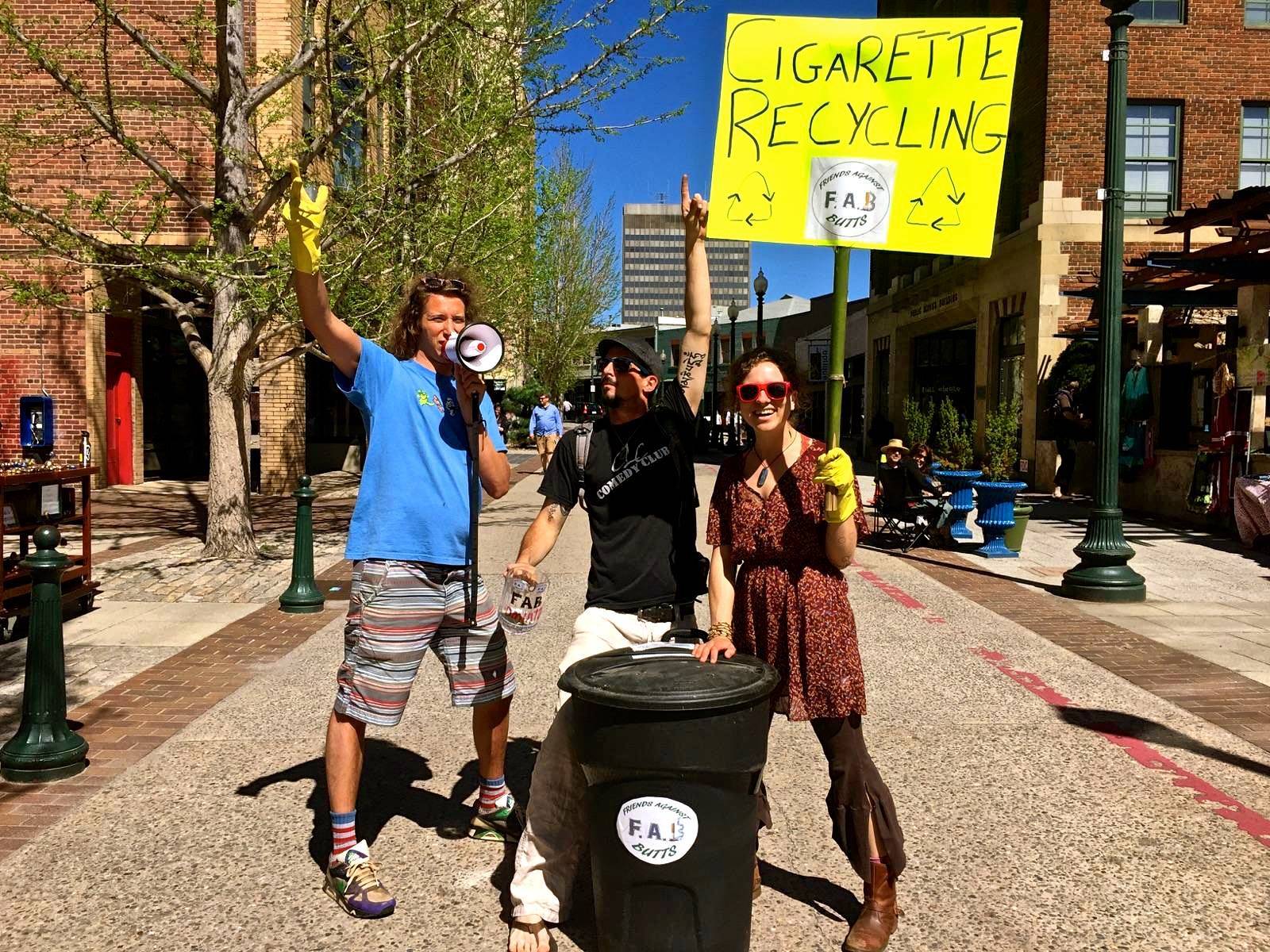
Friends Against Butts raising awareness in Asheville.
In February of 2015, Rowdy Keelor, Adam Agee, Lyric Antio and Caroline Francis founded Friends Against Butts, a small organization that recycles cigarette butts and turns them into industrial plastics by partnering with a company called TerraCycle out of New Jersey. Lyric had already been doing some cigarette recycling at UNCA, and all the members were excited about the project, “Caroline is a former cigarette smoker and she is my lady partner. She felt like she had some karmic reparations to do for all the years of smoking. Adam is my roommate and my brethren. I’ve known him for a really long time and he’s a really caring individual.” The group strongly feels that cigarettes hurt the earth. Once they realized they could be recycled, they were so excited to spread the news.
TerraCycle gives the organization one dollar per pound that they send in, which helps the group cover their costs. This project is an absolute labor of love. Rowdy says, “We didn’t start this to make money, we started it to divert waste because landfills filling up is a big thing.”
On his experience at Dogwood and all that he has learned in his journey in environmentalism, Rowdy says, “When you get into the environment, there’s just so many different aspects of it, waste diversion, energy sector, land use, water use, climate change, forestry, so it’s all a part of protecting and preserving and doing something positive for the environment.
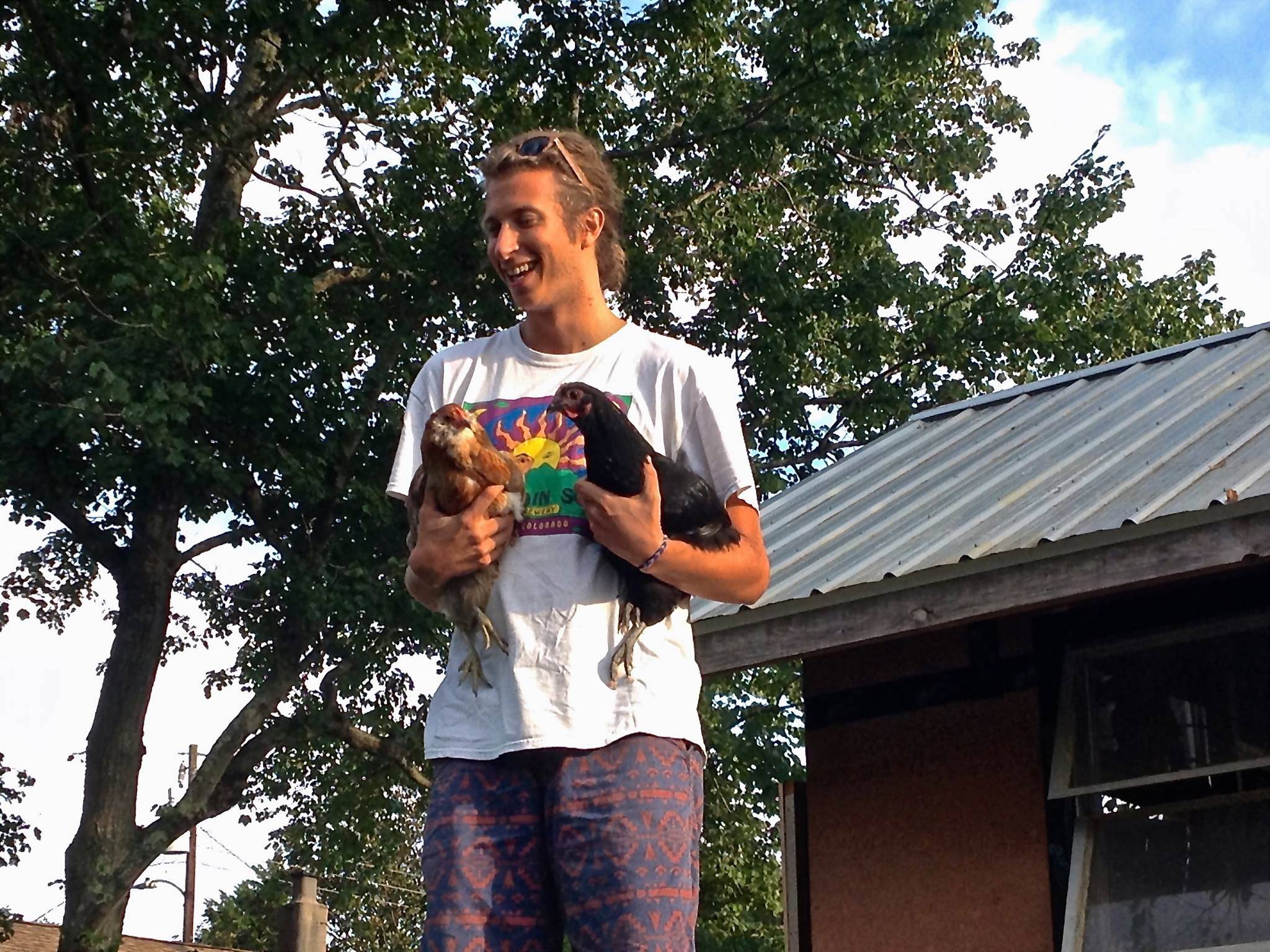
Rowdy Keelor holding some chickens.
Environmental work has shown Rowdy the power individuals have to be environmentally conscientious with their diets. It has lead him to vegan advocacy,
“I really care about people having the power themselves to do something and that’s lead me to veganism and the power that we have every day with our diet to effect the planet because of how much oil, water, everything that a vegan diet uses less of is really fascinating to me and so that empowers people to make a choice every day to help the planet. Because there’s a lot of statistics like even if the energy sector is completely halted where it is right now, emissions from animal agriculture would still cause the gigaton threshold in a certain amount of years and I also really love animals, and think it’s terrible how they’re treated and it’s also great for healthcare and economy if you care about that kind of thing.”
Rowdy hopes to continue on with his vegan advocacy using some of the tools of organizing that he has gained during his time with us at Dogwood Alliance.
“Never give up, even if a single action seems like a failure. When you look at is as part of a movement, it’s not. I want to talk to thousands of people at once and reach masses and masses, huge amounts of people, but there’s something to be said about one-on-one conversations with someone you’ve never met before.”


 Donate