


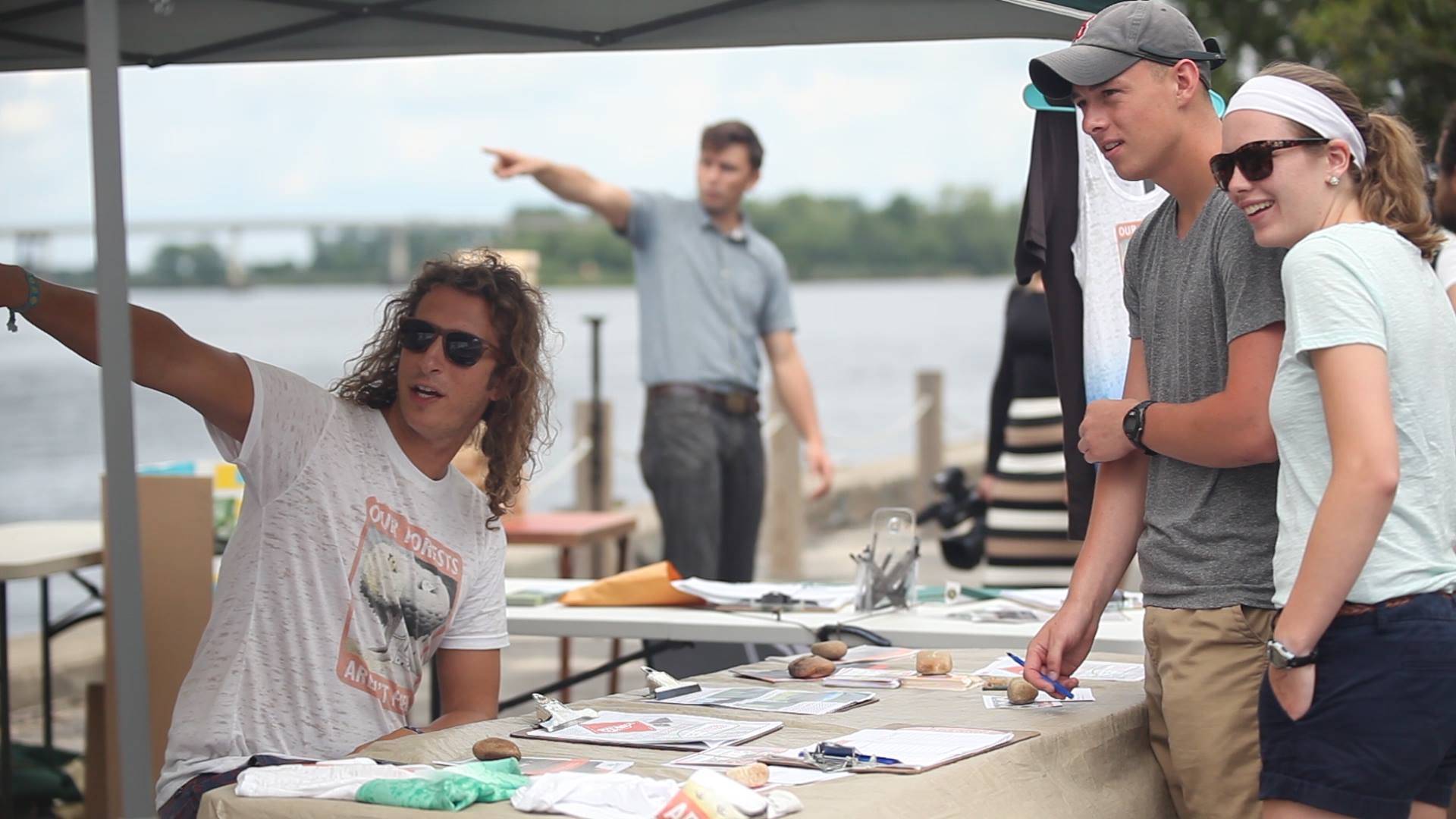
Rowdy on the SOSForests Tour pointing out a new biomass dome in Wilmington, NC.
Meet Rowdy Keelor; his amazing spirit and compassion for all living creatures is inspirational. We’ve been so luck that Rowdy became our part-time, temporary Campaign Organizer this summer and is a big reason why our SOS Tour was such a success. Before we met Rowdy, he was a touring musician in a band called Jahman Brahman. Rowdy explains, “I found Dogwood when I first started to pursue environmentalism instead of rock n roll; it happened very organically.” He soon began tabling at places around town like the CO-OP and local events. Rowdy also began cross-promoting Dogwood among the bands he’d worked with, and when Dogwood began looking for a temporary organizer, he was ready to meet the challenge.
“It’s my first time actually getting to work for an environmental non-profit. It’s been a great learning experience, and there’s just something about a local, environmental, non-profit that’s special. It’s great to be here in Asheville and work for local causes and for local forests.”
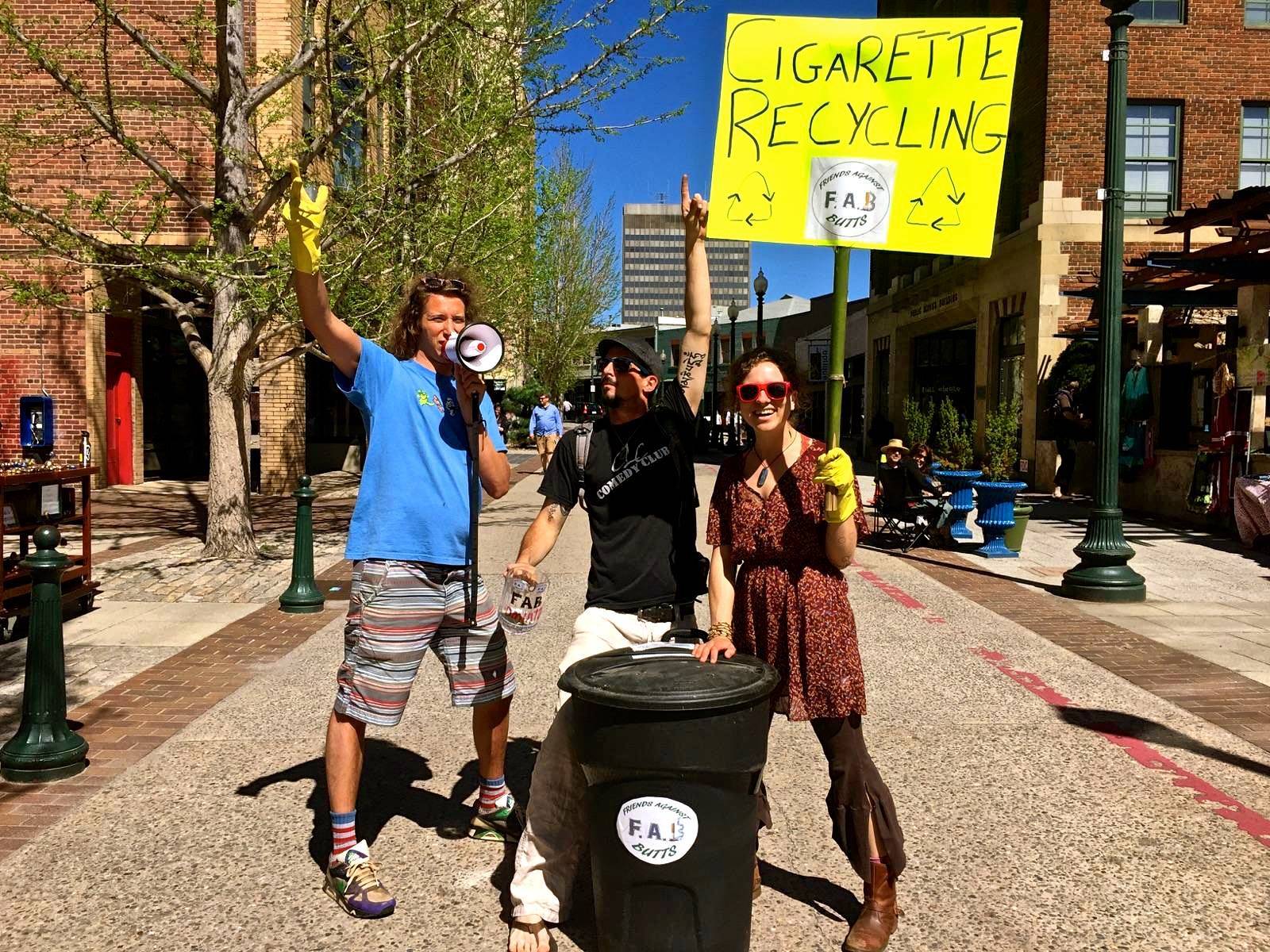
Friends Against Butts raising awareness in Asheville.
In February of 2015, Rowdy Keelor, Adam Agee, Lyric Antio and Caroline Francis founded Friends Against Butts, a small organization that recycles cigarette butts and turns them into industrial plastics by partnering with a company called TerraCycle out of New Jersey. Lyric had already been doing some cigarette recycling at UNCA, and all the members were excited about the project, “Caroline is a former cigarette smoker and she is my lady partner. She felt like she had some karmic reparations to do for all the years of smoking. Adam is my roommate and my brethren. I’ve known him for a really long time and he’s a really caring individual.” The group strongly feels that cigarettes hurt the earth. Once they realized they could be recycled, they were so excited to spread the news.
TerraCycle gives the organization one dollar per pound that they send in, which helps the group cover their costs. This project is an absolute labor of love. Rowdy says, “We didn’t start this to make money, we started it to divert waste because landfills filling up is a big thing.”
On his experience at Dogwood and all that he has learned in his journey in environmentalism, Rowdy says, “When you get into the environment, there’s just so many different aspects of it, waste diversion, energy sector, land use, water use, climate change, forestry, so it’s all a part of protecting and preserving and doing something positive for the environment.
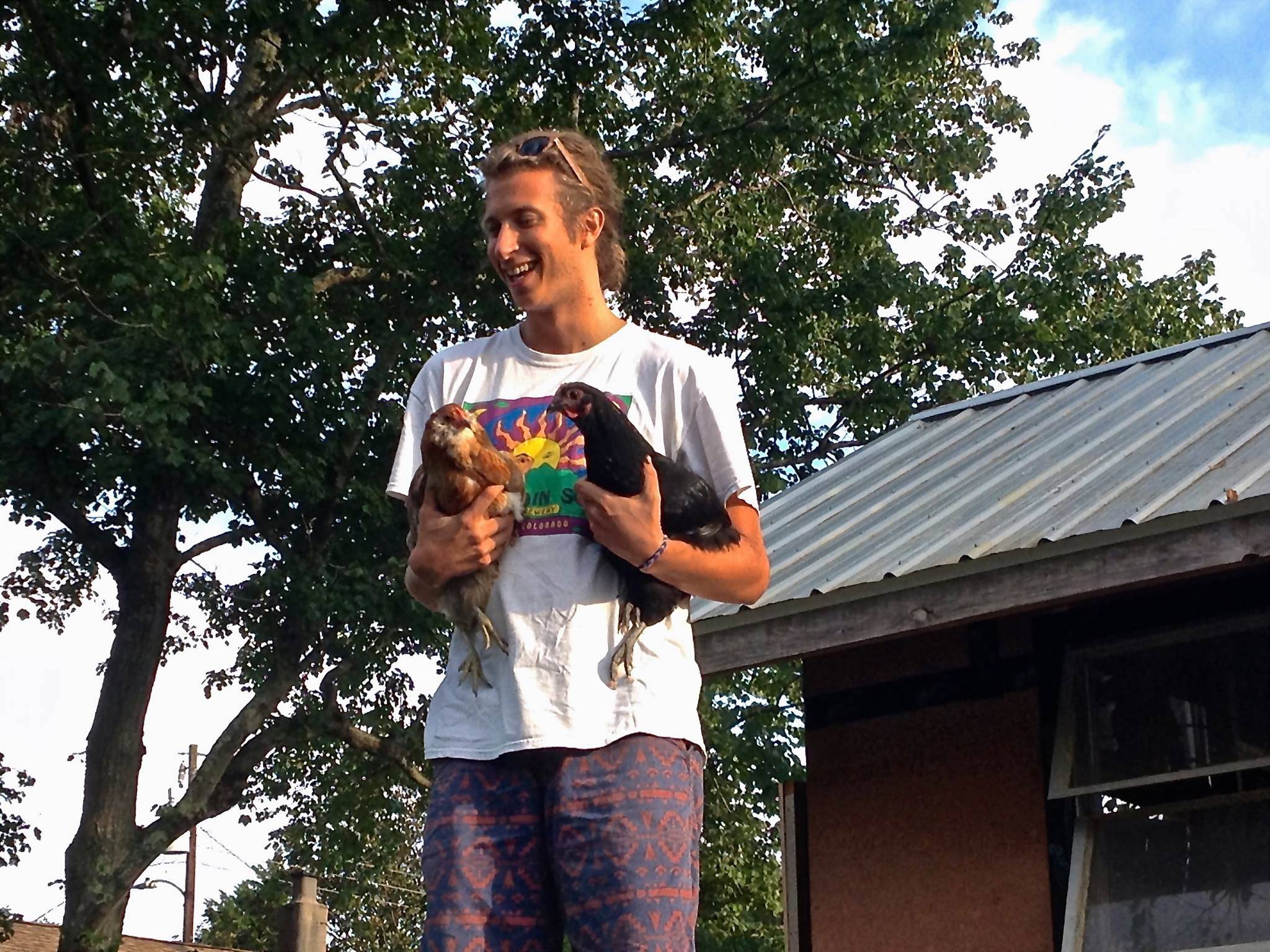
Rowdy Keelor holding some chickens.
Environmental work has shown Rowdy the power individuals have to be environmentally conscientious with their diets. It has lead him to vegan advocacy,
“I really care about people having the power themselves to do something and that’s lead me to veganism and the power that we have every day with our diet to effect the planet because of how much oil, water, everything that a vegan diet uses less of is really fascinating to me and so that empowers people to make a choice every day to help the planet. Because there’s a lot of statistics like even if the energy sector is completely halted where it is right now, emissions from animal agriculture would still cause the gigaton threshold in a certain amount of years and I also really love animals, and think it’s terrible how they’re treated and it’s also great for healthcare and economy if you care about that kind of thing.”
Rowdy hopes to continue on with his vegan advocacy using some of the tools of organizing that he has gained during his time with us at Dogwood Alliance.
“Never give up, even if a single action seems like a failure. When you look at is as part of a movement, it’s not. I want to talk to thousands of people at once and reach masses and masses, huge amounts of people, but there’s something to be said about one-on-one conversations with someone you’ve never met before.”
This year, Dogwood Alliance intern Audrey Howarth linked up with Lake Eden Arts Festival to bring forest protection to the Asheville community. Below, Audrey reflects on the festival, and her joy of working with people who are passionate about our Southern forests!
Dogwood had a wonderful turn out at the LEAF festival in Downtown Asheville! A big shout out to all the staff members and volunteers that came out and promoted our Biomass campaign! Thanks to your enthusiasm we were able to collect over 200 photo petitions to send overseas to European policy makers.

Our Forests Aren’t Fuel!
Despite a little noise competition from our location right next to the main stage, we had many engaging conversations with locals who share our passion for the environment. Children and adults alike were drawn to our tent by the blown up posters of Enviva’s clearcuts. It didn’t hurt to be located right next to the delectable cupcakes of Short Street Cakes!
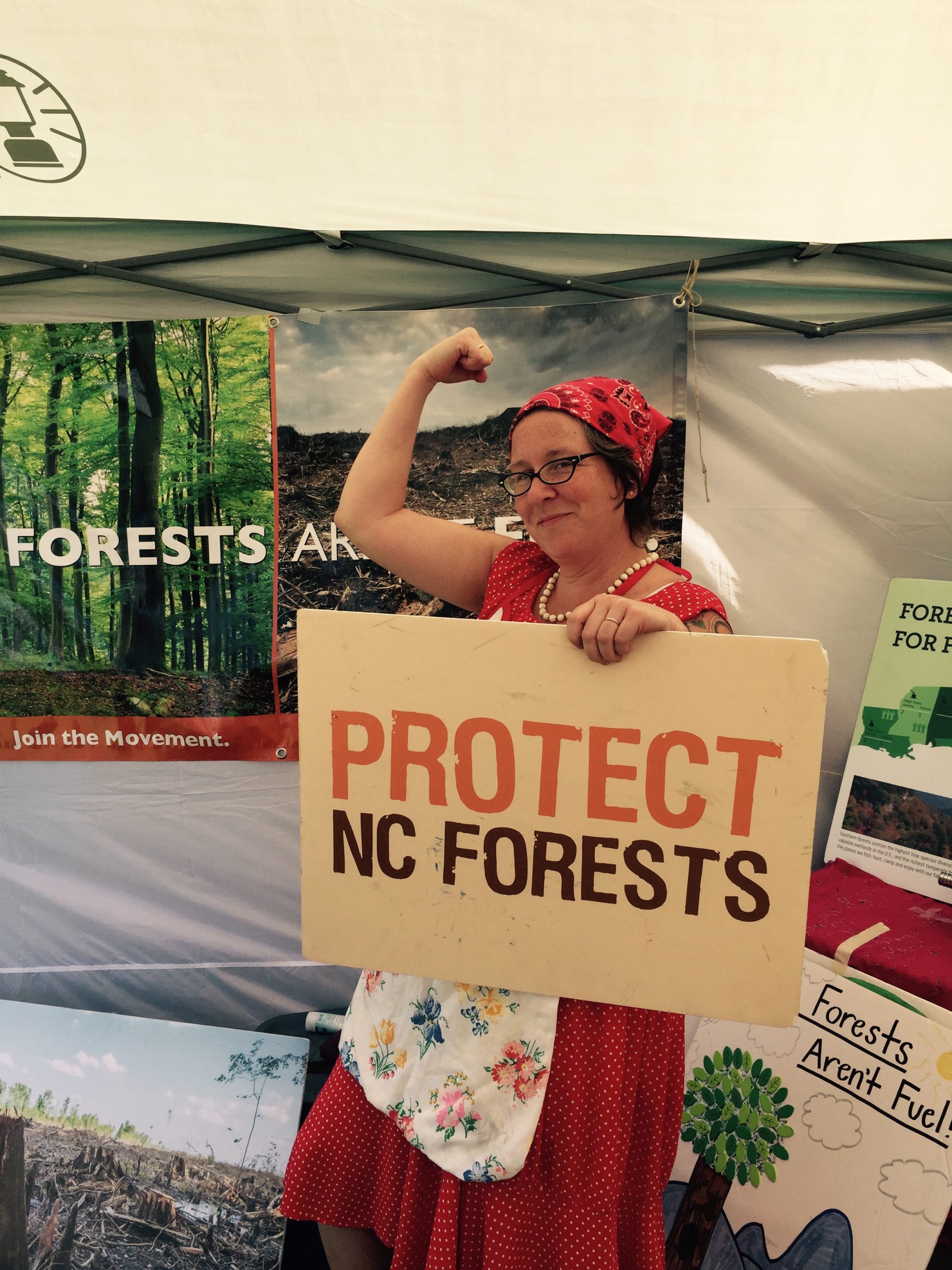
Jodi Rhoden from Short Street Cakes stands up for NC forests!
I was pleasantly surprised by Ashevillians’ enthusiasm to learn more about bioenergy. Even those who were hesitant to have their photo taken for a petition were curious to learn more and took fact sheets.

Another Asheville family for forests!
I feel incredibly fortunate to work for an organization and live in a city that has so much passion for the beautiful forests that surround us!
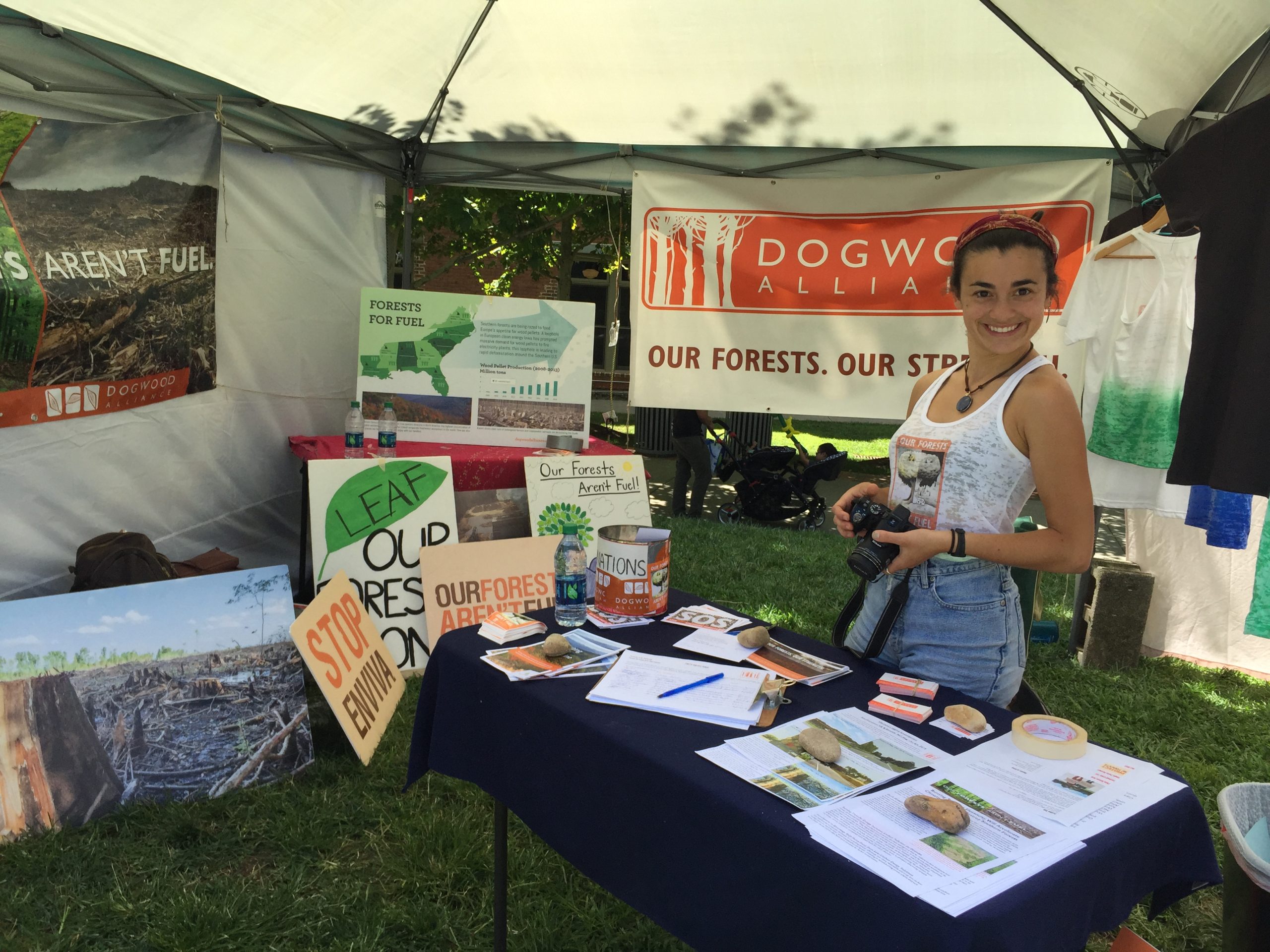
Dogwood Alliance intern Audrey Howarth gets ready for a day of collecting photo petitions from fellow forests lovers!
This summer, I hoped to learn how a nonprofit organization helps bridge the gap between the input of local people and that of elected officials. I was eager to understand what role nonprofits played in influencing policy at both local and global levels. As the “Our Forests Aren’t Fuel” Policy Intern here at Dogwood, I experienced this firsthand. I worked very closely with campaign organizers here at Dogwood to develop strategic policy angles to stopping the biomass industry in the Southeast. It just so happened that a large portion of this exploration occurred either in, around or via Betina.
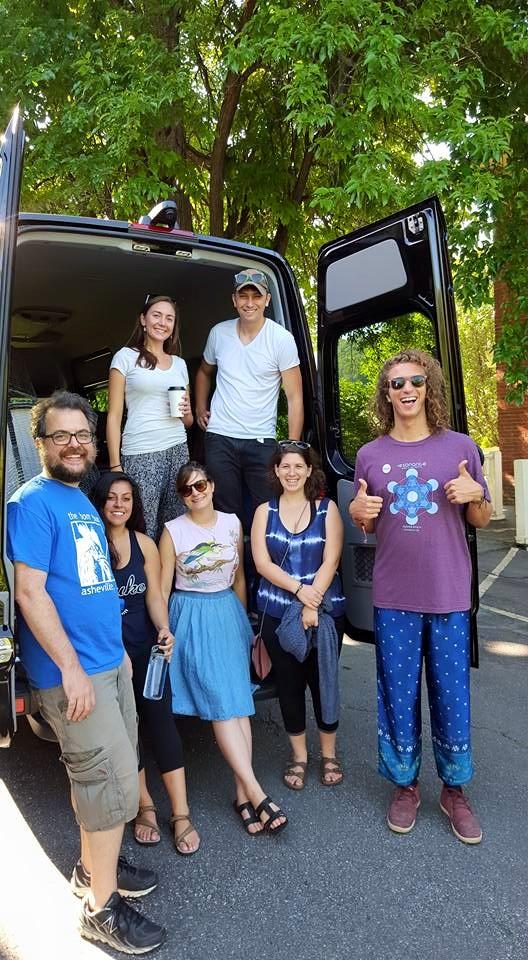
The SOS Tour team poses with Betina as they get ready to take-off for the Launch in Baton Rouge.
What or who is Betina, you ask? Betina is none other than the super rad tour van that I traveled around in for roughly 2 weeks across 5 southern states in the U.S with 6 incredibly passionate people. We were on our Save Our Southern (SOS) Forests Tour. We set out to raise awareness and equip communities across the South to challenge the destructive biomass industry and send a clear message to decision-makers that our forests aren’t fuel. Throughout the course of 2 weeks, we held 10 powerful events in 6 different cities, reaching thousands of citizens and dozens of local organizations.
My top priority for the summer was to lead outreach and recruitment of local elected officials to attend events in each tour location, engage with the issue, hear the concerns of community members regarding biomass export facilities in their cities and have meetings with us. I succeeded in reaching over 80 elected officials across the Southeastern US who became aware of this issue. More than 500 local citizens united by sending SOS messages directly to decision makers, engaging with local officials and creating SOS human banners.
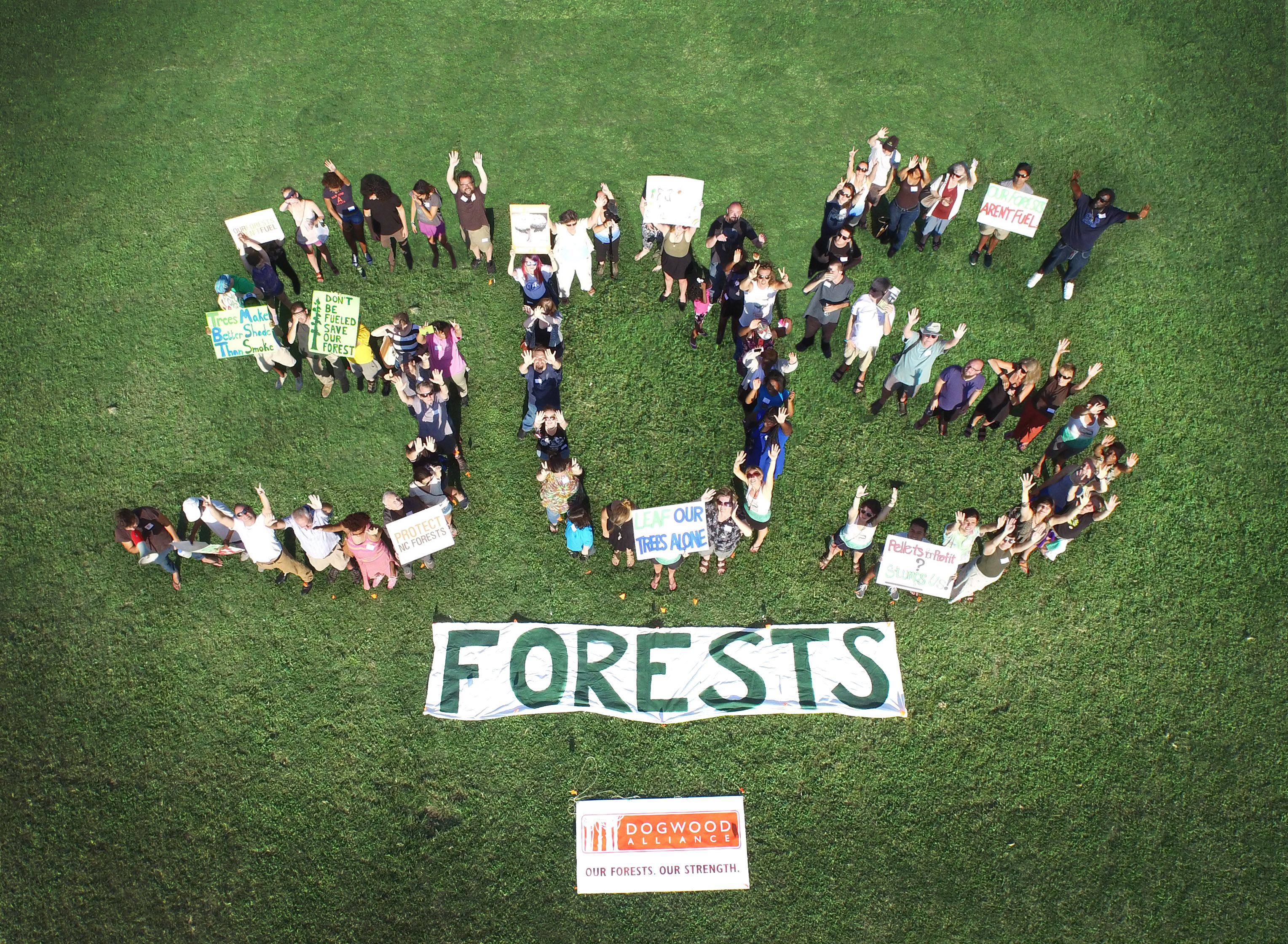
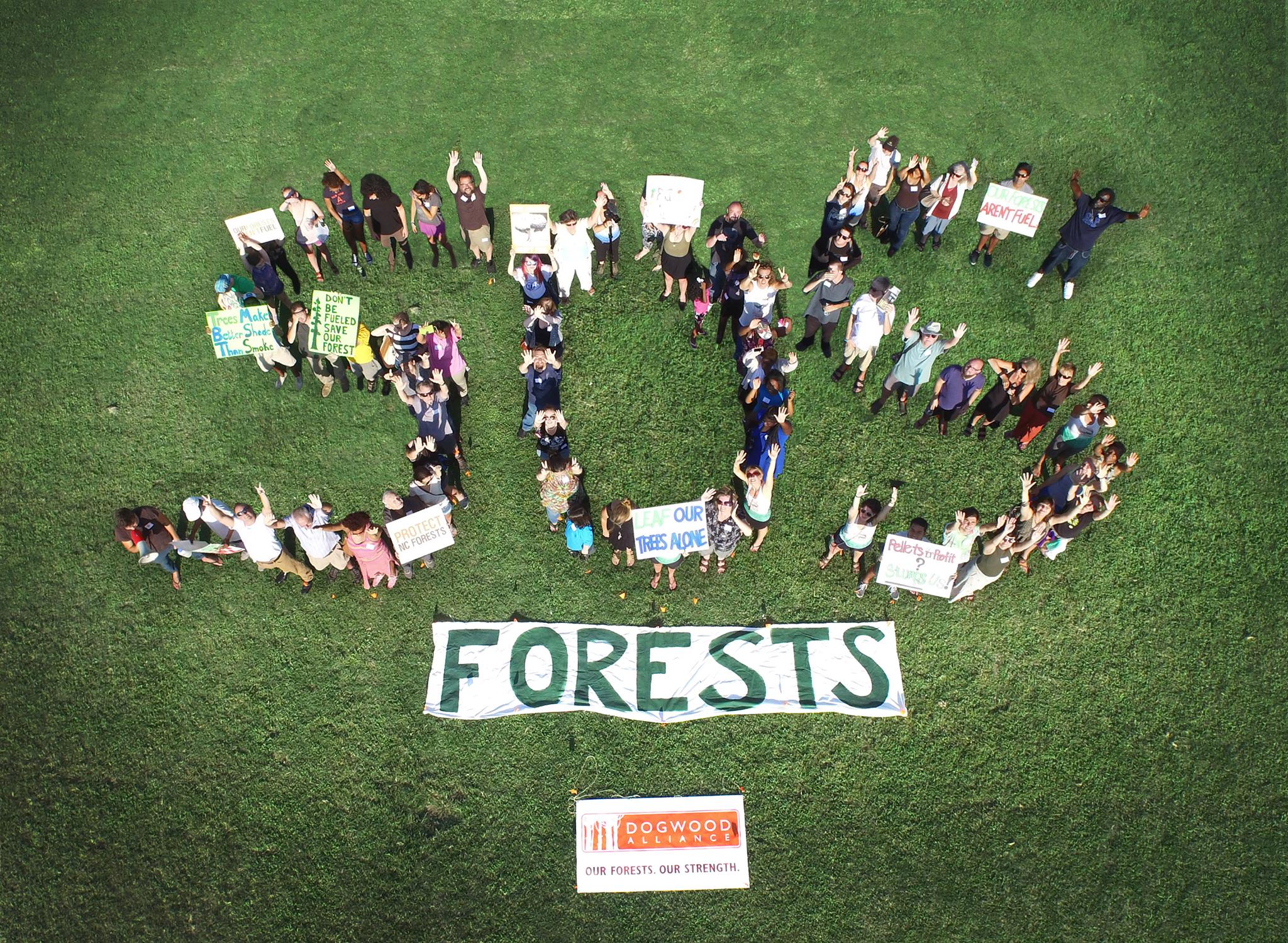
Community members form a giant human SOS banner at a tour event in Savannah, Georgia.
The SOS Tour events generated incredible dialogue about what can be done to change the way our forests are valued and how we can work together to highlight the fallacies of the biomass industry. Local communities are now aware of biomass facilities in their area and how the industry poses serious threats to our health and lifestyles, destroys much of the biodiversity in the Southern US and is entirely driven by unsustainable subsidies, which creates unfair competition with our traditional wood products industries. I loved recruiting elected officials for these events because their engagement with this issue is critical to mitigating the effects of the biomass industry.
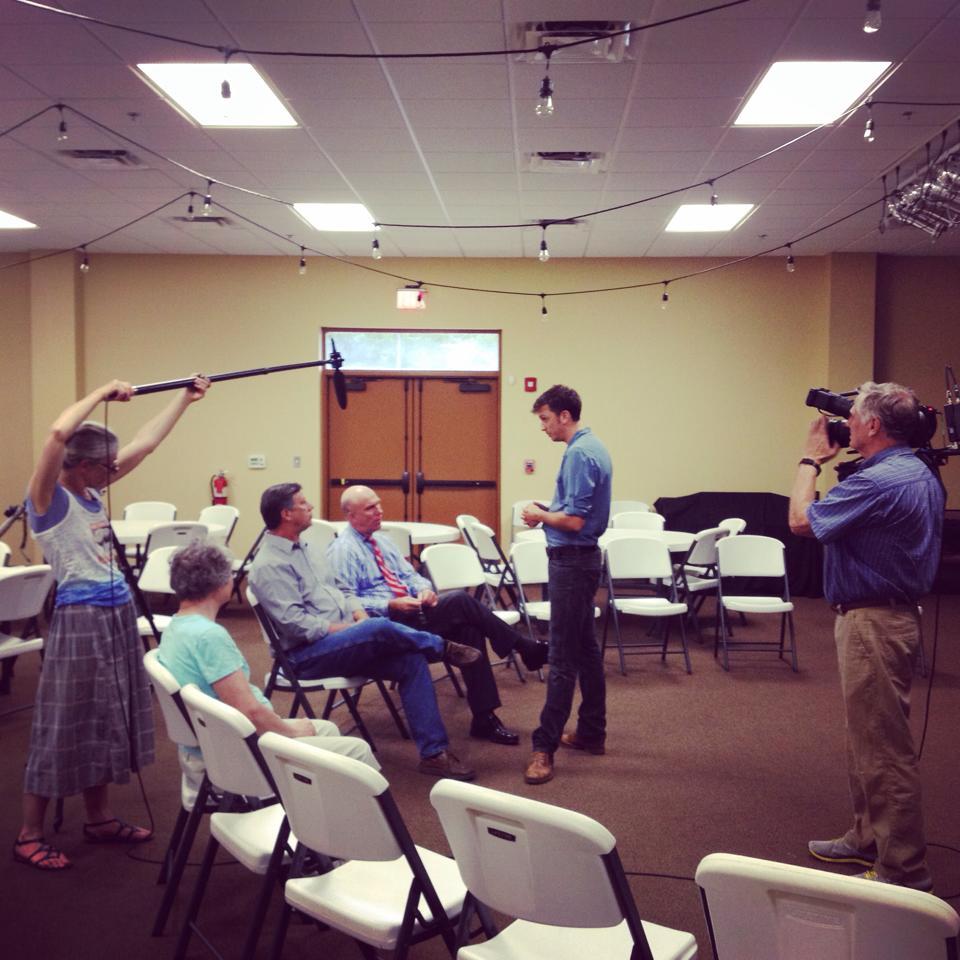
Campaign Director, Adam Macon, speaks with County Commissioner William Dozier before a community meeting in Panama City, Florida.
In addition to recruiting officials, I also collected petitions, created and edited campaign materials, phone banked and organized post-tour follow-up and wrap-up statistics. Outside of the SOS Tour, I created an investigation flyer for Dogwood’s most recent investigation of a biomass facility in Southampton, VA and Ahoskie, NC. I also communicated with Australian elected officials, encouraging them to vote against the inclusion of native forest biomass in Australia’s renewable energy target. Post-tour my top priority has been recruiting a diverse group of organizations across the South to sign a letter to the EPA to help protect Southern Forests.
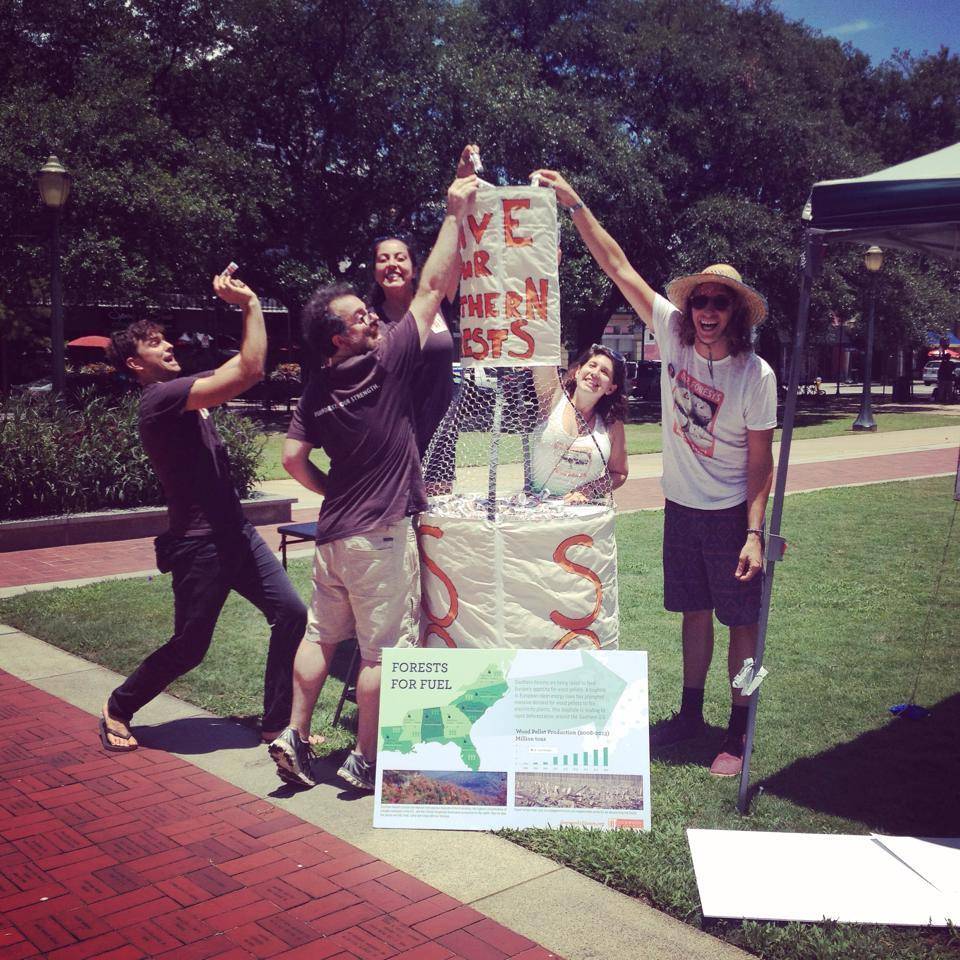
The team starts collecting petitions in Mobile, Alabama to send an “SOS message” in a giant bottle to European policymakers.
Betina was an integral part of my experience here at Dogwood. She helped me travel with the team to meet with effected communities to identify key concerns and ways to address these issues. She facilitated my development of a strong understanding of the biomass industry and campaign messaging. She even exposed me to a variety of methods for change, including organizing, policy advocacy and local government. However, the 6 other bodies that Betina transported were what made my experience here at Dogwood incredible.
My team, along with my other co-workers at Dogwood, are some of the most intentional, passionate, supportive people with whom I have ever had the privilege of working. They inspire me each day to work for a better world and a better me. Whether it’s packing extra cherries to share around the office at lunch time, teaching others how to race crabs at the beach or recycling cigarette butts, these people are so aware and intentional with their actions. I can only hope to surround myself with such a community in the future, and I look forward to witnessing the change they make beyond the foundation we have laid this summer.
I recently traveled to Florida to meet up with the Dogwood Alliance in Panama City. On the journey from North Carolina, I took the road less traveled and explored the byways that stretch from the Southern Appalachians to the piney woods of the beautiful Emerald Coast. Along the road, I noticed the further south I ventured the higher the frequency of desolate landscapes and clearcuts amidst our southern forests.
This was the reason for my journey. I have lived in the South nearly half my life. And I as get ready to celebrate my birthday next month, I realize that I have been working for 15 years to protect Southern forests and help Southern people and economies prosper. Over the last year, my passion has been guided to conversations on climate change via my new project, the Climate Listening Project, a storytelling platform for conversations on climate change resilience. It has come to my attention that some people have determined that the best way to fight climate change is to burn the very forests that are supposed to protect us from it.
The Dogwood Alliance is an inspiring organization bringing together people around the world to safeguard the environmental and economic value of forests. This summer, they traveled around the Southeast to port cities from Wilmington to Baton Rouge on an #SOSforests Tour, bringing people together along the way to send out a big SOS across the Atlantic. Check out the tour video below. I have to give a shout out to Climate Listening Project editor Andrea Desky of K23 Media who put it together! You might just see me smiling at :24 and talking with my hands at 1:07.
[youtube]https://www.youtube.com/watch?v=jHgBs7jZhZU[/youtube]
I am really inspired by how many people are adding their voice to this important issue. Why? Because we are paying to cut down and destroy our Southern forests, including old growth forests, to be shipped across the ocean to Europe and burned for energy. What!?! I know, it seems strange, but believe it or not, this is being called renewable energy by some. The thing is – what we are losing is not renewable. It is actually extraction, not only of the forests, but of people and communities.
A new report prepared for Dogwood Alliance by Key-Log Economics shows that the long term consequences of biomass far outweigh any suggested benefits. Standing forests provide critical ecosystem services, supplying coastal communities with natural storm protection and abundant and clean drinking water; plus, using wood pellets as fuel for generating electricity is likely to accelerate climate change with enormous economic costs that would disproportionately impact our coastal communities; and the increased degradation of forests and the natural services they provide could significantly limit a community’s ability to attract new businesses and residents, one of the most important factors affecting economic growth across the South. Plus, biodiversity!
In a recent interview, Danna Smith, executive director of Dogwood Alliance talks about the report:
Our rural communities and broader regional economy are bearing the brunt of the long-term costs. It is pretty clear that growing the wood pellet export market is not a sound economic development strategy for the rural South in the 21st-century. This is a classic economic justice issue where a few are benefiting at the expense of many. It’s time to put the brakes on funneling hard-earned taxpayer dollars into the pockets of wood pellet manufacturing companies and European utilities.
Boom! Danna inspires me. If Danna and the Dogwood Alliance team, and all the people who are raising their voices together, inspire you to protect our forests and communities, then please -> Join the SOS!
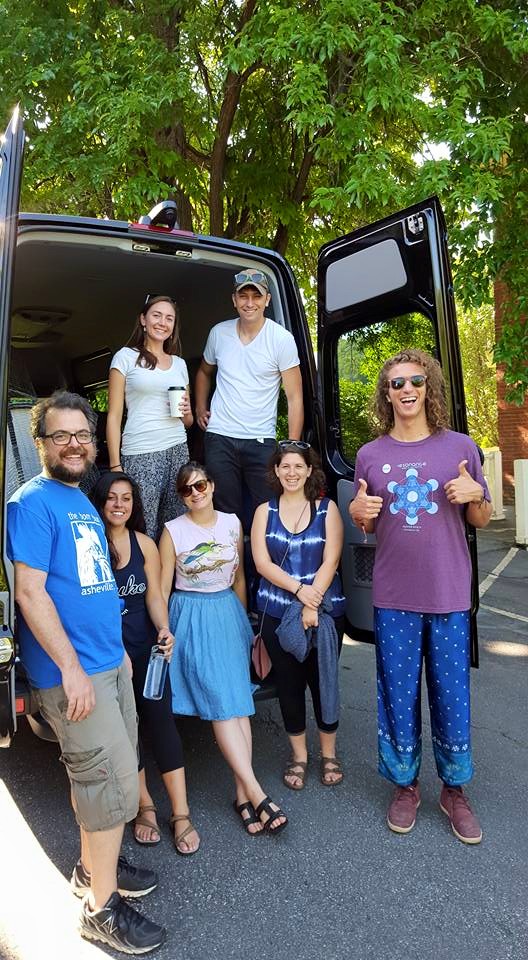
The Dogwood SOS Tour group gathers for a send-off
This summer I had the privilege of working on the Our Forests Aren’t Fuel campaign as an organizing intern. As a second summer intern and student board member, I was excited to dive into a campaign I’ve been following closely and learn about the organization from yet another angle. Under the leadership of Campaign Organizer Emily Zucchino, my responsibilities included assisting with SOS Tour promotion and outreach, logistical support, volunteer engagement and on-the-ground tour work.
When I arrived in the office in mid-May, coordination of the SOS Tour to Save Our Southern Forests was already well underway. I began helping to iron out travel logistics and lodging arrangements as well as developing city profiles to make our journey across five Southern port cities smooth sailing.
The most time-intensive task was phone recruitment for the tour. Phonebanking is one of the most effective methods for getting folks to turn out for an event, and attendance for our SOS human banners in Savannah and Wilmington was crucial. To manage the timing and effectiveness of our phone recruitment strategy, I coordinated our calling schedules and spreadsheets and wrote phone raps (campaign blurbs for voicemails and for guiding conversation with people on our list). During this time, I worked with Rowdy Keelor, one of Dogwood’s organizers, to plan a volunteer night at the office, not only helping us to reach our phone recruitment goals, but also to engage our Asheville base in the campaign. With the help of local volunteers, fellow interns and staff, we dialed over 1000 numbers! We had wonderful conversations, left some voicemails and had a few hang-ups.
Traveling with the SOS Tour across the Southeast was an opportunity critical to my personal growth as an aspiring organizer. Working with the team to help execute two weeks of tour events and travel proved to be exciting and challenging: from event set-up and breakdown, to spreading the word about the issue to local citizens, to reflecting on our strengths and weaknesses. The constant high energy throughout the tour was palpable, and I was inspired by the passion that both new and veteran activists had in each of the cities we visited.

All SOS Tour petitions go into the SOS Tour bottle to be sent across the ocean to EU decision-makers
In addition to helping make the SOS Tour a success, I also accompanied Dogwood staff on two investigations of Enviva logging practices. During these investigations, I witnessed first-hand the alarming and destructive practices of Enviva, including wetland clearcuts—right up to the edge of the waterway, leaving behind only cypress knees and stumps of awe-inpsiring, old trees. These shocking experiences helped me to communicate the urgency of the campaign to people we met across the South. Like bookends to my internship, I went on these investigations during my first week in the office and one of the last.
Yesterday, President Obama and the Environmental Protection Agency released the historic Clean Power Plan which finally acknowledged that, in President Obama’s words, ‘No challenge poses a greater threat to our future or future generations than a changing climate.’ The Administration affirmed what science has been telling us for over a decade, that climate change is real and bold action must be taken to address this escalating challenge. We applaud President Obama for taking this vital first step.
Our organization works to protect the forests and communities of the Southern US. Over the last five years we have seen a growing rush to burn forests for electricity and call it good for the climate. Unfortunately, Europe thus far has wholeheartedly embraced this false solution to climate change and has been dramatically increasing the destruction of our forests in the form of wood pellets to burn for electricity. Thankfully, the Clean Power Plan does not fully embrace burning wood for electricity at the same level that Europe has.
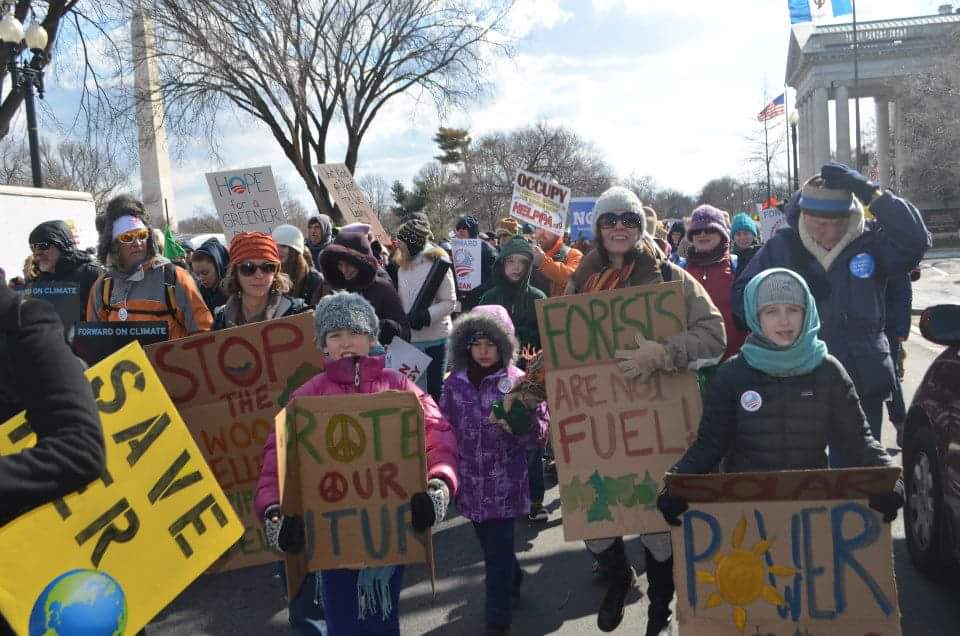
Though we had hoped the EPA would categorically exclude biomass from the Clean Power Plan, they chose not to do so. Instead, they acknowledged that not all forms of forest-based biomass are carbon neutral and with the guidance of their scientific advisory board will be evaluating what feedstocks qualify. If we have learned anything from the European debacle on biomass, we know that burning wood for utility-scale electricity production requires whole trees and high carbon feedstocks to operate, which has been a disaster for our forests.
As the EPA states in their guidance as it relates to biomass, claims of emission reductions ‘must be quantifiable, verifiable, non-duplicative, permanent and enforceable’ with respect to each power plant. The strict guidelines that the EPA has implied for qualifying biomass are a signifier that there are serious concerns about the affects that burning wood has on our climate and environment. In fact, the latest science is showing many forms of biomass are worse for our climate than burning coal. Therefore, unlike wind and solar, which get a full green light, the EPA has urged caution in including biomass in the mix.
Again, this is a step in the right direction, but as with all rule-making there are still many questions to be answered and many loopholes that can be exploited. In a sense the EPA has left it to the states to determine sustainability, what defines forest-derived waste, and potentially the carbon accounting. As we all know, conservationists and the general public have a much different definition of sustainability than the industry. States need to avoid biomass and focus their energy on true renewable solutions like wind, solar, conservation and efficiency.
Biomass advocates will be fighting tooth and nail to burn, burn, burn. They will attempt to exploit the definitions of forest-derived wastes in a way that makes it possible to continue burning everything as usual. We can not, nor should we expect the EPA to be in the business of measuring sustainable forestry or the definition of wastes. Instead, we should categorically exclude most feedstocks besides the small scale use of manufacturing waste and urban trimmings.
Powerful lobbyists and big-monied special interests from the industry will fight to include biomass, and the EPA should have strictly limited it. Now that the Clean Power Plan is a reality it is important that we dig into the details and make sure that most, if not all biomass is eliminated. Otherwise, we will see the fight move to Congress, where friends of the industry will try to falsely legislate the carbon neutrality of biomass.
Forests represent our best defense against climate change. Now is not the time to increase logging, it is the time to put greater investment into protecting forests so that they can do the job they do best.
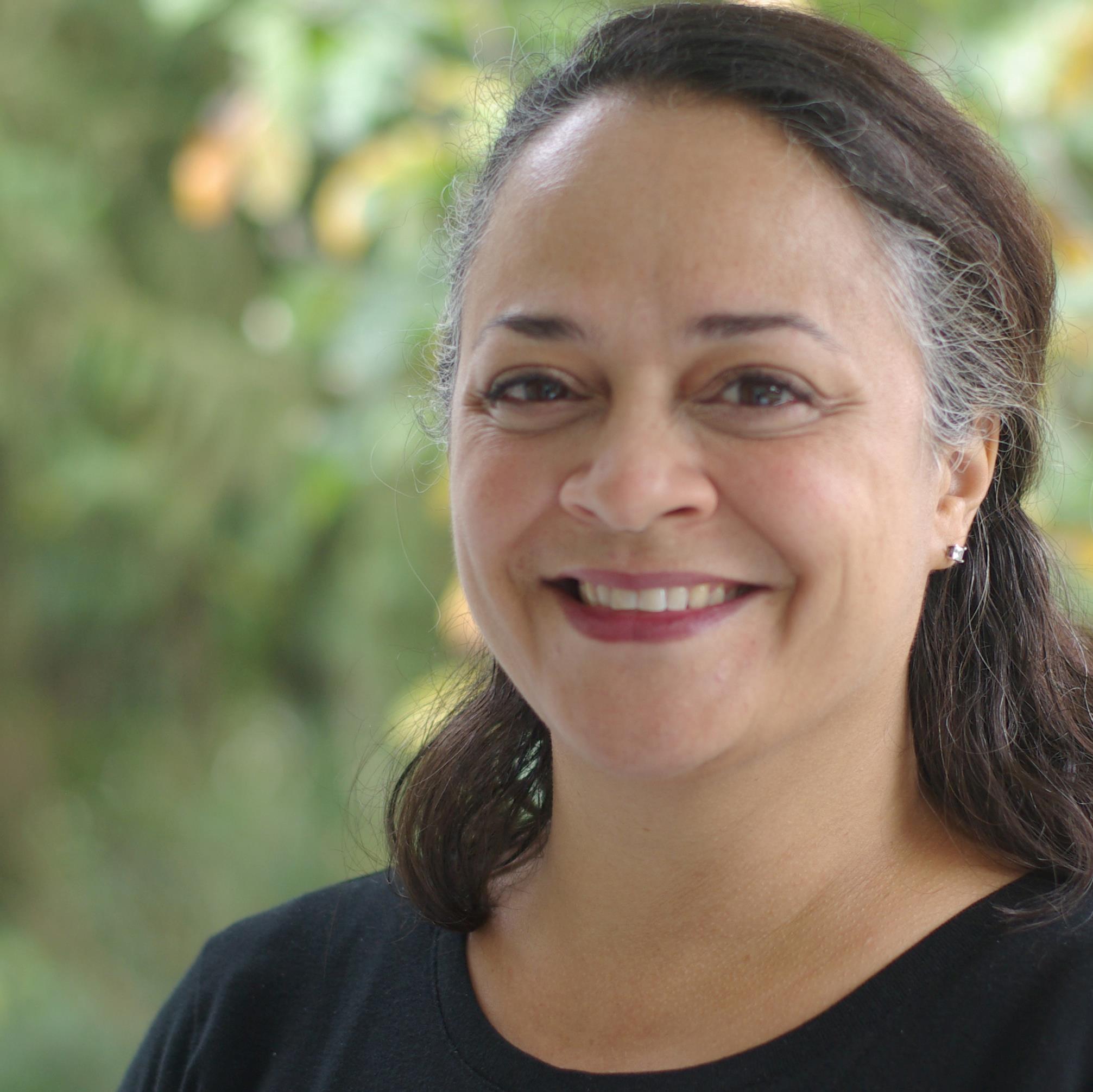
Sasha Mitchell enjoying the outdoors.
Sasha Mitchell is Dogwood’s new Operations Coordinator! What does that mean? It means that our well-oiled machine is only as well-oiled as Sasha keeps it, and in the mere few months that Sasha has been with us, our machine is running better than ever!
Sasha moved to Asheville six years ago. A transplant from New Jersey, you can still hear the faint Northern Accent in her voice, but she has all the warmth and hospitality that would allow you to mistake her for a natural born Southerner. She has brought that warmth and bright spirit to us at Dogwood. Our meetings now come with fresh fruit and muffins, and in her office hangs a brightly colored tapestry that she made herself, depicting Frida Kahlo and flowers of red and orange. She is always happy to see you and always happy to answer any question you might have.
Sasha originally read about Asheville and loved it so much that it was not long before she was living here with her husband, three sons, dog, cat and lizard. Sasha and her husband are also foster parents and are currently caring for an 11-month-old baby girl. Sasha loves the forests and being outside.
In addition to running the ins-and-outs of Dogwood Alliance, Sasha also founded the website Color of Asheville. Before coming to Dogwood, Sasha was a stay-at-home mom self-employed as a professional organizer and family historian. After moving to Asheville and researching for clients, she learned about the YMI Cultural Center (one of the earliest African American cultural centers in the country) and the business district. She says,
All this history started accumulating in my house and in my computer. It kept coming up, ‘Oh! We should have a Black business directory; people need to know this!’ I have a really strong grasp of the history here, just from doing so much research over the years, so now I’m the chair of the African American Heritage Commission.

Sasha Mitchell with her family on Halloween.
Her sons who are 17, 14 and 12 are cosplay enthusiasts. Even though Sasha isn’t herself a cosplayer, she is a very accomplished seamstress and has made all of their costumes for years. She says, “We were in Nintendo Power Magazine because the whole family was dressed up as Super Mario Brothers.”
On being at Dogwood, Sasha says, “I love it here. I feel like I’m a part of people doing really good work in the community.” Sasha used to work in the corporate world, but didn’t feel right there. She explains, “I felt like I was trading off too much and not getting much back from it. Here I work in administrative tasks, but I feel like I’m contributing to something that’s really important to me, so that gives me a really good feeling.” She adds,
“I feel a great responsibility to do my job well.”
All of us at Dogwood feel very happy and excited to have Sasha on the team!
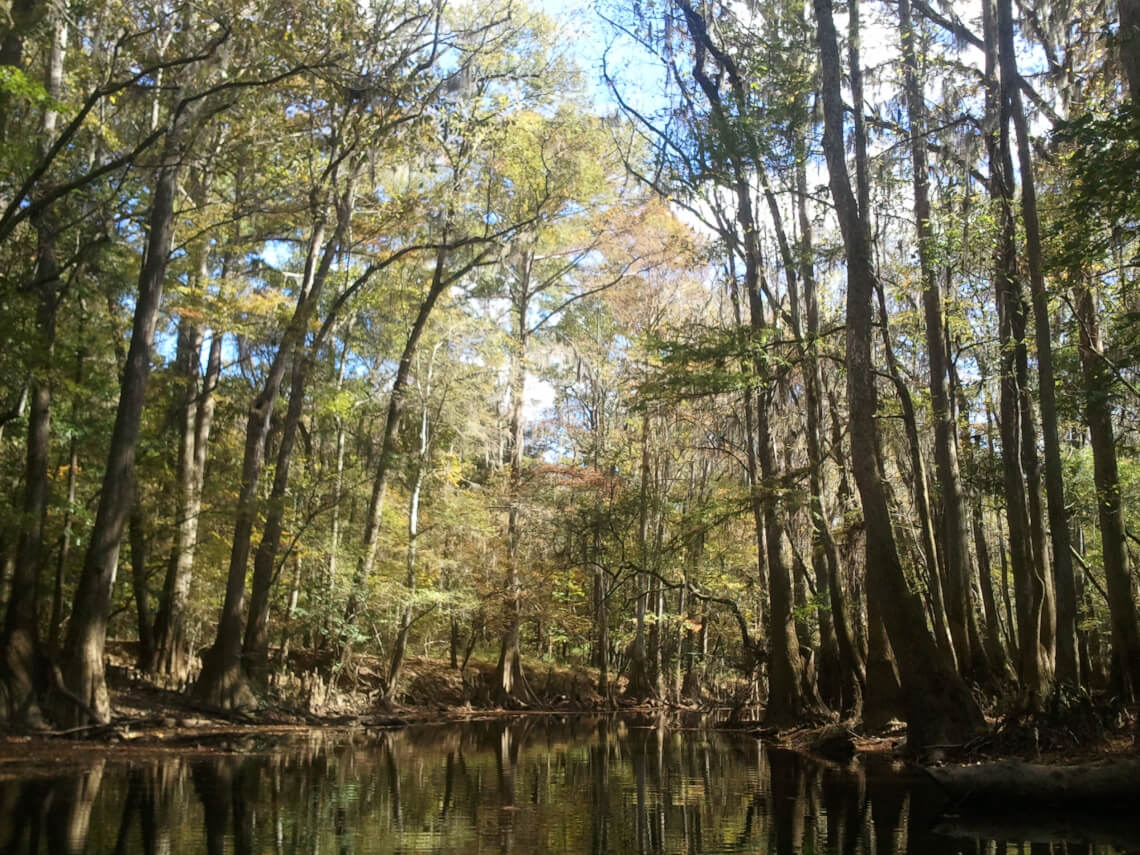
Congaree National Park
Bottomland hardwoods in the Southern United States have been reduced to a small portion of what they once were for reasons anywhere from disease prevention to pine plantation development. The lands that bottomland hardwoods produce are highly fertile, making them excellent for growing any agricultural crop. There are few old growth bottomland hardwood swamps that remain relatively untouched, but places like Congaree National Park are a taste of what could be.
A large part of my role at Dogwood Alliance was to develop materials to work on valuing these bottomland hardwood systems. They hold immense ecological, social and environmental health values that are often identified as a region’s ecosystem services. Bottomland hardwoods are a forested system that is periodically flooded and therefore have a large number of unique and endangered species that exist only in these regions. These low-lying regions have great potential to prevent large-scale flooding and improve water quality through water filtration. They are also massive carbon sinks with stoarage in both the above-ground dead and living trees as well as in the soil. Bottomland hardwoods are historically undervalued, and the land is usually sold for the utilitarian values. Their qualities make bottomland hardwoods much more valuable than what any landowner could possibly get for selling them, clearing them or converting them.
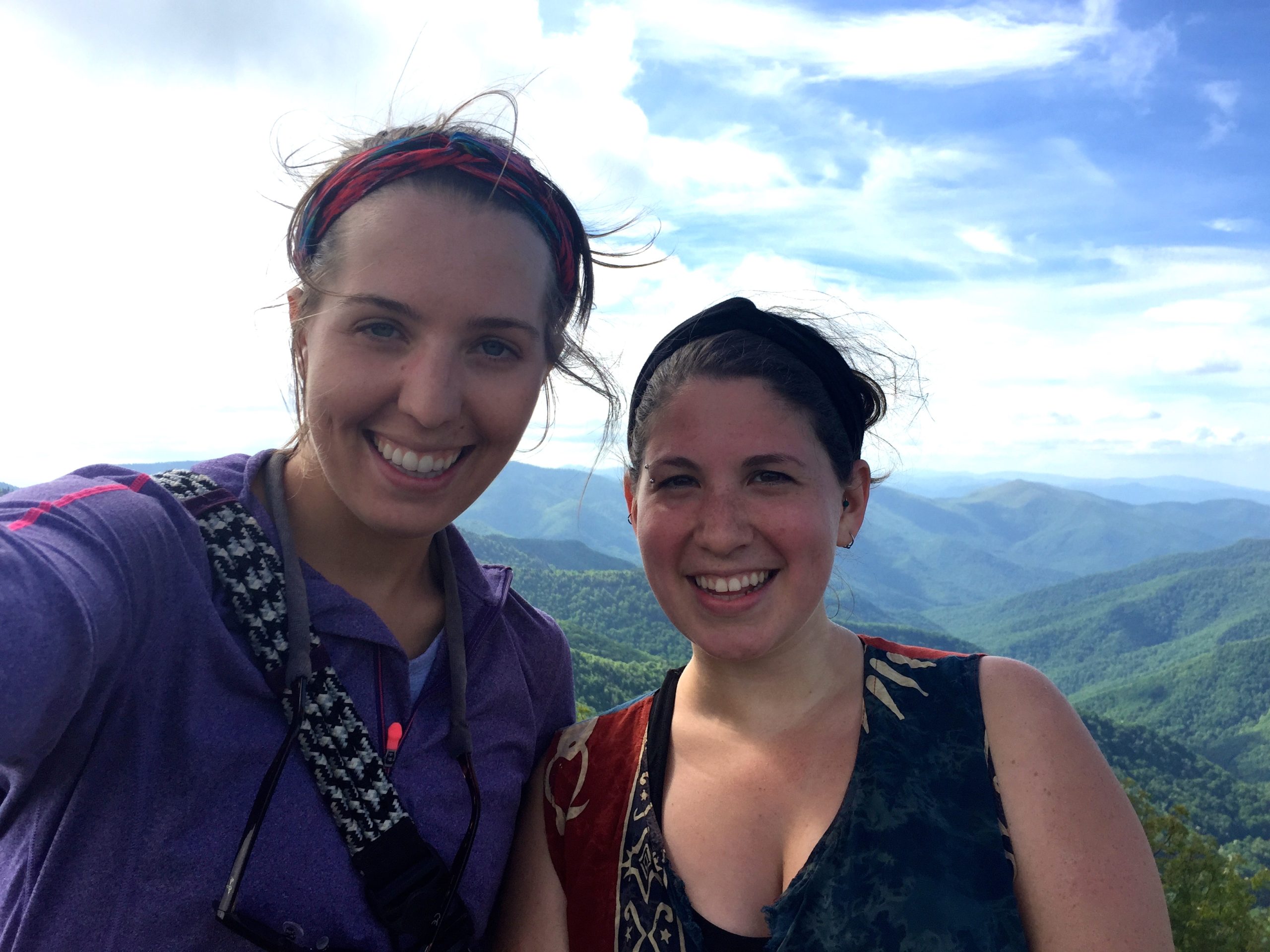
Johannah Ramer and fellow intern Rachel Weber at Sam’s Knob.
Beyond material development, I was able to help generate knowledge and interest around the Our Forests Aren’t Fuel campaign through phone banking and tabling.
It was a true honor to be able to experience this first-hand in helping with the campaign.
My experience has taught me a great deal about all of the pieces that go into making a true positive difference in the environment, and I look forward to taking this knowledge with my as I more forward in my environmental career.
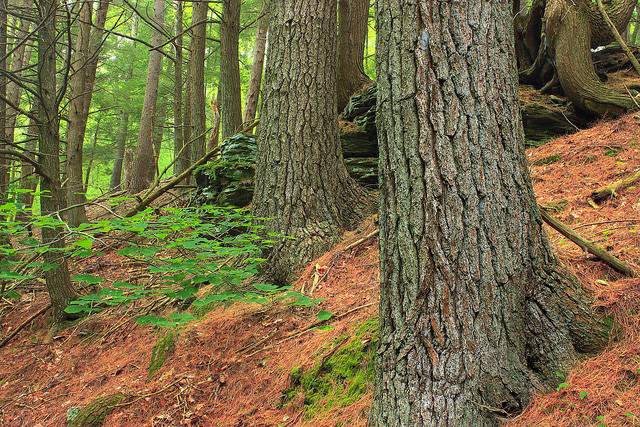
Eastern white pines
The white pines of Michigan were 200 feet tall and 5 feet in diameter, straight and beautiful. In the 1880s, thousands clogged the swollen spring rivers as they floated to sawmills, where they were transformed into ships, houses and railroad ties. Within 20 years, crazed loggers had denuded 20 million acres. At the end of the boom, the nouveau riche “lumber barons” quickly sold their naked acreage to out-of-state farmers, who soon discovered their new-found “stump prairies” could barely grow radishes.
It’s a story retold across the globe. Virgin timber, those lovely, dark and deep forests that filter water, capture carbon dioxide, anchor the soil, generate medicine and host a Noah Ark’s worth of life – just gone. Stolen.
Half of the world’s forests have already played their part in that story. Today, more than 11 million hectares disappear annually, accounting for 11%-20% of all human-caused carbon emissions. The act of deforestation itself accounts for a staggering 17% of all carbon emissions on the planet.
There are so many ways you can help.
When you purchase wood-based products, look for the FSC (Forest Stewardship Council) stamp of approval. Contribute your time and money to organizations like Dogwood Alliance, Sierra Club or Conservation International.
Clippings fertilize your lawn and transform it into a carbon sink. Think that’s not important? Lawns, which cover more of America than corn fields, are one of the country’s most potent weapons in the war against carbon dioxide.
Plant native, weather-resistant foliage, and reduce your outdoor water usage. Better yet, take a lesson from the hand-planted, 142,000-acre Nebraska National Forest, and transform your Homeowners’ Association into an oak oasis.
White roofs reflect heat, which lowers your monthly electric bill. Your energy rates will go down, and ultimately produce less carbon and other atmospheric pollutants.

Despite zero-deforestation pledges by the government, Indonesian forests are vanishing to provide room for palm oil plantations. Indonesia ranks third in the world for carbon emissions, behind China and the United States. Palm oil is used in everything from makeup to margarine – and the more we buy, the more they burn, so look for products with the sustainable palm oil seal.
Here are a handful of other ideas:
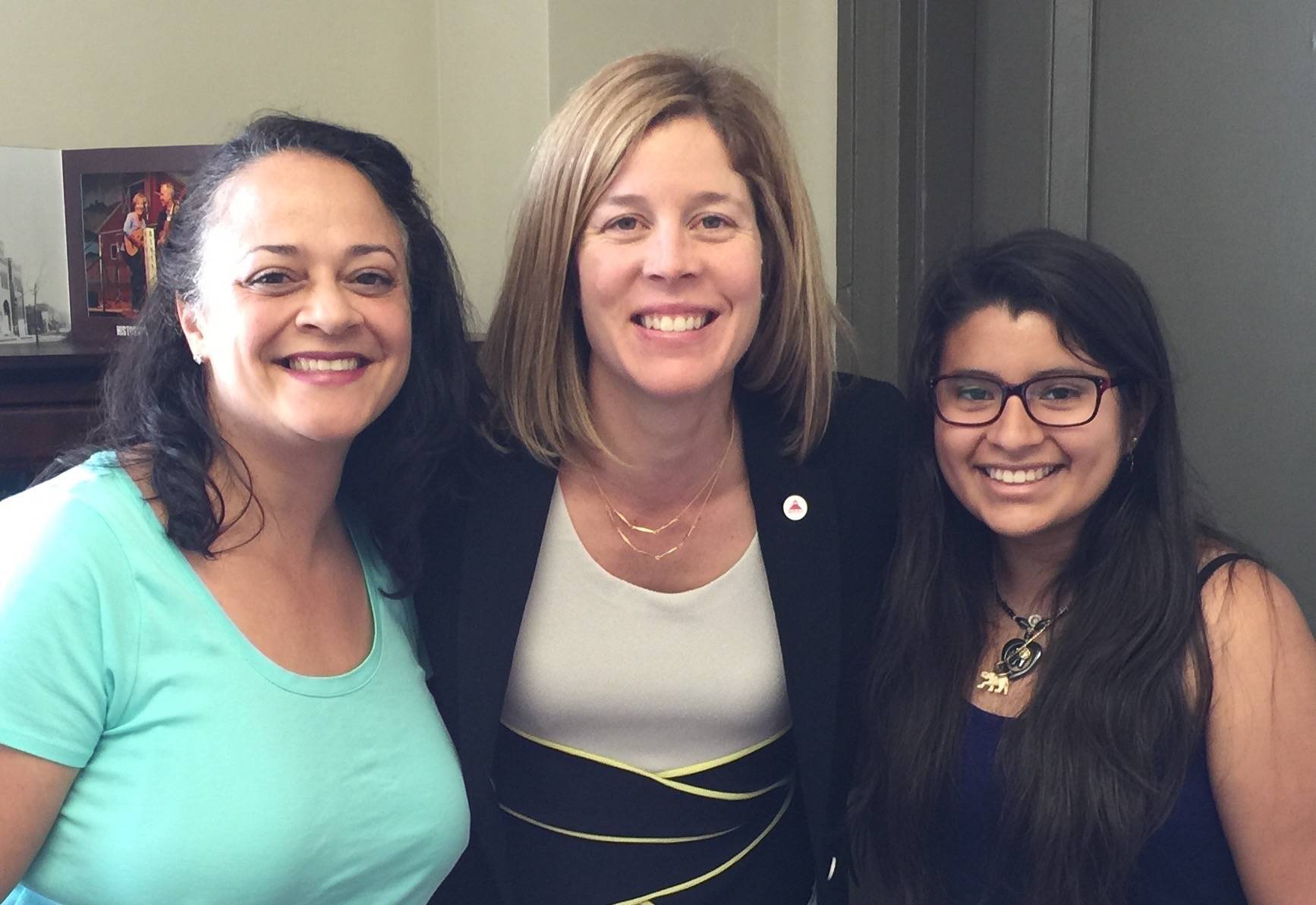
Kimberly Vargas (right) with Asheville Mayor, Esther Manheimer (center) and Dogwood Alliance Operation Coordinator, Sasha Mitchell (left).
Kimberly will be going into the 12th grade this fall at Asheville High School. She is in the SILSA (School of Inquiry and Life Sciences at Asheville) program there.
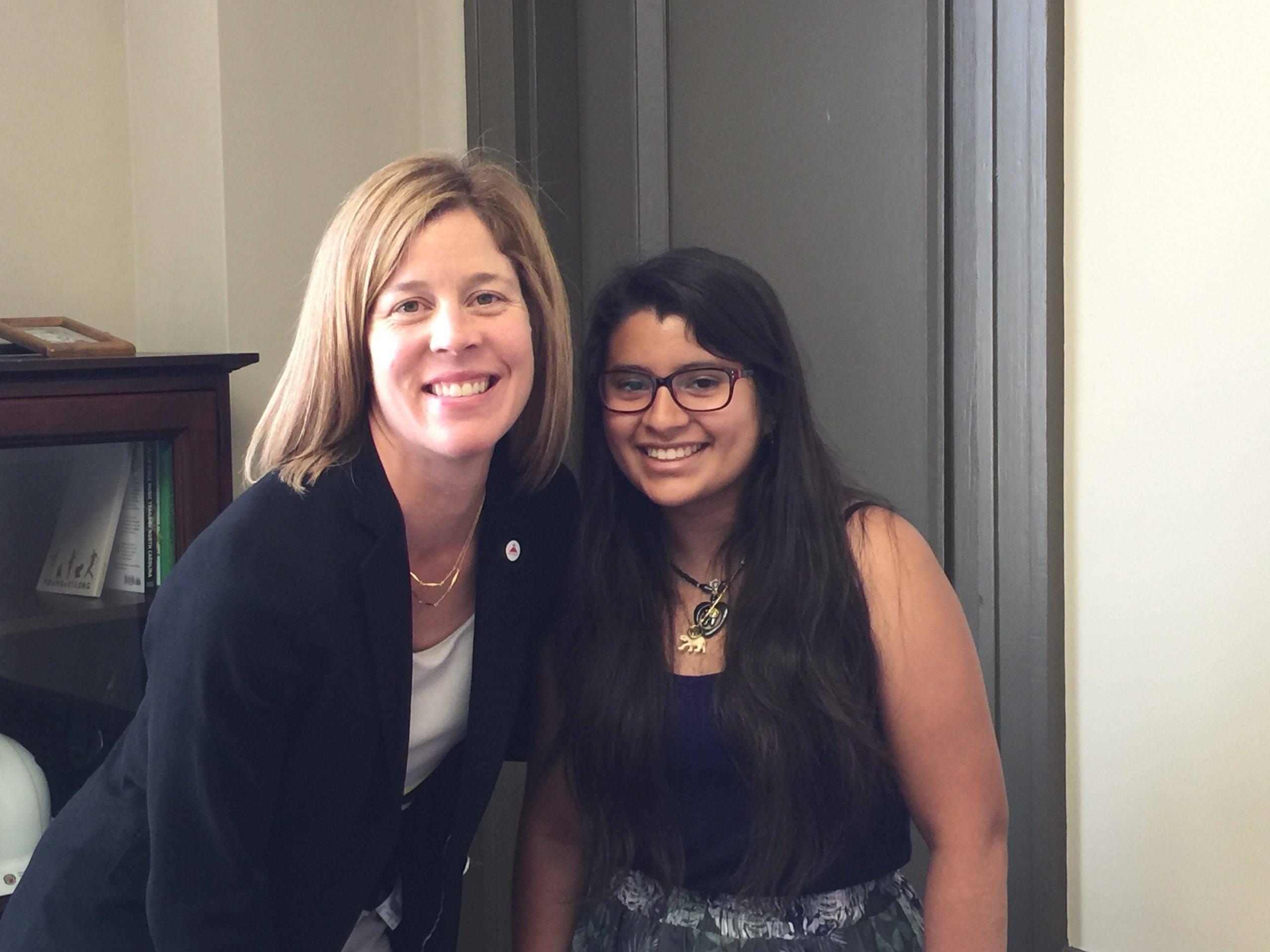
Kimberly Vargas (right) with Asheville City Mayor, Esther Manheimer (left).
Kimberly’s favorite subject is math, “I like numbers,” she explains. Kimberly wants to go into forensics and is planning on going to Western University because of their forensic program. She says,”I want to do forensics because I like puzzles and mysteries.”
In her spare time she likes to read and look at nature. Her favorite kinds of books are mysteries, and she is currently reading Winesburg, Ohio, a collection of short stories by Sherwood Anderson. She likes looking at nature because she finds it calming.
Kimberly got involved with the CAYLA program through AVID (Advancement Via Individual Determination). From the CAYLA website they explain that CAYLA is:
“The City of Asheville Youth Leadership Academy (CAYLA) is committed to providing its students with a) a meaningful summer work experience, b) leadership development through seminars and community service, and c) college preparatory activities, including yearlong academic support. Since its inception in 2007, CAYLA has been nationally-recognized by the U.S. Conference of Mayors and the Harvard Kennedy School of Government. In 2011, CAYLA was honored with the North Carolina Governor’s Award for Volunteer Service.”
We are very excited to work with Kimberly and the CAYLA program this year!


 Donate