
Kimberly Vargas (right) with Asheville Mayor, Esther Manheimer (center) and Dogwood Alliance Operation Coordinator, Sasha Mitchell (left).
Dogwood Alliance is lucky to partner with the CAYLA (City of Asheville Youth Leadership Academy) program each year TO welcome a new youth leader as an intern. This year, we have the privilege to work with Kimberly Vargas.
Kimberly will be going into the 12th grade this fall at Asheville High School. She is in the SILSA (School of Inquiry and Life Sciences at Asheville) program there.

Kimberly Vargas (right) with Asheville City Mayor, Esther Manheimer (left).
Kimberly’s favorite subject is math, “I like numbers,” she explains. Kimberly wants to go into forensics and is planning on going to Western University because of their forensic program. She says,”I want to do forensics because I like puzzles and mysteries.”
In her spare time she likes to read and look at nature. Her favorite kinds of books are mysteries, and she is currently reading Winesburg, Ohio, a collection of short stories by Sherwood Anderson. She likes looking at nature because she finds it calming.
Kimberly was a part of the Ecology Club at school. She became interested in Dogwood Alliance because she was interested in learning more about conservation. Kimberly admires how Dogwood works together with other organizations to accomplish goals.
Kimberly got involved with the CAYLA program through AVID (Advancement Via Individual Determination). From the CAYLA website they explain that CAYLA is:
“The City of Asheville Youth Leadership Academy (CAYLA) is committed to providing its students with a) a meaningful summer work experience, b) leadership development through seminars and community service, and c) college preparatory activities, including yearlong academic support. Since its inception in 2007, CAYLA has been nationally-recognized by the U.S. Conference of Mayors and the Harvard Kennedy School of Government. In 2011, CAYLA was honored with the North Carolina Governor’s Award for Volunteer Service.”
We are very excited to work with Kimberly and the CAYLA program this year!
For the past few years the drum beat for wood pellet exports in the Southern US has gotten louder and louder. State Governors, local officials, European utilities and wood pellet executives have all touted the impact of new jobs in rural communities and growing markets for small, private landowners. Behind the rosy picture that’s been painted about job creation and economic prosperity is another not so pretty picture of the true costs of the unfettered growth in wood pellet exports.
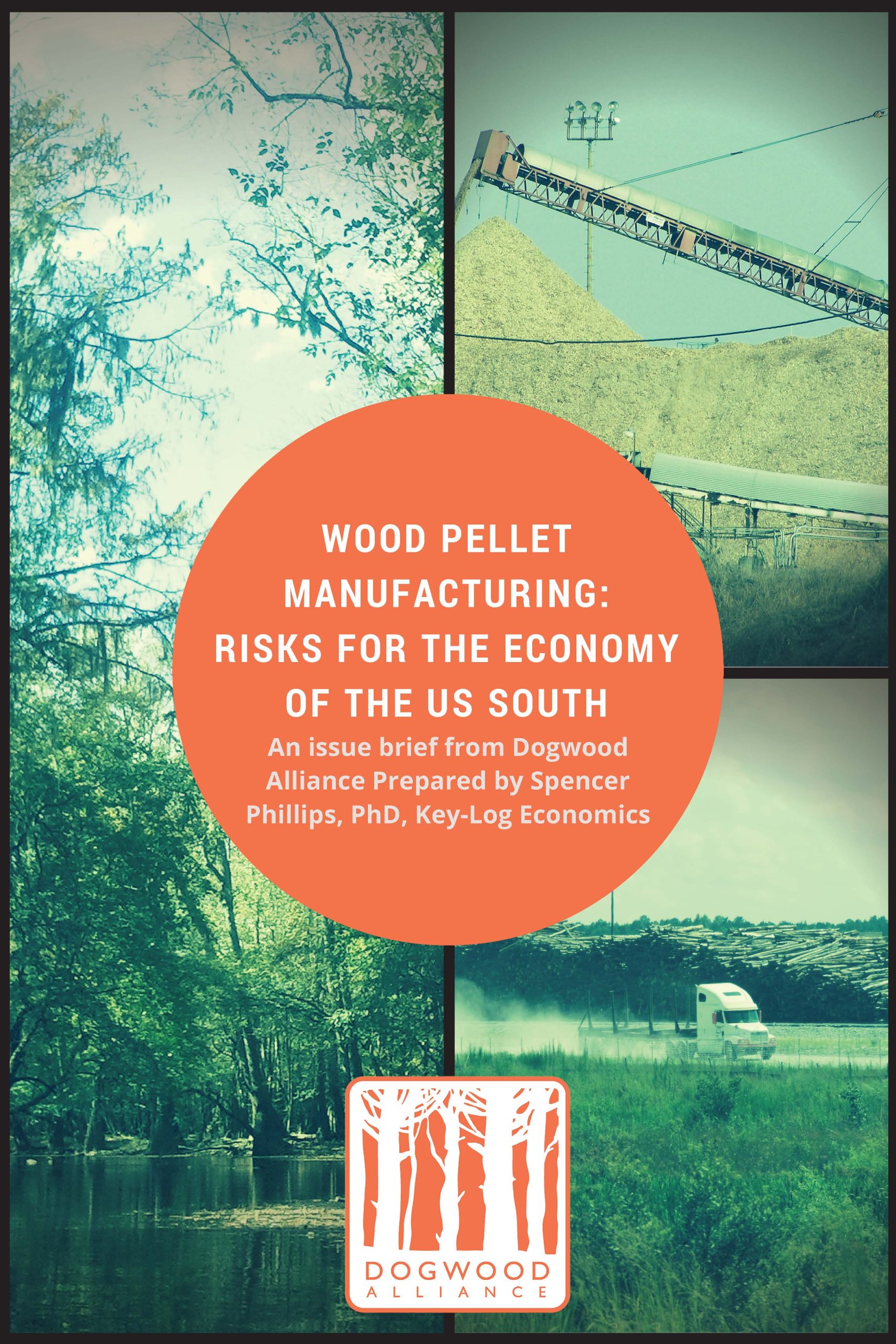 The bottom line? The wood pellet export market is simply not a very smart 21st Century economic development strategy for our Southern rural communities. We can and must do better to support the economic well-being of the South’s rural communities.
Highlights from the report include:
- Switching from coal to wood pellets as fuel for generating electricity is likely to accelerate climate change with enormous economic costs that would disproportionately impact our coastal communities.
- The wood pellet industry’s increased degradation of forests and the natural services they provide could significantly limit a community’s ability to attract new businesses and residents, one of the most important factors affecting economic growth across the South.
- If the rapid build-out of wood pellet manufacturing is allowed to continue to expand without limits, it will likely negatively impact the region’s traditional local lumber, panel and paper manufacturing industries, which create more jobs than wood pellet exports.
- Increased logging and the conversion of more natural forests to plantations could harm long-term timber productivity.
- All signs point to wood pellet exports being a boom-bust market, which will leave rural communities with stranded assets, denuded forests and diminished jobs when the massive government subsidies in Europe come to an end.
- Standing forests provide critical ecosystem services, providing coastal communities with natural storm protection and abundant, clean drinking water. Accelerated logging for wood pellet exports threatens to degrade these economically valuable services with potentially substantial costs borne by the public.
Economists are increasingly recognizing the important economic value forests have when left standing.
They not only naturally generate and purify the water we drink, but they protect us from storms and provide for a stable climate. Beyond that, the scenic, wildlife and recreation opportunities afforded by healthy forests are magnets for creative entrepreneurs and retirees, which encourages a multitude of diverse service and other related businesses to grow and thrive. When forests are degraded, a community’s ability to diversify its economy is limited.
A recent peer-reviewed study on the size and impact of the ecological restoration economy found that the restoration industry is a $25 billion dollar a year industry and employs more people than the logging, steel and coal mining industry.
We should be investing in forest protection and restoration, not wood pellet exports, to support economic growth and rural community well-being.
Further, the South’s traditional and local wood products industries provide jobs and livelihood to people across the rural coastal plain of the South. Yet according to recent USDA reports, the new kid on the block: the wood pellet export industry and its explosive growth threaten to displace traditional wood products markets. Considering the fact that each new job in a saw mill or paper mill creates between two and three additional jobs in the regional economy, while each new job in wood pellet manufacturing creates less than one additional job, it’s fairly clear that if it’s jobs in the forest industry we want to create, wood pellet exports aren’t the answer.
Another major economic issue arises from the fact that the Southern wood pellet export industry is wholly reliant on foreign government subsidies. Massive government subsidies in Europe are supporting big utility companies to convert power plants to burn wood in place of coal. These subsidies have been the sole driver of the wood to fuel market and the rapid expansion in wood pellet manufacturing and export capacity across the South. According to a recent analysis by UK NGO Biofuelwatch, in 2014 UK utility Drax received over 79% of their gross annual profit in subsidies, the equivalent of over $1.5 million per day. That number could rise to over $3 million per day in 2015. Without these subsidies, it doesn’t make sense to burn wood imported from across the Atlantic to generate electricity.
The tax structure that artificially holds this industry up is starting to crumble.
High-ranking government officials in the EU have been on record stating that burning wood “is not a long-term answer to our energy needs” and that the energy policies driving the use of wood as fuel need to be re-examined as scientific reports document that burning wood may actually increase carbon emissions when compared to coal. The UK government just announced that it was scrapping the Carbon tax exemption for Drax, causing the company stock to plummet 28%.
All signs point to this being a temporary European market for wood pellets from the South. This market is driving a lot of new investments now, but Europe isn’t going to subsidize this market for long. As more and more scientific evidence emerges, documenting that burning wood actually increases carbon emissions and destroys forests, the policies driving the substitution of wood for coal must and will shift. When the subsidies run out and the market falters, our rural communities will be left high and dry with a degraded landscape, stranded assets and lost jobs.
The net effect of the wood pellet market has been to develop the US South as a resource colony, exploiting its natural resources for the short-term benefit of a foreign governments and utility companies.
So why are wood pellet manufacturers being subsidized by taxpayer money here in the US? An Enviva facility in Southampton County, Virginia, for example, received $300,000 in the form of one grant from the Commonwealth, plus unspecified amounts in the form of subsidized recruitment and job training assistance, funds from a community development block grant and a Virginia Port Tax Credit. In North Carolina, Enviva was awarded $500,000 from a Community Development Block Grant for its wood pellet facility in North Hampton, NC as well as a Job Development Investment Grant that will yield $1.7 million over 12 years. These subsidies totalling nearly $2.5 million are mere examples of the level of subsidies here at home that are being doled out to wood pellet manufacturers in the name of “economic development”.
Our hard-earned taxpayer dollars are being funnelled to fuel the profits of a few wood pellet company executives for the short-term benefit of utility companies overseas at the expense of the public, our rural communities and our broader regional economy. What are we getting in return? Sure, Enviva and others will provide some possibly short-term jobs, but at what cost? If we factor in the accelerated degradation of important ecological services, forgone economic development opportunities due to forest destruction and displacement of jobs in the traditional wood products industry, the net effect could very well be a loss not a gain in jobs. Landowners aren’t even getting that good of a deal. The wood pellet market pays landowners a mere $2 to $8 a ton for the lowest value wood.
We hope policy-makers and investors on both sides of the Atlantic will take the time to seriously consider the economic costs associated with wood pellet exports. Our rural communities deserve better, and we can do better.

The White House has taken the right position regarding the myth of carbon neutrality of burning trees for electricity. In a statement released today in response to H.R. 2822 – Department of the Interior, Environment, and Related Agencies Appropriations Act, 2016, the Executive Office of the President, Office of Management and Budget, asserted that:
“The Administration objects to the bill’s representation of forest biomass as categorically ‘carbon-neutral.’ This language conflicts with existing EPA policies on biogenic CO2 and interferes with the position of States that do not apply the same policies to forest biomass as other renewable fuels like solar or wind. This language stands in contradiction to a wide-ranging consensus on policies and best available science from EPA’s own independent Science Advisory Board, numerous technical studies, many States, and various other stakeholders.”
Dogwood Alliance is pleased to see the Administration taking a position that is grounded in science and that recognizes the massive threat that a large scale-up in burning trees for electricity represents. Carbon Accounting sounds like a dense and wonky subject…and it is. But if the EPA and other regulatory bodies don’t get the math right when it comes to emissions from burning trees and the true value of our forests, then we will end up increasing greenhouse gas emissions instead of reducing them. Additionally, we will further harm the quality of life in our local communities by increasing air pollution.
It may seem that, given the renewable nature of trees and forests, this resource instead of fossil fuels is the right path, but as NRDC and others have shown, using whole trees for electricity can be worse than coal. Now is the time to invest more in energy conservation and renewables, like wind and solar, instead of an industry that is massively subsidized and impacting critical ecosystems.
Senators Warren and Markey are right to be calling for a moratorium on wood-based bioenergy in the Clean Power Plan. They recently issued a letter to the EPA, maintaining that by treating biomass power plants as if they have zero emissions under the draft Clean Power Plan, EPA risks undermining the ability of the Plan to actually reduce emissions from the power sector.
Dogwood salutes the leadership of these Senators and the White House in taking a position and looks forward to supporting more elected officials in recognizing the dangers of utility-scale use of trees for electricity. Southerners from Louisiana to Virginia are increasingly standing up to stop their forests from being burned for electricity here or in Europe and will continue to press local, state and national politicians to take the same bold step that the Obama administration has.
For far too long extractive industries have disrupted and degraded communities across the Southern U.S. From coal and oil to dangerous pipelines and industrial logging, our quality of life, local economies, and natural world are being sacrificed to the detriment of many for the benefit of a few.
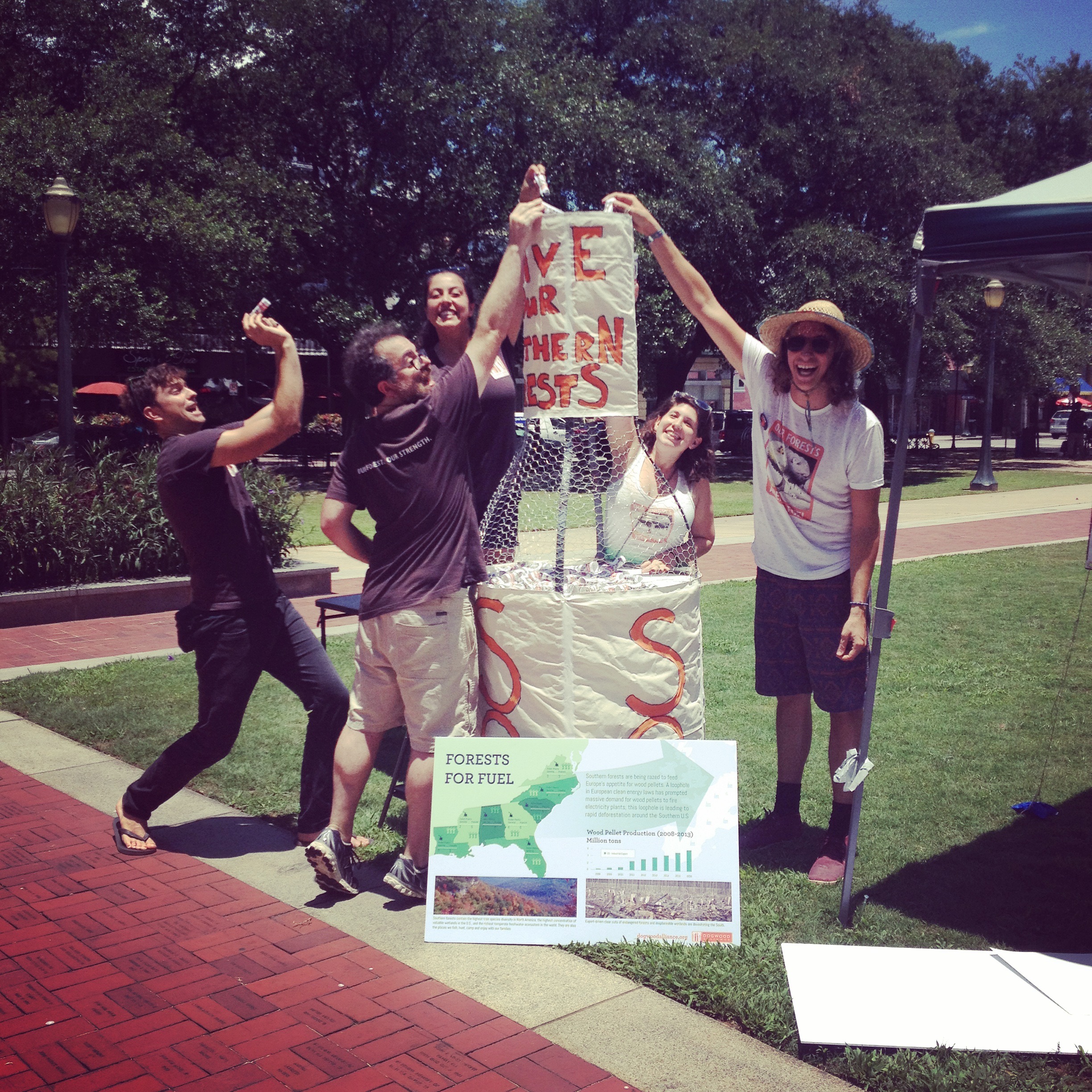
The emerging biomass industry, led by companies such as Enviva and Drax, is adding fuel to this fire (pun intended!). The biomass industry is clearcutting our forests – we’ve proved it and went on tour to stop it. On June 15th our team of Dogwood Alliance forest defenders left our home base in Asheville, NC on the Save Our Southern (SOS) Forests Tour. We took to the road with a mission to raise awareness and equip communities across the South to challenge the destructive biomass industry and send a clear message to decision-makers that our forests aren’t fuel.
We’re pleased to report: mission accomplished! Over 2 weeks we held 10 powerful events in 6 different cities, reaching thousands of citizens and dozens of local organizations. These amazing people came together in unison to echo the SAVE OUR SOUTHERN FORESTS call.
Below are some highlights from the SOS Tour.
After kicking off the SOS Tour in Asheville, we headed down to Baton Rouge, LA, ground zero for extractive industries and new home to the British utility Drax. At the event our team was deeply moved by speeches from local activist, Shamaka Schumake, and leader of the Green Army and American hero, General Russel Honore. Both made bold anti-biomass statements highlighting the fact the Louisiana has welcomed this industry with open arms through subsidies, embracing the export of its forests and degradation of its communities. One of our favorite quotes came when Ms. Schumake said, “They put up those pellet domes, now lets take them down!!”

In Mobile, AL and Panama City, FL the SOS Tour was honored to meet some of the most passionate and committed activists in the Gulf South. The local band Sassafrass even wrote a song for the tour! Our community meetings in these locations generated incredible dialogue about what can be done to change the way their forests are valued and how we can work together to change the narrative around biomass and stop its expansion. We can’t wait to continue building power in Alabama and Florida.
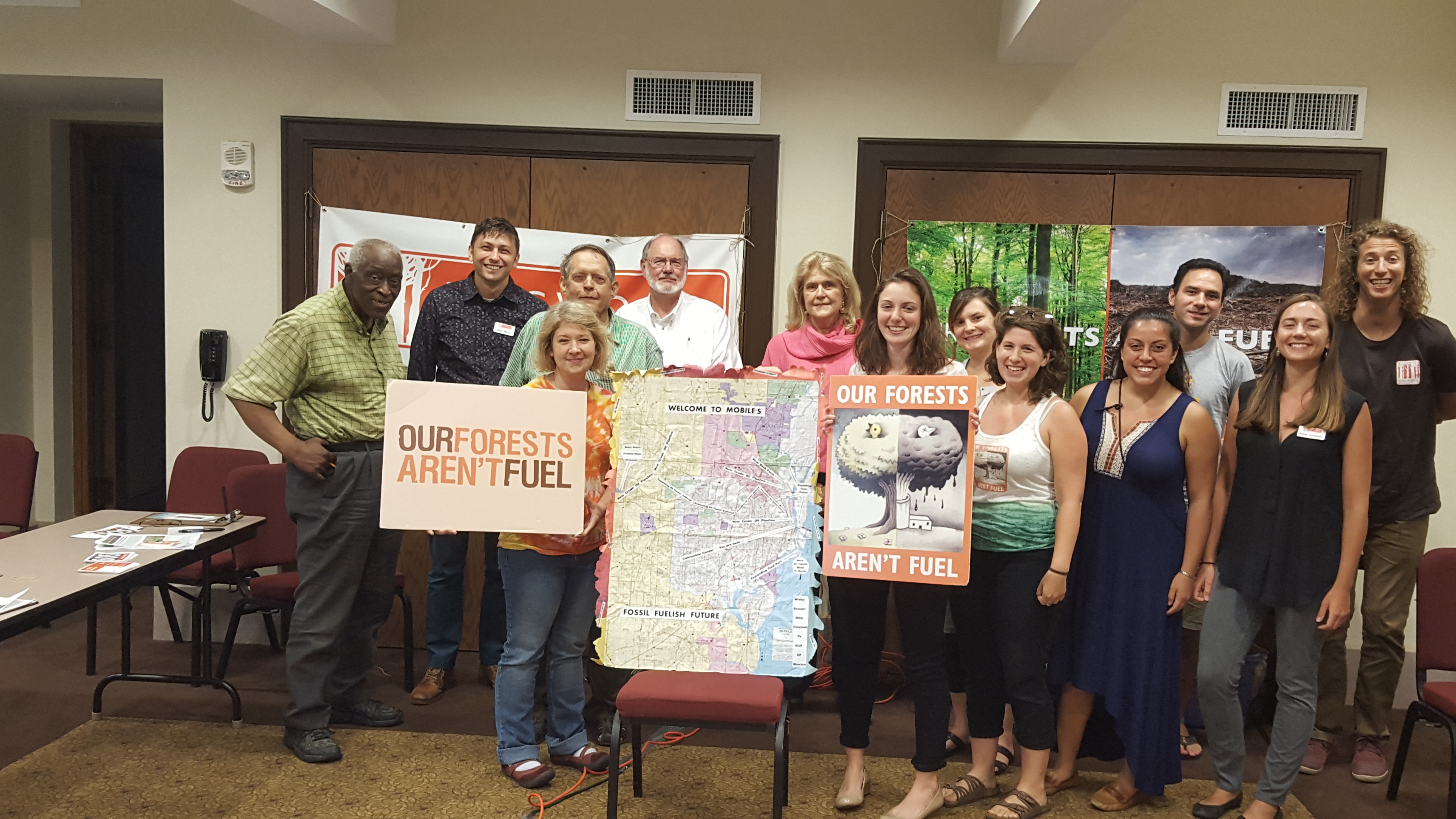
From the Florida panhandle we made our way over to Savannah where the SOS movement is growing at an exponential rate. Hundreds of people joined us throughout the day for our two events. Capped off by individuals coming together for a powerful SOS human banner photo that will stand as a uniting image for our movement. Europe hear our call: Savannah says: Save Our Southern Forests!!
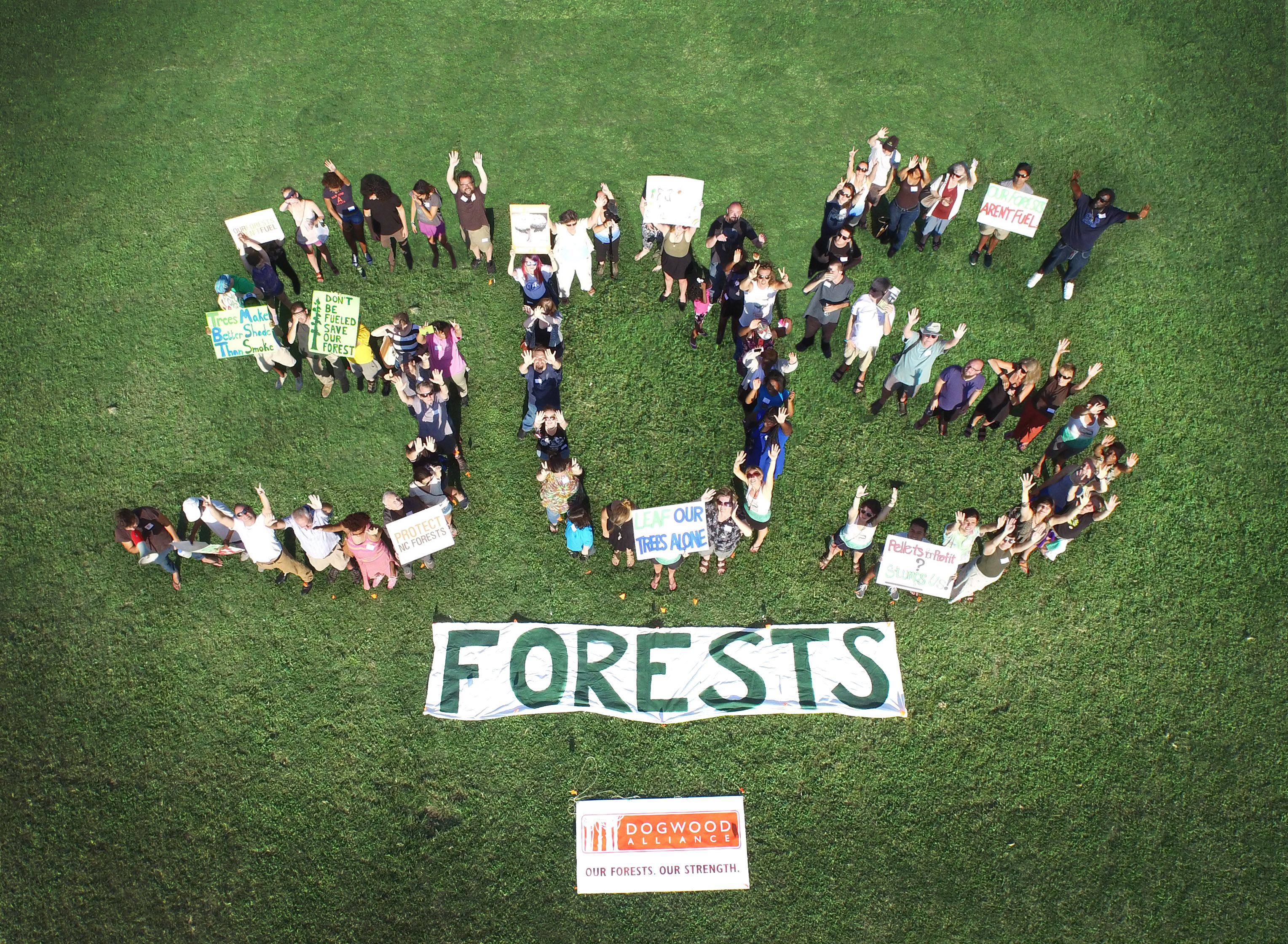
Finally, the SOS Tour journeyed up the coast to Wilmington, NC whose skyline was recently tarnished with huge wood pellet export domes built by Enviva. This fight is personal for those of us living in North Carolina. Multiple times our campaign has documented Enviva clear cutting our wetland forests and turning them into pellets. They consider our mature Cypress swamps as “waste” or “low value,” but for the people of Wilmington and surrounding coastal communities, nothing could be further from the truth. While Enviva attempted to combat our presence there by paying for a full page ad in the local paper, local citizens united by sending SOS messages directly to decision makers, engaging with local officials and demanding change, and creating yet another SOS human banner.
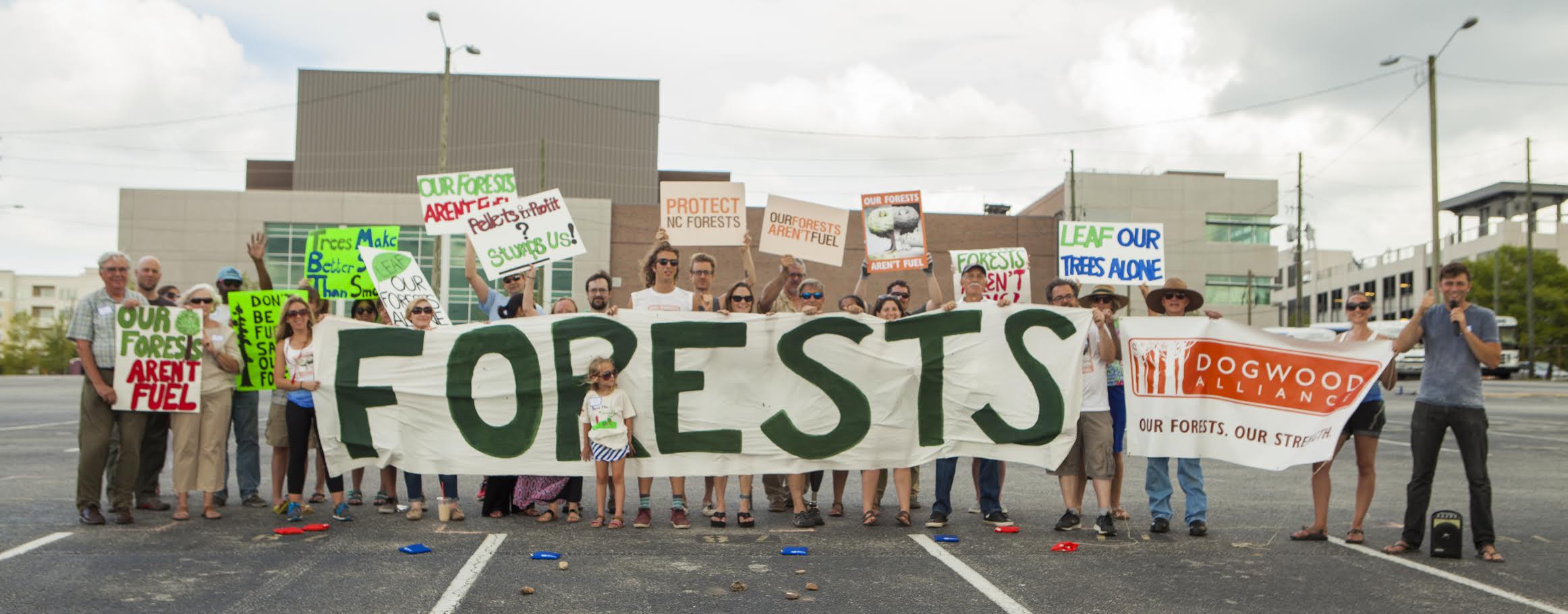
The industry may think that they can continue to paint a false picture and buy their way out of being held responsible, but our movement is here to say, “keep dreaming.” The SOS movement is growing, Southern communities are rising up, and we will no longer stand silent as our forests are clearcut and burned in the name of green energy. Join us. #sosforests. We’re going to win.
Cross-posted with permission from the Jonas Gerard Art Blog
Dogwood Alliance Launches SOS Campaign at Jonas Gerard Gallery in Asheville
Abstract art and forest preservation may seem an unlikely pairing, but with passion and purpose as common denominators, the two make perfect sense. Based out of Asheville, Dogwood Alliance is a nonprofit organization ardently devoted to protecting our Southern forests; and abstract artist Jonas Gerard is passionate about many things, especially the transformative power of art.
So when the nonprofit needed a different sort of venue for its Save Our Southern Forests (SOS) campaign launch event, the Jonas Gerard gallery at Riverview Station provided just what they were looking for—an inspiring and interesting place that mirrored their passion and would engage their local supporters and donors.

The vibrant mural welcomed Dogwood Alliance supporters and donors
While Shannon Barrett, the organization’s Advancement Director, was in the gallery considering the space for the kickoff event, one painting in particular stood out to her. Something in the bold and vibrant, River Park Vignette #8 reminded her of a forest. That connection with the piece along with the gallery’s open space, many alcoves, and of course, walls of artwork compelled her to hold the SOS Tour Send-off party there. “We wanted something new and wonderful to entice our local supporters. Jonas’ art is so passionate and organic. The place was part of the event,” she said.

River Park Vignette #8 34″x 84″ Acrylic on canvas
With about 60 people attending on June 11, 2015, the night included food, drinks, a lively and informative discussion led by Dogwood Alliance’s Campaign Director Adam Macon and music by Josh Phillips and Suzanna Baum. It also included a visit from Jonas. “He was amazing. He hung out and mingled with us. We appreciated it so much,” Barrett said.
The gratitude flows both ways. Jonas is thankful to have an inviting space for groups to have events such as the one organized by Dogwood Alliance.
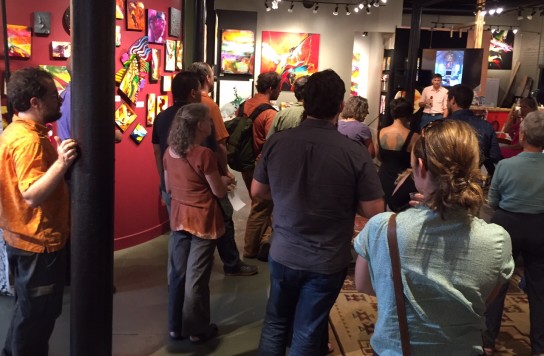
Adam Macon discusses the SOS campaign with a lively crowd
 PRESS RELEASE FOR IMMEDIATE USE: Thursday, June 18, 2015CONTACT: Oliver Munnion, 07917693337, [email protected].ukSuzie Gilbert, 07523 742 072, [email protected]
Giant White Elephant Delivers Over 110,000 Signatures to Demand UK Stop Funding New Coal Plant Using Public Money
VIEW THE PETITION HERE: http://www.thepetitionsite.com/857/945/308/whiterose/PHOTOGRAPHS AVAILABLE HERE: http://www.biofuelwatch.org.uk/2015/wr-pr-on-the-day/At 9am this morning, environmental groups delivered a petition signed by over 110,000 people to new Secretary of State for Energy and Climate Change, Amber Rudd. The petition calls for an end to government support for Drax’s new White Rose ‘carbon capture’ power station. Campaigners took a giant inflatable white elephant to DECC’s Whitehall offices and held banners saying “No Public Funds for Coal and Biomass!”The UK Government is expected to make an imminent announcement of a grant of up to £1 billion to the White Rose coal power station ‘carbon capture’ project, being developed by a consortium including Drax Plc, owners of the UK’s largest power station. [1] In response to this, campaign groups Biofuelwatch, Coal Action Network and US-based Dogwood Alliance started a Care2 public petition against the new power station [2] which was quickly signed by over 110,000 people.The project consists of a new 448 megawatt coal or coal-plus-biomass power station, from which the developers aim to capture up to 90% of carbon dioxide (CO2). It will then be pumped beneath the North Sea by the National Grid. In addition, the new power station is expected to qualify for significant ongoing subsidies paid via a surcharge on electricity bills. [3]Campaigners warn that the project will waste large amounts of public money on a technology shown not be economically viable, [4] whilst exacerbating Drax’s current global coal mining and biomass sourcing impacts. Drax’s existing power station burns more biomass than any other plant in the world and more coal than any other UK power station. Wood burned at the power station has been shown to come from the clearcutting of biodiverse wetland forests in the southern US, [5] while Drax also burns coal from opencast mines in Northern Colombia for which whole communities have been evicted [6] and mining companies have been implicated in funding paramilitary violence and the murder of trade unionists. [7]Speaking outside DECC’s offices this morning, Biofuelwatch Campaigner Duncan Law said: “We’ve just given Amber Rudd 113,000 reasons not to support the White Rose project. Public funds should be spent on slashing carbon emissions through insulating draughty homes, improving energy efficiencies and genuinely low-carbon and sustainable renewable energy, not new thermal power stations. The White Rose will be hugely expensive and tie the UK into even more coal and biomass burning long into the future.“
“With or without carbon capture, this project is fundamentally destructive.” Said Richard Solly, Coordinator of the London Mining Network. “The extra 1.2 million tonnes of coal a year that the White Rose will burn will likely come from the same opencast mines that already cause such harm to communities living next to them, whether from Cerrejon in Colombia, or even from Mountain Top Removal in the US. It is simply unacceptable to put so much public money into a project that will add to the impacts of global coal mining.“ENDSNotes:[1] The official website for the White Rose project is http://www.whiteroseccs.co.uk/. The White Rose CCS project and a second project in Peterhead were shortlisted for a total £1 billion grant by the Department for Energy and Climate Change (DECC) in 2013 and a final decision regarding this grant is to be announced early in 2015: www.parliament.uk/briefing-papers/sn05086.pdf. However, no relevant planning application has been submitted for the Peterhead proposal, while a full planning application for the White Rose project was accepted for consideration by planners in January.[2] http://www.thepetitionsite.com/857/945/308/whiterose/[3] Carbon capture and sequestration is eligible for ‘Contracts for Difference’ subsidies introduced through the government’s Electricity Market Reform, however actual subsidy figures are yet to be announced:https://www.gov.uk/government/uploads/system/uploads/attachment_data/file/233004/EMR__Contract_for_Difference__Contract_and_Allocation_Overview_Final_28_August.pdf[4] Europe’s only oxyfuel power plant so far has been Vattenfall’s 30 MW Schwarze Pumpe pilot plant in Germany – though this project did not actually attempt to sequester any CO2. Vattenfall closed the plant in July 2014, having announced that they would largely abandon carbon capture and sequestration research for economic reasons: http://www.spiegel.de/wissenschaft/technik/rueckzug-vattenfall-gibt-forschung-zu-ccs-weitgehend-auf-a-968042.html[5] For details and evidence see www.dogwoodalliance.org[6] Human rights abuses in Colombia because of conflict between communities and coal mining companies have been extensively documented by many organsiations over many years, for example:http://www.globaljustice.org.uk/resources/cerrej%C3%B3n-minehttp://londonminingnetwork.org/2014/06/cerrejon-coal-colombia-an-abusive-marriage-full-of-machismo/[7]PAX Netherlands issues Report on “The Dark Side of Coal”:http://www.paxchristi.net/news/pax-netherlands-issues-report-dark-side-coal/3374#sthash.R2N340Vc.dpbs
The controversy around woody biomass energy (the burning of wood for fuel) continues to escalate around the globe. Will Europe change direction on biomass? What will the United States do? How do we measure forest carbon loss? Most of these complicated questions often come with complicated answers. But for folks who live in the South and have interacted with extractive industries on a daily basis for years, the issue is simple: this is just another set of large corporations who come to our region, into our environment and communities, extract our natural resources, making millions at the expense of hard working Southerners with no lasting benefit to those of us who call this region home.
When the well goes dry, they leave behind a wake of destruction.
Dogwood Alliance has been standing up for our Southern forests and communities for nearly 20 years with the clear and accurate message that burning trees for electricity is bad for our forests, communities and climate.
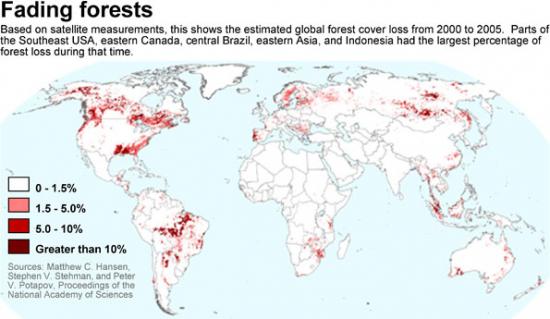
The US South is already one of the major global hotspots for forest degradation. The Southern US contains about 2% of the world’s forests but produces about 25% of the world’s timber products. At the same time our native Southern forests are some of the most ecologically important and biodiverse in the world. The last thing our forests and communities need is another industry that has been proven to increase rates of logging and conversion of our natural forests to pine plantations.
 The wood pellet industry attempts to delude decision-makers and the general public that the logging and burning of trees will benefit our climate and our forests based on a complex economic forecasting that conveniently models an industry fantasy and not reality. A fantasy where despite more logged forests and conversion of natural forests to monoculture pine plantations, there are actually more “forests”.
As we know all too well here in the South, industry funded studies come out with industry desired results – just ask the coal companies.
We don’t need a complicated timber model to predict what will happen to Southern forests if the wood pellet export market continues to grow. We know exactly what happens to forests when markets expand. They disappear all around us. We have plenty of historical data documenting the rate and scale of forest cover loss and associated degradation of ecosystems when markets for wood expand. Increased logging and the conversion of natural forests to plantations across the South over the span of many decades have combined to create a fragmented landscape of clearcut forests and single species, intensively managed pine plantations. The wood pellet market will most certainly get us more of the same.
Yet, pellet manufacturers continue to claim that they “..do not and will not contribute to deforestation.” and due to these false claims it’s critical that we generate evidence of the wood pellet industry is really doing to native forests in the South. Recently a couple of us here at Dogwood went out on an investigation of the wood pellet manufacturing facilities in North Carolina. All of the facilities are owned and operated by Enviva and exist for the sole purpose of producing wood pellets to feed the market in Europe, particularly the UK-based utility company Drax.
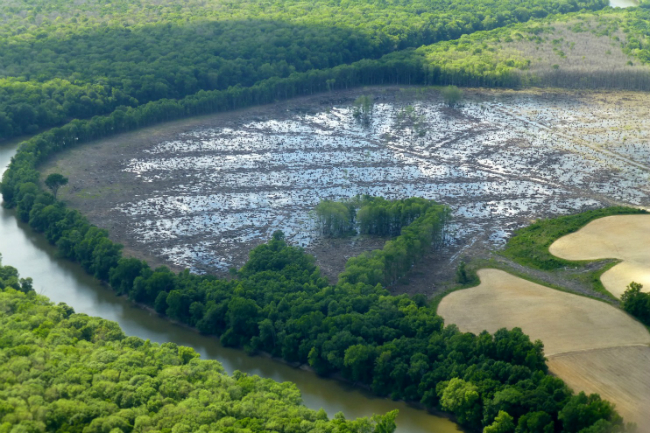
Little remains but stumps and puddles in what was once a bottomland hardwood forest on the banks of the Roanoke River in northeastern North Carolina. The trees were turned into wood pellets for burning in power plants in Europe. (Joby Warrick/The Washington Post)
We travelled six hours from our home base in Asheville, NC to the coastal plains of northeastern North Carolina and southwestern Virginia – ground zero for the US wood pellet industry. The three Enviva wood pellet facilities located in this area (Ahoskie, NC, Garysburg, NC and Southampton, VA) are clustered together in overlapping sourcing areas that leave little chance for native wetland and bottomland forests to stay off the chopping block or avoid being impacted.
As someone whose work is dedicated to protecting Southern forests, arriving at the Enviva facility in Ahoskie is a terrifying experience. First, it’s located practically in the middle of town with restaurants, homes, shopping centers all in close proximity. The facility’s smokestack emits an enormous, white cloud, and in our approach, we could practically feel ourselves breathing in the wood dust. Log piles of hardwood trees stacked 30-40 feet high and hundreds of yards long loom above as logging trucks loaded with trees entered the facility every few minutes. We saw more trucks loaded with pellets leaving, on their long journey to be burned in foreign power stations.
My first incredulous thought on this day was: This is “green” energy?
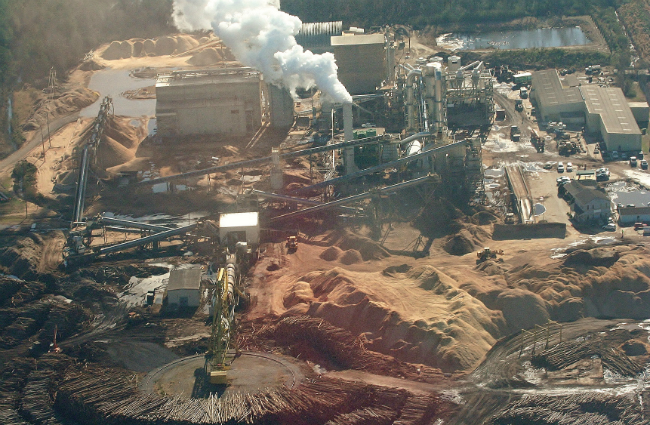
Overhead picture of the Enviva Ahoskie pellet manufacturing facility.
To keep our evidence as irrefutable as possible, we must identify a specific truck.
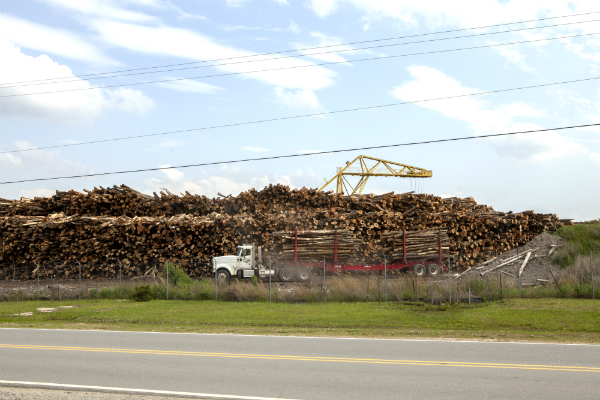
Logging truck loaded with trees drives inside the Enviva Ahoskie facility. Trucks just like these enter the pellet facility at estimated rates of 10-25 trucks per hour.
We visually mark the truck as it enters the facility loaded with hardwoods; we record the license plate and registration numbers listed on the truck, and then we follow it when it exits to pick up another load. Pellet facilities can have a sourcing radius of up to 75 miles, and we often run the risk of a truck leading us nowhere. But on this hot day in May, we lucked out and tracked the empty logging truck from the facility in Ahoskie, NC to a forested area about 20 miles away. From where the truck entered the site, it was impossible for us to follow.
For obvious reasons, a team of forest activists with cameras are not the most welcome crew at a clear-cut.
Before we would attempt to document what we assumed was a clearcut, we had to first ensure that trees from with site were being sourced for pellets. It took almost an hour for our marked truck to exit, and during that time, several trucks continued to enter and exit the site. When our truck did exit the site, we followed it directly back to the Enviva facility. Now we knew for certain that this site was sourcing for pellets. It was time to see exactly what the cut looked like and where it was located.
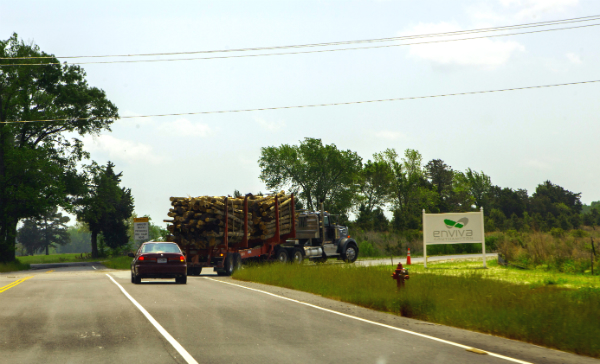
After following trucks from the logging site we trace them directly back to the Enviva facility. Making certain that the site is being sourced for pellets.
Getting to this clearcut was extremely difficult. Entering from the front was far too visible, and any access points from the sides would be too far of a trek. Our only option was to trek in from the back, which required going directly through the Urahaw swamp. After organizing our gear, we headed in, guided by the destructive sounds of logging equipment in the distance.
We trudged through mud and water up to our knees. Wildlife buzzed, chirped and splashed all around as huge Cypress trees towered above. This majestic swamp serves as a true testament to the incredible biodiversity that exists in this region. Then we hit a thicket – an almost impassible tangle of thorns, shrubs and invasive species. This morass was nothing like the incredible forest that we’d just passed through. There’s only one way that such a drastic change in the landscape could have taken place.
This was the site of an old clearcut.
It had been cut and left to regrow years ago and was now filled with invasive tree species such as privet and tree of heaven. The ground was almost dry, a stark difference from the freshwater aquatic ecosystem that we had just waded through. Many decades from now (or maybe never) this old clearcut might return to being a true forest, but will never be the same as it once was. This was an important reminder that when we destroy forests, they’re gone forever.
Yes, new trees and plants will grow, but you can never replace a native forest. We must protect the native forests we have left.
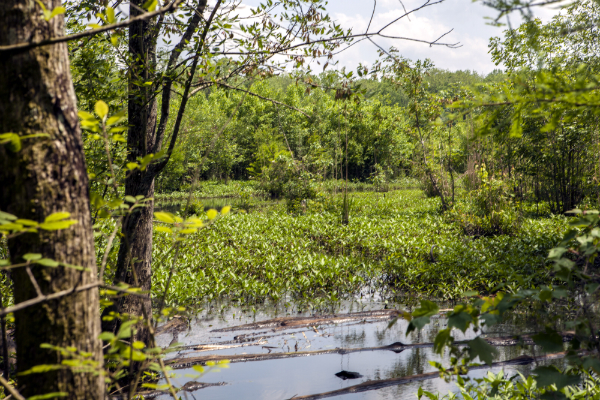
After walking through a beautiful wetland forest we entered an old clear-cut now turned into an exotic-invasive thicket seen above in the distance.
Walking through the thicket made the going much slower, but sounds of trees falling were getting closer; that was all the motivation we needed to keep moving forward. After another 20-30 minutes we arrived at the edge of Potecasi Creek, which was a welcome relief compared to the nearly impassible thicket. But our joy was short lived as we approached the creek’s edge and saw what lay on the other side.
The knees of Cypress trees are iconic to the species, essentially the tree’s roots that emerge from the ground. Although scientists are still unclear as to their actual use, I like to think of them as the tree’s communication network – beacons that communicate with other Cypress in their wetland home.
When we looked across Potecasi Creek, all that was left were these knees and the stumps of once great Cypress trees. They had destroyed an irreplaceable wetland treasure.
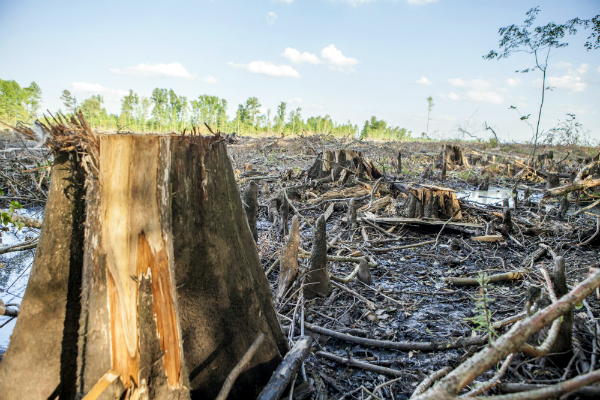
Cypress stumps and knees of a once great wetland forest.
We crossed the creek, holding our gear high above our heads as we waded through the neck deep water. They had left a small buffer of trees along the bank, just enough for us to hide behind as the cutting continued on the opposite end of the tract. The cut was huge, and the work was happening on the far end, sadly too far away for a good picture. We documented the site to the best of our ability under the circumstances. It was late in the day, and soon the loggers left, which allowed us to walk out onto the land and into the middle of the clearcut to view its vastness. As I walked out, a hawk flew above. It’s head moving back and forth surveying the damage as if to say, “What happened to my home?”

This native forests will never be the same again. Critical habitat is lost forever. What happens to the animals who lose their homes?
Though the effort we made was dangerous and the discovery was incredibly sad, documenting the true story of the impacts of European demand for wood pellets is vital and will hopefully serve as a reminder of how the best intentions can often produce damaging results.
This madness must stop. Biomass is not green energy.
I hope European and American decision makers see our efforts and hear the call of all those individuals, organizations and companies from around the world for true energy solutions, not burning forests for electricity. I hope they correct the mistakes that were made before it is too late.

Hear our message – this is a SOS. SAVE OUR SOUTHERN FORESTS!
Written by Joby Warrick. Cross-posted from The Washington Post.
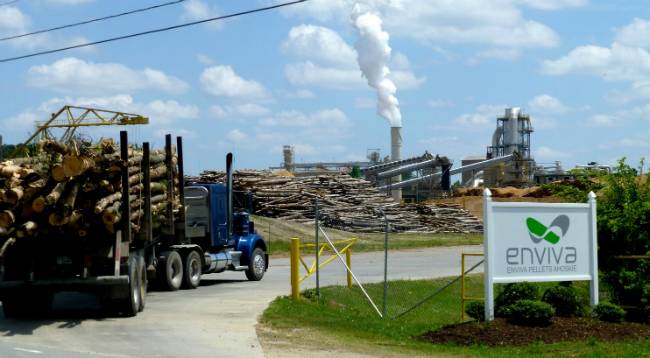
A logging truck loaded with freshly cut hardwoods enters the Enviva wood-pellet plant in Ahoskie, N.C. (Joby Warrick/The Washington Post)
OAK CITY, N.C. — For the sake of a greener Europe, thousands of American trees are falling each month in the forests outside this cotton-country town.
Every morning, logging crews go to work in densely wooded bottomlands along the Roanoke River, clearing out every tree and shrub down to the bare dirt. Each day, dozens of trucks haul freshly cut oaks and poplars to a nearby factory where the wood is converted into small pellets, to be used as fuel in European power plants.
Soaring demand for this woody fuel has led to the construction of more than two dozen pellet factories in the Southeast in the past decade, along with special port facilities in Virginia and Georgia where mountains of pellets are loaded onto Europe-bound freighters. European officials promote the trade as part of the fight against climate change. Burning “biomass” from trees instead of coal, they say, means fewer greenhouse gases in the atmosphere.
But that claim is increasingly coming under challenge. A number of independent experts and scientific studies — including a new analysis released Tuesday — are casting doubt on a key argument used to justify the cutting of Southern forests to make fuel. In reality, these scientists say, Europe’s appetite for wood pellets could lead to more carbon pollution for decades to come, while also putting some of the East Coast’s most productive wildlife habitats at risk.
“From the point of view of what’s coming out of the smokestack, wood is worse than coal,” said William H. Schlesinger, the former dean of Duke University’s Nicholas School of the Environment and Earth Sciences and one of nearly 100 scientists to sign a letter to the Environmental Protection Agency last year asking for stricter guidelines on using biomass to generate electric power. “You release a lot of carbon in a short period of time, and it takes decades to pull that carbon back out of the atmosphere.”
The pellet makers and their supporters dismiss the criticisms, saying their industry will help lower greenhouse gas emissions over time, in part by giving landowners an incentive to plant still more trees. “Healthy markets have contributed to a 50 percent increase in volume of trees since the 1950s, which help offset 15 percent of U.S. carbon emissions annually,” said Gretchen Schaefer, spokeswoman for the National Alliance of Forest Owners, a trade group.
The controversy is prompting renewed scrutiny of a rapidly growing industry that is reshaping Southern landscapes from coastal Virginia to the Gulf of Mexico. All but nonexistent a decade ago, pellet mills have sprung up in seven states to fill galloping demand for renewable fuels to reduce global dependence on coal and petroleum.
What is biomass?
Biomass fuels use energy from plants — corn, used to make ethanol, but also hemp, wood, sugar cane and even yard waste — to produce electric power. Burning plant matter as fuel also releases carbon pollution into the atmosphere, but that carbon can be reabsorbed by new crops, especially in the case of fast growers such as hemp and switchgrass.
[The EPA’s not-so-green emissions plan.]
The popularity of wood pellets as a fuel is being driven largely by government policies. Facing mandates to cut back on coal, European governments are offering generous subsidies to utility companies that switch to biomass and other renewables. The price break makes wood pellets — easily twice as expensive per ton as coal — affordable. For formerly coal-dependent countries such as Britain, wood pellets are an especially attractive option because they can be burned in the country’s existing coal-fired power plants without significant modifications.
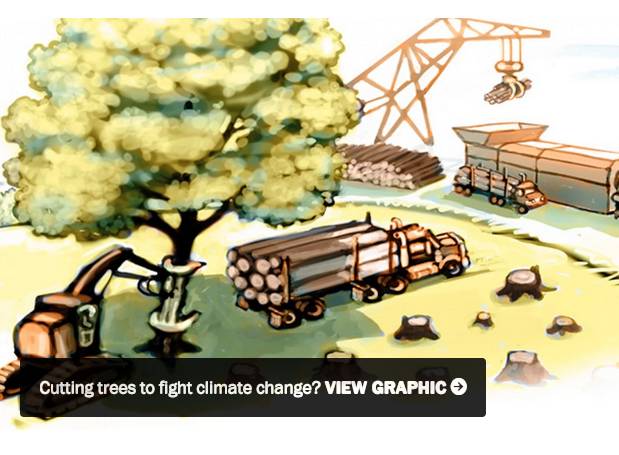
As a result, demand for wood pellets is soaring, particularly from the United States. U.S. exports of wood pellets doubled between 2012 and 2014, from 2 million tons to 4.4 million, and climate policies are expected to drive even higher increases over the next decade. After surpassing Canada in 2012, the United States “continues to be the largest wood pellet exporter in the world,” an April report by the U.S. Energy Information Administration stated.
U.S. companies are now racing to keep up with demand. The country’s largest producer of wood pellets, Enviva, based in Bethesda, Md., has built six pellet mills in four states since its founding in 2004 and recently announced plans to build three new ones. The company operates its own deep-water terminal in Chesapeake, Va., loading sea¬going barges with nearly 1.5 million metric tons of wood pellets every year, most of them bound for Britain.
To qualify for European contracts, Enviva must certify that its wood pellets emit 60 percent less carbon pollution than coal, Enviva spokesman Kent Jenkins said. “In fact, our audits show that we produce 80 percent less,” he said.
Unlike other wood-pellet companies that use dedicated pine plantations as their primary source of wood, Enviva buys logging rights from farmers and other private holders. Once the timber rights are secured, Enviva dispatches its crews to harvest the trees and haul the logs and brush to one of its pellet mills.
There, the wood is ground into sawdust and then fed into a machine that uses heat and pressure to create dry pellets, a fuel that can be transported as easily as corn kernels and burned as readily as lignite.
To keep carbon emissions to a minimum, the company makes its pellets from low-quality wood that would be wasted or sold to pulp and paper mills, said Enviva Executive Vice President Thomas Meth.
“We take wood that was meant to be sold but doesn’t have a home,” Meth said. “If you come to our plants, you will see trees that are crooked, diseased or rotten. You can’t use them for saw timber or for a telephone pole.”
Multiple studies support the notion of using discarded wood — the parts of harvested trees that would otherwise be wasted — as a source of biomass fuel. But the problem comes when whole hardwoods are cut down to be burned in power plants, scientists say.
Wood is less energy-dense than coal, so it takes more of it to produce the same amount of electricity. And because oaks and maples mature slowly, it takes decades for new saplings to absorb the amount of carbon dioxide that escapes from a chimney when the trees are burned, scientists say.
“All biomass emits carbon when it’s burned, but when you burn a tree, you’ve liquidated a lot of carbon into the atmosphere and you have to wait a very long time to recapture it,” said Mary S. Booth, an ecologist and director of the Partnership for Policy Integrity, a nonprofit research organization that focuses on biomass energy. “The truth is you’ll never re-sequester all the carbon you release.”
Environmental groups sharply contest Enviva’s claim that it predominantly uses tree waste. Photographs supplied by activists showed trucks entering an Ahoskie, N.C., plant loaded with mature trees. During a visit last week to the plant, a reporter also observed a steady stream of trucks entering the front gate, each hauling trailers stacked with up to 50 freshly cut tree trunks, many of them more than a foot in diameter.
Enviva officials assert that even larger trees qualify as “waste” because they are unsuitable for other uses. In the past, the trees would have been cut and sold for pulp, Meth said. Robert C. Abt, a professor of forestry at North Carolina State University who has extensively studied the pellet industry, acknowledged that companies and their critics often clash over what constitutes “waste” timber.
“Everyone has a reason to be vague about it,” Abt said. “It’s not necessarily scraps from a harvesting operation. It can be a tree that doesn’t have another use, in an economic sense. It might be a tree that is perfectly straight and of a decent size.”
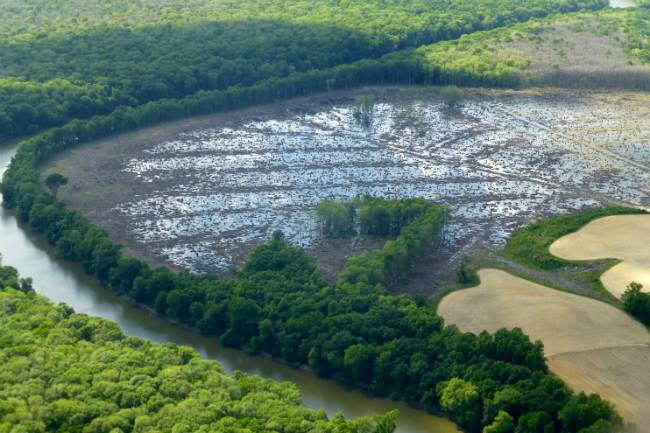
Little remains but stumps and puddles in what was once a bottomland hardwood forest on the banks of the Roanoke River in northeastern North Carolina. The trees were turned into wood pellets for burning in power plants in Europe. (Joby Warrick/The Washington Post)
But the bottom line, activists say, is that the companies are using the wrong kinds of trees to make pellets.
“The pellet industry and the [British] utility have been deceptive about the sources of wood they use,” said Derb S. Carter Jr., a Chapel Hill, N.C., attorney with the Southern Environmental Law Center, a nonprofit group that has conducted its own investigation of the company’s practices. “Enviva’s Web site says they’re using only waste wood, but you can follow the trucks to the harvest sites and see what they’re doing.”
The data
Carter’s group recently hired a private research firm to analyze Enviva’s logging practices to measure the net impact on greenhouse gas emissions over a 40-year time scale. Under guidelines set by Britain’s Department of Energy and Climate Change, biomass fuels are required to be “cleaner” than coal, producing no more than 285 kilograms of heat-trapping carbon dioxide for every megawatt of electricity produced.
Because they come from hardwoods, Enviva’s wood pellets fall short of Britain’s standard by a wide margin, according to the research firm, Spatial Informatics Group. An advance copy of the firm’s report was obtained by The Washington Post.
A study last month by the Natural Resources Defense Council reached a similar conclusion about cutting whole trees for fuel. The report found that the practice “can increase carbon emissions relative to fossil fuels for many decades — anywhere from 35 to 100 years.”
“This time period is significant,” a summary of the report stated, continuing, “These emissions will persist in the atmosphere well past the time when significant reductions are needed.”
Enviva officials disputed the reports, saying their own data — backed by independent reviewers hired by the company — shows substantial benefits over coal over the long term. Company officials cited an Agriculture Department report this year that said wood pellets “can deliver very significant greenhouse gas savings, compared to fossil fuels,” when forests are responsibly managed.
“We get audited by our customers frequently, and they know exactly what we do,” Meth said. “We’re very comfortable with our performance from a carbon perspective.”
The concern over emissions is compounded by what ecologists describe as a growing threat to forests and wildlife in the Southeast as demand for wood pellets grows. In North Carolina, the heaviest logging is occurring in flood plains and wetlands that are among the region’s most productive natural habits. In Georgia, where most of the trees for wood pellets are grown on pine plantations, natural forests are rapidly disappearing as landowners see new opportunities to make money, said Ben Larson, forestry and bio-energy program manager for the National Wildlife Federation.
The landscapes most at risk, Larson said, are traditional Southern savannas with a canopy of tall pines and an understory of grass and shrubs that provide food and shelter for wildlife. With more land converted to pines to make wood pellets, the vital understory is disappearing, replaced by stands of fast-growing pines that are raised as a cash drop.
“The result may be more ‘forests,’ but they will mostly be pine plantations,” Larson said. “And that’s bad for wildlife.”
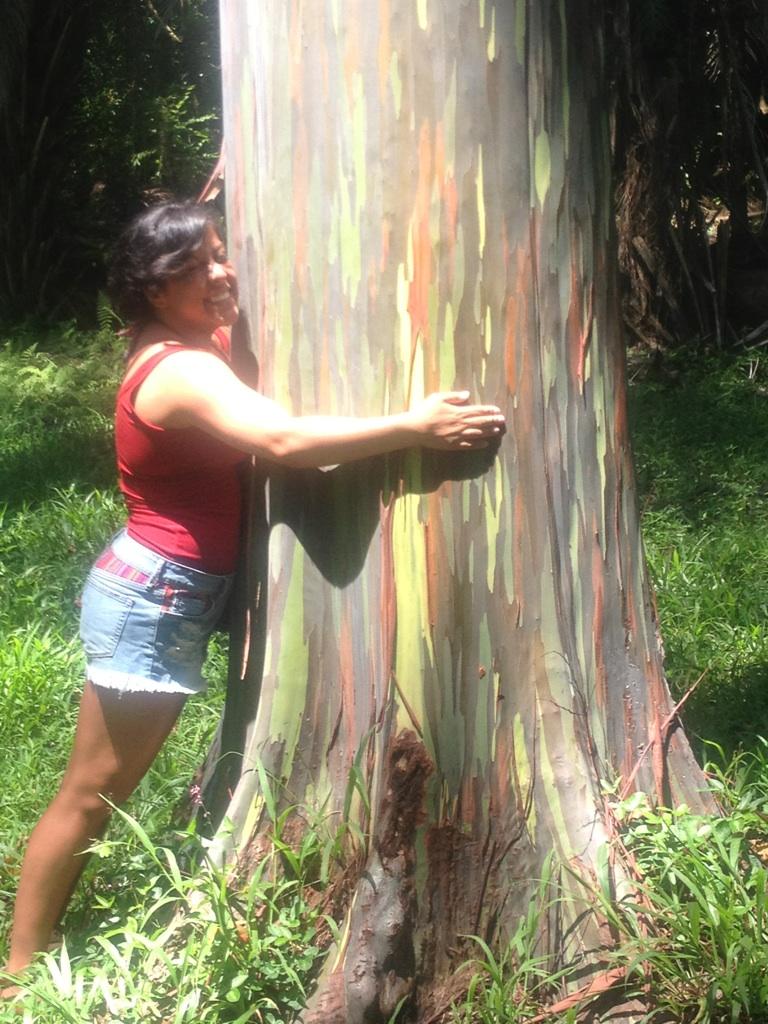
Julianna hugging a Rainbow Eucalyptus tree in Hawaii.
Julianna Martinez did not discover Dogwood Alliance until this past semester at Duke when her friend Rachel Weber (who is also an intern at Dogwood) told her about her previous work at Dogwood Alliance. It was Rachel’s positive experience with Dogwood and how excited she was to return to the organization that convinced Julianna that Dogwood would be the perfect fit for her as well. Julianna is excited to work with an organization that is dedicated to making change while engaging with communities locally and globally.
Julianna grew up as a girl scout in Western North Carolina.
She says,
Needless to say, I LOVE spending time outdoors. Whether it’s hiking, rafting, camping, etc, I love to explore the beauty that is right outside our doors! The woods offer a unique peace that I have yet to find elsewhere. I enjoy hanging out and exploring in the woods whenever I can.
Julianna is most excited to learn about how Dogwood Alliance engages with communities across the Southeastern United States and overseas.
Julianna elaborates,
I am thrilled to have the opportunity to work with my team so closely this summer on the SOS Tour and learn how Dogwood connects the input of local people with that of local elected officials.

Julianna jumping on a trail to Lac Blanc in Switzerland.
Outside of academics, Julianna is on the cheerleading team for Men’s Basketball and Football at Duke University. She also loves hiking, traveling and crafting and is a self-proclaimed movie enthusiast. In her first week in Asheville, she explored three different theatres and saw five different films. She’s “already addicted” to our $3 and $5 discount showings.
You can check out the full #SOSTour schedule that Julianna will be going on here.
 This is a re-post from NRDC.
- NRDC’s new modeling shows that wood pellet fuel made of whole trees sourced from areas in the U.S. Southeast will emit carbon pollution comparable to fossil fuels when burned to produce electricity.
- Unfortunately, the biomass wood pellet industry in the southeastern United States is expanding rapidly, driven largely by exports to Europe in response to flawed policy incentives on renewable resources that regard all biomass as carbon neutral.
- The wood pellet industry has the responsibility to come clean with the public, investors, and regulators by disclosing the makeup of its fuels, and to take steps to ensure that its pellets do not increase carbon emissions.


 Donate


