


 Shannon Barrett is the new Advancement Director at Dogwood Alliance. “One of the things that really attracted me to the position is the thoughtfulness that’s gone into planning where Dogwood goes next,” she explains, adding that it is a very exciting time for Dogwood because the organization is poised to go to the next level.
“It’s almost like starting from the ground floor and having this opportunity to be a part of something new and to help shape it.”
Shannon originally grew up in the small town of Chester, South Carolina. Shannon is the kind of person who not only wants to live intentionally by giving back to her community and the environment, but also wants to explore our world: she has been to Guatemala, Mexico, England, France, Italy, Canada and all over the United States. Last year, she even visited Nepal through a legislative exchange program. “Being exposed to that culture and meeting with people there in their government and in their non-profits and NGO’s was just so fascinating!” she says.
Shannon comes to Dogwood Alliance from a 10-year-long career in local government in Marrietta, Georgia where she served as Assistant City Manager and had many Human Resources responsibilities. Before that, she worked in fundraising and development in Charlotte’s Arts & Sciences Council. Shannon has always chosen to work where she feels she can make the biggest difference, and that’s exactly why she chose Dogwood.
Through Dogwood, she is excited to work towards something she is both passionate about and that she hopes will bring people together by talking about Dogwood and our forests. She says it’s all about asking the right questions.
“How do we take all the great information we have and make it accessible? There’s a lot of technical information with what’s going on with bioenergy and even carbon canopy. How do we present it in a way that people can relate to?”
She cites Dogwood Alliance’s recent Ron Maxwell video as a great way to communicate the importance of protecting our forests against the bioenergy crisis.
[youtube]https://www.youtube.com/watch?v=bKNAePtgaBE[/youtube]
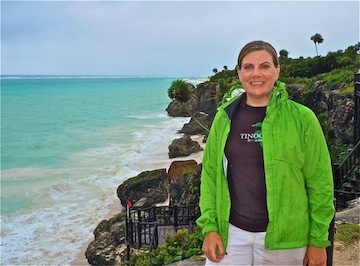
A true lover of the outdoors, Shannon looks forward to exploring and hiking Asheville’s beautiful mountains.
Dogwood Alliance is excited to announce the addition of 3 Greencorps organizers to our team! This month, John Qua, Rita Frost, and Katya English joined the Dogwood team to help stop the expansion of the biomass industry and to save our Southern forests. They will be working in key biomass export cities: Wilmington, Savannah, and Baton Rouge. They join our team at a crucial time as the biomass industry gears up to expand, threatening some of our most biodiverse wetland and bottomland hardwood coastal forests.
Equipped with Greencorps organizing training and on the ground experience, John, Rita, and Katya bring to the Our Forests Aren’t Fuel team knowledge of successful campaign work and a passion for Southern forests and environmental work.
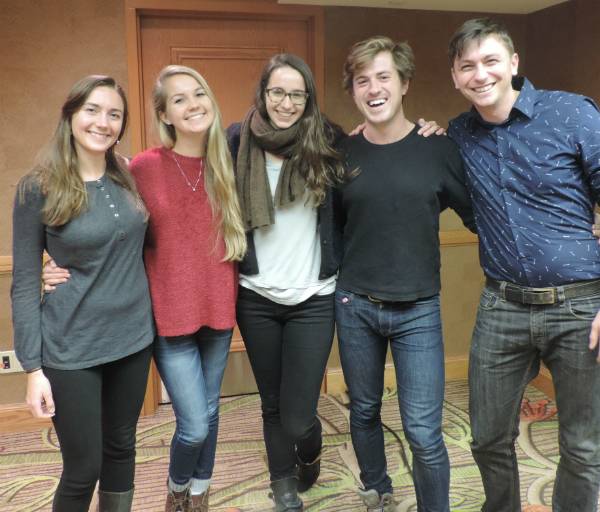
Dogwood Alliance staff members with the Greencorps Organizing Team.
Rita Frost spent the fall working on a campaign to divest Duke University’s $18 billion endowment from fossil fuels, and helped secure almost 100 professor sign-ons of support and 1,500 student petitions. Now, Rita is excited to be working for forest protection from Savannah, GA. “I’m part of this team today because I’m a southerner too. I’m from Texas and I remember exploring the swamp land in the Big Thicket forests with my brothers on vacation every summer as a kid. While I may not look like that girl with the bangs in her face and the mud on her cheeks anymore, I know there are many southern kids just like myself hoping to explore the beautiful hardwood forests and wetlands that y’all hold so closely to your hearts. We must keep these forests where they belong: in the hands of our children.” So far, Rita has loved getting to know the people of Savannah, especially the many committed environmentalists and students. One volunteer, Marlee, petitioned with Rita and a farmer’s market where they collected 85 petitions in 3 hours!
John Qua’s previous campaign was with Food and Water Watch in Texas, where he worked to commit Austin to a growing list of cities calling on Congress to stop the misuse of antibiotics on factory farms. John is excited to work on this campaign from Wilmington, NC because this issue, “not only affects some of the most valuable forests we have left in this country, but also life for residents here in Wilmington. With the construction of the port downtown, it’s been exciting to help educate the community on the issue of biomass and see the community work together to protect their neighborhood.” John’s had an eventful first couple of weeks, with a highlight being a county commissioners meeting about the city zoning exemptions for facilities at the port. Three residents of Sunset Park, one of the neighborhoods most affected by the port’s construction, came out to represent their community and voice their concerns. The resident’s passion to protect eachother and their community was an inspiration to John, and a reminder of the extent to which the biomass industry negatively impacts Southern communities.
Katya English spent the previous fall working on a campaign in Portland to pass a GMO labeling initiative on the Oregon ballot, which lost by just a small margin despite industry spending upwards of $22 million. In Baton Rouge, Katya says, “I am delighted to be working with the Dogwood Alliance on the Our Forests Aren’t Fuel campaign because protecting Southern forests is critical. Especially when they are being destroyed to make wood pellets used on the other side of the world. That’s bad for the local community, Louisiana’s environmental heritage, and the planet.” A big highlight so far has been getting out and talking to local people, and hearing why they care about this issue! People in Baton Rouge are ready to get organized and fight back against the destructive wood pellet industry.
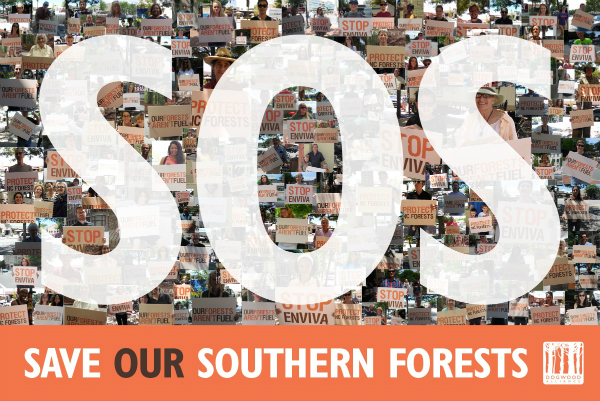
Greencorps organizers will be sending the messages of concerned community members to European policymakers, calling on them to Save Our Southern forests.
The Greencorps organizers are off to a flying start, and that’s just the first couple weeks! We’re thrilled to have them on the Dogwood team, and are grateful for their commitment to environmental and forest protection. Over the next few months, John, Katya, and Rita will be holding kick-off meetings, informational sessions, and will be working with volunteers to collect signatures for SOS postcards to be sent to EU policy makers urging them to Save Our Southern forests. Stay tuned for exciting updates from our campaign!
Brussels, 11 December 2014. For immediate release
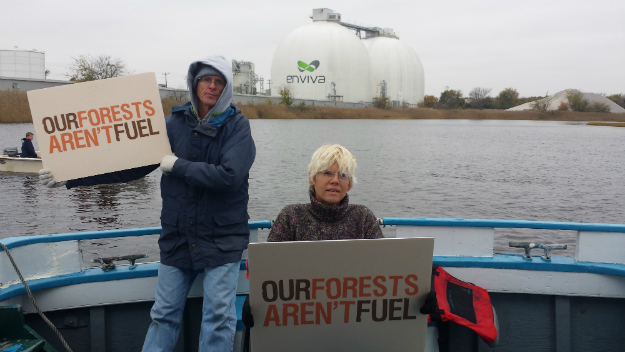
Concerned US citizens protest wood pellet export conference in Virginia
Southern US forests are being logged to feed Europe’s appetite for energy produced by wood pellets burned in biomass power plants. A loophole in European laws designed to promote clean energy has prompted massive demand for wood pellets, leading to the rapid expansion of logging in the Southern US. An appeal by more than 50,000 United States citizens asking the EU to stop supporting the unsustainable use of bioenergy was delivered today to European Commissioners Miguel Arias Cañete and Karmenu Vella, who are in charge of portfolios for energy, climate and environment. The appeal was further supported by five US conservation organizations – Dogwood Alliance, Natural Resources Defense Council, Gulf Restoration Network, Green America and ForestEthics – and, in Europe, by BirdLife Europe and the European Environmental Bureau.
The growing demand for woody bioenergy has caused a rapid expansion of wood pellet production in the South Eastern US, with more than 30 new pellet mills planned. Citizens are witnessing clear cuts and loggings in biodiversity-rich bottomland hardwood forests, and the logging of whole trees simply to feed European power plants. The EU currently has no sustainability requirements for the kind of wood or biomass burned in order to fulfil renewable energy targets by 2020.
“The accelerating destruction of our forests is disrupting the critical services forests provide as well as threatening the quality of life and the long-term economic viability of our coastal communities and existing forest-dependent businesses. Privately owned forests in the Southern US have practically no legal protection to ensure valuable forests are preserved. We urge the European Commission to acknowledge the growing citizens’ concern,” said Adam Macon, Campaign Director at Dogwood Alliance. Peter Lehner, Executive Director, Natural Resources Defense Council added: “European leaders are usually ahead of the game when it comes to climate solutions—but this is one misguided policy that needs to change. Clean, truly renewable energy comes from sources like wind, solar or geothermal, and energy efficiency. This is where nations should be focusing their energy investments, not subsidizing companies that burn dirty biomass and contribute to the destruction of forests. There are better ways to keep the lights on than burning trees for electricity.” “This appeal by American citizens is further evidence that EU bioenergy demand is hitting other countries hard. If this is allowed to grow without safeguards, there will be more environmental damage and no reduction in greenhouse gas emissions. The Commission must set bioenergy use on the right track when drafting the legislation for the 2030 climate and energy framework“, concluded Sini Eräjää, EU Bioenergy Policy Officer at BirdLife Europe and at European Environmental Bureau.
ENDS
NOTES TO EDITOR
[1] links to US petition and official letters to Commissioners:
http://www.birdlife.org/sites/default/files/attachments/11.12.2014_letters-to-Canete-and-Vella.pdf
[2] US Save our Southern Forests Day of Action Video: https://www.youtube.com/watch?v=rwtLJj7E0BQ&list=UUoj7pn0GA7J4znb_d6PVuUw
Pictures from Dogwood Alliance available at: https://www.dropbox.com/sh/kfwsk9scgrjd9se/AADFX3IDb1fdiQB9A1rBXLF7a?dl=0]
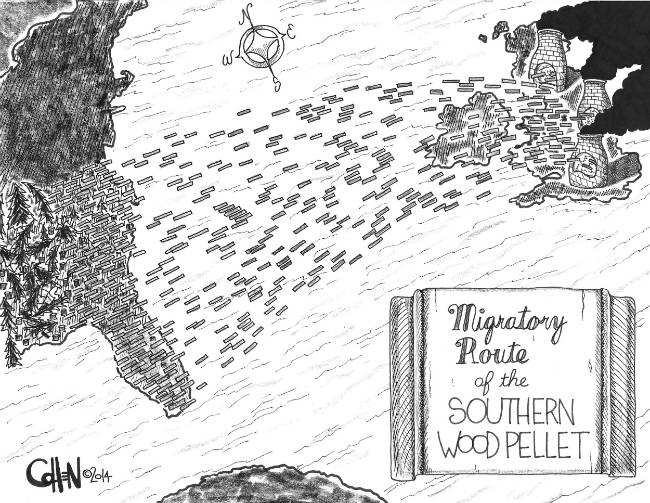
Since 2012, the Southern United States has been the world’s largest exporter of wood pellets for electricity. This rapidly expanding industry is having a dramatic impact on the bottomland hardwood and swamp forests of the mid-Atlantic and Gulf coasts. Flawed European policies meant to reduce carbon emissions and fight climate change have large utilities rapidly shifting from coal to wood at the expense of wildlife habitat and the impacts are being deeply felt by vital bird populations.
Loss of mature hardwood forests is having a significant impact on bird populations that depend on these forests for breeding and survival. Many species hurt by this growing industry are already the focus of conservation initiatives to protect their declining numbers. Bottomland hardwood forests are vital for absorbing carbon, protecting against coastal flooding, providing clean drinking water for local communities and are home to at least 30 species of birds that are the focus on conservation efforts.
Birds that are at risk include the Wood Stork, Swallow-tailed Kite, Northern Parula, Cerulean Warbler, Wood Thrush, and many more. Clearcutting these valuable bottomland forests for the production of wood pellets destroys important breeding areas that are critical to the survival of these species.
Over the past couple of years, Dogwood Alliance has been working hard with our corporate partners, Southern landowners and technical experts through our Carbon Canopy Project to develop the tools necessary to help landowners reap a financial benefit from protecting Southern forest carbon sinks.
A few months ago, Dogwood Alliance and our Carbon Canopy partners were out in the woods with technical experts who were re-measuring and re-calculating the carbon stored in one of our first forest carbon offset projects: a 9,200 acre forest in Southwestern Virginia. Verification on a second project will begin next month. In order for these landowners to capture the value of carbon offsets from this forest, they have had to go through a rigorous process to verify and validate that their offsets meet basic requirements.
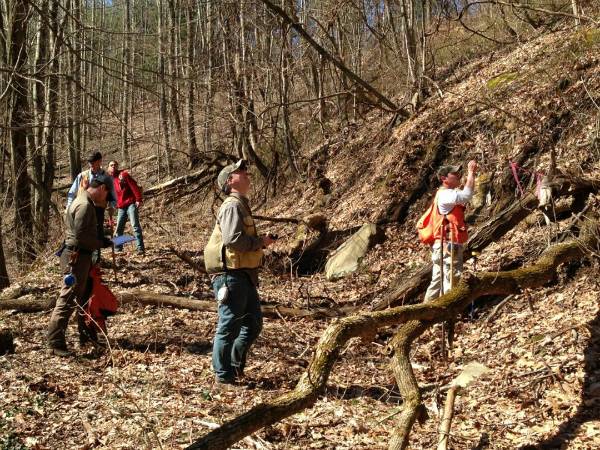
Field verification of Dogwood’s Heartwood Carbon Canopy Project near Dante, VA
First, the landowner had to show “additionality” — that they are actually increasing the amount of carbon in the forest beyond what would have occurred otherwise. In other words, you don’t get credit just because you have trees growing on your land. This particular landowner is changing the management plan on this forest to expand protected areas and reduce the volume of trees logged.
In addition, this landowner has had to ensure “permanence” — that the carbon they are selling will remain stored in the forest over the long-run. This particular landowner has committed to maintain the carbon in this forest for the next 100 years, and the forest carbon will be re-measured and “verified” via a third-party every six years. Because of the change in management, the long-term commitment and third-party verified proof of measured carbon stocks, this landowner will be able to sell over a million tons of carbon at a nice profit.
Unlike European utility companies, this landowner can’t take credit today for carbon that might be stored in the future; rather, they can only take credit for climate benefits that have already materialized. They can’t take credit for someone else’s forest growth either. They have to document that they own the forest. Moreover, credits aren’t valid unless they are tied to a legally-binding commitment to keep the carbon stored in that forest over the long-term. Finally, credit is only given after the carbon benefit claims have been verified and validated by an independent third party.
So, how is it that utility companies in Europe can get away with claiming offsets without having to verify and validate those claims? Why are they not held to the same globally-recognized set of standards as everyone else? Why do they get to take credit today for an offset that is not likely to accrue for decades into the future, if it even happens at all? Where is the legally-binding agreement to keep the carbon stored in the forest for 100+ years? And, perhaps most disturbing of all, how are the utility companies taking credit for (and reaping the value of) the carbon stored in someone else’s forests without paying the forest owners? This double standard is beyond troublesome.
To be clear, these utility companies are increasing carbon emissions at the smokestack while degrading forest carbon sinks. They are taking credit for Southern landowner’s forest growth and not paying for it. All the while, they are calling it good for climate and for Southern landowners! This current biomass policy scam might be a sweet deal for utility companies and wood pellet manufacturers, but it’s a pretty rotten deal for forests, climate and Southern landowners.
Right now, world leaders are meeting in Peru at COP-20. This 12-day session is the 20th Conference of the Parties to 1992’s UN Framework Convention on Climate Change. Key strategies for reducing carbon emissions across nations will be discussed before final agreements are reached at COP-21 in Paris in 2015. One of the most important areas for consideration is forests and their role in the fight against climate change.
Forests not only remove carbon from the atmosphere by ‘breathing’ in carbon dioxide, but they also store it in wood, roots and soil. A recent scientific report published in the journal Nature confirms that the older the tree, the more carbon it pulls out of the atmosphere.
This basic biological fact has given rise to a number of international programs and policies designed to encourage the protection of forests as carbon sinks. In fact, the Kyoto Protocol of the United Nations Framework Convention on Climate Change, of which many European nations are signatories, has developed a variety of tools and policy frameworks to encourage greater forest conservation. Likewise, in the US, the State of California has adopted cap and trade policies consistent with international frameworks to encourage the protection of forest carbon on the landscape. While these policies are not without valid criticisms, the end game is right on target: greater protection for the world’s forests.
Over the past several years, these policies have established a new market for forest carbon. Companies emitting carbon that want to “offset” their emissions with forests must pay for it. In fact, forest carbon is becoming an increasingly valuable asset. According to State of the Carbon Market 2013, “Markets for forest carbon offsets have evolved at breakneck speed” as the market value of carbon offset demand reached an all-time high during 2011 and 2012, averaging $225 million/year. In addition to paying for it, the offset they are purchasing must be verified as meeting certain standards designed to ensure that emission reductions are actually achieved.
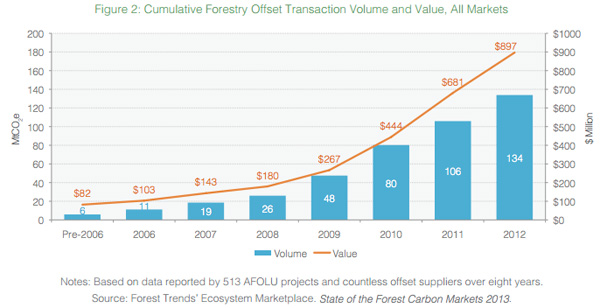
Cumulative Forestry Offset Transaction Volume and Value
Despite this heightened awareness and an evolving framework of global policies designed to protect the climate value of standing forests, Europe has remarkably turned this thinking upside down with its current push to convert existing coal-fired power plants to burn wood or “biomass.”. Ironically, under the guise of reducing carbon emissions, European policy is driving the logging and burning of trees to generate electricity as a “renewable” and “carbon neutral” alternative to fossil fuels. And incredibly much of the wood is imported from the Southern US.
However, European policy assumes (without requiring any proof) that the accelerated carbon emissions of today will be “offset” by forest growth at some point in the future. This is true even though multiple studies, including a recent scientific report published by the UK government, warn that in most cases, burning wood to generate electricity will accelerate climate change.
Under Europe’s current climate policy, utility companies like the UK’s Drax are receiving tremendous government subsidies to convert coal burning plants to wood, burning large volumes of wood pellets produced from destructive clearcutting in sensitive forest ecosystems in the Southern US. In effect, under current policy, utility companies are allowed to take credit for “offsetting” their smokestack carbon emissions today, based on a series of assumptions about future forest growth. That this faulty logic has been adopted into climate policy in Europe is, well, quite frankly, unbelievable.
In doing so, utility companies are in effect allowed to circumvent basic, globally-recognized forest offset protocols and standards. And, just as disturbing, they are getting the carbon offsets for free. Utilities burning fossil fuels are not able to get away with “offsetting” their carbon emissions today based on a shaky set of assumptions about forest growth in the future. Yet Europe is getting away with taking credit today for the assumed future carbon growth in forests owned by private landowners in the Southern US without having to validate, verify or pay for it!
Logging and burning forests to generate electricity is not a solution to climate change. Rather than a scaled-up use of forests as a fuel alternative to fossil fuels, global leaders must double down on efforts to scale up the protection of forests for their ability to remove and store carbon from the atmosphere.
Last week, on the SOS National Day of Action, individuals across the U.S. sent 50,000 messages to send an SOS to Ed Davey, UK Secretary of State for Energy and Climate Change, urging him to Save Our Southern forests. That’s right, 50,000! Across the U.S., 50,000 people expressed their concern about the European policies that continue to drive the destruction and irreparable damage of our magnificent Southern forests. In addition to sending an SOS to EU policymakers, activists, organizations, and concerned citizens shared the SOS message on Facebook and Twitter, reaching more than 400,000 people through social media. We came together to share a message loud and clear: Our forests aren’t fuel!
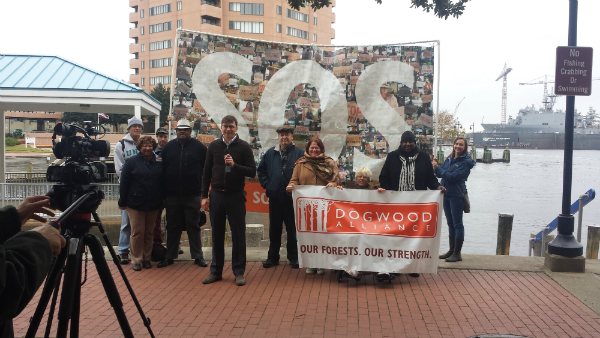
Community members and activists met for a press conference outside the Wood Exports Conference site in Portsmouth, VA.
As so many of us spoke out to stop the devastation of our forests, wood product industries met in Chesapeake, VA, to celebrate forest exports. We responded with an action of our own. Outside of the conference site, we hosted a press conference featuring affected community members Belinda Joyner and Carl Scott, VA landowner and Hollywood director Ron Maxwell, and Dogwood Alliance Campaign Director Adam Macon. We had great media turnout, including a clip on WVEC ABC News 13 in Norfolk, a print story in the Virginian Pilot, a piece in Scientific American, and a piece in E&E. Additionally, SOS blogs were featured by Energy Justice, OHVEC, and Forest Ethics, and Rainforest Rescue and NRDC published newsletter articles about the event. And, our event is highlighted in a short feature film found HERE.
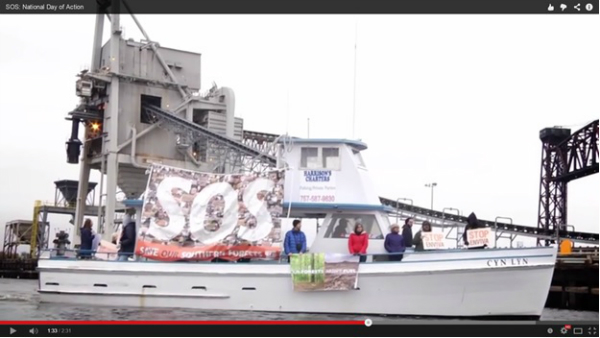
Watch and share the SOS National Day of Action video
Following the press conference, concerned community members joined us as we boarded a boat showcasing our 16-foot SOS banner and traveled down the river to where conference attendees were touring the Enviva export facility. As the tour walked out, our team was there to send a message that our forests aren’t fuel. “The communities of the Southern U.S. have had enough of the plunder of their forests”, one rally participant told the tour. We chanted, “Biomass has got to go”, as the guide attempted to continue his tour. Seemingly more interested in our demonstration than in the Enviva tour, several participants turned to watch us, waving and taking photos. Eventually, the tour concluded and wound back out of sight, and our group ended the day with a celebration of Southern forests and a great day of action.
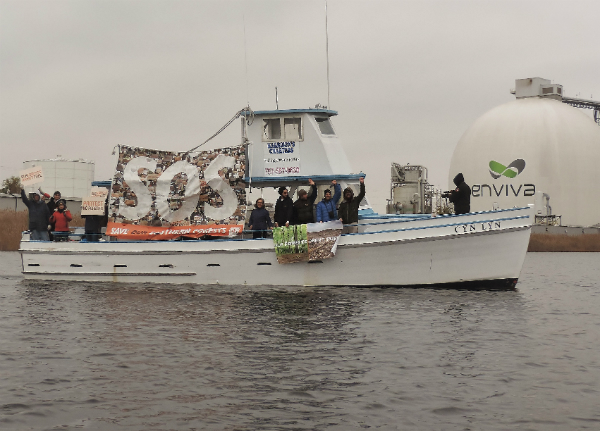
Activists and community members boated to the Enviva export facility to send a message of SOS to Wood Products Exports Conference attendees.
We know our forests aren’t fuel. We refuse to sit by and watch as our forests, our climate, and our communities are sacrificed to this destructive industry. That’s why we’re calling on EU policymakers to lead the way towards smarter and truly renewable energy sources, such as wind and solar. And with almost 50,000 of us ringing the alarm, our emails are sure to be on the minds of climate and energy legislators as they meet to rethink climate policies in 2015.
The Environmental Protection Agency (EPA) has failed to protect the forests, communities and climate with its new proposed framework for regulating biogenic carbon emissions from stationary sources. They have not followed the recommendations of their own Scientific Advisory Board as well as the mounting government and academic research that burning trees for electricity is going to increase carbon emissions and accelerate climate change.
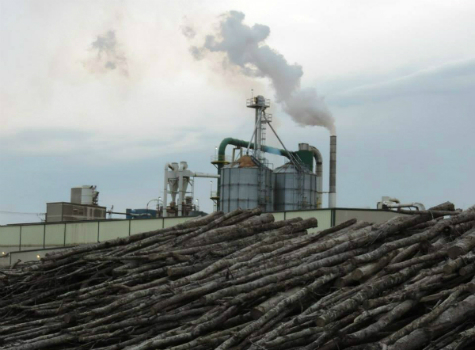
Clearcutting forests, shipping them to Europe and burning them for electricity is not good for our climate.
On one hand, the EPA recognizes “the critical role that America’s forests play in addressing carbon pollution in the US,” while, on the other hand, they give states and companies a free pass to burn at will with little to no oversight or guidance.
This is especially true in a region where the forest industry is deeply entrenched and holds a lot of power over state agencies and governments like the Southern US. The federal government should be setting the guidelines on sustainability – air and GHG emissions know no borders.
We are at a critical moment in time when we should be working to increase protection and conservation of forests to store and sequester more carbon and to provide valuable protection against the impacts of climate change like storm surge. Rather than showing bold leadership based on the emerging scientific consensus and stopping the wholesale burning of High Conservation Value and Endangered Forests based on faulty carbon accounting, the EPA is giving a free pass to burn our forests.
The EPA should have followed the UK Department of Energy and Climate Change’s lead who found that burning anything but forest residuals under 4″ in diameter had detrimental impacts on the climate. Now is not the time to increase the destruction of our forests and exacerbate climate change. Instead we should protect them and increase investment in truly renewable energy like wind, solar and conservation and efficiency. Additionally, over 90 US scientists sent a letter to the EPA in June calling on the agency to follow the best available and most rigorous science in crafting its new policy, which they have clearly failed to do.
Dogwood Alliance will continue to dig into the brand new proposal and provide more substantive feedback, staying full engaged with the EPA throughout the public comment period, including our members and allies to ensure these regulations gain some teeth to protect our forests, communities and climate rather than speed up their demise.
 FOR IMMEDIATE RELEASE – November 13, 2014* Note – High quality video and photos from the press conference and action will be available at www.dogwoodalliance.org or by e-mailing [email protected]
CONTACT:
Scot Quaranda, Dogwood Alliance, 828.242.3596, [email protected]
Portsmouth, Virginia – This morning Dogwood Alliance, Virginia landowner and Hollywood Director, Ron Maxwell, and local community leaders spoke at a press conference to draw attention to the growing citizen opposition to the unchecked growth of the wood pellet export industry in Virginia and across the Southern United States. Meanwhile, right next door, the world’s largest wood pellet manufacturer, Enviva, which operates a wood pellet export terminal in Chesapeake, attended the Mid-Atlantic Forest Products Export conference to plan for further expansion of wood pellet exports.
Following the press conference, speakers and local community activists boarded a boat at 1pm with a banner reading “SOS – Save Our Southern Forests”, with a plan to disrupt a scheduled conference tour of Enviva’s Port of Chesapeake export terminal. Additionally, thousands of Southerners sent emails to UK Department of Energy and Climate Change head, Ed Davey, calling on him to end subsidies going to the utilities that are importing and burning wood pellets made from destroyed Southern forests.
“Companies like Enviva are destroying our Southern forests for the benefit of big power companies in the UK and across Europe” said Adam Macon, Campaign Director at Dogwood Alliance. “The accelerating destruction of forests is disrupting the critical services forests provide such as wildlife habitat, clean drinking water and protection against storms, while also threatening the quality of life and the long-term economic viability of our coastal communities and existing forest-dependent businesses. We urge Mr. Davey to acknowledge growing citizen concern, embrace the warnings of his own scientists and stop subsidizing the burning of our forests for electricity.”
The Southern U.S. is currently the world’s largest exporter of wood pellets, mostly to Europe, where they are burned for electricity. Massive government subsidies from the Green Investment Bank in the UK and from the European Union have bolstered this industry despite a growing body of scientific evidence showing that burning wood for electricity may do greater harm to the climate.
A recent report from the UK Department of Energy and Climate Change has shown that burning wood from logged forests in the US South, shipping it thousands of miles across the Atlantic and burning it to generate electricity releases more greenhouse gases than coal in many cases. Leading scientists believe that climate change and its associated impacts are expected to hit coastal communities the hardest. Despite this growing body of evidence, the wood pellet industry and European utilities, with massive support from the government, continue to expand the logging, export and burning of wood from Southern forests, impacting ecosystems and communities across the Atlantic and Gulf Coasts.
“As a Virginia landowner with a great love for the forests and cultural heritage of our region, I am dismayed at the huge tax subsidies going to support the plunder of America’s forests to supply energy to the UK and other foreign countries,” said Ron Maxwell, Director of Gettysburg and Gods and Generals. “I stand here today with local communities and environmental leaders urging policy makers here at home and in Europe to stop subsidizing the destruction and burning of America’s forests to keep the lights on in London.”
The rapid expansion of the wood pellet industry has taken many local communities by surprise as state and local governments extend large tax breaks and subsidies to wood pellet site facilities in their towns. This has led to a disruption of quality of life including increased truck traffic, noise, dust and risk of fire. Residents of Garysburg, North Carolina, who had an Enviva wood pellet mill built in their community, were on hand to speak about the impact this had.
“Enviva came into our community and built their pellet mill without consideration of local residents and has greatly disrupted our quality of life,” said Belinda Joyner, resident of Garysburg, North Carolina. “In addition to noise, dust, and increased traffic on our roads, we are concerned about the impact to our forests and drinking water. It’s time policy makers in Europe understand the extent to which Enviva and its wood export business is harming the people and forests of the US South.”
# # #
Dogwood Alliance is increasing protection for millions of acres of Southern forests by transforming the way corporations, landowners and communities value them for their climate, wildlife and water benefits. Dogwood Alliance has revolutionized the environmental practices of some of the world’s largest corporations. For more information on the organization please visit www.dogwoodalliance.org or follow on Twitter @DogwoodAlliance.
Recently, I was fortunate to be asked to speak in a live panel interview at the Association of Science-Technology Centers (ASTC) world conference about my youth activist experiences. ASTC has been around for 40 years. Everyone I met was highly educated especially in science. I was very nervous, but it was incredible to share my experiences with others and to learn from others, too. I spoke at the Raleigh, NC Science Museum. Everyone was so thoughtful and interested in saving our planet in one way or another.

Cole Rasenberger speaks on a panel of youth activists at the Action for Nature Conference.
In 2009, my 2nd grade Talent Development teacher assigned a project for me to write a letter to a government official on an environmental issue. After researching topics, I came across Dogwood Alliance’s website that talked about the terrible destruction North Carolina Coastal Forests were going through. NC coastal forests have the highest concentration of different tree species, aquatic diversity and wetlands in North America. There are over 31 million acres, but thousands being destroyed daily. Furthermore, many endangered animals and plants are being destroyed, too.
This is where my story begins, along with the start of my wonderful relationship with Dogwood Alliance. And, a big thanks to Mr. Scot Quaranda for always teaching me and making me laugh! They are all awesome and do amazing things for our environment! Let me tell you a little more about my journey over the past few years of my life.
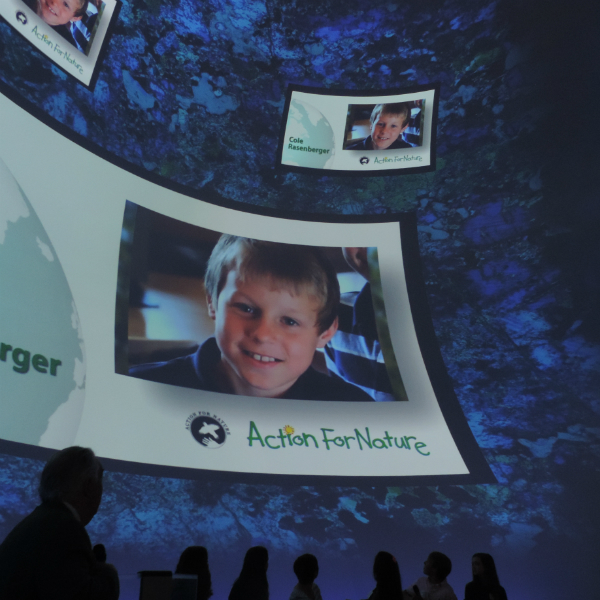
Five years ago, Cole began his journey as an environmental activist.
A few years ago, I realized the companies destroying the North Carolina Coastal forests were the paper mills producing paper for fast food restaurants.
My first target was McDonald’s for my campaign. I knew I was only one voice, so I decided to get my whole school to sign postcards. Together, we were 2,500 voices strong. Successfully, I mailed McDonald’s 2,500 handmade signed postcards asking them to be an “environmental leader for my generation by increasing the use of post-consumer recycled fiber in their paper products.” Months later, McDonald’s informed me that they would be using more post-recyclable fiber in their paper and changing their bags to 100% post-consumer recycled fibers. I was ecstatic!
Spring of 2010, I decided to take on a giant in the fast food industry: KFC. My mission was a bigger and took 12 months to organize to get seven schools to agree to support my project by signing over 6,000 postcards that would be hand delivered to KFC. During this time, I spoke out to different media venues to make an environmental change. Some of these were: Radio Disney, Rick Ranger Magazine, Charlotte Today show, Story of Stuff the podcast and local papers. I communicated about the North Carolina Coastal forest issues at local events: Christmas in Davidson and Davidson Farmers Market. For a year, I sent numerous letters, email, voice and videos messages to KFC trying to set up a meeting to hand deliver these postcards.
[vc_row][vc_column width=”1/1″][vc_video link=”https://www.youtube.com/watch?v=PIQUcDt1dhE”][/vc_column][/vc_row]
Although we flew out to KFC headquarters, the executives did not give me any positive feedback that they were going to use more post recyclable fibers. So, I walked away a bit defeated, but didn’t give up. For the next year, KFC did not respond to me too much. I campaigned again with friends and sent more video message to KFC’s CEO begging for their help to save the richest temperate freshwater ecosystems in the WORLD and to help to stop and slow down the destruction of these forests by using recycled paper.
In 2013, with my help, Dogwood Alliance was able to convince KFC to use more recycled paper in its packaging and to stop using Endangered Forests, too! In addition, KFC will not convert important NC wetlands to tree plantations, which protects land for important wildlife like the Red-Cockaded Woodpecker and Venus Flytrap. Greenpeace also got KFC to protect Indonesia’s rainforest during this time. My project was 100% successful!
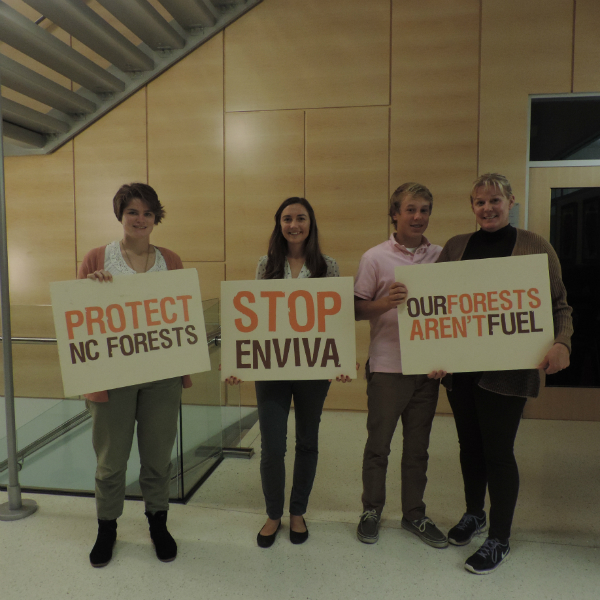
Cole launches a new student campaign to protect our forests from the expanding biomass industry.
As for 2014, unfortunately, there are new threats to North Carolina Coastal forests that are growing dramatically! Companies from Europe are now using these forests for fuel to generate electricity, despite growing scientific evidence that burning trees will accelerate industrial logging, increase carbon emissions compared with fossil fuels and threaten human health with air pollution similar to burning coal. Destroying our natural forest for biomass is a threat to the biodiversity of our plants and animals. Burning our forests for fuel is not the solution to our energy crisis. We need to invest in true renewables like wind, solar and geothermal.
It will be a national day for students to protect our Southern Forests! If you are interested in your school participating please let me know. The more schools we get to participate, the stronger our message will be!!! Please contact campaign organizer Emily Zucchino for more information.


 Donate
