


Today’s biggest threat to Southern forests is the growing biomass industry. The wood pellet industry is expanding at a rate that is impossible for Southern forests to sustain. Our beautiful forests are being clear-cut, processed into pellets and then shipped to Europe to be burned for electricity.
On November 13th, as the wood products industry meets in Chesapeake, VA to celebrate the destruction and export of our incredible forests, people from across the US are coming together for a National Day of Action to send an SOS to Save Our Southern forests. With 20 existing wood pellet facilities and 33 proposed, it’s crucial that we show EU policymakers that the biomass industry is bad for our environment, our communities and our economy. Join us in sending an SOS of more than 10,000 messages to EU policymakers.
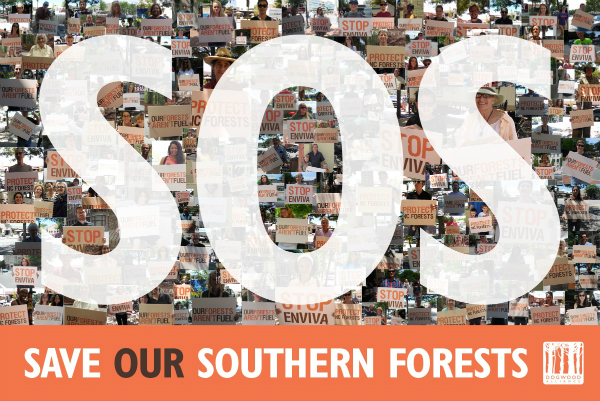
Join us on November 13th to send an SOS to Save Our Southern forests.
The increased demand for wood as a fuel source in the EU and particularly in the United Kingdom is driving the expansion of wood pellet manufacturing and export in the Southern US. We call on policymakers in the EU to hear our SOS and take action to stop the destruction of these forests.
Mounting scientific research shows that burning wood pellets manufactured from trees will increase near-term carbon emissions and accelerate climate change. A recent report released by the UK Department of Energy and Climate Change confirms that all scenarios in which whole trees or coarse woody residuals are used for wood pellets produce a result that is not carbon beneficial.
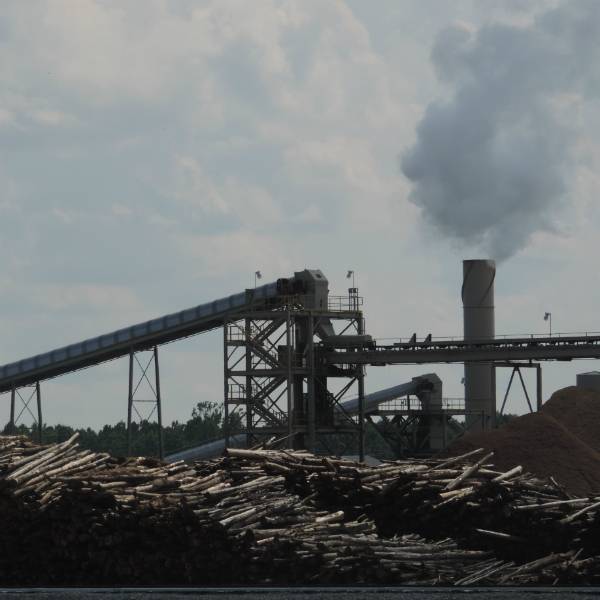
Enviva wood pellet facility in Northampton, NC.
Additionally, our living forests provide many benefits.
Forests provide our communities with clean air to breathe, water to drink, and natural protection from flooding and hurricanes. They are home to countless species of plants and animals found nowhere else on Earth. Cutting them down as a solution to the climate crisis is bad policy and makes no sense. We can no longer invest in forest destruction; we need to focus on forest conservation.

Protect our bottomland wetland forests!
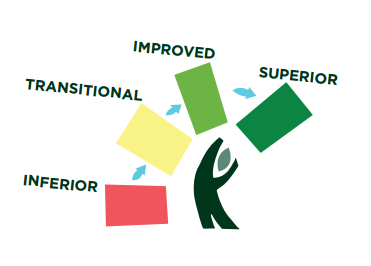
Paper Steps and the Paper Man Guide Purchasers to Green Progress
Early this month, Dogwood Alliance was proud to attend the Environmental Paper Network’s 2014 Fall Steering Committee meeting in Boulder, Colorado. Environmental Paper Network (EPN) began in 2002 as an unlikely alliance of organizations with very diverse approaches to a common problem — addressing the scale of the challenges and opportunities for social justice and conservation presented by the expanding forest, pulp and paper industry. It should come as no surprise that with 15 years of history working to transform the pulp and paper industry in the US South, Dogwood Alliance was one of the founding partners of the EPN, co-sponsoring the Environmental Paper Summit in California in 2002 along with many important allies. This group eventually coalesced in North America as the Environmental Paper Network, aligned around a Common Vision for transforming the pulp and paper industry.
Dogwood counts on the EPN for its important work, including the Paper Calculator, Paper Steps and the Global Vision that we have shared with our activists as well as with dozens of leading corporations working to improve their environmental performance. These are all excellent tools that I use regularly in my work. For example, the Paper Steps gives clear guidance on how paper buyers can move away from inferior to “Environmentally Superior” paper. Behind the scenes, we also rely on our colleagues in the EPN for strategic and tactical advice, movement updates and plenty of warm comradery. Nobody loves a “paper head” like another “paper head.”
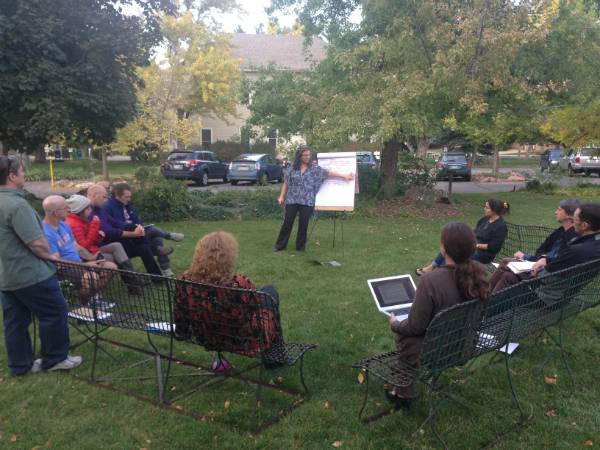
Environmental Paper Network Steering Committee Hard at Work Planning 2015
At our meeting, we plotted the 2015 EPN agenda. Among other cool projects, you can look forward to the release of important research from EPN’s Forest Carbon Counts projects setting out a scientifically based accounting of the climate impacts of harvesting and burning of forests for products and energy. This research will address a critical carbon accounting error which unfortunately is used by our own Environmental Protection Agency that sets the burning of forests for energy as zero. As the forest and paper industry is the largest user of bio-energy (burring wood waste to make pulp and paper) in the US setting out the true carbon cost of our paper and forest management decisions is critical for addressing climate change. This error is also a key component of Dogwood’s Our Forest Aren’t Fuel campaign because regulators in Europe have adopted the same faulty science which somehow classifies the burning of wood pellets made from forests here in the US South as carbon neutral.
Back from the EPN meeting, I remain impressed by the skill and commitment of the EPN community and look forward to continuing this important work in 2015.
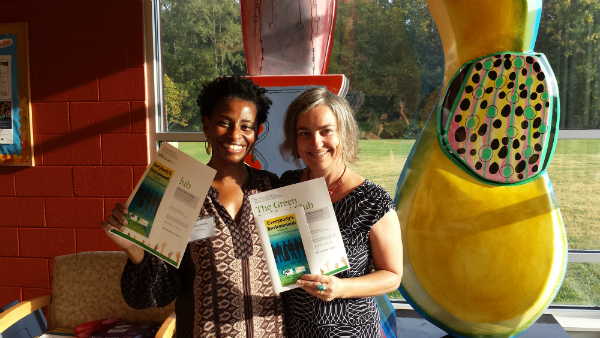
Melissa Williams of WNC Alliance & Helen Powell-Busch at Everybody’s Environment
I feel so lucky to have worked with the Center for Diversity Education at UNCA on the planning committee for the first annual Everybody’s Environment Conference at the Wesley Grant Southside Community Center here in Asheville. I’m also grateful that Dogwood was able to be a sponsor. Our goal was to bring diversity to the local conservation community. As you may already know, there is a nationwide issue of conservation staff and board being mostly white; it’s an issue that many are striving to remedy by bringing diversity and inclusivity into their organizations. Read this report to find out more.
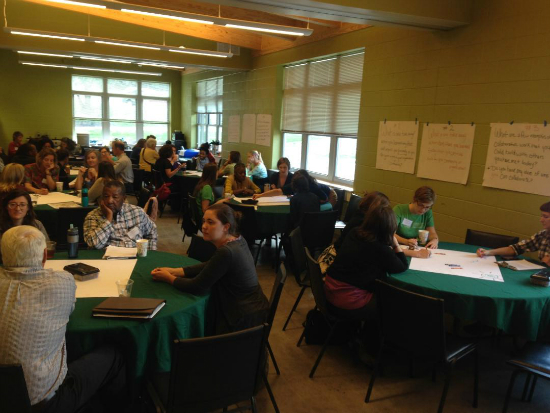
Friend of Dogwood, Sarah Nuñez, facilitates a World Café.
Here are the top three takeaway tips from our keynote speaker, Melanie Allen, Conservation and Diversity Coordinator at Conservation Trust for NC:
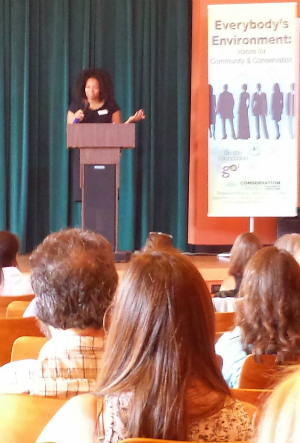
Keynote speaker Melanie Allen
There are many other great events and organizations to deepen your knowledge and experience of diversity right here in Asheville. I personally recommend Building Bridges, which is an eye-opening multi-week course that gave me a full picture of my white privilege and the intersectionality of marginalization while connecting me to new groups and people in town. I also recommend the YWCA annual Stand Against Racism events. The next step in my education is to dive deeper into my own unconscious bias by taking this survey. Please join me.
We exceeded our goal of 100 registrants and there were 46 organizations from WNC represented. This event was just the beginning for many of us. Stay tuned to learn more about another great event we’ve got coming up in the spring of 2015.
Dogwood has several current job postings. See our recently expanded inclusion language.
As the biomass industry continues to rage across the Southeastern US, it leaves in its wake the destruction of our beautiful Southern forests and the wildlife habitats and ecological benefits they provide. The wood pellet industry has undoubtedly been devastating to our environment and our forests. Yet there is another layer to the injustice.The biomass industry is one more instance of the corporate greed that concentrates wealth in the top 1% of our society, increasing #inequality while ravaging the resources of and giving little in return to the communities that bear the consequences. On Blog Action Day 2014, Dogwood Alliance highlights and applauds the community power and resistance that is growing in opposition to biomass and calls on policy makers and biomass corporate executives to stop destroying our forests and our communities.
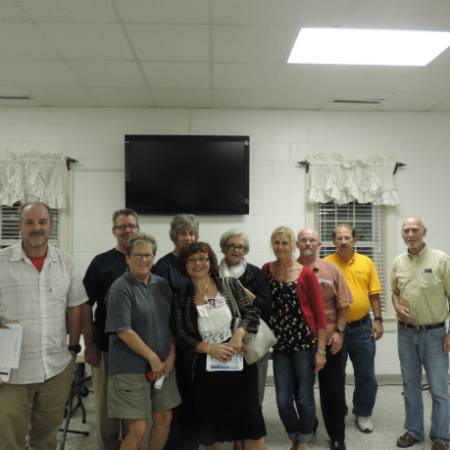
Community members in Wilmington, NC oppose the expansion of Enviva and the biomass industry.
In early September, North Carolina Governor Pat McCrory announced plans for two new Enviva wood pellet facilities to be built in North Carolina. “By developing these projects,” McCrory stated that Enviva “plans to double the size of its operating footprint in North Carolina, and in doing so, will be creating good, sustainable jobs.”
The two new proposed mills are in Sampson and Richmond Counties. Costing $35 million to complete, the mills will provide 160 jobs between the two of them. With unemployment rates of 6.6% in Sampson County and 8.7% in Richmond County, there is no doubt that jobs are needed in these communities. But when these temporary jobs destroy thousands of acres of valuable forests and disrupt the regions ability to improve water quality, provide food control, prevent erosion and absorb carbon emissions, it begs the question of what is it worth?
Three weeks ago, I traveled through North Carolina to meet with those most impacted by the immediate threats of Enviva’s new pellet mills and export facility. In Clinton, located in Sampson County, I met with Dwight Miller, a member of the local NAACP community and leader in the movement against the Fibrowatt chicken litter incinerator. Dwight reminded me that this is not the first time industry has tried to exploit this community. Years ago, plans were put in place to develop an incinerator to burn chicken waste. The plant, he told me, would be built right on top of the community’s African-American population.
With plans to build on the same lot as the Fibrowatt incinerator, Enviva’s wood pellet facility in Sampson County will present yet another barrier to community residents who are working to build a space that is safe, clean and vibrant. Dwight posed the question, “How did Enviva pick this community?” Why is it this community that deserves to be subject to the dust, noise and pollution of this new plant? Why is it this community whose peace is disturbed and local businesses disrupted with the constant back and forth of trucks heading to Interstate 40? How do 160 temporary jobs offset the destruction of the environment and a community’s quality of life?
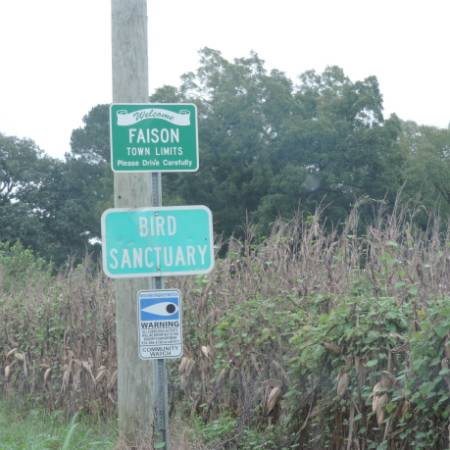
The construction of Enviva’s wood pellet facility in Faison, NC threatens the environment and quality of life in the community.
That evening, I met with a group of residents who have been active in pushing back against the proposed Enviva plant. Deborah, a long-time resident of Calypso, NC, just miles away from where the proposed plant is to be built in Faison, has worked with others in the community to take their concerns to local commissioners, policymakers and the media. Their efforts have been met with little to no response from local policy makers, leaving the group to wonder, “Where are the people who are supposed to represent us? Why are we working so hard to represent ourselves?” Most of the people present had lived in the county for decades and have enjoyed the peace and calm that comes with living in a small town in Eastern North Carolina. For some, that is set to change drastically.
She worries about the constant clanking and grinding of the conveyor belts that run outside of the plants. The group also expressed concerns about the 120-130 truckloads per day that will lead to traffic, noise, and increased risk for accidents.
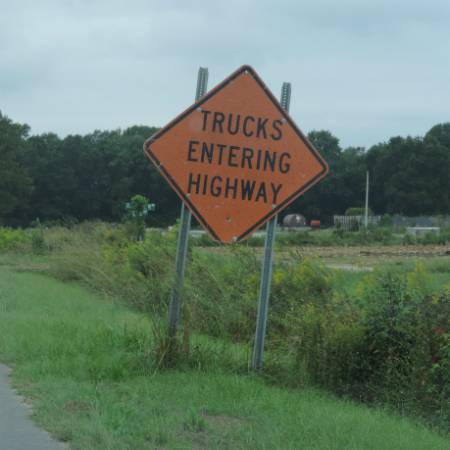
Increased truck traffic from the new plant will damage roads, disturb the peace and present increased risk of traffic accidents.
Not one of the group offered any hope of economic improvement. Rather, the group feared for what will happen in 5-10 years when the market inevitably changes and demand for wood pellets disappears. “Can the plant be utilized for something else?” one woman asked. Another wondered of Enviva, “Will you clean up when you leave?” The group had little faith in Enviva’s willingness to care for the community. They cautioned that while the company says they will replant the trees they cut down, the landowners are the ones who are actually tasked with the cost of doing so. No one will follow through to make sure they actually do it. And while Enviva might even offer economic incentives to the community, for many, this is just not enough. William, an environmentalist in the group, demanded a greater responsibility to the public.
The long-term impacts of Enviva’s destructive practices are not to be taken lightly; economic incentives and 160 short-term jobs are no substitutes for justice.
The negative impacts of Enviva’s practices are not just felt at the sites of harvest. Sixty miles away, in Wilmington, NC, community members worry about the export facility that is to be built at the Wilmington port. The Sunset Park Neighborhood Association has come together to oppose the construction of the two large domes that will store the pellets.
Additionally, they call on Enviva and their local policy makers to put in place measures that require Enviva to repair road destruction caused by their truck traffic, implement sound buffers, create a constant monitoring system that is made available to the public on a quarterly basis and that all these things be enforced by city authorities. Roberta, an active member of the association, reminded the group that their tax money is paying for these harmful additions. With the potential of $1.7 million in awards offered to Enviva by the state of North Carolina, it is NC residents who are paying for these plants, and it is NC residents who should have the loudest voice in how development practices do and do not serve them. Enviva does not and will not get the right to create the future of these communities. We stand in solidarity with the residents of Wilmington as they push for investment policies that benefit them and with the communities in Sampson and Richmond County who demand living spaces that are environmentally and economically sustainable.
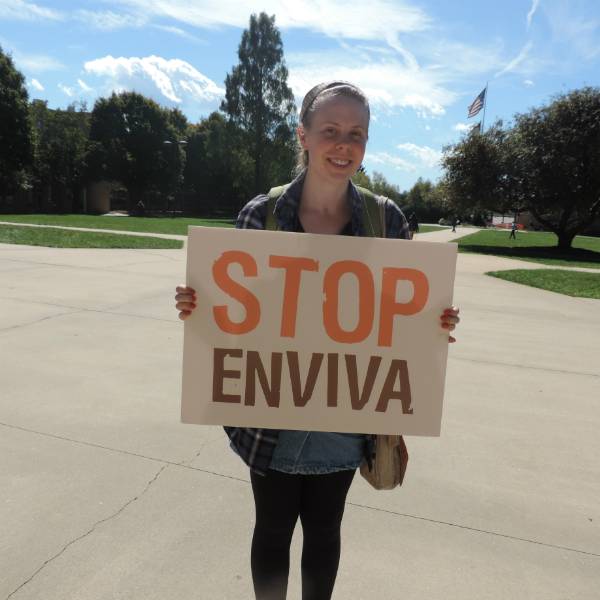
We call on Enviva to stop their destructive practices.
Enviva can continue to tout their false claims of economic and environmental improvement. But as community resistance continues to swell, we know theirs will not be the loudest voice. Today, #BlogAction14, we call on Enviva and NC policy makers to stand against #inequality. On-the-ground resistance won’t stop until we have achieved policies and practices that support equality, justice and the promise of a better future.
Last month in New York City, world leaders from government, business and non-governmental organizations gathered at the UN Climate Summit to discuss key issues and strategies for addressing climate change. Over 300,000 people hit the streets of New York demanding strong action on climate (including Dogwood Alliance staff and board members).
Let’s hope that the momentum carries through to December when the UN convenes the Conference of the Parties (COP) of the United Nations Framework Convention on Climate Change in Lima, Peru.
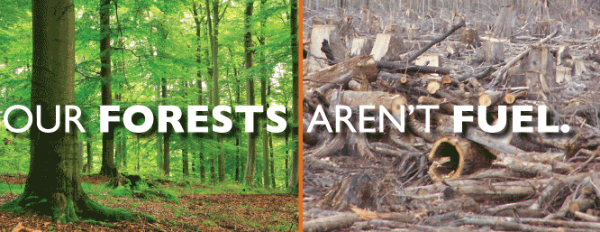
Since launching the Our Forests Aren’t Fuel campaign last year, I have been scratching my head in disbelief about the contradiction that exists when it comes to global forest climate policies. Over recent years, there has been a suite of initiatives aimed at reducing carbon emissions from forest loss and degradation, which admittedly accounts for 20% of global carbon emissions. As part of the New York Declaration of Forests, three European nations – UK, Norway and Germany – announced increased global funding for reducing deforestation and increasing forest conservation.
On the other hand, recent energy policies treat the logging and burning of forests to generate electricity as a climate friendly alternative to fossil fuels despite how much forest carbon it releases into the atmosphere.
What adds to the absurdity is that many of the European nations supporting the Declaration on Forests released in New York, led by the UK, are also heavily subsidizing burning forests for electricity.
Maybe the New York Declaration on Forests will mark a turning point. After all, the aggressive goals to stop deforestation and forest degradation are right on target and can have a major positive impact.
Not only do they have the power to pull carbon out of the atmosphere, but they purify and protect drinking water, prevent floods and provide critical habitat for 80% of the world’s terrestrial species.
It rightfully suggests that we must start treating the scale up of forest protection as being just as important as transitioning away from fossil fuels.
But, if world leaders keep ignoring the flawed global energy policies that erroneously treat the logging of forests for fuel as a path to reducing carbon emissions so that forests become a primary fuel source for generating electricity around the world, we are in big trouble. And right now, the world is on a path to do just that.
Here in the Southern US, the world’s largest wood producing region, the stark contradictions in global forest climate policies are evident on the ground. As European utilities strive to meet “renewable” energy targets, massive government subsidies have funded the conversion of big coal plants to wood.
In just the past three years, wood pellet exports from the Southern US to Europe have gone from almost nothing to nearly 3 million tons a year. And if current policies driving this market continue, wood pellet exports from this region could double in annual volume to over 6 million tons a year by 2016. The clearcutting and degradation of wetland forests along the coast of the Southern US – a resource already under stress – to supply this booming new market for wood has been well documented.
The expansion currently underway by the South’s largest wood pellet exporter, Enviva, is estimated to impact millions of acres of forests over the next 20 years. Plans by a plethora of other companies to build dozens of other wood pellet facilities have been announced, magnifying the threat to our forests.
In direct contrast, good faith efforts designed to protect forests as carbon sinks struggle to find the capital and market value necessary for meaningful scale-up. Despite all the policies intended to help fund the protection of forests, it just doesn’t pay to leave trees in the woods. The bottom-line?
This paradigm must shift if global leaders are serious about addressing climate change.
Perhaps the bold targets set forth in the Declaration will mark the beginning of the end to the forest climate policy contradictions. Global leaders must acknowledge that when it comes to generating electricity, burning carbon sinks isn’t “carbon neutral” and doesn’t fit with the stated goals in the Declaration on Forests coming out of the UN Climate Summit in NYC.
Even more important, they must take swift action to halt the runaway wood pellet train before it goes too far down a dead end track. Finally, now is the time for governments, investors and businesses to get serious about the capital that needs to be directed to scale up the protection and restoration of forests.
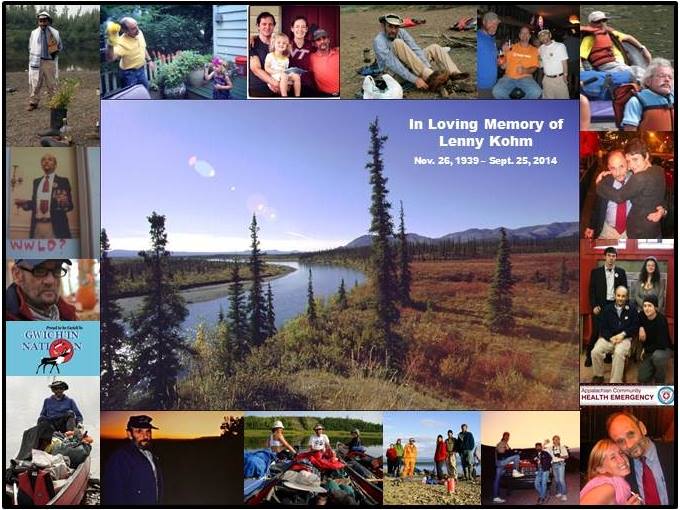
Last week the world lost one of its best, brightest, and most fun environmental champions, Lenny Kohm. Lenny was a long time champion of wilderness, the Arctic National Wildlife Refuge, ending mountaintop removal, and protecting forests and communities across the Southern US.
I first met Lenny in 1997 in Santa Barbara, California, when he was tirelessly traveling around the United States working to raise awareness around the need to protect the vast arctic wilderness. When I started with Dogwood Alliance in 2000, one of the first people I called on to help me become a better organizer and help stop the invasion of the chip mills in North Carolina was Lenny, who at the time was living in Rutherford County and helping local community members organize and fight back against a chip mill that was decimating the forests and disrupting the quality of life in that county.
Over the years, I have worked, organized and played with Lenny. He always had a joke even in the toughest of situations and firmly believed that collectively we could overcome the most difficult of environmental tragedies. He was a true inspiration and will be sorely missed. I am proud to have called him a friend and believe that he would want us to raise a glass in his honor and then get back to the business of challenging corporate power and protecting all of the wild places that we love.
Read more about Lenny on the Appalachian Voices blog.

FSC General Assembly was in Seville, Spain this year.
I’m just back from the Forest Stewardship Council’s (FSC) General Assembly in Seville, Spain, and my head is spinning. Held every three years, the General Assembly is an exercise in direct democracy where FSC’s members gather in support of the FSC’s noble idea to bring together social, environmental and economic interests into one system for the responsible management of the world’s forests. The General Assembly played out like a compelling novel; savvy business leaders sitting down with environmental activists, labor unionists from around the globe sharing coffee, leaders of Indigenous peoples from the tropics dialoging with FSC officials.
People talk and argue and talk some more. Sometimes just like in congress, when all sides are together in one room, progress can be hard to discern! Motions are debated and amended with feedback from “across the aisle.” Unlikely partnerships are formed. Votes are counted, and the future is written.

Delegates put their heads together to work out important issues.
While many motions were passed in Seville, there are a few that are of critical importance to Dogwood Alliance’s work here in the Southeastern United States, revealing why the FSC matters so much. First up is Motion 84 – an omnibus motion that urged the development of an FSC Global Strategy – was voted in unopposed. The planning process will allow for all stakeholders from large pulp and paper companies to environmental advocates like Dogwood to work to set a clear forward direction for the FSC. This is critical here in the US where, thanks to growing awareness about the importance of protecting forests resulting from our campaigns, there has been tremendous growth within the FSC system with FSC certified acres reaching over four million in the US South.
Similarly, Motion 11 – on the need for an innovative approach to enabling smallholder access to the FSC – passed without opposition. This is as critical globally as it is in the US South, where our forestlands are owned by literally millions of smallholders. To give insight into what that means here at home, the average timber sale in the state of Kentucky is just 40 acres.
Lastly, this General Assembly marked the first with the presence of the FSC’s Permanent Indigenous People’s Committee (PIPC). The debate regarding Indigenous peoples’ rights and forestland is not one that we hear very often in the Southern US, but it’s absolutely critical across the globe.
The FSC, I am pleased to say, made another strong stride in that direction in passing Motion 83, which called for a new approach to certification of Indigenous groups and traditional communities, addressing challenges and creating social benefits for forest-dependent communities.

Juan Carlos Ocampo, who belongs to the Miskito Community in Central Americas and member of the PIPC addresses a meeting.
And so another FSC General Assembly has come to pass. This time, we can say Dogwood was there. We contributed and we made a difference. Now we will continue the work of protecting our forests and be thankful that we have a tool like FSC certification that helps us do the right thing.
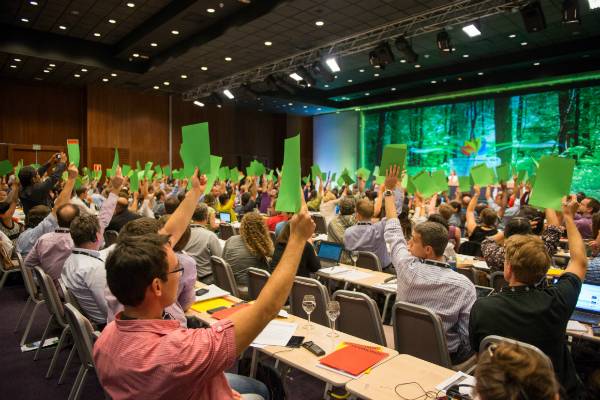
Dogwood’s vote (a vote for Southern US forests) is counted.
Last Sunday, I joined 400,000 people in NYC for the largest and most diverse march the climate movement has seen. As world leaders prepared to gather at the United Nations for a summit meeting on climate change, people from around the world came together to take action in the face of inaction by world leaders. Though I’ve participated in many marches for a variety of causes, I’ve never been to one of this size, with this much energy and excitement.
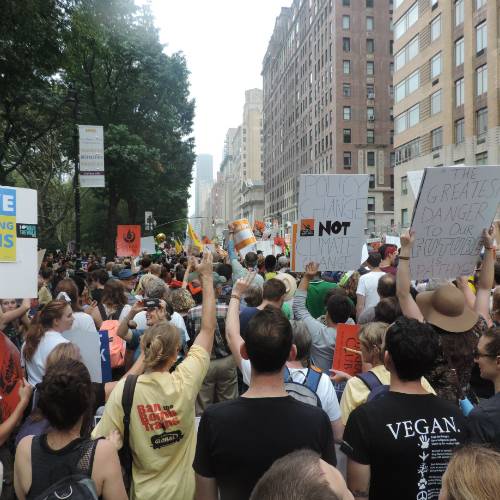
400,000 people gathered to demand action for our climate.
The diversity of people and backgrounds that mobilized on Sunday reiterated the message that the climate crisis is a global one that, while impacting some sooner and stronger than others, will eventually affect us all. The variety of signs, ranging from calls for food justice to Dogwood’s own Our Forests Aren’t Fuel banner underscored the fact that environmental irresponsibility has devastating consequences for nearly every aspect of our lives. And, as I stood there growing impatient for things to start moving, I thought about how, like the march, the climate change movement requires an extraordinary ability to coordinate diverse nations, issues and challenges.
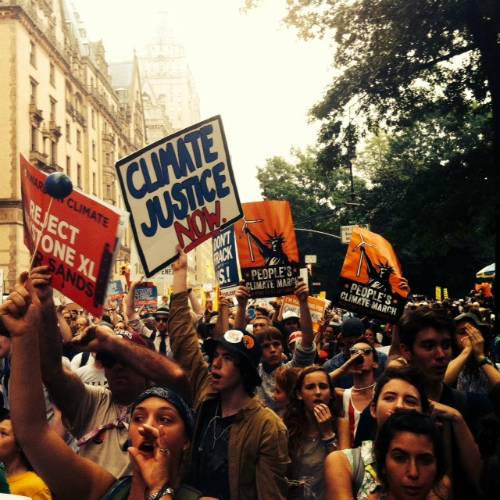
Sounding an alarm at the People’s Climate March in NYC.
The march was intentionally open and devoid of a concise and central ask. The marchers came together under the umbrella issue of the urgency of the situation. Representatives from indigenous communities, island nations, faith communities and the science community were present, as well as children, students, the elderly and all ages in between. Even with 400,000 of us present, we knew that we represented so many more who couldn’t be there. At 12:58, the crowd grew silent, as we took a moment to reflect on the gravity of the situation and to honor all those who have suffered the most from climate change. Then, one minute later, we rang an alarm – drums beating, horns blaring and mostly, the whoops and hollers of the marchers.
On one of my first marches, many years ago, in support of immigration reform, I met with a state senator afterwards. Sitting in his office, he told us that while we marched past their offices, state senators and their aides were doing little to take us seriously. To which my colleague replied, “We don’t do it for you, we do it for us”. This has always stuck with me and came to me again during the climate march. While no one believes the solutions will come over night, we came together as the people…because to not do so is too dangerous. What is at risk is so great that we can no longer sit silently. And, I believe that eventually our policymakers will take notice. I asked John Beal, a valued Dogwood Alliance Board Member, what brought him to the people’s march, and he replied, “I saw the power of the peace movement to change the direction of our country in the late 60’s. So I wanted to participate in this historic effort to move governments and corporations toward a greener future for the earth.” Throughout the march, I glimpsed similar messages of empowerment, from people who had changed their own personal habits, to those who were not giving up on the fight to protect their communities from new and existing threats. “It was also important to me as a board member,” John added, “to make sure that Dogwood Alliance was represented.” I agree. I felt proud to march behind the Dogwood banner, knowing that we at Dogwood are standing up to an industry that is built on false solutions and corporate greed, and that we are protecting some of our earth’s most incredible forests here in the Southeast. As I travel through North Carolina this week, meeting with community members in areas where new wood pellet facilities are to be built, I feel a renewed sense of belief in the power of the people to create the world we want to live in.
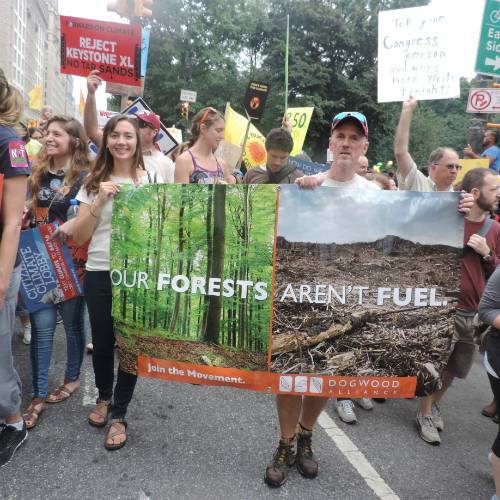
Campaign organizer Emily Zucchino and Dogwood Alliance board member John Beal carry the Our Forests Aren’t Fuel banner.
We need to do it now. March attendees sent a strong message to global leaders to act now on issues of climate change. Island communities reiterated that they do not have time to wait, and students and young people held signs urging policymakers to consider what will be inherited by their children and grandchildren. It is crucial that global leaders do the right thing and pave the way for sustainable policies that curb greenhouse gas emissions and encourage investment in true renewables such as wind and solar. But, the energy, urgency, and excitement of Sunday’s march is a reminder that we will not and cannot wait for our world leaders.
While we wait for global leaders to catch up, we can all play a part to demand action and protect our earth. At Dogwood, we know that every voice matters and that every step in the right direction is part of the solution.
[vc_row][vc_column width=”1/1″][vc_video link=”https://youtu.be/GW7vy7afxWY”][/vc_column][/vc_row][vc_row][vc_column][vc_column_text]
A month ago, Dogwood hosted a reporter from the BBC, and on September 22nd, the story aired. Millions of people saw the massive scale destruction of our forests all in the name of meeting the UK’s renewable energy demands. The BBC showed the other side of the climate story, revealing that there’s huge concern about the efficiency and sustainability of using wood for fuel.
If you’d like to view the full 30 minute BBC piece, click here.
[/vc_column_text][/vc_column][/vc_row]

Dogwood Executive Director Danna Smith debates Seth Ginther, Executive Director of US Industrial Wood Pellet Association, at Southern Environmental Journalists Conference
You know you’ve effectively gotten the attention of the media when they ask you to speak on a panel about your campaign at the Society of Environmental Journalists annual conference. On September 7th, I hopped a plane to New Orleans to debate Seth Ginther, the Executive Director of the US Industrial Wood Pellet Association, in front of a roomful of journalists. Over the last few of years, coal burning power plants have been converted to burn wood pellets as a supposedly clean and renewable energy source.
As my flight boarded, I wondered how my fellow panelist was going to defend his industry’s increasingly questionable claims that wood pellets provide a “sustainable, low carbon fuel” for generating electricity in Europe. Looking out the window of the plane on my flight, I had a bird’s eye view of Southern forests. For a brief moment, I imagined what it must be like to be that bird who, after a long and tiring flight from Canada on the way back to South America, discovers that the mature wetland forest it used to rely on as a safe haven has been laid flat. For years, bird experts have been urgently calling for greater protection of the South’s wetland forests, which have suffered tremendous degradation from industrial logging. I wondered how Seth was going to defend the South’s largest wood pellet exporter, Enviva’s, sourcing of wood from clearcut wetland forests as “sustainable.”
With the recent evidence from NASA of the rapid pace of forest cover loss from logging in the Southern US, how would Seth justify the rapid growth in wood pellet exports? At this critical moment in time when experts around the world are calling for greater protection of forests for their ability to purify water, prevent floods and protect us from climate change, how was he going to justify the skyrocketing demand his industry is placing on a resource already under tremendous stress?
Moreover, as the spokesperson for an industry whose very existence hinges on claims that wood pellets exported from Southern forests are a “low carbon” fuel alternative to fossil fuels, how was he was going to respond to the latest report released this summer by the UK Department of Energy and Climate Change (DECC), which found that when it comes to carbon emissions, leaving trees in the forest is largely the best strategy?
The next day, Seth and I had a chance to chat before our panel. I had met Seth before at one of the industry’s conferences last year in Atlanta. Nice enough guy. Smart too. But as his industry comes under increasing scrutiny and more evidence surfaces, his job as defense council for the wood pellet industry is getting far more difficult.
Being a sharp lawyer, Seth defended his industry the best he could.
Professing that removing millions of tons of wood from the forest and burning it into the atmosphere reduces carbon emissions is a tough sell when yet another government report was just released providing direct evidence to the contrary. Asserting that there is more “forest cover” today in the South than in previous decades is a losing argument, when recently released satellite imagery shows the South as a major global hotspot for forest cover loss due to logging. Stating that no forest has been logged for wood pellets when the biggest player in the industry, Enviva, was exposed on the front-page of the Wall Street Journal and on the BBC News for buying wood from a clearcut 100-year-old wetland forests is just plain not true.
When I pointed out that the UK government recently admitted in the press that they have been wrong in assuming that the burning of trees is carbon neutral, Seth went on public record accusing me of not telling the truth, even though that fact is easily verifiable by this BBC News article. Accusing your critics of not telling the truth might be an old defense tactic, but it clearly backfired on him here since the facts (and the BBC) are on my side.
The wood pellet industry’s defense strategy is nothing new. We see it all the time. Coal and other fossil fuel companies, determined to defend the status quo and their investments, continue to state as fact that climate change is a hoax despite overwhelming evidence to the contrary. They continue to assert that their practices of extracting fuel out of the ground are “safe” and “sustainable” in the face of stark evidence to the contrary.
We know what kind of public groundswell it took to earn women the right to vote and to end segregation. That’s why hundreds of thousands of people marched the streets of New York last weekend at the largest climate rally ever.
Dogwood Alliance leading the movement for forest protection at the Peoples’ Climate March.
So, despite being on the right side of history, science and plain old common sense, the wood pellet industry’s rapid expansion across the US South continues, largely unabated. New investments are being made as I write this and taxpayer subsidies continue to flow freely. Just last month, North Carolina’s Governor publicly supported Enviva’s massive scale up of wood pellet exports from the state as “sustainable.”
Rolling back the financial and political momentum behind the wood pellet industry and the tremendous threat that it poses to forests and climate is going to take nothing short of a massive movement across the US South.
Join the growing movement to demand action on climate and protect Southern forests.


 Donate