


[vc_row][vc_column][vc_column_text]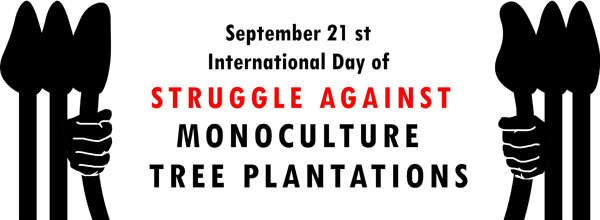
Today, September 21st, is a big day for action as we celebrate the International Day of Struggle against Tree Monocultures and the People’s Climate March.
Ten years ago, at a meeting of 250 members of communities affected by large-scale eucalyptus plantations in Brazil, September 21st was established as the National Day Against Tree Monocultures. The aim was to increase the visibility of the many peoples and communities struggling against tree monocultures, as a way of breaking the circle of silence around the numerous violations faced by the communities whose territories were surrounded by these monocultures. Year after year, organizations and social movements carry out a number of activities during this month to give visibility to their struggles and to denounce the negative impacts plantations have on their livelihoods and territories. This year, September 21st is also a day of mass mobilizations for climate justice. Thousands of people will join the People’s Climate March, while political leaders – and increasingly also corporate representatives – are meeting at the United Nations in New York City for the Climate Summit 2014, convened by UN Secretary General Ban Ki-moon.
The UN and other international agencies will launch the “Climate Smart Agriculture” initiated at the summit. This initiative is a new smokescreen being used to greenwash the worst practices of industrial agriculture: chemical fertilizers, industrial meat production and genetically modified crops, such as tree plantations and other monocultures, which are being disguised as ‘climate smart’.
As we continue in the fight to protect our Southern Forests from the destructive biomass industry, stopping the conversion of natural forests to monoculture pine plantations is a top priority. If we’re going to create lasting protection for our standing forests, our best defense against climate change, we need everyone taking action and raising their voices against unsustainable forest destruction. Dogwood Alliance and the Our Forests Aren’t Fuel campaign are excited to join and support these actions that are carried out in several countries in all continents and urge everyone to do the same.[/vc_column_text][/vc_column][/vc_row][vc_row][vc_column width=”1/1″][vc_video link=”https://youtu.be/17QxF61PVC4″][/vc_column][/vc_row]
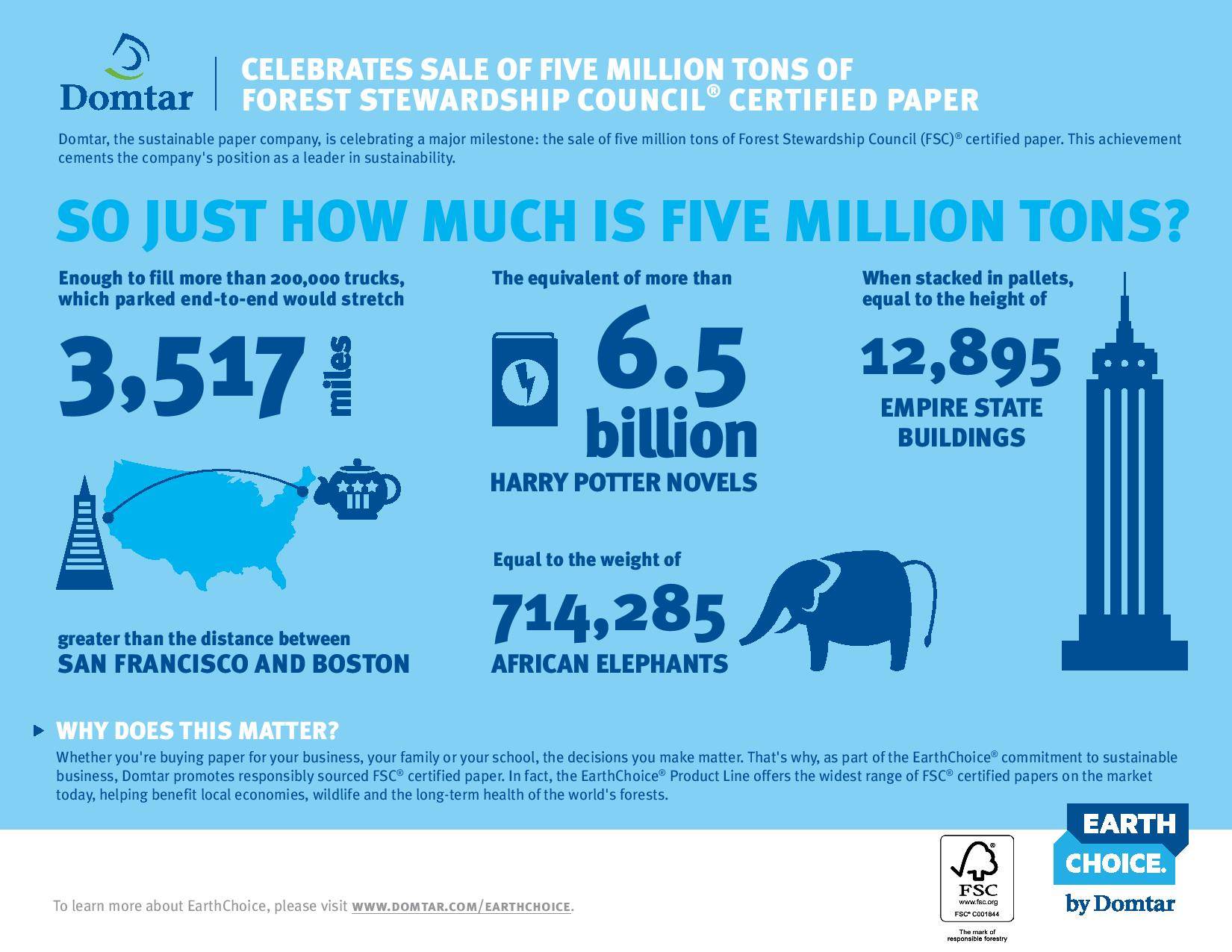
Domtar, the largest manufacturer of office copy paper in North America, today announced that it has sold its five millionth ton of Forest Stewardship Council (FSC) certified uncoated fine paper, a first for the North American market. Domtar’s EarthChoice® Product Line represents the widest range of FSC certified papers available today, and the milestone solidifies the company’s position as a longstanding industry leader in responsible fiber sourcing and sustainable practices.
Domtar revolutionized the industry when it became the first company in North America to offer FSC certified copy paper in 2005. By breaking from the norm and embracing sustainable goals, Domtar helped create a new model of collaboration – one that has led to long-standing partnerships with some of the world’s leading environmental organizations, including the Rainforest Alliance and Dogwood Alliance.
“As an organization working to conserve forests in the largest paper producing region in the world, the US South, we have been pleased with the leadership Domtar has taken to produce paper that has a lighter touch in the woods,” said Danna Smith, Executive Director at Dogwood Alliance. “Domtar was an early adopter of Forest Stewardship Council (FSC) certification, when many people said it couldn’t be done in the US South. They proved their critics wrong with the production of Earth Choice and 5 million tons later are continuing to lead the way.”
Domtar is also an active participant and supporter of the Carbon Canopy, a collaboration between Dogwood Alliance, Fortune 500 companies, ENGOs, and sustainability leaders in the pulp and paper and wood products industry. Carbon Canopy is a ground-breaking initiative that incorporates the preservation of ecosystem services into forest management in the Southern U.S. This is the highest bar for responsible forestry supply chain management in existence. We’ve started with building a credible carbon market model and envision developing similar markets for other benefits of ecosystem services like reduced soil erosion, plentiful aquifers and water quality.
Read more about how Dogwood Alliance has worked with some of the largest paper companies in the world, including Domtar, to transform their practices.
The Our Forests Aren’t Fuel campaign team recently took a trip to Enviva‘s wood pellet facility in Southampton, Virginia, where we documented yet another clear-cut site.
The pellets processed at the Southampton site are then trucked to the export facility in Chesapeake, VA, where they are shipped to Europe to be burned as fuel.
This past week, we traveled again to Chesapeake. This time, we visited Enviva’s export site, met with concerned community members living in Virginia and spent some time in the incredible forests that we’re working to protect.
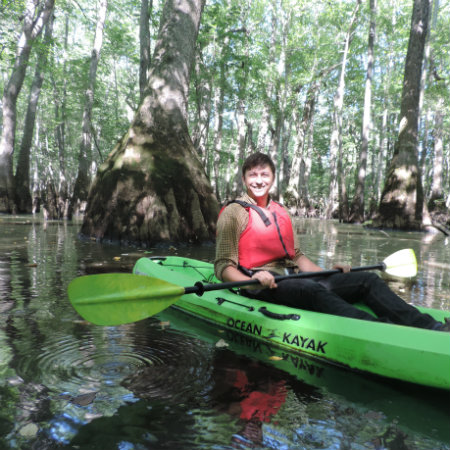
Campaign Director Adam Macon kayaking on the Nottoway River in Virginia.
We started the week kayaking through old-growth Cypress groves on the beautiful Nottoway River. Out on the river, surrounded by the dark, tannin-stained water and majestic Bald Cypresses, our friend and guide, Tim McCormick, reminded us of the great importance of this type of ecosystem. Wetlands are home to many species, including rare and endangered animals; they provide flood control by absorbing runoff and maintain and improve water quality. The area we kayaked is public land and therefore protected, but just up the river, many of the trees have been destroyed for profit.
On Wednesday afternoon, we went up to Chesapeake to get a closer look at the Enviva export facility. The southern part of the Elizabeth River runs through Portsmouth and Chesapeake and is lined with industrial centers on both sides. From the Jordan Bridge crossing the river, it is easy to spot the two enormous white silos that store up to 100,000 metric tons of wood pellets. We paddled our kayaks through Paradise Creek, which runs right next to the domes. The structures are massive. It’s alarming to realize the amount of forests that must be cleared to stock these domes, and the impact of this huge loss on our environment and communities.
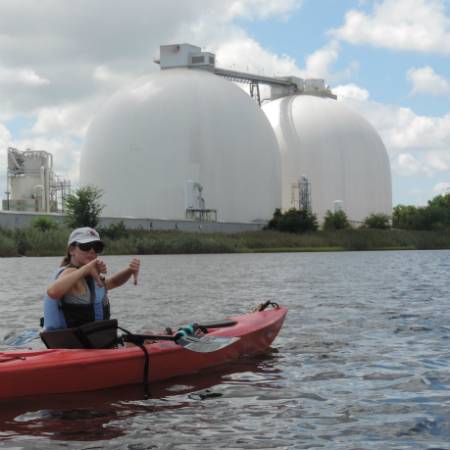
Campaign Organizer Emily Zucchino at the Enviva export facility in Chesapeake.
While in Virginia, we met with environmentalists, students, professors and community members who are concerned about Enviva’s role in destroying our Southern forests. At teach-ins in Norfolk and Richmond, we met with allies and invited people to take part in expressing opposition to the growing biomass industry.
We had a great trip, connecting with allies and seeing Enviva’s destructive facility firsthand. We look forward to heading back to Chesapeake at the end of the month!
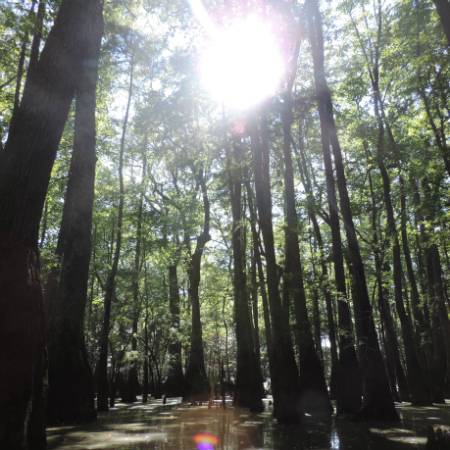
Cypress grove on the Nottoway River.

Back to school!
Across the country, Labor Day informally marks the end of summer and the beginning of a new school year. When kids head off to school, it’s a good time to think about the pads, notebooks and paper students use to learn all across the country.
From the books in the library to the composition pads and math notebooks, paper is a fantastic and effective tool for learning. We want to help you, though, to be aware of the choices that are out there. These choices are important, because by choosing recycled and Forest Stewardship Council certified paper made from responsibly managed forests, you limit your impact on the environment. It’s a great feeling to be able to buy your children’s school supplies and help protect important conservation values in the forests of the US South and around the world.
Dogwood Alliance and our colleagues in Environmental Paper Network have worked long and hard to advance the responsible purchasing of paper from the world’s forests as an extension of our environmental values and as a tool to drive improvement in the protection and management of the world’s forests. Our goals are expressed in the Global Paper Vision that is endorsed by over 120 organizations from around the world.
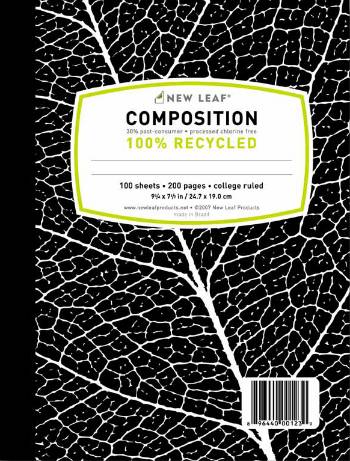
Are your school supplies recycled and FSC certified?
So what does this mean when parents are gathering supplies and sending their kids back to school?
First, see what you already have first. Check around the house for what you may already have on hand – unused school supplies from last year or maybe unneeded office supplies cluttering your desk.
If you need some new stuff, like my family did this year, buy supplies that are made from recycled materials or certified by the Forest Stewardship Council (FSC). When picking up paper and pencils, look for the FSC logo. This ensures that the products come from responsibly managed forests.
What to look for: the FSC logo
Because people like you care about our forests, Dogwood Alliance has been able to convince some of the largest retailers of paper in the world like Staples and Office Depot to commit to responsible paper procurement practices. As big customers started to demand recycled and FSC paper options, the forest products industry responded by improving their own environmental performance and offering greener products to the marketplace. After over a decade of conflict over the impact of industrial logging for paper production on the forests of the Southern US, Dogwood has a partnered with International Paper (IP), the world’s largest paper and packaging company, to advance forest conservation in the world’s largest paper-producing region. Though we were once foes, Dogwood has joined forces with IP to map and protect endangered forests, discourage the conversion of natural hardwood forests to pine plantations and expand FSC certification. You can also look forward to a new Green Grades report rating the wood procurement practices of the largest forest products companies operating in our region coming up this fall.
When you make responsible choices with your back to school supplies, you’re making a real difference. So my daughter went back to middle school with green school supplies and purple hair. What more can a Dad ask for?
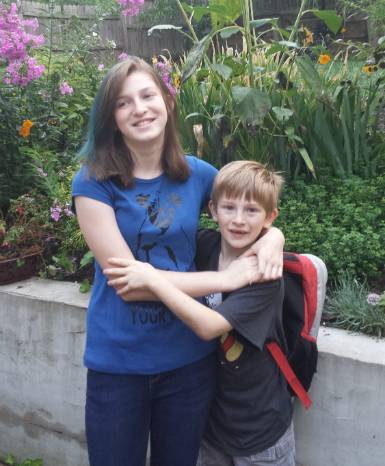
The Goldberg family on the first day back to school!
At worst, an internship can be a place where you’re forced to go every day to sit in front of a computer for eight hours and waste time. At best, I thought, an internship can be a place where you’re given work that’s kind of interesting, nice people to work with, at an organization you support. That’s how I imagined my summer at Dogwood would go, but it has proven to be so much more than that. Working as the Communications Intern at Dogwood this summer has inspired me even more deeply to dedicate my career to environmental work and led my love of nature to grow even stronger – and I wouldn’t have thought that was possible!
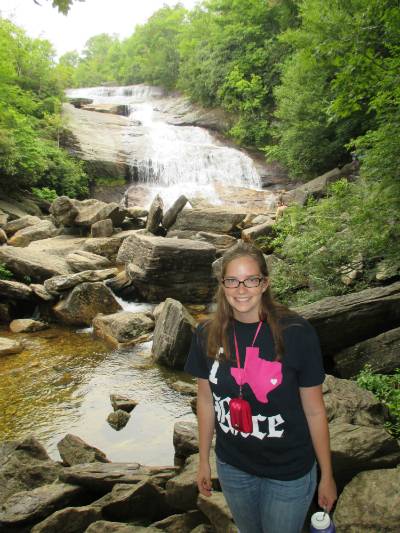
Waterfalls and the forest!
Originally, I applied to intern here at Dogwood because of my interest in the energy industry. I hoped that this internship position would not only give me an introduction to environmental work in the nonprofit sector, but also help me evolve my own views on what the answer is to the global energy crisis. If there’s one thing I’ve learned for sure this summer, it’s that woody biomass is not the answer – our forests aren’t fuel!
During the past ten weeks, I’ve been working on communications, marketing and campaign projects for Dogwood. I’ve built lists of media contacts for the organization’s various campaigns, called more than 300 people to personally invite them to the People’s Public Hearing in Wilmington earlier this summer, managed and updated all of Dogwood’s social media accounts and worked on the website’s Google Analytics.
More important than the skills I’ve honed through my various assignments, though, is what I’ve gained by asking questions and paying attention to what’s going on in the organization at a higher level. Before beginning this internship, I had only limited experience in environmental work. It seemed like a daunting, difficult cause to work for. Making change is hard, and the opposition to environmental voices is quite loud and vehement. Quickly after beginning work here, though, I realized that Dogwood’s current campaigns stand on the shoulders of the success of its original paper campaign. With those great accomplishments defining what Dogwood is today, it’s impossible not to face the current biomass campaign with a sense of hope and excitement.
One of the most memorable experiences of the summer happened in Wilmington, during the public hearing. On the day of the event, as it was starting, a man approached me to ask if I knew how to access the stairs in the building because his wife was afraid to use elevators but wanted to make it up the three flights of stairs to attend the hearing. I went downstairs to find this man’s wife, and as I was escorting her around the side of the building to the staircase, she explained to me what led her to attend the hearing. She’d had no knowledge of the issue of woody biomass until “someone” from the Dogwood Alliance called her to explain the situation, but during that phone call she realized that she had actually seen some forest clear-cuts on a road trip with her family the previous year. Connecting what she’d seen with what she heard on the phone had motivated her to attend the hearing. Speaking passionately about how ugly the clear-cuts were, she told me that she wanted to do whatever she could to help out the campaign. I specifically remembered talking to her on the phone because we’d had a bit of an awkward interaction when her 15-year-old daughter had been on my list of people to contact, but I could tell that she didn’t know it was me who called her. As I walked that poor little lady who was afraid of elevators up the stairs, I felt extremely proud to have motivated someone else to care about an issue that’s so important; it didn’t matter that she didn’t know it had been me.
As I get ready to start grad school at Duke in the fall where I’ll be working towards a Master of Environmental Management degree, I’ll carry with me the inspiration and enthusiasm this job has given me. I sincerely want to thank my supervisor, Scot Quaranda as well as Amanda Rodriguez and Adam Macon, with whom I’ve also worked this summer, for giving me such a positive experience here. To everyone at Dogwood Alliance – I’m amazed by the work that you do and your passion for the environment, and it’s been a pleasure working with you this summer. I can’t wait to continue to support Dogwood when I can and to read about all your future success stories in the news!
Dogwood Alliance is proud to be a part of the People’s Climate March, joining world leaders in New York City for a United Nations summit on the climate crisis. With our future on the line and the whole world watching, tens of thousands of people from every imaginable background will take to the streets and demand the world we want is within our reach: a world with an economy that works for people and the planet; a world safe from the ravages of climate change; a world with good jobs, clean air and water, and healthy communities. To change everything, we need everyone on board.
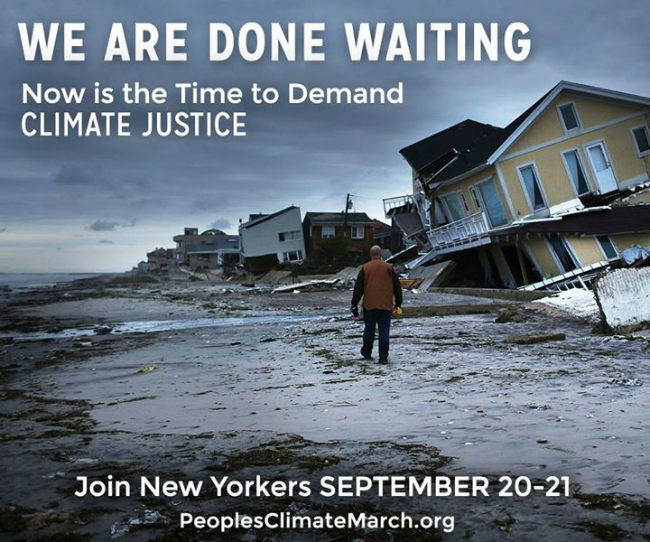
You know how serious climate change can be: rising seas, violent storms, droughts, the list goes on. All too often, these devastating conditions directly impact those who can least afford it. This must stop. Now more than ever, we must take serious action to protect our planet from the worst effects of climate change.
Dogwood Alliance members from across the South will be joining in and raising their voices for one of our most important assets in the fight to protect our planet: Southern forests. Currently, deforestation is the third leading emitter of carbon pollution. This massive problem will only worsen if the biomass industry continues to burn our forests for fuel. Rather than protecting forests and the vital role they play in removing carbon from the atmosphere, companies like Enviva and Drax are razing Southern forests to feed Europe’s appetite for wood pellets. We know that Our Forests Aren’t Fuel. We know that our forests should be valued for the true benefits they provide. We know that without forests our planet wouldn’t make it. We know, and after September 21st, so will the world.
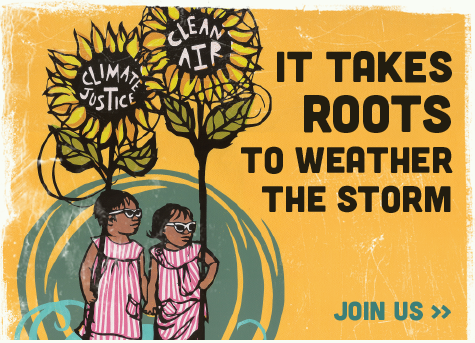
Sending a strong message of action, not words, to the UN world leaders needs to happen now. Let’s seize this opportunity to make history and change the world for the better.
It was mid-October, the Fall Break of my sophomore year at Duke, and I spent the weekend visiting Asheville and camping in Pisgah National Forest. I immediately fell in love with the city and the mountains and forests that surround it, and I knew that I would eventually have to make Asheville my home. Through the Stanback internship program and Dogwood Alliance, I had the lucky opportunity to do so this summer—while protecting some of the very trees that brought me here in the first place.
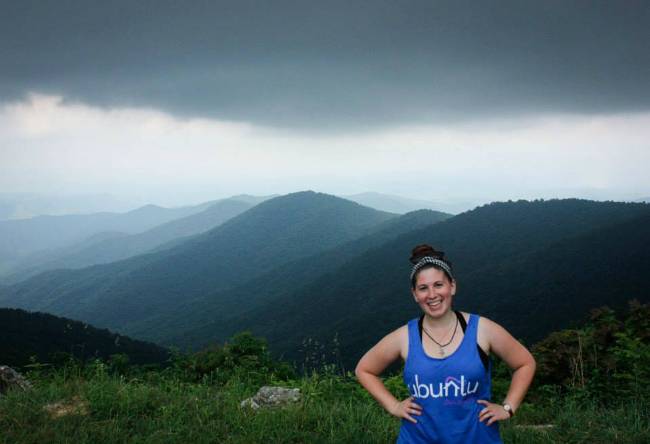
Hiking at Mt. Pisgah trail & enjoying the beautiful Blue Ridge Mountains!
For the past eleven weeks, I interned on the Business Plan Development team for the Carbon Canopy project. Under the guidance of Dogwood Alliance’s Director of Corporate Engagement, Andrew Goldberg, I worked with two other Stanback interns, Arjun Wadwalkar and Yimeng Wang, to analyze the voluntary carbon market and think strategically about the Carbon Canopy going forward.
Interning on the Carbon Canopy project has been an interesting and challenging experience. It has pushed me to focus on developing new skills, but also to consider what skills I want cultivate in the future. The position also required me to think critically about certain environmental issues. My views as an environmentalist are constantly evolving, and it was formative to spend a summer tackling topics like the carbon market and corporate partnerships from an inside perspective. Plus, I lucked out with a window desk, where I could peer out of Dogwood’s beautiful brick house and watch a family of groundhogs scurry by us (an adorable source of inspiration).
In addition to working on the Carbon Canopy project, I also appreciated the opportunity to branch out and learn more about Dogwood Alliance’s other campaigns and organizational happenings. The staff made sure to introduce us to each of the departments and functions of the organization so that we could better understand how a nonprofit like Dogwood Alliance operates. Most enjoyable was collecting photo petitions for the Our Forests Aren’t Fuel campaign. It was great to get out of the office and interact with locals (and tourists), spreading the word about a cause that is important to me.
Interns were also invited to attend and participate in the organization’s board meeting. This was my first time gaining a hands-on perspective on how a nonprofit operates at the board level, and it was a valuable learning experience to listen in and even contribute to the conversation.
I truly enjoyed my time working with the wonderful folks here at Dogwood Alliance, and I loved living in Asheville, a lively city of music and culture and endless opportunities to get close to nature. In a way, Dogwood Alliance reminds me of Asheville itself: small, but with a big personality and a lot of heart. I can’t wait to see what the organization does next.
As a 24-year old professional degree candidate, I suppose it’s pretty unusual that I am actually doing my first ever internship. Being excited and somewhat nervous, I brought my suits and high-heels with me. Well, it turned out that I worried too much. The city is so Bohemian, which means literally everyone is more casual than you might be; and luckily Dogwood Alliance cares more about your performance than your appearance.
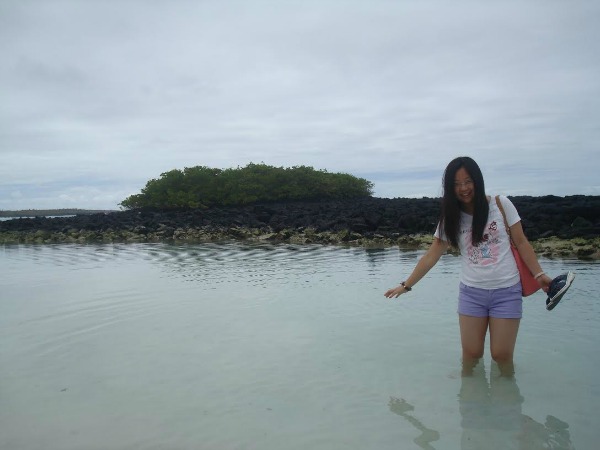
Siyu playing in the water
The casual working atmosphere, however, doesn’t affect the professionalism of the work at all. I sat in the office next to the Campaign Director and Communications Director, and everyday I could hear them talking about the Our Forests Aren’t Fuel campaign. I could definitely hear the enthusiasm for their work in their voices, which matched their enthusiasm for the US soccer team in the World Cup.
Though all staff weren’t as interested in the World Cup as we were, everyone was very nice and helpful. My internship started with a series of face-to-face talks with each of the staff members, where I learned about their roles and responsibilities in the organization. It helped me to understand how nonprofit organizations work within themselves and out in the world. This also helped me get to know all the passionate environmentalists and with their friendly personalities who work at Dogwood. You’ll never find a poker face at Dogwood…well, probably except for maybe the technician…
I was the technician. I created maps to present the current projects of Dogwood Alliance as well as the scale and severity of environmental problems that Dogwood Alliance is working on. I also conducted spatial analysis to identify potential parcels to develop new Carbon Canopy projects as well as forests with high conservation value. It was a great experience to get the opportunity to integrate knowledge and skills learnt in classroom along with real world problem solving. Mapping projects in a real working environment is different from what I did for my course project at Duke. I was given all the data I needed to complete my course project at Duke, but for my Dogwood internship, I had to look for the data. Sometimes I even had to search to figure out what data I needed to look for. I was joking with my supervisor that I was supposed to spend my summer with ArcGIS, but it turned out, I spent it with Google, Google Maps and Gmail.
It was very interesting and inspiring to find the large amount of work that has been done on mapping this planet’s environmental conditions and natural resources as well as how much other organizations and government departments were willing to help me on my project. On the other hand, I had to keep in mind that all this information isn’t necessarily accurate. Some of them are able to be corrected, e.g. the geocoding process might use the PO Box instead of the actual address to draw the point on the map. Some of them you have to tolerate and work with, e.g. the vegetation type assigned to a pixel might be the most likely one based on the satellite image taken 10 years ago, which can be totally different from what it actually is right now. Therefore, I had to learn to accept the non-perfect but useful result and to make the most of current available resources.
A benefit for environmental organization employee (especially those living in Asheville, North Carolina) is that, after hours of staring at the screen, you always get the chance to dive into the green. Into the mountains! We drove through the gorgeous Blue Ridge Parkway and visited the standing forests managed under the Carbon Canopy project as well as the clear giggling streams filtered by the forests. After a trip to Columbia Forest Products, I even got a piece of paulownia (a tree from my home country of China) plywood as a souvenir.
Other than work, I also had a lot of fun in Beer City USA with the nice people I met. I have decided to keep all the experiences of watching the World Cup, Ziplining, a butterfly trip and Downtown After Five in my private blog so that people won’t think I was just having a vacation here in Asheville! In case you’re really interested in the fun I had in Asheville after working hours, visit me in Durham for an “Asheville Rocks!” talk. 🙂
Working with Dogwood Alliance was an amazing experience! (Did I mention that they celebrate interns’ birthday there?) As a final conclusion for the 11 weeks, I would say: I learned, I helped, I enjoyed. I appreciate the internship opportunity very much, not only because of its adding to my professional resume, but also because it affected the way I interact with the world and with my inner self. It encouraged a future environmental professional on her first step of her career path.
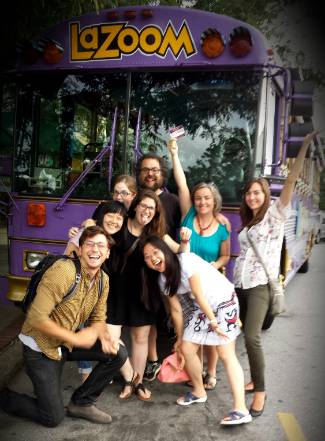
La Zoom bus ride with Dogwood staff & interns
My internship developing a business plan for the selling of carbon credits in the virtual carbon market was such a novel thing for me. I was totally obsessed with the idea during my interview for the internship with Andrew Goldberg, Dogwood Alliance’s Director of Corporate Engagement. To explore a completely new field and really contribute my own effort to the project was a dream for me, and what I got as an intern in Dogwood Alliance is far greater than that. As a graduate student majoring in Engineering Management with a background in Naval Architecture and Ocean Engineering, I didn’t have much experience with environmental work until I came to Dogwood. Work and life here made me think about the impact of human on the environment and ways to improve it more and more. Together with Arjun Wadwalker and Rachel Weber, I worked as a business plan development intern for the Carbon Canopy Project, which is a project that aims to protect Southern forests while profiting landowners and providing high quality carbon credits to the voluntary carbon market. My major tasks during the internship were to develop a feasible business plan for the future development of the project and complete a white paper together with reports on brand-building and recommendation regarding individual retail opportunities. Even though I worked on business plan development for other projects during my last semester at Duke, I learned a lot during this process from both staff and other interns, not only with respect to the project itself , but also the attitudes towards life and work. Besides Carbon Canopy, I also had opportunities to work on other projects. For the biomass campaign, I helped with phone banking and gathering photo petitions. Both of them required talking to people about the campaign and inviting them to join an action, which requires a lot of courage, and it was definitely a challenge for me. It often happened that people didn’t have much interest in our environmental issues, and I found the experience of being refused to be unenjoyable. However, it was worth it so that we could build awareness around the importance of protecting our forests and encourage more people to participate in the activity and make a difference. Getting to attend the Carbon Canopy Stakeholder meeting and Dogwood’s board meeting were such a plus for the internship. Attending these meetings and having the chance to participate in discussion granted me more information about the project and also about the structure and operation of non-profit organizations. My research also gave me insight on a key issue: how to raise people’s environmental awareness. Due to generally low awareness of the importance of protecting our forests, the price for carbon credits is not high enough to protect the forest or make the industry sustainable. That is the main reason that landowners choose clear-cutting over improved forest management: to make more profit. Clearly our work still has a long way to go. But with Dogwood Alliance and other NGOs along with their supporters pushing the issue with their projects and campaigns, we can definitely protect our environment and make a pact with nature. A big thank you to Dogwood Alliance and the Stanback Program of Duke University for making my summer in Asheville happen. The LaZoom bus tour, the Tourist baseball game and the friendly staff at Dogwood all made my internship one of my most unforgettable experiences in the United States. Farewell Asheville,. I will miss you.
Destroying forests to burn for electricity to keep the lights on in Europe seems crazy right? We know, like us, it outrages you, but sadly with so many threats to our environment, this issue is not yet on a lot of people’s radars. So Dogwood Alliance teamed up with a team of creative designers and developed this easy to understand (and share) infographic explaining the issue. Our new infographic is a great visual tool for understanding the issue, and the new Our Forests Aren’t Fuel campaign page has more in-depth data if that’s helpful to you.
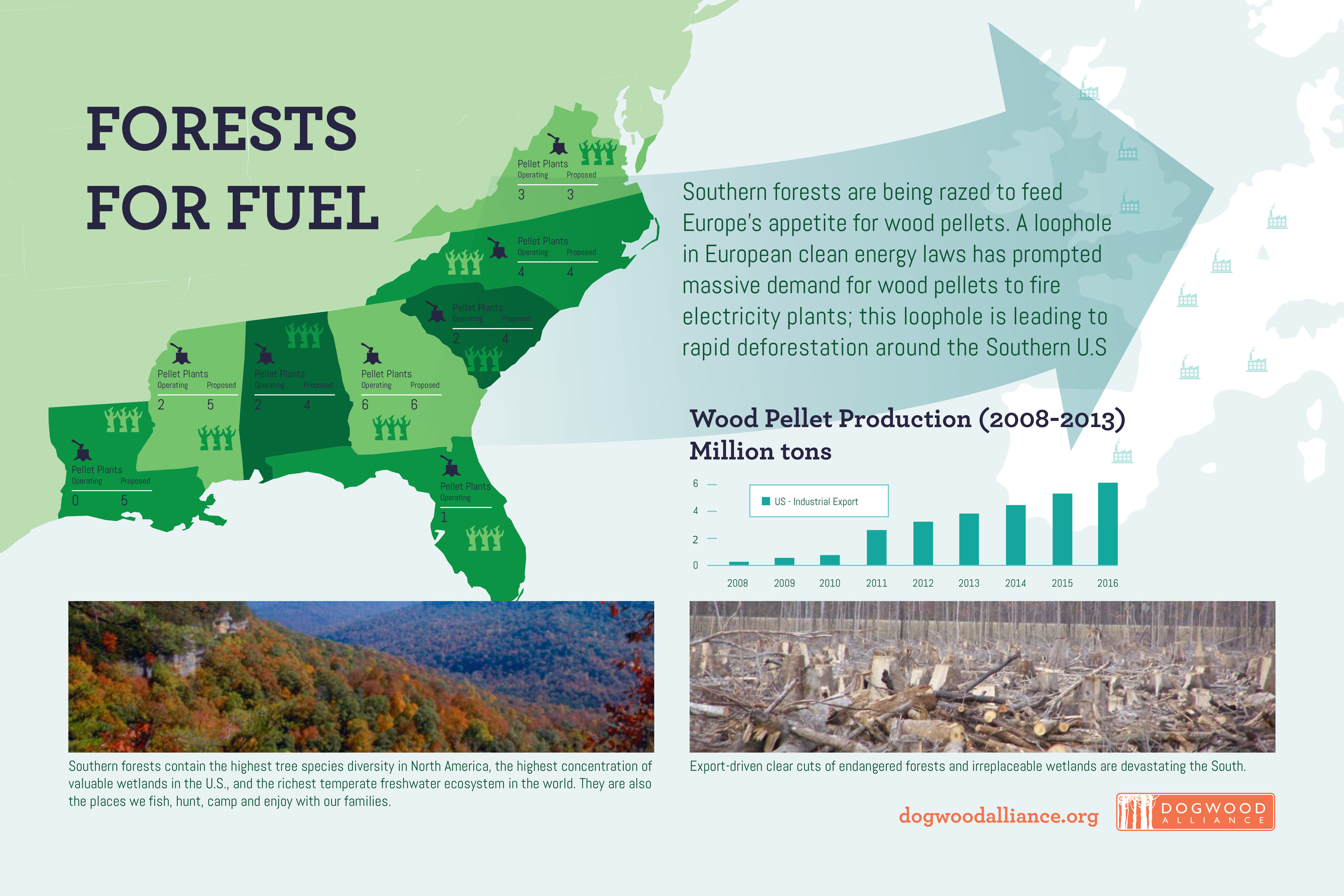
To embed this image on your own site, copy the code below.
Please take a moment to share this new resource with your friends and family on Facebook, Twitter, Google+ and Pinterest. Use the buttons below to share with your networks. If you happen to have your own personal blog or are tech savvy, we include an easy to use the above embed code for use on your site. Whole trees are being converted into pellets, and shipped across the ocean to European power plants – all in the name of “clean energy.” On top of the deforestation issue, the climate impacts of this loophole are also immense, as the carbon emissions of burning whole trees, after shipping them across the ocean, make wood pellets even dirtier than coal.


 Donate