


Burning the forests that are supposed to be our best defense against climate change to protect us against climate change has to be one of the most ridiculous ideas I’ve ever heard. Yet over the last few years, Europe has wholeheartedly embraced this false solution to climate change, and we’ve seen a dramatic increase in logging in the Southern US to fuel European demand. Along the way, the US South has become the largest wood pellet export region in the world.
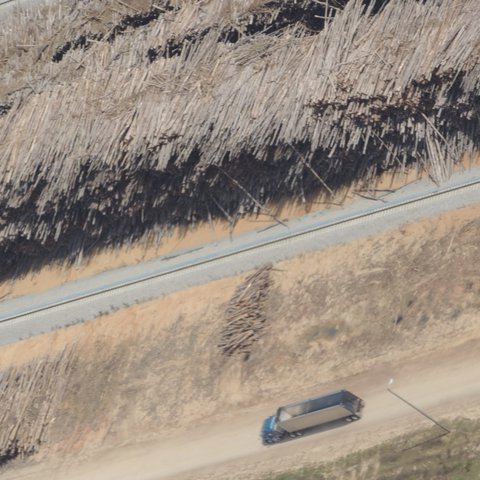
Aerial Shot of Enviva Northampton Facility
Last year, in response to this growing threat, we launched the Our Forests Aren’t Fuel campaign and have seen the controversy surrounding biomass energy escalate. Corporations have ramped up the greenwashing, and communities have risen up to fight back. We started out with a bang: a front page story in the Wall Street Journal highlighting the destructive nature of this new industry. Our members responded by sending over 20,000 emails to Enviva, Drax, and Dominion in the first couple weeks of the campaign.
Since last summer, we have seen over 90 media stories written that highlight the biomass controversy. We also recruited over 60 scientists from around the country to weigh in on biomass policy as well as forest impacts with the UK government, European parliament and the U.S. EPA. Bringing the fight right to the corporations and policy makers who are deciding the fate of our forests from across the Atlantic, we went to Europe to represent Southern forests and communities. We met with agency representatives in the UK and Netherlands, high level EU commissioners in Brussels, and the largest utilities investing in this industry – Drax and GDF Suez.
Looking ahead to 2014, we are excited about what is to come and how we can continue to raise the profile of this issue and build the strength and leverage to change policies in Europe. We plan to influence EU level biomass policy as well as policies of the largest investors in biomass: the UK. We coordinated a compelling tour of effected US areas for Dr. Anna Stephenson who is developing the UK’s biomass carbon policy and will continue to exert pressure to make sure they get it right.
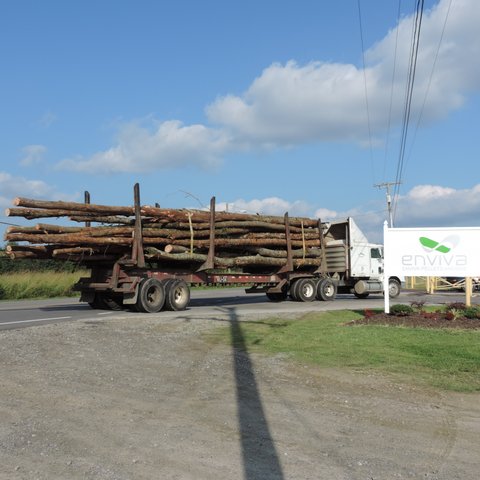
Truck driving into Enviva’s Ahoskie wood pellet facility
Thankfully we are not alone in this! In addition to the great work that our primary campaign partner, NRDC has been doing, much of our focus in 2014 is working with other allies to build the controversy and increase action to stop the unregulated expansion of this new industry.
In North Carolina, the Sierra Club has made wood pellet expansion and the associated deforestation one of their top conservation concerns in 2014. Regional groups have already toured an Enviva facility (the largest producer of wood pellets in the US), hosted presentations about the impact woody biomass is already having on the state and enlisted the aid of their members.

Atchafalaya Swamp in Louisiana
In the Deep South, the Atchafalaya Basinkeeper, the Louisiana Environmental Action Network and others have been hard at work investigating the current and potential impact of this industry on the region. We are joining them in April to plan next steps together. Enviva has already established itself in Mississippi, and Drax is moving forward with their first US wood pellet facility in Louisiana, scheduled to open in early 2015. Al Jazeera America published an article on this under-reported story last month greatly increasing the visibility of this issue and our campaign.
We also released our first investigative video, Wetlands up in Smoke. It was picked up by a number of notable news and conservation sites, and people are really responding to the truth of what’s going on in the forests of our backyard. Keep a lookout for our second video, Injustice in Northampton, to come out in early March.
We are so grateful to have so many committed partners and the wellspring of support from our members. We’ve come a long way toward exposing the dirty reality of biomass energy, but we’ve still got a long way to go if we want to protect our forests in a meaningful way.
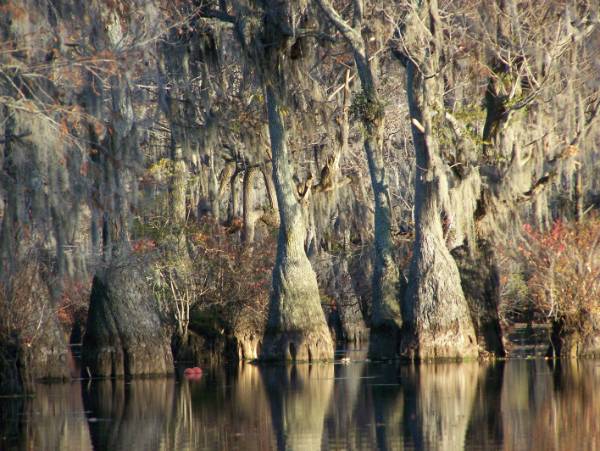
Cypress Forests like these at Merchant’s Mill Pond in NC have been identified as endangered forests in our work with Georgia-Pacific
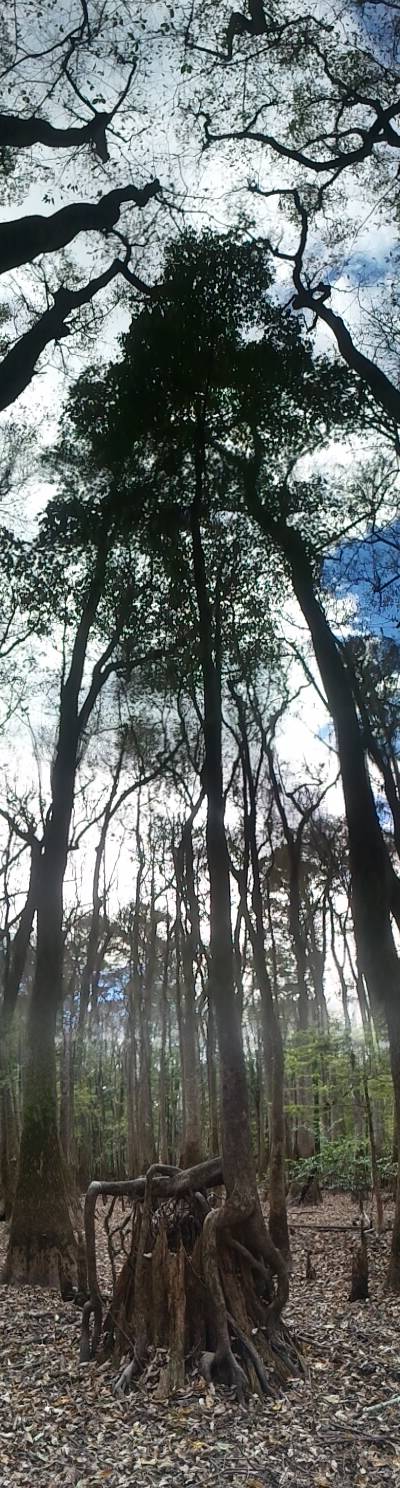
Bottomland hardwood forests like these in the Congareee River floodplain have been identified as Endangered Frosts through our work with Georgia-Pacific
In 2014, a key part of our work to secure a legacy of forest protection is the implementation of our agreements with forest products giants Georgia-Pacific and International Paper. Now that we have a seat at the table, Dogwood Alliance will remain vigilant to make sure that promises are kept by GP and IP to analyze the conservation values in their sourcing regions, to protect endangered forests and to work to maintain natural hardwood stands from conversion to pine plantations. In addition, we will be working with International Paper to help guide their multi-million dollar conservation initiative with the National Fish and Wildlife Foundation(NFWF) to fund conservation projects in the Cumberland Plateau, the Piney Woods of East Texas and the Coastal Plain of the Carolinas.
In 2014, we will complete the mapping of endangered and high conservation forests across GP’s US footprint. This means that for the first time we’ll be doing mapping work outside the South in the Pacific Northwest and Upper Midwest. We’ll have to reach out to new environmental stakeholders to make sure that the mapping effort accurately captures all of the important conservation values of those new regions. In addition, we will work with GP to finalize their tools to track natural hardwood stands to ensure that if the stands are converted, no wood will end up in the GP supply chain.
With International Paper (IP), 2014 focuses on kicking into gear the agreement announced last March with conservation mapping of forest in and around IP’s large Rieglewood Mill located in Southeast North Carolina. The sourcing footprint for this mill covers a lot of important forests, and we will be working closely with additional environmental groups on the ground in the region to make sure our work with IP captures the important conservation values. We also hope to identify worthy conservation initiatives in the region and bring resources to them through the NFWF program.
Keep your eyes peeled for progress reports from the field.
Earlier this week, the Vermont Public Service Board rejected an application to build a 37-megawatt wood-fired power plant in the town of Springfield. The Board rejected the project saying it “would unduly interfere with the orderly development of the region and the power benefits of the plant could be provided in a more cost-effective manner through energy conservation programs and energy-efficiency.” Essentially, they ruled that the new biomass plant would be bad for public health and the climate.
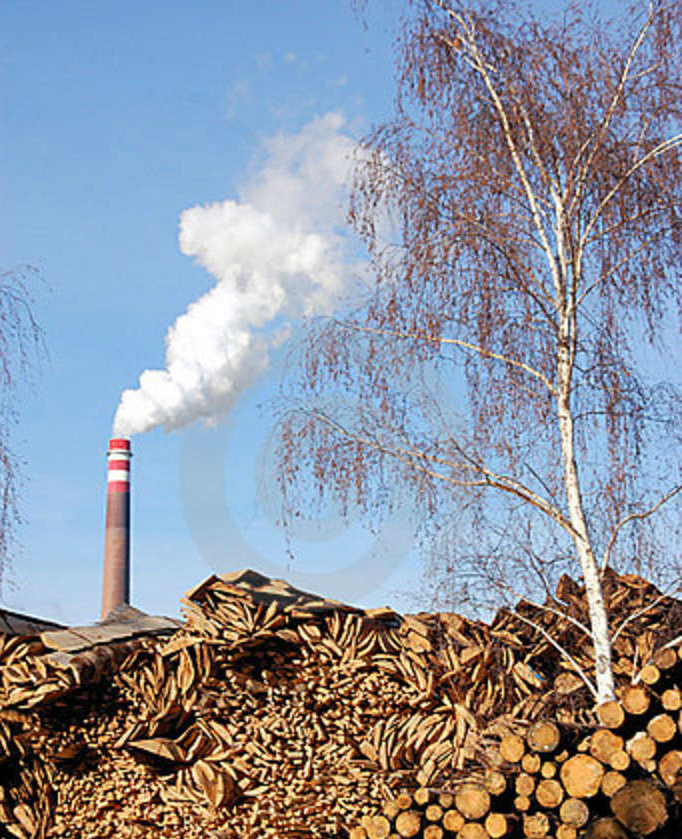
Across the border, Massachusetts was the first state to implement strong biomass energy carbon accounting, which has effectively ground to a halt all industrial-scale biomass development in the state. So while our neighbors to the north are seeing biomass energy for what it is – bad for our forests, our communities, and the climate – state legislatures in the South and the federal government are failing to take action and lagging further and further behind.
At the federal level, the EPA has yet to release any guidance on how biomass carbon emissions should be regulated, even though its own scientific advisory board has recommended they eliminate the use of whole trees and track emissions closely on all other sources. And in the South, states are lining up to hold the doors wide open for any and every wood pellet company to open up shop and chop down our trees to turn into wood pellets for them to burn for electricity.
Hopefully, our Southern legislatures and the EPA can learn a thing or two from the citizens of Vermont and Massachusetts and call a halt on further development until we can stop the destruction in the woods and account for carbon in a way that will reduce emissions rather than letting them explosively grow.
North Carolina State University (NCSU) is attempting to sell their Hofmann Forest, an extremely large tract of pine forests and pocosin wetlands located near Jacksonville, NC. At 79,000 acres, Hofmann Forest is the largest university-owned research forest in the world, and the largest state-owned property in North Carolina.
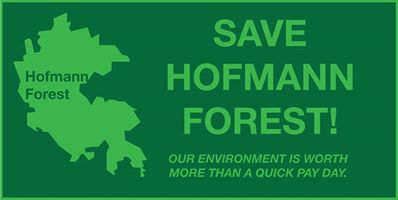
NCSU, acting in secret against the wishes of faculty, students, and alumni, has already signed a sale agreement with a corn farmer from Illinois, Jerry Walker. Shortly after the sale agreement was announced, Mr. Walker’s prospectus for potential investors was leaked to sale opponents. The prospectus reveals Walker’s plans to bulldoze 45,000 acres of pine forest into cornfields over the next 10 years, producing corn that would almost certainly be used to feed more of North Carolina’s immense herd of corporate-owned hogs. Also included in the prospectus are plans for a 9000-acre development project, including golf courses, strip malls, and thousands of homes.
Despite the sale agreement, it is not too late to stop the sale of Hofmann Forest. Crucially, NCSU failed to complete the environmental impact assessment that is required whenever a state agency attempts a project that will significantly damage the environment. A group of plaintiffs filed suit to block the sale (before the agreement was signed), and that lawsuit is now headed to the NC Court of Appeals. The NC Attorney General’s office is defending NCSU against the lawsuit, instead of protecting the public interest by forcing the university to comply with the law. We need your help to pressure the Attorney General, Roy Cooper, to do the right thing and block the sale.
NCSU has owned Hofmann Forest since 1977, when the land was transferred to the University Endowment Fund from its original owner, the nonprofit Forestry Foundation. The forest was originally purchased for the benefit of the NCSU College of Forestry by the College’s first Dean, Julius “Doc” Hofmann, all the way back in 1934. So this tract of land has been managed on behalf of NCSU for 80 years! Hofmann didn’t trust the University to own the forest directly, as he (correctly as it turns out) was worried they would try to sell it after he was gone. So he created the Forestry Foundation to hold the forest and use it as both a research and education facility and as a mechanism for financially supporting the College. But, in 1977, the local County tax offices were pressuring the Foundation to pay property taxes on the land, so the decision was made to transfer ownership to the NCSU Endowment Fund to make it state property.
Fast forward to 2008, which is when the Forestry Foundation was convinced to merge with the Pulp and Paper Foundation, creating the Natural Resources Foundation to support the renamed College of Natural Resources. Just a few years later, in early 2013 the NCSU Endowment Fund, with the blessing of the Natural Resources Foundation, voted to sell the forest. College and university leaders promised everyone all spring and summer last year that Hofmann would stay a working forest and that NCSU would retain access to the tract. These promises muted much of the opposition to the sale, especially from environmental groups, who figured that as long as Hofmann stayed a huge pine plantation, it didn’t matter whether the university or some timber company owned the land.
Unbeknownst to everyone, only a few timber companies were actually invited to bid on the tract, and they offered prices that were consistent with the land staying forest. Jerry Walker’s group, on the other hand, bid substantially more ($150 million). This may not have been just a coincidence, as NC’s corporate hog farming industry imports 200 million bushels/year of corn to feed the 9-10 million pigs that reside in the state, and they are desperate to find cheaper sources of feed. It just so happens that two prominent and wealthy hog farmers are on the NCSU Board of Trustees, and they would certainly have known about the potential benefits of converting Hofmann Forest into Hofmann Farms and Hofmann Estates (the sale agreement does promise to keep the name Hofmann, if little else!).
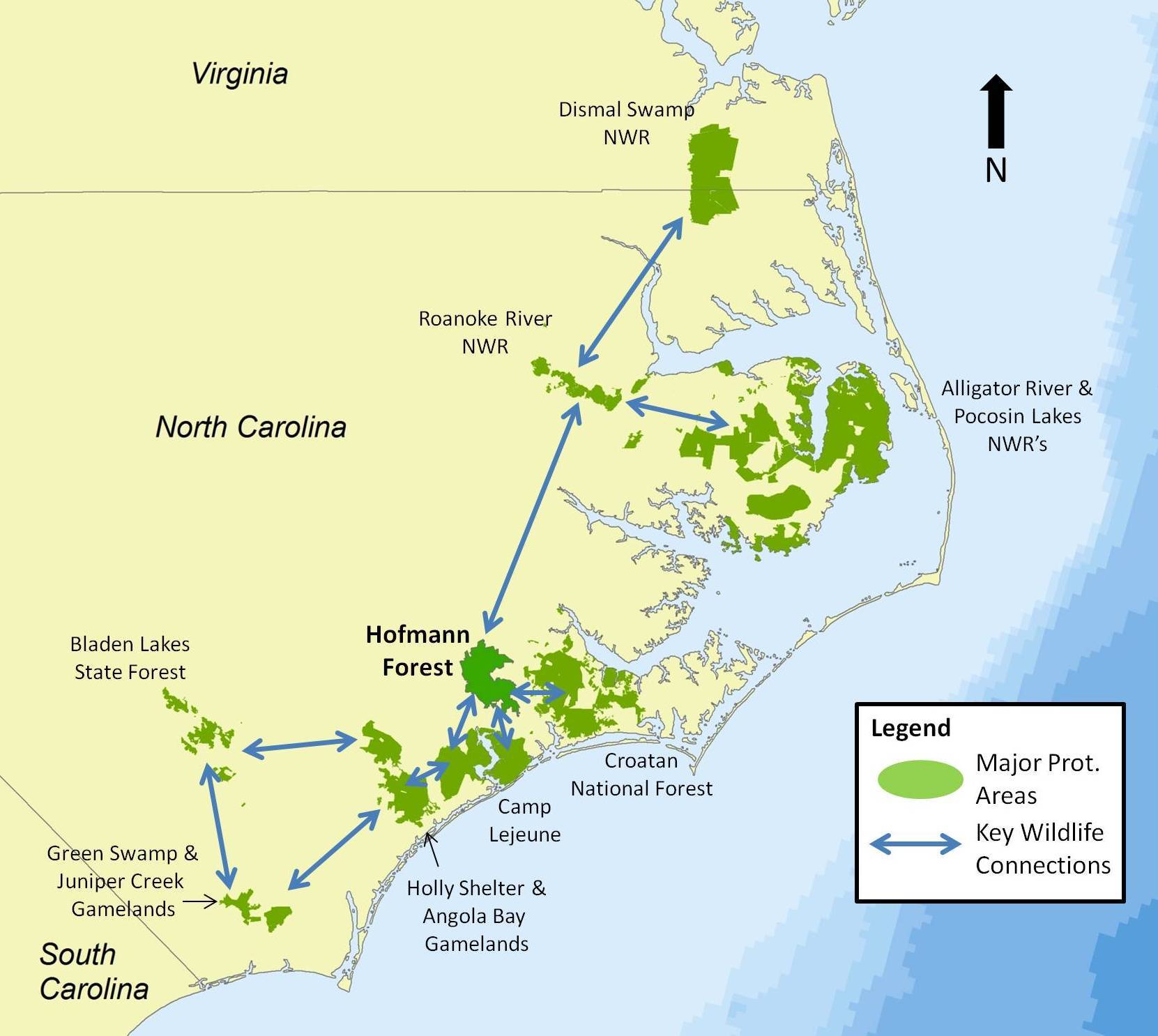
Hofmann Forest Map courtesy of Wildlands Network
At almost 80,000 acres, Hofmann Forest is one of the largest tracts of public forest in North Carolina, exceeded only by a few federal properties such as Great Smoky Mountains National Park and the National Forests. As such, it provides substantial room to roam for numerous species, including a healthy population of black bears. Conservation scientists know that truly large protected areas are much more likely to retain viable populations of native species over time.
In addition to its sheer size, Hofmann Forest is even more important given its strategic location as a crossroads for habitat connectivity in Eastern North Carolina. Bears and other species that want to disperse up and down the coast almost certainly have to go through Hofmann Forest (see locator map). Habitat connectivity is also becoming more and more important as the climate warms and numerous species need to migrate to keep up with their preferred environmental niche.
Due to its history as a heavily managed pine forest, Hofmann is far from being a pristine tract of virgin woods laden with rare species. But as recently as 1999, Hofmann Forest was home to at least two colonies of red-cockaded woodpeckers. The rivers that flow out of Hofmann (did we mention there are three, the Trent, the New, and the White Oak?) are home to endangered species of sturgeon, and these fish would be greatly harmed by the dramatic loss of water quality that would follow conversion of the forest to cropfields and urban development.
Looking at the bigger picture, Hofmann is critical for the future of the red wolf, which is one of the most endangered wild canid species in the world, and at present is only found in the wild in eastern North Carolina. If red wolves are ever allowed to spread off of the Albemarle Peninsula (where they’ve been stuck since their reintroduction in 1987), the next point south where they could realistically establish another population would be the large complex of wildlands represented by Hofmann Forest, Croatan National Forest, and the Marine Corp Base at Camp Lejeune. If Hofmann Forest is destroyed, that will sever the connections between Croatan and Lejeune, dividing the area into pieces that are too small to support a healthy wolf population.
The same is true for the eastern diamondback rattlesnake, a large snake that is now extremely rare in North Carolina due to habitat loss, road mortality, and direct persecution. Already ranked as “State Endangered”, the species has recently been proposed for federal listing. The destruction of Hofmann Forest would essentially put the nail in the coffin for diamondback rattlesnakes in North Carolina. On the other hand, if Hofmann Forest can be saved now, then we anticipate that much of the property could gradually be restored to better wildlife habitat over the decades to come, with NCSU students and faculty leading the way.
In less than a year, the Our Forests Aren’t Fuel campaign has shined a big spotlight on the forest destruction that has followed in the wake of the South’s expanding wood pellet export industry. We’ve elevated the concerns of affected communities, conservation organizations and top US scientists, rocketing those concerns into the international spotlight. As a result, the UK Department of Energy and Climate Change (DECC), which is responsible for regulating utilities like Drax(a company that is increasingly reliant on wood pellets imports from the US South to generate electricity), decided it needed to investigate.
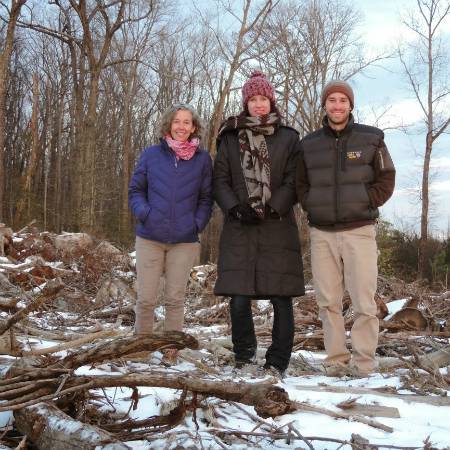
Danna Smith, Dr. Anna Stephenson, and Tom Llewellyn
Last week Dr. Anna Stephenson, a scientist from DECC, flew from London to Raleigh, North Carolina to begin a two week investigation of the forest and climate impacts associated with the UK’s increasing reliance on imported wood pellets as a fuel source for generating electricity. Her first stops were in North Carolina and Virginia, where Enviva, the South’s largest wood pellet exporter, operates three facilities that have been a major source of controversy, having been linked to the destruction of hardwood wetland forests.
Dr. Stephenson’s two week itinerary, which in addition to meeting with us and our conservation allies, involved meetings with top scientists in the region, foresters and the wood pellet industry, including Enviva. Dogwood Campaign Organizer, Tom Llewellyn, and I organized a day and a half of her itinerary. We thought it would be good to get Dr. Stephenson out in the forest for some ground-truthing around Enviva’s facilities in North Hampton, North Carolina and Courtland, Virginia.
In frigid conditions (high of 30 degrees F), we took Dr.Stephenson out on a kayak in the Blackwater River of Virginia. We quickly forgot the freezing temperatures once we kayaked into a stretch of ancient, bottomland hardwood wetland forest with thousand-year-old cypress trees.
Our river guide, Tim McCormick, who grew up playing along this very river, guided us effortlessly through the maze of giants, telling us about both the uniqueness of these bottomland hardwood forests and the tragedy of the destruction he has witnessed in his lifetime. Time seemed to stand still as we meandered through this endangered forest. We were in awe at every turn, admiring every tree, big and small, straight and twisted. After nearly two hours, we emerged from the swamp, everyone vividly more relaxed, refreshed and peaceful than when we started. That feeling that you get when you spend time in a healthy forest is truly priceless, and I’m glad we were able to bring that to the forefront of Dr. Stephenson’s investigation.

Dr. Stephenson experiences the peace of the wetland forest in a kayak
The next leg of our field trip wasn’t so inspiring but just as essential. We traveled to a logging site that Tom had traced back to the Enviva wood pellet facility last fall. The site was off on a dirt road and flanked with industrial pine plantations on either side. After about a mile or two of seeing nothing but pine plantations, we stopped at a mature wetland forest that had just been clearcut. We estimate that the cut was about 150 acres, stretching as far as the eye could see. What used to be an oasis in the middle of a landscape dominated by industrial pine plantations was gone, flattened to the ground.
That forest is not coming back in our lifetime. It will likely take 100 years or more for that forest to grow back to maturity, reminding us that the bottomland hardwood forests we lose today will be gone for a very, very long time. Not only that, but chances are it won’t be left alone for 100 years. If current trends in wood pellet production continue, that forest will be cut again long before it can regrow to maturity. Gone is the habitat for the species that thrived in this forest. So much for wood pellets being a source of “renewable” energy.
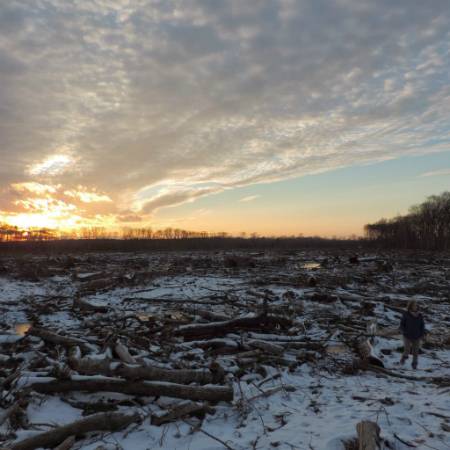
Danna Smith is dwarfed by the devastation of this clearcut
Gone is the carbon stored in the trees that were turned into wood pellets, shipped across the Atlantic and burned into the atmosphere to generate electricity in Europe. Beyond that immediate release of otherwise stored carbon, every time a forest is cut, any trees growing back are removing a lot less carbon from the atmosphere than the previous forest. It’s like having to start all over again. This point was reinforced yet again just last month in another scientific study published in Nature, documenting that the older a tree, the faster it sucks carbon out of the atmosphere. So much for wood pellets being an energy solution to climate change.
For the past several years, wood pellet manufacturers in the US South have been lobbying government officials across Europe, assuring everyone that all is well in the Southern US and that their practices are “sustainable”. But, as we ramp up the Our Forests Aren’t Fuel campaign, Europe is now beginning to hear another side of the “sustainable forestry” story. Evidence of the dangers of relying on forests as a fuel source for electricity generation is mounting. Maybe, just maybe, Dr. Stephenson’s visit is an early sign that the tide is starting to turn. Maybe, just maybe, government officials in the UK and throughout Europe are starting to seriously question the notion that burning trees to generate electricity is a solution to climate change. Let’s hope so. Our future depends on it.

A huge, ancient cypress tree…and a piece of our future

Dr. Anna Stephenson surveys a clearcut wetland forest.
As you probably already know, Dr. Anna Stephenson from the UK Department of Energy and Climate Change paid North Carolina and Dogwood Alliance a visit as part of her two week investigation of the forest and climate impacts associated with the UK’s increasing reliance on imported wood pellets as a fuel source for generating electricity. We took her on a kayaking trip through intact bottomland hardwood forests.After feeling the awe and majesty of those wetlands, we took her to see an Enviva clearcut to show her the devastation that wood pellet production to meet European electricity demand wreaks on the landscape.
In addition to getting out in the woods, we also convened a meeting for Dr. Stephenson with a number of conservation groups concerned about the exploding wood pellet export industry in the South and the impacts on forests, climate and our rural coastal communities. The National Wildlife Federation presented key highlights from its recently released a study: Rising Demand of Southeast Trees Puts Wildlife, Biodiversity at Risk. This report documents major concerns about the growth of the wood pellet industry’s impacts on wildlife across the Southern US, including specifically the impacts of Enviva’s sourcing from wetland hardwood forests. Dr. Stephenson also heard from the Southern Environmental Law Center (SELC) about the findings of a recent scientific study which shows burning trees from Southern forests actually results in more carbon released in the atmosphere over 35-50 years when compared to burning coal. SELC brought data compiled by the US Forest Service showing that logging of bottomland wetland forests exceeded growth rates by 300% as recently as 2007 in the counties surrounding Enviva’s North Carolina operations.
North Carolina Coastal Federation talked about the local concerns related to two port expansions planned to accommodate the wood pellet export industry in Moorehead City and Wilmington. North Carolina Sierra Club told her about how concerns raised by local chapters across the state have elevated the issue as a priority issue within Sierra Club.
Despite the claims of wood pellet manufacturers and European utility companies that they’re practices are “sustainable”, the Our Forests Aren’t Fuelcampaign is exposing these claims for the greenwashing they are. Concerned citizens and the UK government can’t afford to ignore the mounting evidence of the dangers of relying on forests as a fuel source for electricity generation. Together, we must continue to change the minds of European government officials, showing them that burning trees to generate electricity is not a solution to climate change. Time is short. Our future depends on turning the tide of biomass.
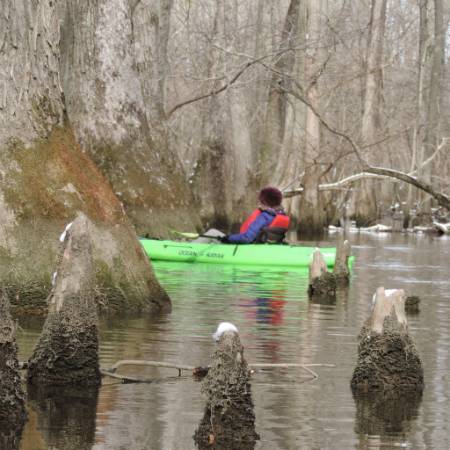
Floating in kayaks along the Blackwater River
Last month we released our first investigative video in support of the Our Forests Aren’t Fuel campaign: Wetlands Up in Smoke.
The short film featuring a wide variety of voices documents the growing impact of the wood pellet industry on our Forests, community and climate.
Southern wetlands are going ‘Up in Smoke’ so that European governments can meet their renewable energy targets and European citizens can keep their lights on!
Giant wood pellet manufacturers like Enviva, featured in our new video below, are chopping down our forests, turning them into pellets, and shipping them over to Europe for companies like Drax to burn for electricity. This madness needs to stop!
We’re at a critical point in this campaign, and we need your help to build national awareness around this destructive new industry as we continue the work of protecting forests in the Southern US. Please join the long list of citizens, organizations and media outlets who supported last month’s release and SHARE this video with your friends and family, post a message on Facebook and don’t forget to tweet!
***Register to show this video to a group of 10 or more people a member of Dogwoods staff will call or Skype in for a Q&A session following your screening! (Contact [email protected] for further details.)
Feel free to use these sample posts or ones of your own:
Facebook: Watch and share this important Dogwood Alliance video “Wetlands Up in Smoke” about the clearcutting & burning of US forests for European electricity. http://www.dogwoodalliance.org/wetlandsupinsmokeTwitter: Watch/share @DogwoodAlliance #biomass video “Wetlands Up in Smoke” re:US forest destruction for electricity.http://www.dogwoodalliance.org/wetlandsupinsmoke
We must send a clear message: Our Forests Aren’t Fuel! Please spread the word about Our Forests Aren’t Fuel: Wetlands Up In Smoke.
For the Forests,

Tom Llewellyn Our Forests Aren’t Fuel Campaign Organizer Dogwood Alliance
Come on out and drink delicious, hand-crafted, local beer at Hi-Wire Brewing on Thursday, January 16th. All that day and evening, Hi-Wire will be donating a percentage of proceeds to Dogwood Alliance to help protect our Southern forests!

Dogwood Alliance mobilizes the public and exposes the truth about forest destruction to inspire individuals, communities, corporations, and government to take action while working collaboratively with industry leaders to put innovative business solutions to work. “The result:” increased protection for millions of acres of Southern forests through Dogwood’s transformation of the forest products industry.
Hi-Wire Brewing strives to be as independent and authentic as possible, while maintaining an approachability their beers. Their light-hearted circus theme embodies the fun, authenticity, and creativity of this deep-rooted craft. Located in Downtown Asheville’s Brew District, Hi-Wire Brewing embraces its craft from top to bottom – from its highly drinkable, hand-crafted brews to its artwork, hand-drawn by a local artist.
Pelham, MA – Environmental groups in 23 states today requested that the Environmental Protection Agency (EPA) end its three year exemption of biomass power plant greenhouse gas emissions from Clean Air Act permitting – an exemption that also enables biomass plant builders and operators to avoid using the best pollution controls for the smokestack emissions that cause local air pollution and harm human health.
Signers to the letter requesting EPA action included groups in AK, AR, AZ, CA, DE, FL, GA, HI, IN, MA, MD, MO, MT, NC, NY, OH, PA, TN, VA, VT, WA, WI, and WV.
Wood-burning power plants emit as much or more conventional air pollution as coal and gas plants, including particulate matter, nitrous oxides, and carbon monoxide. A BACT (Best Available Control Technology) analysis under the Clean Air Act would reduce emissions of these pollutants, but the EPA loophole that exempts biomass carbon dioxide (CO2) from regulation under the Clean Air Act means that bioenergy facilities also escape federal regulation of other air pollution as well. The result has been a surge in biomass power plant proposals that are allowed to emit twice the pollution that they would be if they were held to stricter federal standards.
“The City of Lithonia, Georgia is severely impacted by various high polluting facilities such as landfills and a transfer station,” said Lithonia Mayor Deborah Jackson, echoing the concern of many citizens located “downwind” from biomass power plants. “The addition of a poorly regulated biomass facility will add to the health burden in a community that already suffers from high rates of asthma and other respiratory ailments.”
The letter comes at an important moment, as the EPA is working to create a science-based carbon dioxide accounting scheme for biomass facilities. The agency’s own Science Advisory Board (SAB) has stated that biomass energy can not automatically be considered “carbon neutral.” The DC Circuit U.S. Court of Appeals concluded that EPA’s exemption of biomass energy from regulation of carbon dioxide under the Clean Air Act was not justified, but the agency has not yet reversed the exemption.
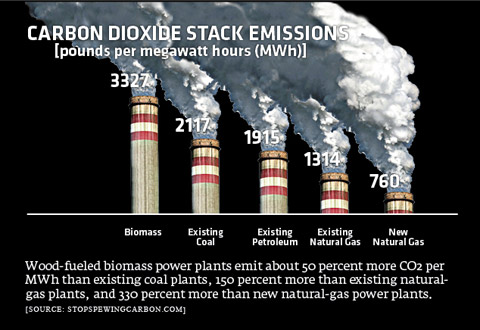
Burning biomass emits more climate warming carbon dioxide emissions at the smokestack than fossil fuels, including coal. Both the court and the SAB concluded that CO2 from bioenergy facilities warms the climate just as CO2 from burning fossil fuels does, and that bioenergy facilities should not escape regulation.


 Donate