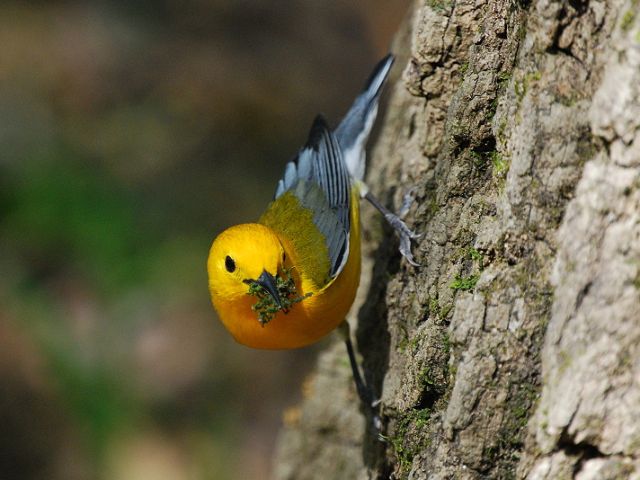
The Prothonotary Warbler is a songbird native to Southern wetlands whose habitat & survival is threatened by biomass logging.
The Southeastern US has become the world’s largest exporter of wood pellets for biomass electricity generation. Between 2012 and 2013, wood pellet exports doubled to 1.7 million tons, and export volumes from this region are projected to jump to nearly 6 million tons by 2016.
This explosive growth in wood pellet exports is being driven by misguided European energy policies which incorrectly assume that burning wood will lower carbon emissions and help address climate change. Countless scientific studies show that compared to coal, burning trees in the form of wood pellets produces more atmospheric carbon per BTU of energy produced over the life cycle of both energy resources.
Adding insult to injury, Europe’s rising consumption of wood pellets is generating greater demand for trees at a time when our southeastern US forests are already under tremendous pressure from the more traditional wood and paper industries. This in turn threatens to further compromise the future ecological integrity of some of our most important and imperiled ecosystems.
For example, in May, the Wall Street Journal uncovered the fact that Enviva, the South’s largest exporter of wood pellets, relies on clearcutting hardwood wetland forests in the Mid-Atlantic Coastal Eco-region at its mill in Ahoskie, North Carolina. Today, Dogwood Alliance and its campaign partner Natural Resources Defense Council released a series of maps and a brief report underscoring the threat Enviva’s operations at this facility poses to these forests, some of the South’s most threatened and valuable forest ecosystems.
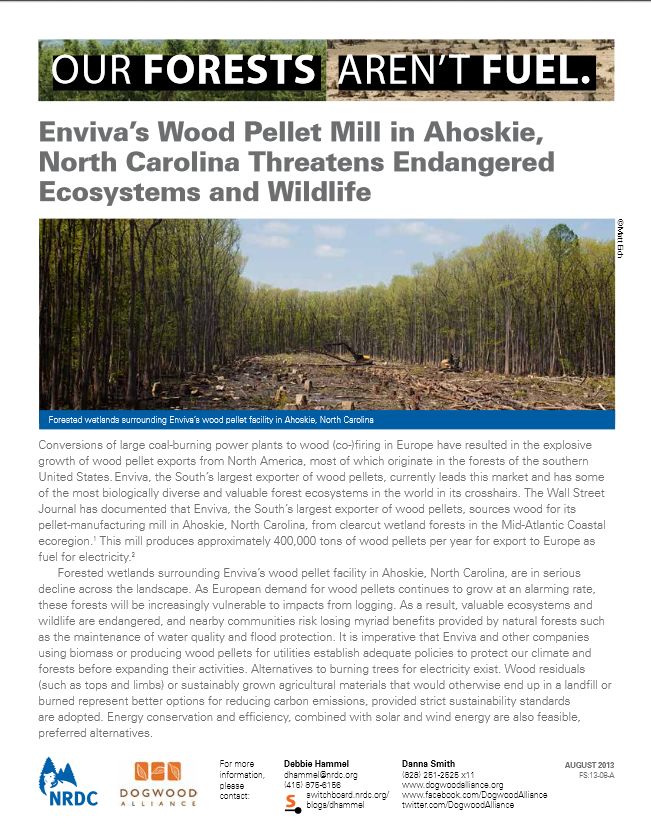 The maps and report tell a compelling story of the extreme fragmentation as well as the enormous ecological value of the few remaining natural and semi natural forests, much of which are wetlands, that surround Enviva’s wood pellet mill in Ahoskie, North Carolina. Like many of the forests across the South, the planting of fast-growing industrial pine plantations has replaced many of the natural forests. The remnant natural forests that remain contribute invaluable and often unnoticed services we all depend on.
In addition to storing substantial amounts of carbon in the standing trees and soil, the slow-growing bottomland hardwood forests buffer natural and human communities from storms, floods, and droughts, maintain water quality of rivers and estuaries, and provide critical habitat for birds, black bear, reptiles, amphibians, fish, and other wildlife. In fact, according to the World Wildlife Fund, these forests “contain the most diverse assemblage of freshwater wetland communities in North America and perhaps of all temperate forest ecoregions” and “are some of the most biologically important habitats in North America.” They also “serve as a resource sink for upland aquatic communities, support[ing] aquatic food webs when flooded and terrestrial food chains during the dry season.”
Less than one percent of the forests within this sourcing region are permanently protected from logging. Neither the federal government, nor the States of North Carolina or Virginia sufficiently regulate industrial forestry, leaving the floodgates open to Enviva and other wood pellet manufacturers that are destroying some of the last remaining natural forests in the region.
One would hope that the European government, which many of us view as acting responsibly on environmental issues, might be of some help here. After all, their current policies are driving the destruction of our Southern forests. However, in a document leaked to the European press two weeks ago, it seems the EU government is siding with pellet manufacturers, as the current draft “sustainability criteria” they are considering would do nothing to help protect wetland or other critically important and endangered forests or ensure carbon emission reductions. Let’s hope they don’t just approve these meaningless standards and instead get their climate policies on the right track.
There are far better ways to convert biomass into electricity than clearing and burning our forests. For instance, if strict sustainability standards are adopted and enforced, on a small scale, wood waste or sustainably grown agricultural materials that would otherwise end up in a landfill could be used. Of course, in the end, energy conservation and efficiency combined with real renewable energy sources such as wind and solar, are almost always our best bets.
FOR IMMEDIATE RELEASECONTACT: Philip McGowan, 615/327-7999, [email protected]
Maps are the latest in a mounting body of evidence proving the damaging environmental impacts of mass-scale biomass energy production
AHOSKIE, N.C. (August 27, 2013) – New maps and a report released today by the Natural Resources Defense Council (NRDC) and Dogwood Alliance reveal the ecological threat a major wood pellet manufacturing mill in Ahoskie, North Carolina, poses to surrounding endangered forests. The facility, operated by the South’s largest exporter of wood pellets, Enviva, produces approximately 400,000 tons of wood pellets per year to ship to Europe as fuel for biomass electricity.
This mill relies on clearcutting some of the most diverse wetland forests in the world that have been reduced to a mere fragment of their original extent. Less than one percent of the forests surrounding the Ahoskie facility are protected from logging that would degrade native ecosystems, making remaining natural forests, and in particular wetland forests, vulnerable to wood pellet production. The four maps and the report show the facility not only threatens sensitive plants and animals within the 75-mile radius from which the mill buys trees for wood pellet manufacturing, but that it also contributes to the reduction and fragmentation of the hardwood forests in which these species thrive.
The collection of maps can be accessed online here.
“The data adds to the growing body of scientific evidence documenting that large-scale biomass energy, and the wood pellet industry that fuels it, threaten the environment,” said Debbie Hammel, Senior Resource specialist with NRDC. “Natural hardwood forests are already disappearing across the region, and Enviva’s Ahoskie facility could destroy the few sensitive forested wetlands remaining in the area. When these landscapes vanish, so do all the benefits they provide, such as critical habitat for wildlife and water quality and flood protection for nearby communities.”
The first map in the series shows that the few remaining natural and seminatural forests surrounding the Ahoskie plant are highly fragmented. What was once an area full of diverse forest has now become dominated by pine plantations, which generally provide poor wildlife habitat compared to natural forests.
The second map identifies locations of wetland hardwood forests surrounding the wood pellet facility. A recent Wall Street Journal investigative news report found that Enviva has procured whole trees for the Ahoskie facility from clearcut wetland forests located within the map area. Wetland forests play a vital role in maintaining biodiversity and providing ecological benefits to the region. Wetlands provide habitat for waterfowl, songbirds, black bear, and a variety of reptiles and amphibians. Wetland forests are also beneficial to surrounding communities by improving water quality, providing flood control and buffering water flow during drought. In addition, these standing forests help moderate the earth’s climate by removing carbon from the atmosphere.
“Hardwood wetland forests play a vital role in maintaining biodiversity in this eco-region, and increased industrial logging in these forests can have significant, negative impacts,” says Dr. Alan Weakley, Director and Curator of the University of North Carolina Herbarium and one of several academic peer-reviewers of the maps. “Natural forests have been highly fragmented by conversion to pine plantations, and they are important anchors for remaining biodiversity across this broad landscape.”The third and fourth maps in the series differentiate between the increased presence of pine forests, mostly pine plantations, and the remaining natural forest types in the region, which consists principally of Upland Oak-Hickory, Bottomland Oak-Gum-Cypress and Bottomland Elm-Ash-Cottonwood.
“Having grown up romping around in these woods, I have witnessed first-hand the tragic disappearance and degradation of our majestic Southern wetland hardwood forests,” said Danna Smith, Executive Director of Dogwood Alliance. “The logging of Southern forests for fuel to generate electricity has exploded almost overnight with no regard for the region’s endangered ecosystems. We’re calling on Enviva, along with all other wood pellet manufacturers and European and domestic utilities, to stop using trees as fuel for electricity until adequate policies are in place to protect the climate and valuable ecosystems.”
Ahoskie is just one of dozens of wood pellet facilities operating in the U.S. South, which in 2012 emerged as the largest exporter of wood pellets in the world. Recent figures from market analysts project that annual exports of wood pellets will quadruple from 1.3 million tons in 2012 to nearly 6 million tons by 2015, driven by an ever increasing demand from European utilities such as Drax that are converting coal power plants to burn wood pellets in order to produce electricity. Virginia’s Dominion Resources, which also buys wood from Enviva, has among the largest investments in wood-generated power in the Southeast region. In total, the company is now poised to have a generation capacity of approximately 350 MW of electricity from burning wood with potential for more in the future.
Recent research shows that burning whole trees in power plants increases carbon emissions relative to fossil fuels for many decades – anywhere from 35 to 100 years or more. It also emits higher levels of multiple air pollutants. Despite these findings, burning whole trees is mistakenly characterized as a renewable energy source in the United States as well as the European Union.
NRDC and Dogwood Alliance point to several alternatives to burning whole trees for electricity. Wood residuals – such as tops and limbs – or sustainably grown agricultural materials that would otherwise end up in a landfill or burned represent better options for reducing carbon emissions, provided strict sustainability standards are adopted. And truly clean energy should be prioritized. Energy efficiency, solar, wind and geothermal are smarter cleaner energy resources that provide abundant economic opportunity.
Additional information about biomass and the wood pellet industry can be found here.
# # #
The Natural Resources Defense Council (NRDC) is an international nonprofit environmental organization with more than 1.4 million members and online activists. Since 1970, our lawyers, scientists, and other environmental specialists have worked to protect the world’s natural resources, public health, and the environment. NRDC has offices in New York City, Washington, D.C., Los Angeles, San Francisco, Chicago, Livingston, Montana, and Beijing. Visit us at www.nrdc.org and follow us on Twitter @NRDC.
Dogwood Alliance is increasing protection for millions of acres of Southern forests by transforming the way corporations, landowners and communities value them for their climate, wildlife and water benefits. Dogwood Alliance has revolutionized the environmental practices of some of the world’s largest corporations. For more information on the organization please visit www.dogwoodalliance.org or follow on Twitter @DogwoodAlliance.
When I think of Europe, I generally think “socially progressive and green”. Their food is largely GMO and hormone-free. Plastics are free from harmful Phthalate chemicals. Public transportation is ubiquitous and just about everyone rides. Heck, they even have universal healthcare. And unlike here in the US, the government has embraced the realities of climate change, mandating reductions in carbon emissions by 20% by 2020, the phase-out of coal and new investments in renewable energy.
But, over the past year I must say, my romantic view of Europe as a beacon of enlightenment has been shattered by its misguided climate policies that treat burning trees for electricity as a “clean and green” alternative to coal. Recent scientific studies warn that burning trees for electricity might actually increase CO2 emissions. In addition, new evidence has emerged documenting that current European demand for wood as fuel is destroying some of the world’s most precious and vulnerable ecosystems – wetland forests in the Southern US.
Yet, it looks like the UK and EU governments are choosing to ignore the recent climate science and emerging evidence of bad logging practices and is charging full steam ahead in transitioning to trees as a primary fuel source for generating electricity. The UK Department of Energy and Climate Change released its “sustainability criteria” for biomass yesterday and last week, a draft document outlining the sustainability criteria the EU is proposing for biomass was leaked to the press. Unfortunately, neither the EU’s proposed “sustainability criteria” or the UK’s adopted criteria require utilities to fully account for carbon emissions associated with tree burning. And neither provide safeguards for Southern forests, Europe’s leading source of imported wood for fuel for electricity.
Both ignore a 2013 European Commission Joint Research report, which warns that when it comes to harvesting trees for biomass “the assumption of ‘carbon neutrality’ is not valid since harvest of wood for bioenergy causes a decrease of the forest carbon stock, which may not be recovered in short time, leading to a temporary increase in atmospheric CO2 and, hence, increased radiative forcing and global warming.” Equally as troublesome, the UK has embraced the Sustainable Forestry Initiative (SFI) certification system, which certifies destructive logging practices like large-scale clearcutting and the conversion of natural forests to plantations as “sustainable”. The proposed EU criteria also fail to adequately ensure responsible forestry practices.
Ariel Brunne, a campaigner with BirdLife Europe, one of the EUs largest environmental organizations, referred to the EU proposed criteria as a “sham” in an article entitled Commission floats ‘weak’ criteria for biomassthat was published in the European Voice last week. The article highlighted how the EU seems to be siding with utility companies like Drax and wood pellet manufacturers like Enviva who assert that strong forest sustainability criteria are unnecessary for biomass because most of the wood imported to be burned in Europe’s power stations comes from forests in North America, and not from countries with a “troubling history of land degradation such as Indonesia and Brazil.” But, in the Southern United States, the leading exporter of wood pellets to Europe, there are virtually no laws regulating industrial forestry on private lands which make up 90% of the forests in the region.
Just like Indonesia and Brazil, this region of the world is a hot spot for biodiversity (home to the most biologically-diverse temperate forests in the world) and does have a “troubling history of land degradation”. Tens of millions of acres of natural forests across this region of the world have been destroyed to make way for fast-growing industrial tree plantations. This practice has contributed to a well-documented, significant decline in hardwood wetland forests and the near disappearance of entire ecosystems, such as the long-leaf pine savannahs, which has brought countless species to the brink of extinction. Destructive clearcutting in remaining natural forests, including wetlands, is increasingly common with the explosive growth in the wood pellet export market to Europe.
For example, Enviva, the South’s largest exporter of wood pellets to Europe, relies on clearcutting in hardwood wetland forests to make its pellets. The hardwood wetlands forests of the Southern US are some of the most biologically-rich temperate forests in the world. In addition to storing substantial amounts of carbon in the standing trees and soil, the slow-growing bottomland hardwood forests along the US Atlantic Coastal Plain buffer natural and human communities from storms and floods, maintain water quality of rivers and estuaries, and provide critical habitat for birds, fish, and other wildlife. Yet, the bottomland forests that once covered this region have been reduced to a mere fraction of their original extent. Niether the UK nor the EU criteria as currently written will do anything to protect what remains of this and other important ecosystems throughout North America, which are increasingly threatened by clearcutting to supply fuel to European utility companies like Drax.
The window for us to avoid the catastrophic effects of climate change and prevent the massive extinction of species is rapidly closing. In the absence of strict carbon accounting and protections for forests, burning wood to make electricity is like playing with fire, taking us down a dangerous path of continued ecological destruction where we are all sure to get burned.
Fortunately, the EU Government still has an opportunity to get this right, just as it has on so many other critical issues of our time. Now, more than ever, we need Europe to lead the world in carving the path forward to a clean energy future. Burning trees is not it. Come on Europe, we are counting on you.
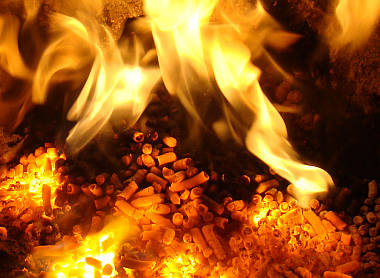
Our Southern forests turned to wood pellets to burn by European utilities
European utility companies are driving the destruction of Southern forests in the name of ‘renewable’ energy and are even being subsidized for their trouble…for now anyway.
The European Union has enacted a goal to derive 20% of its energy from renewable sources by the year 2020 and to phase out reliance on fossil fuels such as coal. We applaud this goal and wish that our own government would emulate it. Unfortunately, due to a false assumption driven by industry that burning trees is good for the atmosphere, European coal-fired power plants have been retooled to burn wood pellets (imported from the Southern US) instead of shutting down.
This skyrocketing demand for wood pellets was enough to drive exports from the Southern US up 70% in 2012 to 1.7 million tons leading our region to surpass Canada as the largest exporter of wood pellets in the world. Projections are that exports of wood pellets will jump to 5.7 million tons by 2016. This number comes as a serious point of concern when you factor in that our forests are already overtaxed by current lumber and paper production.
Over the years, Dogwood’s campaigns have been very successful at putting pressure on corporations and getting previously unthinkable results. But we knew that even with partners like NRDC and the support of over 70 organizations, we were going to need partners in Europe to take on European utility companies like DRAX and their US suppliers like Enviva. So, last year we reached out across the Atlantic to the source of the escalating pressure on Southern forests as fuel and formed an international coalition with allies in Europe. Our Forests Aren’t Fuel campaign now has eyes and ears in Europe with the power to influence policy and stop the destruction of Southern forests for fuel.
 The Royal Society for the Protection of Birds (RSPB)
The RSPB speaks out for birds and wildlife, tackling the problems that threaten our environment. RSPB is the largest wildlife conservation organization in Europe with over one million members. Wildlife and the environment face many threats. RSPB’s work is focused on the species and habitats that are in the greatest danger.
The EEB stands for environmental justice, sustainable development and participatory democracy to ensure the EU secures a healthy environment and rich biodiversity for all. The EEB is now Europe’s largest federation of environmental organizations.
By focusing on birds, and the sites and habitats on which they depend, the BirdLife Partnership is working to improve the quality of life for birds, for other wildlife (biodiversity), and for people.
In addition, we also coordinate with Biofuel Watch, Greenpeace and Friends of the Earth, who play a critical role in holding European utilities accountable for sustainability standards and shaping government policy.
We’re not the only ones that recognize that European organizations will play a very important role in ensuring the protection of our Southern forests. Following on the coattails of Dogwood is Enviva, the South’s largest manufacturer and exporter of wood pellets to Europe. Enviva has not only been actively lobbying the EU government, but has also been reaching out to many of our European allies despite refusing to meet with Dogwood and NRDC. They have taken a similar route here in the US, meeting with and trying to sway our allies along the North Carolina and Virginia Coast. However, Enviva has been met with a unified voice from Europe: “If you want to engage with one of us then you will have to talk to all of us!”

Roxanne Turpen’s Amazing Capes is an innovative company based in Asheville, NC where every purchase positively impacts our planet. Amazing Capes has chosen Dogwood Alliance as the beneficiary of their “Intrepid Adventurer cape: The Carson because of Dogwood’s ground-breaking advances towards creating a safer, healthier and more sustainable world and because Roxanne and Amazing Capes want to thank and support real-life superheroes who improve the quality of life for all who share this amazing planet.

For the Intrepid Forest Loving Adventurer: The Carson cape
Amazing Capes are a play item that can unlock your imagination, stimulate cognitive learning abilities in children, and provide kids with a jump-start towards being a real superhero in our world. Though geared towards children, Amazing Capes wishes to empower those of any age with a tool to release their inner superhero!
Amazing Capes are available in three sizes and feature eye-catching color combinations, high quality materials, fine craftsmanship and cutting edge design. These quality products ignite superhuman resolve so that all of us (child and adult alike) can grow up with kindness, confidence and a vibrant imagination.
Connect with Amazing Capes on Facebook and share their love of creative photo shoots.
Without a doubt, my summer with Dogwood has been the most impressing and meaningful time in my life. Let’s roll back to the very beginning of my interview, when Haiz Oppenheimer, Dogwood’s Campaign Organizer at the time, told me the success story of the Staples campaign, forcing Staples to make environmental sustainability commitments. I knew then that Dogwood Alliance was a non-profit organization that would share me with its powerful spirit, but it turned out what Dogwood gave me was far greater than that.

Before I came to Dogwood Alliance, I did not have any previous work or intern experience, and this made me wonder what the real world working experience would be like. Some people warned me that the adult’s world is cold and relentless, and it is quite difficult to make friends with co-workers. Well, based on my summer in Asheville, this theory is not sound at all. I fell “in love at first sight” with Dogwood when I saw the red brick two-story house with both a scent of history and a gorgeous appearance. In the following days, I was constantly welcomed by all kinds of warm greetings and given considerate tips, including the famous local restaurants, music halls and art galleries. Moreover, with a little help from Dogwood’s orientation program, I seamlessly transferred from campus life to my internship, during which I learnt how Dogwood Alliance operates, its origin and the details of my summer project; not to mention fun things like where to put the recycling and compost as well as the story of the conference table, which doubles as a ping-pong table.
Under the supervision of Andrew Goldberg, the Director of Corporate Engagement, I put much effort into Dogwood’s Carbon Canopy Project, focusing on current corporate carbon policy, creating a report summarizing the voluntary carbon market while building a bibliography of forestry-related carbon offset projects. At the beginning of my research, I was confused with many abstract carbon market terms, such as “carbon registry” and “carbon verified”. Carbon Canopy did me a great favor in teaching me the development process involved in a carbon project as well as the appropriate lingo. Carbon Canopy successfully developed a carbon project, persuading the landowners to keep a number of acres of forestry from being clear-cut to sell the saved carbon offsets as carbon credits to corporations instead. I witnessed the whole negotiation process and met many brilliant people from many professions, ranging from forestry consultants to project verifiers. In addition, the Washington, DC carbon market meeting, reviewing the State of Voluntary Carbon Market Report, also let me gain deeper insight into the details of this carbon market. Thanks to Dogwood Alliance and Andrew, who provided me with valuable opportunities to participate in the practice of this carbon market, I gained precious experience that I couldn’t have found in the classroom.
Besides the impressive working experience, Dogwood Alliance is also a great expert in entertainment and relaxation. Among all the fun events, the LaZoom bus tour is absolutely my favorite, during which I kept laughing all the time. Though, to be honest, I did not get the jokes most of the time, and this made me believe that laughter is contagious. Though it was rainy around Independence Day, with baseball games and with delicious cuisine prepared by Patrick Fitzsimmon, Dogwood’s Director of Development, the magnificent scene of fireworks was not ruined at all. (Patrick, thanks for the invitation!) Moreover, the beautiful hiking routes along the Blue Ridge Parkway and all the fun musical and art events made this summer even more enjoyable.
Dogwood Alliance is like a big family to me, where each of us worked together in a cute house while sharing the same belief, spirit and, above all, mission to protect Southern forests. I would like to sincerely thank everyone at Dogwood Alliance, for all the help, advice, instruction and kindness. I will always cherish the precious and valuable memory of my summer with you all.
Although I imagined thousands of possibilities for what my internship might be like, the real one proved to be still different and beyond my expectations.

I’m Jewel, a graduate student studying Economics at Duke University. I’m very interested in the biomass policy and biomass market, and that’s the reason why I planned to work as an intern for Dogwood Alliance. My research is to provide support for the “Our Forests Aren’t Fuel” biomass campaign, which deals with the fact that European countries increased their import of wood pellets dramatically from the Southern US in order to meet growing demand for wood-based fuel sources. I also did part of my research comparing different renewable energy technologies in terms of costs and job creation. Renewable energy is relatively new, so the market is very dynamic and responsive to public policies. In the second part, I did a brief review of the world wood pellet market and summarized the relevant policies of major EU importing countries. This has been a very good opportunity for me to hone my research skills as well as dig deeper into my field of interest. The process of getting familiar with the target issue, collecting data, organizing information and finally forming the report, is key to independent research, and is just what I need to advance my studies.
I love the working atmosphere here at Dogwood Alliance. It is very exciting to work here: I’m not only doing meaningful research, but I’m also joining in on the different activities of the organization. I have attended orientation presentations, so I got to know the structure of a non-profit organization and what impact Dogwood Alliance might have on society or industry. I worked as part of an assembly line to combine the letters to members of Dogwood Alliance, which taught me that the awareness necessary to protect Southern forests is accumulated over time and with sustained efforts. I had a shift at the Dogwood booth during River Arts District Studio Stroll, and I came to understand that Dogwood’s strategies make sense and more work is still needed. In addition, I had the opportunity to attend the carbon offset conference in DC, which broadened my view of the green economy. I’ve done internships at for-profit companies, and this internship is a bridge to the other side. I got the chance to internalize the non-profit perspective that the non-profits stand and understand how it is unique when compared to profit-driven companies. This experience really enriched my life in the U.S. and is helpful for my future career.
I sincerely appreciate the work experience I had with my supervisor, Scot Quaranda, Dogwood’s Campaign Director. He provided good suggestions and comments for my research, and he gave me a great level of freedom in my research so that I could both contribute to the goal for the campaign and satisfy my own research interests at the same time. I also appreciated all my interactions with the staff at Dogwood Alliance; they are very helpful and passionate about their jobs. Talking to them is pretty enjoyable. I also made good friends with other interns in Asheville, which largely added to my happiness during my 11 week stay.
I also enjoyed the cool summer in Asheville. Asheville is such a wonderful city with its arts, music, and also beer. The life and the city style are quite different from any other cities I have visited in the US. This summer has been a prime time for me to get to know more about American life and the real non-profit organization working environment. I believe this internship has been unique, and I will cherish it forever.
Alliance is the first organization that I worked with outside campus here in United States. As an international student at Duke University, I kept trying to gain an opportunity to work in the industry before I applied for the Stanback Internship program. I am a Masters candidate at Duke majoring in Engineering Management with a concentration in Construction Management. Many people question the reason I joined the non-profit organization Dogwood Alliance which helps to protect Southern Forests. One of the most significant reasons is that buildings and their surrounding environment cannot be separated. For example, the construction industry and the environmental industry both follow the Leadership in Energy & Environmental Design (LEED) and both relate to energy conservation issues.
I am a Paper Industry Transformation Campaign intern at Dogwood Alliance. My goal was to help develop the framework and methodology for the “Southern Paper Company Report Card” which details the companies’ progress on key measures and creates a race-to-the-top across the sector. In my research, I utilized my supply chain management knowledge to evaluate the whole life cycle of paper products. When I was attending a dinner meeting with my supervisor, Andrew Goldberg (Dogwood’s Director of Corporate Engagement) in Charlotte, I met different stakeholders in the paper industry and heard the voices of different perspectives, which helped my research and gave me a unique understanding of corporate engagement.
Every morning, I input “129 Biltmore Ave” in my GPS and drove to the Dogwood office through downtown Asheville. I came into the office and settled down at my table and said hello to everyone who walked by my work station. These simple, repeated actions gave a sweetness to my memories at Dogwood Alliance.
I enjoyed the time I spent with my colleagues. The comedy bus LaZoom showed me the concept of “American Humor”. Even though my cool supervisor instructed me on my research seriously in the office, he was teased by the comedienne several times on the bus. Yes, they enjoyed that kind of interaction. We also went to a baseball game together: Asheville vs. Greensboro. The tempo of the game was slow, but I learned how the locals celebrate victories. Of course, the funnel cake was my favorite. The fireworks after the game were amazing. I even got my picture taken with the cute Asheville Teddy Bear mascot. During Independence Day, I was invited to Development Director Patrick Fitzsimmons’ home to celebrate the holiday with his family and friends. Patrick is the most knowledgeable director I have ever seen because of his white hairy-face. 😉
I’d like to express my sincere thankfulness to my supervisor, Andrew Goldberg. He instructed me all though my research. I would also thank Scot, who answered my questions so carefully and patiently. Helen, your elegance impressed me. Amanda, your smile is so sweet! Suzanna, you are the most stylish singer I have ever seen. Patrick, such a cool man!
My dream starts off at Dogwood Alliance, and now it is well on its way.
I first knew Dogwood Alliance from the Stanback Internship Program at the Nicholas School of Duke University. I chose Dogwood partly because I’m an environmental student who is interested in renewable energy, and partly because Dogwood Alliance is not a big NGO that could give me real hands-on experience! It turned out that this was a decision I’ll never regret.

I spent much of the time digging up why whole-tree burning biomass is much worse for the environment than wind and solar energy. Although I learned a lot about fossil fuels and some of the renewable energies in school, I’d never had a chance before to research biomass. As I am getting familiar with this topic, I am surprised to know how deep my supervisor Scot Quaranda (Dogwood’s Campaign Director) has gone into it. When I tried to understand the increasing demand of biomass from Europe, he interpreted this problem by showing how many more export ports are constructed along the southeast coast in the US, which I had never thought of or researched before. Furthermore, I continue to be impressed with the enthusiasm they all have in this organization. Generally speaking, Scot’s day begins with checking voice messages, followed by continuous phone calls and phone conferences all day long. Sometimes, with his busy schedule, he can only squeeze in a quick carryout lunch. Even so, he has been working here for 13 years, and he is so excited and happy when talking about his work! So is Andrew, the Director of Corporate Engagement. He once attended a conference three days in a row, then drove to Charlotte to have a work dinner and didn’t make it back to Asheville until 2am. I have to say, I admire their great passion and their dedication to their careers!
Aside from work, Dogwood Alliance is like a new, warm family to me here in Asheville. I had my first live baseball game with my nice colleagues. I remember clearly the moment when Scot, the other interns and myself sat in the field, watching the beautiful fireworks in the sky. I knew for sure that this picture would live in my memory forever. I also had my first July 4th in the US here at Dogwood’s Development Director, Patrick Fitzsimmons’ house. It was a lovely and warm family party, I’m so grateful that I could enjoy the holiday with traditional BBQ and fireworks with my American friends.
Suzanna was the first person I met here, and the orientation week she organized was truly helpful. Her big smile always made my day. Amanda gave me tips on where to find the best coffee shop in Asheville and also brought us delicious cake. Helen showed me all the postcards on the refrigerator that she and others send to Dogwood from their world travels, and she shared with me her enthusiasm for nature and life. Danna, as the Executive Director, is more like a helmsman of a ship, giving the whole direction of the organization. I know I’ll miss ya’ll after my 11 weeks!
I like the idea of Dogwood Alliance that if you want to protect nature, you need to love nature first. Thankfully, we can take every other Friday afternoon off to embrace mountain life. You live in the mountains, why not go hiking?!
Thank you so much Dogwood Alliance for my wonderful summer in Asheville, and thank you Fred Stanback for the opportunity to meet so many amazing people pursuing their dreams!
 In just the last two years or so, the wood pellet export industry in the US has exploded to meet spiking demand in Europe, where utility companies are phasing out coal and phasing in wood as a primary fuel source for electricity. Almost overnight, a multitude of new companies no one has ever heard of have incorporated and set up manufacturing facilities that are turning trees from America’s forests into wood pellets to supply this new global market.
The US South is ground zero for this new phenomenon, where wood pellet exports jumped from over a million to three million tons in roughly the past year. UK utilities like Drax, are way out in front, actively converting coal boilers to wood and co-firing wood along with coal. In the absence of enough forests in Europe to supply the fuel needed to run these giant power plants, Drax and others rely on imported wood in the form of pellets from elsewhere, particularly the US South. Scrambling to be the leader in this new market is Enviva, the South’s largest wood pellet manufacturer and supplier to Drax. Enviva and Drax are now working in concert to increase investment in the expansion of two port facilities on the coast of North Carolina.
Just how stable is this market? What are the economic risks to investors? What kind of long-term impacts will this industry have on economic development in coastal and rural communities across the South?
The very existence of this market hinges on government policy propped up by huge government subsidies. In Europe, government mandates to reduce carbon emissions and retire coal burning power plants combined with massive government subsidies for renewable energy have combined to create the new global market for wood pellets. Companies like Drax and Enviva are pointing investors to industry projections that exports from the South will reach as high as ten million tons in the next three years.
Hmmm… not so fast. This is one market whose very existence depends on its ability to deliver real, verifiable environmental benefits. Yet, at the same time this market is taking off, a mounting body of scientific evidence has emerged documenting that burning trees for electricity could actually increase carbon emissions when compared to coal and other fossil fuels. Environmental organizations across the US and Europe have joined forces to stop the burning of trees for electricity in favor of low carbon intensive alternatives, such as solar and wind. Government is starting to take notice, and investors are soon to follow.
In just the past two weeks, the UK government announced a cap on the construction of new wood burning power stations, and all government subsidies for biomass will come to a screeching halt in 2027. In an article that ran in BBC on July 16, 2013, Ed Davey, the UK’s Energy Secretary stated, “Making electricity from biomass based on imported wood is not a long-term answer to our energy needs – I am quite clear about that.” A similar signal came out of the Netherlands last week with news of an Energy Agreement that was signed by employers, labor unions, energy companies, governments, NGOs and others announcing that as five coal power plants close, the co-firing of biomass will be capped so that it will stay relatively small as the country focuses on a scaled-up reliance on wind power. Even here in the US, where utilities like Dominion Power are burning wood as a fuel source, a federal court, citing scientific studies demonstrating significant carbon emissions from burning trees, reversed an EPA rule exempting biomass from carbon regulations under the Clean Air Act.
Clearly, the writing is on the wall – the recent market boom is going to bust and investors won’t want to get caught in the bubble. Within an evolving policy context where the science is in direct contradiction to the business model, it’s likely we’ll see even more restrictions on tree burning and associated wood pellet exports in the next few years, making new investments pretty risky.
Take a look at this video of Gainesville Mayor Braddy calling biomass a scam:
[youtube]http://www.youtube.com/watch?v=kCeQliTMfQg[/youtube]
Of perhaps greater importance, however, are local communities where these wood pellet facilities are locating. The prospect of new jobs is enticing, but what happens in 15 years when the government subsidies run out and the demand for wood as a fuel source dries up? What happens when even tighter restrictions on biomass in Europe are enacted and demand shrinks in the nearer-term? Local communities will be left with a degraded landscape of destroyed forests and countless hardworking folks will lose their jobs. Hard-earned tax dollars will have been wasted, burned up in smoke in European power plants along with the surrounding forests. Wood pellet manufacturing is not only not the path to a clean energy future, it’s also not the path for community economic revitalization or long-term economic stability.
Drax, Enviva and others are painting a much rosier economic picture. After all, they are the front-runners, and they have already sunk a lot of money into this market. Investors will most likely increasingly take their financial forecasts and market projections with a grain of salt. Hopefully, local economic development agencies across the South will do the same.


 Donate