


Today, Dogwood Alliance and our long-time partner, Natural Resources Defense Council, launched Our Forests Aren’t Fuel, a campaign to stop the large-scale burning of trees for electricity. It’s no coincidence that the launch of this new effort coincides with today’s Wall Street Journal front-page story exposing how Southern wetland forests are being clearcut, turned into pellets and shipped overseas to be burned in European power stations.
For over a year now, we’ve been doing our homework, researching the market trends, identifying the major corporate players and investigating the impacts on the ground. We’ve been cultivating partnerships and allies (check out the 75 groups signed on to our campaign platform) and informing the media, including, of course, the Wall Street Journal, who we extensively briefed on the issues leading up to today’s article. We’ve been preparing for just the right moment to expose the inconvenient truths about burning wood for electricity: it not only threatens wildlife and water resources in the world’s most biologically diverse temperate forest, but it also threatens to accelerate climate change, endangering life as we know it on planet Earth. Today, the smoking gun is revealed, with evidence that trees from clearcut 100-year old wetland forests in the Southern US were burned as fuel to generate electricity.

Misdirected renewable energy policies both here in the US and in Europe treat biomass, including the burning of trees, as renewable energy just like solar and wind. With billions of dollars of government subsidies available, over the past several years, major utility companies have been converting coal burning power plants to wood, even though there is a mounting body of scientific evidence that burning trees for electricity releases more carbon into the atmosphere than burning coal. In a rush to find much-needed alternatives to fossil fuels, this inconvenient truth, along with evidence that it’s destroying forests, has been largely ignored.
The Economist recently hit the nail on the head in depicting the practice of burning trees for electricity with an illustration of a caveman lighting a fire with sticks in hand. With the emerging technologies of solar and wind power, burning trees as fuel for electricity is indeed quite primitive and clumsy by comparison. The use of forests as a primary fuel source is taking us backward, not forward, on the path to clean energy.
Europe is currently at the forefront of this rush to burn, which has led to an explosion of new facilities here in the South that are chopping down our forests, turning them into wood pellets and exporting them across the Atlantic. Currently, the Southern US is the world’s largest exporter of wood pellets. Wood pellet exports to Europe from the South doubled from 1.5 million tons to over 3 million tons over the past year and are projected to double again to 6 million tons by 2015.
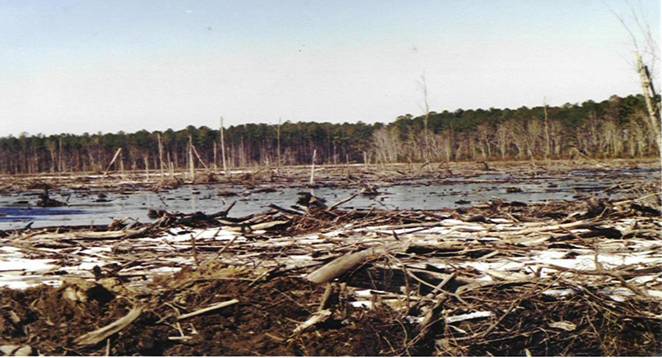
Trees from clearcut wetland forests like this one are being turned into wood pellets and shipped overseas to burn for electricity.
At the head of the pack in Europe is Drax, who is investing billions of dollars to convert dirty old coal plants to wood burning. Much of the wood comes in the form of pellets from the Southern US. Drax is not alone, with many of Europe’s largest utilities including Electrabel, GDF Suez, Dong, and Forth burning wood pellets imported from the US South to generate electricity as well.
Domestic utilities here in the South are not far behind the Europeans. All of the top utilities in the South already have some capacity to burn wood for electricity with plans for further expansion in the future. Currently, Dominion Power in Virginia leads the pack. Other companies are not far behind like Southern Company, Duke Power, TVA, and Florida Power & Lights, who all have plans of their own.
The largest company pelletizing forests in the South is Maryland-based Enviva. Though they claim that the trees they use come from “sustainable forestry”, Enviva ‘s sourcing of wood from clearcut cypress tupelo wetland forests along the North Carolina Virginia coast was revealed today by not only the Wall Street Journal but also the BBC.
What an embarrassment this must be to Virginia’s Dominion Power and Drax in the UK, both of whom rely on Enviva for wood to burn. Drax purchases wood pellets exported to Europe by Enviva and Dominion Power buys the leftover tops and limbs from Enviva’s operations. Both Drax and Dominion claim that they hold their wood suppliers to high standards of forestry. The fact that Enviva has been caught sourcing from clearcut wetlands is yet another inconvenient truth I am sure these companies don’t want to hear. I suspect the other huge wood pellet companies, including Georgia Biomass, Green Circle, and more have some inconvenient truths of their own that will come out in due time.
Before that happens, however, these companies can make the right choice. The leaders in this fiasco, Dominion Power, Drax and Enviva, can set a better example by choosing not to burn trees for electricity and announcing their leadership in developing non-destructive, clean energy sources that will actually reduce carbon emissions. As leading developers of forests as a fuel source, these companies now have an opportunity to take swift and decisive action before additional investments are made and the problem reaches a scale that is irreversible for our forests and climate.
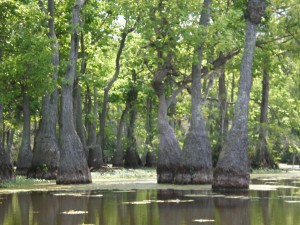
Our wetland forests provide critical habitat to countless species of plants and animals, and they protect coastal communities from flooding and serve as vital carbon sinks. Our wetland forests are many things, but they are NOT fuel.
Now, more than ever, we should fast-track investment in clean energy such as solar and wind while simultaneously accelerating efforts to protect forests. Our forests are vital for clean air, clean drinking water, flood control, wildlife habitat, and protect us from climate change. They should not be burnt for electricity – our forests aren’t fuel.
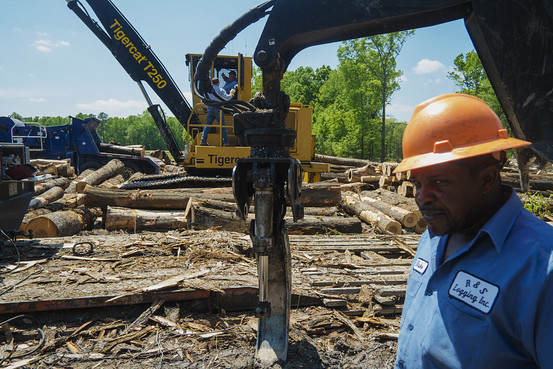
Matt Eich took this image for The Wall Street Journal of Duke Wrighton of R&S Logging at a North Carolina site
 Today, Dogwood Alliance and our long-time partner, Natural Resources Defense Council, launched Our Forests Aren’t Fuel, a campaign to stop the large-scale burning of trees for electricity. It’s no coincidence that the launch of this new effort coincides with today’s Wall Street Journal front-page story exposing how Southern wetland forests are being clearcut, turned into pellets and shipped overseas to be burned in European power stations.
For over a year now, we’ve been doing our homework, researching the market trends, identifying the major corporate players and investigating the impacts on the ground. We’ve been cultivating partnerships and allies (check out the 75 groups signed on to our campaign platform) and informing the media, including, of course, the Wall Street Journal, who we extensively briefed on the issues leading up to today’s article. We’ve been preparing for just the right moment to expose the inconvenient truths about burning wood for electricity: it not only threatens wildlife and water resources in the world’s most biologically diverse temperate forest, but it also threatens to accelerate climate change, endangering life as we know it on planet Earth. Today, the smoking gun is revealed, with evidence that trees from clearcut 100-year old wetland forests in the Southern US were burned as fuel to generate electricity.
Misdirected renewable energy policies both here in the US and in Europe treat biomass, including the burning of trees, as renewable energy just like solar and wind. With billions of dollars of government subsidies available, over the past several years, major utility companies have been converting coal burning power plants to wood, even though there is a mounting body of scientific evidence that burning trees for electricity releases more carbon into the atmosphere than burning coal. In a rush to find much-needed alternatives to fossil fuels, this inconvenient truth, along with evidence that it’s destroying forests, has been largely ignored.
The Economist recently hit the nail on the head in depicting the practice of burning trees for electricity with an illustration of a caveman lighting a fire with sticks in hand. With the emerging technologies of solar and wind power, burning trees as fuel for electricity is indeed quite primitive and clumsy by comparison. The use of forests as a primary fuel source is taking us backward, not forward, on the path to clean energy.
Europe is currently at the forefront of this rush to burn, which has led to an explosion of new facilities here in the South that are chopping down our forests, turning them into wood pellets and exporting them across the Atlantic. Currently, the Southern US is the world’s largest exporter of wood pellets. Wood pellet exports to Europe from the South doubled from 1.5 million tons to over 3 million tons over the past year and are projected to double again to 6 million tons by 2015.
Trees from clearcut wetland forests like this one are being turned into wood pellets and shipped overseas to burn for electricity.
At the head of the pack in Europe is Drax, who is investing billions of dollars to convert dirty old coal plants to wood burning. Much of the wood comes in the form of pellets from the Southern US. Drax is not alone, with many of Europe’s largest utilities including Electrabel, GDF Suez, Dong, and Forth burning wood pellets imported from the US South to generate electricity as well.
Domestic utilities here in the South are not far behind the Europeans. All of the top utilities in the South already have some capacity to burn wood for electricity with plans for further expansion in the future. Currently, Dominion Power in Virginia leads the pack. Other companies are not far behind like Southern Company, Duke Power, TVA, and Florida Power & Lights, who all have plans of their own.
The largest company pelletizing forests in the South is Maryland-based Enviva. Though they claim that the trees they use come from “sustainable forestry”, Enviva ‘s sourcing of wood from clearcut cypress tupelo wetland forests along the North Carolina Virginia coast was revealed today by not only the Wall Street Journal but also the BBC.
What an embarrassment this must be to Virginia’s Dominion Power and Drax in the UK, both of whom rely on Enviva for wood to burn. Drax purchases wood pellets exported to Europe by Enviva and Dominion Power buys the leftover tops and limbs from Enviva’s operations. Both Drax and Dominion claim that they hold their wood suppliers to high standards of forestry. The fact that Enviva has been caught sourcing from clearcut wetlands is yet another inconvenient truth I am sure these companies don’t want to hear. I suspect the other huge wood pellet companies, including Georgia Biomass, Green Circle, and more have some inconvenient truths of their own that will come out in due time.
Before that happens, however, these companies can make the right choice. The leaders in this fiasco, Dominion Power, Drax and Enviva, can set a better example by choosing not to burn trees for electricity and announcing their leadership in developing non-destructive, clean energy sources that will actually reduce carbon emissions. As leading developers of forests as a fuel source, these companies now have an opportunity to take swift and decisive action before additional investments are made and the problem reaches a scale that is irreversible for our forests and climate.
Our wetland forests provide critical habitat to countless species of plants and animals, and they protect coastal communities from flooding and serve as vital carbon sinks. Our wetland forests are many things, but they are NOT fuel.
Now, more than ever, we should fast-track investment in clean energy such as solar and wind while simultaneously accelerating efforts to protect forests. Our forests are vital for clean air, clean drinking water, flood control, wildlife habitat, and protect us from climate change. They should not be burnt for electricity – our forests aren’t fuel.
FOR IMMEDIATE RELEASECONTACT: Scot Quaranda, Dogwood Alliance, 828.242.3596, [email protected]
Dogwood Alliance and NRDC Launch “Our Forests Aren’t Fuel” Campaign to End the Practice; Release Case Studies Highlighting the Major Energy Corporations Responsible
May 28, 2013 – Southern forests are being burned for electricity, and a new campaign announced today aims to put an end to it. Dogwood Alliance and the Natural Resources Defense Council (NRDC) have launched “Our Forests Aren’t Fuel” to raise awareness of an alarming and rapidly-growing practice of logging forests and burning the trees as fuel to generate electricity
At the forefront of burning trees logged from Southern forests for electricity are some of Europe’s largest utility companies, including Drax, Electrobel and RWE. Rising demand by these companies has resulted in the rapid expansion of wood pellet exports from the Southern US. The American South is now the largest exporter of wood pellets in the world. Recent analyses indicate there are twenty-four pellet facilities currently operating in the Southeast, and sixteen additional plants planned for construction in the near-term. Market analysts project that annual exports of wood pellets from the South will more than triple from 1.3 million tons in 2012 to nearly 6 million tons by 2015. All of the South’s largest domestic utilities, including Dominion Resources and Duke Energy, are also beginning to burn wood with plans for expansion in the future.
“This rapidly expanding trend of burning trees for energy will both accelerate climate change and destroy forests,” said Danna Smith, Executive Director of Dogwood Alliance. “Southern forests not only protect us from climate change, but protect our drinking water, provide habitat for wildlife and contribute to our quality of life. We need these companies to stop burning trees for electricity and embrace a clean energy future that helps to protect, rather than destroy forests.”
“With the advancement of clean, renewable energy alternatives, the growing practice of burning trees for electricity is a major step in the wrong direction,” said Debbie Hammel, Senior Resource Specialist of the Natural Resources Defense Council. “Our Forests Aren’t Fuel lets the public know about the extent of this ecological devastation and calls on utilities to end the practice. It’s an even dirtier form of energy production than burning fossil fuels, it destroys valuable southern ecosystems, and it isn’t necessary.”
Energy from burning trees – or biomass – has been widely promoted as a form of renewable energy along with technologies like solar, wind, and geothermal. Over the past two years, however, mounting scientific evidence has discredited biomass from forests as a clean, renewable fuel. Recent scientific reports document that burning whole trees to produce electricity actually increases greenhouse gas pollution in the near-term compared with fossil fuels and emits higher levels of multiple air pollutants. This fact, combined with the negative impacts to water resources and wildlife associated with industrial logging have discredited whole trees as a clean fuel source. But current European and U.S. renewable energy policies and subsidies encourage the burning of trees as a “renewable” source of energy for power generation, helping to facilitate the rapid increase in demand for trees from Southern forests to burn in power plants.
Consequently, a new industry is spawning in the South. Companies like Maryland-based Enviva, the South’s largest pellet manufacturer, are grinding whole trees into wood pellets to be burned in power stations in Europe while also supplying wood to domestic utilities like Dominion Resources. New evidence that Enviva may be relying at least in part on the harvesting of wetland forests has recently emerged. Georgia Biomass, a wholly-owned subsidiary of the German utility RWE Innogy, is also manufacturing millions of tons of wood pellets annually to be burned in European biomass facilities.
“Our Forests Aren’t Fuel” organizers reveal the scope and scale of the growing biomass industry through a series of case studies on the campaign website that include wood pellet manufacturers, domestic utilities, and European utilities. Particular emphasis is placed on the following companies:
Full case studies for companies driving the biomass industry can be found on the “Our Forests Aren’t Fuel” website, http://www.dogwoodalliance.org/campaigns/bioenergy/, along with recommended actions for those concerned about losing southern forests for electricity, and a list of more than 70 supporting environmental groups.
Press Release -Our Forests Arent Fuel Campaign
# # #
Dogwood Alliance is increasing protection for millions of acres of Southern forests by transforming the way corporations, landowners and communities value them for their climate, wildlife and water benefits. Dogwood Alliance has revolutionized the environmental practices of some of the world’s largest corporations. For more information on the organization please visit www.dogwoodalliance.org or follow on Twitter @DogwoodAlliance.
The Natural Resources Defense Council (NRDC) is an international nonprofit environmental organization with more than 1.3 million members and online activists. Since 1970, our lawyers, scientists, and other environmental specialists have worked to protect the world’s natural resources, public health, and the environment. NRDC has offices in New York City, Washington, D.C., Los Angeles, San Francisco, Chicago, Livingston, Montana, and Beijing. Visit us at www.nrdc.org and follow us on Twitter @NRDC.
Reprinted fromBiofuelwatch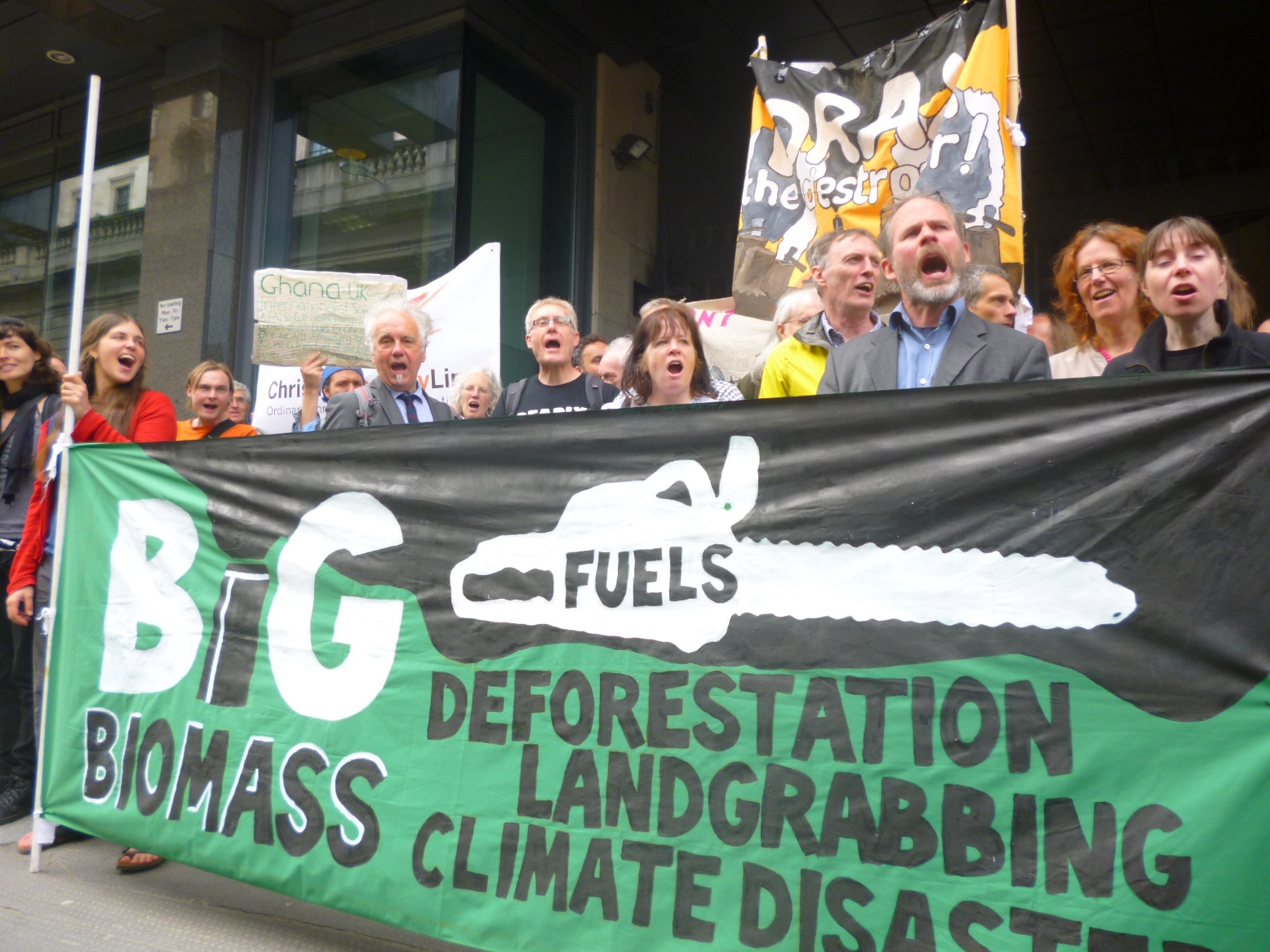 50 people took part in a demonstration and rally outside the annual general meeting of Drax Plc, at the Grocers’ Hall in London, organized by Biofuelwatch [1] and supported by 16 other groups [2]. Demonstrators chant3e “Drax Drax, what do you say? How many trees have you killed today?” and holding banners reading “Big Biomass: Fuelling Deforestation, Land-grabbing and Climate Disaster”, “Big Biomass is Greenwash not Renewable Energy” and “Drax the Destroyer!”. Biofuelwatch called the demonstration to oppose Drax power station’s plans to convert half of its generating capacity to biomass, and to highlight the impacts that this will have in terms of increased deforestation, land-grabbing and carbon emissions.
Natalie Bennet, Leader of the Green Party in England and Wales attended the demonstration and addressed the crowd. She said: “I made the time to come today as this is a really important issue. We absolutely must stand against big biomass. We need to write “decarbonisation by 2030″ into the Energy Bill and provide for the investment in solar, wind energy and energy conservation, which are the only answers for Britain.” Oliver Munnion from Biofuelwatch who took part in today’s protest said: “I’m here today to dispel a modern myth that big biomass is sustainable, low-carbon energy. Drax isn’t going green – it’s cashing in on massive subsidies to the tune of half a billion pounds a year and trying to keep its old, dirty power station going for as long as possible. You can’t paint a green façade onto the UK’s most polluting power station. Big biomass and coal spell disaster for communities and the climate – it’s time these dinosaurs closed.”
Sophie Bastable, also in attendance at the demonstration said: “In order for governments to meet renewable energy targets and to make dirty companies look green there is a massive push for biomass in the UK right now. But the fuel that Drax currently uses and will use much more of directly contributes to the destruction of biodiverse forests in North America. There is nothing sustainable about burning 1.6 times as much as the UK’s total annual wood supply in one power station every year. Creating such a vast new demand for wood will lead to more destruction of biodiverse forests and, whether directly or indirectly, more land-grabbing for tree plantations in the global South.”
Today’s protest coincides with the publication of an open letter to Drax Plc signed by 49 different organisations and networks worldwide, including Friends of the Earth International, the Global Forest Coalition and World Rainforest Movement [3]. The letter concludes: “We oppose commercial and industrial scale bioenergy, and demand that the UK halt coal conversion plans and force these coal plants to shut down. Meanwhile focus must be redirected towards a serious reduction of energy consumption and dramatic measures to protect and restore forests and other ecosystems.”
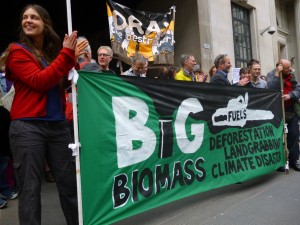 Drax’s biomass plans will require pellets made from 15.8 million tonnes of wood each year, making it the biggest biomass-burning power station in the world. By comparison, the UK’s total annual wood production is only 10 million tonnes. Overall, energy companies in the UK are planning to burn up to 10 times as much wood as the UK produces ever year. Wood burned by Drax increasingly comes from whole trees felled for this purpose [4].
In addition to issues of deforestation and land-grabbing, recent scientific studies have shown that biomass used for electricity generation is actually more carbon intensive than burning coal [5]. Duncan Law from Biofuelwatch said: “Burning biomass on the scale proposed will be even more carbon intensive than the coal it will replace, and result in a massive carbon debt stored just where we don’t want it, in the atmosphere. Far from being a low-carbon fuel, it’s a total climate disaster!”.
For local communities, coal to biomass conversions will mean decades more of high levels of pollution, since the conversions allow power stations to continue operating when they may otherwise have to close down [6]. Reverend Paul Cawthorne, Environmental Officer for the Lichfield Diocese and a near-by resident to Ironbridge, another coal-fired power station converting to biomass said: “After the dash for gas comes the dash for wood and with similar uncertainties about how noxious emissions will affect our local air. Why do some people think cutting down forests in other countries is somehow better for the planet than using our local resources and putting effort into becoming more efficient in our domestic use of energy. This is absurd and culpable short-termism. Even the wood trade is warning ministers this is a disaster in the making.”Notes
[1] Biofuelwatch is a not-for-profit grassroots organisation set up to raise awareness of the negative impacts of industrial biofuels and bioenergy.
[2] The following organisations are formally supporting Taking DRAXtic Action: Campaign Against Climate Change; Carbon Trade Watch; Christian Ecology Link; Climate Justice Collective; Coal Action Network; Coal Action Scotland; Colombia Solidarity Campaign; Corporate Watch; Frack Free Somerset; Fuel Poverty Action; Gaia Foundation; London Mining Network; London Rising Tide; Occupy London Energy, Equity and Environment Group; Rising Tide UK; World Development Movement.
[3] The Open Letter to Drax can be found here.[4] The Dogwood Alliance, a nonprofit organization working to protect forests in the Southern US, released a report entitled “The Use of Whole Trees in Wood Pellet Manufacturing,” in November 2012 documenting the fact that the top exporters of wood pellets in the region rely heavily on cutting down whole trees to satisfy demand from European power stations. Scot Quaranda, Campaign Director for Dogwood Alliance said “Energy companies in the UK, including Drax, RWE and E.On are converting large, old, dirty and inefficient coal power stations to biomass all in the name of reducing carbon emissions, but the reality is that this shift will accelerate climate change while also driving destructive industrial logging in the world’s most biologically diverse temperate forests.” Through direct investigation and research, the report documents the use of whole trees from Southern forests by the largest wood pellet manufacturers and exporters in the Southern US. Pellet manufacturers such as Georgia Biomass, a wholly owned subsidiary of RWE, and Enviva, a major supplier of Drax and E.On are highlighted in the report as using or if not open, planning to use, whole trees. The report can be found here.
[5] For a list of studies into the carbon impacts of biomass electricity, see www.biofuelwatch.org.uk/resources-on-biomass. In addition, the report “Dirtier than coal?” published by RSPB, Friends of the Earth and Greenpeace can be found here.
[6] According to a briefing by Department for Energy and Climate for the House of Lords on 14th February 2013, “the conversion of existing coal generating plant to biomass or higher levels of biomass co-firing is a way of keeping open some existing coal plant that would otherwise close before 2016 under environmental legislation, and therefore improve capacity margins over this decade.”
Today marks a pinnacle moment in Dogwood’s campaign to protect Southern forests from the impacts of industrial forestry for paper production. Since our humble beginnings in 1996, Dogwood Alliance has been openly critical of the paper industry’s impact on Southern forests. After all, the South is the world’s largest paper-producing region. And at the forefront of all of our campaigns over the past twelve years has been International Paper (IP). As the largest paper producer in the world’s largest paper-producing region, IP has had a significant footprint in our forests. And we’ve known for many years now that if we wanted to halt the conversion of natural forests to industrial pine plantations and the loss of unique forested ecosystems we would need to need to win over the Southern forest industry’s most influential player.
To take on IP seemed like a monumental task over a decade ago. But, we had a long-term vision, and we believed we could achieve it. We were going to convince IP’s biggest customers to join us in our fight to protect Southern forests. And once we had some big customers on our side, we were going to convince IP’s competitors to respond to those customers who were asking the right questions. We believed that this would create a new context where paper companies would have to compete for business not just on the price and quality of paper, but also on their commitments to forest conservation. Our strategy was perhaps part theory and part dream. Some doubted that it would work, but we didn’t let it stop us.
Over the years, one by one we convinced major customers of IP including Staples, Office Depot, OfficeMax, FedEx Office, Johnson & Johnson, GlaxoSmithKline, Universal Music Group and McDonald’s to embrace new environmental standards for their paper suppliers. That paved the way for three of the South’s largest paper producers, Domtar, Georgia-Pacific and Resolute Forest Products to begin working with Dogwood Alliance to improve forestry practices by embracing Forest Stewardship Council (FSC) certification and/or committing not to purchase any wood from endangered forests or from plantations established at the expense of natural forests.
And then, about a year ago, in the midst of a campaign targeting another one of IP’s customers, Yum! Brands/KFC, I got a call from IP’s new VP of Sustainability, Teri Shanahan. Fast forward to today and IP has developed the most comprehensive approach to addressing long-standing concerns about the impacts of industrial logging in the US South. Not only are they working to aggressively expand the acreage of FSC certified forests across the South (by 2014 they expect to be one of the world’s largest users of FSC certified fiber in the world), but they have also committed to invest $7.5 million to help conserve forests in the ecoregions that have been the focus of our campaigns. Beyond that, they have agreed to work with Dogwood Alliance to map endangered and other high conservation value forests and to discourage the future conversion of natural hardwood forests to pine plantations.
This is a big shift from business as usual in the Southern forest industry, and IP deserves credit for embracing new approaches and beginning to create a new paradigm for their industry. They also deserve a lot of credit for seeking out Dogwood Alliance, one of their biggest critics, as a partner on their path of continuous improvement. That takes courage and a bit of a leap of faith.
We still have a long way to go to ensure our forests have the protection they so deserve. And there is still need for even greater improvement in the paper industry. But, today is a day to celebrate and to feel hopeful about what’s possible in the future. This has been a long road. It has been hard work involving the time, energy and support of many people over the years. Together we dreamed a big dream and it came true…at least in part… giving rise to an even greater confidence in our ability to manifest even bigger dreams for Southern forests in the future.
Imagine a future where our forests resemble a Sci-Fi horror movie – a harsh landscape empty of biological diversity, overgrown with frankentrees planted only to produce resources for a polluting energy industry. If ArborGen, with the help of the US Department of Agriculture (USDA), has their way, that dismal nightmare could become a reality.
That is why I’m asking you to submit public comments by April 29th, demanding the USDA reject frankenforests and protect the biological diversity of the Southern US. The USDA is accepting public comments on a request by GE tree company ArborGen to commercially sell hundreds of millions of freeze-tolerant genetically engineered eucalyptus trees annually for vast plantations across Texas, Florida, Georgia, Alabama, Louisiana, Mississippi and South Carolina.
The only way to stop GE trees from becoming a dangerous invasive species that contaminates native forests is to ban the commercial release of GE trees before it’s too late.
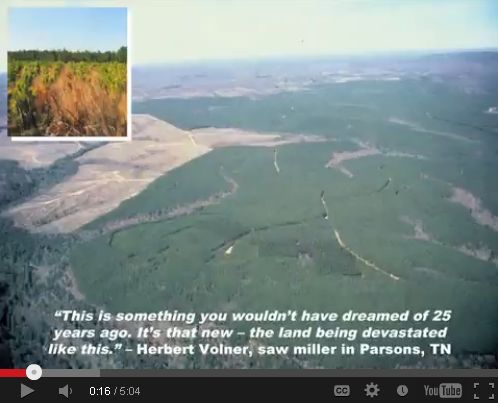
Watch our 5 minute video on the impacts of timber plantations & GE trees
Non-GE eucalyptus plantations already have devastating impacts all over the world. Based on these documented impacts, GE eucalyptus plantations in the US will likely cause:
In addition to the points above, you can find more on the dangers of GE trees and detailed information for your comments in our GE trees fact sheet.
Find out even more from Dogwood Alliance Executive Director, Danna Smith, and other experts about the effects of fast-growing timber and GE trees.Read the full 580 page petition requesting deregulation of freeze-tolerant GE eucalyptus trees here.
From May 26-June 1, industry leaders, scientists and policy makers will meet in Asheville, NC for the Tree Biotechnology 2013 Conference. The conference will discuss current and future applications of GE trees, such as large-scale plantations of GE eucalyptus trees in the southern United States, from South Carolina to Texas.
The STOP GE Trees Campaign is mobilizing events and protests in Asheville calling for a ban on the release of GE trees into the environment. To be alerted to updates on this situation and get involved in these events or the campaign to stop GE eucalyptus trees, email [email protected] or go to www.nogetrees.org
I was walking in the forest yesterday and saw so many BEAUTIFUL animals. Of course there are many birds and lizards. It made me think of how so many animals are endangered because we are cutting down their homes to use for wood and paper. I was really happy to hear that Dogwood Alliance convinced KFC to buy more recycled paper for their packaging.
I know my favorite animal in the forest is the otter. I mean, they are so cute and adorable! I really hope that their habitat and the habitats of other animals will be preserved.
The forest has always been my backyard, and it is practically endless!!! I have always enjoyed playing in it with my friends and family. It is one of my favorite things to do. It is definitely worth preserving.
 Hannah Fox lives in Brevard, North Carolina.
Dogwood partner, Geostellar, is a sustainable energy network taking the fight against climate change and high utility bills nationwide. Through advanced simulations on an intuitive social platform, Geostellar helps homeowners take control of their energy use by deploying solar energy and energy efficiency solutions that cut costs, increase savings, and reduce carbon pollution.
Geostellar recently announced the launch at SXSW of a first-of-its-kind online Sustainable Energy Network that helps homeowners slash costs, save money, and fight climate change by reducing carbon pollution – all through the use of advanced home energy simulations, expert guidance and a broad array of solar installation, equipment and financing options. The intuitive social platform connects homeowners together to share expertise and encouragement while promoting the successful deployment of solar energy and energy efficient technologies.
[youtube]http://www.youtube.com/watch?v=ZDbJMQ_pULY[/youtube]
With increasing public concern about the impacts of climate change and rising utility bills nationwide, Geostellar’s network meets a significant and growing challenge for American homeowners. Every home has a unique combination of energy demands, solar potential, utility rates and incentives. Geostellar’s advanced simulation provides an instant, free, and independent analysis of each and every home’s potential to take advantage of programs to reduce costs and carbon pollution.
“For many homes, the cleanest source of energy is now also the cheapest,'” said David Levine, founder and CEO of Geostellar. “By reducing costs and removing barriers to entry, Geostellar makes solar energy and energy efficient technologies more competitive across the U.S.”
“Every neighborhood has a solar enthusiast. Geostellar gives that person a way to encourage their neighbors to deal with ever-rising electric bills by switching to solar,” said Jigar Shah, founder of SunEdison and an advisor to Geostellar. “After years of confusion and obscurity around home energy opportunities, Geostellar’s Sustainable Energy Network makes those choices simple, transparent, and accessible.”
 Last Friday, I packed up a rented minivan with my ten-year-old daughter, Summer, as well as two friends and their young daughters. With handmade signs in tow, we headed from Brevard, North Carolina to Washington, D.C. for the Forward on Climate Rally to join people from all over the country in calling on President Obama to take action on climate change. Our task was to make sure that protecting forests was a part of the message. We arrived in DC late, but the excitement of being in the nation’s capital overshadowed our exhaustion as we drove past the Washington Mall, pointing out the Lincoln Memorial and the Washington Monument. We checked into our hostel, where we immediately met two young women traveling abroad from Scotland and England. Our daughters were quick to tell the young women about the rally, and, as they were both studying environmental policy in college, they vowed to be there. (Those girls are natural organizers!)
 We spent the next day sightseeing. The hands-down favorites were the Martin Luther King and Lincoln Memorials. We each were quick to point out our favorite MLK quotes engraved on the stone wall. We talked about what an amazing person MLK was and how cool it was that we were going to be marching, as MLK did, for positive change the next day. We also praised Lincoln for standing strong against slavery.
We went to the Smithsonian Museum of Natural History and studied with great curiosity the amazing diversity of life on Earth from dinosaur bones to funky deep sea creatures to the familiar forest-dwelling butterflies and orangutans. We talked about the rally, climate change and our collective responsibility to our fellow human and nonhuman species.
The next morning, we braved the frigid cold, and walked to the Washington Monument for the rally, where we joined an estimated 50,000 people. Together, we marched to the White House. The cold wind was piercing but it didn’t matter; we were making history, bringing national and even global attention to the most important issue of our time.
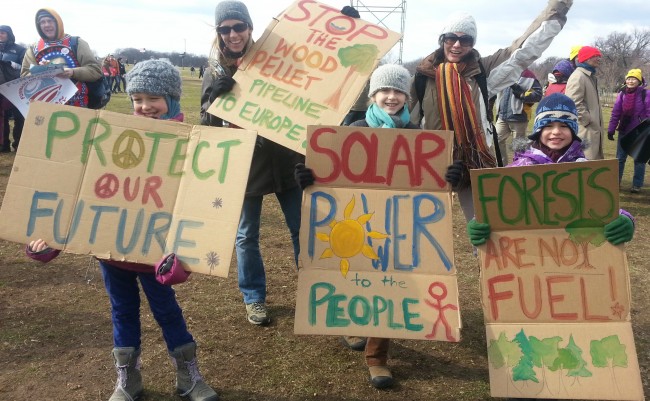 The next day we read the news stories and viewed the pictures on the Facebook pages of 350.org, Sierra Club and the Hip Hop Caucus. Out of 50,000 people, a picture of us holding our signs, was posted on 350.org’s wall (1 of 18 photos posted)! In the midst of thousands of signs focused on ending the use of fossil fuels, there were our colorful, handmade signs, carrying the message of forest protection!
In the end, I couldn’t think of a better and more appropriate way for my daughter to see the nation’s capitol for the first time. It was truly an inspiring and experiential education in democracy. I hope one day she can look back on this experience and say with confidence that she was there when the pendulum in the US began to shift towards clean energy, the protection of forests, water and air as well as economic justice for all. But, most of all, I hope she remembers that the voice of her moral compass when combined with the actions of her spirit are her most powerful forces for positive change.


 Donate