


For the last couple years now, we’ve been tracking a new threat to our forests – bioenergy. Utility companies have been devising schemes to burn large amounts of wood from Southern forests for electricity. Recently, there has been an alarming increase in wood from our forests turned into pellets which are then shipped to Europe and burned for electricity by big utility companies to meet short sighted EU climate requirements. Currently there are 25 operational export pellet mills in the region with approximately 15 more planned across the South. Essentially, we are destroying our Southern forests so Europe can burn them to meet its climate goals, which are based on the mistaken blanket assumption that biomass energy is carbon neutral.
This is of course one of the most ridiculous schemes we have seen in years. Why would we burn the forests that are supposed to buffer us from climate change to fight climate change? Forests play a vital role in taking in Carbon from the atmosphere and sequestering it which is then lost when it is logged and burned. Numerous studies have shown that burning wood is far from climate neutral and in fact may be worse for the climate than burning coal.
Last month, a colleague from Greenpeace, Larry Edwards, based up in Alaska joined me for a “Tour of Destruction,” where we visited and documented the impact that some of the biggest of these new facilities are having on our forests in Georgia, South Carolina and North Carolina where 5 facilities are currently in operation with 5 more planned for the future. The following is an account from our trip.
Days 1 and 2: Port of Savannah, Appling County Biomass in Baxley, GA, and Georgia Biomass in Waycross, GA
Our first stop was Savannah, Georgia where we hoped to check out the operations of Georgia Biomass, a subsidiary of RWE in Germany. We had two goals in Savannah, first to see the actual export facility of Georgia Biomass located at the Port of Savannah, where they plan to ship over 700,000 tons of wood pellets to their power plants in Belgium, UK, and the Netherlands. Our second goal was to visit their corporate offices, and gather information on their operations.
Sadly, both of these goals were a dead end. When we rang Georgia Biomass’ buzzer, they chose not to let us in and instead referred us to their website, which you can see here. And though we tried, we could not get access to the port to view the export operations because post September 11th security is high and access is limited to dockworkers only. We were not deterred and so decided to make our way south and visit Georgia Biomass pellet production facility first hand.
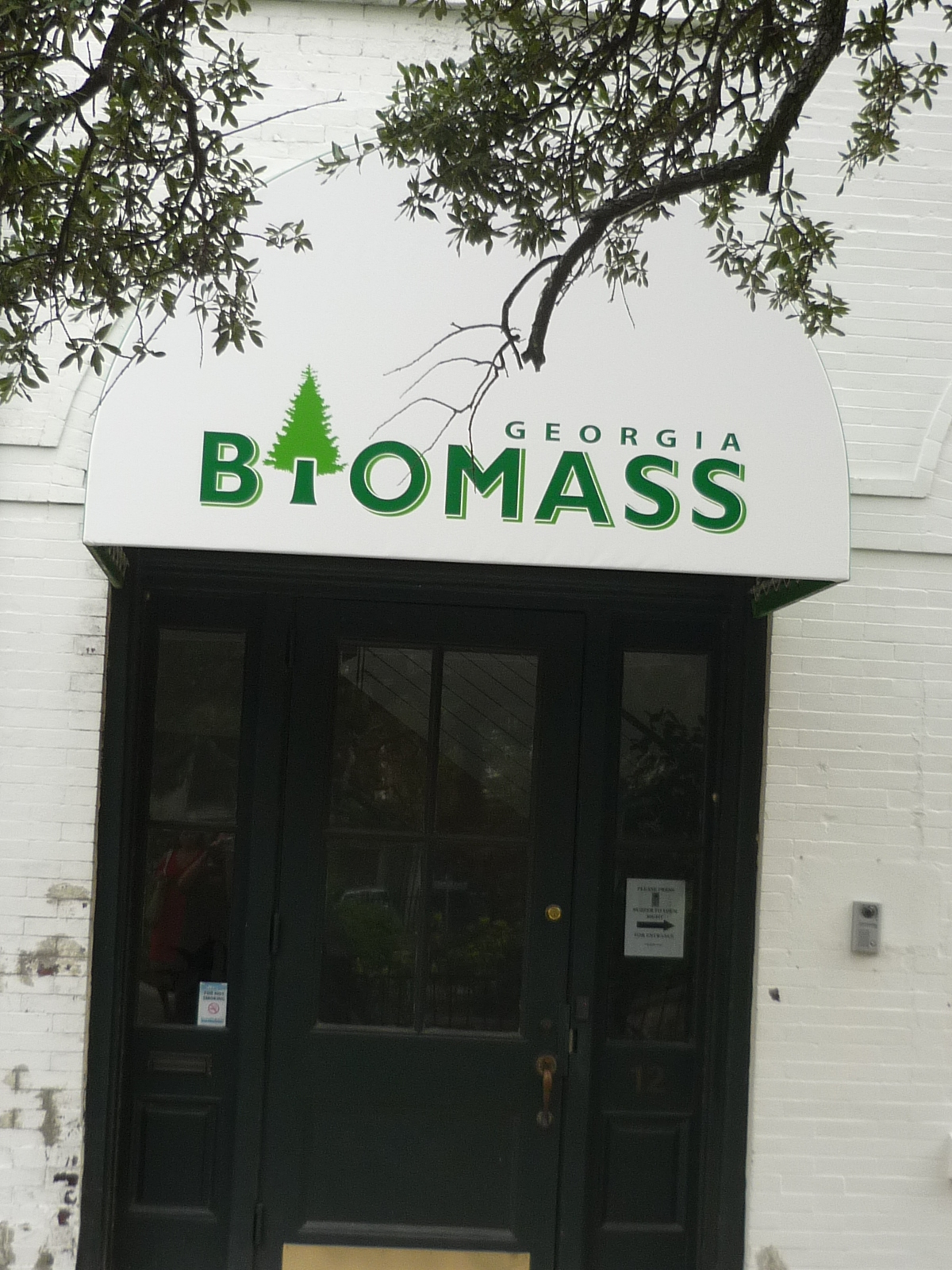
“Hi Georgia Biomass, Scot from Dogwood Alliance, would love to come in and speak to you about your operations.” “Nothing to see here, check our website”
Our route took us through Appling County and the town of Baxley, Georgia, where we stopped at the Appling County Biomass facility which is a subsidiary of Fram, a “renewable” energy company owned by a Norwegian shipping magnate. This facility has a planned capacity of nearly 300,000 tons of pellet production a year for export to Europe. We sat in the parking lot, watching truck after truck come in and drop off loads of wood chips and tree residuals (which include tree tops and branches which are traditionally left on the forest floor) which were being processed into wood pellets for the Northern European market. Unable to get an official tour, we witnessed everything firsthand from the parking lot. It was clear that this facility was utilizing every last drop of wood it could claim from the local market.
Appling County Facility in Baxley, GA owned and operated by Fram Renewables.
Truck after truck filled with residual and wood chips delivering to the facility.
From Baxley, we made our way further south to Waycross, Georgia, the northern gateway to one of the most biodiverse hotspots in the South, the famed Okefenokee Swamp. As we were entering town, we noticed a lot of log trucks making their way on the roads, but still had no idea what was to come. Eventually we made it over to the business park that hosts Georgia Biomass, a wholly owned subsidiary of RWE (one of Europe’s largest utility companies), currently the largest stand-alone wood pellet manufacturing facility in the world, projected to produce nearly 750,000 tons of wood pellets every year.
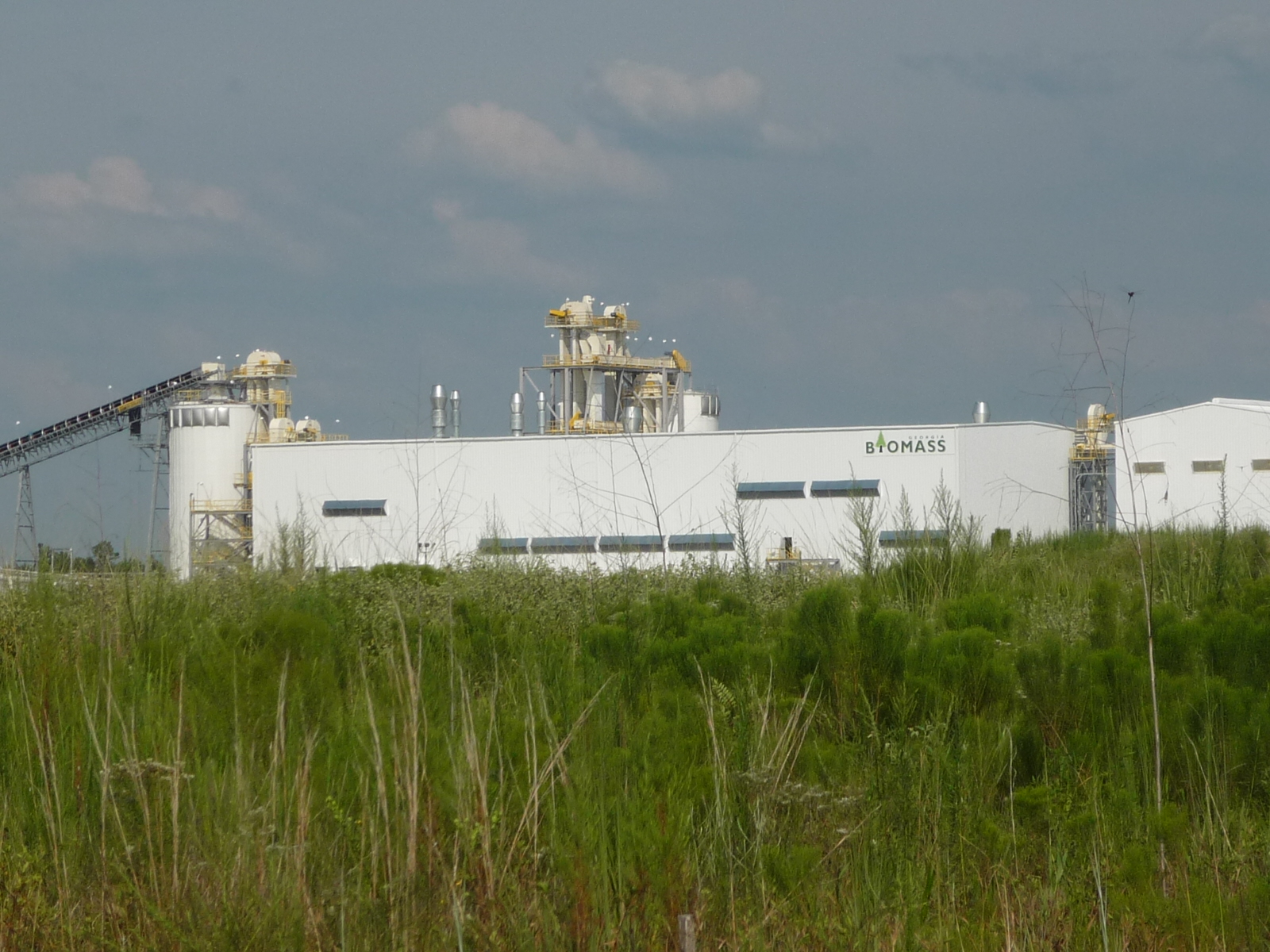
View of Georgia Biomass facility in Waycross, GA, currently the largest wood pellet manufacturing facility in the world.
The brand new facility is incredibly shiny and modern; putting a clean façade on a very dirty business. It looked like a chip mill on a mega-dose of steroids. It is a “fully integrated” facility, meaning whole trees are debarked, chipped and processed into pellets on site. A rail line runs straight into the facility for easy shipping by train to the company’s port in Savannah, Georgia where the pellets are loaded onto bulk-carrier ships and sent to Europe.
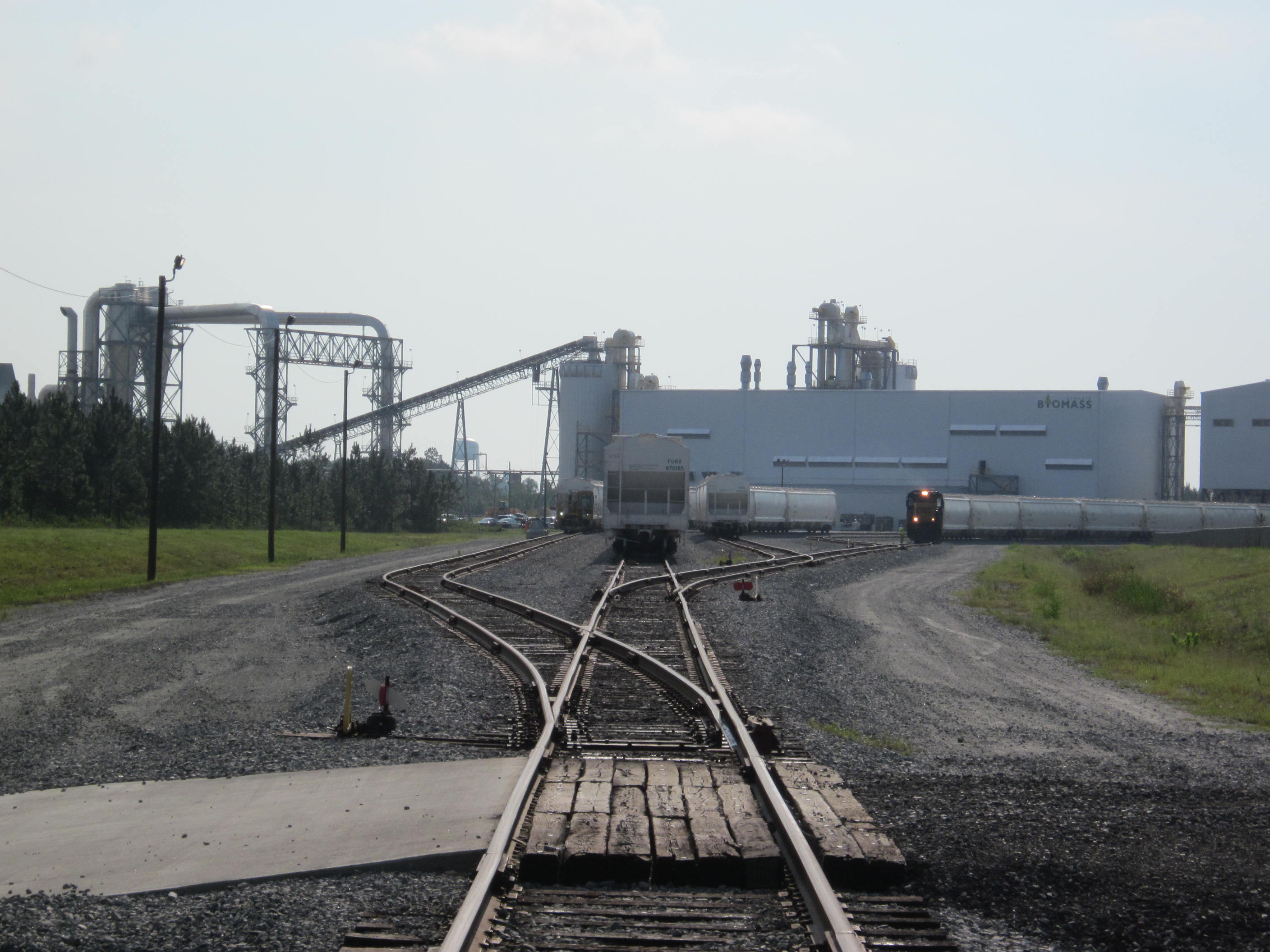
Rail cars loaded with pellets in Waycross, GA are sent to bulk-carrier ships at the Port of Savannah for export to Europe. (photo credit – Larry Edwards – Greenpeace)
What was most striking was the sheer volume of trees from fully loaded log trucks entering the gate and being unloaded into giant piles to be processed. We watched countless trucks enter the facility. Larry put it best when he said that it was analogous to bees swarming to a hive. Despite all of the claims that pellet and bioenergy companies make about sustainability, it was clear that this is a voracious industry that will swallow up as many trees as it can get. With other large pellet manufacturers planning facilities in Virginia and North and South Carolina, the RWE plant was a portent of bad things to come if someone doesn’t pull the brakes.
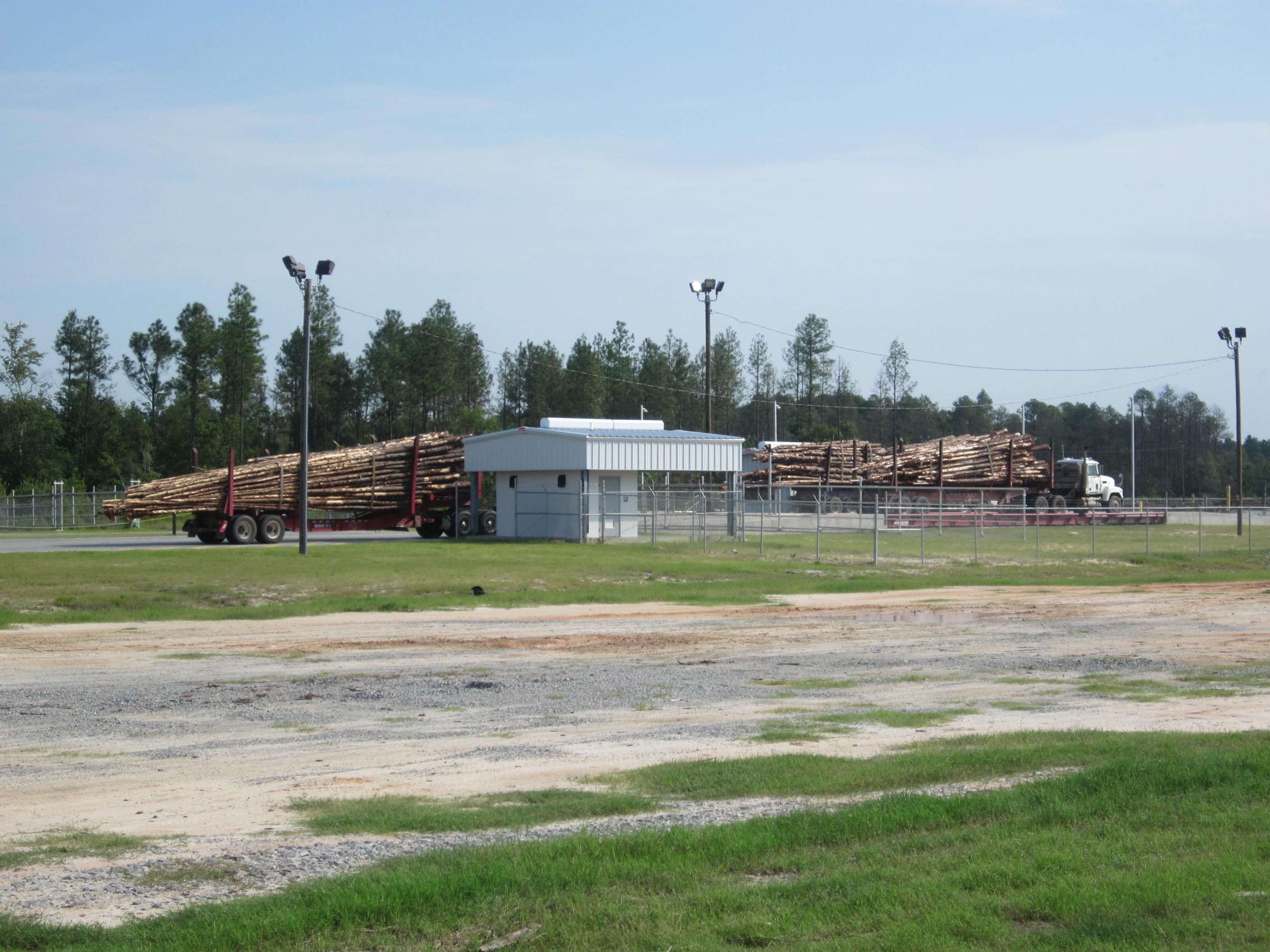
Trucks loaded with whole trees swarming like bees at the weigh station of the Georgia Biomass facility. (photo credit: Larry Edwards – Greenpeace)
Day 3: Okefenokee Swamp, Varn Industries in Hoboken, Georgia, Low Country Biomass in Ridgeland, SC and Charleston, SC
After the depressing stops in Baxley and Waycross, GA, we needed to take in a little bit of wild nature to get some much needed inspiration, so we made our way to Okefenokee Swamp Park south of Waycross. It was absolutely beautiful and was a great opportunity to see what much of the coastal plain in the South used to look like with forested wetlands, longleaf pine savannahs, and unique plants and animals found nowhere else in North America.
At the park we took a walk into the woods to spot gators, spiders, and countless plants and then took a boat ride, so we could experience the swamp firsthand. It was well worth the visit, not only for the wildlife, but for the opportunity to meet locals who’ve called this region home for generations and truly care about protecting and preserving this national treasure. Feeling refreshed, we headed out and made our way north.
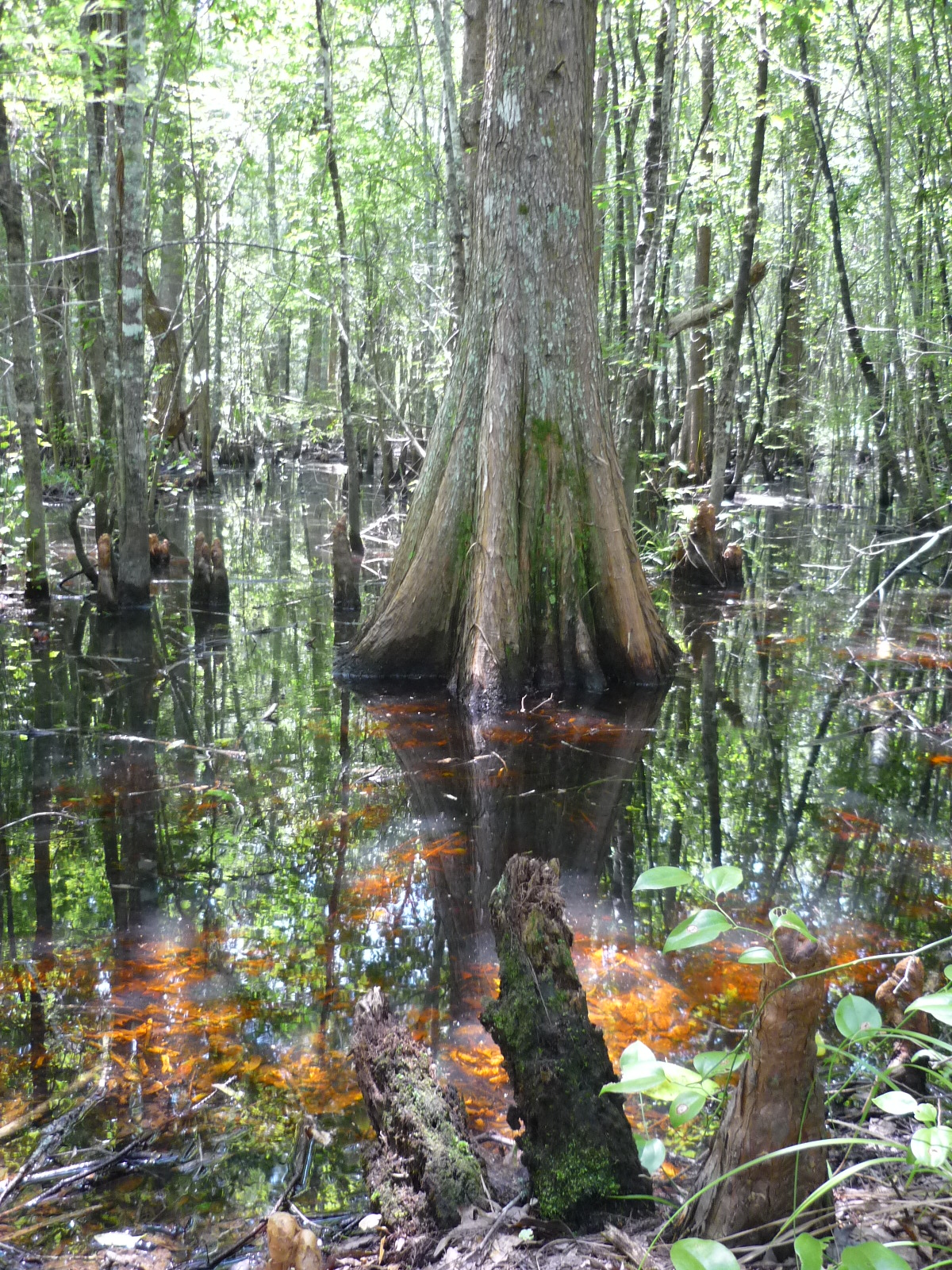


Okefenokee Swamp, a jewel of the Southern US, but threatened by growing biomass industry all around its edges.
On our way from Waycross to Augusta, we passed through Hoboken, Georgia. Hoboken is home to Varn Industries, a large sawmill and lumber manufacturer that processes excess wood not suitable for lumber into wood chips. Varn is also planning to add a wood pellet processor producing 80,000 tons of pellets per year to its already massive sawmill facility. Though the pellet mill is not yet operational, the proximity to both the Georgia Biomass facility and the Okefenokee Swamp could mean added pressure to the local forests. The future of highly degraded South Georgia forests is dependent on decreased pressure on the woods to allow for restoration especially in corridors leading to the swamp. Instead, all over South Georgia, we saw first-hand that corporations are ramping up massive new capacity which will minimize any chance for future restoration.
We stopped next in Ridgeland, SC, home to a relatively new small-scale wood pellet facility called Low Country Biomass owned by Nimmer Turf Company. It was such a small facility, in a non-descript building, that we drove right past it and had to stop someone on the street to find out where it was. The small facility is planning to produce around 40,000 tons of pellets a year, and is presently running at one-quarter that capacity. The long range goal is 100,000 tons yearly. The raw materials are local saw mill residue and locally grown miscanthus, a non-native grass species.
The reason we didn’t spot the facility was because instead of piles of trees or wood chips, there were just a few bales of hay sitting in front of the plant, and there was no visible activity. I can’t pretend to fully understand the implications of introducing a non-native grass species to the local area. What I do know is that at least it is being done by a company that specializes in growing grass and there are no plans to convert forests to miscanthus plantations. That said, this is a development to watch and in meeting one of the owners I felt a lot less concerned than I did after visiting the facilities in Baxley and Waycross.
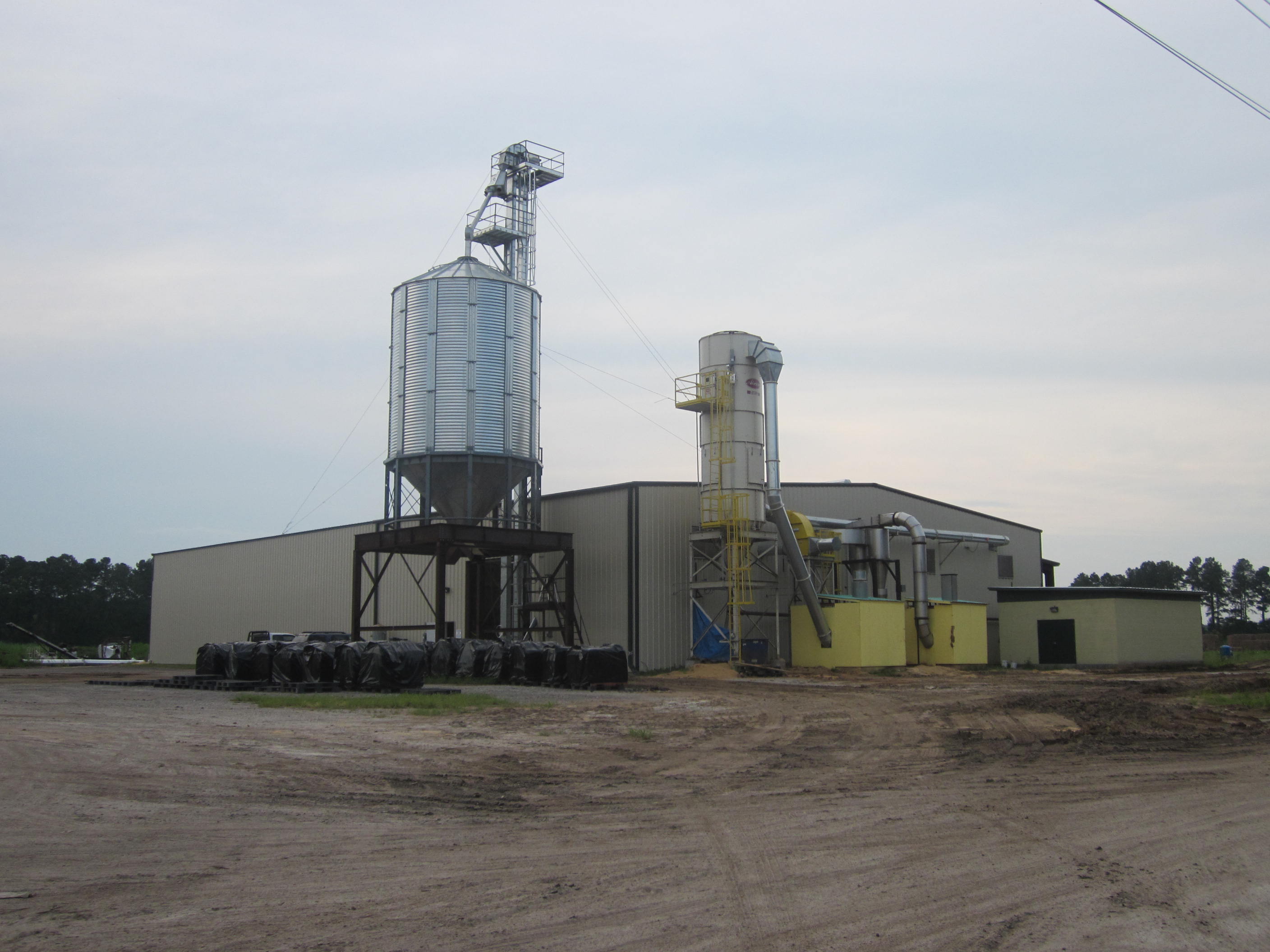
LowCountry Biomass facility in Ridgeland, SC that is processing residuals from local saw mills and Miscanthus into pellets for export to Europe. (photo credit: Larry Edwards – Greenpeace)
From here we headed to Charleston, where we overcame our disappointment once again at not being able to access a port to see the container ships sending pellets to Europe, by having a really fun night. A special thanks to the kind folks at Not So Hostel for putting us up for the night and being so accommodating.
Days 4 and 5: Francis Marion National Forest in SC, Georgetown, SC, and the Green Swamp in Southeastern NC
After a relaxing night in Charleston, we headed north to Francis Marion National Forest to see some of the amazing biodiversity and get a better sense of what is at stake from the threat of a growing bioenergy industry. We took the I’on Swamp trail which takes you through a section of low country swamp complete with old ditches and embankments that had been set up for use in old rice plantations. Besides the endless stream of mosquitos it was a beautiful section of swamp with countless birds sharing their songs and incredible wild nature to inspire us.
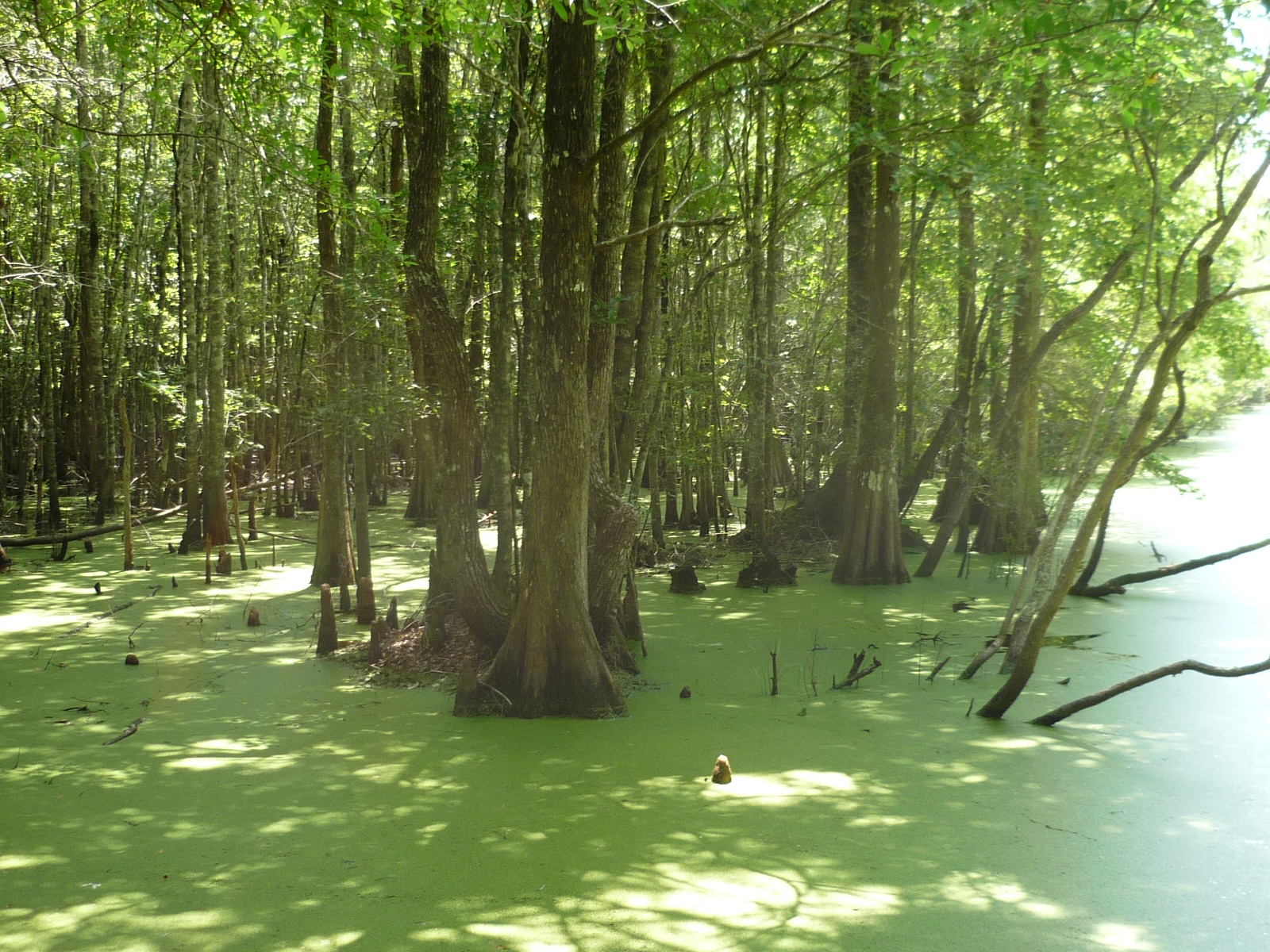
I’on Swamp in the Francis Marion National Forest, SC, that is within the sourcing area of newly proposed wood pellet facilities.
After a night visiting family, we set off out to the Green Swamp in southeastern NC. The Green Swamp is a real biological gem, home to countless species found nowhere else on the planet, including seven different species of carnivorous plants. Sadly, the Swamp has been greatly degraded by a long history of ditching and draining of historic wetlands for agriculture and pine plantations for the paper industry. Now it is smack dab in the middle of the sourcing area of two proposed new bioenergy facilities in Lumberton and Elizabethtown, North Carolina.
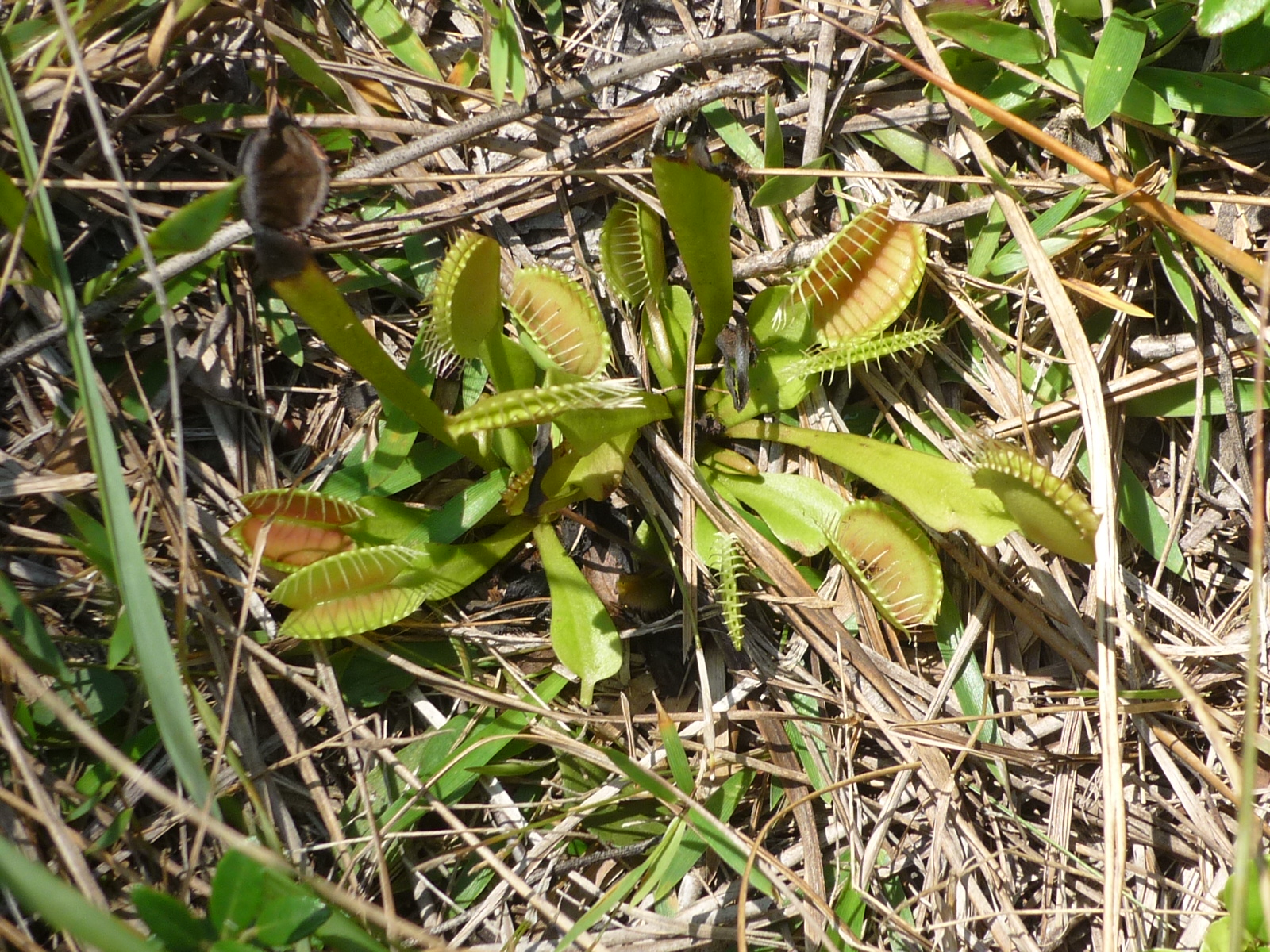
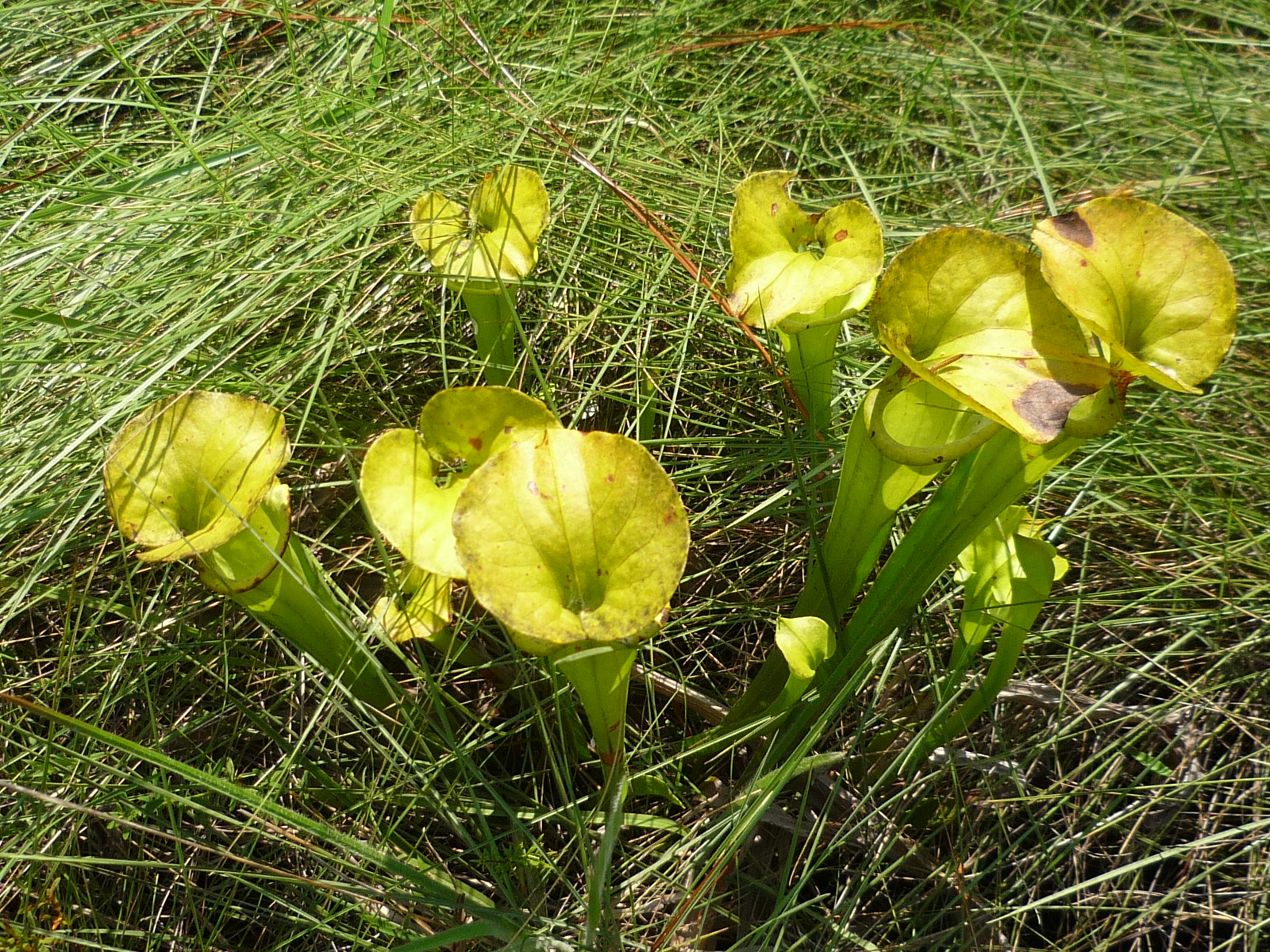
I took Larry here for two reasons. Firstly, so he could experience large-scale industrial logging in our region first hand. Sadly, you can’t drive more than a few miles in the Green Swamp without seeing an active logging job or recent clearcuts that extend hundreds of acres. Secondly, to visit the world famous Green Swamp Preserve, a nature reserve owned by the Nature Conservancy that is home to Venus flytraps, sundews and three different species of pitcher plants. We were successful on both fronts.
We walked into a clearcut so that he could get a feel for the shocking scope of industrial forest management on the landscape and the pain associated with the destruction of forested wetlands. Additionally, we followed a logging truck to an active job so he could see the heavy machinery at work, in this case a skidder, and watching truck after truck exiting the site with full loads.
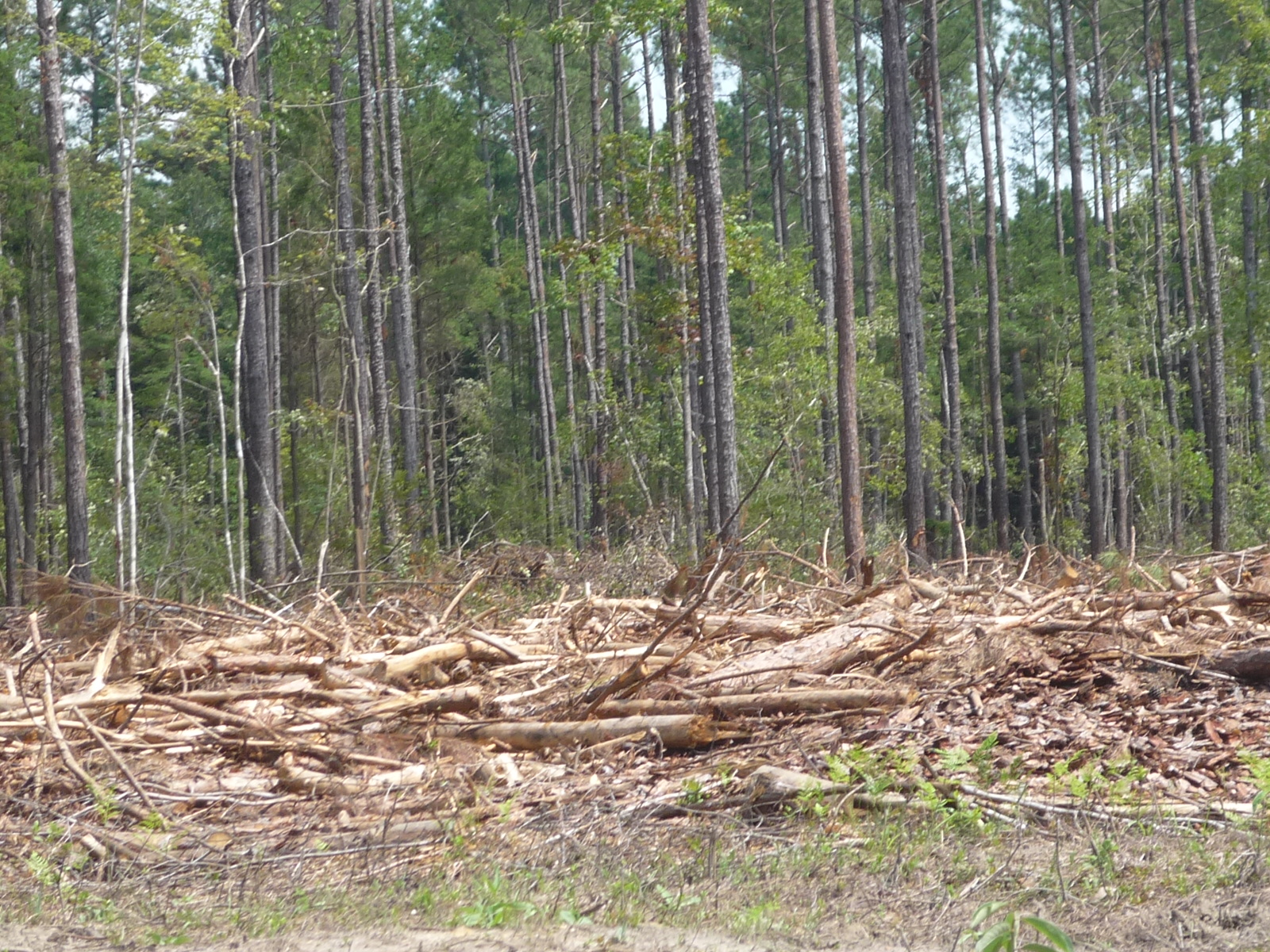
Industrial-scale clearcut in the Green Swamp in Southeastern, NC. Two new wood pellet facilities in the area threaten to dramatically increase logging rates.
Thankfully, the Green Swamp Preserve helped to mitigate some of the psychic pain associated with all of the destruction. While wandering around the 14,000 acre tract, we magically stumbled upon an international tour being hosted by a friend from the NC Sarracenia Society. Folks from around the world who had just been at a carnivorous plant conference in Boston travelled all of the way to the Green Swamp to see the amazing plants. They invited us to tag along, and we were able to see all that this amazing place had to offer. It was a great way to finish what had been an arduous and often hurtful journey.
 Conclusion: This is a Huge New Threat, and Dogwood Alliance Will Address It
We are incredibly proud of all that we’ve achieved through our 15 years of increasing protection for millions of acres of forests across the Southern US. Sadly, just when we thought we had a moment to breathe with the slow and steady progress we had catalyzed in transforming the pulp and paper industry into better stewards, a new threat has come on the scene in the form of the large-scale burning of southern Forests for energy. Thankfully, communities and environmental activists across the region have won great victories, but now we need to prepare for the latest and greatest threat.
Over the coming months we will be setting our sights on the bioenergy industry – talking to allies, further documenting both beauty and destruction, and preparing to take on some of the largest utility companies in the world to stop this new threat before it’s too late. We look forward to working with each and every one of you on saying “no” to more Southern forest destruction and saying “yes” to a truly clean, green renewable energy future instead! Stay tuned…
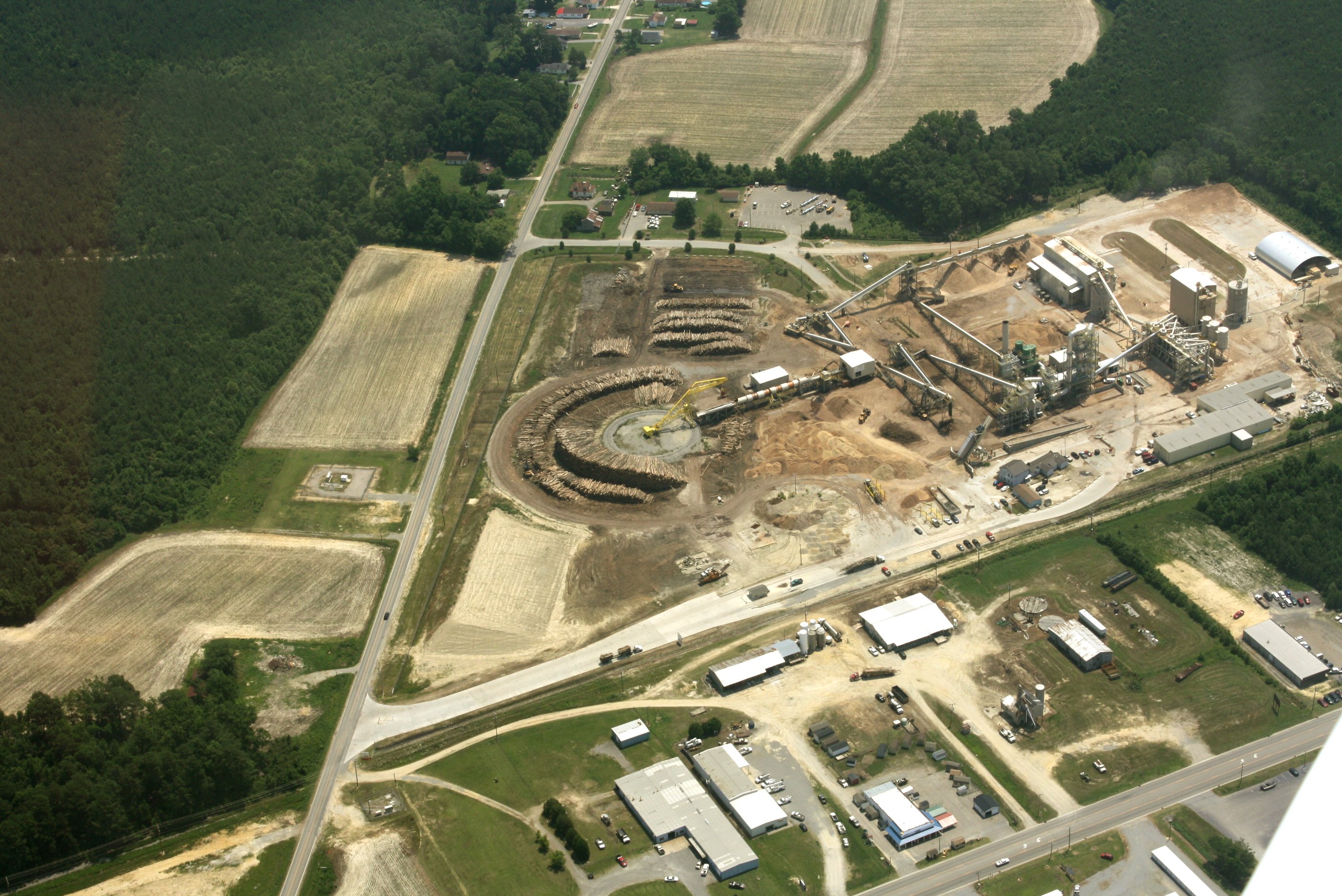
View from a Southwings flight of the newly opened Enviva pellet mill in Ahoskie, NC.
At a time when scientific evidence is mounting that burning trees for electricity will actually result in increased carbon emissions when compared to coal over the next 30 to 50 years, utilities in Europe are making a mad dash to convert coal burning power plants to wood, all in the name of “renewable energy.” The recent explosion in the use of wood to generate electricity in Europe has resulted in the proliferation of new mills across the US South that are turning whole trees into wood pellets for export to European utility companies. That’s right. Forests in the US South are being logged, turned into wood pellets and shipped across the Atlantic Ocean to Europe all in the name of “green energy.”
In what felt like a full on Southern forest assault, in September, a multitude of new projects were announced that will help take tree burning to a whole new level. Between September 18th and September 24th four new wood pellet manufacturing facilities were announced, one in South Carolina and three in Georgia. Just two days later on September 26th a port expansion project was announced in Moorhead City, North Carolina, for the stated purpose of supporting the growing wood pellet export market to Europe. New companies with catchy green-sounding names like “Enviva” and “Enova Energy” are popping up out of nowhere, staking their positions as leading suppliers of “sustainable, “renewable” energy. Heck, even the word “biomass” sounds kind of green, so it’s no wonder that the German utility company RWE that owns the biggest wood pellet facility in the South has branded it as simply, “Georgia Biomass“. When you click on their website the first thing you notice is a tree coming out of the logo next to the words “We’re Carbon Neutral.”
Also on September 26th, BusinessWeek reported that England’s biggest utility, Drax announced plans to convert the country’s biggest coal burning power plant into Western Europe’s largest burner of wood, which they describe as a major, $1 billion investment in “renewable” energy. This power plant will require the harvest of a forest equivalent to “four times the size of Rhode Island” every year! The company is now “investigating building wood pellet plants in North America.” Unfortunately, England’s recently proposed “sustainable biomass” standards do nothing to protect our forests or ensure real carbon emission reductions. Even worse, they allow companies to claim sustainability if their wood comes from bogus certification schemes like the Sustainable Forestry Initiative (SFI) which has routinely certified as “sustainable” destructive logging practices such as the ditching and draining of wetlands along the Atlantic Coast to make way for pine plantations.
Perhaps the European government, utilities and pellet manufacturers are hoping that with a little “green” smoke, no one will be able to see what’s really going on. Never mind the mounting body of scientific evidence including the European Environmental Protection Agency’s own Scientific Committee warning that burning trees could actually accelerate climate change. Never mind that protecting forests is actually a much better strategy for reducing carbon emissions than burning them. Never mind that beyond climate change forests are critical protectors of drinking water or that countless species of plants and animals are already in serious danger of extinction because of habitat loss and degradation. Never mind all that. Let’s just call it “green”, “renewable” and “carbon neutral” and bulldoze ahead.
Never mind the people who live in the regions whose forests will be stripped and shipped to burn overseas. Never mind the existing industries (forest products, tourism and outdoor recreation) that employ millions of people that depend on that same limited resource. Never mind the huge economic disaster that will occur in the wake of catastrophic climate change if we don’t drastically reduce carbon emissions over the next two decades. Let’s just call it good for the economy and charge on ahead.
The time is now to stand up, make our collective voice heard and demand an immediate halt to the burning of whole trees in the name of “clean, green and renewable” energy. Europe is heading in the wrong direction and if the mad dash to burn forests for electricity isn’t redirected to truly green and clean sources of energy like solar and wind we might as well forget any chance of slowing climate change. We can’t afford to wait until the green smoke fades away and our forests are laid to waste to realize what a huge mistake it is to burn trees for electricity. Biomass is the new coal and it, too, must be stopped. The time is now to ramp up investment in energy conservation and truly clean energy like solar and wind.

Ryan Hala, Canvass Director
While many college students spend their summers by the pool or in run-of-the-mill jobs, Ryan Halas was directing and implementing Dogwood’s first-ever door-to-door canvass — and delivering remarkable results.
Halas took on the role of Canvass Director this summer, and he and fellow UNCA student Amber Williams knocked on over a thousand doors and shared key messages about Dogwood Alliance and its work with hundreds of people. Halas, an up-and-coming grassroots organizer, calls the outcome “spectacular.”
“The average measure of success for a canvass is a ‘yes’ rate of 15%. That’s the percentage of people we talk to who actually become members of Dogwood and contribute to the campaign. We achieved a 20% ‘yes’ rate, which is incredible for a first year canvass. Another significant gauge of success is that in just one summer, we increased Dogwood’s total membership by 25%.”
Dogwood Alliance hired Halas to conduct this test canvass to see what the reception would be in Asheville. Even with a tiny staff and a limited window of time, the results were amazing and show the potential for an ongoing partnership between Asheville residents and Dogwood.
“Dogwood is a cool organization because it is so issue specific, and it wins its campaigns,” says 25-year-old Halas, a Lakeland, FL native who has worked on a number of other canvass-based grassroots environmental and social justice campaigns. “Dogwood has a very straightforward, effective corporate strategy that makes it easy to show results.”
We extend a very big thanks to Ryan for serving as Canvass Director this past summer and for opening the door to a powerful new tool for Dogwood Alliance!
Join us as we reflect on 15 years of protecting Southern forests.
Would you cut down all the trees in your yard so your neighbor could use them in his fireplace and still maintain his own shady canopy? Of course not, but that’s exactly what utility companies in the Southern U.S. are currently doing with our forests. Nearly 2.5 million tons of wood pellets — made from trees in Southern forests — are being shipped to European utility companies each year so that they can burn them for electricity while still meeting their climate goals.
The number of wood pellet mills and the demand for trees to fuel them are on the rise in our region. For four days in early September, Dogwood’s Campaign Director Scot Quaranda hosted Greenpeace colleague Larry Edwards from Alaska on a tour of these mills in Georgia and South Carolina. Although the two were denied entry and tours at all the locations, what they saw from the outside was enough to cause concern.
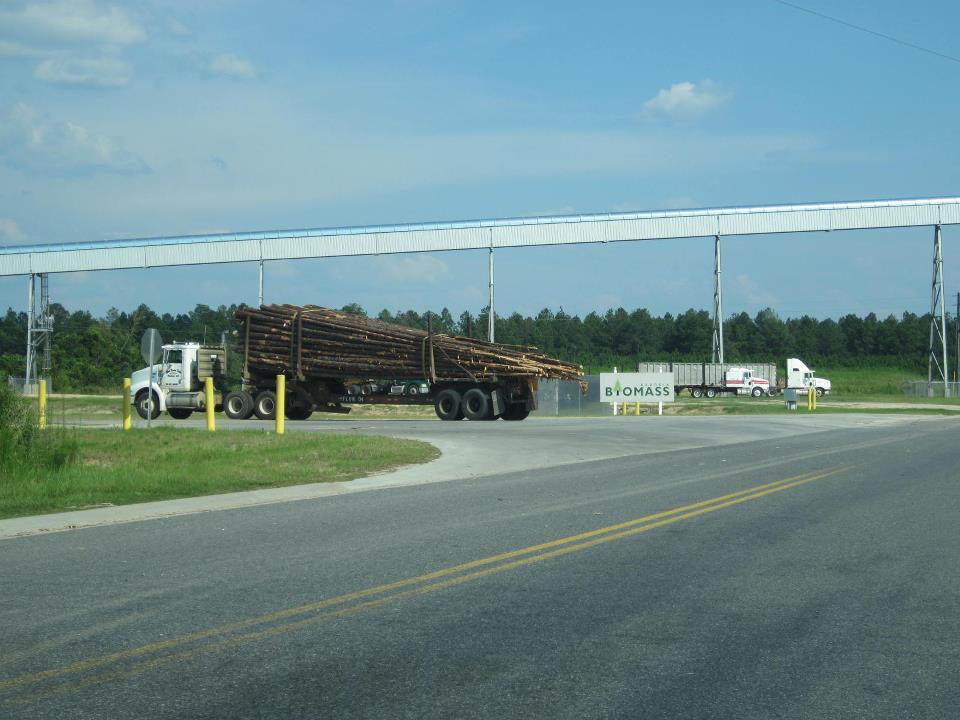
Georgia Biomass facility in Waycross. Our forests are getting pelletized to send to Europe to be burned…
“It literally looked like a swarm of bees heading to the hive as truck after truck of whole trees entered the enormous Georgia Biomass plant in Waycross,” said Quaranda. “The pace was overwhelming. At Appling County Biomass in Baxley, Georgia, it was semi after semi of wood chips.”
Georgia Biomass is the largest pellet mill in the country, producing 700,000 tons of pellets each year to ship overseas to its German parent company, RWE. Appling County Biomass is owned by the Norwegian-based FRAM and produces approximately 350,000 tons of pellets per year for European consumption.
Quaranda and Edwards also visited smaller mills: a soon-to-be-operational pellet mill built by Varn Wood Products in Hoboken, Georgia to accompany its sawmill operation, and Lowcountry Biomass in Ridgeland, South Carolina, which uses saw mill residue and miscanthus (Chinese silvergrass), a non-native invasive grass, to make its pellets.
“Essentially, we are destroying our forests so Europe can burn them and meet their climate goals,” said Quaranda. “This is, of course, one of the most ridiculous schemes we have seen in years. Why, in the name of climate change, would we burn the very forests that are supposed to buffer us from climate change? Scientific study after study has shown that burning wood is far from climate neutral and, in fact, over the first 50 years may be worse for the climate than burning coal.”
The good news? Dogwood Alliance and others are taking proactive measures to stop a biomass industry explosion before it starts. “The biomass industry has been slow to develop, thanks to groups like Dogwood Alliance and individual communities that have fought off local mill proposals,” says Quaranda. “That’s been great, but the recent growth in the number of wood pellet mills means we need to become even more aggressive in exposing the biomass myth for what it is — a grave threat to the long-term health of our forests and the communities they sustain.”
[vc_row][vc_column width=”1/1″][vc_column_text] As Dogwood Alliance’s work to protect Southern Forests grows, so do our ranks of friends and supporters. Throughout the past several months, we’ve gathered hundreds of people to learn about and assist in our efforts.
We’ve been the featured topic of conversation at a number of volunteer-hosted house parties, informal and fun ways for our friends to introduce their friends to Dogwood Alliance and help us raise funds in the process. We have gathered in San Francisco (CA), Davidson (NC) and Carrboro (NC), and we’re looking forward to upcoming house parties in Charleston, Durham, Nashville and Asheville. Interested in hosting a party in your town? Contact Patrick Fitzsimmons for more information.
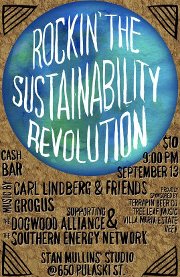 Our second annual Rocking the Sustainability Revolution party happened September 13th at the beautiful studio of artist Stan Mullins in Athens, Georgia. Around 200 people turned out to listen to live music from Carl Lindberg & Grogus; enjoyed local food from The National, Farm 255 and Heirloom; bidded on silent auction items and support Dogwood Alliance. We were happy to share the spotlight with our partner, Southern Energy Network, and offer heartfelt thanks to our generous sponsors, Terrapin Beer, VeeV Acai Spirits, Villa Maria Estate Winery and Tree Leaf Music.
Southern forests are something to celebrate, but it takes more than parties to spread the word. Over the summer, we conducted a door-to-door canvass operation that took our message directly into our local Asheville neighborhoods. This direct, one-on-one outreach raised funds, educated the public and secured several new members for Dogwood Alliance.
There’s an easy way that you can help us make friends. Simply view our short Dogwood Alliance 15th Anniversary Video, and then forward it to a friend! It tells the Dogwood story in a simple and effective way, full of information and inspiration. View and share it today![/vc_column_text][space height=”15″][vc_video link=”http://www.youtube.com/watch?v=ciahJhFTC1g&feature=player_embedded”][/vc_column][/vc_row]

Come out to support environmental non-profits Dogwood Alliance & the Southern Energy Network. Check out a rockin’ concert performance from Athens celebrity Carl Lindberg & Grogus while enjoying local brewery Terrapin Beer & their limited, special release Tree Hugger altbier! VeeV will also be mixing up their specialty acai berry spirit cocktails from their wind-powered distillery, and Villa Maria Estate will be providing wine from their sustainable New Zealand winery!

Last week, an article in the Wall Street Journal reported that the State of Massachusetts began implementing strict regulations on the burning of wood in power plants to generate electricity. The new regulations are based on an emerging body of scientific research documenting that burning wood on a large scale, and in particular the burning of whole trees, will likely result in increased carbon emissions when compared to coal and other fossil fuels. The new regulations are aimed at ensuring that energy providers who use wood as a “renewable” energy source are actually achieving net carbon emission reductions when compared to fossil fuels.
The practical impacts? Energy companies burning wood to generate electricity in Massachusetts won’t likely be able to verify net carbon emission reductions if they burn whole trees. And even if they are only burning wood waste they will still need to meet rigorous efficiency standards.
While Massachusetts is getting out in front, EPA and state agencies have yet to take action (though this could change soon, at least for EPA). Meanwhile some utility companies are already expanding their use of wood as an energy source. For example, Dominion Power in Virginia already operates one of the country’s largest biomass power plants, is actively converting three coal powered plants to biomass and plans to generate up to 20% of the electricity from its new coal plant in Wise County, Virginia from burning wood.
Even Europe is behind the curve, with utilities there burning wood imported from the US South and Canada, without regard for the true climate and forest impacts. Just last week, Dogwood Alliance Campaign Director, Scot Quaranda joined staff from Greenpeace US’s forest campaign on a tour of wood pellet mills in the South that are turning whole trees into pellets for export to burn in European power plants – all in the name of reducing carbon emissions!
In addition to carbon impacts, increased use of wood to provide electricity could have huge negative, landscape level impacts on forests and water resources while increasing air pollution in local communities. With a mounting body of science confirming that burning wood isn’t a green alternative to fossil fuels, it’s time to rethink wood as a “renewable” energy source for the future. While the small-scale use of wood may could a minimal role in meeting energy needs in the future, momentum is building for the large-scale use of wood as a primary fuel source. Utility companies should not look to wood as an energy source until they have appropriate policies in place, such as those required by the State of Massachusetts, to verify that they are actually reducing carbon emissions, and furthermore that they are not destroying forests or increasing air pollution for local communities. Massachusetts got it right…will others??
Earlier this month, Dogwood Alliance was scheduled to meet with executives at KFC to discuss the company’s paper packaging and how they could end the destruction of endangered forests in the South by adopting a sustainable packaging policy. This meeting was scheduled following a public statement made by CEO David Novak at the company’s Shareholder meeting in May saying that his sustainability team should meet with representatives of our organization. At the eleventh hour, we received an email from Chief Sustainability Officer Roger McClendon cancelling the meeting.
In our eyes, this represent a total lack of integrity, as we had a good faith agreement to meet. This is one in a long string of cancellations made by the company in our multi-year engagement with them. Below, in its entirety, is our letter in response to Roger McClendon, the Board of Directors, and leadership at YUM and KFC.
It is our hope that one day the company will see the error in their ways and make a good faith effort to protect the forests and communities in the region they call home. In the mean time, we plan to raise the stakes and not only advocate for the forests of the South, but also support Greenpeace International’s brand new campaign targeting KFC for destroying the last wild forests in Indonesia to make packaging for its Chinese market.
Here is the letter:
Roger McClendon, Chief Sustainability Officer Yum! Brands 1900 Colonel Sanders Lane Louisville, KY 40213
RE: Cancelled Yum! Brands – Dogwood Alliance Conference Call
Dear Roger McClendon,
We received your letter on July 10, 2012 cancelling our scheduled phone conservation and were left feeling extremely disappointed. Your message follows a long string of promised meetings that have been cancelled dating back to our original contact with YUM and Karen Sherman well before the launch of a public campaign. Cancelling the conference call at the last minute was disrespectful and unprofessional, especially in light of the fact that in May at YUM’s Annual General Meeting, your CEO publicly advocated for our team to meet with you, Jonathan Blum and other relevant executives.
The cancelled meeting represented a key missed opportunity for our organization and your company to move beyond public confrontation and begin an honest dialogue that would not only be good for our forests and communities, but also for your company’s image and brand. We had hoped to be in a position by now to give you support for your efforts, but any emerging confidence we had after the AGM that YUM is taking these issues seriously has eroded.
You stated in your letter that after a meeting with your suppliers “we are confident in our suppliers and our strategies around sustainable sourcing.” However, your strategies are not endorsed by key stakeholders in regions where you source paper. By failing to broaden the depth of your understanding about the threats to forests beyond the perspective of your paper suppliers you are refusing to be an active participant in developing solutions. The unfortunate end result is that YUM continues to be a part of the problem. Meanwhile, we have been in active dialogue with your suppliers and will continue to engage with these companies to advance solutions to ensure the protection of our forests.
While we appreciate some of the efforts that you have made related to recycling, these efforts are simply are not enough to ensure the protection of important forests in the Southern US and around the world. YUM’s continued reliance on misleading forest certification systems such as SFI is simply insufficient to ensure that its paper is not contributing to the destruction of important forests. Let me be clear that we are always willing to engage in a constructive conversation to help YUM or any company for that matter find solutions. But, your actions give us little hope that YUM is truly willing to assume responsibility for its role in forest destruction.
The refusal to engage those who have legitimate concerns will not make the issues go away or somehow absolve YUM of its responsibility to take an active role in ensuring the future health of forests. Until Yum deals with these issues by working with environmental stakeholders to adopt a meaningful global fiber sourcing policy, public criticism is only going to escalate as evidenced by Greenpeace International’s recent launch of a campaign targeting your company for its role in global forest destruction.
Sincerely,
Danna Smith Executive Director Dogwood Alliance
CC:
David Novak Roger Eaton Jonathan Blum YUM Board of Directors Rolf Skar, Greenpeace
 Bob Cabin, Ph. D., started off his Dogwood Alliance board service with a bang, speaking “truth to power” on behalf of Southern Forests at the Yum! Brands shareholders meeting in Louisville, Kentucky on May 17th.
“I’d never spoken directly to a corporate CEO before ,” he says. “It was empowering, and it was great to hang out with the Dogwood staff and Gary Phillips.” You can read Cabin’s personal reflections about the experience on his Huffington Post blog.
Cabin is no newbie to environmental preservation. He’s been a professor of ecology and environmental science at Brevard College in Brevard, North Carolina since 2005. Before that, he taught at Kenyon College and The State University of New York at Plattsburgh. He earned his Ph. D. from the University of New Mexico. After graduate school, Cabin worked in the conservation trenches of Hawaii as a research ecologist for the U.S. Forest Service.
“Hawaii is both the best and the worst place to be a conservation biologist,” he says. “It has more native endangered species and more noxious alien species than anywhere else in the world. So while it can be depressing, you can also make a huge difference, and single-handedly prevent a species from going extinct.
In addition to research and teaching, Cabin has written many technical and popular scientific articles. His first book, Intelligent Tinkering: Bridging the Gap Between Science and Practice, (Island Press) was published last fall, and his second book, Restoring Paradise: Rethinking and Rebuilding Nature in Hawaii, (University of Hawaii Press) is scheduled for release early in 2013.
Shortly after moving to Brevard in 2005, Cabin met Dogwood’s Executive Director Danna Smith, and began inviting Dogwood staff to come speak to his classes at the college. “I was always impressed with Dogwood’s work, and their ability to inspire my students and me,” he says. “This past year was a sabbatical year for me, so it was the perfect time to act on my longstanding desire to become more actively involved in the conservation of the Southern Appalachians. I really liked the Dogwood model, so I decided to jump in as a board member.”
“I am deeply concerned about Southern forests, and have a strong personal interest in protecting them,” says Cabin, who especially enjoys spending time in nearby DuPont State Forest with his wife and two children, ages 6 and 9. “Being a part of Dogwood Alliance helps to remind me that things are not hopeless. Sometimes David can get Goliath to change.”


 Donate