


 This past October, Dogwood Alliance’s campaign to reform fast food packaging was recognized with the BENNY 2011 Path to Victory Award, given by the Business Ethics Network (BEN) at their annual gathering in San Francisco. The Path to Victory Award recognizes the significant progress made in catalyzing corporate transformation in the last year through campaign work.
We at Dogwood Alliance are proud to receive this recognition from our colleagues and fellow activists working to change negative corporate behavior. Dogwood Alliance is a longtime member of BEN, a project of Corporate Ethics International, which is the largest network of non-profit, marketplace advocacy activists and organizations in the U.S. and includes activists from such notable organizations as ForestEthics, Greenpeace, Healthcare without Harm, the Humane Society of the United States, Rainforest Action Network, and the Teamsters.
The Business Ethics Network Executive Director Anne Pernick has said, “The American public is calling for corporate accountability and limits on corporate power. The activists in these campaigns are working to benefit us all, and they are winning incredible victories against powerful foes.” We agree! In this time of Occupy Wall Street, we are glad to do our part for the common good.
Over the last few years, Dogwood Alliance has been working hard to convince the largest users of paper packaging from Southern forests to use less packaging, use more recycled content, and ensure their paper packaging does not come from endangered forests in the South. Most recently our efforts have focused on the fast food industry where we have made great progress raising awareness about the impact of industrial forestry on Southern Forests. Just this spring, fast food giant McDonald’s announced a Sustainable Land Management Commitment that points the company in the right direction. And, of course, our Kentucky Fried Forests campaign against fast food behemoth Yum! Brands has already brought change to the largest restaurant company in the world, but we are still pushing for more protection for our forests!
[vc_row][vc_column][vc_column_text]This fall marks Dogwood Alliance’s 15th Anniversary. We’ve celebrated with parties and special projects, but none so important as our year-end campaign to help jump start the next 15 years for even bigger success. We’re kicking off our next decade-and-a-half with a special effort to raise an additional $15,000 by the end of the year.
We’re already off to a great start! On Saturday, November 5th, Dogwood Alliance and several hundred friends and supporters honored 15 years of revolutionizing forest protection with a big birthday bash at Highland Brewing Company in Asheville. Since the party, with birthday gifts, donations and our silent auction, we’ve raised over $5,000 toward our $15,000 goal!
The event included something for everyone to commemorate our successes and to say a very special “Thank You!” for the enthusiasm, commitment and ongoing support we’ve received over the years from our members, donors, volunteers and activists of all ages. It also featured the world premier of Dogwood Alliance’s new video!
[/vc_column_text][space height=”15″][vc_video link=”http://www.youtube.com/watch?v=_3e-gSjsMjA”][vc_column_text]The celebration was made possible by a number of generous sponsors, including Black Dome Mountain Sports, Short Street Cakes, Ultimate Ice Cream, A Divine Event, and ImageSmith Communications.
Check out our Facebook album of the awesome pictures we took at the party.
“Dogwood Alliance has covered some serious ground over the past 15 years, increasing protection for over 90 million acres of Southern forests through changing the business practices of some of the world’s largest companies like Staples, McDonald’s and Georgia-Pacific ” said Danna Smith, Executive Director. “With an even stronger base of support, we can continue to successfully hold the paper industry accountable while also stopping the next big threat: utility companies that want to burn our forests for energy. Most importantly, we can move beyond pushing back the threats to also focus on building a new future where protected forests are truly valued for all their benefits.”[/vc_column_text][/vc_column][/vc_row]
Check out Dogwood’s new slideshow! Some of the best moments of Dogwood’s 15 years of forest protection are highlighted in this four minute slideshow. It’ll inspire or re-inspire you about the beauty and importance of Southern forests and the work Dogwood does to protect them.
Morganton, NC residents Kelly and Seth Collings Hawkins discovered Dogwood Alliance when they first moved to North Carolina years ago and have been avid supporters ever since.
“I learned about Dogwood when I was with the Environmental Defense Fund in Raleigh and worked on projects in the western part of the state,” says Kelly, who became a Dogwood Board member from 2005-2008.
“I like Dogwood’s approach to solving problems, the fact that they go at campaigns from multiple angles. They begin relationships with companies using an open, conciliatory approach, but if that doesn’t get results, they don’t hesitate to go a different route.”
As the founder of the Appalachian Center for Wilderness Medicine, Seth appreciates the symbiotic relationship between Dogwood’s work and his own. “Our work focuses on the delivery of healthcare in austere environments — like forests and other places where an ambulance can’t go. As a result, I have a growing appreciation for Dogwood’s work to protect those forest areas.”
Southern forests were a new discovery for this couple, who transplanted to North Carolina after graduating from Yale. Kelly is a native of Missouri, and Seth is a self-proclaimed “true Yankee” from Connecticut.
“I agreed to live in the south as long as we could have some altitude,” he says. The two have since fallen in love with the region and are happy to be raising three sons here, ages 4, 8 and 11.
While Seth serves as an emergency physician in the local hospital and medical director for the county, Kelly focuses on raising the boys and engaging with environmental groups like Dogwood as a board member and volunteer. Her favorite Dogwood “victories” have been the office supply campaign and the Georgia-Pacific agreement.
“The office supply campaign was fun and also turned out to be a defining campaign for Dogwood. It helped target the organization’s work in terms of marketplace campaigns. And as far as Georgia-Pacific goes, that’s such a large corporation and getting them to agree to higher environmental standards is a huge success.”
What would this couple like to see from Dogwood Alliance over the next 15 years? “We’d love to see Dogwood Alliance do its work so well that all companies and private landowners would be using the very best practices in terms of forest protection and conservation,” says Kelly. “That would be a great thing to celebrate.”
Over the summer and fall, we’ve collected stories from our Facebook and email friends about their favorite forests. Your submissions were inspiring, and we’re pleased to announce that Don Higgins wins a Dogwood 15th Anniversary T-shirt for his post about the Cedar Creek Canyon forest on Petit Jean Mountain in Arkansas.
Here’s what Don had to say:
“My favorite forest is the virgin streambottom forest of Cedar Creek Canyon on Petit Jean Mountain in Arkansas. Always cool and damp, locally rare trees like the Ozark chinquapin and vernal witchhazel can still be found here. The gentle scent of the witchhazel is an intoxicating treat in late winter. Like the forest primeval, here one can imagine an earlier forest, 300 million years ago, whose decline formed the sandstones and shales of this steep-walled canyon, here seen mirrored in a waterfall’s pool.”

The contest may be over, but it’s always time to talk about your favorite forest. Visit us on Facebook and add yours today!
P.S. There were many great entries from around the world. Here are a few more of our favorites:
My favorite forests are the forests of the Berkshire Mountains in Connecticut and Massachusetts. My parents owned a vacation place in the Berkshires with some pine forests and hardwood forests. My home in Connecticut also had a strip of forest in back which ran all the way behind my neighbors’ back yards to the end of the block.
The place that stands out the most for me was a time when we were backpacking in the Allegheny State Park in PA. The woods aren’t especially wild, but that time it was late summer and there had been recent rains. The ground was covered, including the trail, with mushrooms, everywhere. It was like a fairyland, and it made it special for us both.
My favorite forest is a nearby wildlife center. Although small it has an up and down winding path that at one and the same time provides a challenging walk and rich varieties of trees, shrubs, grasses, and flowers ever changing with the seasons. Always different, yet always the same, this small “forest” delights the eyes, energizes the body, and feeds the soul.
My favorite is the San Juan National Forest, where you can be absorbed into cool mountain air, shady spruce towering over a mossy forest floor, and wildflower meadows filled with wild strawberries!
My story revolves around the redwood forests north of Arcata, CA in Prairie Creek Redwoods State Park. My daughter moved to Arcata & I went to visit. It was my first interaction with the redwoods. I walked into the forest & was simply mesmerized by the presence of the big trees. I felt they were a family with grandparents, parents, children. I had never had that feeling before in a forest. I also felt strongly that I was a part of that family. It was my most spiritual experience up to that point in my life. To just walk amongst them, or sit & absorb their peacefulness, was magical. I have had fantasies of somehow protecting the redwoods from never being logged again.
One of Dogwood Alliance’s first actions as a fledgling organization was launching a campaign to protect forests from the effects of chip mill operations. Turns out, it was an award winning effort. In 2000, Dogwood Alliance was honored by the Environmental Protection Agency’s Southeast Region with an Environmental Merit Award, “in appreciation and recognition of outstanding environmental stewardship.”
In 1996, Dogwood Alliance created the chip mill campaign to call for a moratorium on permits for new facilities pending a study of their impact on forests. “It was a broad, regional campaign to challenge a growing industry and get government to look at the impacts,” recalls Dogwood Executive Director Danna Smith. “Community leaders played a crucial role. Whenever Dogwood got word of a new chip mill, we began organizing with nearby communities to stop the permits.”
One of Dogwood Alliance’s first actions as a fledgling organization was launching a campaign to protect forests from the effects of chip mill operations. Turns out, it was an award winning effort. In 2000, Dogwood Alliance was honored by the Environmental Protection Agency’s Southeast Region with an Environmental Merit Award, “in appreciation and recognition of outstanding environmental stewardship.”
In 1996, Dogwood Alliance created the chip mill campaign to call for a moratorium on permits for new facilities pending a study of their impact on forests. “It was a broad, regional campaign to challenge a growing industry and get government to look at the impacts,” recalls Dogwood Executive Director Danna Smith. “Community leaders played a crucial role. Whenever Dogwood got word of a new chip mill, we began organizing with nearby communities to stop the permits.”
As a result of Dogwood’s campaign, the US Forest Service, the EPA and the US Fish and Wildlife Service conducted the first-ever Southern Forest Resource Assessment. (The 2011 Southern Forests Futures Report is second generation of that work.)
The chip mill campaign wasn’t just a first for Dogwood, says Smith. “The entire paper industry in the Southeast had pretty much been unchallenged up to that time. When the report was released in 2001, it documented the dramatic expansion of paper and logging and a loss of 9 million acres of forests, plus an increase in the use of fertilizers and pesticides.”
Dogwood used this information to help stop chip mill permits around the region, gain a moratorium on new mills in Missouri and to help gain stricter permit requirements for mills in North Carolina. The organization also garnered national media attention. “This was the next big forest story after the spotted owl,” says Smith.
“This campaign also helped us realize that we’d need to focus on markets to be truly effective in protecting forests,” Smith adds. “We created our new approach and started with Staples. We used the report to show them the impact of their sourcing decisions, and within two years, they were on board.
“We were surprised by the award,” she recalls, “but it was very validating. It showed that issue was worthy of concern and that our campaign was run with integrity and broad support. It was a fitting way to celebrate what was essentially the birth of the Dogwood Alliance we have today.”
The chip mill campaign wasn’t just a first for Dogwood, says Smith. “The entire paper industry in the Southeast had pretty much been unchallenged up to that time. When the report was released in 2001, it documented the dramatic expansion of paper and logging and a loss of 9 million acres of forests, plus an increase in the use of fertilizers and pesticides.”
Dogwood used this information to help stop chip mill permits around the region, gain a moratorium on new mills in Missouri and to help gain stricter permit requirements for mills in North Carolina. The organization also garnered national media attention. “This was the next big forest story after the spotted owl,” says Smith.
“This campaign also helped us realize that we’d need to focus on markets to be truly effective in protecting forests,” Smith adds. “We created our new approach and started with Staples. We used the report to show them the impact of their sourcing decisions, and within two years, they were on board.
“We were surprised by the award,” she recalls, “but it was very validating. It showed that issue was worthy of concern and that our campaign was run with integrity and broad support. It was a fitting way to celebrate what was essentially the birth of the Dogwood Alliance we have today.”
A recent report by the Southern Environmental Law Center, puts Columbus County at the top of the list when it comes to toxic air pollution based on 2010 Federal Environmental Protection Agency Data. Ranked higher than any other county in the state for the pounds of toxic pollution released into the air, Columbus County industries released nearly 4 million pounds compared with the second highest ranked county for toxic pollution, New Hanover County, with slightly more than 3 million pounds released.
The Southern Environmental Law Center emphasizes that toxic air pollution includes chemicals known to cause cancer. Columbus County ranked number one in the amount of known carcinogens released totaling 197,082 pounds –that is just three positions ahead of Brunswick County, ranked fourth with 103,151 pounds of known carcinogens released into the air.
And, the single largest emitter of toxics in the state, is ‘s Riegelwood Mill which releases more than 3.9 million pounds a year, according to the report. Nice…
Dogwood Alliance Joins Leading Global Environmental Groups in Calling Out Industry-Driven Forest Certification Schemes That Fail to Protect Forests
“On the Ground” Report Supports Organization’s Campaign to Stop and KFC from Destroying Southern Forests for Wasteful Fast Food Packaging
Asheville, NC, USA – A coalition of environmental and social NGOs (1) released a investigation today exposing the failings of forest-industry-controlled certification worldwide.
‘On the Ground: The controversies of PEFC and SFI’ (2), details a series of cases, including how forested wetlands have been ditched and drained to make way for sterile plantations in the Southern US, indigenous peoples’ rights in Chile, Canada and Finland have been dismissed, how massive old growth forest destruction has been certified as “sustainable” in the Northwest US, Tasmania and Sweden, and how clear cutting tropical rainforest to make room for plantations has been endorsed in Indonesia.
“Not all forest certification schemes are created equal”, said Judy Rodrigues, forest campaigner with Greenpeace International. “The results of the On the Ground investigation clearly show that certification schemes must deliver real change in forest management on the ground to be considered successful. Unfortunately, PEFC is failing to do this; buyers should beware of greenwash when considering PEFC and SFI labelled wood products”.
The researchers for the On the Ground report found that PEFC and SFI certified forests fail on key ecological and social parameters that wood and paper buyers expect from a credibly certified product. Drawing from fourteen on-the-ground (3) and eight procedural case studies (4) the coalition report found that PEFC and SFI certified products:
“While PEFC and SFI have offered many words about sustainability, this study looked at what is actually happening on the ground”, continued Rodrigues. “What we found is that these certification schemes do not represent sustainably or responsibly managed forests in a number of cases, at several locations around the globe”.
“In the Southern US, SFI trumpets itself as North America’s leading forest certification system even as it continues to slap a green label on the worst of the worst practices by industry giants like (IP), the largest paper producer in the South and across the globe,” said Scot Quaranda, Campaign Director at Dogwood Alliance. “IP is notorious for logging endangered forests and ditching and draining forested wetlands in the Green Swamp. This all leads to more sterile pine plantations which are then certified by the SFI. When you see the SFI label on products coming from the region you know you are getting certified forest destruction.”
Certifying destructive forest practices is not limited to the South, it is a global phenomenon. In Malaysia, an organisation called JOAS, the Indigenous Peoples Network of Malaysia (5), are clear about the failure of the PEFC’s endorsed Malaysia Timber Certification Scheme’s (MTCS) to recognise and protect their rights.
“MTCC does not recognize nor protect indigenous peoples’ rights over traditional lands. This is despite the fact that several court decisions have actually recognized indigenous peoples´ native customary rights to land”, said Jen Rubis from JOAS.
The On the Ground report also found issues about the quality and reliability of the chain of custody system, demonstrating weak, and some cases, no minimum regional standards exist for wood getting into PEFC and SFI-labelled products to the point of not knowing the origin of the wood and if the forest is being sustainably managed.
The study concludes that PEFC and SFI labels do not provide the reassurance that their certified forests and products are being managed sustainably and that buyers of these products are at risk of purchasing products that do not meet the ecological and social standards they could reasonably expect when purchasing a ‘certified’ product.
“PEFC must make two choices in order to meet these promises”, said Jim Ford, the Director of Climate for Ideas, ‘By raising its forest management standards it will either have to revoke a number of certificates where indigenous and community rights have not been respected, biodiversity values are not being protected and forest conversion has occurred; or it will have to verify changes on the ground have actually happened.”
ENDS
Note to the Editor:
The executive summary and the full report are available here.
(1) The coalition of NGOs included Climate for Ideas (United Kingdom), Forests of the World (Denmark), Dogwood Alliance (United States), Hnutí DUHA (Friends of the Earth Czech Republic), Greenpeace, Sierra Club of British Columbia, and Finnish Association for Nature Conservation.
(2) PEFC the Programme for the Endorsement of Forest Certification is a global forest certification and SFI is the Sustainable Forestry Initiative a certification system used in North America.
(3) The report details fourteen case studies of PEFC and SFI certified forest areas from around the world, in Sweden, Finland, Czech Republic, the US, Canada, Malaysia, Australia and Chile, as well as studies of procedural failings in products that are eligible or have been demonstrated to carry these certification systems’ labels.
(4) The report details eight procedural case studies of PEFC and SFI national endorsed schemes in France, Finland, Germany, USA and Indonesia.
(5) A quote from the JOAS (JARINGAN ORANG ASAL SEMALAYSIA – Indigenous Peoples Network of Malaysia) statement by, X, made at the Dutch Timber Procurement Assessment System (TPAS) Hearing of the SMK (Stichting Milieukeur –a Dutch Eco-label Assessment Body) Board of Appeal on 5th August 2011, Utrecht.
(6) There are at least 2 Indonesian legal documents that relate to the depth of peat and plantations: 1) Presidential Decree: Number 32/1990 and 2) Government Regulation: Number 26/2008. Both stipulate that areas of peat more than three metres deep should be protected if upstream or in swamps.
Today is the National Blog Action Day and to coincide with World Food Day, this year’s theme is food. We decided to take a look at food that comes from our forests.
Southern forests are some of the most biologically diverse on the planet. Intact forests not only provide the people of our region with clean drinking water, healthy air, and a place to recreate, they also happen to be an amazing place to gather food and herbs.
Our forests are a global hot spot for medicinal herbs like ginseng and goldenseal and for a huge variety of mushrooms. Local folks have been foraging for mushrooms for generations in the Southern Appalachians and now more and more people are getting in on the fun by identifying mushrooms and collecting them for delicious wild-crafted food.
There are over 10,000 mushroom species in North America, and only 5 or 6 are deadly poisonous. Some of the most common species, and the easiest to identify are morels, chanterelles, lobster mushrooms, milky cap mushrooms, and chicken-of-the-woods.
For first-timers, it is recommended that you forage with an expert and consult a book for every mushroom you gather from the wild. Keep in mind that mushrooms will absorb toxins from the environment. Even a perfect morel will be unsafe to eat if it has been exposed to toxic substances such as pesticides, herbicides, or car exhaust.
Here are some tips on gathering wild mushrooms from Asheville’s own Mushroom Man, Alan Muskat, recently featured in this Blue Ridge Outdoors article:
• In general, the more mature the forest, the more mushrooms you’ll find.
• Some mushrooms are more common under specific trees. For chanterelles, go to deciduous woods. Boletes often prefer pine forests.
• The best time to search for mushrooms is about five days after a good rain.
• Avoid areas where mushrooms could have soaked up toxins, like a golf course, well-manicured (pesticide-laden) lawn, or places downwind of a coal-fired plant.
• The first time you are eating a new edible species, cook some, but eat only a tablespoon. Any bad response—like nausea or an upset stomach—will usually happen within two hours.
• Cook wild mushrooms well: When a guidebook says a variety is edible, it’s talking about the cooked version of it.
When all is said and done, the point is to have fun. Go grab a guide, a friend and enjoy walking in the woods. Southern forests have a lot to offer and while you are at it you might find some delicious treats!
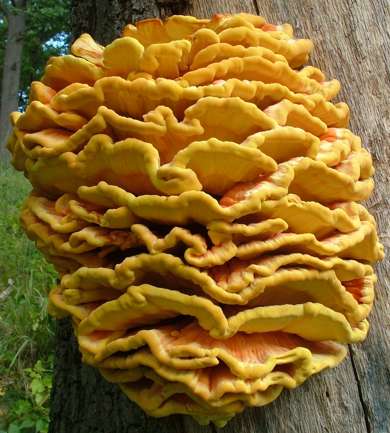
Chicken-of-the-Woods in the Southern Appalachians
When most college students picture their future careers, they don’t typically include drawing pictures with scented markers, singing repeat-after-me songs, or playing games involving both chases and charades. While these activities may be enjoyable and entertaining, one must be realistic. I mean really, what organization in their right mind would let you have a “real” job that’s so much fun? Well my friends, think again. This summer, surrounded by the cool breezes and gorgeous mountain vistas of Asheville, I spent 11 weeks working as a full-time intern at Dogwood and discovering just how much fun following your passions can actually be.
As Dogwood’s first intern dedicated primarily to youth outreach, I spent the majority of my time traveling to summer camps around WNC and talking to elementary and middle school kids about forest protection. I reinvented hobbies from my own childhood to create a fun and engaging presentation, which included a song about Venus flytraps (watch it on Dogwood’s YouTube Channel) and a game about fire in the Green Swamp. I tried to create an atmosphere of “less presentation, more conversation” in order to really ensnare the kids’ attention; we talked about why forests are special and important, the impact of the paper industry, and Dogwood’s current campaign against KFC. Then, the kids drew pictures asking KFC to stop destroying endangered forests, which will be sent to the company later this year (check out some of their super creative art here). The rest of my work included creating new youth activist materials, helping with campaign outreach at summer music festivals, and suggesting further opportunities for Dogwood’s youth outreach program.
Now, as I reflect on my summer experiences, I see innumerable ways to quantify my efforts. I could measure my summer in numbers, counting out the 447 pieces of original kid’s artwork I collected during the course of more than 30 presentations to kids ranging in age from 5-15. I could measure it by the workplace skills I gained (perhaps most notably how to use the downstairs water cooler), the colleagues (more accurately, friends) I made, the colorfulness of the Kid’s Activist Packet I created, or even the degree of messy handwriting in petition signatures I amassed while talking to festival-goers. However, I think my greatest accomplishment relates to the further implications of my interactions with hundreds of local kids. The kids came from a huge variety of backgrounds and situations; many ate at KFC regularly and had minimal knowledge about the environment. While it has been difficult to gauge the impact of my short visits, I hope that my words and questions inspired them in any small way. I hope they walked away from our interactions thinking that learning about forests is FUN. And, most importantly, I hope they understood that they can not only take action to change the world, but that their actions make a huge difference!
Ultimately, I LOVE teaching and interacting with kids, especially when I can get them excited about environmental activism! I have learned that I still have a lot more to learn, but also that I have the passion and skills to be an effective and excited environmental educator. My career goals have been both confirmed and clarified throughout this summer. As I return to Durham and Duke for the school year, I am driven to seek more opportunities related to environmental education and youth outreach. I am so glad to have had this experience in the non-profit world, and can see clearly how Dogwood, with its strong vision, enthusiastic volunteers, and dedicated staff, can create incredible positive change. Most of all, I owe a HUGE thanks to the Dogwood Alliance and Fred Stanback, both of whom made this opportunity for growth and exploration possible.
May the forest be with you
Sarah Ludwig
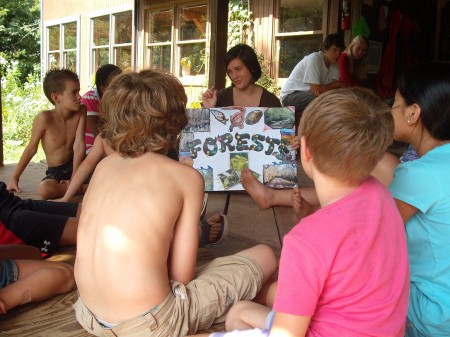
Sarah Ludwig giving a presentation to kids at Camp Celo in Burnsville, NC.


 Donate