



Saturday, November 5thHighland Brewing CompanyFamily Fun & Cake 4:00 – 6:00 The Josh Phillips Folk Festival 6:00 – 8:00 VIP Gathering 8:00 – 10:00
Highland Brewing’s cash bar and food vendors will be on hand to help us enjoy the party!
From 4:00-6:00, we’ll enjoy fun, family-friendly activities and birthday cake! The Josh Phillips Folk Festival will perform an awesome, rockin’ set from 6:00-8:00. Then stick around and be a VIP from 8:00-10:00 where we’ll host a silent auction, give birthday toasts to Dogwood, and premiere our new video!
Sponsored by:
A Divine Event
ImageSmith
Ultimate Ice Cream
Short Street Cakes Black Dome


Friday, October 21st Piedmont Biofuels
Solar Double Cropping Sneak Preview 4:00
VIP Cocktail Reception 5:00-6:30Public Pizza Party 6:30-10:00Tickets: $75.00VIP Cocktail Reception will feature:
Culinary delights: Angelina’s Kitchen, Chatham Marketplace, and General Store Cafe
Beer: Carolina Brewery
Celebration cocktails: Local Spirits
Music: Justin Johnson
In honor of Dogwood Alliance’s 15th Anniversary: Tres Leches Birthday Cake!
Piedmont Biofuels
Solar Double Cropping Sneak Preview 4:00
VIP Cocktail Reception 5:00-6:30Public Pizza Party 6:30-10:00Tickets: $75.00VIP Cocktail Reception will feature:
Culinary delights: Angelina’s Kitchen, Chatham Marketplace, and General Store Cafe
Beer: Carolina Brewery
Celebration cocktails: Local Spirits
Music: Justin Johnson
In honor of Dogwood Alliance’s 15th Anniversary: Tres Leches Birthday Cake!
Public Pizza Party will feature: Music performed by Trilogy Make your own pizza in an outdoor pizza oven! Local beer provided by Carolina Brewery
If you’re just coming to the public pizza party, no need to RSVP. It’s only $10.00 at the door!
Sponsored by:Common Ground Building CenterWeaver Street RealtyDesign & Environmental Analysis Larry’s Beans Southern Energy Management



Today is the third installment of our Colonel Sanders, Memories of Destruction Series. Currently, KFC is cashing in on memories of the Colonel with colonelsanders.com where they are collecting photos and stories of the Colonel. We think that if the Colonel were alive today he wouldn’t be too happy with having his face on millions of buckets made from clearcut Southern forests.
We are releasing our own series of photos of the Colonel on our blog, Facebook and Twitter with creative captions to match what’s happening in the photos. We would love it if you would post captions of your own by commenting on the pictures on our blog and Facebook, and share these photos with your friends. You might even consider grabbing the photo and making it your profile picture for a day or two, or posting it on KFC’s wall.
Here is the third photo from Jim of the “Colonel’s Crew:”
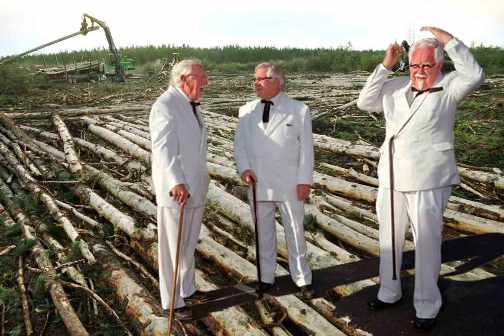
“I met the Colonel in 1970 when he was on a speaking tour. I was a young man then and I wasn’t really sure sure what to do with myself, and the Colonel’s story of hard work paying off really inspired me. Ever since then I guess have been pretty fascinated with the guy. About 5 years ago, I started growing my beard and mustache and dressing up as the Colonel for fun. I heard about Bill, and the other guys and we started getting together and formed the Colonel’s Crew. Well, last year we were doing our act down in Wilmington North Carolina and this guy named Scot from some organization called Dogwood Alliance came up to me and asked me if we were interested in going to check out what KFC is doing to the forests to make their chicken buckets. When we got out there and saw those clearcuts, I just couldn’t believe it. It was awful, and it made me so mad that they put the Colonel’s face on buckets that are destroying our wetland forests. I think if he were alive today it would just make him sick.”
FROM THE WESTERN NORTH CAROLINA ALLIANCE WNCA’s founder, Esther Cunningham, died yesterday, September 20, 2011 at age 93.
Esther was a Macon County native and a wife, mother, and grandmother when she founded the Alliance at age 64. She was motivated by her love of the mountains and forests and was outraged when the Forest Service considered allowing private companies to explore for oil and gas in the national forest. She pulled together her friends and neighbors, environmentalists and hunters, natives and newcomers in a successful effort to stop that proposal – and eventually to change the way the Forest Service manages its lands.
Their work continues today after almost 30 years and many other victories, as the Alliance continues its advocacy to protect the region’s mountains, rivers, and forests. From those early days when Esther and other volunteer leaders worked out of the trunk of a car in the far western counties, the Alliance has grown into a strong organization with six staff and two AmeriCorps volunteers who work throughout the region’s 23 mountain counties.
Those of us fortunate enough to work for the Alliance are cognizant of the legacy we carry every day. Esther, we are grateful for your passion, your commitment, and your vision, and we are proud to continue your work.
Today is the second installment of our Colonel Sanders, Memories of Destruction Series. Currently, KFC is cashing in on memories of the Colonel with colonelsanders.com where they are collecting photos and stories of the Colonel. We think that if the Colonel were alive today he wouldn’t be too happy with having his face on millions of buckets made from clearcut Southern forests.
We are releasing our own series of photos of the Colonel on our blog, Facebook and Twitter with creative captions to match what’s happening in the photos. We would love it if you would post captions of your own by commenting on the pictures on our blog and Facebook, and share these photos with your friends. You might even consider grabbing the photo and making it your profile picture for a day or two, or posting it on KFC’s wall.
Here is the second photo from Ben Stumped, who was just a toddler when he met the Colonel near his home in the Green Swamp of Southeastern NC:
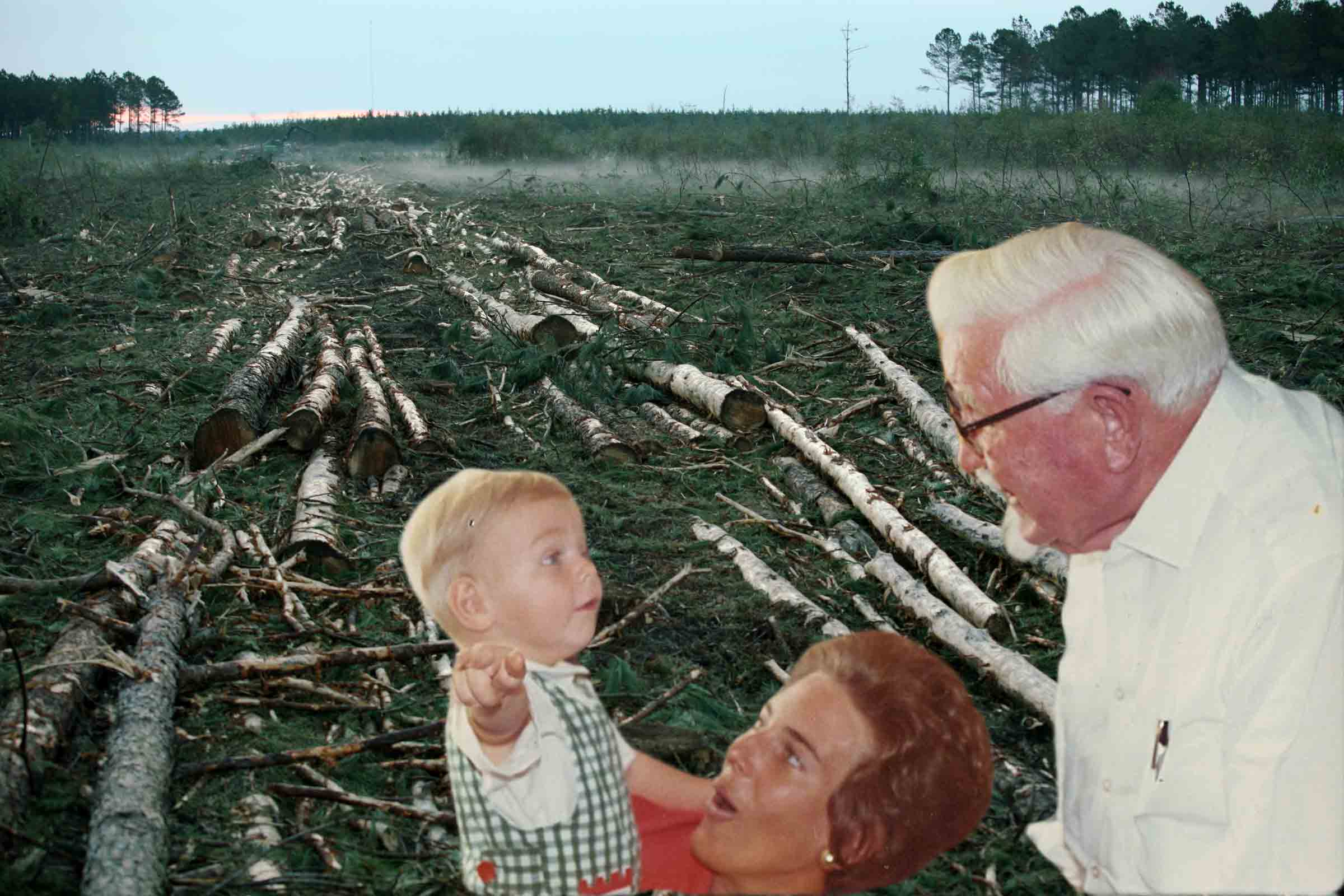
“When I was not even two years old I got to meet the Colonel. He was out with the men from the paper company touring the swamps where they were cutting trees to make his buckets. We lived out off the old highway, right next to where they were clearcutting that day. We were just getting home from church and there was the Colonel right across the road. Mom scooped me up and took me to meet the ole Colonel. I don’t remember but she says he was real nice. The men from the paper company were telling him all about how the new Sustainable Forestry Initiative was going make sure sure the swamp grew back. He was real happy about that. It’s a shame though, cause that’s not really what happened. After they cut all the trees, they came in with big machines and dug ditches to drain all the wetlands so they could plant nothing but fast growing pine trees. After that, there wasn’t much left around here, much but tree farms anyway. Dad had to quit hunting cause he said there just weren’t any deer left anymore, nothing for them to eat. I wish I could have grown up hunting with dad like he did with grandpa.”
Colonel Harlan Sanders, the iconic founder of KFC led a long and storied life. Currently, the slick marketing department at KFC is cashing in on his memory with colonelsanders.com, a new website where they are collecting stories, photos and videos from people who had the opportunity to meet him.
We have a feeling that if he were alive today, he would be disappointed that his face is on millions of chicken buckets that come from clearcut forests in his beloved home region, the Southern US. So we put on our thinking caps and decided to mock up a few parody photos of our own to tell the whole story.
Over the next month we will be releasing these photos on our blog, Facebook and Twitter with captions that we think would match what’s happening in the photos. We would love it if you would post captions of your own by commenting on the pictures on our blog and Facebook, and share these photos with your friends. You might even consider grabbing the photo and making it your profile picture for a day or two, or posting it on KFC’s wall.
Here is the first photo and story from Wilma Tunn, a nice little old southern lady from Southeastern North Carolina:
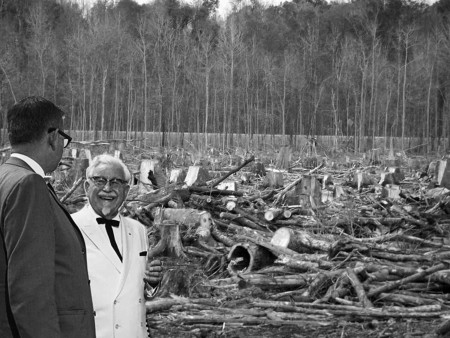
“My papa met with the Colonel to help him choose a good location for getting the paper he needed for his chicken buckets. I rode along with him and Mr. Sanders to the swamps in eastern Carolina and thankfully brought our family camera. I got this photo while papa was telling the Colonel not to worry about this swamp cause it would grow back and that this would be the perfect place to get his buckets. I wish my papa had known that cutting down all those trees and ditching and draining that swamp would be so devastating. Ah to be back in simpler times again. If the Colonel were alive today, I imagine he wouldn’t want his buckets from anything but recycled paper after seeing what happened to those beautiful swamps.”
Have fun with this one! Let’s send KFC the message that all jokes aside, forest destruction is serious business!
Two recent news releases from (IP), the largest pulp and paper company in the world, have caused me to pause and revisit some of the fundamental strategic underpinnings of my work at Dogwood Alliance. And as I will explain, I have resurfaced with a renewed confidence in our market strategy to drive the greening and transformation of the forest products industry to protect forests here at home in the US South and around the world.
First, we cannot forget that in good times or bad, large-scale exploitation of our natural resources in the scale and manner by the forest products industry and the very well managed is a very profitable business.
This July, in the midst of a recession, announced the company had nearly doubled year over year earnings on 8% revenue growth with quarterly net sales of $6.6 billion with 2nd quarter operating profits of $483 million. That my friends is not chump change! And because you are following me on a Dogwood Alliance blog, you know those revenues are all derived from cutting down trees and that the financial bottom line in no way reflects the costs of IP’s business on forests, water, air or our climate. So the first take home for me is that our current economic model still fails to incorporate and value the natural world. This leaves so many of the negative impacts of their business operations on the natural world as well as society at large – and not the company.
Second, IP also recently released their 2010 Sustainability Report, and in many ways it delivers positive news. Yet, upon deeper review and reflection it truly reveals how far we have come in greening the forest products industry and just how much further we have to go. The good “Today’s paper, pulp and packaging customers demand more of their suppliers than high-quality, innovative products. They want a supply chain partner who can help them achieve their sustainability objectives…” Hard to argue with that, a complete validation from the largest pulp and paper company in the world of the market strategy that Dogwood developed and continues to work. IN FACT, I think I may have written those exact words myself on more than one occasion.
So what are WE telling IP’s largest customers? To the office supply and paper packaging customers we say that Southern forests are worthy of protection and companies can reduce their impacts on these special forests by using paper efficiently, increasing their use of recycled fiber and insisting on paper certified to the Forest Stewardship Council standard which ensures no fiber from endangered forests or natural forests converted to pine plantations.
But all is not peachy keen. IP’s website also notes that only 1.5% of all the fiber used in U.S. operations is certified to the high standard of the Forest Stewardship Council (FSC). So that leaves 98.5% of their wood supply coming from sources that are not certain to be responsibly managed or from forests with special high conservation values. Instead, wetland forests like the Green Swamp in southeastern North Carolina are being ditched and drained to cut down and make chicken buckets for KFC, amongst other customers.
So after stewing on these recent pieces of news I can conclude that though clearly we are making great progress greening one of the most resource intensive industries on earth, we still have a long way to go. And real change must come to , the wizard behind the curtain of forest destruction.
On August 12, 2011, several environmental groups, including Dogwood Alliance ally groups Wild Virginia and Georgia Forest Watch, filed a lawsuit challenging the Environmental Protection Agency’s new rule granting biofuel and biomass facilities a free pass to emit carbon unregulated and hastening the widespread deforestation of the Southeast. (76 Fed. Reg. 43,490 et seq. (July 20, 2011))
As it commences regulation of CO2, EPA’s practice for all sources of carbon emissions other than “biogenic” sources is to add up how much a facility is emitting and regulate it if it meets the necessary threshold. Biogenic sources, on the other hand, will not have to obtain permits for their CO2 emissions, no matter how large. The problem with this approach is that regardless of what the fuel source is (biogenic or fossil), CO2 still causes climate instability. Biogenic carbon is not carbon neutral; biogenic sources have recently been found to actually emit more CO2 per unit of energy produced than more energy-concentrated coal and natural gas. In addition, where trees are harvested for fuel, forests, which are critical carbon sinks, are destroyed, leading to more carbon remaining in the atmosphere.
While EPA’s rule states that the exemption for biofuels and biomass facilities will only last three years, the structure of the Clean Air Act permitting program ensures that the effects of this three-year, one-industry pass will be felt for decades to come. This is because once an emitting facility is constructed, no additional permitting is required until it undergoes a major modification—which may not happen for decades, if ever.
This special exemption for biomass facilities creates an incentive to build as many as possible over the next three years to take advantage of the competitive advantage the exemption gives these facilities over those using different fuels. This spells serious trouble for Southern forests. According to the Forest Service and power producers, there is not enough biomass waste material to meet the projected demand. Therefore whole trees will have to be used. Anticipating this demand, the North Carolina Utilities Commission recently included whole trees within the definition of renewable energy resources. This new definition means that, in addition to qualifying for the EPA’s permit exemption, biomass facilities will be eligible for funds intended to encourage renewable sources of energy (such as solar and wind) and will be able to include the energy produced by these facilities when reporting how much of the energy they produce is renewable.
Biomass facilities that would require a Clean Air Act permit but for the exemption also emit other air pollutants, although often in insufficient quantities to trigger permitting requirements (under 100 tons per year). Therefore, by achieving the exemption for CO2, the biomass industry has obtained an effective exemption from regulation of these other pollutants. This is bad news for people living near these facilities who will breathe these pollutants that often have acute human health effects, such as triggering asthma attacks or causing cancer.
For all of these reasons, the August 12 lawsuit challenging the EPA’s authority under the Clean Air Act to offer this special treatment to the biomass and biofuel industry should be applauded.

Ricardo Carrere (third from from right) during a ‘field trip’ in South Africa to sappi–a global paper and pulp group. WRM had an international meeting in South Africa on the dangers of monoculture timber plantations in 2007. Standing next to Ricardo, with camera, is Timberwatch’s Wally Menne. Timberwatch hosted the conference in Johannesburg. Photo: Langlle/GJEP-GFC
It is with great sadness that we report the passing of our dear colleague and friend Ricardo Carrere on August 16. Although we had known for several months that he was ill, his death took us by surprise, as his condition rapidly deteriorated in just a few short days.
We extend our deepest sympathies to his wife Mari, his children Cecilia and Francisco, his sister Margarita, and the rest of his family.
We who worked with him at WRM – Ana, Lizzie, Teresa, Raquel, Flavio and Winnie – are deeply sorrowed by his loss, and yet we are left with his clarity, conviction and love for what he did, his wholehearted commitment to social and environmental justice, seasoned with his unique sense of humour, optimism and zest for life.
Ricardo was the coordinator of the World Rainforest Movement (WRM) from 1996 until December 2010, when he retired. Throughout all those years, he played a fundamental role in building the organization and forging its network of contacts and partnerships based on shared trust and a clear definition of its ultimate goal, to defend the forest and provide support for the local struggles of communities and peoples for their rights and their ways of life.
Ricardo liked to listen to what the people of these communities had to say about their lives and their struggles, which is why he considered himself to be, as he put it, “more than a coordinator of anything, a learner of everything.” He reflected a great deal on everything he heard, during his morning ritual of drinking mate, in silence, during his many travels, and at home, in his garden full of native trees and plants, which he created and nurtured with enormous dedication and love.
Like few others, Ricardo was able to pass on what he learned to a great many people: to those of us who had the tremendous privilege of working directly with him, to others who met and worked and lived with him at different times in his life, and to people from organizations, networks and movements in many different countries.
We want to thank our friends and colleagues for the many messages we have been receiving from around the world. We plan to share back a bit of this outpouring of affection in our September bulletin, which we will be dedicating to Ricardo.
We also want to take up the suggestion made by some of our friends to hold a special tribute to Ricardo this coming September 21, the International Day Against Monoculture Tree Plantations. We will organize a tribute here in Uruguay, and our friends are more than welcome to hold tributes of their own wherever they are. But the most fitting tribute of all will be to join in the activities for this international day of struggle that Ricardo worked for so many years to disseminate and promote, with the enthusiasm, determination and passion that he was known for.
¡Hasta siempre Ricardo!
Ana, Lizzie, Teresa, Raquel, Flavio and Winnie
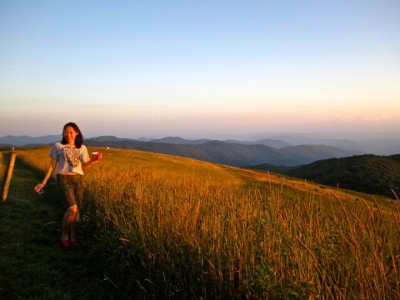
The summer of 2011 is definitely one of the best summers in my life so far which deserves to be put in my history book.
I was working at Dogwood Alliance as a research intern studying the health impact of woody biomass power generation. The reasons I choose to apply for this position are first, as a graduate student from Duke University with concentration on Energy & Environment, I would like to know more about energy industry and popular topics in this field by doing research work, and biomass fuel is absolutely one of the hottest topics in the US in the recent years; second, even though I have done much research work since undergraduate study, I used to be in charge of supporting work for the entire project doing data collection or literature review, however, this position provides me the opportunity to study a topic highly independently which is very challenging but also means I can have a general picture of conducting solo research. Now, at the very end of my 11-week internship, I have to say I am glad that I made a sound decision to work here which is an amazing life changing experience.
For me, a job cannot be a good one without delightful work environment, and Dogwood Alliance which is located in downtown Asheville is a quiet, convenient and comfortable place to work in. I always enjoyed the regular meetings for all the stuff and interns on every Monday morning. People share the exciting things happening in life and progress on their work. I believe this kind of communication is crucial to improve the interdepartmental cooperation as well as team building. As a beautiful tourism city, Asheville is surrounded by many wonderful hiking, swimming and biking spots, especially in summer. I spent most of my free time trying good food, hiking and watching shows. In these experiences I met some lifelong friends and a number of them are also working on environmental issues.
My research work this summer focused on the health impact of woody biomass power generation. Wood is considered by many people as a “clean” “renewable” and “sustainable” alternative energy source to replace coal and even natural gas to generate electricity. However, burning wood for energy will lead to emissions of air pollutants such as carbon monoxide, particulate matters, nitrogen oxides, sulfur dioxide and other toxic air pollutants which have been proven by many organizations to arouse heart and lung disease, and even cancers. Woody biomass power generation can also result in more greenhouse gases emissions and deforestation, because the explosive biomass fuel development makes it unlikely to meet the demand of biomass power industry just by using wood wastes and wood residues. Actually some power plants have already used whole tree chips to generate electricity which will put severe pressure on forests. More research needs to be conducted to make sound policy on biomass energy. However, EPA announced in July 2011 that they will give a three-year exemption for biomass energy industry during which time they will do more work to prove the feasibility of woody biomass power generation. This decision may lead to more investment on biomass energy industry and cause high health risks and greenhouse gases emissions.
After this summer’s independent research, I know more about energy issues and got familiar and confident with research process involving literature review, data collection and report writing. Moreover, the experience of working in a non-profit organization helps me understand how non-profit organizations work and which kind of skill sets are needed. More importantly, my interests on energy issues especially energy policy are highly motivated which is a perfect supplement with the coursework in school.
In all, I had a great experience working in Dogwood Alliance with Campaign Director Scot Quaranda. I appreciate all his help and instructions which definitely have a positive influence on setting my career goal and obtain skills for working in non-profit organizations. I hope more people can know the excellent work of Dogwood Alliance on protecting Southern forests and support this outstanding organization.


 Donate