


Groups Force USDA to Re-release Draft Environmental Assessment on Genetically Engineered Eucalyptus Trees for Southern U.S. Forests: Original Assessment Lacked Key U.S. Forest Service Hydrological Studies
The U.S. Department of Agriculture re-released their draft environmental assessment [1] regarding a request by ArborGen, a subsidiary of timber giants and MeadWestvaco, to plant over a quarter of a million genetically engineered eucalyptus trees in so-called “test plots” across seven southern U.S. states. [2]
“If these invasive GE eucalyptus are planted across the South on this large of a scale, it is highly likely that fertile seeds will escape into surrounding forests,” said Dr. Neil Carman, a plant scientist with the Sierra Club. “This is a major problem since eucalyptus is already known for its invasiveness. Once they escape into the forests, there is no way to call them back. It would be an ecological nightmare for southern forests.”
The environmental assessment was re-released by the USDA after groups concerned about the environmental impacts of transgenic eucalyptus trees pointed out that the assessment was missing key hydrological studies conducted by the U.S. Forest Service that directly refute the conclusions of the USDA’s draft environmental assessment which recommend approving ArborGen’s request. The USFS studies point out that eucalyptus trees have heavy water requirements and can seriously impact ground and surface water reserves. [3]
The USDA is seeking public comments on their draft environmental assessment through February 18th, 2010. [4]
“In countries that are already suffering the impacts of large-scale eucalyptus plantations–like Brazil, Chile and South Africa–people have organized massive campaigns against them,” stated Anne Petermann, Executive Director of Global Justice Ecology Project and North American representative of the Global Forest Coalition. “This is because eucalyptus plantations have devastated forests and communities. In Brazil, the Mata Atlantica forest has been all but wiped out by eucalyptus plantations. In Chile, communities living near eucalyptus plantations have lost their access to fresh water.”
Other new information in the assessment reveals that some of the supposedly infertile engineered eucalyptus trees in existing field trials produced fertile seeds. Eucalyptus is a non-native tree and numerous species of eucalyptus are already considered invasive. This new transgenic (or GMO) eucalyptus has been engineered to tolerate colder temperatures giving it the potential for invading forest ecosystems throughout the South.
“I had hoped that the disaster of kudzu would have taught us the consequences of releasing invasive species into the environment,” agreed Scot Quaranda, Campaign Director for the Dogwood Alliance. “Instead, ArborGen wants to release invasive GE eucalyptus trees. Unlike kudzu, however, these trees are not only invasive, they are also highly flammable and use huge quantities of fresh water. California is already spending millions to eradicate invasive and flammable eucalyptus trees. We do not want these invasive trees to be mass-planted in the South.”
The STOP GE Trees Campaign [5] is working with the Center for Food Safety on plans to stop ArborGen’s proposal to release hundreds of thousands of genetically engineered eucalyptus trees across the U.S. South. “This is a very slippery slope,” warns George Kimbrell, an attorney for the Center for Food Safety. “Allowing the release of these GE eucalyptus trees will set a legal precedent that could allow the release of genetically engineered poplars or pines–which have wild relatives across the continent. The commercial release of engineered versions of native trees would lead to the contamination of forests with engineered pollen. Once this occurs there is absolutely nothing that can be done to stop the further contamination of more forests. We have to stop the release of GE trees before this contamination occurs.”
The public is encouraged to submit comments to the USDA regarding the ArborGen proposal to release 260,000 genetically engineered cold tolerant eucalyptus trees across seven southern states. For details on this, please visit: http://www.globaljusticeecology.org/stopgetrees.php?tabs=0
[1] To download the USDA’s December 17, 2009 revised draft environmental assessment, go to: http://www.aphis.usda.gov/brs/aphisdocs/08_014101rm_ea2.pdf
[2] The seven states targeted for ArborGen’s GE eucalyptus deployment are South Carolina, Georgia, Florida, Alabama, Mississippi, Louisiana and Texas.
[3] The summary findings of the USFS with regard to the impacts of eucalyptus plantations on water resources can be found on page 57 of the new USDA draft environmental assessment. These findings include the fact that the water usage by eucalyptus plantations is at least double the water usage by other forest types, and that afforestation to eucalyptus plantations will reduce stream flow, lower the water table and affect groundwater recharge.
[4] Comments to the USDA can be submitted at: http://www.regulations.gov/search/Regs/home.html#submitComment?R=09000064809c344a
[5] Global Justice Ecology Project coordinates the STOP Genetically Engineered Trees Campaign. The Sierra Club and Dogwood Alliance are part of the Steering Committee for the Campaign. For more information on the campaign, go to: http://www.nogetrees.org.
Look out Fast Food Giant – you know who you are…
As we move into a new decade, we’re excited to kick off the New Year with a new face in the office. In early January, we hired Lindsey Simerly as our new organizer to help take our No Free Refills campaign (targeting the fast food industry) to a whole new level. Lindsey brings a wealth of community organizing experience to our team.
At 23 years old, Lindsey decided to run for City Council in Asheville, campaigning using only her bike for transportation, pushing a progressive environmental and social agenda and generating new interest in local politics from young voters. Since then, she has become a celebrity-like organizer in town, most recently playing a major role in the successfull campaigns of progressive political candidates.
Lindsey couldn’t have joined Dogwood Alliance at a better time. We’ve successfully leveraged change with most of the largest corporate consumers of office paper and some of the biggest consumers of paper packaging. Even some of the big paper producers in the South are making real improvements. But, (IP) and one of its big fast food customers continue to lag behind, and stand in the way of broad sweeping protection for Southern forests.
On the cutting edge of online organizing and with creative, out-of-the-box strategic thinking, Lindsey is a real asset to Dogwood as we gear up for a fun and exciting new campaign that challenges one of the biggest fast food giants in the world to stop destroying Southern forests with their wasteful paper packaging. Stay tuned….our packaging campaign is about to get really fun!

Take action now
One of the most long and controversial struggles in Clean Water Act history has reached a key decision-making point, and we need your help. A new draft permit for Blue Ridge Paper Products, dba Evergreen Packaging, in Canton, NC would end all cleanup to the Pigeon River and allow for more toxins to be dumped. The NC Division of Water Quality is currently accepting comments on the permit – let your voice be heard! Don’t allow the Division of Water Quality to continue to stand in the way of progress on the Pigeon River.
·“Color” is not just an aesthetic concern – it indicates the presence of a mixture of harmful and toxic chemicals in discharges to the river. The Pigeon River remains classified as “impaired” on several sections below the mill in North Carolina and Tennessee.
·This is an issue of national importance: after 101 years of pollution and decades of struggle to clean up the Pigeon, it’s time to bring the Clean Water Act alive again to restore the river!
·The mill still has not met standards which EPA called for in 1987. Cost-effective process changes are available to the mill to reduce pollution to the river, but DWQ is not requiring implementation of these methods! Contrary to what you may have hard, these changes are affordable and no threat to the mill’s operation or jobs.
GET INVOLVED – LET YOUR VOICE BE HEARD!
Attend the public hearing in NC Attend the public meeting in TN:
Tuesday, January 26, 2010 Monday, January 25, 2010
Tuscola High School Cocke County High School
Waynesville, North Carolina Newport, Tennessee
Can’t attend the public comment? CLICK HERE TO SEND COMMENTS
The proof is in the woods.
Yesterday’s announcement from Office Depot that its top-selling recycled copy paper is now 30% post consumer recycled content and Forest Stewardship Council (FSC) certified marks an important milestone. Following our successful grassroots campaign and our ongoing engagement with Office Depot, our work has once again turned words into action in the form of improved on-the-ground management practices in the forests of the South.
With more than 1.4 million cases of Office Depot Green 30% Recycled EnviroCopy Paper sold annually, the switch dramatically increases the availability of FSC certified and post consumer recycled fiber paper in the U.S. marketplace. It also means more acres of well-managed FSC certified forests around producer Domtar’s mills in Ashdown, Arkansas; Kingsport, Tennessee; Marlboro, South Carolina and Hawesville, Kentucky.
As I say in the press release; “Office Depot’s new paper delivers the key components necessary for protecting forests in the Southern U.S. and around the world – high post-consumer recycled content and responsible forest management associated with FSC fiber. We are pleased to see the Company honor its environmental commitments and embrace these attributes in a high volume product and wish them success in the marketplace.”
So there you have it, the Dogwood Alliance strategy of working to improve the environmental paper practices of the large corporate paper buyers to protect forests in the South continues to get results. Thanks to Office Depot’s Director of Environmental Strategy for working hard to develop and market a greener paper coming from the South, thanks to Domtar for leading the southern paper industry in its commitment to improved forestry practices, thanks to our colleagues at ForestEthics for their help on the Green Grades, and as always thanks to our members, activists and donors who make this important work to transform the paper industry and protect Southern forests possible.
IP is pushing harder than ever for the deregulation of genetically engineered trees…
In a recent article, the implications of genetically engineered trees are explored in relation to and the company’s desire to find ways to continue to expand the use of trees in paper production as our forests continue to be devastated by business as usual practices. is the world’s largest paper producing company as well as the wizard behind the curtain of forest destruction. The company is a hard-driving proponent of using these genetically engineered trees for paper and packaging production. You can read the full article about IP and biotechnology here: http://businesstn.com/content/201001/giving-trees The consequences of GE trees will likely result in devastating depletions of the South’s natural forests as they are replaced with desert-like monocultures.
IP’s recent interest and desire to implement the use of GE trees demonstrates an obvious deviation from their stated commitments to environmental responsibility. According to John Faraci, the company’s Chairman and CEO, “At IP, we’re proud of our legacy of sustainability and environmental stewardship. Demonstrating our ongoing commitment to these efforts through continuous improvement is important not just for our employees but for our customers, shareowners, and neighbors in the communities where we operate”. However, IP’s actions directly contradict this statement as they continue to practice large scale clear-cutting, the conversion of forests to pine plantations and the routine spraying of toxic chemicals. As IP continues to advocate for and fund research to grow more trees on more acres through the industrial-scale planting of GE trees, it fails to consider the very real and serious consequences of doing so.
In the above-mentioned article, Kathleen Bark, IP’s spokeswoman does not respond to scientific research and documentation that confirms potential devastating consequences to forests if GE trees are in fact planted on an industrial scale to meet the demand of a company as large as IP. Instead, she focuses on the motive for using science and technology to further IP’s profit. And, according to IP’s official website, the company claims that it is protecting the ecosystems on which they are dependent on for their resources. Nevertheless, IP continues to use outmoded and devastating forestry practices, and now instead of progressing towards a more responsible and sustainable future, they are turning to Franken-science.
As the article mentions, “one needs look no further than the nearest kudzu-carpeted hillside — and the South has plenty — to be reminded of the devastation even the most well-intended transplant can cause”. The introduction of invasive species to the existing natural forests threatens ecology on every level. The Australian eucalyptus, the GE tree of choice is threatening to replace our natural forests while displacing indigenous plant and animal species, all for the sake of IP profit. According to the Organic Consumers Association, “Opponents fear that biotech trees, to which scientists have added genes from bacteria, chickens and even humans, will provide poor habitats for beneficial insects and birds, transforming biologically diverse woodlands into sterile “Frankenforests.” These foreign species are not only invasive, but they drain on critical water resources and represent the danger of opening nature’s Pandora’s Box. IP’s motives and false statements are an obstacle to positive change and its out-dated mode of operating directly endangers forests in the South and around the world.
Since December 1st, more than 500 Dogwood Alliance members and volunteer activists have sent letters to (IP) CEO John Faraci, calling on him to give up the company’s current destructive forestry practices and greenwashing efforts — including its involvement in the misleadingly named Sustainable Forestry Initiative (SFI). If you’ve not yet sent the letter, you can do it now with just a click.
“In our recent five-part blog post, we explained how IP’s practices are anything but green and sustainable, and knowing the facts has spurred many people who care about Southern forests into action,” said Scot Quaranda, Communications Director.
As the Dogwood blog highlights, IP has consistently defended destructive “business as usual” forestry practices, made millions from taxpayer subsidies by exploiting a loophole in alternative fuels legislation, and has helped to create an elaborate veil of greenwashing through its involvement with the Sustainable Forestry Initiative (SFI).
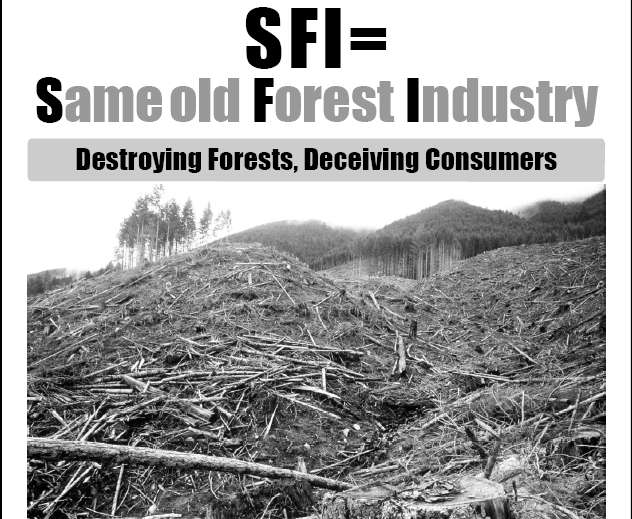
SFI was created by the pulp and paper industry in response to the Forest Stewardship Council (FSC) forest management certification program. While FSC endorses changing practices to create more sustainable forests and forestry, SFI endorses lose certification standards for continued destructive logging and forestry practices.
Dogwood isn’t the only organization that has taken action to help spur IP to change its approach. Both the Sierra Club and ForestEthics have filed formal complaints against SFI at the Federal Trade Commission and the Internal Revenue Service accusing the certification program of lax standards and deceptive marketing.
“As the largest paper producer in the South and the world, IP should be a leader and not a laggard” said Dogwood Alliance Executive Director Danna Smith. “While other companies are making progress and embracing new ways of doing business in the forest, IP continues to be the old guard – defending forest destruction and standing in the way of progress”.
Raise your voice to Southern forests! Join others who care about the future of forests and send a letter to Mr. Faraci and . Let them know you’re watching, and that you won’t stand for continued destruction.
The impact of environmental work isn’t always easy to quantify. As you consider your year-end gifts, how do you know your donations are really making a difference? Here’s a simple breakdown of Dogwood Alliance’s 5 most notable accomplishments for 2009 — and the 5 we’ve set our sights on for 2010. We think you’ll agree that your gift to Dogwood Alliance truly pays off for Southern forests!
2009
• OurPackaging Campaign secured commitments to create more sustainable packaging practices — from FSC and recycled sourcing to reducing overall paper content — from major corporations like Sony Home Entertainment, Universal Music Group, and Johnson & Johnson, and we reviewed a draft green packaging policy from GlaxoSmithKline. • McDonalds, one of the top fast food giants, began working with Dogwood to develop their own commitment to sustainable packaging practices, with an eye toward emerging as the industry leader in 2010. • Working with our former-adversary-turned-ally, Staples, we launched the Carbon Canopy project, a “sequester where you source” program that will help forest landowners and land managers earn money for carbon sequestration through more responsible forest management, and help Fortune 500 customers adopt more sustainable practices in the process. • We released our third Green Grades report card for the office supply sector, evaluating the practices of twelve major players in the retail, distribution and wholesale paper sectors on their use of environmentally responsible practices. • We officially named Danna Smith, co-founder and longtime Dogwood leader, as our Executive Director, leveraging her 13 years of experience working with Dogwood to protect Southern forests.
2010
• As part of our “No Free Refills” fast-food packaging campaign, we’ll launch our next large-scale public awareness push to highlight the impact that one of the biggest giants in the fast food industry has on the South’s coastal forests. Watch for that in late winter. • Inspired by our awesome 8-year-old friend Cole Rasenburger, we’ll launch a youth organizing program to help educate the South’s youngest activists. • We will continue to put pressure on as the biggest obstacle to broad-sweeping progress in the paper industry. (See story below.) • The Carbon Canopy project will launch its first pilot project to help Southern forest landowners expand forest conservation on their land and, over time, remove carbon from the atmosphere. • We’ll begin to attack the next new threat to Southern forests: “bio-energy,” the burning of trees for energy. We’ll make sure that awareness grows about the dangers to our forests and communities from this industry, which threatens to double the amount of logging and pine plantations in the South.
Because of the work of Dogwood Alliance, more of the South’s forestlands are protected and managed responsibly. As a result, these forests continue to help support the bio-diversity, clean air, and pure water that are essential to our region’s communities. Your support is essential to Dogwood Alliance. Thanks for all you do to protect Southern forests!
For Mitch Russell, learning about Dogwood Alliance was a happy accident. “I was searching the Internet for something else green-related, and Dogwood Alliance’s website popped up. The more I looked, the more intrigued I became,” says this longtime Vista Circle donor.
Originally from Mississippi, Mitch spent many years in Atlanta before moving with his family to Asheville, North Carolina in 2007. “My wife and I began supporting Dogwood Alliance while we were still in Atlanta. It felt good living in such a sprawling metropolis to know that we were helping sustain a more beneficial environment,” he says. Mitch says it’s Dogwood’s niche that has been particularly attractive to him as a donor. “There are lots of groups working on forest conservation, but this is the only group focusing specifically on this region. I’ve spent a considerable amount of my life roaming in forests from the Mississippi Delta to the Appalachian Mountains, and it’s important to me to protect them to ensure air quality, bio-diversity, recreational opportunities and pure aesthetics.
“I also like Dogwood’s marketplace approach, and the wit that they incorporate into those campaigns.”
Environmental conservation is a key driver for Mitch, who spends time as a Muddy Water Watch volunteer, helps out with environmental education at his 8-year-old daughter’s elementary school, takes his 3-year-old son on “trash walks,” serves as coordinator for the Asheville chapter of the North Carolina Native Plant Society, and writes a monthly “green” column for his neighborhood newsletter.
“My involvement with Dogwood Alliance has been an uplifting experience,” he says. “I know I’m part of an effective effort to steward Southern forests, and that gives me a sense of pride. My donation is turned into something much larger, and has a great impact.”
Part 4 of 5 part series exposing as the South’s largest forest destroyer is the largest pulp and paper company operating in the Southern US and the largest paper company in the world. As the industry behemoth, the company is in a unique position to drive the evolution of modern paper production. But rather than embracing a truly green and sustainable vision for the way paper is produced, the company has not only chosen to remain a stalwart of destructive forestry practices but taken the lead in painting those poor practices in a thick layer of greenwash.
The cornerstone of IP’s greenwashing efforts is the Sustainable Forestry Initiative (SFI), which was the paper industry’s response to the Forest Stewardship Council (FSC) forest management certification system, which is the only certification system that has wide-scale support from the environmental community across North America. Instead of embracing the critical, stepwise improvements forwarded by environmental organizations, indigenous communities and progressive players in the wood and paper manufacturing industry via the FSC, IP and its cronies at the American Forest & Paper Association created the SFI. The SFI “certifies” millions of acres in the US and is used on numerous products… meaning it is one big problem!
Unlike the FSC, SFI rubber stamps some of the most destructive logging practices, attempting to hide them behind a green sheen. SFI allows for large-scale clearcutting, conversion of natural forests to plantations, unlimited use of toxic chemicals in forest management, and many other of the worst practices that leave behind a wake of degradation and destruction. IP has spent millions of dollars supporting the SFI and aggressively works to ensure its continued misuse.
Recently, both our friends at ForestEthics and the Sierra Club filed complaints against SFI at both the Federal Trade Commission and the Internal Revenue Service. The organizations accused the certification program of lax standards and deceptive marketing intended to obscure irresponsible foresting standards. To read more about this, check out this article or this one.
Recently, IP announced FSC chain of custody certification for most of its mills in North America. The fact that IP now has this certification at some of its facilities means simply that it has the appropriate mechanisms in place to be able to track FSC certified fiber from the forest, through the mills and to an end product. It does not mean that IP is actually moving FSC certified fiber through its mills or producing any FSC certified products. Most importantly, it does not mean that anything at all has changed in the forest. To read more about our take, go here.
Unlike many of its competitors who have embraced FSC as the gold standard for certification in North America, IP continues to promote SFI as equal, hasn’t produced one FSC certified product to date and refuses to work with conservation groups on expanding FSC on the ground. So, while IP is moving in response to market pressure, there is no tangible evidence yet that IP is in fact changing its behavior. While IP now has the keys to the Prius (FSC) it is still driving a Hummer (SFI).
While a litany of other paper companies and a growing number of Fortune 500 corporations that make up the bulk of IP’s customer base are changing the way they think about paper and its impact on our planet, IP continues to support business as usual forestry, meaning more logging of endangered forests, large-scale clearcuting, conversion of natural forests to plantations and some of the worst practices on the ground in our forests and local communities.
Check back next week to learn why is one big problem and how you can help change that!
Dogwood Alliance response to the announced closure of three mills…“When we look at global economic conditions today, it appears the worst is behind us,” CEO John Faraci said in late July.
The worst may be behind for IP shareholders and CEO John Faraci, but that is not the case for IP workers. Last week, announced the impending closure of three of its mills in the United States – Franklin, VA, Pineville, LA, and Albany, OR. Our hearts go out to the workers and all of their families in this tough situation.
It is not the goal of Dogwood Alliance to close down paper mills and displace workers. To the contrary, it is our belief that the long-term survival of the US paper industry is closely tied to its ability to compete in a marketplace that is increasingly demanding environmental and social accountability. The Franklin, Pineville and Albany Mills could have been a model for the 21st century but instead failed under the 20th century mentality of one of the biggest dinosaurs in the paper industry – .
We have been aware for many years now that IP, driven by short-term profits, has never taken the long-term interest of local communities, workers or the environment to heart. Instead, the use it, abuse-it mentality still prevails at the corporate headquarters of IP.
The Franklin, Albany and Pineville mills are closing even as IP receives ever-growing taxpayer handouts. For more about those subsidies, go here. Meanwhile, CEO John Faraci continues counting his ever-growing pile of money.
According to the Corporate Library, as reported on CNN Money and various other outlets, John Faraci is one of the top five most overpaid CEOs in the U.S. He was paid over $38M in 2008, including receipt of $21M in pension payments though he is still full-time with the company. You can see the story here.
Pitting the environment against local communities is creating a false dichotomy. The real problem is not the organizations and local communities working to protect their forests; it’s the profit over people business mentality of companies like IP.


 Donate