


Press Release from Global Justice Ecology Project and the STOP GE Trees Campaign: FOR IMMEDIATE RELEASE 31 MAY 2008 UN CBD Fails to Protect Forests from Genetically Engineered Trees Bonn, Germany–Under heavy pressure from Brazil, Canada, Colombia, New Zealand and Australia, the Convention on Biological Diversity’s Ninth Conference of the Parties (COP-9) failed to pass a moratorium on the release of genetically engineered trees into the environment despite support for a global ban endorsed by hundreds of organizations around the world, and the unified efforts to stop GE trees carried out by NGOs, Indigenous Peoples’ Organizations, scientists and foresters present at the COP. The negotiations around the issue of GE trees were heated, with the entire African Group and numerous other Parties staunchly supporting a suspension of the planting of GE trees until risk assessments show that they will have no negative impacts on forests or forest dependent peoples. Among those blocking this effort were the countries of Brazil, Canada, and New Zealand, all of which are currently conducting field trials of GE trees. One member of the Brazilian delegation admitted that their delegation included a representative from ArborGen, the world’s leading GE trees research and development company, which projects millions in profits from GE tree plantations that they plan to develop in Brazil. [1] “Most of the COP resolutions will increase hunger, especially in Southern countries,” explained Ana Filippini of World Rainforest Movement and the STOP GE Trees Campaign. [2] “Accepting genetically engineered trees is only one more in the chain of wrong policies that will worsen the already serious hunger situation. Millions of hectares of land are being turned over to the production of agrofuels. With the new emphasis on cellulose-based agrofuels, even more land will be taken for even larger plantations of trees-which will likely someday be GE trees, since the COP would not pass a moratorium on them. Business has been pushing these unsustainable agrofuels all through this COP, which are only for the benefit of transnational corporations at the expense of human hunger and environmental destruction,” she concluded. “Yesterday was a bleak day indeed,” added Anne Petermann, of Global Forest Coalition, Global Justice Ecology Project, and Co-Coordinator of the STOP GE Trees Campaign. “The fact that the COP failed to take strong collective action against GE trees means that more forests will be destroyed, more biodiversity devastated and more peoples displaced. Global warming will be worsened and livelihoods lost. As has historically been the case, the work to protect ecosystems will ultimately and unjustly fall upon the communities and peoples that live there. “Under the leadership of CBD Executive Secretary Ahmed Djoghlaf, the CBD has chosen to actively embrace business and a market-based approach to biodiversity conservation, which has had the inevitable effect of watering down protection of biodiversity where it runs counter to the interests of business. It is having the effect of seriously jeopardizing the legitimacy of this body,” she concluded. Contact: Anne Petermann, Co-Coordinator, STOP GE Trees Campaign +49 (0) 160 435 9236 (Bonn mobile until 9 am Bonn time Sunday 1 June) or +1 802 578 0477 (US mobile after 5 pm eastern U.S. time Sunday 1 June) Notes: [1] “Rubicon Interim Report”, Rubicon. 02/28/07 (Rubicon is a joint owner of ArborGen) [2] The STOP GE Trees Campaign is comprised of 137 organizations in 34 countries, all of whom support the call for a global ban on GE trees. http://www.nogetrees.org
UN called on for Genetically Engineered Tree Ban FOR IMMEDIATE RELEASE 27 MAY 2008
Activists Symbolically Cut Trees to Save Forests and Call for GE Trees Ban
Bonn, Germany-A large number of activists today stopped and cut Genetically Engineered frankentrees that attempted to invade a tree planting ceremony outside of the meeting of the UN Convention on Biological Diversity (CBD).
“We came here to this event because this tree planting ceremony is representative of corporate green-washing initiatives pretending to protect biodiversity,” said Peter Gerhardt of the German based group Robin Wood. “The tree planting ceremony is symbolic of what industry is pushing–non-native, often invasive trees for monoculture timber plantations. If industry has its way, in the near future these will be genetically engineered (GE) trees for production of second generation agrofuels or pulp and paper,” he continued.
The activists expressed concern about the refusal of the EU and Brazil to ban GE trees. “These trees are simply too dangerous, not only to forests, but also to local communities and Indigenous Peoples who depend on forests for their existence,” stated Camila Moreno of Terra de Direitos of Brazil.
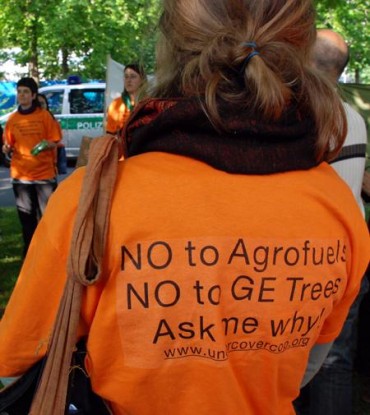
“Already forest dependent communities, especially women, are threatened by monoculture timber plantations and GE trees will mean more plantations and an even greater threat,” stated Anne Petermann, of Global Justice Ecology Project, and the STOP GE Trees Campaign. [1] “Imposing a ban on the release of genetically engineered trees into the environment is the only sensible position, which is supported by the entire African delegation plus numerous Parties from Asia and Latin America.”
The environmentalists also expressed their concern about the One Billion Trees campaign of the UN Environment Program. [2] “This campaign fails to inform people that planting the wrong tree at the wrong place can be ecologically and socially harmful”, stated Dr. Miguel Lovera, Chairperson of the Global Forest Coalition.
“Companies also want to use GE trees and other tree monocultures for offsetting carbon emissions,” highlighted Ana Filippini of World Rainforest Movement and the STOP GE Trees Campaign. “The destruction of forests, which are important carbon sinks, for new tree plantations releases huge amounts of carbon, worsening climate change. What we need is forest restoration with native species, not monocultures.”
A potential ban on GE trees was discussed at length during the first week of the Biodiversity Convention and will now move into the High Level Session where Ministers from around the world will decide what will happen with this issue. A decision to stop GE trees is considered critically important at this time because of the rapid advancement of GE trees technology, which is being especially driven by the projected increase in demand for wood that would accompany cellulose-based second generation agrofuels.
Contact: Orin Langelle, GFC Media Coordinator, +49 (0)176 771 87583 Dr. Miguel Lovera, GFC Chairperson, +49 (0)152 225 344787
For photographs of this action and other events during the CBD please go to: http://globaljusticeecology.org/gallery.php?catID=26
Notes: [1] The STOP GE Trees Campaign is comprised of 137 organizations in 34 countries.
[2] The United Nations Environment Programme (UNEP) has launched a major worldwide tree planting campaign called Plant for the Planet: Billion Tree Campaign.
One of the oldest reptiles in the world…
As one of the very oldest of living reptiles, the turtle is a special animal. For generations before ours the turtle symbolized the primal mother. Honored in many cultures, the turtle is a reminder that the Earth provides for all of our needs.
The turtle is also respected for its strength and solidarity. The turtle moves by steady progression with all living things and as an animal of two elements, the turtle reflects an ability to flourish and adapt. Awareness, longevity, and stability are important qualities associated with the turtle. At times when we cannot see the forest for the trees, the turtle can slow us down to help us see veiled opportunities.
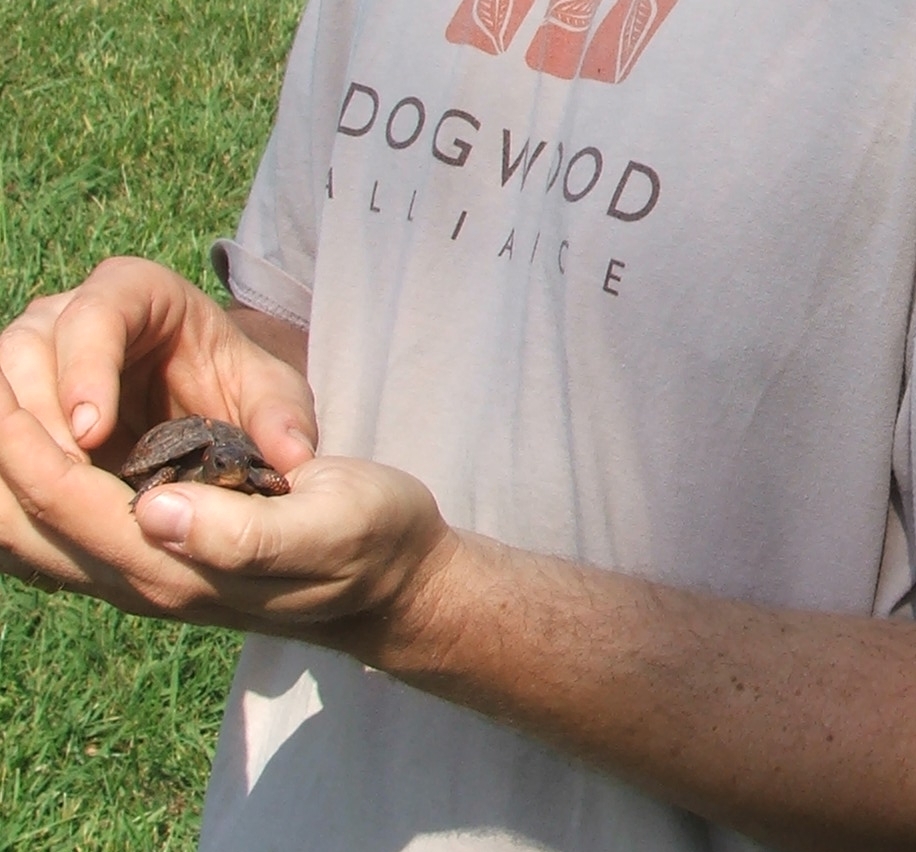
Part of the southern forest landscape is the Eastern Box Turtle. A crucial member of our native herpetofauna, a box turtle can endlessly fascinate in the way it stands robust and vivid in color or carefully eats a worm or piece of fruit.
The box turtle’s southern cousin, the Gopher Tortoise, also shows us a part of our humanity that we cannot afford to lose. Gopher tortoises create extraordinary burrows in the ground up to 40 feet deep that they share with hundreds of other animals, such as the Florida Mouse who cannot survive the seasons without the gopher tortoise’s burrow. The burrows are also shared with opossums, armadillos, snakes, frogs, and beetles among many others.
But today the gopher tortoise and the box turtle, along with other turtle species, are exposed to a number of serious environmental threats. In recent years more and more people have realized that it is time for urgent conservation action for these important ancient animals.
But not just for the turtle. All factors, changes and conditions that impact the turtle’s habitat impact the turtle itself and eventually all other organisms in their ecosystem. Efforts to protect turtles reflect the immediate need to preserve and sustain the naturally intact pieces of our southern forests and greater biosphere.
Let today be a reminder of the part of our humanity that quietly connects to these animals and the fragile places in which they live.
For the forests,
Bud Howell
Board of Directors
Dogwood Alliance
“Change is painful but the failure to change is the kiss of death.”
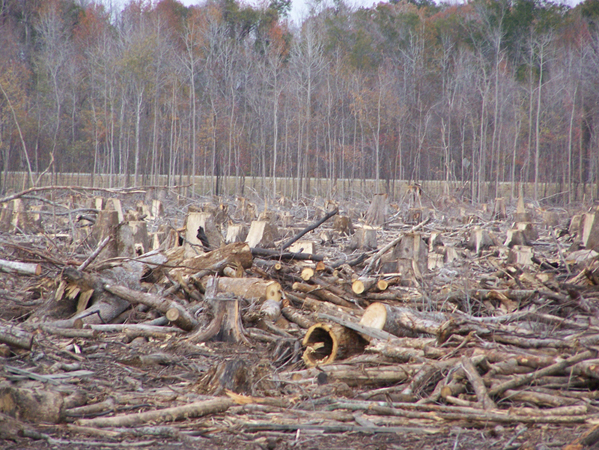
As I fly through the air on my way back to North Carolina from the (IP) annual shareholder meeting in White Plains New York, I can’t help but wonder just how long it will take for IP’s CEO, John Faraci, to get it that his company’s production of paper is devastating forests and that continued business as usual is a sure recipe for ecological and financial disaster.
John Faraci, in the midst of major financial turmoil in the global paper industry, has positioned IP as the global leader in paper technology and production efficiency – effectively retooling old paper mills to produce the same or more paper at less cost to IP.Certainly this is the kind of guy that, if he put his mind to it, could also position IP as a clear leader when it comes to forest practices. Yet IP is throwing up nothing but excuses when its customers approach them about producing products without destroying forests.
Meanwhile, positive change is happening all around IP. IP customers in the office supply market have set aggressive goals for expanding their purchases of post-consumer and FSC certified paper.Some of these companies are shifting paper purchases to companies other than IP that are able to meet higher environmental standards. IP isn’t even in the race with some of its competitors when it comes to taking real action to improve forestry practices.
 And, as if pressure from customers and competitors weren’t enough, IP is even getting the squeeze from shareholders. Domini Social Investments introduced a
shareholder resolution this year calling on the company to produce a feasibility report on transitioning all of its fiber to FSC certified and recycled sources. Domini filed a similar resolution with MeadWestvaco – one of IP’s major competitors in the packaging sector. While MeadWestvaco agreed to take action on the resolution and will be producing a report over the next year, IP stubbornly stood opposed to it. Why IP would oppose this resolution is very difficult to understand, given that the marketplace is becoming more sophisticated in its understanding of forestry issues and is increasingly endorsing recycled and FSC certified paper as environmentally preferable to business as usual.
And, as if pressure from customers and competitors weren’t enough, IP is even getting the squeeze from shareholders. Domini Social Investments introduced a
shareholder resolution this year calling on the company to produce a feasibility report on transitioning all of its fiber to FSC certified and recycled sources. Domini filed a similar resolution with MeadWestvaco – one of IP’s major competitors in the packaging sector. While MeadWestvaco agreed to take action on the resolution and will be producing a report over the next year, IP stubbornly stood opposed to it. Why IP would oppose this resolution is very difficult to understand, given that the marketplace is becoming more sophisticated in its understanding of forestry issues and is increasingly endorsing recycled and FSC certified paper as environmentally preferable to business as usual.
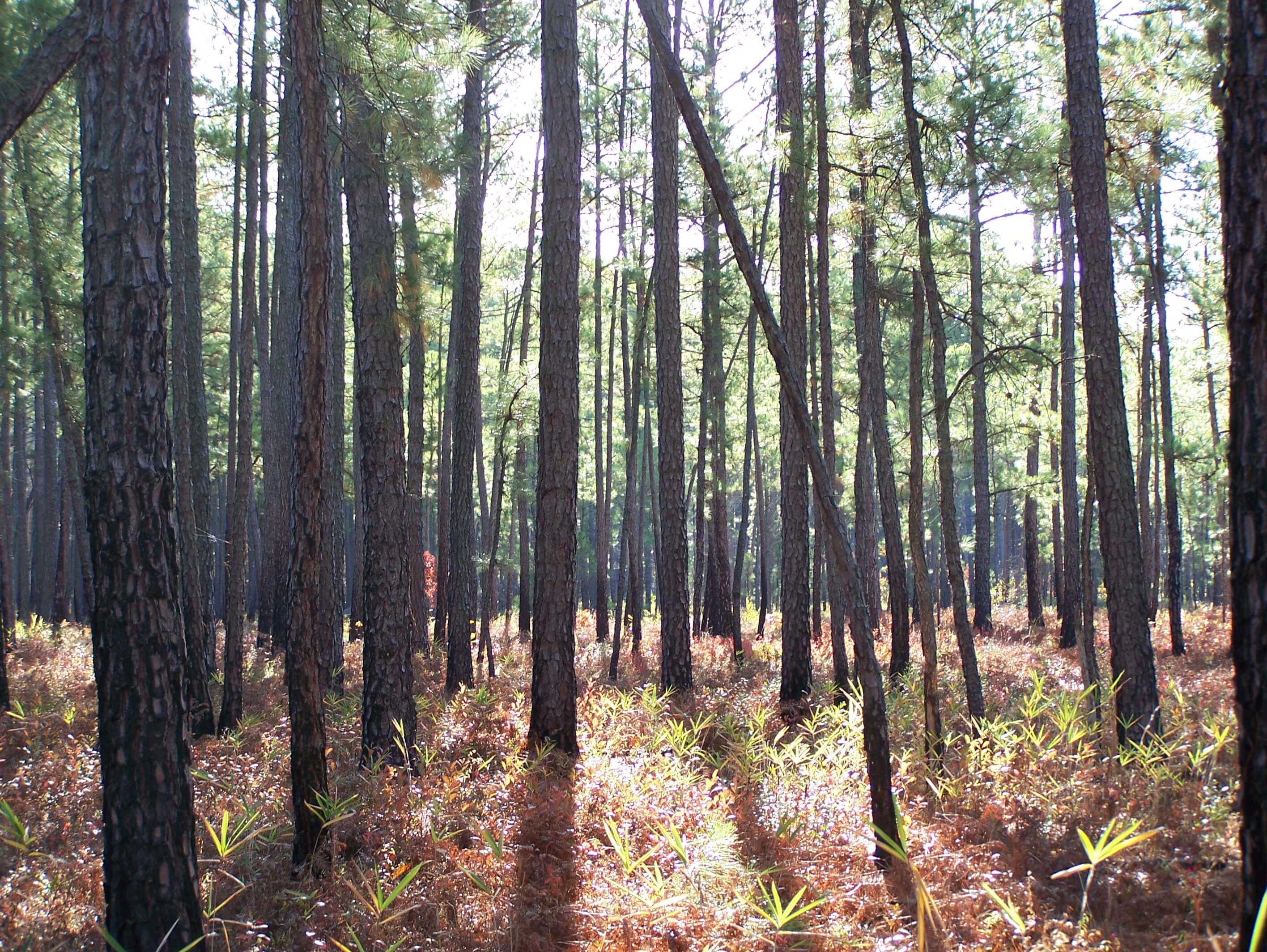 My colleague Andrew Goldberg and I flew to New York to attend the IP annual shareholder meeting hoping to get some answers.We asked Mr. Faraci why IP has not been meaningfully engaged with Dogwood Alliance, the leading organization in the Southern US (where IP’s operations are most concentrated) driving change in the marketplace with its customers and competitors, in trying to resolve concerns about IP’s forest destruction. We also asked him to explain why IP is a clear industry laggard when it comes to embracing high standards of forest management, when it such a leader in its industry on issues unrelated to the environment.
Faraci’s answers were less than impressive, reminding me of the teachers in the old Charlie Brown cartoons – whaa whaa whaa whaa whaa….
Come on Mr. Faraci! IP’s customers are getting it; your competitors are getting it.SFI certification is simply inadequate to ensure the long-term viability of the world’s forests.
An IP shareholder unknown to Dogwood Alliance or Domini reminded Mr. Faraci that “Change is painful but the failure to change is the kiss of death.”I was reminded of Darwin’s basic theory of evolution – species adaptability to change is critical to long-term survival.John Faraci is a survivor. IP will adapt when push comes to shove.Dogwood Alliance, through its work with IP customers in the office supply and packaging sectors and through moving IP competitors along, is creating the change that will help the world’s largest paper producer evolve.
We’re trying to help you, Mr. Faraci, because we know you can do better….much better.Oh, and by the way, the health of the Earth – our home — depends on it.
GRN is a great organization working to protect the Gulf. Read about the campaign to Save our Cypress forests…
A quick update from Charlotte, NC for everyone. Yesterday, about 20 activists and I demonstrated outside the Lowe’s Corporate Headquarters with banners and fliers calling on Lowe’s to live up to their corporate environmental policies by no longer selling unsustainable cypress mulch. We wanted to make sure Lowe’s employees knew about the destruction their company is causing and feel the pressure to stop! And we decided to have a little fun with it too by bringing along all the fixins for a crawfish boil (crawfish and crawfishermen love the cypress swamps). It was a great success. Check out more photos on flickr.There were newspaper folks, cops, Lowe’s security, and lots of Lowe’s employees (unfortunately no one took us up on our offer for free crawfish). The HQ is a giant compound complete with guard booth and all, so we were situated at the end of the driveway (on public property) so that everyone leaving work from Lowe’s could see us. We handed out hundreds of fliers and you couldn’t miss our banners. The message was clear- Lowe’s is violating its own corporate rulebook by continuing to sell unsustainable cypress mulch.A small group of us attempted to peacefully enter the compound in order to deliver thousands of petition postcards to Lowe’s. Despite representing thousands of people, from radical students to suburban gardeners, we were turned away at the gate. I’m determined to deliver them before I go home though! You can help get the message directly to Lowe’s by picking up your phone and making a call right now. The phone number and talking points are available at http://action.healthygulf.org/petition.jsp?petition_KEY=490.Many thanks to Josh and his huge crew from Guilford University for making the drive. Thanks to John and the UNC-Charlotte Earth Club for everything (including housing me for the last couple days).And much appreciation to Shannon for all the great photos!
Will you help us kick off the national Fast Food Packaging Campaign?
The Southern US is the largest paper producing region in the world. Packaging is the #1 paper product from our forests, led by the fast food industry.
Will you send a message to the fast food CEO’s having the biggest impact on our forests? Click here to send your message.
While you’re there you can let the CEO’s know that they should a) use more post-consumer recycled paper; b) use less; and c) stop using paper for packaging from endangered forests.
We have been on the road the last couple of weeks holding press conferences and community meetings to let kickoff the campaign. We’ve met some great people, gotten some good media, taken some great photos and videos, and worked with awesome volunteers. No matter where we are, one thing always rings true-Southern forests are too important to be wasted for fast food packaging.
You can tell the biggest Fast Food chains to stop buying their packaging from Southern forests. We identified the top offenders and they are… Taco Bell, KFC, Long John Silvers, Pizza Hut, A&W, McDonalds, Wendy’s, Quiznos, Jack in the Box, and Bojangles.
Tell the 11 Fast Food Junky CEO’s to stop trashing Southern forests for chicken buckets, burger boxes and to-go containers.
Click here to send your message today!
While you’re there you can check out the new website and find more info about the campaign, including a downloadable report linking the top offenders to Southern forest destruction at www.nofreerefills.org.
Why fast food? Because Southern forests are too important to be wasted for fast food packaging.
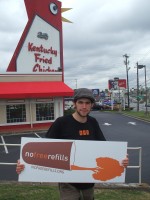
· Fast Food Chains are buying packaging from Southern forests
· 15% of landfill waste is fast food packaging
· The average American throws out 300 lbs. of packaging waste every year
Our fast food lifestyle is burying us in an avalanche of excessive packaging and waste. Every year millions of pounds of food packaging waste litter our roadways, clog our landfills and spoil our quality of life.
Southern forests, the jewel of the American landscape, are being destroyed to bring you fried chicken, burgers and fries, and super-sized convenience in a glut of wrappers, boxes and cups. Simple choices and creative solutions can reduce the excess and destruction while still allowing us to enjoy the level of convenience we have come to expect.
Join Dogwood Alliance in challenging corporations to change their habits. Our forests are too important to be wasted for disposable packaging. With nearly 100 paper packaging mills in the South, the packaging decisions of these corporations have a tremendous impact on our forests.
Take action today!
http://dia.dogwoodalliance.org/campaign.jsp?campaign_KEY=24343&t=nofreerefillsAction.dwt
For the forests, Eva Hernandez Organizing Director Dogwood Alliance
10 easy things musicians can do to go green to celebrate earth day…
I was recently at a workshop led by Environmental Lifestyle Expert Danny Seo – a best-selling author & media personality. The room was filled with industry and corporate representatives, product consumers and music fans. Obviously these people were interested in learning how they can live a more eco-friendly existence and chances are, your fans are interested as well.
While every day should be considered Earth Day, April 22nd is the official date when the media and your fans will be hyper-aware of green initiatives and activities–all month people will have green on the brain. Do your part by adding some eco- friendly promotions to your marketing plan & up coming gigs and you can help save the planet and grow your fan base.
What’s your issue? Global Climate change is driven by deforestation, air pollution, corporate control of resources, agribusiness, etc. It’s all connected, and there are Environmental Organizations that can help promote your efforts. Choose your issue, and become an Environmental advocate starting this Earth Day.
Here are some things you can do:
Starting this Earth Day, you can educate and promote social action, and change the world one gig at a time. To find out more check out Dogwood Alliance, Rainforest Action Network, or check out the Business Ethics Network website for a list of Corporate-sponsored campaigns.
Stay tuned: Next month I’ll be writing about environmentally friendly musicians, what they’re doing and how you can get in the mix. If you’re already doing something Green, let me know and maybe I’ll write about you!
For Immediate Release: March 31, 2008 Contacts: William Craven, cell 415-407-3426; Andrew Goldberg, cell 828-251-2525 x19 Office Supply Industry’s Environmental Progress—and Problems— Cited by Environmental Groups As NY Paper Week continues, USA Today Ad and Scorecard Reveal Leaders and Laggards Asheville, NC – An advertisement in today’s USA Today highlights the forest-related paper practices of five major office supply companies: Corporate Express (NYSE: CXP), FedEx Kinko’s (FDX), Office Depot (ODP), OfficeMax (OMX), and Staples (NasdaqGS: SPLS). Environmental groups Dogwood Alliance and ForestEthics say FedEx Kinko’s and Staples are making significant progress in their paper purchasing, while OfficeMax has been doing the least to back up its “green” spin with concrete actions. In addition to several other cities, the ad ran in USA Today’s New York City edition, where paper industry executives are gathered for the American Forest & Paper Association’s annual “Paper Week.” The environmental groups released the ad and their “Green Grades” report card to provide the environmental information that companies and consumers increasingly use to guide their buying choices—and to remind paper industry executives of where progress is still needed. “Office supply companies buy and sell large amounts of paper and their decisions directly affect the world’s forests and forest communities—including forests that provide homes for endangered species and shield us from global warming,” said Andrew Goldberg of Dogwood Alliance. “While no office supply company is perfect, Staples and FedEx Kinko’s are making real progress and lead the sector overall,” said Daniel Hall of ForestEthics. The two companies have been the industry’s most responsive in shifting their paper sourcing from Endangered Forests to more sustainable sources. Last month, Staples stopped sourcing from Asia Pulp & Paper, Indonesia’s largest paper manufacturer and the subject of current investigations into illegal logging and endangered rainforest destruction. Last fall Staples committed to shifting the majority of its paper offerings to Forest Stewardship Council (FSC) sources by 2010. FedEx Kinko’s played an important role in a landmark agreement to protect endangered caribou in British Columbia by shifting its paper purchases away from caribou habitat to FSC sources. The company was the first to adopt a strong FSC preference, and has renewed efforts to avoid controversial Indonesian fiber sources. The “Green Grades” report card also notes that Office Depot and Corporate Express are making strides in some areas, but the jury is still out on key questions. Office Depot has a strong fiber tracking system, is phasing out its last remaining Asia Pulp & Paper products based on longstanding recognition of concerns there, and is promising to help bring more FSC products to market, including in the US South. However, the company needs to more aggressively cut its sourcing from imperiled Canadian Boreal Forests. Corporate Express adopted a new paper procurement policy last fall, and is now making large FSC purchases. It is not yet clear whether the company will drop Endangered Forest sources from Indonesia and elsewhere. The report card identifies OfficeMax as the industry’s clear laggard, with the company’s procurement policy lacking strong Endangered Forest protection measures or a preference for FSC certified products. While some progress has been made to increase FSC products, the groups also noted that too much of the company’s paper still comes from destroying forest ecosystems in Canada and the US South. The two organizations are confident their work will spur further progress in this important sector, having guided the office supply industry over many years towards more sustainable policies, as evidenced by the actions of Staples, FedEx Kinko’s, Office Depot, and other companies. “Pressure from major corporate customers is often crucial to encouraging forestry companies and governments to protect Endangered Forests and adopt more sustainable practices,” said Hall. “The office supply sector has a major role to play in forest ecosystem protection and restoration,” said Goldberg. Several office companies have already helped protect selected Endangered Forests—and all of the companies need to take more aggressive steps elsewhere, including by addressing their utilization of fiber from the Southern US and , a company with a long history of destructive logging practices in that region. The “Green Grades” report card evaluates companies on five categories crucial to forest protection: post-consumer recycled content; sustainable forest management; Endangered Forest protection; establishing chain-of-custody to determine origin of paper products; and prohibiting the conversion of native forests into tree farms or other non-forest land uses. The report card is available at forestethics.org/greengrades # # # Dogwood Alliance is the only organization in the Southern United States holding corporations accountable for the impact of their industrial forestry practices on our forests and communities. In addition to holding the office supply industry accountable to their environmental commitments, Dogwood Alliance is working to stop the destructive practices of the paper packaging sector. Visit dogwoodalliance.org for more information. ForestEthics, a nonprofit with staff in Canada, the United States and Chile, recognizes that individual people can be mobilized to create positive environmental change—and so can corporations. Armed with this unique philosophy, ForestEthics has protected more than 12 million acres of Endangered Forests. Visit ForestEthics.org for more information.


 Donate