


What an incredible Kick-Off Meeting we had here in Norfolk.
Annie and I are thrilled, excited, and inspired by the student leaders of the Norfolk Chapter of Dogwood Alliance. Forty-five people turned out to learn more about the campaign and how to get involved. Our guest speaker, Professor Sussman of Old Dominion University did a great job emphasizing why it is SO important for people to become active and enable change in our world, whether it be in our electoral politics, or pressuring fast-food companies to stop supporting the clear-cutting of our forests for hamburger wrappers and coke cups. We broke up into three groups so that folks would focus, strategize and plan how we can make the biggest impact in Norfolk- and the juices were flowing! So many ideas to engage as many people as possible and make a huge splash. There is no doubt in our minds that the passion and drive to protect our forests will continue on here in Virginia.

Go Team!
How do go from being a small team of excited forest crusaders steadily gathering one pledge after the next to being a huge team of committed activists working with stealth, precision, and mass impact garnering the support of thousands here in Wilmington?
The answer, as we proved it this week here in Wilmington was to kick it up a notch with a kick-butt Kick Off Meeting! (Bruce Lee would be proud of us and all our kicks, wouldn’t he?) On Wednesday night, over 55 people crowded into our meeting,
bringing with them a whole host of awesome ideas for how we can really amp up the pressure on Taco Bell, KFC, and Pizza Hut to quit using our amazing forests in North Carolina for their disposable packaging. To think – these companies are currently sitting comfortably and content with the destruction they’re causing in our communities just to make more trash for their fast food! Not for long, though, eh? Though they might think they’re safe in their ivory tower of paper-packaging madness, they’re soon to hear from us.
Coming out of our Grassroots Pressure (aka – gROOTS!), Community Outreach, and Media Visibility teams will be a whole chorus of support for sustainable forestry, sane reductions in packaging, and the no-brainer switch to post-consumer recycled content.
Check out the photos too – I think you can even see someone doing a roundhouse kick in the back of the room!


Saturday afternoon, a group of 30 campus and community Dogwood Alliance volunteers gathered at the Nature Conservancy’s Green Swamp Preserve in Brunswick County for a tour of the amazing forests we’re working to protect. Students, grandparents and children alike came to check out the 15,

907 acres of awesome long leaf pine savanna and all the neat critters and carnivorous plants that live there.
Joe Abbate of Cape Fear River Watch (www.cfrw.us), a long leaf pines expert and riveting bird enthusiast joined our group to give us the low down of just how awesome long leaf pine savannas really are. Also with us was Mark Todd of the North American Sarracenia Conservancy (http://www.nasarracenia.org/). (Sarracenia is the fancy name for a pitcher plant.) While this isn’t the best time of year to find them, Mark was able to hunt down a few choice carnivorous plants. He even pulled some of the dried ones apart so we could see the dead bugs inside- definitely a highlight for the youngest among us.
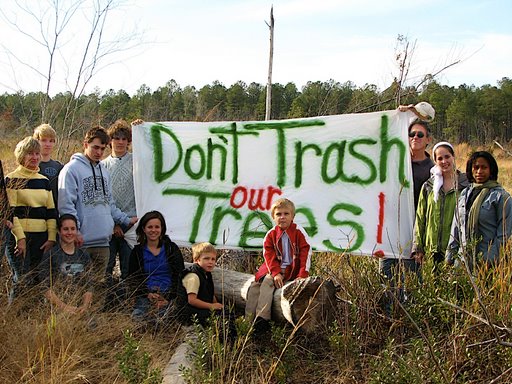
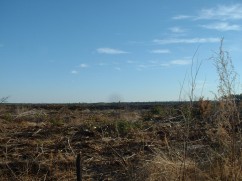
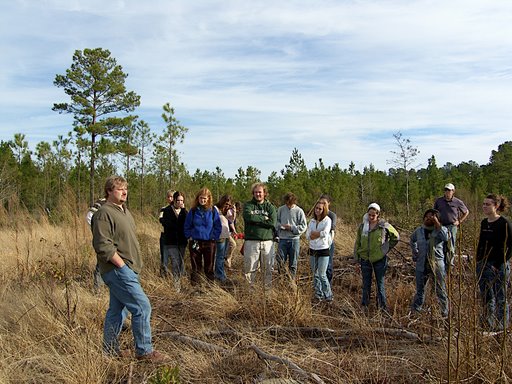 After touring the beauty that our forests have to offer, we drove back towards Wilmington and stopped at a pine plantation to get a taste for what industrial logging is really like. There Mark gave us the run down on ditching and draining, herbicides and all the other things that make pine plantations problematic. We checked out some of the pine plots and then went to a recent clearcut. The silence seemed to be the first thing everyone noticed. After some exploring we picked a spot and took this awesome picture- soon to be in a Yum! Brands inbox- as well as some video for our documentary project.
To learn more about the Green Swamp Preserve or how to get there, check out: http://www.nature.org/wherewework/northamerica/states/northcarolina/preserves/art5606.html
Wilmington, affectionately referred to as “the Dub” by the students who go there. Since the first day the Spring term we’ve been working with a super kick-butt group of students to bring attention to the packaging campaign and get more folks involved.
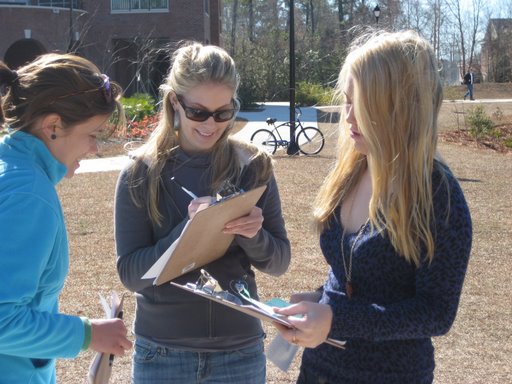 Students have been clipboarding all over campus, talking to their peers about the campaign and getting a crap-ton of petition signatures. Hundreds of students and faculty members have signed the pledge to save our forests and many have joined the effort as volunteers.
Today was our big Packaging Pledge Drive. We amassed a big team of clipboarders, including a lot of brand new volunteers, and took campus by storm. More than 20 student volunteers turned out to help with the effort and by 2pm, we’d had 165 students signed up to volunteer with the campaign! In addition to our hard work, we attribute our 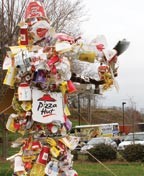 successes to the awesome fast food trash sculpture of a tree that some of our stellar ladies came up with. With chicken wire and chicken nugget boxes they constructed a pretty sweet tree on Chancellor’s Walk. We solicited trash from passersby and unsuspecting diners throughout the day to add to the sculpture and by the end of the day it looked pretty wonderful. And don’t worry, unlike the fast food companies, we recycled all the paper packaging we used when we were done.
Given today’s success, things are looking mighty exciting for our Campaign Kick Off Meeting next week. Stay tuned for photos and highlights from that event!
Hello again! This is Annie and Claire in Norfolk, Virginia. We have been blown away by the response here in the city. There has been a cold snap here this week, but volunteers just keep coming out!
The truth about fast-food packaging coming from our endangered forests is now all over campus. The student environmental groups on both campuses are so excited to work on this campaign.
This week we got above and beyond the petition signatures we had hoped for. Students and community members agree readily that fast food companies need to do the right thing and stop fueling the destruction of our forests.
 Annie and I both had great visibility events on campus complete with tables, a tree with trash hanging off of it, and a speech bubble to pose with. “Dear Fast Food: Stop Clear-cutting for packaging!”. It was a hit. Take a look at the pictures. Almost more people came to the tables to sign the petition than we could handle. But we have great volunteers!
Next week is our kick-off meeting to brainstorm how to make an even bigger impact here in Norfolk. Everyone is eager to get going and be heard loud and clear by the fast-food companies.
We are continuing to meet with leading environmentalist groups in the area who share a vision for a sustainable future. Norfolk clearly has an environmental ethic that wants to see change on fast-food paper packaging.
Noelle and I have arrived in Wilmington – the Port City!
And quickly, it’s become clear to us that of all the things Wilmington has become famous for – Dawson’s Creek, massive sprawl, more lattes than you can shake a stick at – the Green Swamp is by far its most awesome asset.
We got to town last Wednesday but it didn’t take us long to book it out of the office and out to the swamp. We were able to head out to Brunswick County just West of town and tromp around the forests of the Green Swamp with Mark Todd, a most amazing tour guide from Supply, NC. Mark grew up in Brunswick County and still lives there. He’s also active with the North American Sarracenia Society. For those out there who don’t know what that means (as I so ashamedly did not before I met Mark), Sarracenia is the genus of a set of 9 unique and incredible carnivorous plants. Carnivorous plants…!? I know. That was my reaction too. But it’s true! These plants, many of which are endemic to the area of the Green Swamp, will essentially tempt insects with their sweet smells and beautiful blooms to come and hang out where they have strategically evolved to trap them in a kind of poisonous liquid. The Sarracenias, or Pitcher Plants, as they’re more commonly known, then use the nutrients from the decomposing insects to grow and flourish.
Woah! Feels like an episode of Bill Nye the Science Guy, right? But it’s all for real and on Sunday we got to take it all in.
After an hour or so of just trekking around and soaking up the sun, listening to the wind up in the pines, and having Mark tell us more about the different plants and animals species unique here in the Green Swamp of North Carolina, we commenced our search for the wild and illusive-in-winter, Venus Fly Trap. In summer, I’m told, these guys can grow quite large, in clumps of 5, 10, or 20 plants all together. But at this time in the winter they like to hide out under the grasses and fallen pine needles. So, we had to scavenge, digging around in the dirt and grass, scouring the ground beneath our feet, practically listening for the sound of the fly trap, until at last we found some! Actually, I found them! I was rather proud, being a native North-Easterner originally, but I quickly forgot my pride and just got wrapped up in the amazing quality and fragility of these amazing plants.
 To think that we’re jeopardizing the
habitat where these plants have traditionally flourished for centuries is even
more unconscionable having now seen them in action. With any luck, come the
spring, our campaign will be humming and the Sarracenias will be blooming. Que
viva los sarracenias!
To think that we’re jeopardizing the
habitat where these plants have traditionally flourished for centuries is even
more unconscionable having now seen them in action. With any luck, come the
spring, our campaign will be humming and the Sarracenias will be blooming. Que
viva los sarracenias!
Abigail has met some great people, all who have a place in their hearts for Southern forests.
I spent a couple more days at Lake Waccamaw last week, speaking with folks and checking out the Nature Conservancy’s preserve down in the Green Swamp.They recently acquired an additional piece of land known as Juniper Creek, which connects their Green Swamp with Lake Waccamaw.In the land of pine plantations, it’s heartening to see some long leaf pine savannah being restored and wildlife corridors connected.
The folks I met with in the Green Swamp/Lake Waccamaw area were grassroots activists, policy-focused activists, forestry consultants, park rangers, professors, engineers, paddlers, businessmen, naturalists, nurses, and environmental educators.I saw some nasty wetlands logging and some beautiful sunsets and big old cypress trees.I became crepuscular (active at dawn and dusk), wanting to soak up as much of the still, open water and moss-covered gum trees as I could before heading back home to the mountains.And I learned of a few environmental education initiatives underfoot to get folks out and about in the region’s amazing swampland, studying the area’s ecology and the critters that call it home.
After leaving southeast NC, I made a trip back up to Virginia to meet with a local historian, a whitewater paddling champion, an avid bird watcher, an Earth First!er, a wildlife biologist, and some local folks working to restore the wetlands in their own backyard.All of them sing the praises of the Great Dismal Swamp – its unique history, biodiversity, and substantial wildlife habitat in the midst of an ever-expanding matrix of roads, subdivisions and strip malls.
I also got to attend a 7am bird walk at the Great Dismal Swamp led by the refuge biologist.The birds were a bit elusive, but it was great just to be out in the swamp at sunrise and hear from local folks about their experiences with bears, owls, and other wildlife.
Check out photo gallery soon to come. In the meantime, here are some more photos from the Great Dismal Swamp:

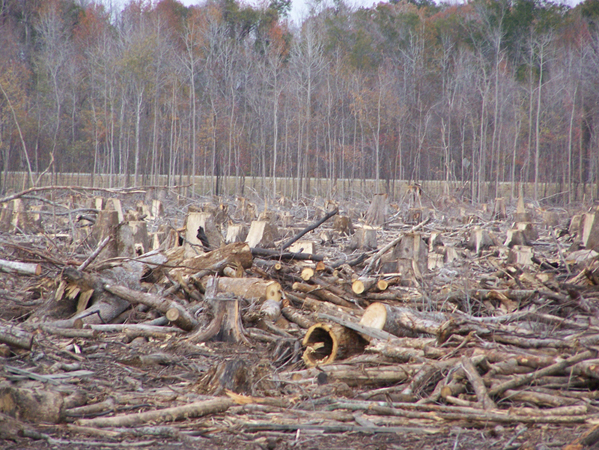
Unfortunately it seems that many logging companies are taking advantage of the current drought, getting into wetland areas that are usually inaccessible and cutting down the hardwood trees. There is a particularly brutal example of this in the White Marsh area just outside Whiteville.What locals tell me used to be a beautiful swamp teeming with wildlife (and which would noticeably create a cooler microclimate in the summer) is now a vast clearcut. Whether and when the swamp will be able to recover is a subject up for debate; wetlands take much longer to recover from disturbances than do other forests, especially in extreme cases like clearcuts. And as more and more land is developed, the remaining wetlands become increasingly necessary for wildlife habitat, a natural water filtration and purification system for agricultural runoff and other human-caused pollutants, a carbon sink to mitigate climate change, and a place for us humans to care for our sanity, reconnect with the natural world and get away from the madness of consumer culture.
All in all, I consider myself pretty lucky to have the opportunity to experience all these amazing places and speak with the folks working to protect and restore the land. The contrast between these remarkable ecosystems and the sterile pine plantations I drive through to get to them is also quite striking. As I approached ‘s Riegelwood mill, I noticed more and more logging trucks converging on the mill from all directions. But it wasn’t until I actually drove up to the mill and watched the endless procession of trucks full of logs entering the monstrous facility that I fully realized the extent of the wholesale extermination of southern forests. Our life-giving forests and wetlands are literally being sacrificed on the altar of disposable consumerism.
We can’t survive without these ecosystems – let’s get out there and save them!
Interviews, photos and clearcuts. The last few days have been a whirlwind, and I cannot believe these forests are being clearcut for packaging…
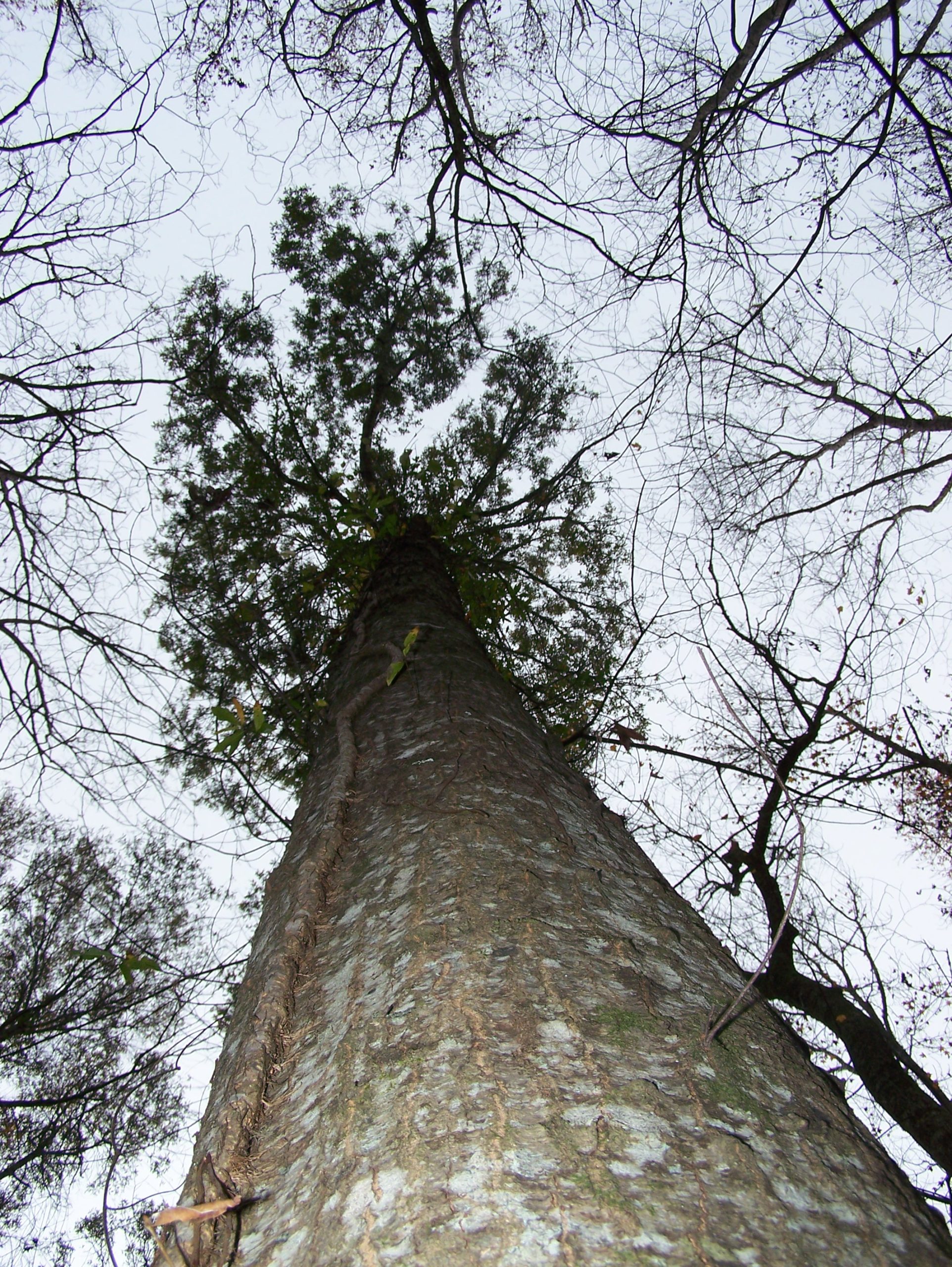
 Now I’m down at Lake Waccamaw, a large shallow lake west of Wilmington that’s one of the Carolina Bays. I’ve been talking with local folks about the distinctive characteristics of the lake, such as the limestone bluffs that give the lake its neutral pH.This pH provides habitat for several rare fish, mussels and snails, some of which are only found at Lake Waccamaw. There are several endemic plant species here as well, both at the lake and in the adjacent Green Swamp, home of the venus fly trap and other carnivorous plants. (This Photo is me in a 1,000 year old Cypress Tree just outside the Green Swamp)
I’ve had the pleasure of spending time with some of the Friends of the Green Swamp (FOGS), who were recently victorious in defeating a new mega-landfill slated to be constructed just a few miles from the lake.FOGS succeeding not only in keeping the landfill out of their own backyard, but also in passing a state-wide moratorium on the construction of new mega-landfills.
Now that the landfill (which may have imported garbage from places as far away as New York) is defeated, FOGS is looking to re-instate curbside recycling in the area in an effort to reduce the amount of waste generated in the first place.Addressing consumerism as a root cause of “the problem” quite resonated with me, since I’ve been touring around the region documenting all the unique ecosystems being decimated by the mass conversion of trees into disposable paper packaging products.
I also had a chance to go down the Pamlico-Tar river with Heather Jacobs, the Pamlico-Tar’s Riverkeeper, and hear about both the ecology of the watershed and the threats to it posed by logging and development.
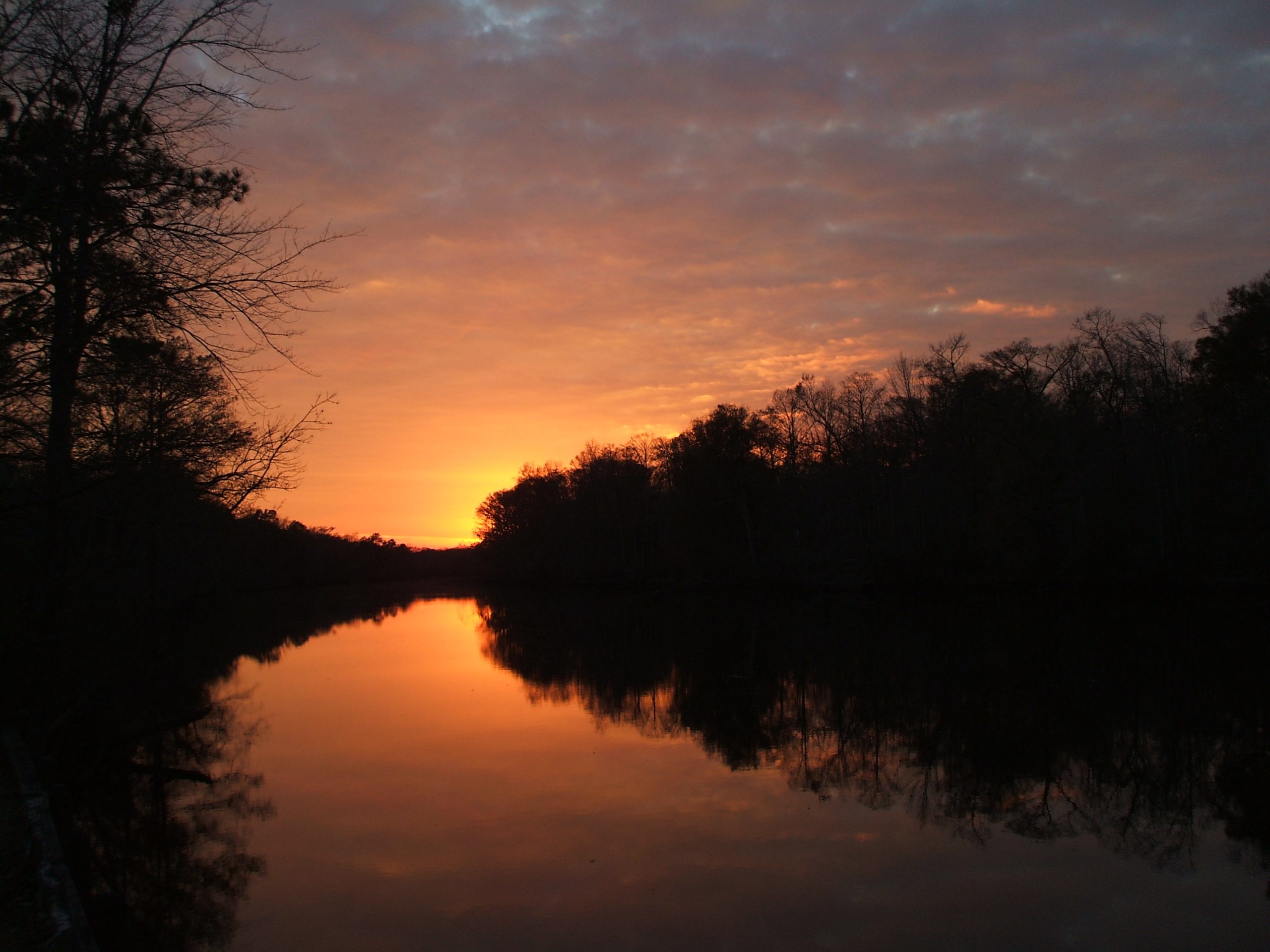
A few days ago, Eva and I met up with Andy Wood, a naturalist with Wilmington Audubon and quite a wealth of information.In the Holly Shelter Game Lands north of Wilmington, we went for a walk in the woods that border the Cape Fear River, exploring some wetlands, poccosin and long leaf pine forest. Along the way we learned several native plant species, visited a thousand year old cypress tree and caught a glimpse of the rare fox squirrel. We were still walking through the long leaf pines and discussing their growing patters when the sun went down in a fantastic sunset and it began to get dark. Check out this sunset on the Cape Fear River, wich runs right through The Green Swamp.
Next stop, SE Virginia… home to the Franlin, VA Mill.
My next stop was the Zuni Pine Barrens in southeast Virginia, a long leaf pine restoration project..
 This site is adjacent to the Antioch Pine Barrens, another long leaf pine restoration area managed by the state.Long leaf pine forests used to cover much of the region; Zuni, Virginia is around the northernmost part of its natural range. These straight-growing trees were very popular in the ship building industry, and most of the original forests were cut to build houses and masts of ships, and also to utilize the trees’ tar, pitch and rosin. In recent decades, the region’s remaining long leaf ecosystem has been largely replaced by the quick-growing loblolly pine plantations favored by the timber industry. Another major blow to the tree has been the widespread suppression of wildfires, which are crucial to the species’ reproduction. Today, between 1 and 3 percent of the native long leaf pine forest remains.
So, I had the pleasure of walking through the Zuni pine barrens one brisk morning in late November, observing the open space and diverse undergrowth made possible by recent controlled burns in the preserve. I also met with Dr. Musselman, a scholar on the long leaf pine and major player in the restoration of the Zuni Pine Barrens, at Old Dominion University in Norfolk.
 After leaving Norfolk, I headed south to Merchants Millpond State Park in northeast North Carolina, an amazing swamp ecosystem dominated by bald cypress and tupelo gum trees draped in Spanish moss.The park is also utilizing controlled burns to bring back the native long leaf pine forest in the rolling hills surrounding the swamp. Paddling through the millpond, I saw lots of turtles and birds, and witnessed an otter invading a beaver den (which resulted in a cacophony of strange squeaking sounds). Nowadays, the millpond even has a few alligators, recent migrants from further south who are heading north due to habitat fragmentation, climate change… no one’s really sure.In any case, Merchants Millpond is a beautiful and unique place, thankfully spared from the destructive wetlands logging that is so prevalent on the surrounding private land.
I also had a brief stopover in Pettigrew State Park, another distinctive place full of old cypress trees, birds and other wildlife. After speaking with a park ranger about the many tree species that exist there, I watched birds dive for fish and the sun set over Lake Phelps.
Next update, from Lake Waccamaw and the Green Swamp!


 Donate