


Click here to sign the letter to Music industry leaders.
Let’s make sustainable Packaging readily available! Click here to download a copy of the fact sheet.

When the opportunity presented itself this week, I traveled east to coastal North Carolina hoping to glimpse something that is at the heart of Dogwood’s mission- a bit of remaining wilderness.
In March, as we at Dogwood Alliance continued to pressure businesses and individuals in the health and beauty and music industries to change their forestry practices, I found myself jaded by the bureaucracy of the work and disconnected from our true purpose. So, when the opportunity presented itself this week, I traveled east to coastal North Carolina hoping to glimpse something that is at the heart of Dogwood’s mission- a bit of remaining wilderness.

The first stop on my pilgrimage, however, was nothing of the sort; I passed ‘s Riegelwood Mill in Brunswick County. The smell hit me miles before I saw the billows of white smoke over the tops of pine trees. Logging trucks passed me left and right on the road. Nearing the mill, I pulled over and snapped some pictures of the mill and the loblolly pines that tower around its outskirts.
Discouraged, I drove from there through a corridor of Wal-Marts, restaurants and banks along NC-17, passing occasional stretches of trees which were almost all loblolly (one of the most common pines in monoculture plantations, displacing the disappearing longleaf pine). Then, suddenly, I turned onto a two-lane road and saw the large green sign: Green Swamp Preserve: The Nature Conservancy. Suddenly, there were no Wal-Marts, nor even gas stations. I parked in the designated lot.
The Green Swamp Preserve is 15,907 acres north of Supply,
NC, consisting mainly of savanna and pocosin ecosystem types. The area, I learned from a sign, frequently undergoes prescribed burns to keep the longleaf pine ecosystem healthy; 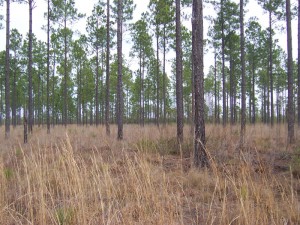 most plants here thrive in fire. At first upon
embarking on the primitive trail I felt only solitude, noticing the grasses, shrubs and longleaf pines that flickered as clouds passed overhead. No humans here.
most plants here thrive in fire. At first upon
embarking on the primitive trail I felt only solitude, noticing the grasses, shrubs and longleaf pines that flickered as clouds passed overhead. No humans here.
Gradually, though, my feeling of solitude disappeared. It began when from across the large pond on my left, the cries of wood frogs with spring fever reached me. Then, I heard the knock-knock-knock of a woodpecker and spotted him jerkily hopping up the trunk of a pine tree. I realized that I wasn’t alone: I flushed a group of birds out of their hiding place under a group of sweetbay shrubs.
I did see a few signs of humans (a boot-print in the mud, a half-decomposed cigarette butt), but they were no more evident than signs of other beings. A pile of droppings- coyote, or maybe gray fox- tipped me off to the presence of predators and prey living out their lives amongst these trees.

Did being in the swamp alone make me uncomfortable? I’ll admit that after spotting the fox scat, I was hesitant to venture deeper into the pocosin. However, this discomfort hardly lasted a few moments, whereas the unsettling feeling of being amidst parking lots and McDonalds is with me always.
As Dogwood Alliance continues its packaging campaign, I think I will find renewed passion for the work. I realized on this trip that the trees we are protecting, stately as they are, are not just trees. They are the foundation for a whole web of flora and fauna that exist outside the understanding of humans, a whole brilliant world that is far superior to the convenience of any product in a paper box.
-written by Katie Blanchard-Reid
March 2007
Update from South x Southwest–transforming the packaging problem.
When we do something at Dogwood Alliance, we do it big, and greening the music industry is no exception to that rule. We have come to SXSW , a monumental music industry conference, to meet with key partners, and to sign up labels, artists, activists and volunteers to sign on to the campaign to green the music industry, transform the packaging problem and help protect Southern forests to slow global warming.
Definitely a hefty task, and we’ve come a long way in the 2 days we’ve been in Austin, TX. The highlight so far for me was the panel, Greening the Music Industry, where we were represented by out friends at TreeSound Studios and Tree Leaf Music. Perry Farrell (of Janes Addiction) was also on the panel, in addition to the other leaders in the movement to green the music industry.
A hot topic of conversation was packaging, especially paper packaging. With forest destruction as one of the leading causes of Global Climate Change, the music industry, savvy as they are, are really picking up on this. Paper Packaging was mentioned by everyone from David Byrne to Frank Mauceri who runs a Green Music Label out of Chicago, Smog Veil Records, and they all genuinely want to do something about it. We’re here to let them know what they can do to protect amazing forests and slow global warming.
We’ve also met with Marc Ross, the director of Rock the Earth , who wants all of the artists who work with Rock the Earth to sign on to the campaign. Rick Farman, of Bonnarroo, wants our volunteers to be backstage throughout this years festival talking to all of the musicians about their packaging choices. No one wants their packaging to come from Endangered Southern forests, and when we can show Sony and Universal that the demand is there for sustainably made packaging, they will create it.
I haven’t even mentioned all of the other artists and managers we’ve talked to who want to sign on the the campaign.
And at the trade show, all of the folks who make the packaging are interested in making sure it’s all sustainably made. And, we’ve had great conversations with our friends at TreeSound Studios in Atlanta, who are definately doing their part in greening the music industry.
I can rest assured that we have broken into the music biz, and now we’re going to transform it!
Oh, I almost forgot, check out our new factsheets about Southern forests and Paper Packaging that we’ve been handing out, just click here. Feel free to download them or email a copy to your friends in the music industry to let them know what they can do.
Stay tuned for further updates.
For the forests (and the music!),
Eva
Company Joins Competitors in Commitment to Reduce Environmental Impact; Comprehensive Report Detailing Environmental Progress within Office Supply Industry to Be Released Within the Year
Asheville, NC – Today, OfficeMax (NYSE: OMX) released a new environmental paper policy which will reduce the company’s impact on forests and further bolster the recycled paper industry. This commitment caps a seven-year effort by environmental groups led by Dogwood Alliance and ForestEthics to green the office supply industry. In less than a decade, the office supply sector has now transitioned from one of the most environmentally destructive industries to one that has begun to challenge the world’s largest paper companies to improve their forestry practices.
The first target of the campaign, Staples (NasdaqGS: SPLS), announced a policy in 2002 which has resulted in the company dramatically increasing the amount of recycled paper products they sell and becoming an industry-wide leader on global climate issues. Their commitment was followed in 2004 by a similar one by Office Depot (NYSE: ODP). Office Depot has also dramatically increased the amount of recycled paper products it sells and planned an important initiative to protect the endangered forests of the Cumberland Plateau. And now, OfficeMax has made a step toward environmental leadership with its new policy.
“After seven years, the largest paper retailers in the office supply sector have made the shift from an environmental nightmare toward environmental responsibility,” said Andrew Goldberg, lead negotiator on the campaign from Dogwood Alliance. “Today OfficeMax grabs a seat at the table and we look forward to working with the company to create real on the ground change.”
Though OfficeMax has publicly stated its intention to work with its suppliers to protect the endangered forests of the Cumberland Plateau, it has failed to take action thus far. The majestic hardwoods of the Cumberland Plateau represent some of the most important intact endangered forests in North America. Companies including Bowater (NYSE: BOW) and Office Depot has initiated efforts to save this hotspot of biodiversity.
“Over the last ten years, our organization has joined countless concerned citizens in the fight to protect the forests of the Cumberland Plateau from the ravages of industrial forestry,” said Danna Smith, Policy Director at Dogwood Alliance. “We expect OfficeMax to prove that action speaks louder than words by instituting real on the ground protection for the forests of our region.”
OfficeMax has also yet to take action to protect North America’s Great Boreal forest, which is one of the best natural lines of defense against global warming and is being mowed down to make paper, much of it used by U.S.-based companies.
# # #
To view the new OfficeMax environmental paper policy, please visit: http://about.officemax.com/html/officemax_environmental_policy.shtml
Dogwood Alliance is the only organization in the South holding corporations accountable for the impact of their industrial forestry practices on our forests and our communities. To learn more, visit: http://www.dogwoodalliance.org
Today, OfficeMax released a new environmental paper policy which will help to reduce the company’s impact on forests and further bolster the recycled paper industry. The company now joins its competitors, Office Depot and Staples, with standing environmental policies.
To read the Dogwood Alliance Press Release about the OfficeMax policy, check out our pressroom by clicking here.
The adoption of a policy by OfficeMax could not have been achieved without your support, from the thousands of postcards and emails you sent to the company to the time spent out in front of OfficeMax stores to your financial contributions which provided us with the resources we needed to continue the fight. Thank you!
Though OfficeMax has notified its suppliers about its concerns related to the Cumberland Plateau and Canadian Boreal, they have not taken concrete action to protect these areas of concern. Click here to send an email to Sue Mills, Director of Environmental Practices and ask her to ensure the company takes immediate action to leverage on the ground protection for endangered Southern forests like the Cumberland Plateau.
In less than a decade, the office supply sector has now transitioned from one of the most environmentally destructive industries to one that has begun to challenge the world’s largest paper companies to improve their forestry practices. We expect OfficeMax to uphold this standard and work with its suppliers to change their forestry practices.
We will continue to work with the company to ensure that it follows through on its commitment. Thank you once again for supporting us in our work to defend and protect the magnificent forests of the Southern US.
Words of wisdom from Rachel, 11 years old
Forests are important because trees give off the oxygen that we breathe. If people keep on cutting down more and more trees, then we won’t have any left. And if we don’t have any left, then we won’t be able to breathe, and we can’t live without oxygen. Using recycled paper and recycling or reusing all the scrap paper that we have can help to save the trees that will save us. So, even though it might seem like making more paper is good, at the same time, it’s bad because it is killing trees. So, if you use recycled paper, you are saving trees and yourself and other people around you.
Companies should use less packaging because using more new packaging means cutting down more trees. And cutting down more trees is bad for the environment. Many stores now over package way too many things like toys, house decorations, and technical equipment. If companies would use less bags and boxes and wrappings, then they would be helping to save plants and many animals that live in these plants. That is why I think that protesting for more recycled paper and less new paper is good for people and the environment.
Rachel, 11 years oldThe Learning Community SchoolBrade 6
Download a pdf version of the report here.
This week is the kick-off of Dogwood’s packaging campaign. This campaign targets companies that use paper-packaging products sourced from endangered Southern forests. Think about it: what could be more wasteful than when a company cuts down trees to make the packaging we discard after purchasing the product? Does the box that my Dove soap comes in really need to be made of virgin material harvested from some of the world’s most biodiverse forests?
Dogwood is going to put an end to these egregious paper practices and here’s how: We’ve re-vamped our website, so its sleeker, sexier and more user-friendly than ever. We are getting packaging pledges signed left and right to show companies that the people demand change. And best of all, we’re giving you a chance and a way to tell these companies how you feel about living in an over-packaged society. Click here to sign the packaging pledge and leave share your input on the problem. Visit our website to learn how you can get involved. Yes folks, together we can make it happen.
What an exciting time to be a part of Dogwood Alliance. Start of a new year, new campaign and start of a whole new look and website for us. And above all for me Dogwood is the start of my future as an environmental activist. Working with this organization has been so inspiring for me. Seeing a little non-profit take on all these multi-million dollar corporations and win…it’s like the little engine that kicked ass.
–Elise Nabors, volunteer organizer
Take the Dogwood Alliance Packaging Pledge
Nationwide Response Illuminates the Packaging Problem
 People from across the country agree that the paper packaging industry needs reform.
It’s just not right and we can do better than generating 300 pounds of packaging waste per person each year.We generate so much waste that 32% of the entire domestic waste stream consists of containers and packaging.
We know that everyone feels frustrated by the packaging problem and we have heard from hundreds of you with great rants and cool new suggestions.
Check out a few of our favorite ones and don’t forget to Take the Pledge and contribute some comments of your own.
People from across the country agree that the paper packaging industry needs reform.
It’s just not right and we can do better than generating 300 pounds of packaging waste per person each year.We generate so much waste that 32% of the entire domestic waste stream consists of containers and packaging.
We know that everyone feels frustrated by the packaging problem and we have heard from hundreds of you with great rants and cool new suggestions.
Check out a few of our favorite ones and don’t forget to Take the Pledge and contribute some comments of your own.
The public is fed up with over-packaging. Here are a few responses to our pledge:
• It is pretty idiotic to produce tons of packaging material that all ends up being tossed out again. At least all the materials should be recycled but a huge amount could and should be eliminated all together.
• I have always been flabbergasted by the size and shapes of boxes for the tiniest things! All that packaging waste!
• We need to streamline our paper packaging! There is way too much wasted paper in the world already!
• Does packaging need to be so excessive in manufactured goods? I think not. Any packaging should be more reusable or recyclable. When procuring trees for paper products, special care should be taken, not to destroy endangered forests.
• It’s ridiculous how wasteful most packaging is! It is time for big changes.
Working together, we will educate the public and the marketplace about the negative environmental impact to Southern forests caused by “business as usual” packaging. We will tell companies that yes they can make changes to protect Southern forests and the rich biodiversity, clean water, clean air, and climate protection these forests provide for us all.
Join the fun: Take the Pledge!


 Donate