


‘-For immediate release, September 30, 2020-
As the Japanese Ministry of Economy, Trade, and Industry (METI) develops the Act on Special Measures Concerning Procurement of Electricity from Renewable Energy Sources by Electricity Utilities, wood pellet biomass must be excluded from consideration if the legislation hopes to secure carbon emission reductions, habitat protection, and community resilience to climate change, say American NGOs in a letter sent to METI, Forestry Agency, and the members of the Biomass Sustainability Working group today.
In an open letter (English, Japanese) from NGOs in the sourcing region for Japanese wood pellet biomass demand, METI is warned that incentives for forest-based wood pellet biomass have adverse impacts on climate, forests, and communities. Enviva Partners LP, the world’s largest pellet producer based in the Southern United States who supplies companies like Sumitomo with pellets, operates with little regard to its climate or environmental impact. Furthermore, the letter writers state, Southern US forests are better left standing than burned when it comes to the fight against climate change. Southern US forests, when left in the ground, are “a critical climate solution, storing enormous amounts of carbon in trees and soils and buffering communities from climate impacts like flooding and storms.”
According to Rita Frost, Campaigns Director of Dogwood Alliance, a signer of the letter: “If we are serious about tackling climate change, we can no longer incentivize burning forests for fuel. The Japanese government has a key opportunity to exclude wood pellet biomass from its definition of renewable energy, which will protect forests, climate, and communities.”
The American NGOs thank the Japanese government for seeking alternatives to fossil fuels in order to fight climate change and yet make clear that their experience with the wood pellet biomass industry shows it is unfit as an energy source in regards to climate aims.
– END-
See this press release in Japanese.
On this week’s podcast, we welcome Indy Srinath. Indy is an avid homesteader, forager, educator, herbalist, and food justice activist. She is currently working in LA managing an urban farm on Skid Row. She shares with us her story entitled, “A Forest As Black As Me.”
“It’s such a different world that we’re in these days, and it is interesting how some of these themes that I touch on in this story transform and transcend time. And I think that’s both beautiful and slightly disheartening because I speak a lot about nature and being a person of color in outdoor spaces, and it’s a challenge I’ve had since childhood.” – Indy Srinath
You can learn more about Indy and the work she is up to on her Instagram page at indyofficinalis.
Want to listen to more?
Elizabeth Lashay: Welcome back to Woods and Wilds podcast. I’m so excited to be here. I’m Elizabeth Lashay with Slay the Mic, and I’m joined by my wonderful cohost.
Kimala Luna: I’m Kimala Luna with Dogwood Alliance, and we have the absolute privilege today to be here with Indy Srinath. Indy Srinath is an avid homesteader, forager, educator, herbalist, and food justice activist. And last year at Woods and Wild’s IRL, she shared a really beautiful story that she’s going to share with us again today, and we’re really excited. So, we’d like to welcome Indy. Hi, Indy.
Indy Srinath: Hey.
Kimala Luna: Hi.
Indy Srinath: Hi. I’m so excited to be talking with the both of you. Again, it’s such a different world that we’re in these days, and it is interesting how some of these themes that I touch on in this story transform and transcend time. And I think that’s both beautiful and slightly disheartening because I speak a lot about nature and being a person of color in outdoor spaces, and it’s a challenge I’ve had since childhood. And I think it resonates a lot more for a lot of folks in these current times. So, yeah, it’s one of those things where it’s fun to be back here again chatting with you all, but having the same conversation feels a little dystopian sometimes.
Indy Srinath: Cool. So, I will just go ahead and share this story that we all got to share together last year. So, this is a story called “A Forest As Black As Me”. I was seven years old when I found out I was black. It was Jacob Glastonbury who informed me, on the playground by the tire swing. His hair was the color of dark autumn rain flooding golden cornfields, with the solstice sun suspended in the broken sky. And he always smelled like kerosene and smoke from his dad’s pickup truck. Jacob Glastonbury had a small circle of my classmates standing around him, each with their palm outstretch, and he dutifully doled out one singular Sour Patch Kid to each of my friends. “Yellow for you, Lindsey,” he said, because your hair is yellow. Edwin, you get green because of your green eyes.
Following suit, I stretched my palm out toward him, hoping for the orange one. The taste of red number 40 already on my tongue. I longed to have fingers coated in crystalline preservatives and palm sticky with corn syrup and fructose juice. “You can’t have one because you’re black,” Jacob said, turning away from me. And his words, they hung in the air stagnant and heavy like a Louisiana night. I could feel tears pushing past the levy of my eyelashes, felt them falling down my cheeks like cold water raindrops tracing rivulets down a foggy window pane.
I pushed past Jacob and his kerosene tongue and pushed past the old tire swing and pushed past the Oak trees and through the goldenrod field and past the pine trees and into the rhododendron and into the place where we weren’t supposed to go, into the dark place, into the place as black as me, into the woods, into the woods where you couldn’t hear the bell ring and you couldn’t see the playground and you couldn’t smell the Sour Patch Kids and you couldn’t taste the metallic flavor of embarrassment and shame on your tongue anymore.
And in the woods, I became black like Jacob said, engulfed in midday shadow, where pine trees offered their darkness upon the forest floor and let me sink into the depth of their beauty. And rhododendron let me climb upon its shoulders like some older brother would so I could reach my black, soil-stained palms toward open sky. And Western wind sang gentle hymns as they caressed the tops of black cherry trees. And the stream flowed with midnight black water. I could taste the gilded drops of sunlight as they squeezed through the continuum of the place where night meets day.
And I watched the holy matrimony of a black spider and an Oak limb as she weaved a glistening web, invisible, if not for the blackness of the tree. And I tasted dew from the moss covering the black stones and watched black ants marched down the length of a fallen branch. A black parade in a silent forest. I found something honest in the blackness of the forest, the way the missed clings to the blue, black sky like a whispered prayer, the way sunlight bows in the presence of shadows and drips from the edges of black pine needles. Finally, I felt proud that the forest was as black as me.
I emerged from the woods a silhouette. All that was dark was contained within me. The beauty and the absence of light through black existence light was surely promised. Jacob came to me at the edge of the woods with our teacher in tow and smiled at me through gapped teeth and violet eyes. “Sorry I called you black,” he said. “I’m supposed to give you a Sour Patch Kid now.” I told him I didn’t want his damn Sour Patch Kids anymore, and I knew my mom wouldn’t be thrilled that I had said damn in front of my teacher. But I was shadow barreling through blind night, and I was the midnight sun trading places with the waning moon. And it was 1999, and I just became black for the first time. There was beauty in the darkened woods, and I was enamored with the starless sky. I couldn’t be bothered with artificially sweetened candy and boys who smelled like pipe tobacco and had scorched smiles and tire swings and yellow hair. Not now and not anymore, because I was seven years old and I knew that the forest was as black as me.
Yay. Thanks for listening.
Kimala Luna: Thank you so much. Oh my gosh.
Elizabeth Lashay: Wow.
Indy Srinath: Yeah.
Kimala Luna: Yeah. I’m so enamored with your writing style, Indy. It almost becomes like a song. It’s like you capture the emotion, the rhythm in the description and just like these really graceful sweeps.
Indy Srinath: Oh, thank you.
Elizabeth Lashay: Yes.
Indy Srinath: Thanks. I’m glad it resonates somewhere with you guys.
Elizabeth Lashay: I mean, it resonated when you said it whenever I saw it live, and then now it still has that power. And I think, again, coming to find our identity in a time where racial tension is running high, we still have young people who are waking up every day and finding out their racial identity. And what is something that you wish you knew back when you were seven years old?
Indy Srinath: Yes. When I was a kid, we would always kind of play that game like, “If you could go back into any time period, which time period would you go to and what would you do?” And I think for me and a lot of other children of color, we were like, “Dude, things are only getting better for people that look like us. There’s no way I’m going back in time to any time period.” And I just would want to let my younger self know that that’s okay, to know that looking toward the future and being excited about being represented more and having more of a voice in the future is great, and it’s not something to be kind of ashamed of. I always felt like I wasn’t living in the present as a kid because I was just hoping for a future where I would experience more equity and more opportunity. So, I would just tell my younger self that, looking toward the future and having these grander visions and dreams is totally acceptable to deal with the unpleasant reality.
Kimala Luna: I also, I wanted to know about this story feels really poignant in that it’s this moment where you turn away from the artificial and you really seek this blend of the natural, and that’s embedded in your whole life now. And I guess I wanted to know maybe about the first time that you tied together nature and community building because I know that’s a big part of your life.
Indy Srinath: Yeah. So, I think it really was this journey, especially throughout high school, where I started becoming really disenchanted with our current food systems and just the way they were unable to nourish me as a teenager. I drank a lot of Starbucks and ate a lot of popcorn from the movie theaters and then realized what a negative impact that had on my health. And as I tried to embark on this journey to get healthier and more organic foods, I realized that in order to do that in a way that’s financially sustainable, I do have to become more involved in my community, and growing food came to the forefront of that and realizing that I can’t just go to whole foods and purchase everything that I want. I have to find these really down to earth farmers who are growing this food and purchase it directly from them at an affordable price. And then, in turn, you’re doing that community building work and really getting more in touch with your farmers and the people who grow your food.
Elizabeth Lashay: I know within your story, there was such an intersection between race and then also nature and finding that beauty in nature, as well. And so, whenever you go out into this world, where is the place that really brings you joy?
Indy Srinath: Yes. I really do find joy in the deep woods and in the forest forest. I think that the forest, especially where it tends to meet the ocean, is very unapologetic. So, pine trees have no problem taking up as much room as they need to grow, and plants have no problem vining and taking up room and branching out and climbing on to other things and creating these support systems in nature and thriving through that means. And then, the ocean lapping away at the shore, it takes what it needs and recedes when it’s had a bit too much. So, I really try to emulate nature in that way and just let my existence be unapologetic because I think everyone appreciates the ocean and looking out on the ocean, and we never say it’s too big or too much or too anything. It’s just immaculate the way that it is. So, I try to emulate that a lot.
Kimala Luna: I bet this translates really well into what you’re working on right now. Can you talk a little bit about what you’re working on right now and the ways that you are unapologetically taking up that space?
Indy Srinath: Yes, absolutely. So, I am a female and I’m a woman of color, as well. I’m a black woman. And right now, I am managing an urban farm here in downtown LA in an area known as Skid Row. And so, Skid Row is predominantly houseless… It’s all houseless population. And so, all of the folks that I am in community with there live in tents and live on the sidewalk. Some of them live in single-room occupancy housing. And so, they don’t have access to a lot of resources, and that’s been the case for many of these people for the majority of their life. And many of the people that I’m in this community with are people of color.
Indy Srinath: So, we are creating this permanent space and this urban farm that I’m managing. We’re taking up space, and we’re showing that we are a permanent fixture of the community. And we grow food together and we eat food together and just create this mini community in a place where people really don’t think much grows and people think that there’s not a lot of love or intelligence or beauty. And we just, we’re loud and we’re proud and we dance and we play music while we’re gardening. And we give out food and play music and talk and laugh. And we just don’t back down to anyone, and we have definitely had instances where the police have come and tried to shut down our food giveaway operation, and we just keep going and let folks know that this is our community and we’re not leaving for anyone.
Kimala Luna: Wow.
Elizabeth Lashay: Such an unwavering person and human you are, and I love hearing what you’ve been able to do in LA. And how does it differ from being on the East coast and being in Asheville?
Indy Srinath: Yeah. Yeah. Asheville definitely has a little piece of my heart, but I grew up in North Carolina and I experienced a lot of racism growing up, as you heard in the story. And one of my last experiences in Asheville was actually pretty traumatic. I was out having lunch with some friends, and these people decided to start waving a Confederate flag and a Trump flag directed at me while I was just sitting and having a goodbye lunch with some of my friends. And this was right in downtown Asheville, so it wasn’t like we were on the outskirts or backwoods or anything like that.
Indy Srinath: And a lot of folks told me growing up that racism exists everywhere and it’s not something that you can run from, and I fully believe that. However, I do think that it’s important to go where you feel like you can grow and go where you feel comfortable. And it has been very refreshing to just not see Confederate flags in LA. I really enjoy that. And I’ve been able to delve into some really lovely conversations around race in the workplace. And right now, the people that I work with are all predominantly POC, so that was such a refreshing feeling. So, I feel a lot for Asheville, and I love how much I learned when I was there, but I’m really enjoying the lessons that I learned and bringing that into my current situation here.
Kimala Luna: I’m wondering about, you’ve worked in nature in several different avenues. You’ve been a forager, you do activist work, you build community gardens, so there’s a lot of work with communities and a lot of work in the woods. And I’m wondering about like, what are some really nice, universal truths that you’ve come away with that apply to the forest and also to community building?
Indy Srinath: Yeah. I think that just the overarching idea that it takes pulling all of your shit and your compost and your dirt out into the open for any kind of growth to happen. There was a time in my super early 20s where I felt like I didn’t need to address these shadow places and I didn’t need to address some of the negativity that I felt growing up. And I thought, “I can just be this happy farmer who grows flowers from flowers,” but that’s really not how growth happens in real life and in your farming life. So, once I started speaking out more about some of my experiences and seeing how that resonated with other folks, I realized, “Yes, it makes sense in and out of the garden that you need this compost in order for things to grow, and you need the dirt and the soil.” So, I think that that’s something that I’ve really carried with me, and it’s helped me be a lot more open about my story. And I hope that it helps other folks feel like they can be more open about their stories, as well.
Kimala Luna: I love that. Thank you.
Indy Srinath: Of course.
Elizabeth Lashay: So, not only fertilizing your growth and what you’re currently doing in your life and your job, what do you think is next in terms of being able to continue to cultivate your passion?
Indy Srinath: Yeah. What next? So, right now, I’m currently crowdsourcing funding to create a farm space to teach other people of color and indigenous folks, and black folks in particular, how to grow their own food, and it’s been really incredible so far and I’ve had so much support from different individuals. So, that’s what’s on the horizon for me, is I really want to create this accessible farm space within this super urban area that I live now, so that, yeah, people can get this experience that I didn’t have growing up and feel reflected by their mentors and see themselves in their teachers.
Kimala Luna: That’s awesome. If people want to support that, where can they find it?
Indy Srinath: Yes. I have a GoFundMe going right now, and there is a link in my bio on Instagram.
Kimala Luna: Great. And what’s your Instagram handle just [inaudible 00:18:51]?
Indy Srinath: Yes. My Instagram handle is Indyofficinalis. So, that’s I-N-D-Y-O-F-F-I-C-I-N-A-L-I-S.
Kimala Luna: Great. Also, I want to talk a little bit about mushroom foraging and some major aspects of that that you found [inaudible 00:00:19:17].
Indy Srinath: Oh, yes. Yes. Oh my gosh, mushroom foraging has been definitely the closest thing that I think I’ve ever had to spirituality or religion. I really, really enjoy how much you have to match the pace of nature and slow down and really become observant and tune into the kind of language of your surroundings when you’re searching for mushrooms. So, I think a lot of folks might have the preconceived notion that I had that you could just walk out into the forest or you just start scrambling around on the ground and look for mushrooms and they’ll pop up. But it takes this different nature literacy where you have to pay attention to the trees and identify what trees are around you and look at the weather conditions and pay attention to the soil. And once you’ve realized what’s going on with the surroundings, then you’ll know what mushrooms will grow there, and then you’ll be able to find them and identify them. So, I think it can be a really beautiful and soothing practice, and I encourage everyone to go out and get into a forest and start looking for mushrooms.
Elizabeth Lashay: We are in a movement, in terms of moving towards justice, but I don’t want to just say racial justice, I want to talk about what’s happening in terms of our forest. And what do you think should be happening and that we as a nation, as a country, as the world, need to be paying attention to.
Indy Srinath: Yes. Oh my gosh. I think that the forest and the way we treat the planet is a great reflection of the way we view one another, and I think that it’s so, so important to, when we’re talking abour racial equity and racial equality, to also bring environmentalism into that conversation. Because the tragedies that affect us in minority populations are oftentimes directly related to a lot of the issues that affect the land. So, when we think of the exploitation of labor and how Mexican immigrants are just so mistreated, so mistreated in their farm labor and they’re the ones who are providing sustenance for us in growing all of our food. And then we’re looking at areas that we’re deforesting in order to create more farmland in areas where that’s not necessary, we see that intrinsic tie between how we treat people and how we treat the land, and it’s just awful. It’s totally awful.
Kimala Luna: I want to jump back a little bit to when you were painting this really beautiful picture of this community on Skid Row, just reclaiming their food sovereignty and dancing and playing music. I was curious what the music looked like. If it was like people were playing it or if it was like you were listening to songs.
Indy Srinath: Yes. Oh, yes. It is soul train. We play the hits, all the hits. Yeah. So, we play a lot of music that I think is super… I call it like my mom’s Sunday morning cleaning mix, so we play the oldies. And I think that’s super nice and comforting for people who grew up black in America and the music that they’re listening to in their homes growing up and they’re hearing that blaring from speakers. Then we’re giving out food and we’re giving up this good food that they actually enjoy eating. So, it’s a really lovely time, and it turns into a fun dance party. A lot of times, we’ll play some of those classic middle school dance songs, as well. Like the Ying Yang Twins. I love that.
Elizabeth Lashay: Yes. I love [inaudible 00:23:38]. With that, to follow on your answer and what Kimala had asked, but how powerful is… Everything that you’ve just described is amazing, but the power of music and then the power of silence.
Indy Srinath: Yes. Yes. Definitely. I think the power of music is so incredible because, I mean, I always see it as a tool to bring people together, and if we already know all of the lyrics to the same song and we’ve never spoken to each other before, then we’re already in sync, we’re already on the same wavelength and able to communicate through that. And then, to the converse, the power of silence, just spending time in the garden with people in community, and you’re doing the exact same work and you’re weeding a garden bed together and you’re doing it in this beautiful synchronicity in silence, I think that is so powerful. And just communicating in that way through the soil is so healing.
Kimala Luna: Well, we’re nearing the end of our time here, but I wanted to ask two questions. I guess the first one would be, what is something that you tell yourself sometimes when you feel like maybe it’s a little overwhelming and you want to get back to a good base? And then, what’s your favorite song to listen to?
Indy Srinath: Yes. Yes. That’s a great question. So, when I’m feeling overwhelmed, I often remind myself that rest is a form of resistance. It’s just that classic idea that you can’t pour from an empty cup. Taking a nap or just resting and closing your eyes during the day can really help you reset so that you can do some of this active work and really get into the depths of who you are as a person. So, I often just allow myself to relax even when I feel like there’s more I could be doing.
Kimala Luna: And then, what’s a favorite song you listen to and you just want to feel fun again?
Indy Srinath: Yeah. Honestly, I don’t know if this is the most fun song ever, but recently I have been listening to, and I think this speaks to what I was just speaking about about rest, Erykah Badu’s Bag Lady, and just, I love that song. It’s so, so beautiful. And just about like unloading and letting yourself put your bags down, and just this idea of… And I think also, too, honestly, in the work that I do on Skid Row, people are physically carrying around all of their possessions with them and aren’t able to be in this space of rest. They’re constantly in fight or flight mode. And if the garden that I manage can be a place where they can take a load off and put their bags down, literally and emotionally, then I feel like I’m really doing my job right. So, I love that song. It really resonates with me.
Elizabeth Lashay: Well, I’m just so appreciative of you taking the time to not only talk to us but share your story, so thank you so much.
Kimala Luna: Yes, thank you.
Indy Srinath: Yeah. Thank both of you. Oh, it’s so good to be back. I loved having this conversation, and it’s like a little mini-vacation to the East coast, so I really appreciate you guys having me.
Kimala Luna: Yay. Can you tell us one more time, where can we go and support you in your GoFundMe?
Indy Srinath: Yes. Yes. So, it’s in the link on my bio on Instagram, and my Instagram is Indyofficinalis.
Elizabeth Lashay: Perfect. Thank you so much for joining us and-
Indy Srinath: Yeah.
Elizabeth Lashay: [inaudible 00:28:11] we’ll see you next time on Woods and Wilds podcast.
Indy Srinath: Sounds great. Thank you. Thank you. Thank you.
This very special issue of Biodiversity in Your Backyard features my favorite mammals: bears! Yes, there are all sorts of bears, like polar bears and grizzly bears around the world, but we’ll be focusing exclusively on the humble, noble Black Bear. Known in the scientific world as Ursus americanus, and in the not-so-scientific world as the Danger Floof, the black bear is one of the coolest big animals that you can see in the wild. Black bears are the only bear species present in the US South and Southeast, but other species of bear are present, alongside black bears, in the western half of the country.

Are bears related to dogs or cats?
In the great tree of life, bears are most closely related to dog-like creatures, including dogs, weasels, and raccoons as well as seals, sea lions, and walruses. This suborder is the Caniformia, whereas cat-like creatures belong to the Feliformia suborder. Both of these are “sub” orders within the Carnivora (meat-eating) order of Mammals.
What is the bear’s best sense?
Bears don’t see very well, but they sure can use their noses! A bear’s nose is seven times better than a bloodhound’s. Bears can smell a food source from over a mile away, which is why keeping your food safe from bears while you’re out on a hike or camping is so essential. A quick trip to YouTube shows countless showdowns between bears and cars…and usually the bears win.
Do all bears hibernate?
No. Some places where bears live are too warm for them to hibernate, like parts of the US South. If you talk to some scientists, they’ll tell you that bears don’t truly “hibernate” at all because hibernation is when the body completely shuts down for a few months, and can even freeze. Hibernation is useful for animals because it helps them get through long periods with little or no food. Bears don’t truly hibernate though; they just enter a state of “torpor”, which is like a deep sleep, but their bodies keep burning through fat stores. An important difference between the two: it’s easy for an animal in torpor to wake up and avoid danger, so don’t go poking a sleeping bear, especially in the winter.
If bears can find food during a warm winter, you’ll catch them wandering around occasionally. This behavior is more common in young male bears than females, probably because they’re not giving birth and rearing young during the winter months. Bears that do hibernate usually do so from late fall into early spring.
What do bears eat?Black bears tend to be mostly vegetarian. Although, like most mammals, they will take an opportunity for meat if it’s easier. Bears live on fruits, nuts, and greens as the bulk of their diet, with insects, fish, and scavenged meat after that. The amount of meat that bears eat really depends on where they live. In highly populated human areas, I’m sure their diet gets a fair amount of human trash, too.
What color are black bears?
Black, right? WRONG! Black bears can be varying shades of black, brown, and even white. Fur color, just like in dogs and cats, is mostly determined by genetics.
Black bears may have a fearsome reputation, but in the vast majority of cases, encounters with black bears leave both parties uninjured. Bears are most aggressive when they’re habituated to humans or have something (like their cubs) to protect. Other species of bear, like the grizzly, are larger and potentially more aggressive.

Image credit: Jon Albert
If you encounter a bear in the wild, back up slowly to a safe distance as soon as possible. If a bear charges you, stand your ground. Running from a bear is a bad idea. They’re definitely faster than you, and running can activate their prey drive. Bears sometimes do “false charges” where they charge you but stop short. Carrying bear spray, noise makers, and minimizing the food smell coming from you are great ways to minimize the chances of bear encounters and attacks.
Prevention is the best medicine. If you’re camping in bear country, be sure to store your food in bear-safe containers, and make sure that you do not smell like food. I’ll never forget a story I read while I was researching hammock camping: Someone had cooked and wiped hamburger grease onto his pants, then went to sleep in those same pants. He referred to himself as a “bear burrito” because the bear had thought his hammock was full of food. He suffered a bite, but survived. Most importantly, he recognized his mistake and didn’t blame the bear. Bears also sometimes go through tents and cars in search of food.
Finally, if you live in bear country, invest in mitigation measures before the bear gets labeled as a nuisance. Bear-proofing your trash cans and bird feeders, as well as deterring bears through loud noises when they’re on your property can ensure that you enjoy each other’s company from a safe distance.
Black bears are not an endangered species, although subspecies of black bear (like the Louisiana Black Bear, found in wetlands) were listed as vulnerable and endangered in the past.

Louisiana Black Bear
The biggest threat to bears is humans. When we don’t interact with bears safely, bears get labeled as a nuisance and killed. Bears also get hit by cars or accidentally poisoned/injured by human garbage.
More broadly, however, bears are at risk, just like we are, from climate change. Warmer weather means that some of their food sources may change: come out at different times of the year, produce less seed/offspring, or die off entirely. Warmer weather also affects how well bears can hibernate and how long they have to hunt for food while they’re awake. As natural disasters increase from climate change, bears are also subject to many of the same problems that we’re facing: hurricanes, tornadoes, drought, and forest fires.
The best thing we can do as stewards of the environment is to continue to combat climate change through holding the largest greenhouse gas emitters — polluting industries like oil, gas, and wood products — to account. We also need to invest heavily in proforestation: let our forests mature into old growth, preserve high quality forests across the US South, reduce the amount of logging in forests, and take steps to improve biodiversity.
Did you enjoy learning about danger floofs? If so, why not show us?
Share your favorite bear photos/videos and tag us on Instagram, Facebook, or Twitter!
Want to do more?
Become a Forest Defender today! Your monthly gift will protect the bears and biodiversity of the South.
Join our email list to get new Biodiversity in Your Backyard sent directly to your inbox!
The biomass industry is expanding pollution in the South under the greenwashed banner of clean, green, and renewable energy. In this time of an international pandemic and climate change, it is immoral, unjust, and irresponsible to let this industry keep expanding.
For example, similar to other wood pellet production facilities in North and South Carolina, the Enviva Greenwood SC plant is located in an environmental justice-designated community. Within a 2 mile radius around this Enviva plant, approximately 2,200 residents are already ranked above the 75th percentile for exposure to particulate matter (PM2.5), ozone, diesel, air toxins, cancer risk, respiratory hazards, Superfunds, and hazardous waste. Increasing production at the plant would further heighten the risk of exposure to many of these common pollutants, especially the PM2.5 and respiratory hazards risks.
Yet the wood pellet industry wants to expand their biomass production in South Carolina, Georgia, North Carolina, Virginia, Alabama, and Mississippi in these targeted BIPOC communities.
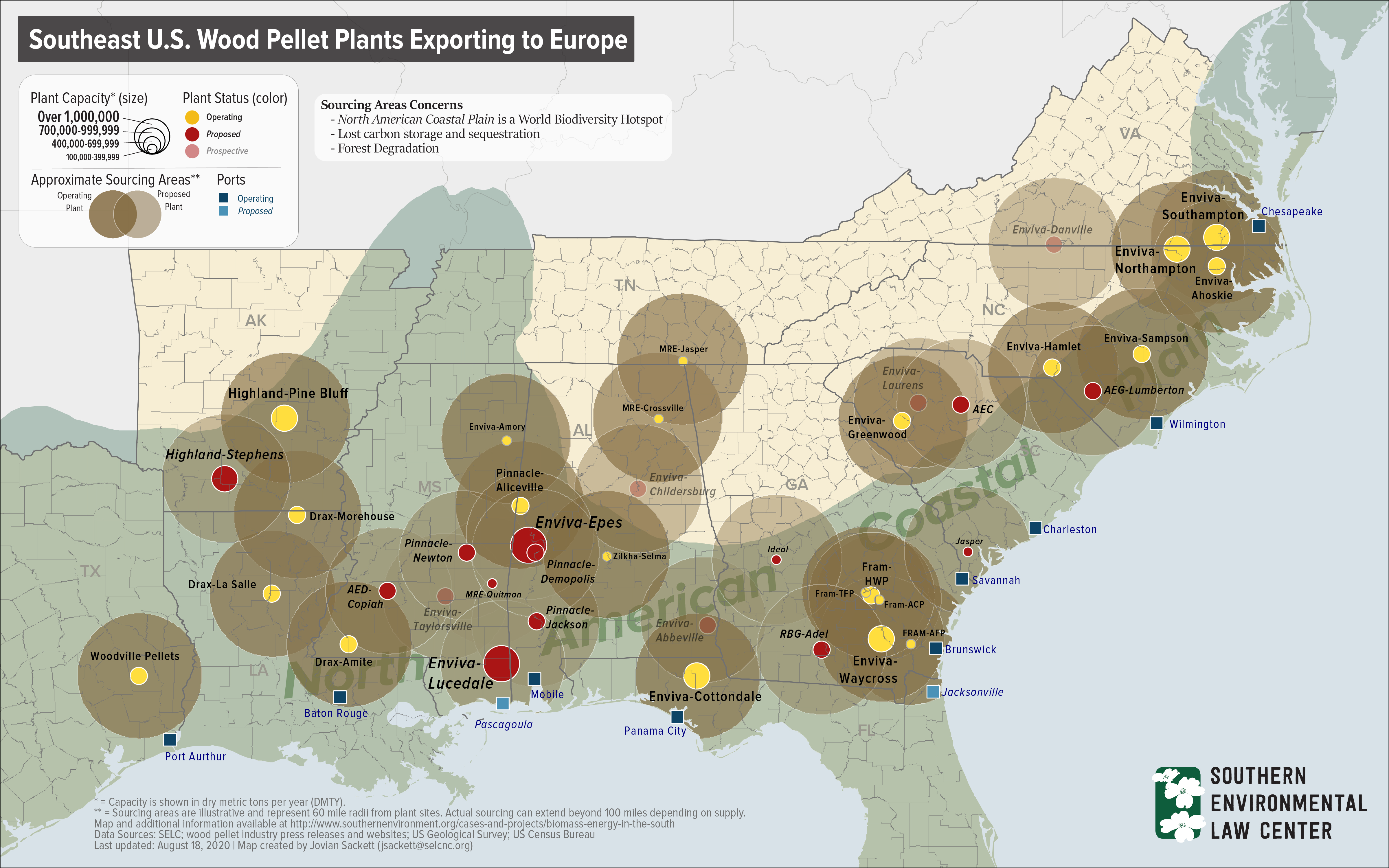
Wood pellet plants are expanding throughout all of the US, polluting our air and clearcutting the best natural tool we have against climate change: our forests. Click to enlarge the image.
Enviva Greenwood SC’s sourcing radius extends into Georgia, and Enviva Hamlet NC extends into South Carolina. Enviva North Hampton NC and Enviva Ashokie NC extend into Virginia. Enviva Southampton VA extends into North Carolina, and The Renewable Biomass Group’s proposed facility in Adel, GA would extend into Florida.
All across this country and around the world, essential services and products have been limited in order to ensure the safety of people.
Its biomass wood pellets are burned along with coal to produce electricity in Europe and Asia.

Click to enlarge the image.
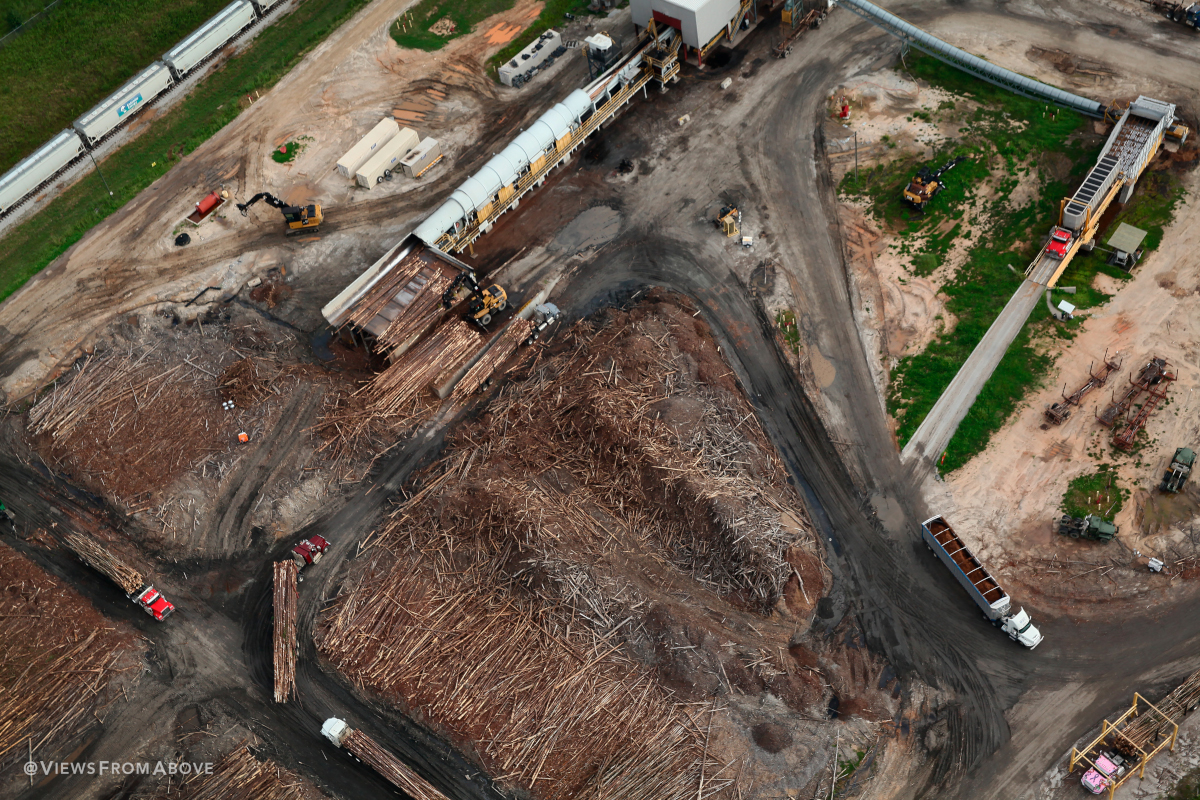
Enviva-Greenwood SC wood pellet plant. Image courtesy of Views from Above
Wood pellets are nonessential both to our economy and to the citizens of South Carolina, Georgia, North Carolina, Virginia, Alabama, and Mississippi.
Wood pellet production reduces the biodiversity of harvested areas. Making wood pellets uses a lot of land. This means that fake forests, plantations made up of one type of pine tree planted all in a row, will continue to increase.
Even the IPCC, the world’s climate change authority, says that we will lose wildlife by using more wood pellets and other biofuels. Since burning wood pellets releases greenhouse gases into the atmosphere, they actually make climate change worse despite industry claims that biomass wood pellets are a climate solution. This, in turn, increases the frequency and severity of hurricanes and natural disasters.
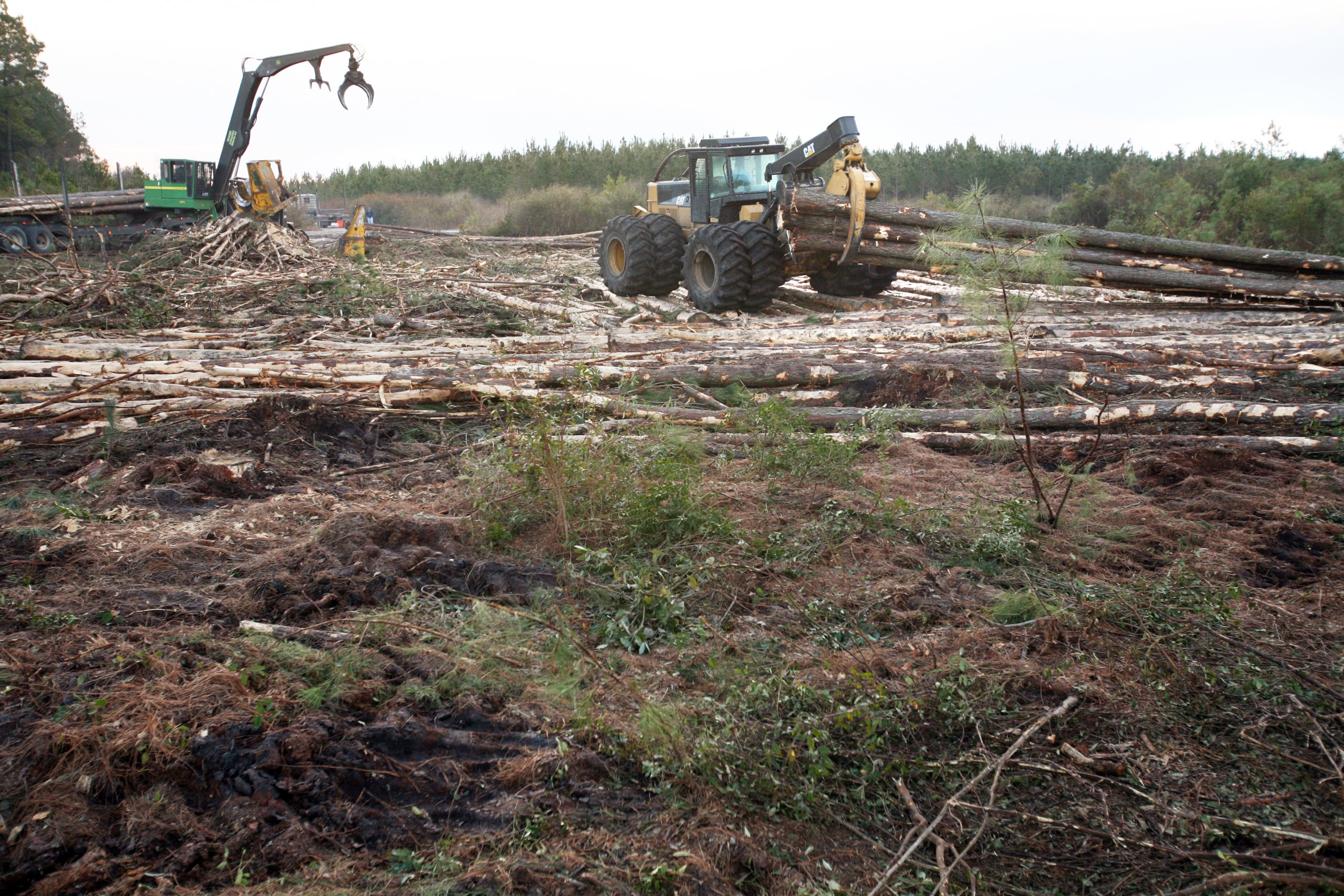
Together we must be a united front of communities, environmental organizations, science, and policy that speaks with one voice. We are all fighting for the same goal: to unveil the truth about this dirty industry. Logging forests, shipping them overseas, and burning them for fuel to meet other countries’ needs while we get all the negative side effects is a ludicrous model.
If the wood pellet industry continues to expand, it will have disastrous impacts on the health of local residents, the ability of natural ecosystems to support greater resiliency to storms and hurricanes, and contribute to global carbon emissions at a time when community health and safety rely on reducing those emissions.
At Dogwood Alliance we believe in thriving communities and healthy forests. We also believe that prioritizing the health and well-being of both is our only chance for surviving the most catastrophic climate impacts, but as we work diligently towards that vision, we wonder: is it enough?
Meanwhile, the largest wood pellet manufacturer, Enviva, continues business as usual to push for new facilities and expansions of their established facilities while not meeting regulation standards for their pollution output. Enviva harvests trees and processes them into tiny wood pellets that are shipped overseas to be burned for biomass electricity to power Europe. This is an inefficient process that makes little sense.
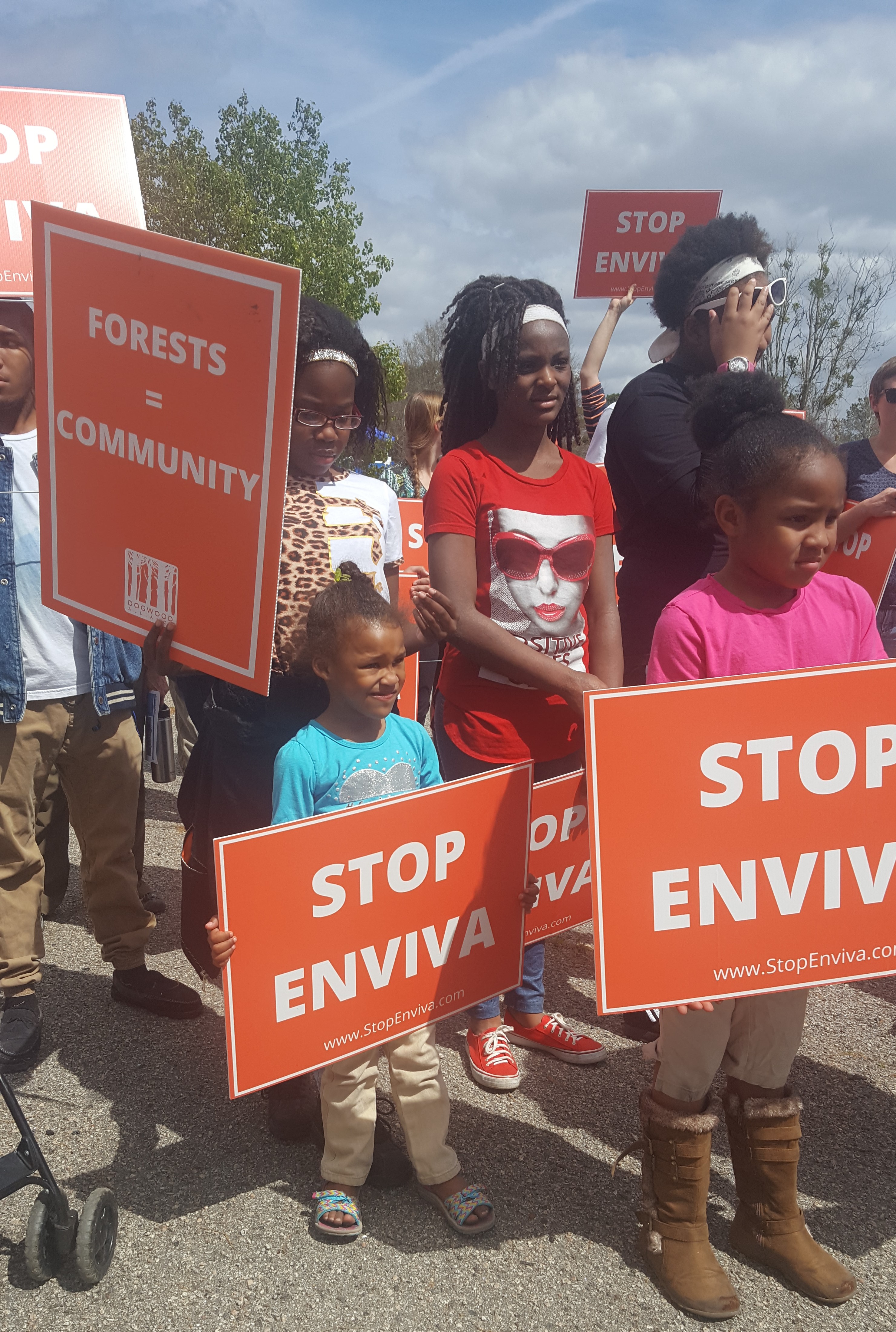
For years each public hearing determining whether or not to approve Enviva’s permits has felt more or less the same. Enviva industry people show up and alternate between intimidation tactics and talking about how this will be so good for the local economy, provide jobs, etc. In advance of these public hearings, they usually provide charitable donations to some of the community members. Those who have accepted gifts also stand up and say that this will be good for the local economy and provide jobs. In one town, they bought the community center new computers and in another, they bought children backpacks. At a recent hearing in Greenville, South Carolina, a community member said they went around to all the neighbors and offered gift certificates. Simultaneously, Enviva covers all residents within a mile of their facility with a blanket of fine carcinogenic wood dust, contributing to rising respiratory illness, destroying the local landscape, running noisy trucks through the neighborhood at all hours of the night, and making the surrounding communities generally unlivable. Most residents who are able to be present at the public hearings have opposed Enviva expansions, citing decrease of comfort and deterioration of health.
All of this would normally be infuriating, but in a global pandemic that links respiratory illness with increased COVID death, we view it as a direct attack on the communities where Enviva builds their facilities.
If the economy boost Enviva always promises was an actual truth, we would see thriving wood pellet towns and an increase in employment for local residents. As it stands, Enviva targets low income towns with a majority Black population. After Enviva swoops in, the poverty rate in those towns remains more or less the same. In fact, Enviva often brings in their own people, providing minimal job opportunities to local residents.
When we zoom out and look at what Enviva is doing across the East Coast, our hearts sink. As a group dedicated to forests, we know what forests do because we’ve spent years studying them. We know they protect us from storms and flooding, filter our air and water, bolster economies with outdoor recreation and tourism opportunities, and provide homes for a rich biodiversity of plant and animal life. We all share a special connection to nature that allows for healing and serenity.

Here’s what else we know: We know that people united will never be defeated. We know that we will continue this fight until we see the future we believe in. We know that as we follow the lead of the luminaries of the forest, climate, and justice movement, we will win.
Dogwood Alliance supports the Breathe Act and we encourage our members to read it.
In closing I’d like to leave you with a poem that was cited in Assata Shakur’s autobiography, a book I highly recommend:
If We Must Die By Claude McKay If we must die, let it not be like hogs Hunted and penned in an inglorious spot, While round us bark the mad and hungry dogs, Making their mock at our accursèd lot. If we must die, O let us nobly die, So that our precious blood may not be shed In vain; then even the monsters we defy Shall be constrained to honor us though dead! O kinsmen! we must meet the common foe! Though far outnumbered let us show us brave, And for their thousand blows deal one death-blow! What though before us lies the open grave? Like men we’ll face the murderous, cowardly pack, Pressed to the wall, dying, but fighting back!
During the spiking outbreaks of COVID-19 cases throughout South Carolina, nonprofit and community-based organizations are hosting a caravan protest at the state’s capital. Protesters will be able to show their dissent while safely social distancing in their own cars. The outcry began when ENVIVA, the world’s largest biomass wood pellet company requested a permit from South Carolina DHEC to expand its production in Greenwood, SC. Greenwood, like many other communities throughout the states, has BIPOC (Black, Indigenous, and People of Color) and low income citizens who suffer disproportionately from preexisting conditions like respiratory illnesses. It is a well-known scientific fact that people with preexisting conditions have disproportionate health impacts and our senior citizens are more susceptible to contracting COVID-19 and becoming ill or a fatality. During the recent virtual public hearing on Enviva’s expansion request, community members and organizations asked that the permit be denied or postponed during the pandemic.
Photo Credit: Views From Above
All across this country and around the world, essential services and production have been limited in order to ensure the safety of people. There is currently no market for Enviva’s products in the United States. Its biomass wood pellets are burned along with coal to produce electricity in Europe and Asia. So, if schools, businesses, governments, and the lives of everyday citizens can be reduced, restricted, or shut down because of COVID-19, then Enviva should be able to do the same.
Many other organizations throughout the state of South Carolina, have expressed the same concern and are joining the protest caravan. Some of the organizations include Dogwood Alliance, New Alpha CDC, The Whitney M. Slater Foundation, Midlands Sierra Club, Kingdom Living Temple, Healthy Communities Sierra Club, Pee Dee Sierra Club, Beyond Coal Sierra Club, Richland County Black Collective, Environmental Action Group, SC EJ Network, Sankofa, Carolina For All, and The Pamplico Stop The Pipeline Committee.
The protest will then proceed to SC DEHC state office at 2100 Bull St, Columbia, SC 29201 and on from there to the Governor’s Mansion at 800 Richland St, Columbia, SC 29201.
Over and over again, destructive polluting industries sweep into rural communities and make sweetheart deals with a few “leading citizens” who help them push tax breaks, subsidies, and rezoning through local governments. Once they get their way, local residents are left to deal with the aftermath – the smell, the chemicals, the blazing lights, the road traffic, the health consequences, and a decimated tax base. All in exchange for a few jobs that may or may not last beyond plant construction.

The misleadingly named The Renewable Biomass Group wants to change zoning laws in Adel, Georgia so they can start the polluting. They will also destroy a beautiful natural environment and may even put the iconic national treasure, the Okefenokee Swamp, at risk. If the city agrees to their plan, the company will open a wood pellet manufacturing plant that produces nearly 500,000 TONS of wood pellets per year, cutting down almost 12,000 acres of forested land each year that will take decades to grow back. All that only to send pellets to Europe to burn for dirty electricity.
The city has an opportunity to stop this planned biomass plant by voting to simply uphold current zoning laws. Now that these polluting biomass corporations have stripped North Carolina, the largest exporter of wood pellets in the nation, they are targeting Georgia, and Adel is right in their crosshairs.
They also consistently target Environmental Justice communities (rural low income and BIPOC communities), believing that those communities won’t have a choice in the matter. But Adel does have a choice. You have a choice.
In Georgia, we have seen how that leadership looks. During the last session of the General Assembly, Stand4Forest resolutions were submitted in both the Georgia Senate and House. Because of the pandemic, they never made it out of committee, but the sponsors of these resolutions stepped up to show what leadership on forest protection looks like.
Adel needs leaders like these.
Asheville, NC, September 1st, 2020 – Today, environmental campaigners from the USA and Estonia delivered a letter to Minister Jørgensen [1], warning that the new Danish Climate Agreement fails to protect their countries’ forests and perpetuates Denmark’s contribution to climate change by allowing large-scale biomass burning to continue unabated.
The groups call on the Danish government to phase out the use of biomass for district heating and incentivize low-carbon clean alternatives, such as heat pumps. They warn that binding sustainability standards, which are to be developed under the Climate Agreement are unlikely to do anything to protect forests and climate. A recent in-depth NGO investigation found no evidence that sustainability standards for biomass anywhere in the world have had any meaningful impact on companies’ wood sourcing, especially where imports are concerned [2]. Moreover, as highlighted in a previous Open Letter by 800 scientists, sustainable forest management makes no difference to the amount of carbon emitted from burning wood for energy [3].
Pellets exported from the Southeastern USA to Denmark regularly include wood from clearcutting of wildlife-rich natural forests. Rita Frost from Dogwood Alliance explains:
“The Southern USA has lost 30 million acres of wildlife-rich forest ecosystems over the pasts six decades. Now the growing demand for wood pellets has become yet another driver for clearcutting what remains of our forests, often replacing them with sterile monocultures. If we are to save those forests, Denmark must help by rapidly phasing out biomass burning in its heat and power plants.”
In Estonia and other Baltic States logging rates have accelerated in recent years, with ever larger areas of mature forests being clearcut due to the growing demand for biomass energy. According to a recent study in the prestigious science journal Nature [3], this is part of a trend seen across much of Europe in response to the growing demand for biomass energy.
Siim Kuresoo from Estonian Fund for Nature states:
“Sustainability standards such as those considered by the Danish government cannot protect our forests from increased logging to meet the growing demand for wood pellets in Europe. Denmark, as the number one importer of wood pellets from our region needs to act quickly to reduce this unsustainable demand, instead of allowing it to increase further.”
Contacts: Rita Frost, Dogwood Alliance: Tel +1 512 423 0620 (USA), [email protected] Siim Kuresoo, Estonian Fund for Nature: Tel: +372 7 428 443 (Estonia), [email protected] Notes: [1] dogwoodalliance.org/wp-content/uploads/2020/08/Danish-climate-law-letter-Summer-2020.pdf [2] biofuelwatch.org.uk/2020/sustainability-standards-briefing/ [3] pfpi.net/wp-content/uploads/2018/04/UPDATE-800-signatures_Scientist-Letter-on-EU-Forest-Biomass.pdf [3] nature.com/articles/s41586-020-2438-y
For historical context, please see these letters and posts: September 2017: Danish Pension Fund’s Green Credentials Questioned October 2019: Track & Trace? More like “Trick or Trace.” Why sustainability certification schemes fall flat in protecting forests & climate October 2019: Groups call for Denmark to Protect Forests & Climate


 Donate
  April 5, 2026