


I must admit that since Super Bowl LX, I’ve had bunnies on the brain. When you think of bunnies Bad Bunny, Bugs Bunny, Thumper, Peter Rabbit, Roger Rabbit, or even the Easter Bunny might hop into your mind. But how much do you know about the actual wild rabbits you can find in your backyard?
The US South is home to four species of wild rabbits, and they play an important role in nature. Rabbits are avid grazers. These herbivores forage on flowers, grasses, herbs, shrubs, weeds, and woody vegetation. Rabbits help keep plant health in balance. They keep weeds under control and encourage biodiversity. Their waste improves soil fertility and promotes plant growth. Because it’s high in nitrogen and phosphorus, it acts as a natural fertilizer. They’re a significant part of the food web. Wild rabbits are also whimsical and a joy to observe in nature. Learn how to identify them and where you’re most likely to find them.
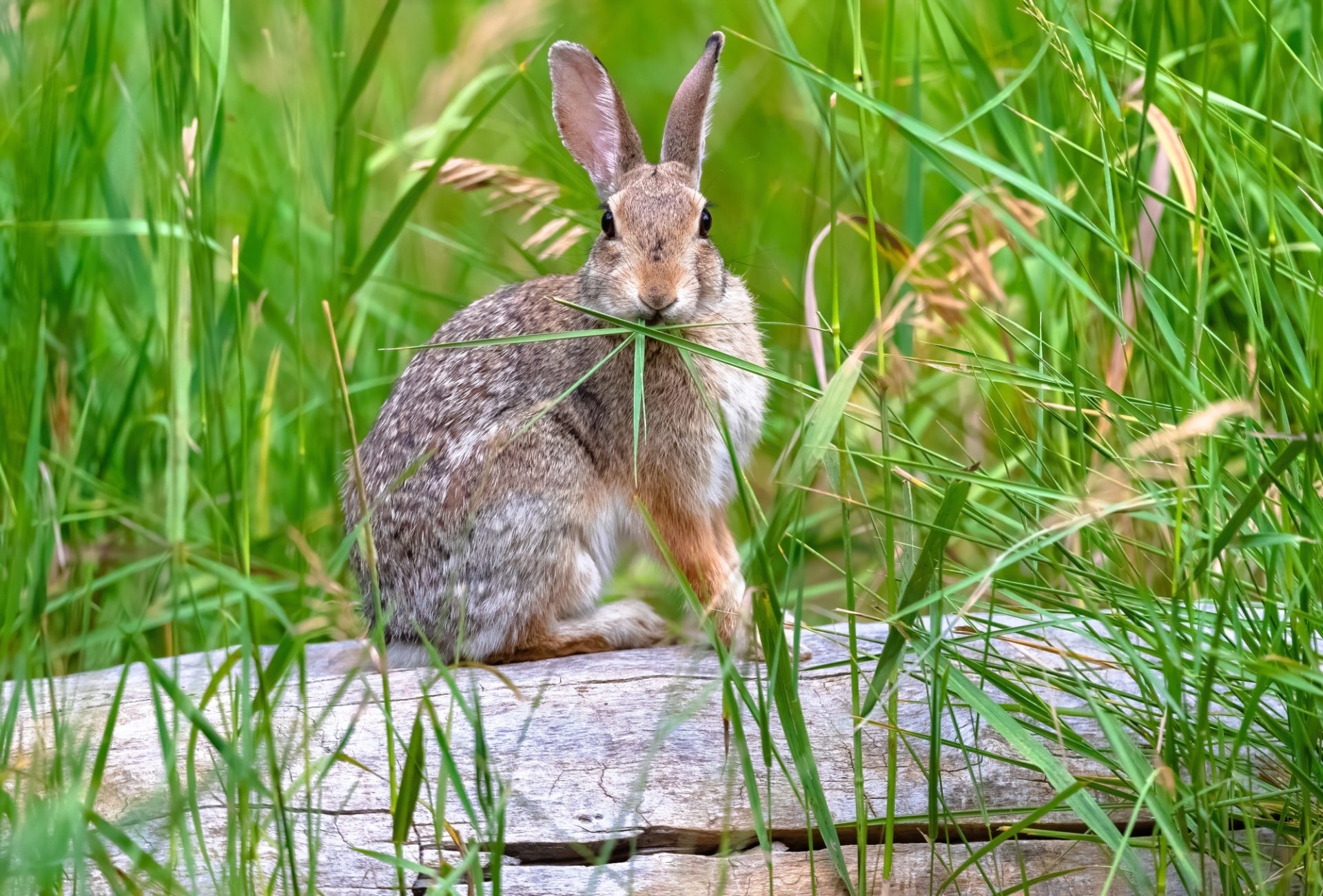
Eastern cottontails have reddish to grayish brown mottled fur and a white underside. They sometimes have a white spot on their forehead and a rusty patch on their rump. Their tail is short, white, and fluffy like their name implies. They also have a white or light colored ring around their eyes. They have large hind feet, long ears, and big brown eyes that help them detect predators. Adults range from 12.5 – 20 inches in length and weigh between 2 – 4 lbs.
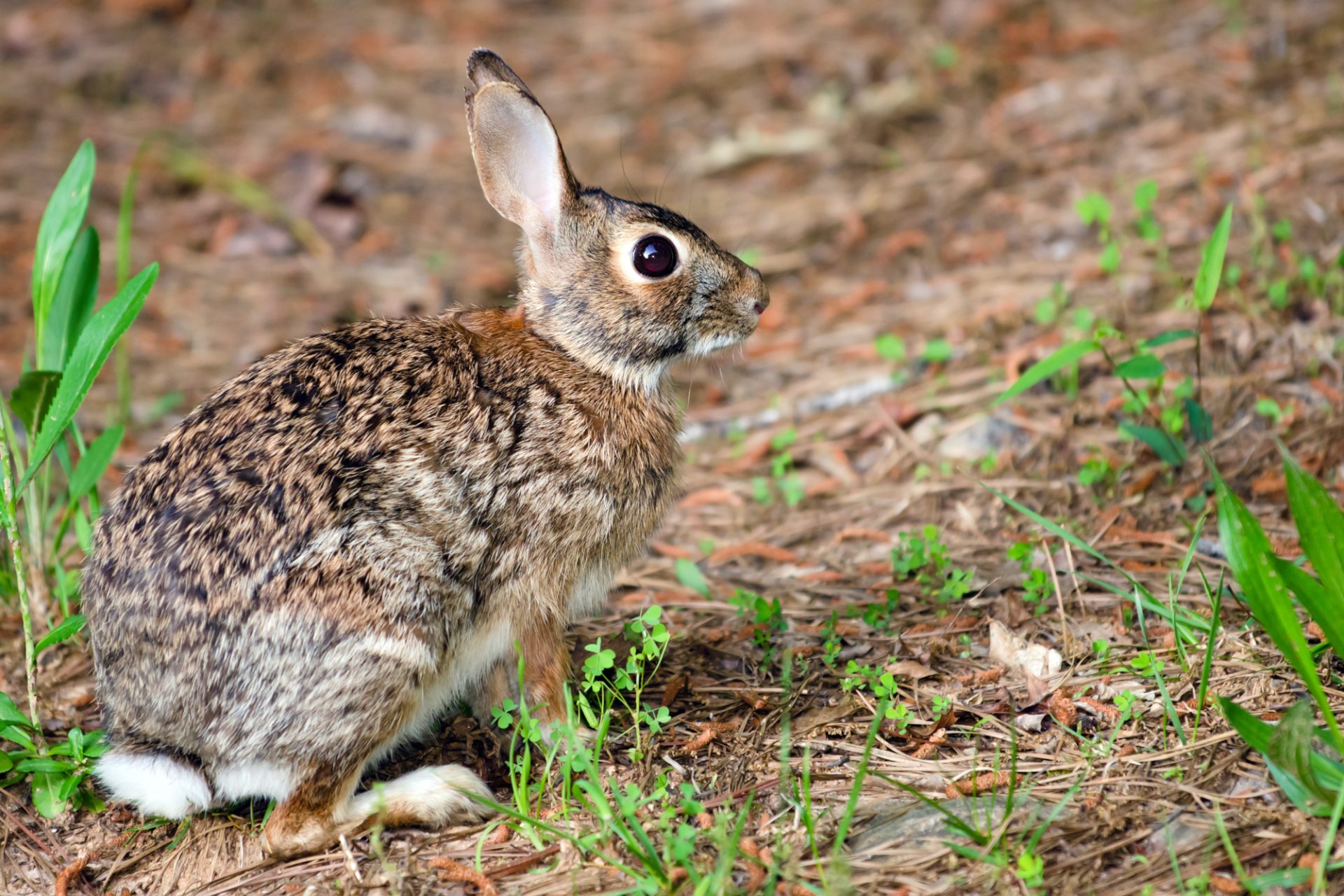
This species is most active at dawn, dusk, and at night. They are territorial and typically stay within the same range. Their speed and agility helps them evade predators. They can run as fast as 18 mph when chased and will typically flee in a zigzag pattern. Eastern cottontails do not dig burrows. Instead they scratch out a shallow hole in grass or thick vegetation. They also seek shelter in the abandoned dens of groundhogs.
Eastern cottontails are the most abundant and expansive rabbit species in North America. Their range spans from southern Canada to northern Colombia. It includes most of the contiguous US from the East Coast to the Great Plains. Eastern cottontails prefer open meadows, grassy fields, thickets, and forest edges. They seldom roam far from the safety of cover. The IUCN Red List considers their conservation status as “least concern”. But they do face threats like disease, predation, habitat loss, and vehicle collisions.
Appalachian cottontails are distant relatives of eastern cottontails. Visually the two are quite similar, and it can be hard to tell them apart. Appalachian cottontails have golden brown mottled fur. You’ll notice they have a rusty neck patch and a white underside. They often have a black spot in between their ears and lack a white spot on their forehead. Their tails are also short, white, and fluffy. They have large hind legs, long ears, and big brown eyes. Females are typically larger than males. Adults range from 15.5 – 17 inches in length and weigh between 1.75 – 3 lbs.
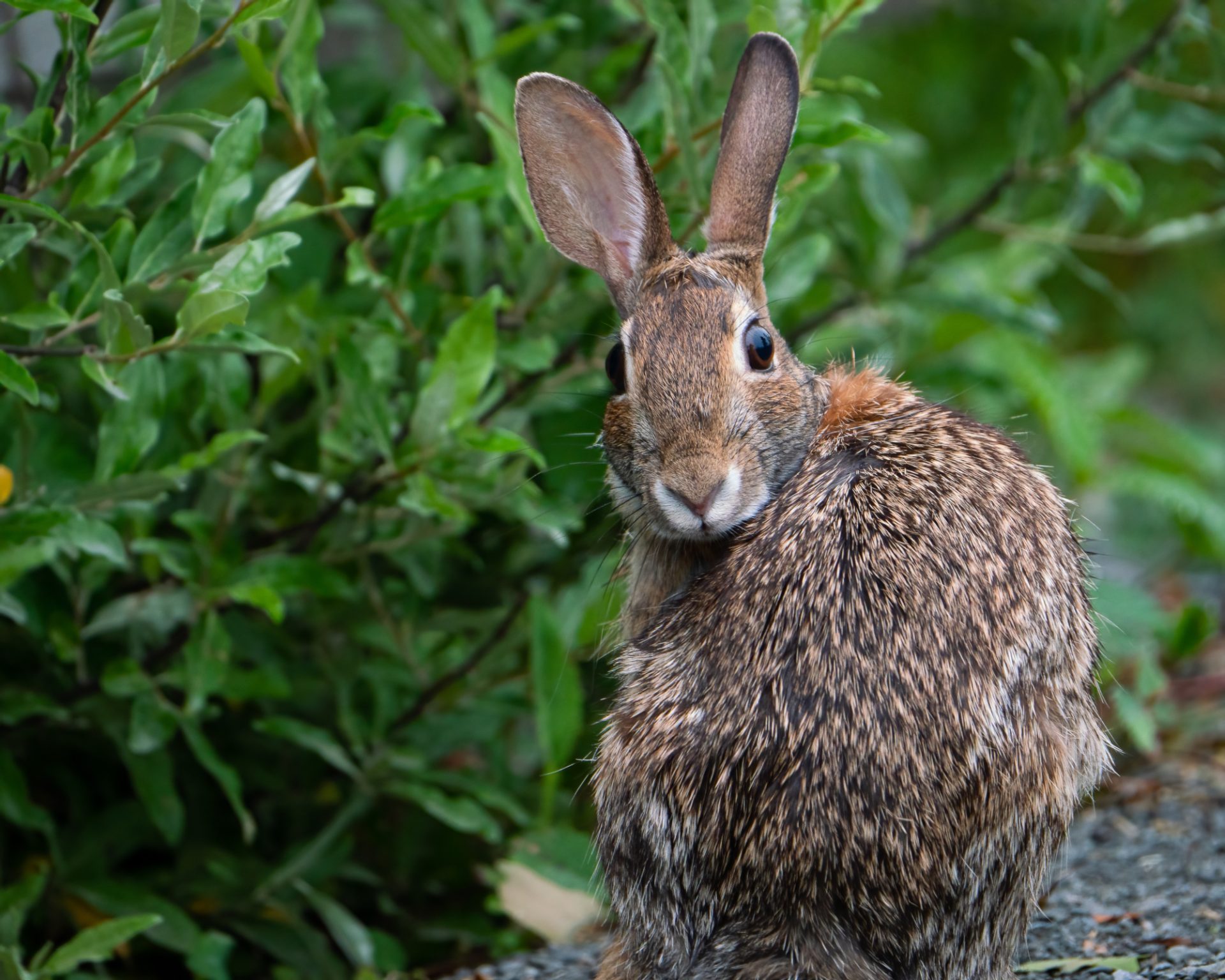
This species is most active at dawn and dusk. During the day they take shelter in dense vegetation. To avoid detection, they move slowly, close to the ground with their ears back. They’re also known to remain quiet and still for up to 15 minutes. When chased, they run in a zigzag pattern to escape predators.
You can find Appalachian cottontails from Pennsylvania to South Carolina. But they’re most prominent in the Appalachians. They’re found in dense forests, brushy areas, and scrub forests. They prefer higher elevations (2,001 to 2,500 ft). Logging and development threaten Appalachian cottontail habitats. The IUCN Red List considers their conservation status as “near threatened”. Unfortunately, their populations are decreasing.
Marsh rabbits are members of the cottontail family and look similar to eastern cottontails. But their faces are slightly mousier. They have blackish brown to reddish brown mottled fur and a grayish underside. Their tails are a bluish gray earning them the name of bluetails. They have black tufts of fur on the prominent edge of their ears. Their ears are also shorter and rounder than eastern cottontails’ ears. They have short legs and often walk on all fours rather than hop. Their hind feet have noticeably long toenails. Adults range from 15.5 – 18 inches in length and weigh between 2.5 – 5 lbs.
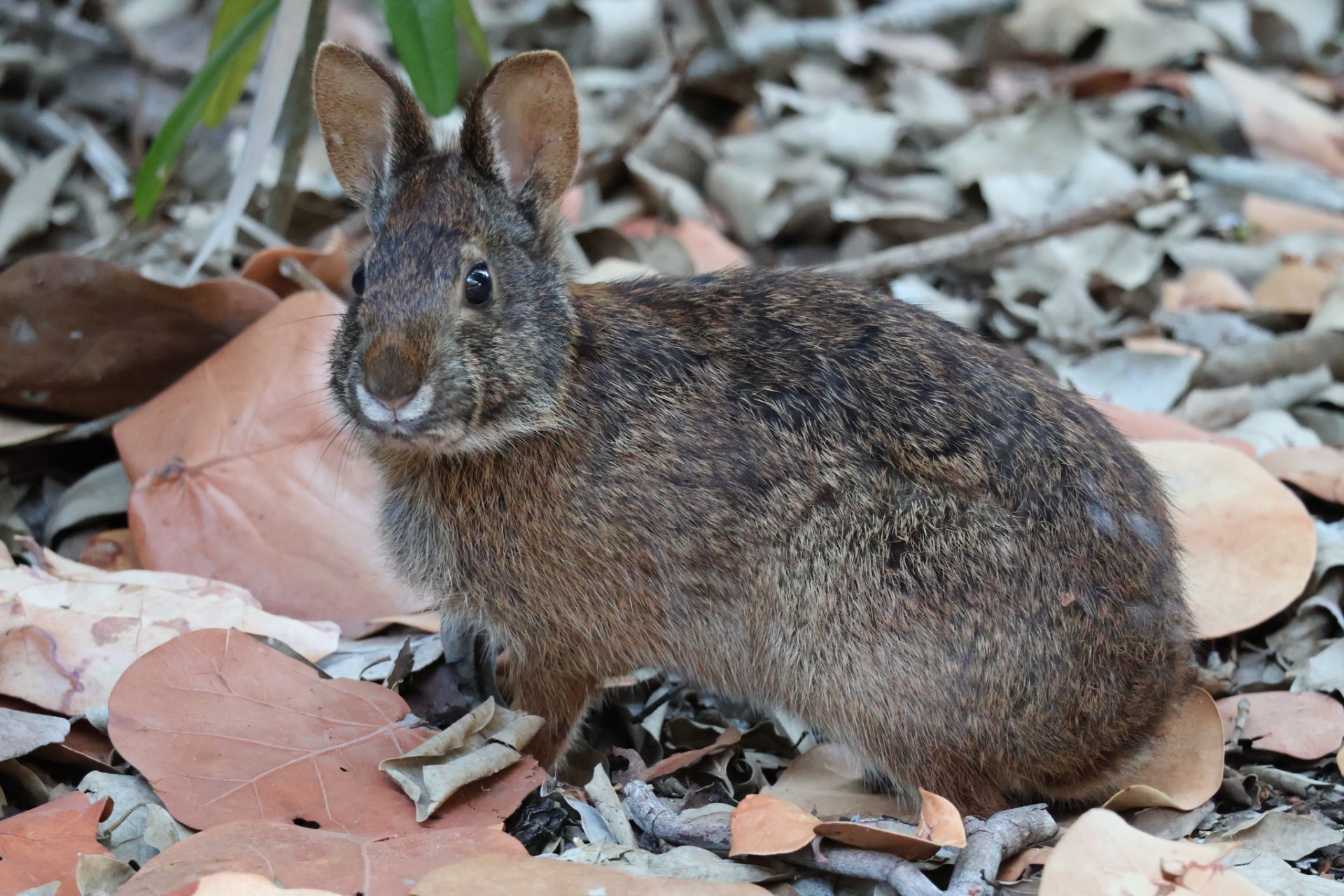
This species is most active at night. They rest during daylight hours hidden in tall grasses, dense shrubs, or hollow logs. Marsh rabbits do not dig burrows. Instead they use the abandoned dens of other animals. Or they’ll create a shallow sunken area under thick vegetation or within hollow trees. Marsh rabbits are avid swimmers and are semi-aquatic. They sometimes hide in muddy waters with only their eyes and nose exposed with their ears tucked back.
Marsh rabbits have a range that spans from coastal Virginia to the lower Florida Keys. They’re only found in wet, lowland habitats and must live near a permanent water source. They prefer marshes, swamps, coastal areas, or anywhere near lakes, rivers, and other waterways. The IUCN Red List considers their conservation status as “least concern”. But the Lower Keys marsh rabbit, a subspecies, is federally recognized as endangered. They’ve lost more than half of their habitat to sea level rise and development in the last 50 years.
Swamp rabbits are the largest in the cottontail species. They’re closely related to marsh rabbits. Their fur is light to dark rusty brown with black speckling. Their chin, throat, and underside are white. They have a cinnamon colored ring around their brown eyes. Their short tails are brown on top and white on the bottom. They have large orange hind legs and medium sized ears. Males are typically larger than females. Adults range from 17.5 – 21.5 inches in length and weigh between 3.5 – 6 lbs.

This species is most active at dawn, dusk, and at night. You’ll rarely see them during daylight hours. They’re very territorial and will leave scent marks to establish their range. Swamp rabbits rest in tall grasses or dense vegetation where they’ve made shallow dugouts for safety. They’re skilled swimmers and will dive into water to escape predators. They sometimes hide in water with only their eyes and nose exposed like marsh rabbits. On land they will flee using confusing maneuvers like zigzagging to evade capture.
Swamp rabbits are native to the south central US and the Gulf coast. They’re most abundant in Alabama, Louisiana, and Mississippi. But their range includes Georgia, Illinois, Indiana, Kansas, Missouri, Oklahoma, South Carolina, Tennessee, and Texas. They prefer wet, lowland habitats near a permanent water source. You’ll find them in cypress swamps, marshes, floodplains, or near waterways. The IUCN Red List considers their conservation status as “least concern”. Though they note that populations are decreasing overall. Data shows the species is rare or imperiled due to loss of habitat in Arkansas, Kentucky, Missouri, and South Carolina.
Most wild rabbits breed from January through September. But mating season can vary depending on elevation, climate, and other factors. Wild rabbits build their nests in dense, low vegetation. You’re most likely to discover their nests while gardening, landscaping, or mowing. If you have rabbit activity in your yard, it’s best to check your grounds for nests before mowing. Especially before your first mow of the year in spring. This could help you avoid discovering a rabbit nest too late.
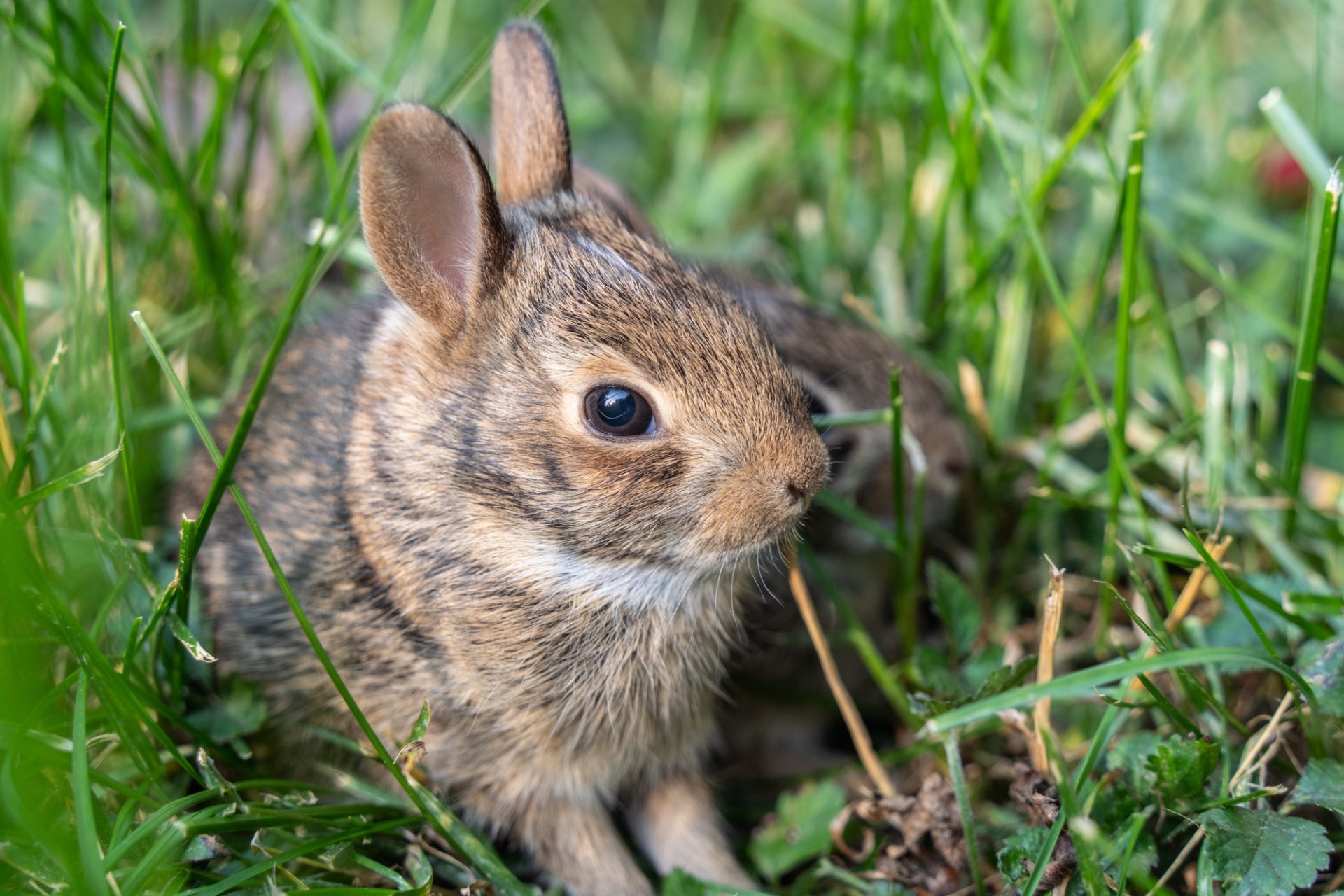
Female rabbits will avoid drawing attention to their nests so the young are often left alone for long stretches of time. If you happen upon a nest of baby bunnies, it’s best to leave it as you found it. Young rabbits found outside the nest usually do not need human help. As long as they’re 4 or more inches long and are able to hop freely. If they’re smaller than 4 inches, injured, or immobile, it’s best to call a licensed wildlife rehabilitator for help. Be careful not to draw predator attention to the nest.
Wild rabbits don’t live very long. On average, their lifespan ranges from 1 year to 18 months. But there have been records of individuals living as long as 9 years in captivity. If you’re lucky enough to have wild rabbits in your backyard, know that their time with you is short. Enjoy watching them forage, lounge, and hop around. Observe them from afar and always keep your distance. Wild animals, even the cute and fuzzy ones, should always be treated with respect and caution.
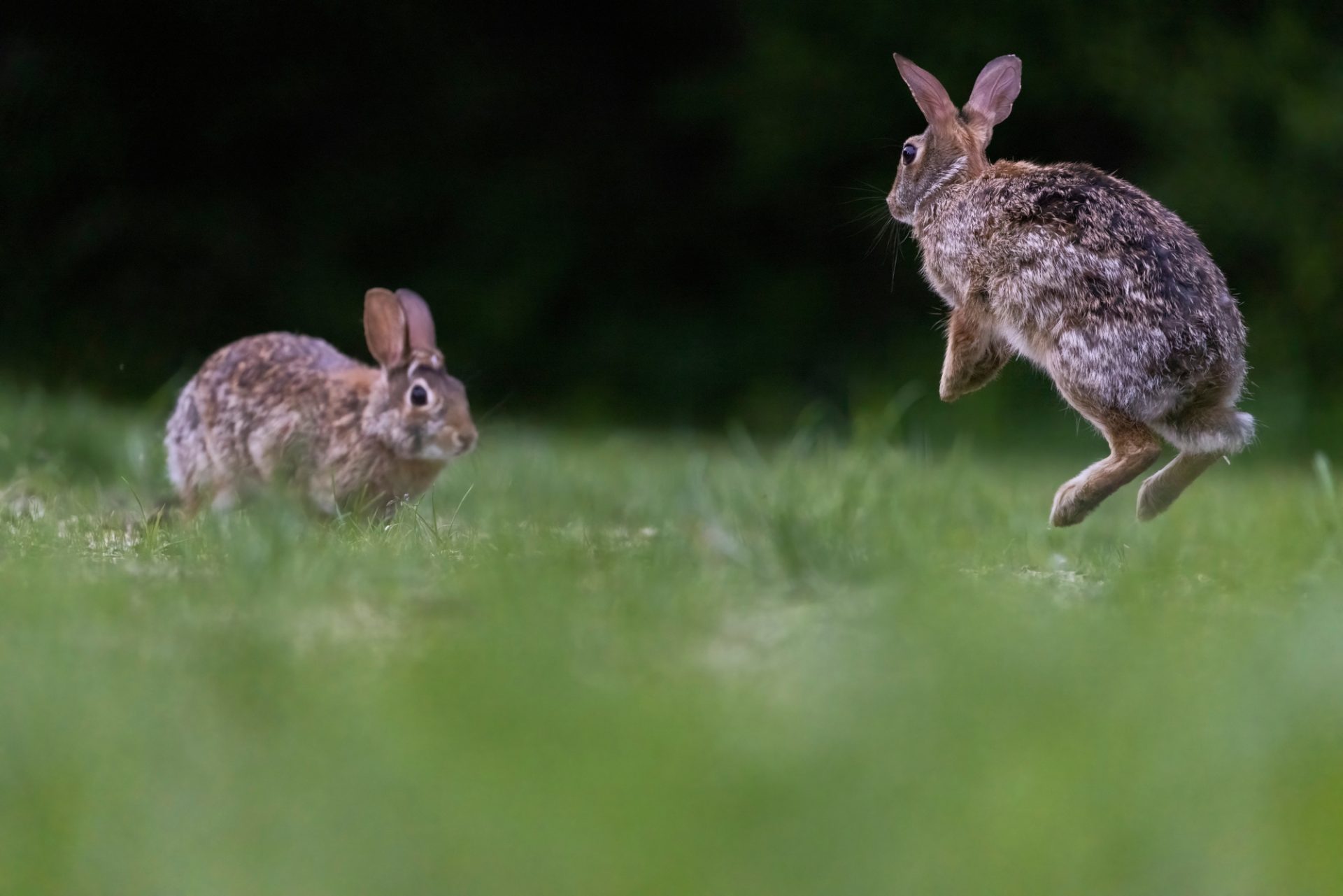
Watching wild rabbits in my backyard is one of my favorite pastimes. It makes me feel happy to know they feel safe enough to make my backyard their home. I love watching them play and chase each other along the tall grass. They make me smile when they lay stretched out like they have nowhere to go and nothing to do. I also look forward to seeing baby bunnies hopping around the yard throughout the year. Observing nature always calms me and fills me with delight. They remind me to touch grass. To be wild and free.
Did you enjoy learning about wild rabbits? If so, why not show us? Share this article on social media and tag us on Bluesky, Facebook, LinkedIn, or X/Twitter! Or share your backyard bunny photos with us on social media.
Join our email list to get new Biodiversity in Your Backyard blogs sent directly to your inbox! And check out the other blogs in our Biodiversity in Your Backyard series!
Things that naturally glow in the dark can capture the imagination of people of all ages. Bioluminescence is a chemical reaction inside living things that produces light. Two key elements must be present for bioluminescence to occur. When luciferase and luciferin combine under the right conditions, they generate light. Many different species have evolved to radiate light throughout history. It can occur in bacteria, birds, fungi, insects, and even marine life. The Southern US is home to many of nature’s night lights. We’ll tell you when and where you can find things that naturally glow in the dark. Nighttime is the right time to discover bioluminescence in your backyard.
This is Part Two of our bioluminescence series. We’ll explore bioluminescent mushrooms and marine life. Check out Part One if you missed it.
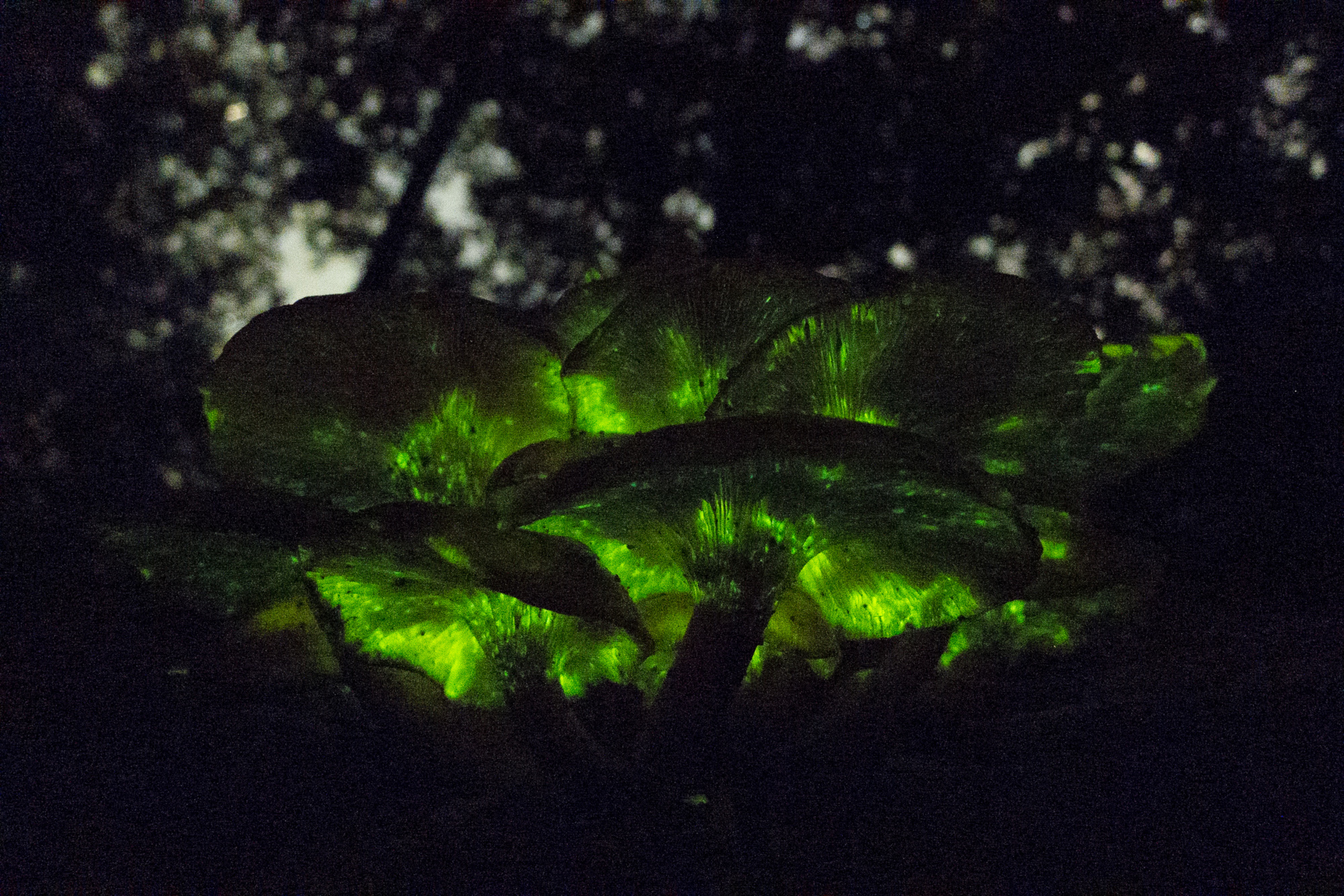
Eastern jack-o-lantern mushrooms by Dave Riggs
Aristotle was the first known person to coin the term foxfire in 382 BC. He documented a mysterious light, distinct from fire, emanating from decaying wood. He noted that it was cold to the touch. The philosopher and scientist was describing bioluminescent fungi. There are 71 verified species of light-emitting fungi in the world. All of them emit light 24 hours per day. Scientists are still unclear why they do so. Some believe it’s to attract insects that can help spread the mushroom’s spores.
In the Southern US, we have a few species of mushrooms where the fruiting body lights up the night. In many cases, though, it’s the underground mycelia that glows. Mycelia is kind of like the roots of a fungus. You can’t observe that part of the mushroom in nature unfortunately.
Finding bioluminescent mushrooms in the wild is not easy, but it can be done. Be cautious because some mushrooms are poisonous if consumed. Your best chance to find bioluminescent mushrooms is during the day. Collect a small specimen in a wooden or natural basket so that the spores get released back to the forest floor. Once you’re back home, go to a dark room and wait for your eyes to adjust. After they do, you should see the mushroom gills glow.
Otherwise, try damp or rainy nights since moisture is believed to play a role. Search for them on nights with a new moon. Allow your eyes to fully adjust to the darkness. Look high and low. Then follow the green glowing light.
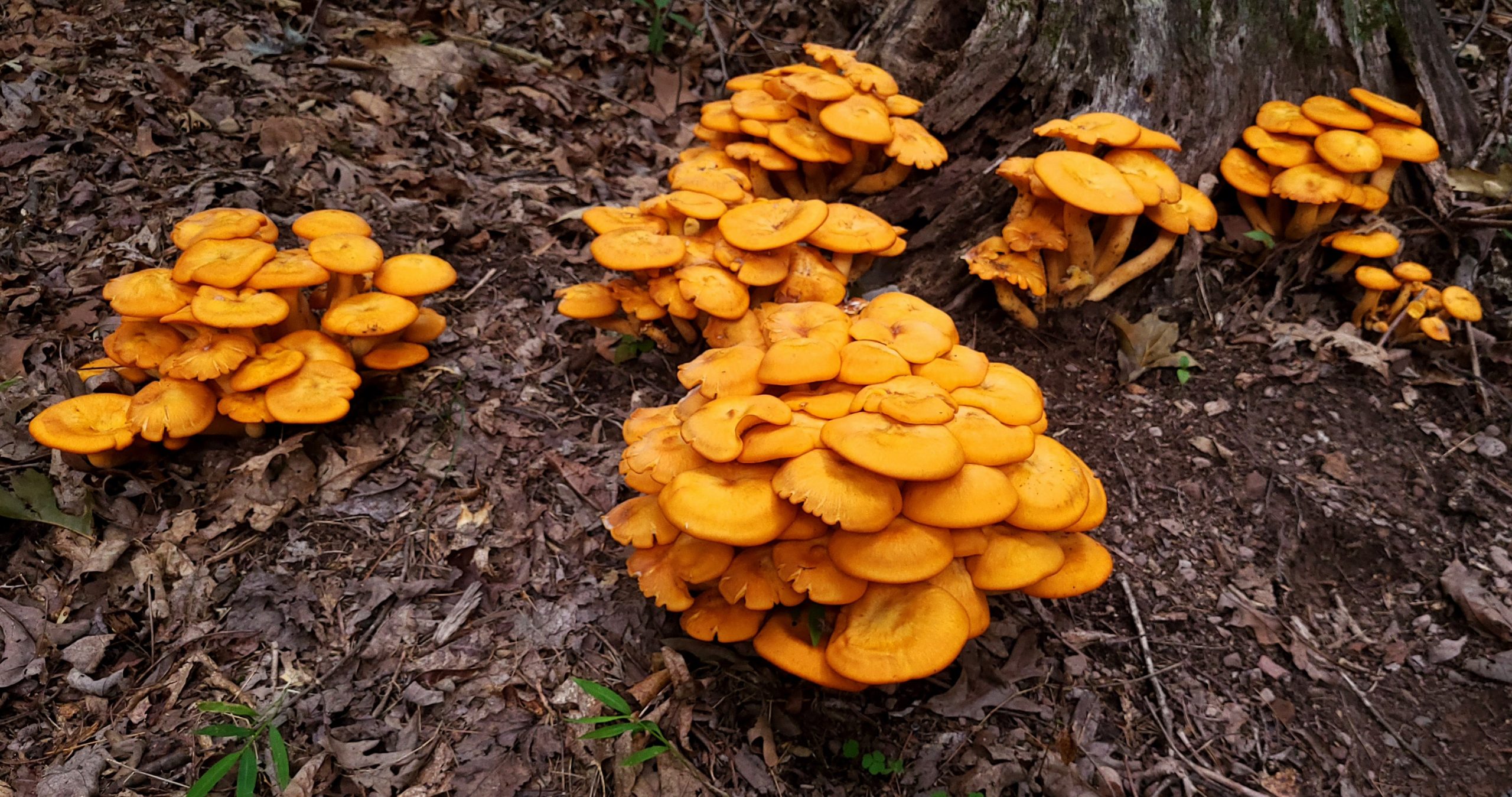
Omphalotus illudens by Pam Owens
Eastern jack-o’-lantern mushrooms are orange and glow, just like their namesake. You can also call them “jacks” for short. The mushroom caps and stems can grow as large as 6 inches wide and 6 inches tall. Their caps start off rounded with a central bump. But they become flat and then cup-shaped as they mature. They have true gills that run downwards towards the stem. They grow in large clusters.
Their thick, bright orange flesh makes them easy to confuse with chanterelle mushrooms. But be careful. Eastern jack-o’-lanterns are poisonous if consumed. Touching them is ok, but don’t attempt to eat them. They will cause major gastrointestinal distress. Learn how to tell them apart.
In the Southeastern US, jacks grow in hardwood forests from summer to fall. You’ll find them in large clusters of up to 15-20 mushrooms between June and November. Look for them at the base of trees and decaying stumps, especially oaks. They also grow over roots on the forest floor. They’re saprophytic fungi. That means their job is to break down dead matter. They help to decompose fallen logs and branches, returning nutrients to the soil. In complete darkness, you can see eastern jack-o’-lanterns’ gills glow green. They’re known to continue emitting light for as much as 50 hours after being picked.
Southern jack-o’-lantern mushrooms (Omphalotus subilludens) are a similar species. They grow in the Gulf Coast of Florida and Texas. You can also find them from late summer to fall in similar habitats.
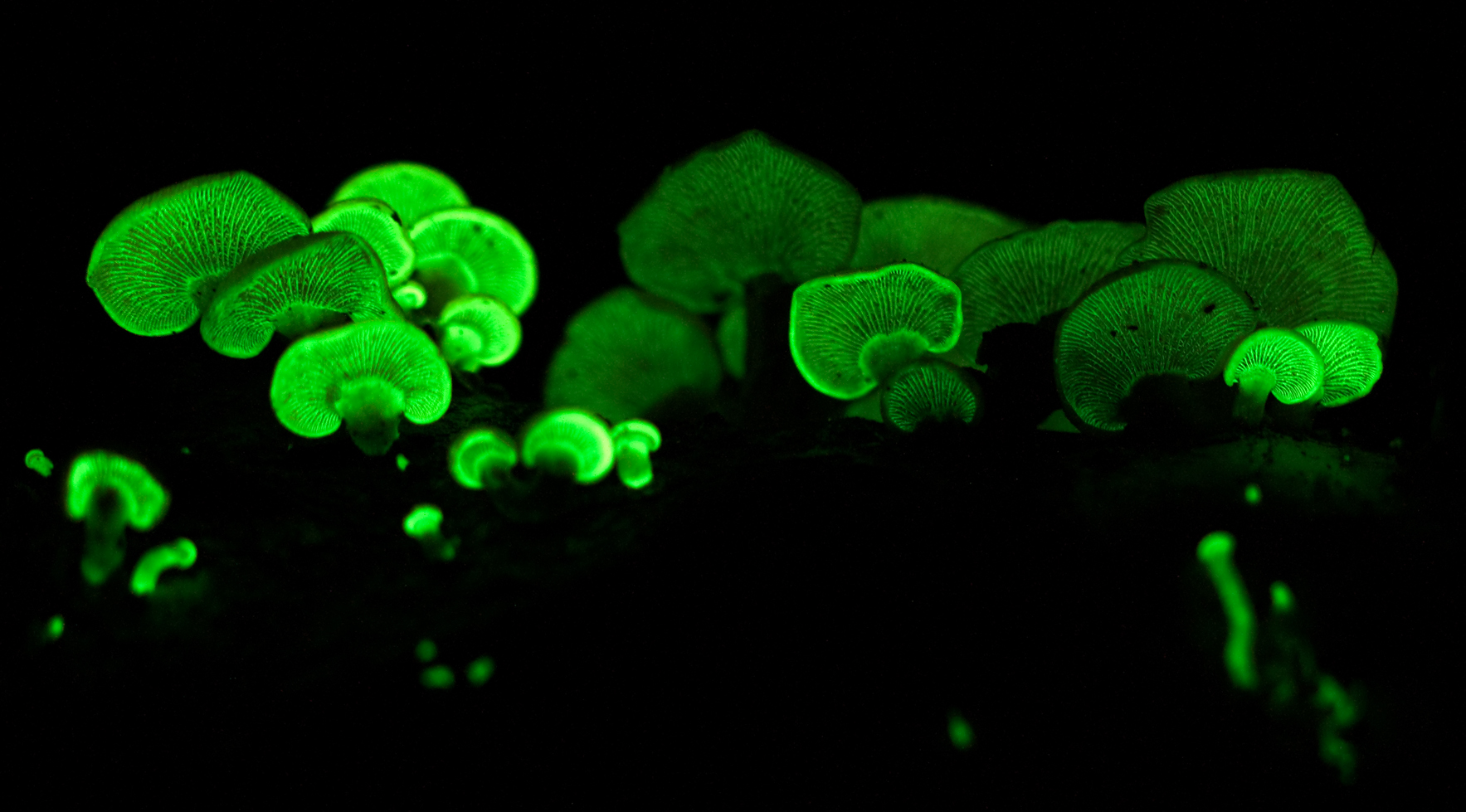
Panellus stipticus by Ylem
Bitter oyster mushrooms are one of the brightest-glowing mushrooms on Earth. This mushroom is common and widely distributed around the world. But only strains from Eastern North America are regularly bioluminescent. Bitter oysters grow in overlapping clusters. They first appear as small, white knobs. Then they slowly develop curved, flat overlaying caps that grow to be about 1.5 inches wide. The stems are less than an inch high. Their color can vary from dingy white to pale yellow to orangish brown. You’ll find their forked gills on the underside of the cap close together. The fruiting bodies can last for months.
Bitter oysters are much smaller than the similarly named oyster mushrooms. But bitter oyster mushrooms are inedible. They’re not poisonous, but they don’t taste good. In traditional medicine, this mushroom has been used to stop bleeding. They’re also being studied for their ability to break down environmental pollutants.
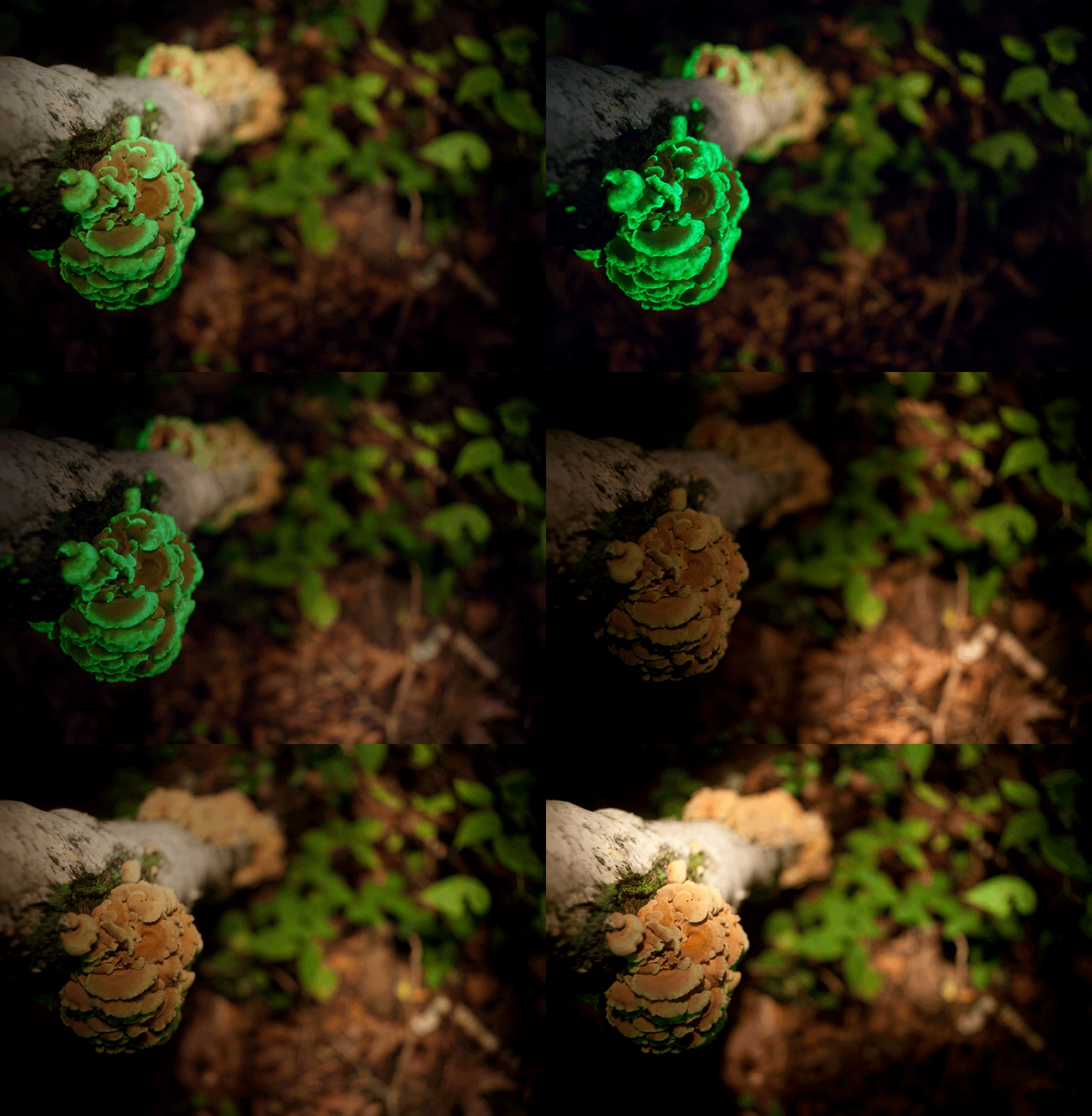
You’ll find bitter oysters in the slow-growing hardwood forests of the US South. Especially in the Appalachian Mountains. This fungus likes to grow on birch, blue-beech, hickory, maple, oak, and pecan trees. They’re also reported to grow on loblolly and eastern white pine trees. You’ll find bitter oysters year-round, but they’re most common from late summer to early winter. They’re also saprophytic and break down decaying matter. Look for them on branches, logs, and stumps. The gills and mycelia of the bitter oyster will glow green in complete darkness.
There are a couple of other noteworthy bioluminescent mushrooms. But their light is not easily visible to the naked eye. In some cases, the fruiting body glows so faintly that it’s only observed using cameras or x-rays. Or just the underground mycelium glows brightly.
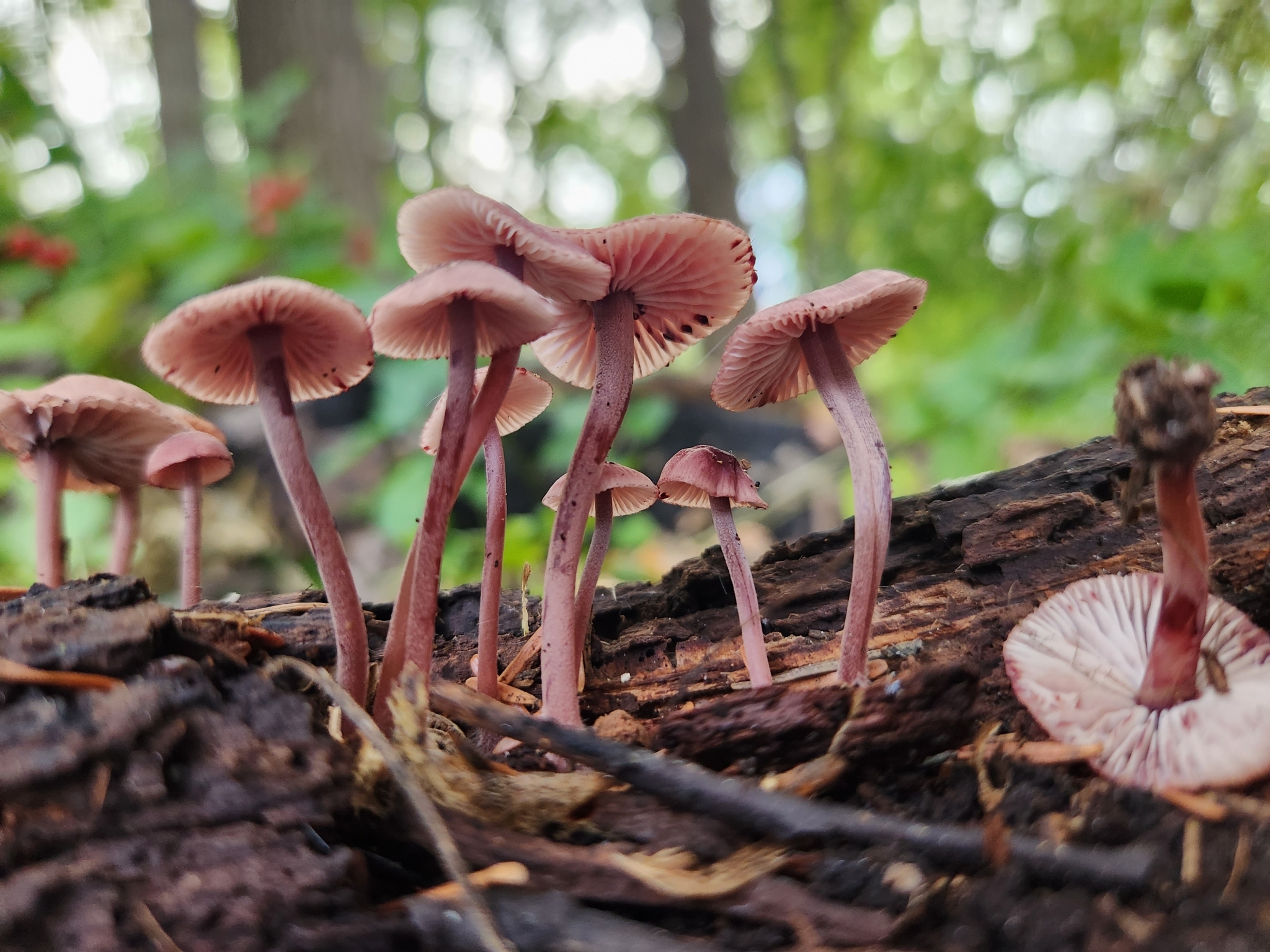
Bleeding fairy helmet mushrooms (Mycena haematopus) faintly glow and have glowing mycelia. They grow in groups joined at the base on old tree stumps and decaying logs. Even if you can’t observe the glowing parts, it’s exciting to know these bioluminescent fungi are out there. You can find them across most of North America.
There are two species of honey mushrooms known to be bioluminescent. Armillaria mellea and bulbous honey fungus (Armillaria gallica). The gills of the honey mushroom occasionally glow green but very faintly. Honey mushroom mycelium glows more brightly than their gills. They’re symbiotic with conifers and hardwoods. You can find honey mushrooms throughout North America growing in clusters at the base of these trees.
Many sea creatures have evolved to create their own light. Especially at the lowest depths of the ocean where sunlight cannot penetrate. In the South, we’re lucky to have glow in the dark marine life at the surface of the ocean, too.
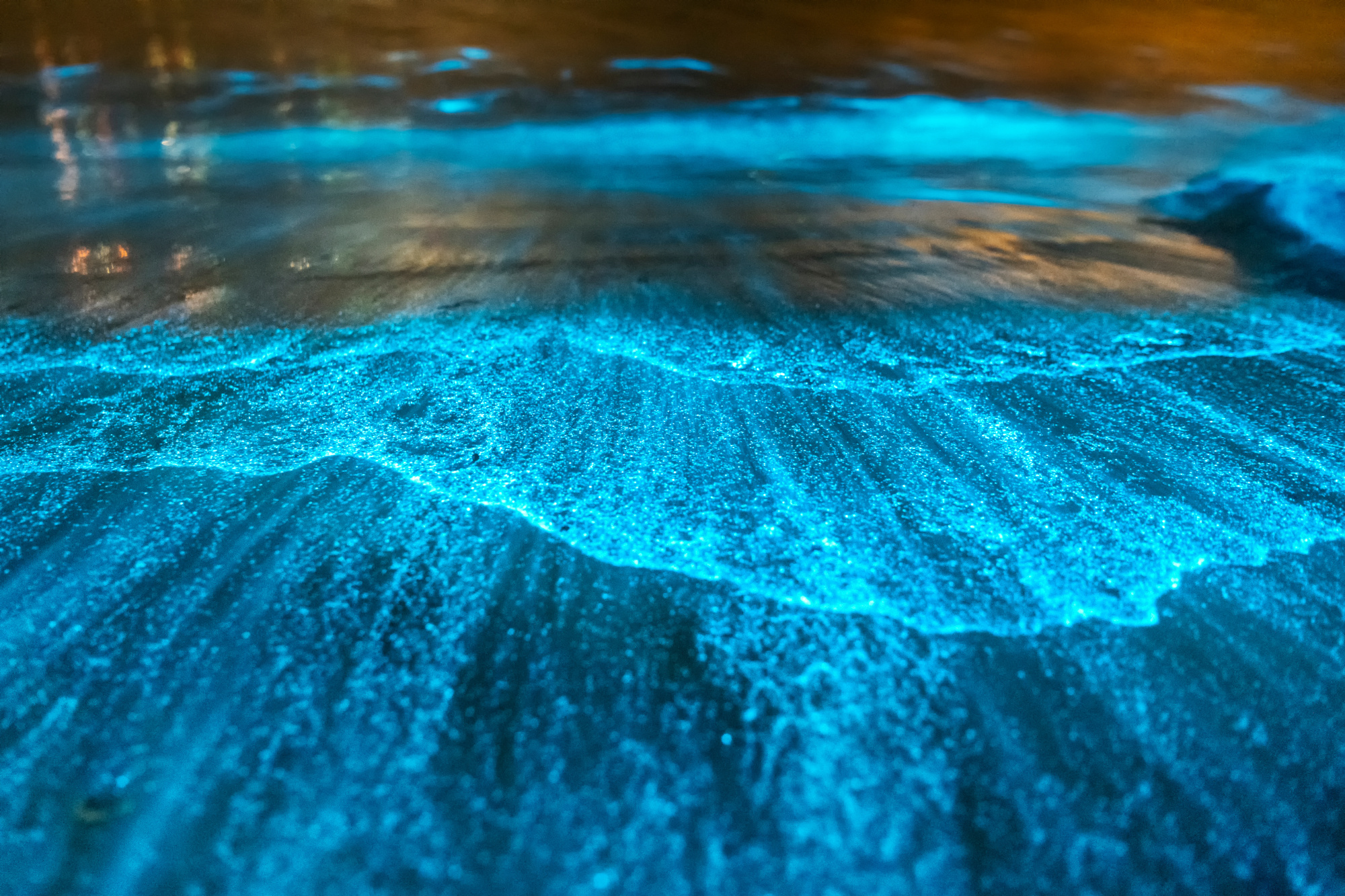
Dinoflagellates are single-celled microscopic algae. They’re plankton that float on or near the ocean surface. But they’re also found in some freshwater habitats. Some genus of the species are bioluminescent. They emit short flashes of blue-green light when disturbed. It can look like a shimmering glitter bomb in the water. Their sparkling serves as defense and offense against predators. They can startle predators when they flash, disrupting their feeding pattern. The light they emit can also attract larger predators that may feed on what’s trying to eat them. It doesn’t take much to trigger this oceanic light show. Any motion in the water can activate a shimmer that you can see along the surface. Splashing waves, swimming, or even a passing watercraft. But it only occurs at night thanks to their circadian clock.
Would you like to experience the wonder of a blue glowing sea? One of the best-known places to see bioluminescent dinoflagellates is along the Space Coast of Florida. Cocoa Beach and the Indian River Lagoon are plentiful with them in the summertime. But if you’re lucky, you can spot them on many Southern US coastal beaches. They’ve been reported all along the Atlantic and Gulf coasts. It’s a special experience you won’t ever forget.
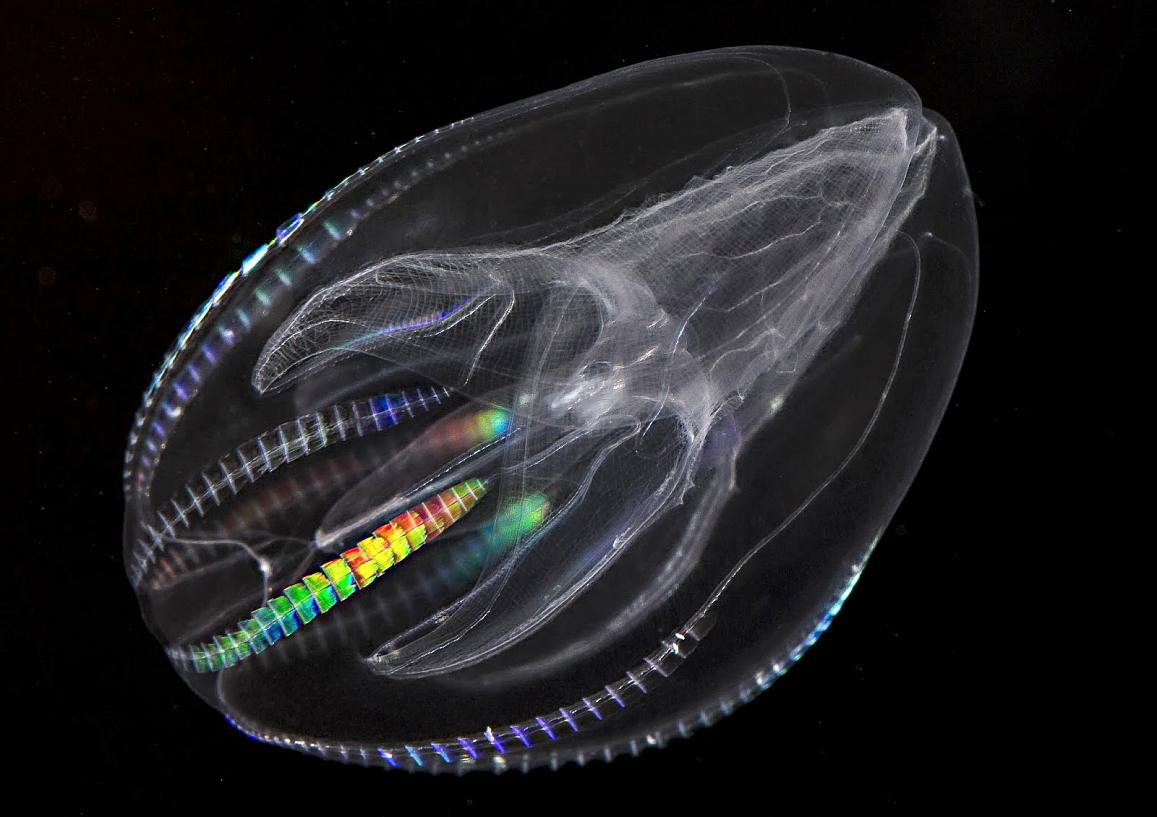
Comb jellies are zooplankton, tiny animals found at the sea surface. These predators use hair-like features to propel themselves through the water. They’re flanked by rows of bioluminescent “combs” called cilia. Though they’re similar in name to jelly fish, they don’t sting. They’re completely clear except for the cilia that will glow blue-green light. Some emit an iridescent or rainbow-colored light, too. Similar to dinoflagellates, comb jellies will light up when triggered by movement. Scientists aren’t sure why comb jellies do this.
You can find comb jellies anywhere from shallow coastal waters to the deep sea. There are two common comb jellies you can find along the Southern Atlantic coast. Sea walnuts (Mnemiopsis leidyi) and pink comb jelly (Beroe ovata). In Florida, you can find large blooms from October through May. But they’re around all year long. In North Carolina, they congregate in large numbers in spring and summer. Though they can also be found year-round. Have you ever experienced these glowing orbs of the sea?
Experiences that inspire wonder can help improve your mental health. Southern forests and wetlands are filled with awe-inspiring phenomena. That’s one of many reasons we must do everything we can to protect them. Appreciating the beauty around you can help you find your own glow within. There are few things as marvelous as those that light up the night. I hope this inspires you to explore the many living things that glow in the dark. Be amazed by the bioluminescence you can find in your backyard.
If you enjoyed this, check out Part One in our bioluminescence series: Things that Glow in the Dark: Fireflies, Lightning Bugs, and More
The best way to protect bioluminescent species is to protect the places they rely on to survive. Act now to protect the forests and wetlands wildlife depend on.
Few things in nature inspire wonder and awe like organisms that glow in the dark. A chemical reaction in living things can cause them to make their own light. This phenomenon is called bioluminescence. Many species have evolved to radiate light throughout history. It can occur in bacteria, fungi, insects, birds, and even marine life. Some living things emit light in short bursts. Some emit a steady glow. The Southern US is home to many of nature’s night lights. We’ll tell you when and where you can find things that naturally glow in the dark. Nighttime is the right time to discover bioluminescence in your backyard. This is the first in a two-part series.

Blue ghost fireflies image by Evan M Raskin
Some creatures use light to attract prey or a mate. Light can also be a defense to ward off predators. Some use light to mimic other species or as camouflage. Sometimes it’s used to communicate with the same species. Some even use light to illuminate their surroundings. We don’t know what the function of bioluminescence is for every species. We still have a lot to learn about why some organisms glow in the dark.
The scientific name Lampyridae is Latin for “shining light”. There are around 2,000 species of Lampyridae across the world. In North America, there are more than 125 known species. There’s no difference between a lightning bug and a firefly. You can use the terms interchangeably. What you call them depends mostly on where you grew up. But Lampyridae are neither flies nor bugs; they’re beetles. Beetles are unique because they have hard wing covers and chewing mouth parts. No matter what you call them, they’re a magical sight to behold!
What do you call this bioluminescent beetle?
Fireflies have a 4-stage life cycle. They spend most of their life (1-3 years) underground. They lay eggs in moist soil. The eggs take around 3 weeks to hatch. They’ll spend 1-2 years as larva before transforming to pupa for another 3 weeks. Finally, they emerge from the ground as adults and live for 3-4 weeks. In general, adults emerge during late spring and midsummer. They’re most active between late May through early August. Once they reach adulthood, their goal is to mate and spawn the next generation.
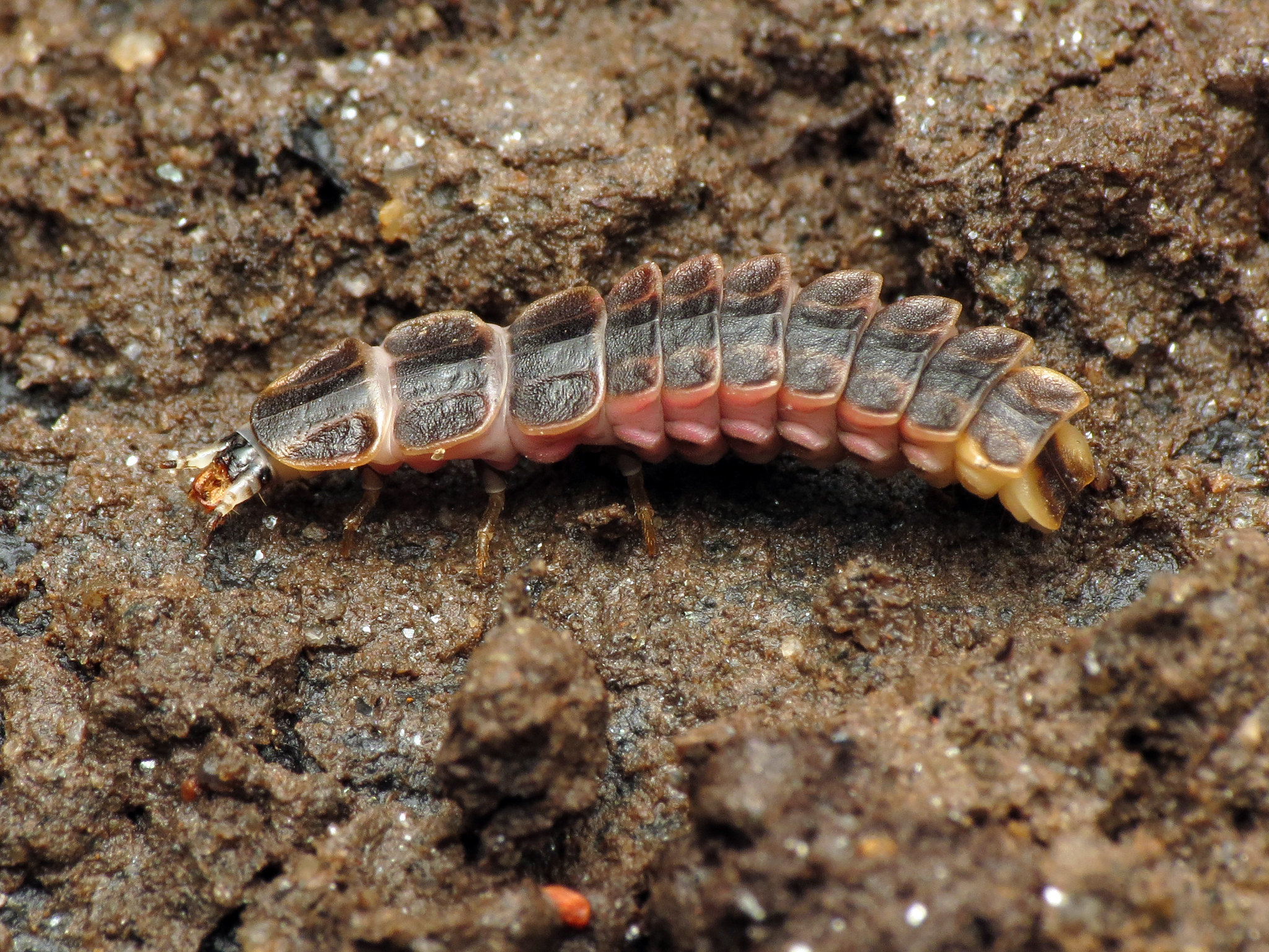
Firefly larva image by Katja Schulz
Lightning bugs vary in color, shape, and size. But many appear very similarly. Fireflies produce light in their larval stage, and many also emit light as adults. Some glow and some flash. The frequency and pattern of a male’s flash and a female’s response is unique to each species. It’s their special love language that helps them identify each other in the darkness. These mostly nocturnal beetles thrive in temperate and tropical climates. They flourish in moist regions and prefer marshy, wet, wooded areas. Here are some of the most well-known lightning bugs you can find in the Southern US.
There are two types of synchronous fireflies in the Southeastern US. This species flashes in unison with one another in a delightful display. Their scientific names are Photinus carolinus and Photuris frontalis.
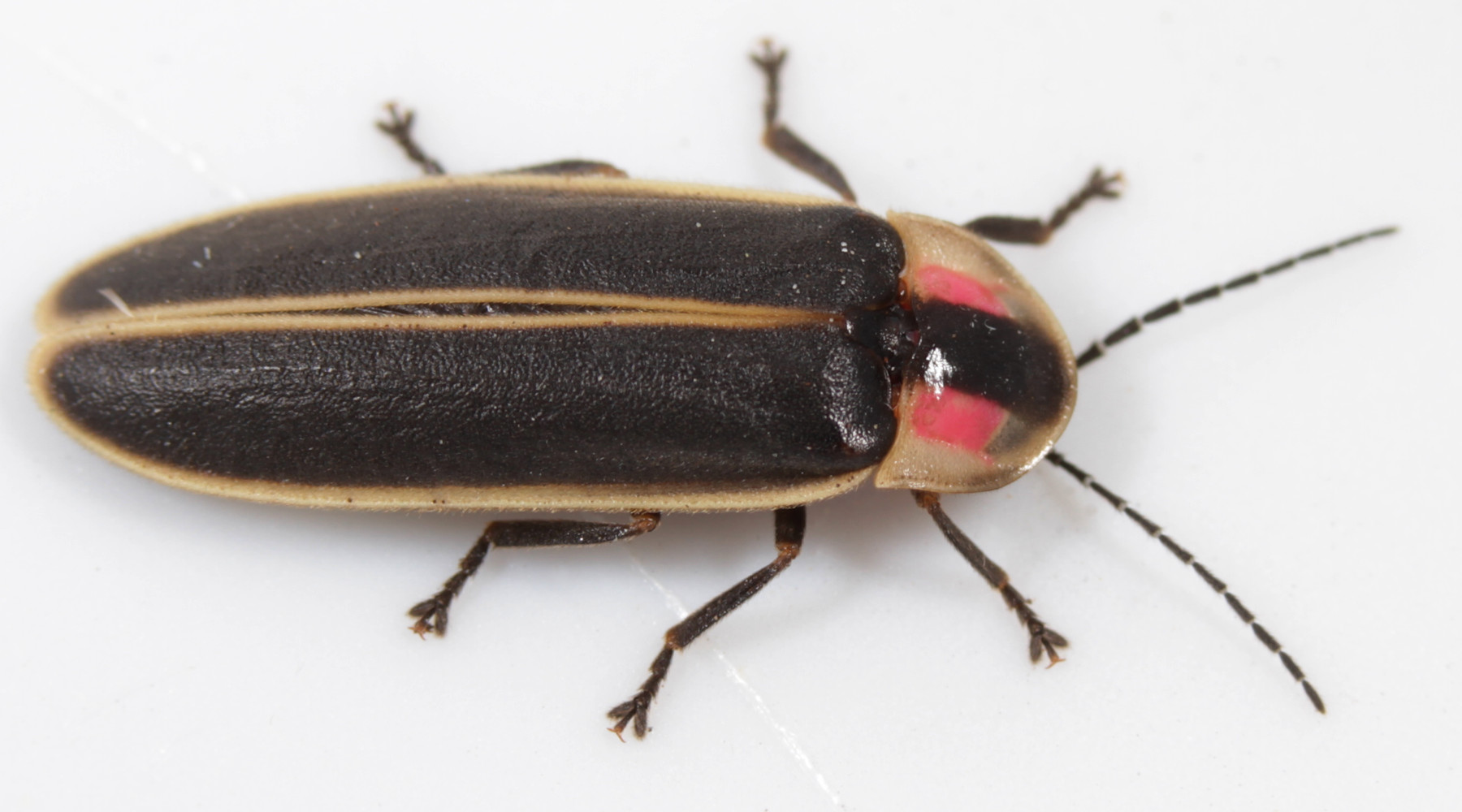
Smokies synchronous firefly image by Patrick Coin
Photinus carolinus are commonly known as the “Smokies synchronous firefly.” Adults are about ½ an inch long. They’re mostly black with yellow-lined wing covers. Their see-through head shield has a reddish splotch and a dark rectangle at the center. They have long, dark antennas. They emit a yellow-green flash from the pale segments of their lower abdomen. Males light up in a flash train. Their pattern is 6 flashes about half a second apart, followed by a pause of 6 seconds. Then they repeat the pattern as often as every 9 seconds. They do this while flying fairly low (3-7 feet) off the forest floor. Their display can appear like a rippling wave of light. By the end of the night, their light can appear less bright and more orange.
Peak Smokies synchronous firefly activity varies from year to year. It depends on weather, temperature, and soil conditions. It can range between late May to late June. Their light show begins about 30 minutes after sunset and can go on well after midnight. Undisturbed, dark forests are their prime habitat. You can find the Smokies synchronous firefly beyond the Great Smoky Mountains. Look in northern Georgia, North Carolina, South Carolina, Tennessee, Virginia, and West Virginia. They prefer mature hardwood forests (65 years or older) in mountain river valleys above 1,400 feet. They avoid thick underbrush and favor small clearings surrounded by open forest.
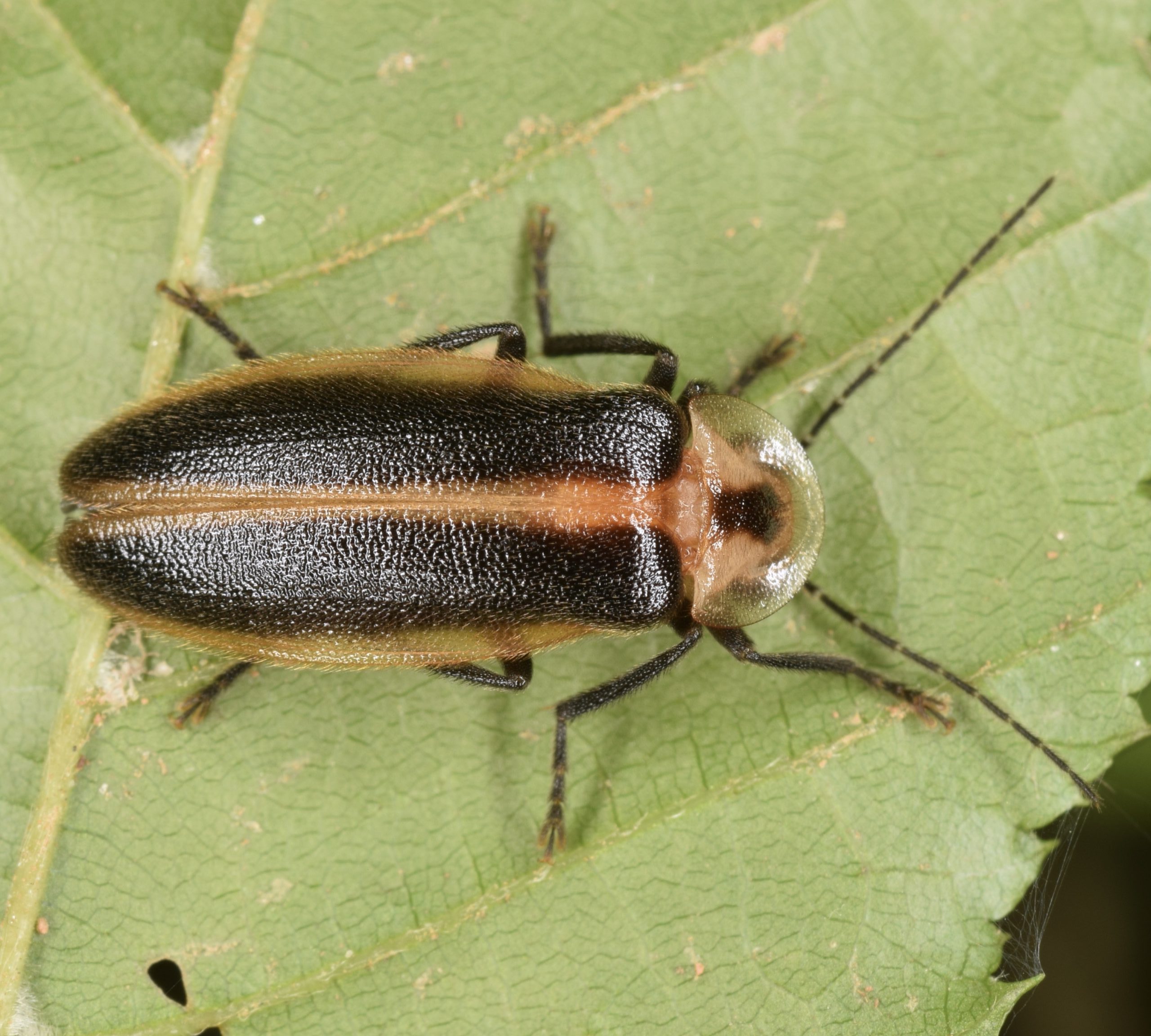
Snappy single synch image by Christina Butler
Photuris frontalis are commonly known as “snappy single synch.” Adults are ½ – ⅔ of an inch long. Males are larger than females. Adults are more rounded looking than other lightning bugs. They’re mostly black with pale yellow, almost translucent lined wing covers. Their head shield is translucent with a dark rectangle or hourglass at the center. They have long thin antennas. Males have two light producing segments on their lower abdomen. Females have a unique split lantern on the top of their two light segments. Snappy single synchs get their name from their quick and constant flash. They emit light two times per second in prolonged bursts. Up close they emit a deep yellow flash, but the light can appear white from afar. Males fly low (2-5 feet) above the ground searching for females in the leaf litter.
Peak snappy single synchs activity usually begins in mid-May to early June. The window to observe them lasts just 2-3 weeks. Their light displays begin about 40 minutes after sunset and can last for 1-2 hours. They’re found in Alabama, Florida, Georgia, Mississippi, North Carolina, South Carolina, and Tennessee. This species prefers the edges of mature cypress swamps and forested bottomlands. They need moist wooded areas with water sources nearby.
People will travel from all over the world for the chance to see synchronous lightning bugs. You can watch Photinus carolinus at Great Smoky Mountains National Park and at Grandfather Mountain in NC. You can watch Photinus frontalis at Congaree National Park in SC. These parks hold an annual lottery to keep visitation manageable during peak times. But there are other locations where you can find synchronous fireflies if you look.
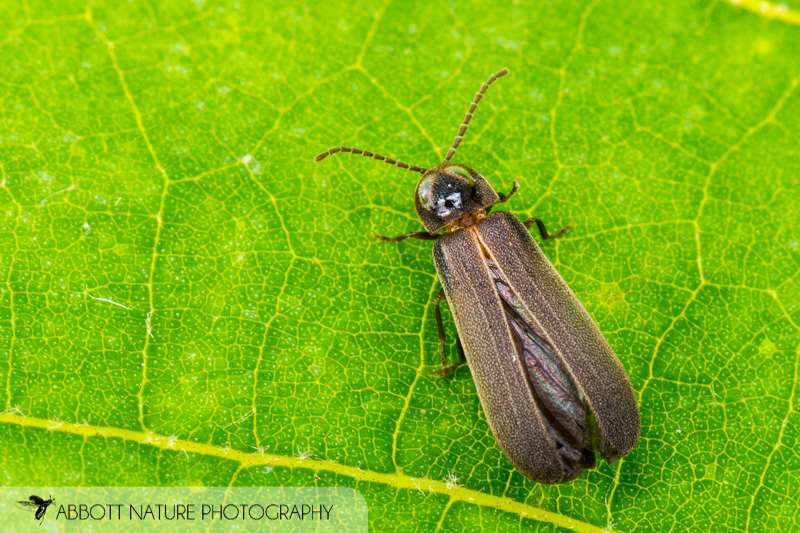
Blue ghost image by Abbott Nature Photography
Blue ghost fireflies are a rare and elusive species. Adult males are tiny at ¼ – ½ of an inch. Their bodies are dark brown to black. Their rounded head shield is black and includes a windscreen around their large eyes. It looks eerily like Darth Vader’s helmet. They have a short and a long set of antennae. Males have two light-emitting segments on their lower abdomen. Females stay as larvae throughout adulthood and are known as Appalachian glow-worms. They have no wings and can’t fly. They’re usually even smaller than the males at ⅛ – ⅜ of an inch. They look like a small golden grain of rice. They crawl along leaf litter on the ground, waiting for a mate.
Instead of flashing, male blue ghosts emit a steady glow that can last up to a minute or more. They fly very low (1-4 feet) off the forest floor. It can sometimes look like they’re shining a spooky spotlight. Seeing them in nature can give an enchanted forest feeling. At a distance, blue ghost males emit a bluish-white light. But the color can appear more green the closer you get. This is due to the way the human eye functions. Light sensitivity can alter the color we perceive. Females give off a faint green glow from 4-9 spots on their bodies.
The window to observe blue ghosts is just 2-4 weeks every year. They can have two peak periods. The first lasts from mid-April to mid-May. Then they can reappear in mid-June. Blue ghost light displays begin about 30 minutes after sunset and last up to 90 minutes each night. They prefer warm temperatures and moist to wet, undisturbed wooded areas. But you can also find them in dry woods and dry high ridges. The most common place to see them is in the Southern Appalachians of North Carolina. But they’ve been reported in Alabama, the Georgia Piedmont, South Carolina, and Tennessee. You can also find them in some isolated pockets of Northern Florida.
Sadly, blue ghost populations are dwindling from habitat loss and light pollution. Logging and development contribute to their decline. Any activity that disturbs the forest floor can destroy their habitat. Humans are their biggest threat. Be careful not to love these tiny bioluminescent beetles to death. If you’re going out at night to see blue ghosts, take precautions. Check out our visiting firefly habitat etiquette below.
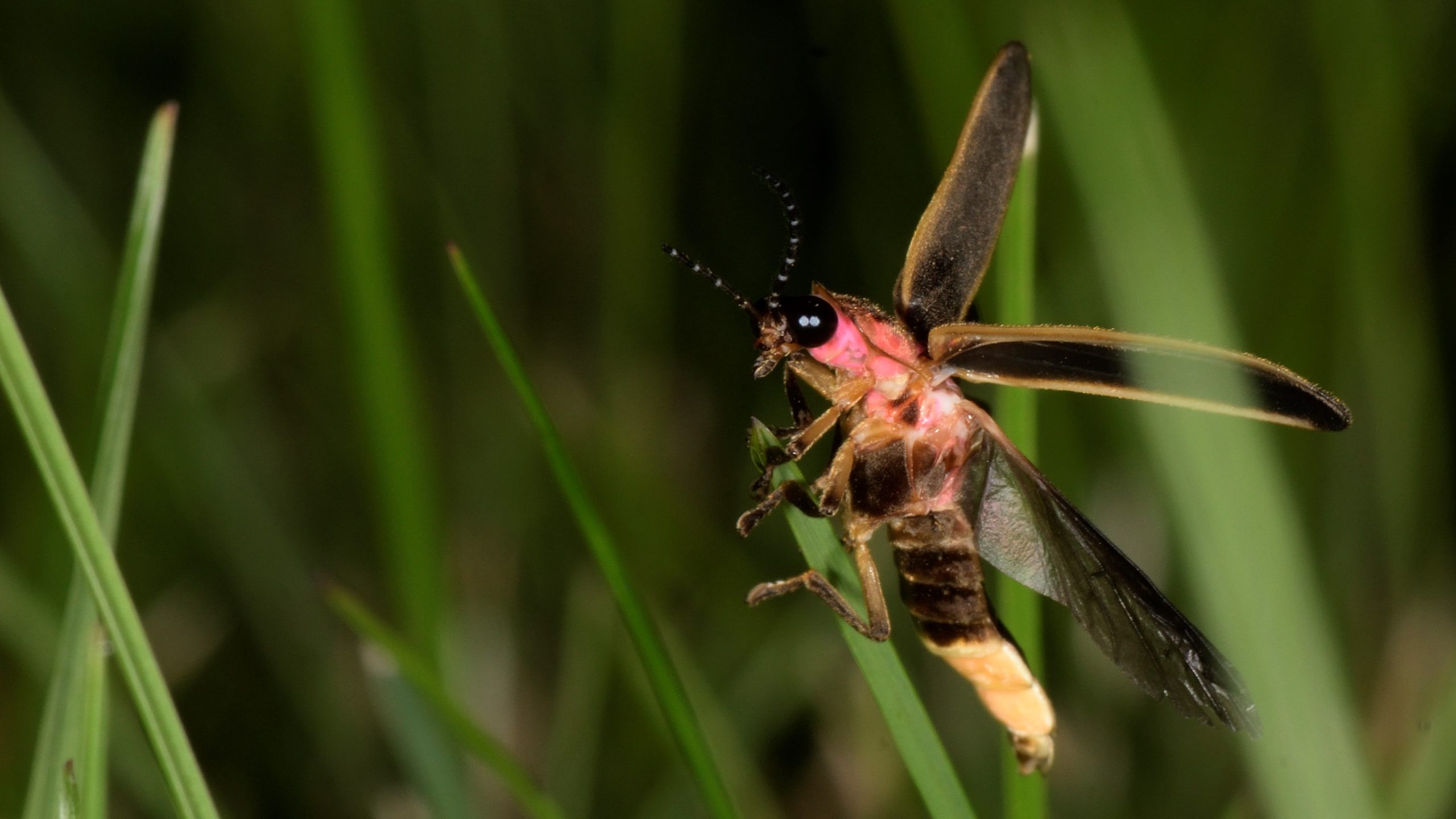
Common eastern firefly image by Dan Hodges
The common eastern firefly goes by several names. It’s the lightning bug that most people east of the Rocky Mountains will find in their backyards. Its scientific name is Photinus pyralis. They’re also called “big dipper” or “J-stroke” fireflies. This is because of their unique flight and flash pattern. They measure ⅓ to ¾ of an inch long. Adults are mostly black with yellow-lined wing covers. Their head shield is a pale yellow with a red splotch and black dot in the center. Males usually have much larger eyes than females. They both have dark, segmented antennas. Males have two light-producing segments on their lower abdomen. Females have a heart-shaped lantern on a single segment of their abdomen. Females often have two dark triangle markings on each side of the lantern. This has also earned them the name “tornado tail.” Both sexes emit a yellow-green light that can look like shooting stars in the night.
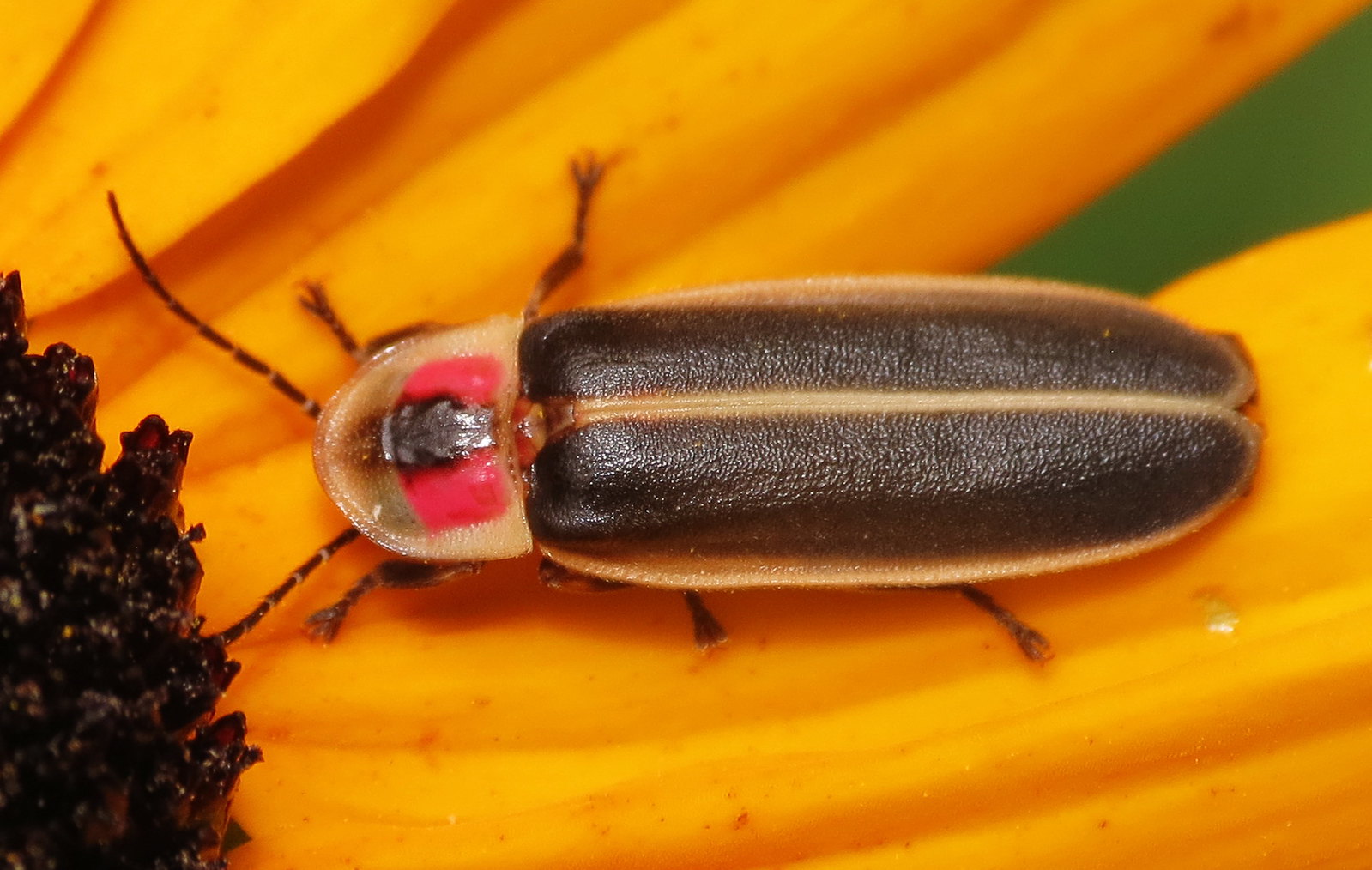
Big dipper firefly image by Paul Bedell
Male big dippers fly in a vertical orientation in a U-shaped dipping pattern. They form a distinct J-shaped courtship flash that lasts for a little more than half a second. Males will flash every 5-7 seconds. They fly low (2-3 feet) above the ground early in the evening. Then they’ll fly very high later in the night. Many end their displays in the treetops. Females remain low to the ground on leaves or grasses. They twist their abdomen towards the male and emit a single flash to alert their interest. Males will present females with gifts to sway their mating selection.
Male big dippers can fall victim to looking for love in all the wrong places. Photuris versicolor fireflies, also known as femme fatales, will mimic female big dippers. They will attract, kill, and eat male big dippers. Big dippers have a defensive chemical called lucibufagins. Photuris versicolor lightning bugs don’t. When Photuris females eat male big dipper fireflies, they absorb the chemical. This helps them deter predators like spiders and birds, increasing their chances of survival. Luckily, male big dippers have another defense mechanism. They can secrete a gooey substance. It locks the jaws of female Photuris versicolor long enough that the big dipper can escape.
The best time of year to find big dipper fireflies is in the late spring and summer months. But you can spot them as early as May and as late as October, depending on the area. Peak activity begins near dusk or about 20 minutes before sunset. Their displays can last for several hours. I’ve seen them flashing well past midnight. Their range is vast. It expands well beyond the Southeastern states. You can find them from Texas to Ontario. They need areas with high moisture to survive. You’ll find big dipper lightning bugs in many habitats. Tall grassy meadows, open fields, wetlands, desert valleys, and dense woods and forests. I see these in my own backyard every spring/summer, and it never fails to inspire me with a deep sense of awe and amazement. It’s something I look forward to every year.
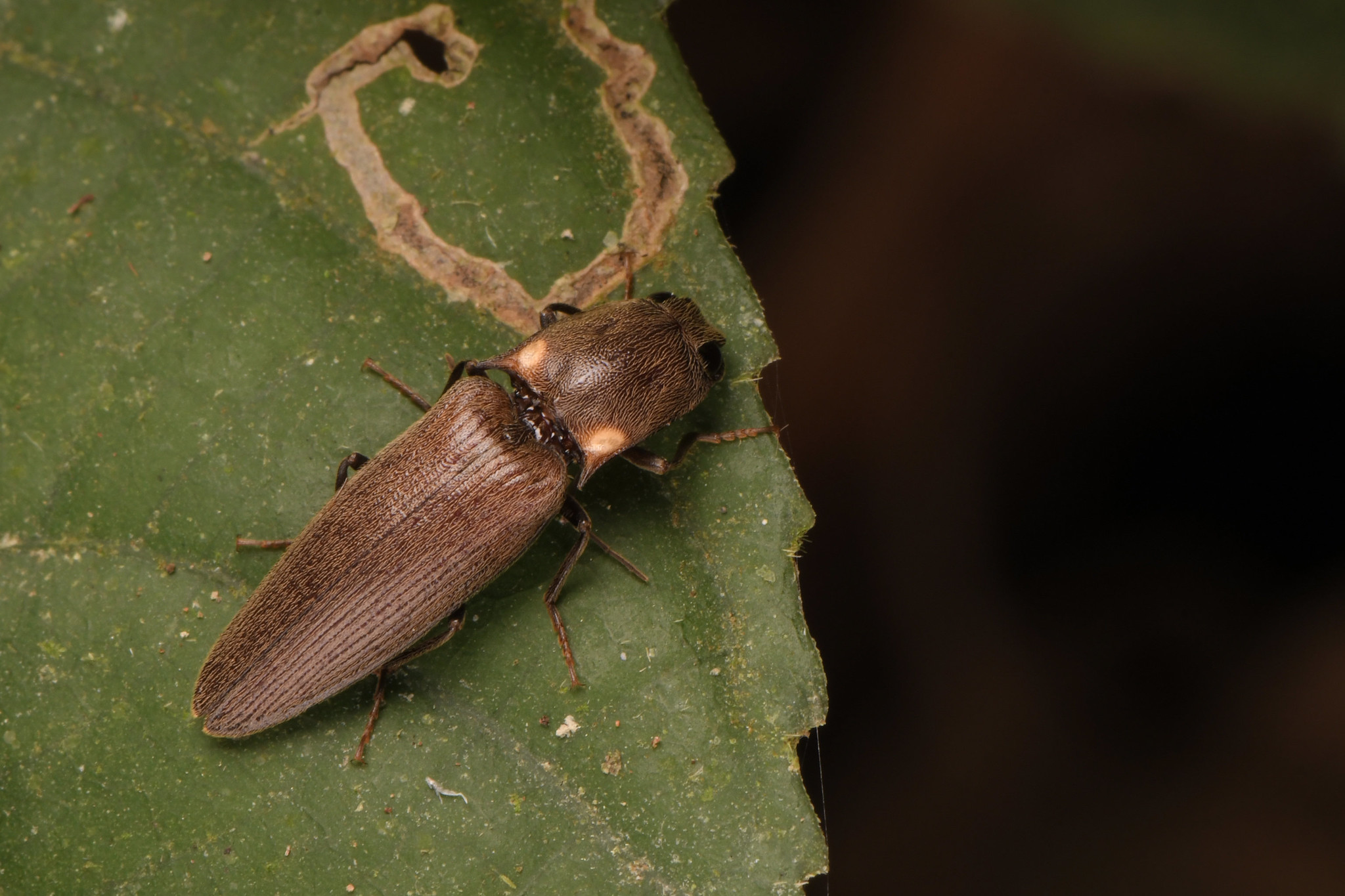
Glowing click beetle image by Dash Huang
I grew up in South Florida, and I always mistook glowing click beetles as a kind of lightning bug. My family called them cocuyos. These bioluminescent beetles are similar, but they’re in the Elateridae family. Adult glowing click beetles are dark brown to black and range from 1 – 1 ¾ inches in size. They have long, dark antennae and small eyes. Their wing covers have a ridged pattern running lengthwise on their body. It gives them the appearance of armor.
Adult glowing click beetles have two bioluminescent organs on their head shield. The lanterns emit a steady green, glowing light and look like “false eyes.” They don’t flash, but they can vary the light intensity they emit. This bright to dim glow can give the appearance of flashing. Some believe that glowing click beetles use this light to scare off predators. Their larvae are also bioluminescent.
You can find various species of glowing click beetles in coastal regions of the Southern US. Especially in Florida, Georgia, and Texas. They prefer sandy and forested areas. I remember seeing them in the later summer months. Typically from August through September.
Fireflies are a source of child-like delight. People of all ages can find inspiration and a deep sense of awe watching them. That alone makes them worthy of studying and protecting. But lightning bugs are also an important indicator species. When they’re abundant in an area, that’s a good sign that pollution is low and the environment is healthy. When their populations decrease or disappear, that’s a bad sign. It means that the environment is suffering.
The conservation status for most fireflies in the US hasn’t been evaluated. There’s little funding to study them. But a 2024 study compiled from citizen scientist data raises alarms. It shows that North American firefly populations are in decline. Lightning bugs need wet, dark, undisturbed forests to survive. These habitats are becoming more scarce in the US.
Human activity poses the greatest threat to fireflies. Climate change increases droughts and surface temperatures. Hotter, drier habitats are unsuitable for their survival. Air and water pollution have a devastating impact on their populations. Deforestation and development destroy their habitats. Light pollution disrupts their mating and development cycles. Pesticides can kill lightning bugs at all stages of their life cycle. Humans will harvest fireflies for scientific, medical, and chemical purposes. But new synthetic options make this practice cruel and obsolete. Unfortunately, in some rural areas harvesting continues. A conservative estimate is that 10% of all firefly species are in danger of extinction.
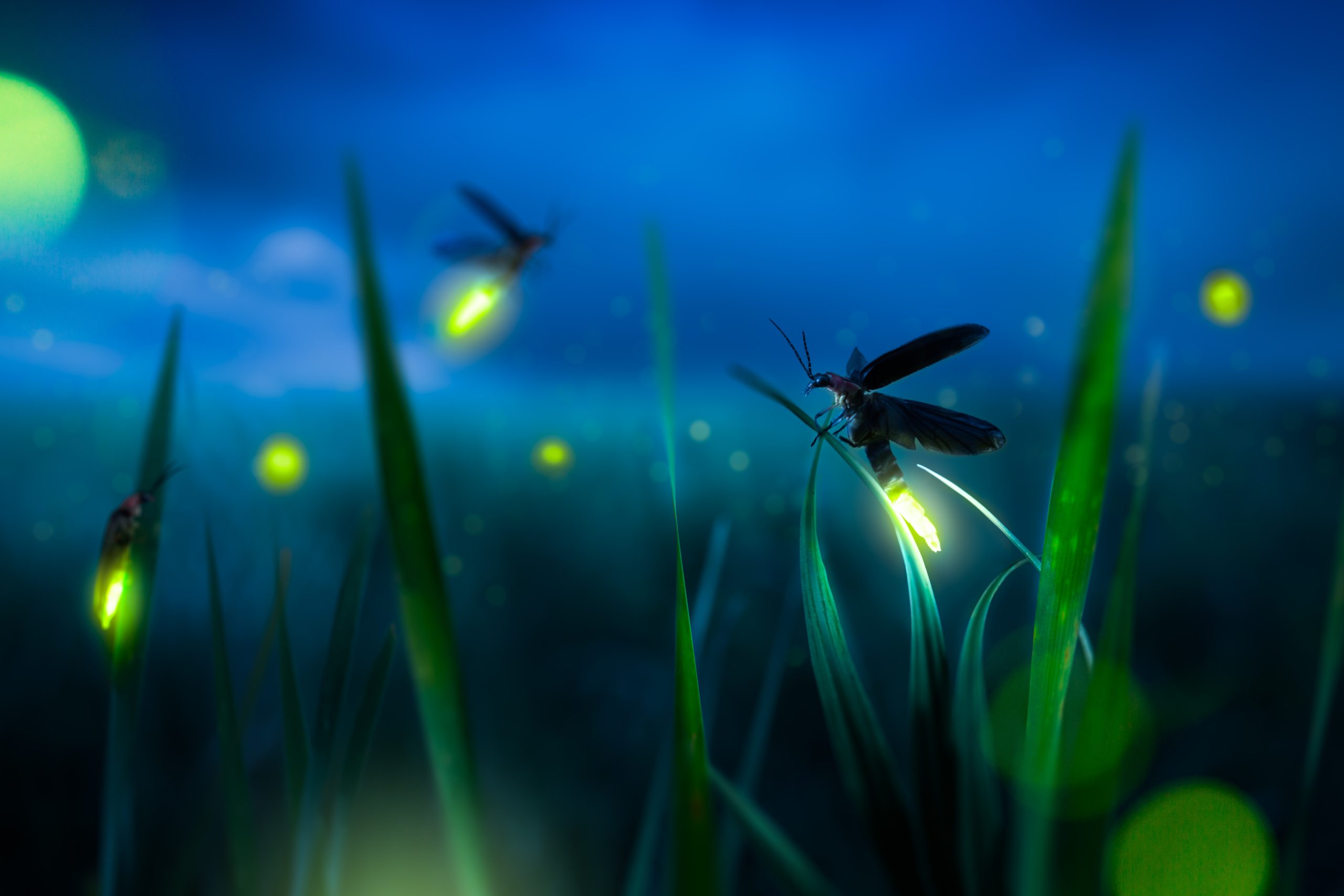
Commit to doing everything you can to ensure fireflies and lightning bugs thrive. To brighten the lives of future generations.
Sign the pledge to protect lightning bugs!
Certify your property. Firefly Research & Conservation offers a firefly habitat certification program. Commit to making your backyard or land a permanent place for lightning bugs to thrive. You’ll even get a beautiful sign to post. Here’s a list of Southern native plants that lightning bugs love.
Experiences that inspire wonder can help reduce depression and improve mental health. Southern forests and wetlands are filled with awe-inspiring phenomena. That’s one of many reasons we must do everything we can to protect them. Appreciating the beauty around you, can help you find your own glow within. There are few things as marvelous as those that light up the night. I hope this inspires you to explore the many living things that glow in the dark. Be amazed by the bioluminescence you can find in your backyard.
The best way to protect bioluminescent species is to protect the places they rely on to survive.
Act now to protect wildlife and wilderness.
Read part two in our our bioluminescence series. More Things That Glow in the Dark: Mushrooms & Marine Life
Learn more about bioluminescent beetles of the Southeast in Fireflies, Glow-worms, and Lightning Bugs by Lynn Frierson Faust.
Check out the nonprofit Firefly Conservation & Research at firefly.org.

People around the world celebrate the first Sunday in May as Dawn Chorus Day. It’s a day to set aside time to listen to nature’s sweetest symphony: birdsong. But you can and should enjoy the sweet melodies of birds any time of year. Listening to birdsong can reduce stress and promote health and well-being.
Birdwatchers can learn to identify birds with their eyes and ears. In most cases, you can hear a bird before you can see them. I’ll introduce you to how to listen for some of the most iconic songbirds of the Southeast. Using mnemonic devices can help you remember a bird’s unique pattern of sounds. But first, do you know what makes a songbird a songbird?
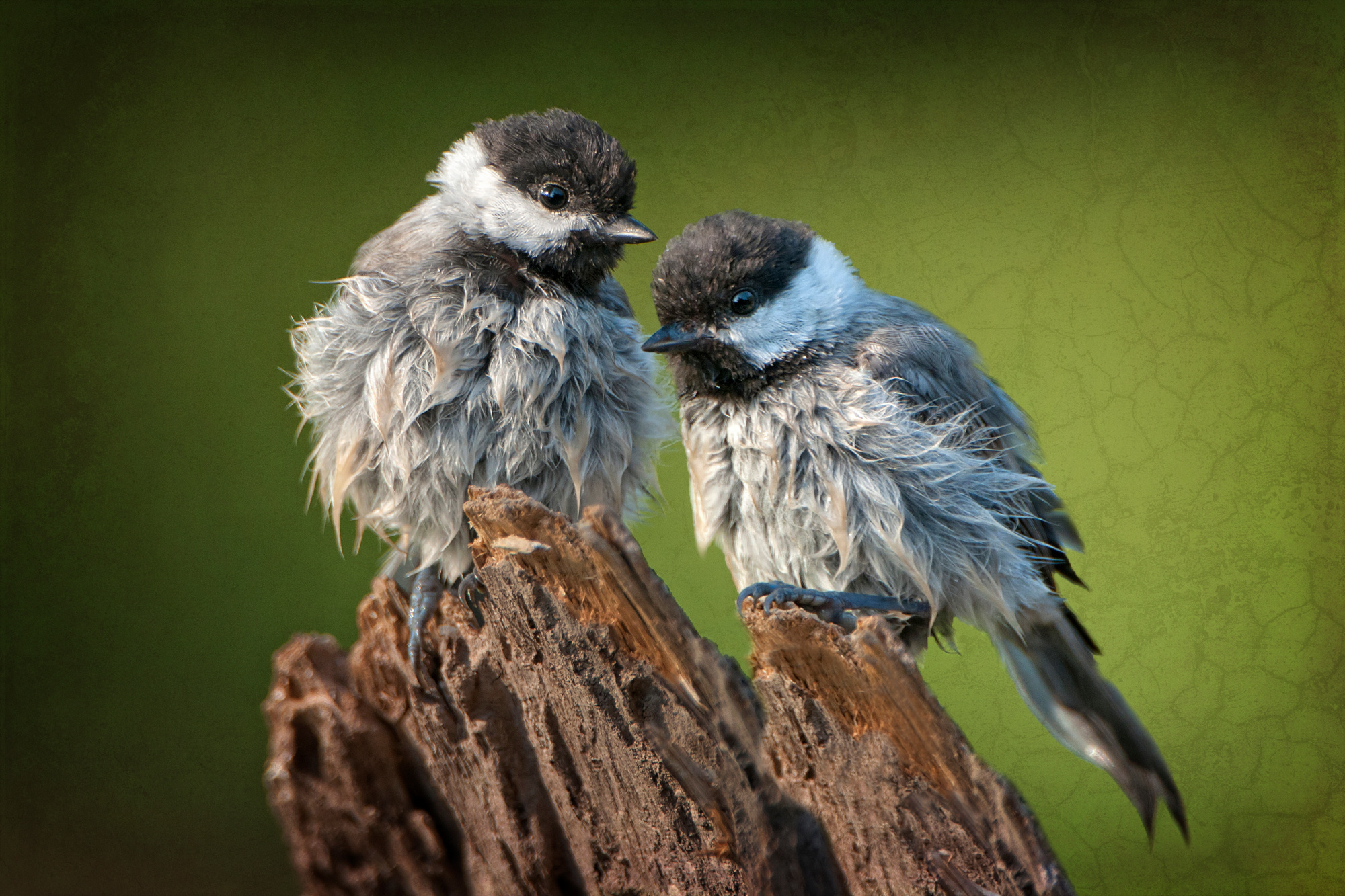
Songbirds are a unique suborder of birds called oscines. There are more than 4,000 birds in this suborder, but they have a couple of common traits. Songbirds are perching birds. They have distinctive toes that allow them to grasp branches. All birds have an organ that allows them to produce sound called a syrinx. But songbirds have exceptional control of the muscles around the syrinx. They can create specific tunes with every exhale. Songbirds learn their distinct songs usually from their parents and other adult birds. They can continue to add to their list of songs, while other birds have limited vocalizations. But not all songbirds sing. Experts believe that birds sing to defend their territory. They also sing or call to bond with or attract a mate.
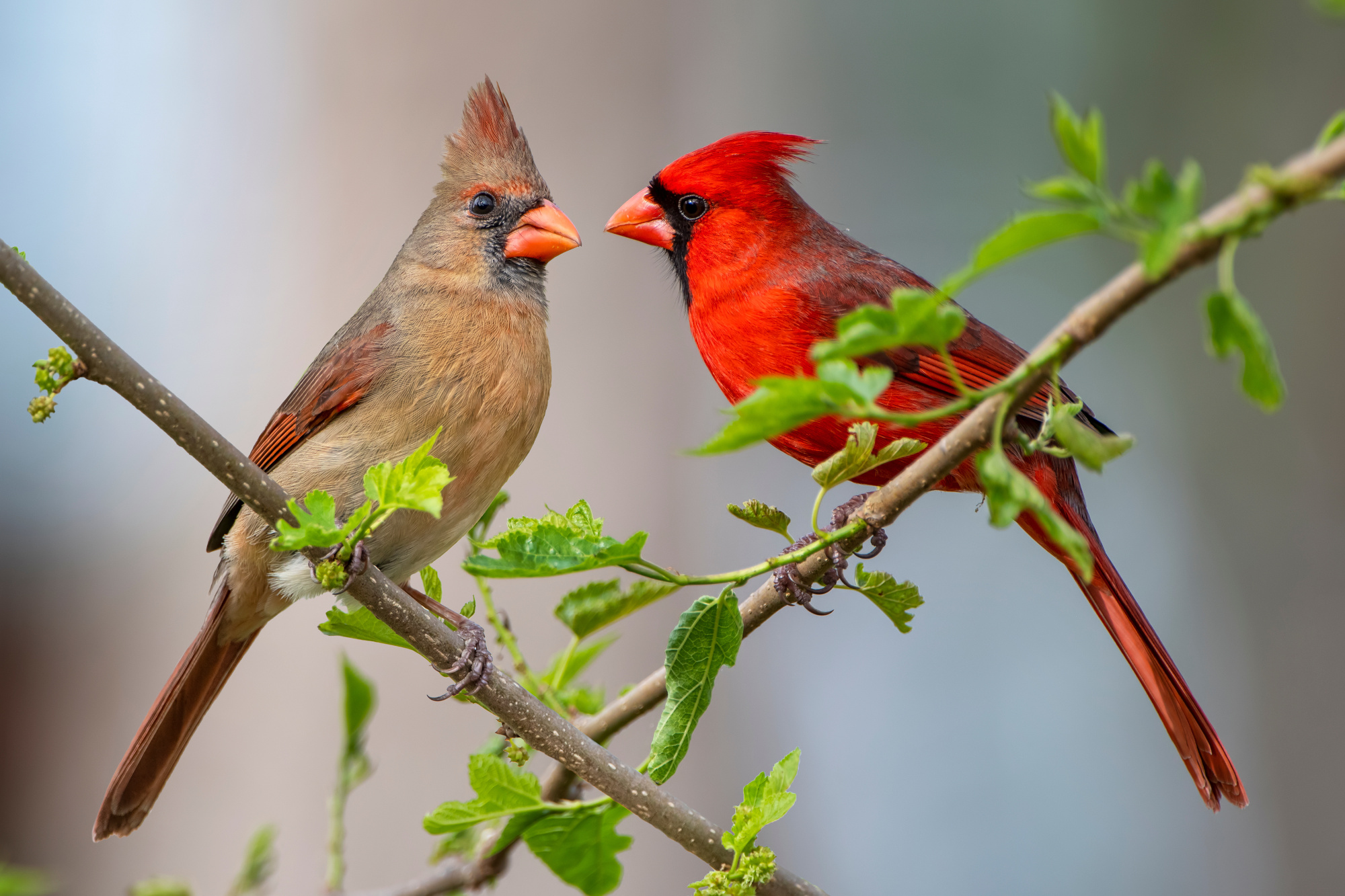
Female Northern cardinal on the left, and male Northern cardinal on the right.
Cardinals are one of the most striking and recognizable birds of North America. They’re the official state bird of seven states including North Carolina and Virginia. Males are bright, crimson red. Females are a ruddy taupe with crimson highlights in the crest, wings, and tail. In very rare cases, a genetic mutation has led to a golden yellow cardinal. Northern cardinals have a dramatic crest that they can raise or lower and a thick, blood-orange beak. They also have black mask-like markings around the eyes and bill. They’re medium-sized birds between 8-9 inches in length (21-23 cm).
Male northern cardinals will sing all year long. Females will usually sing when on their nest. They sing a longer and more intricate tune than their male partners. Cardinal songs often last 2-5 seconds, but they can sing for 15 seconds or more. They sound like a loud string of whistles that speed up and end in a slow trill. It can sound like they’re saying “cheer-cheer-cheer”. Or sometimes it sounds like “tweet-tweet-cheer-cheer-cheer-joy-joy-joy”. Cardinals have more than a dozen calls. They’ll make a metallic chip sound when calling to their mate or to warn that predators are in the area.
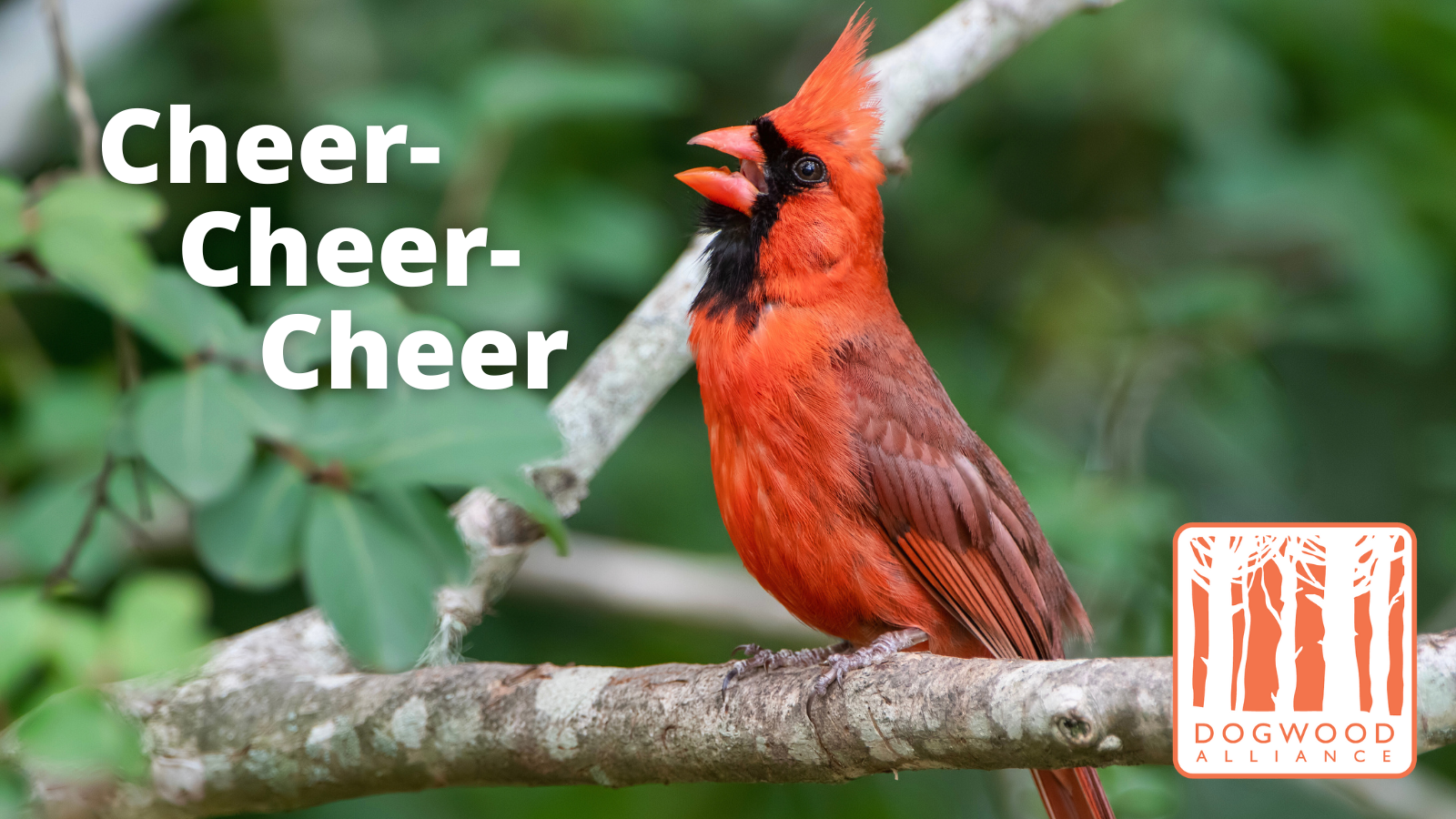
The cardinal’s natural habitat is open woodlands. But they’re often found in backyards, parks, and shrubby areas. Their main diet includes seeds, fruits, and the occasional insects. They love when I leave mealworms out for them, too. It’s very easy to attract these songbirds with a bird feeder. Otherwise, they usually forage for food on the ground. Cardinals get their red plumage from their diet. These feisty birds are very territorial and will chase other birds away. They’re also known to fight their own reflection, believing it to be a competing cardinal. Paired cardinals feed one another to deepen their bond, and they perform courtship dances, too.
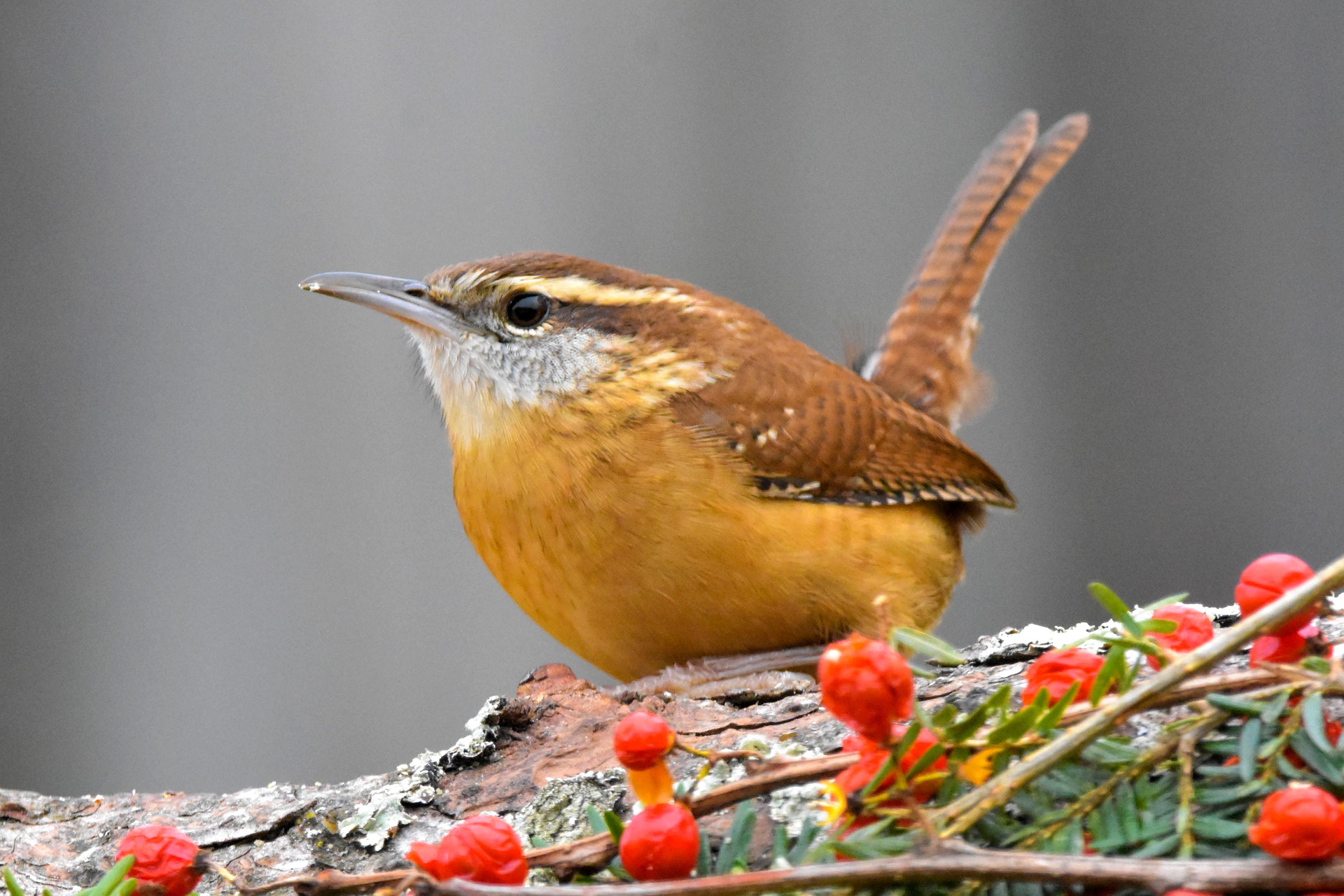
Carolina wren
Carolina wrens are very small in stature, but the sound they create is enormous. Their songs can reach a whopping 90-110 decibels. That means they can be as loud as a train or a jackhammer. Male and female Carolina wrens look similar. Their bodies are stout and round and their tails point up. They’re a warm cinnamon brown from their bill to their tail feathers with light and dark spots and stripes. Their beak is long, thin, and curved downward. This can make the Carolina wren look like they have a disapproving smirk. These wrens have a distinctive white stripe above their brown eyes. Their underside is a ruddy tan. They’re small birds between 4.5-5.5 inches in length (12-14 cm).
When a Carolina wren sings, they often lift their head and voice. They’re known for throwing their heads back and belting out a resounding bright song. Only males sing, and their song usually lasts only a couple of seconds. Some describe the sound as “teakettle-teakettle-teakettle”. But some people say it sounds like “cheeseburger-cheeseburger-cheeseburger”. And they’ll repeat this for up to 15 times in a row. When I first realized that big sound was coming out of that small bird, I became a lifelong fan.
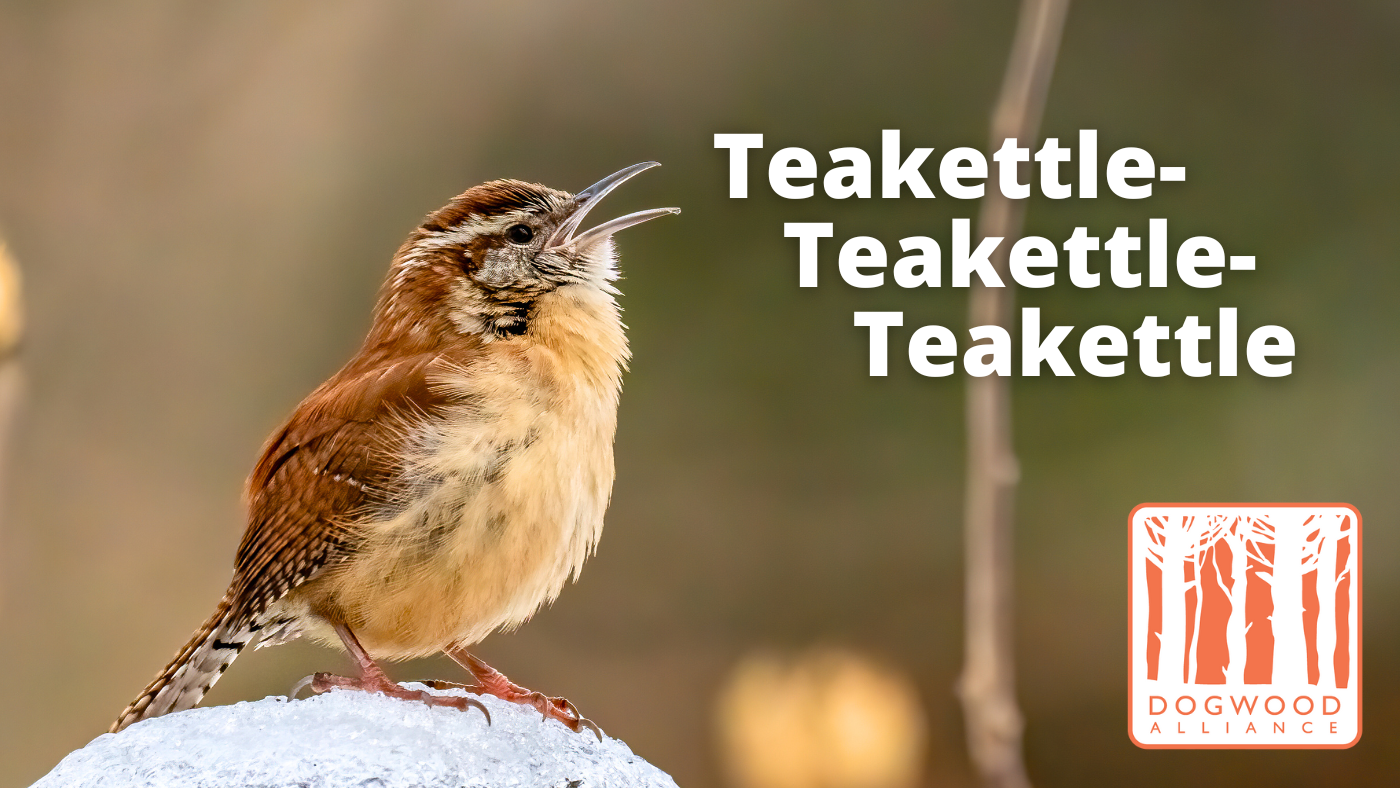
Carolina wrens live year round in the Eastern US. Their natural habitat is open woodlands. They prefer shrubby, wooded overgrown areas. But they’ll visit your backyard if food or suet is available, especially in the winter. I see them regularly on my deck, foraging in and around my planters. Carolina wrens mostly eat spiders and insects, but they’ll also eat lizards, frogs, or snakes. They forage on or near the ground hopping through leaf litter and vegetation. Once paired, these charming birds mate for life.
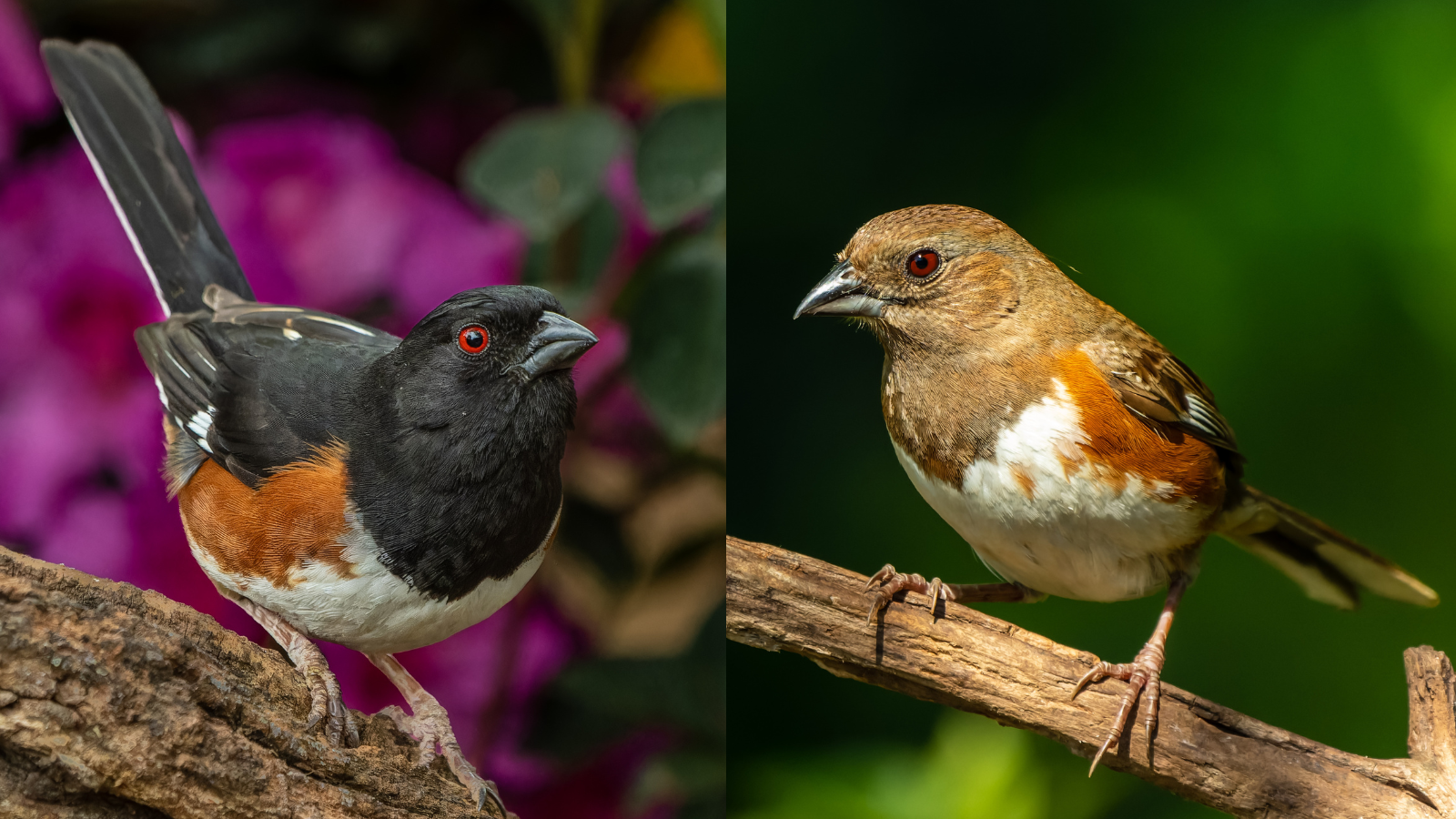
Male Eastern towhee on the left, and female Eastern towhee on the right.
Eastern towhees are strikingly beautiful sparrows with a distinctive song. Males have a black cape that covers their head, chest, wings, and tail. Whereas females have a russet brown cape. Both have tawny feathers under their wings and white underbellies. They have a thick black beak. Depending on the region, some have dark red or white eyes. They’re small to medium-sized and measure between 6.5-8 inches in length (17-21 cm).
Eastern towhees are very vocal, and their song is one of the easiest to identify. Males sing a song that sounds like “drink-your-tea-ee-ee-ee-ee”. The first note is sharp and sometimes doubled and the final notes end in a repetitive trill. Both males and females will call to one another. This helps them stay in contact or alert each other of danger. Their two-part calls vary from region to region. But they usually sound like “tow-hee” or “che-wink”.
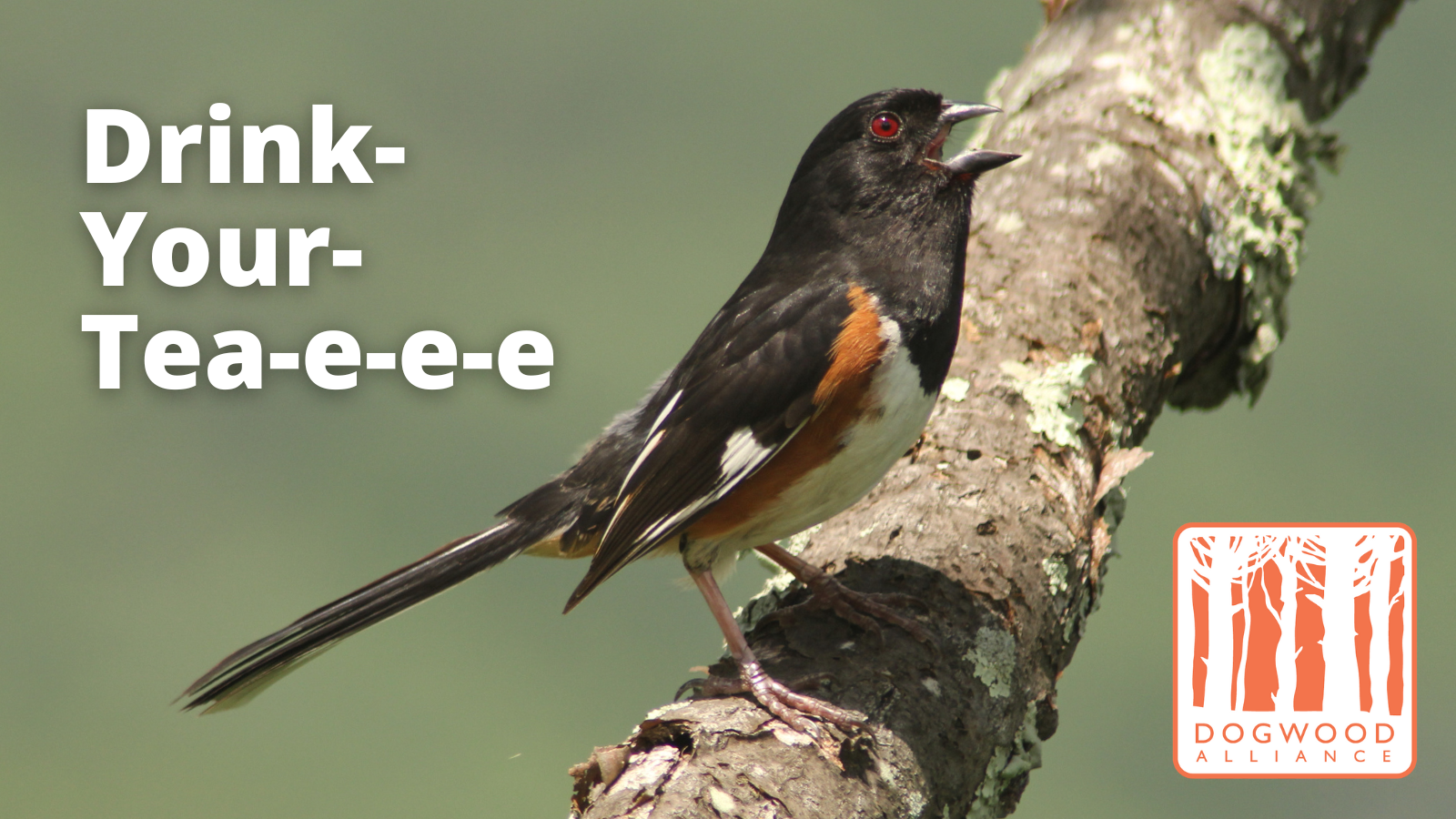
Eastern towhees live year round in the Southeastern US, but they’ll migrate north to breed. Their range overlaps with their cousins, the spotted towhee, in the Great Plains. Sometimes these two distinct species will interbreed. They prefer thick shrub-covered habitats in forest edges or woodlands. They nest and forage for food on the ground. They’re known to scratch with both their feet to turn over leaves in a back and forth hop. Then they’ll eat anything edible that they uncover. They’re omnivores and will eat seeds, fruits, insects, spiders, flower buds, and more. I only see them at my bird feeder in the winter. But I hear them almost every day year round.
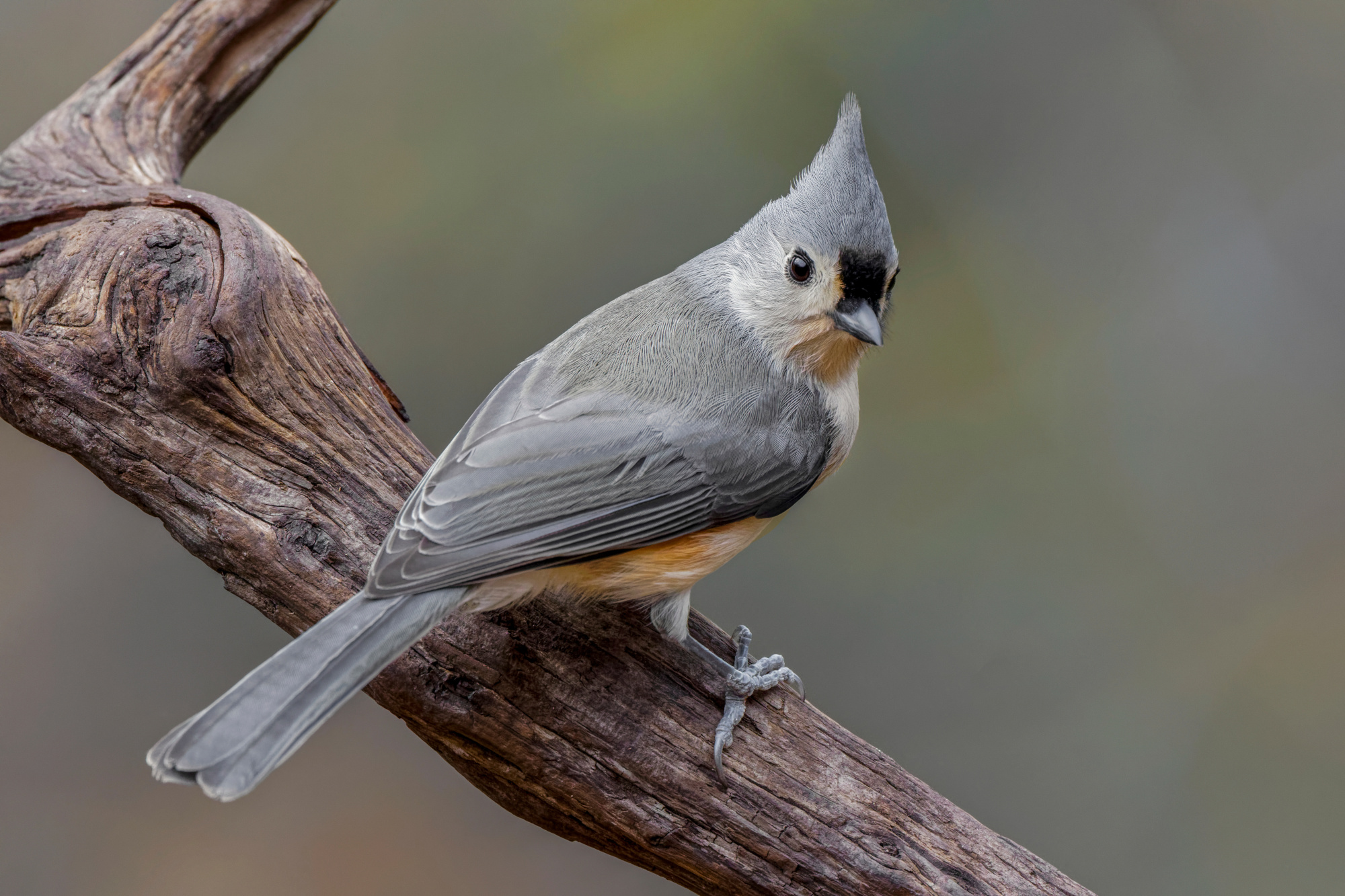
The tufted titmouse is one of my favorite birds of all time. They’re the epitome of cute with soft, mouse-like features. Male and female titmice look similar. They’re mostly gray on their crest , wings, and tail. Tufted titmice have a white face and underside with a splash of rust beneath their wings. With a patch of black above their black beaks. Their eyes are big, black, and endearing. They’re on the small side at about 5-6.5 inches in length (14-16 cm).
Tufted titmouse males do most of the singing, but females will sometimes sing a softer version. Their songs are a clear whistle that sounds like “peter-peter” or “peter-peter-peter”. They will repeat this up to 11 times a minute. My favorite thing about them is their calls. They can sound like a robot going haywire with a short burst of whistles at the end. It sounds like “see-see-see-day-day”. Maybe they’re telling us to seize the day!
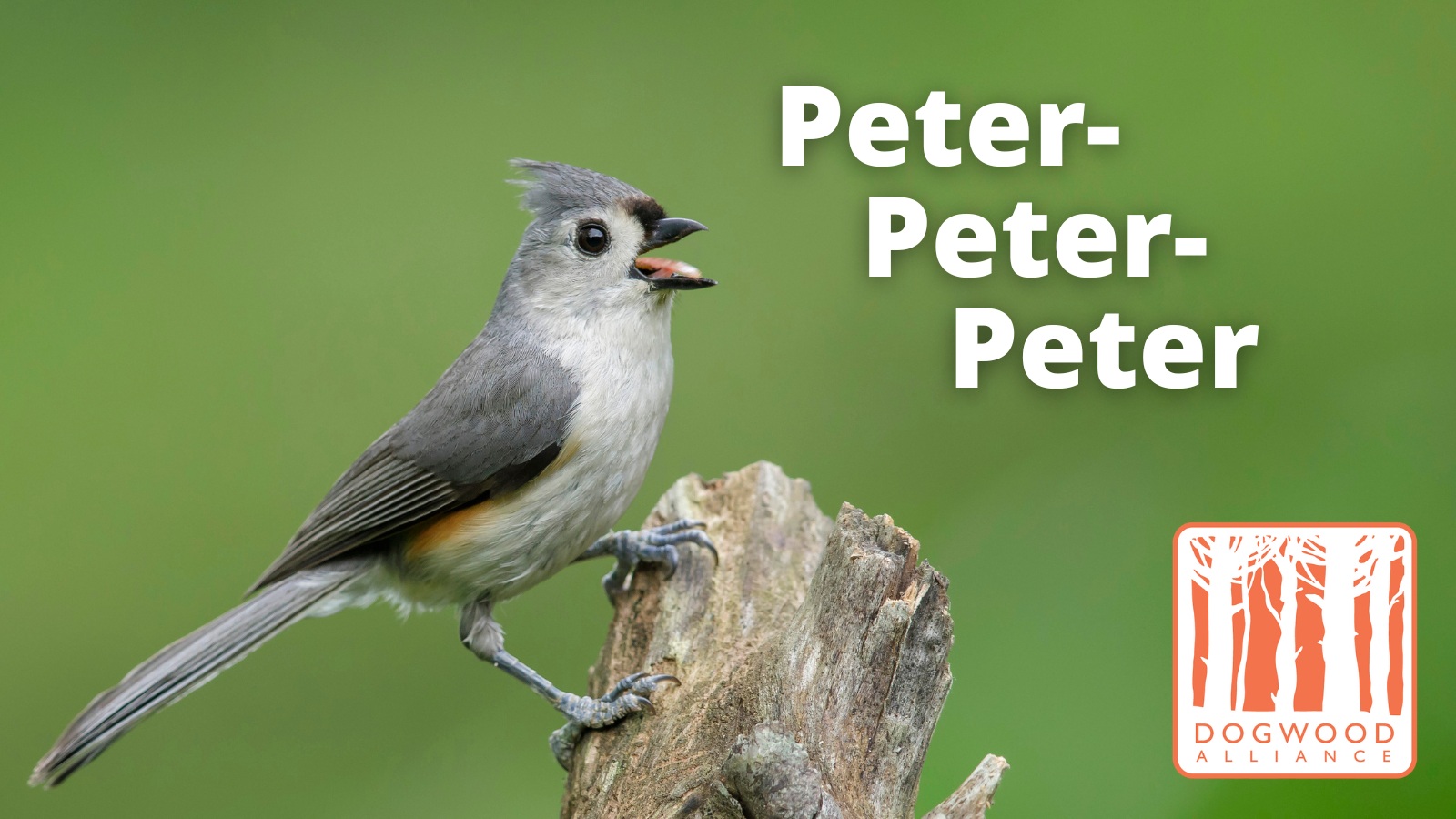
These songbirds live year round in the Eastern US. They inhabit deciduous woods or mixed woods with a thick canopy. But they’re also common in parks, gardens, and suburban areas. They forage in tree foliage, but it’s very easy to attract these songbirds with a bird feeder. They love black sunflower seeds. I’ve seen them fly off with whole peanuts in the shell. The tufted titmouse is a little acrobat. They’ll often swoop in and hang upside down or sideways when looking for food. Once they have a seed, they’ll hold it between their feet and hammer it open. I usually see them foraging in pairs. Double the cuteness!
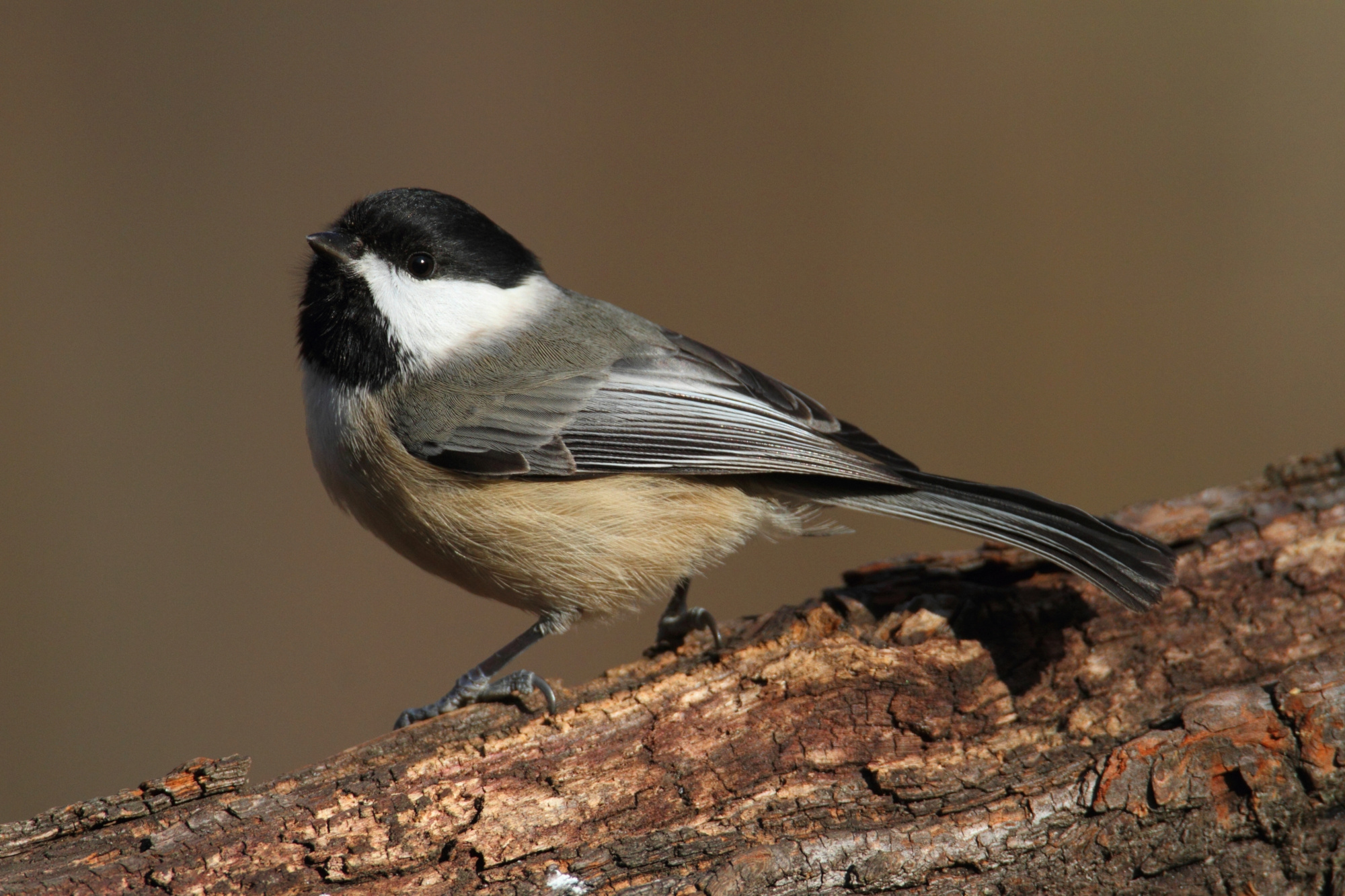
Carolina chickadees look very similar to their cousin, the black-capped chickadee. They’re small, adorable songbirds with a rounded head, short neck, and stout body. The top of their head and throat is black. These chickadees have bright, white cheeks. Their back and wings are a mottled gray. This distinguishes them from the black-capped variety that has more white in their wings. They have a short, rounded, black bill and dark eyes. Their underside has a sepia hue that fades into white on their belly. Male and female Carolina chickadees look similar. They’re very small and average 3.9-4.7 inches in length (10-12 cm).
Carolina chickadees sing more than 35 different songs. Their most characteristic tune sounds like “fee-bee-fee-bay”. The “fee” is very high-pitched. The following note is in a lower register. Their distinct call sounds like “chickadee-dee-dee”. Chickadees can also sound like a robot going haywire with lots of chatter and shrill whistles.
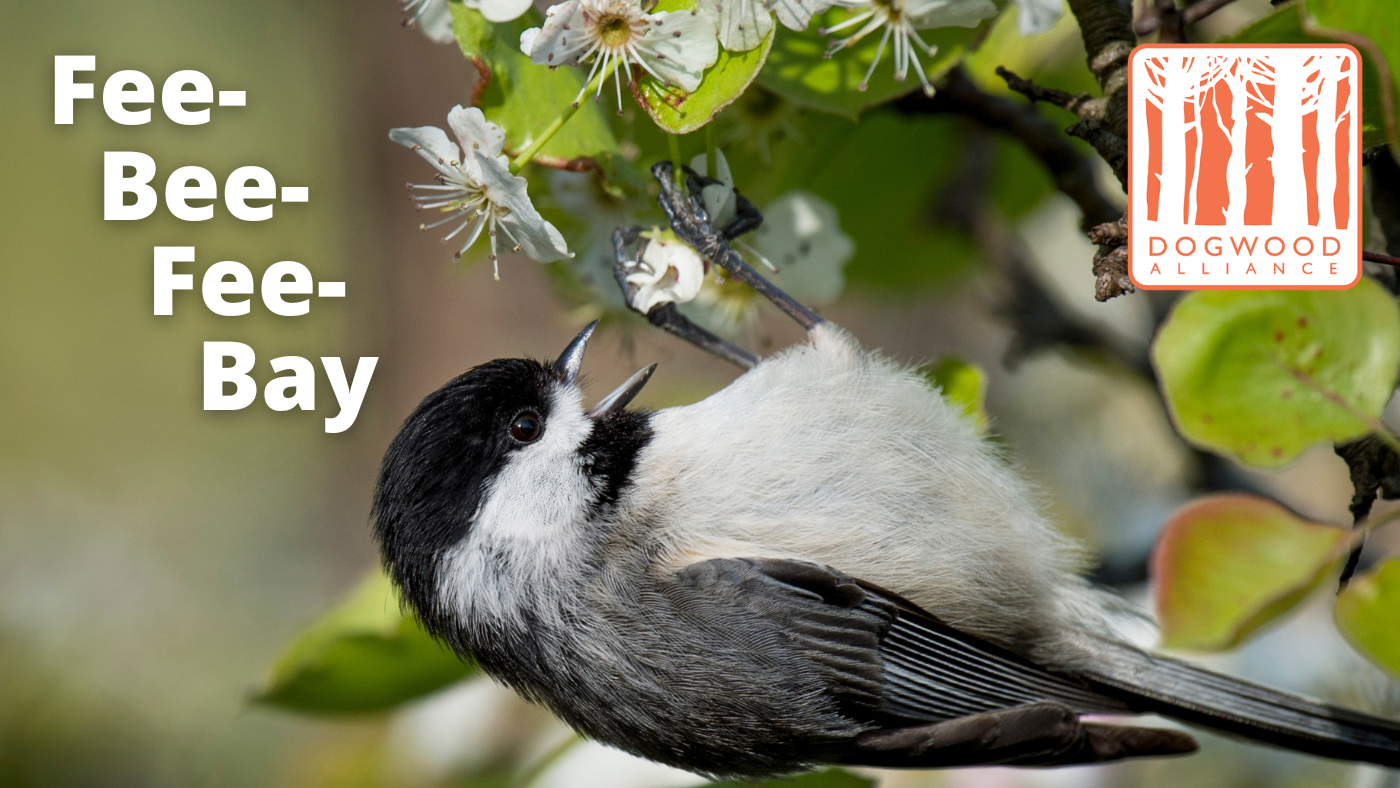
Carolina chickadees live primarily in the Eastern US. This makes them unique from black-capped Chickadees that are found in the Northern US and parts of Canada. They have some range overlap in North Carolina, Virginia, and West Virginia. Their preferred habitat includes forests, woodlands, and swamps. But you can also find them in urban and suburban areas, parks, and in your own backyard. Chickadees’ diet includes insects and spiders most of the year. But they will visit backyard bird feeders. They’re also acrobatic foragers like their cousin, the tufted titmouse. You can find them hanging upside down, sideways, and diagonally to find food.
Backyard bird watching is a great way to relax and enjoy nature. It can remind you that you’re part of an entire ecosystem that needs to be cared for. I hope this guide helps you identify the birds in your own backyard. If not by sight, then by sound. If you love songbirds as much as I do, then you know how important it is that we protect their habitats. When we protect forests, we’re also protecting the sweet songbirds that depend on them.
If you enjoyed learning how to identify songbirds of the Southeast, please share this on your favorite social media channels.
[share-buttons]
If you’d like to learn how to identify more songbirds, leave us a comment below.
Join us as we explore! We’ll learn about the wildlife, plants, trees, and even mushrooms. All right outside our doors. When you sign up, we’ll deliver more Biodiversity in Your Backyard tips directly to your inbox!


 Donate
  April 5, 2026