Donate


One of my favorite things about spring is the return of the butterflies. Some trees are starting to leaf and flower. You might see a few grasshoppers or small beetles, and then one sunny day, you see your first butterfly.
Butterflies, like most insects, are pollinators. Although they don’t have pollen sacs like many species of bee, butterflies are excellent pollinators. They use their proboscis to slurp up nectar from flowers, and pollen gets on their faces, which then gets transferred to the next flower they visit.

A butterfly transferring pollen between flowers. Photo Credit: MrClean on Flickr
My first butterfly of the year was a Spring Azure, warming their wings on a gravel path. Shortly after, I saw my first big butterfly of the year: a Cabbage White. As an entomologist and nature enthusiast, I think folks have a lot to learn about insects like butterflies.
In this blog, and in future blogs, I’d love to share what I know about the widespread biodiversity in the South. Don’t worry, I don’t want to talk about just bugs, but also birds and mammals, reptiles, amphibians, and even plants and fungi. Biodiversity is literally the number of species in a given area. In this case, we’ll be talking about the biodiversity that you can find right in your backyard. Or front yard. Or neighbor’s yard!
Butterfly? Moth? What am I seeing?
Butterflies and moths share cool ancestry, but the answer you’re looking for is this: All butterflies are moths. Not all moths are butterflies. That’s right, taxonomically, every butterfly, even the Monarch, is a moth. Butterflies are a special set of day-flying moths in just a few families that all share one characteristic: their antennae have a “club” on the end. In contrast, moth antennae are all different shapes (fringed, straight, narrow, clubbed, feathered, etc) and sizes (very small to longer than their bodies).
Gossamer-winged
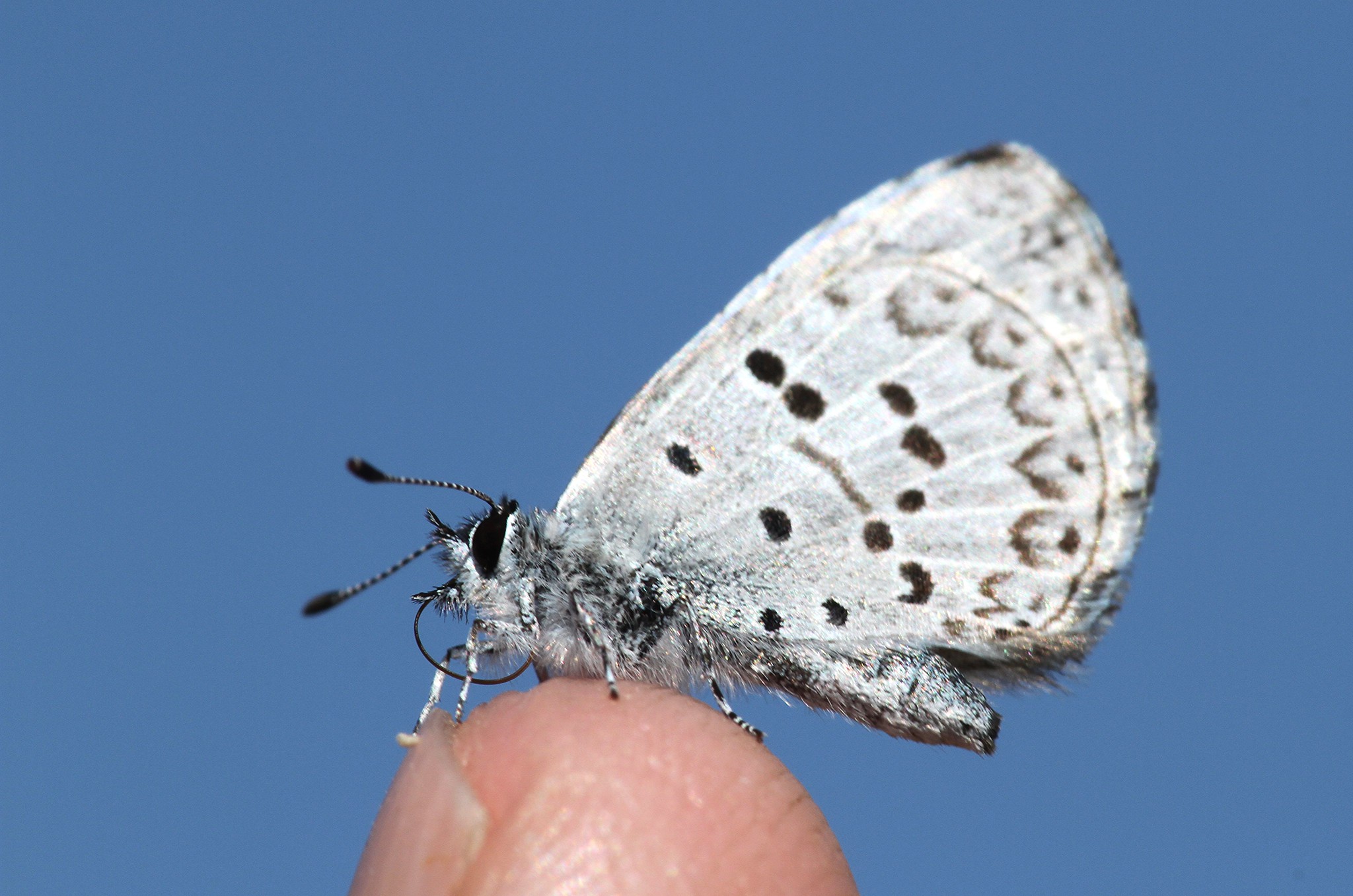
A Spring Azure rests on a person’s fingertip. Photo credit: John Flannery
In your backyard, the most common little butterfly you’ll see is a Spring Azure, Celastrinaladon, a member of the Lycaenidae (or gossamer-winged) butterfly family. These butterflies are very small, often fly low to the ground, and are most active in the afternoon through dusk. Their wings flutter fast enough that you’re not really sure what color they are until they land on a flower to take some nectar. When they fold their wings up behind them, you’ll see white, but when their wings extend, you’ll see blue.
Azures like to lay their eggs on a few different species of woody shrubs. Dogwood trees are a common host, so you may see more of them if you’ve got dogwoods around. They’re strong flyers, too, so you might just see an Azure passing through your backyard on its way to your neighbor’s flowers.
You may also see another member of the gossamer-winged family: Eastern Tailed Blues beginning in the spring and going through the summer and fall, depending where you live. They are similarly colored, but have a neat little “tail” off their wings!

An Eastern Tailed Blue butterfly draws nectar from a flower. Photo credit: Sam Davis
Whites

A Cabbage White draws nectar from a thistle plant. Photo credit: Steve Byrne
The white butterflies you’ll see are most likely the Cabbage White butterfly, Pieris rapae. These butterflies are among the first butterflies you’ll see in a year, and they prefer sunny fields, backyards, and “edge” habitats – where trees meet open space. They lay eggs on Brassica or mustard family plants. This includes your common garden vegetables: cabbage, Brussels sprouts, broccoli, and cauliflower alongside wild mustard plants like “yellow rocket” and toothworts.
If you live in a heavily wooded area, you may also find West Virginia White butterflies, but these are a rare species and hard to distinguish in flight from cabbage whites. Unlike Cabbage White butterflies, West Virginia Whites live almost exclusively in forests and only lay their eggs on a couple of toothwort and rockcress species of plants. Although their name is “West Virginia” white, you can find them from Vermont and Wisconsin all the way South to Georgia. West Virginia Whites are an endangered species in a few regions, at risk of local extinction due to things like logging, climate change, and invasive species.

The West Virginia White is a rare, early springtime forest butterfly. Picture credit: Sam Davis
Swallowtails
The last springtime butterflies that I want to talk about are the swallowtails (Papilio species). These big, showy butterflies are easy to identify by sight. The Eastern Tiger Swallowtail (Papilio glaucus) is a large, bright yellow butterfly that patrols open fields, roads, and even forests, and their range is in the South. If you live in the Northeast or Mid Atlantic, you may encounter the Canadian Tiger Swallowtail (Papilio canadensis) instead. If you live in the Appalachian mountains, you may encounter the Appalachian Tiger Swallowtail (Papilio appalachiensis), which is believed to be a hybrid species of the Eastern Tiger and Canadian Tiger Swallowtails. These three “species” (the jury’s still out on whether or not they’re all species!) are hard to distinguish in flight, so for most of us, calling it a “Tiger Swallowtail” will do nicely.

A Tiger Swallowtail drinks nectar from flowers. Photo credit: Kelly Schradin
Swallowtails are well known for “puddling” — congregating around mineral deposits, usually in puddles, on gravel roads, or in (ew!) carcasses or animal droppings. Many butterflies do this, but they’re not just hanging out! They use their proboscis to get hard-to-find minerals and salts. This helps with finding a mate and laying eggs.
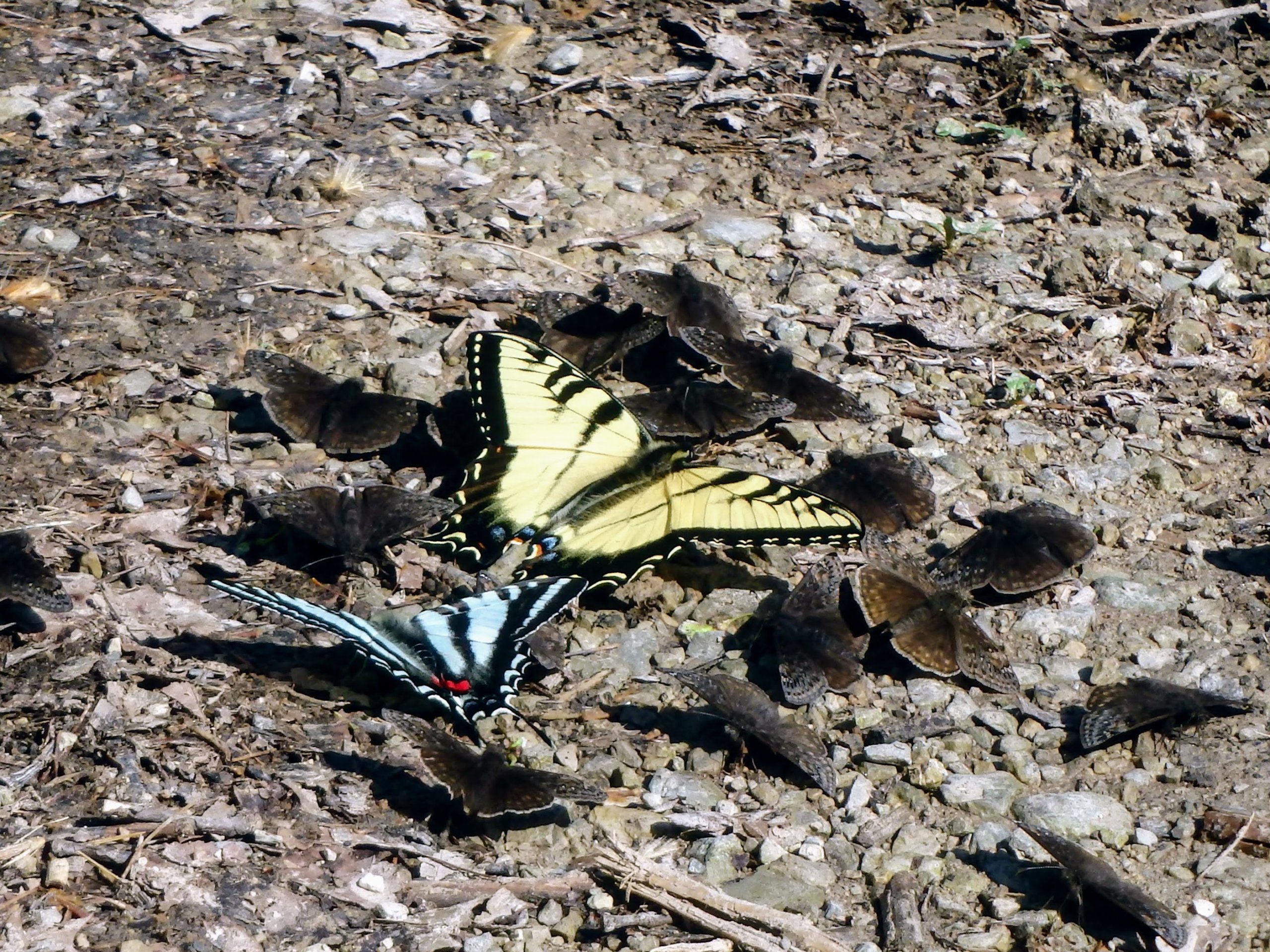
A Swallowtail joins Juvenal’s Duskywings (brown) and a Zebra Swallowtail (white) in puddling. Photo credit: Sam Davis
And… Action!
Did you enjoy learning about these butterflies? If so, why not show us!
Share your favorite springtime butterfly picture and tag us on Instagram, Facebook, or Twitter!
Want to do more?
Become a Forest Defender today! Your monthly gift will protect the butterflies and biodiversity of the South.
Join our email list to get new Biodiversity in Your Backyard sent directly to your inbox!
Check out the other blogs in our Backyard Biodiversity series!
 April 5, 2026
Sam Davis