


From the piney woods of Mississippi, to the swamps of Georgia, and over to the wetlands of the coast of North Carolina, I love the forests of our region dearly. My eyes light up every time I see magnificent trees kiss the Southern skies. You don’t grow up surrounded by that type of beauty and not want to protect it for the rest of your life. I’m always so inspired by communities that rally together to fight for protection and justice.
We watched as people all over the region and the world took a stand against the billions of subsidies governments (like those in the US, UK, and EU) spend on burning trees for energy.
In Gloster, Mississippi, community members gathered to determine ways to fight back against Drax’s wood pellet production facility in their community, which has brought noise, dust, and air pollutants to their town. In fact, this Drax facility emitted 3x the legal level of pollution for several years, leading to a $2.5 million fine—the largest ever biomass fine in the area. Like many communities where biomass plants and pellet production mills are located, Gloster is considered an environmental justice community, a community of mainly BIPOC (Black, Indigenous, and People of Color) that has a high percentage of residents that live below the poverty line.
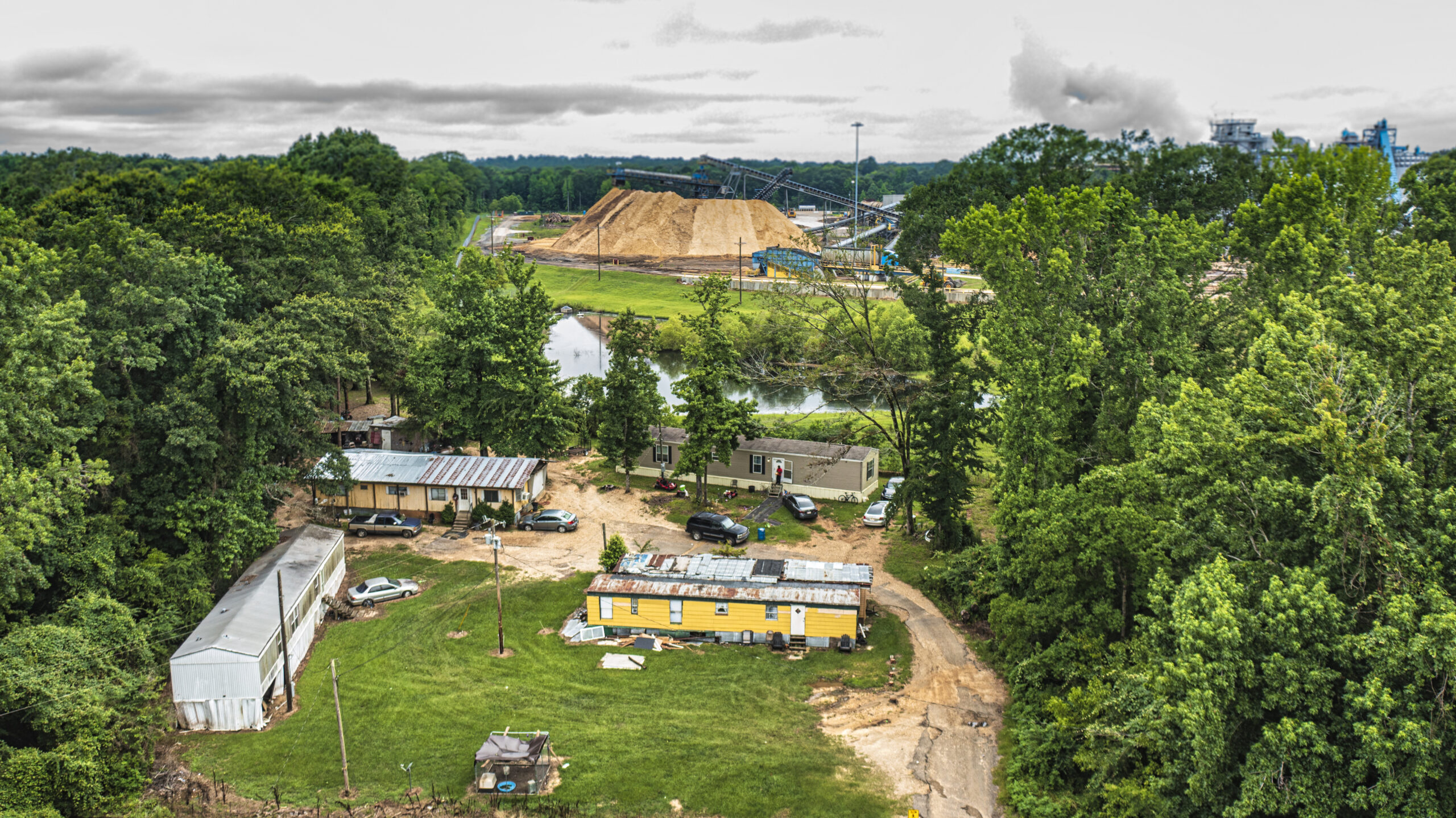
Image by The People’s Justice Council
Concerned community members living on the North Carolina and Virginia coast toured the wetlands in Enviva’s sourcing radius to raise awareness of its detrimental impacts. Even though every single facility had major community pushback in the planning phase, North Carolina approved the permits for all the proposed wood pellet production mills and production expansions. Not only do the mills emit hazardous air pollutants, but Enviva sources wood from bottomland hardwood forests in the area, harming the fragile ecosystem and stripping nearby communities of a critical storm buffer. But Enviva doesn’t factor in the environmental and community harms in their decision-making.
One thing has become clear with each community we’ve fought alongside to stop new facilities regardless of city, county, or state:
For example, all five counties with pellet production plants in North Carolina are Tier 1 environmental justice counties. The percentage of BIPOC (Black, Indigenous, and People of Color) ranges from 55% to 91% with an average poverty rate of 27%. Environmental justice (EJ) communities are twice as likely to have a wood pellet production facility than other communities.
State agencies ignore the cumulative impacts of polluting industries. They approve new, dirty wood pellet manufacturing facilities in communities where residents already suffer the effects of pollution from incinerators, hazardous waste sites, sewage treatment plants, hog farms, and more.
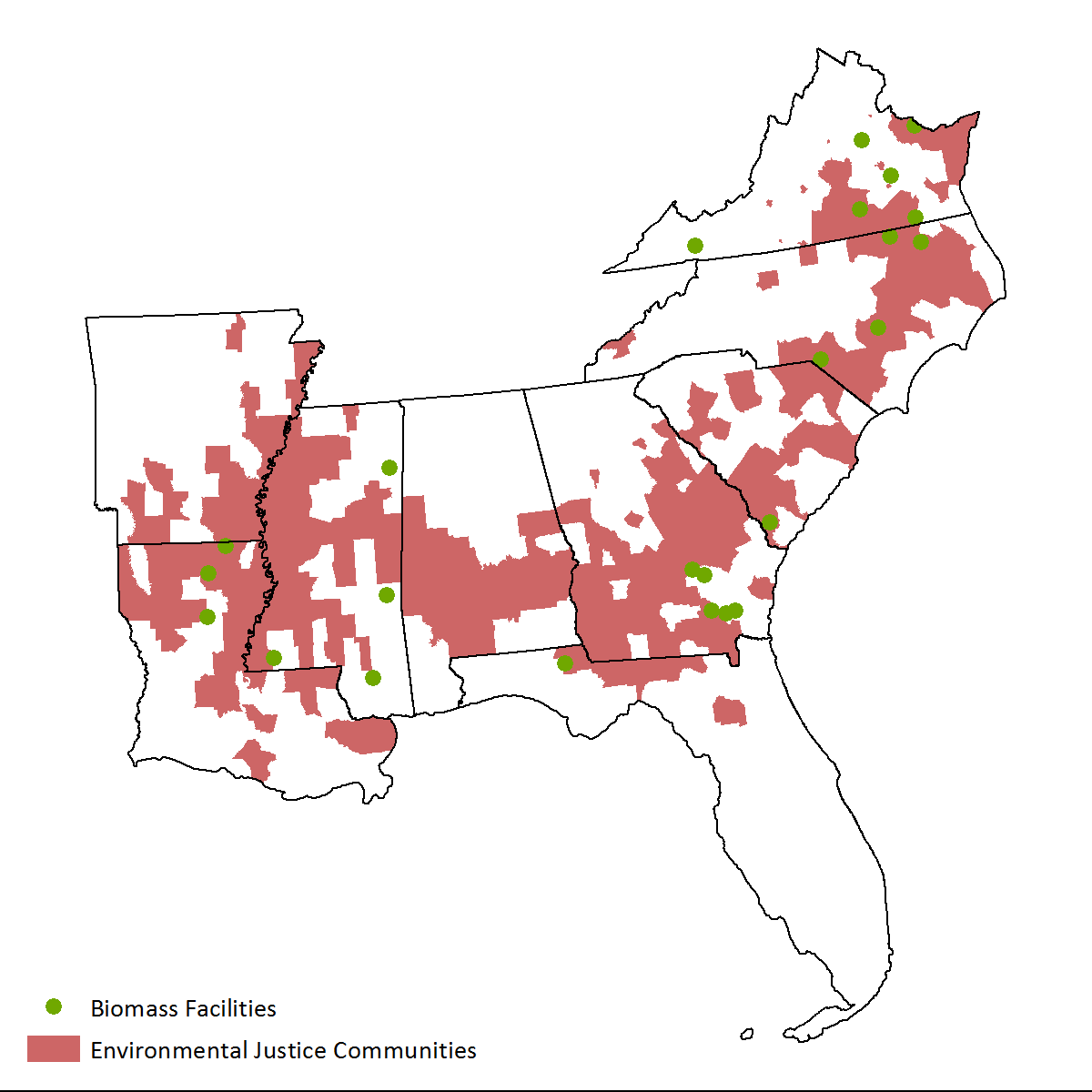 This map shows the location of existing wood pellet mills. The shading indicates environmental justice designated communities in the South. Research finds that there is a greater than 50% likelihood that future wood pellet mills will be located in EJ communities.
One in which everyone– regardless of their zip code, income, or race– has the right to protected forests. The right to resiliency against climate change and its related storms. The right to voice their concerns and have state agencies and representatives hear and respect those concerns in decision-making.
We’re still gathering together with communities affected by the wood pellet biomass industry to say: the wood pellet industry is devastating our forests, climate, and communities. We’ve had enough, even if local officials or the industry try to intimidate us with baseless threats of raised utility bills or loss of jobs. We know they make these threats because they see our movement is powerful.
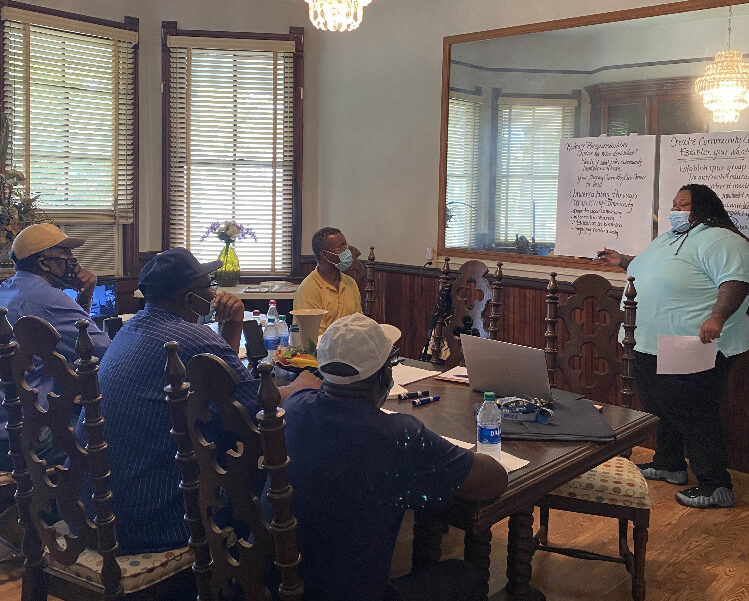
Erniko Brown, Regional Partnership Engagement Manager, leading an organizing training in Mississippi, a state with 7 proposed and operating wood pellet facilities.
For decades, forest policy in the US has served to ensure economic returns for large corporations and private landowners. This comes at the expense of healthy forests, workers, and communities. The forestry industry has manipulated language to their advantage. They call tree plantations “forests.” They falsely claim that logging is the main source of economic development. They falsely claim that younger trees offer more climate benefit than old growth. These myths aren’t scientifically sound and go against basic common sense.
The International Day of Action may be over, but you can still help. It’s time to hold the forestry industry accountable for its climate, biodiversity, and community impacts.
Forests play a vital role in protecting us and our environment, especially against global warming. In fact, deforestation is responsible for an estimated 12-29% of global greenhouse gas emissions. In the US South, around 90% of forests are privately owned. Encouraging land retention and conservation is one way to stop climate change. If we want to encourage forest landowners to keep their trees standing (instead of logging), we can encourage them toward alternative ways to make money from the land.
Agroforestry is a way to integrate trees with crops. Examples of agroforestry include growing coffee in the shade of banana trees or creating a food forest by growing food crops between stands of trees. These are excellent ways to take advantage of the interaction between organisms. There are many benefits to this practice, but let’s take a look at the economic benefits. Agroforestry diversifies local economies. It also increases production and offers a more effective use of the entire field area.
Landowners can take advantage of products produced by crops and specialty forest products. This allows them to increase their profits. Specialty forest products include nuts, fruits, mushrooms, catnip, handicrafts, and specialty woods.
Forest farming allows for crop diversity and improves soil and water quality. These organic improvements often result in decreased fertilizer use and pest management costs. As a result, some products from this practice can meet regulations to be labeled as certified organic crops. Prices tend to be higher for organic products rather than conventional products.
To further increase profits from agroforestry products, landowners can process them, especially products with a short life like some berries. Some producers even make fruit jams or purees or sell shelled or dried nuts.
The United States Department of Agriculture (USDA) provides information about agroforestry systems. There are even some financial incentives and loans. There are cost-sharing options when obtaining organic certification. Financial and technical support exist for agroforestry producers. This helps manage financial risk.
Hunting leases are fees that hunters pay to landowners so that they can hunt for birds and other animals during a specified period. The demand for these leases continues to grow. In the South, private landowners consider hunting leases an essential source of income. For example, residents in North Carolina are more likely to participate in fishing and hunting than the average American.

Landowners can provide leases for hunting on their property.
The hunting lease price depends on the location of the property as well as the benefits that exist. A potential price depends on what kind of property and how many acres a landowner has. Some “high quality” areas may lease smaller properties out for a relatively high price per acre (e.g., 80 acres at $30-40/acre). While “lower quality” areas may lease larger properties for less (e.g., 1,000 acres at $5-10/acre).
There are online platforms that help connect landowners with responsible hunters. Some of those platforms are Outdoor Access and Base Camp Leasing. In Outdoor Access you can list your land for free and once a reservation is made they will charge a fee that goes between 8% and 15%. In the case of Base Camp Leasing there is an annual fee of $85 per property.
Hunting and shooting activities accounted for $14 billion in 2019. From 2014 to 2019 there has been an increase of $1.7 billion. A research study found that land values in Texas were higher in locations with more markets for wildlife recreation activities. It found that lands that hold hunting leases had a 6% increase per-acre in land value.
Camping is increasing in popularity across the United States as an alternative form of travel. This is especially true in a socially distant world. While the United States has begun to recover and lockdowns have started to ease, the demand for campsites is increasing. In June 2020, camping rental bookings went up 350% on at least one outdoor accommodation booking website.
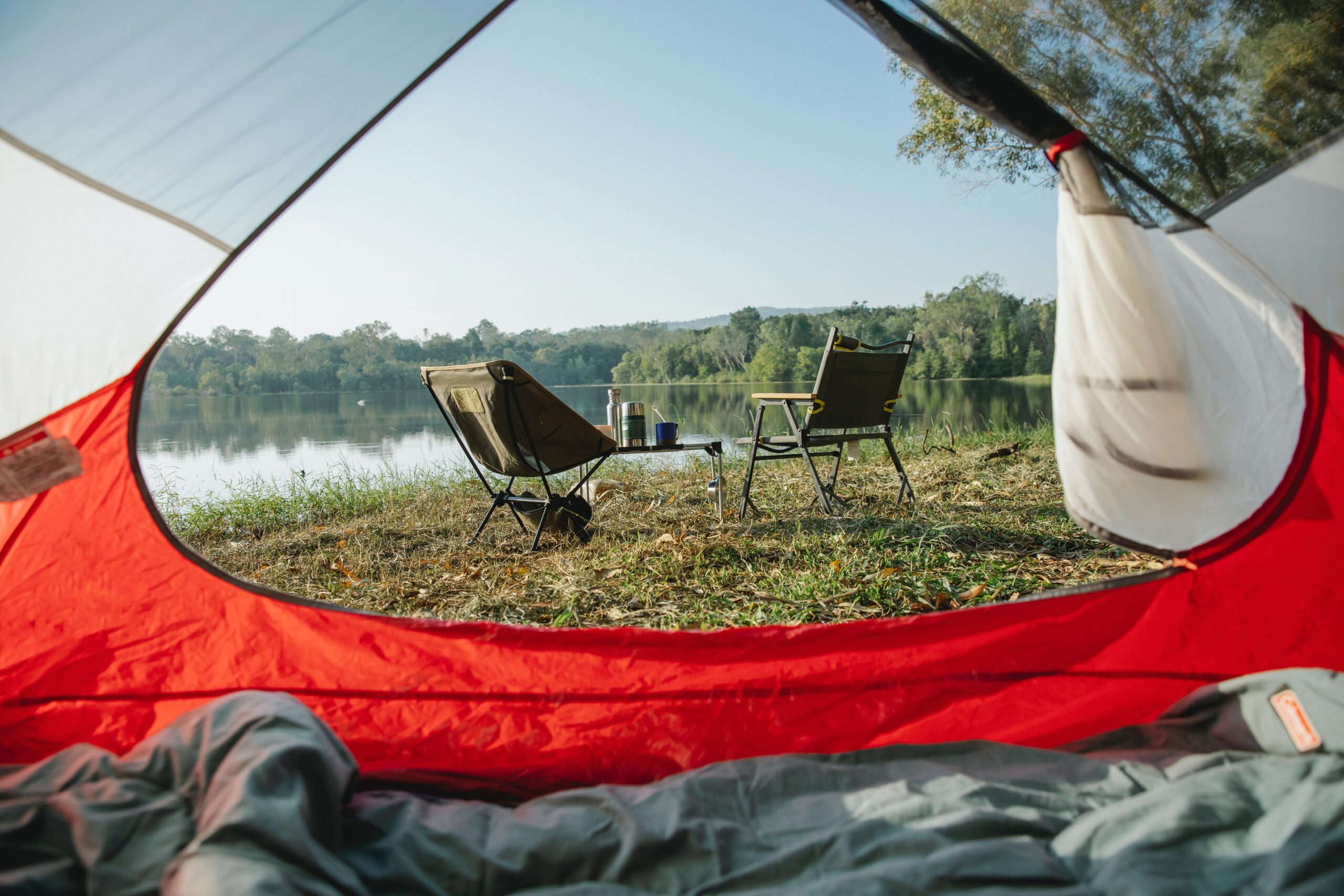
Landowners can rent their land to campers.
Sometimes finding the perfect spot can be challenging. To overcome that challenge, several web platforms have been launched in recent years. These connect landowners with responsible campers. The business model allows recreation to fund the conservation of those lands. It provides landowners the opportunity to earn extra income from renting their properties. Some of those online platforms are: Pitchup, Hipcamp and Tentrr.
Those platforms list, search, discover, and book private campsites, campgrounds, farms, cabins, and recreational vehicles. Tentr specializes in glamorous campsites. They also provide the opportunity to expand the camping experience. They include extra services and amenities for an extra fee, such as hiking tours, rock climbing, canoeing, etc.
Trails and other amenities draw visitors seeking outdoor recreational experiences. In fact, the outdoor recreation industry is increasing at a very fast rate of 3.8% every year. Communities that prioritize trails have benefited greatly from economic, quality of life, health, accessibility, and mobility improvements. Some of those economic benefits include:
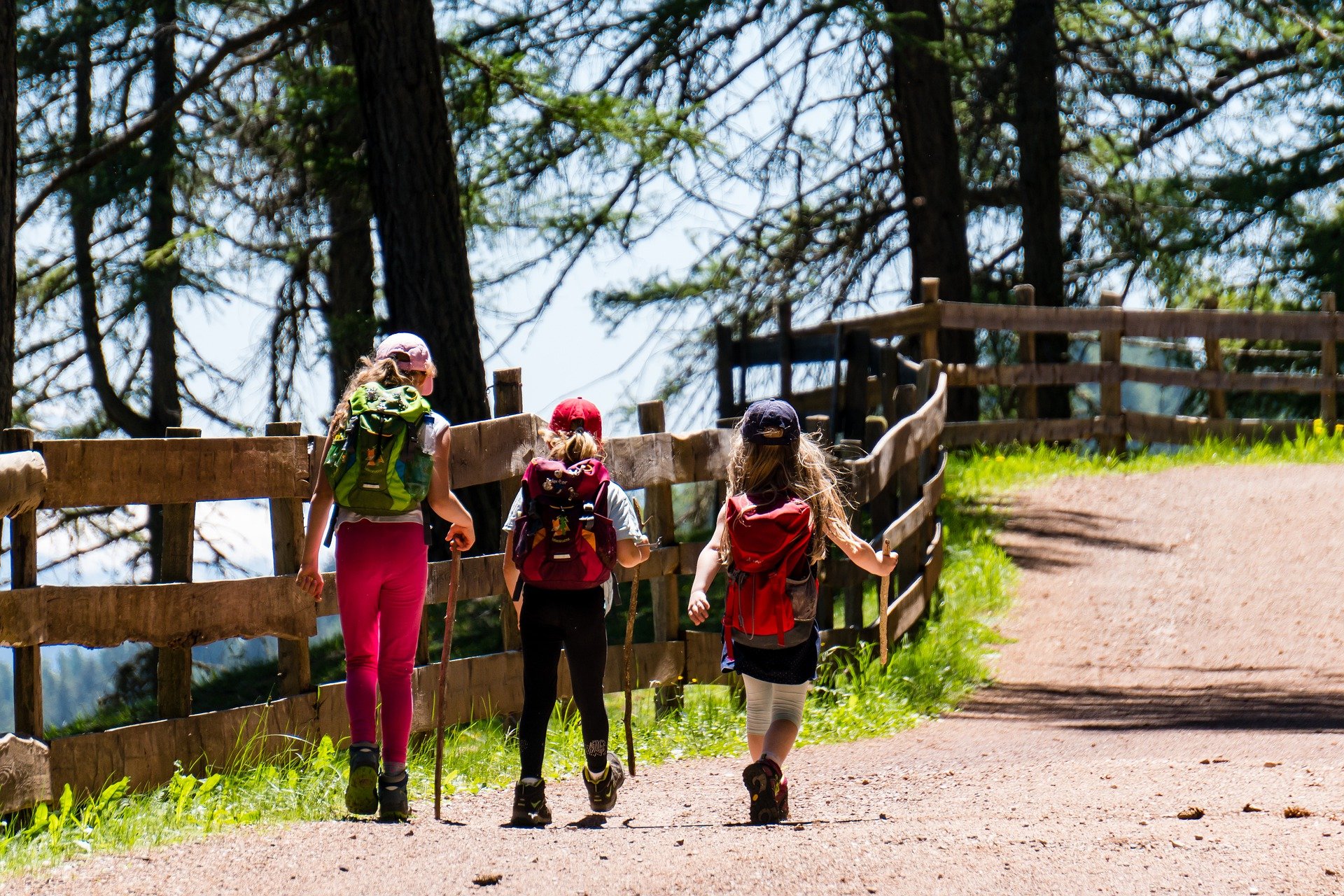
Landowners can create trails on their property for hiking and recreation.
Also known as a conservation agreement, a conservation easement is an agreement between a landowner and a government agency or non-governmental organization. This agreement limits the use of lands to preserve them. Landowners still own the land, can live there, build homes, manage trees, and other natural resources. Another advantage is that this type of agreement has a lower cost than land trusts.
Conservation easements provide economic benefits to both local communities and landowners. For example, tax incentives are available for landowners. They support local economies by providing opportunities for outdoor recreation, hunting, fishing, agriculture, or agritourism. These activities attract business and employees. A report made from a conservation easement in Texas found that their easement program could potentially provide revenues of around $2.9 million for agricultural products and $170,400 for outdoor activities.
Los bosques juegan un papel vital al momento de proteger a nuestro medio ambiente y a nosotros. Estos nos protegen de varias formas, especialmente contra el calentamiento global. De hecho, se estima que la deforestación es responsable del 12 al 29% de las emisiones globales de gases de efecto invernadero. En el sur de los Estados Unidos, alrededor del 90% de los bosques son de propiedad privada. Fomentar la retención y conservación de la tierra es una forma de detener el cambio climático. Si queremos promover que los propietarios de tierras forestales se queden con sus árboles (en lugar de talarlos), debemos proporcionarles formas alternativas de ganar dinero con sus tierras.
La agrosilvicultura es una forma de integrar árboles con cultivos. Algunos ejemplos de agrosilvicultura incluyen el cultivo de café a la sombra de los bananos o el cultivo de alimentos entre hileras de árboles. Es una excelente forma de aprovechar la interacción entre ambos organismos. Esta práctica tiene varios beneficios, pero echemos un vistazo a los beneficios económicos. La agrosilvicultura diversifica las economías locales. También aumenta la producción y ofrece un uso más eficaz de toda el área del campo.
Los propietarios pueden aprovechar los productos producidos por los cultivos y los productos forestales especiales. Esto les permite duplicar sus ganancias. Los productos forestales especializados incluyen nueces, frutas, hongos, hierba gatera, artesanías y artesanías de maderas.
La agricultura forestal permite la diversidad de cultivos y a la vez mejora la calidad del suelo y del agua. Estas mejoras orgánicas a menudo resultan en un menor uso de fertilizantes y costos de manejo de plagas. Como resultado, algunos productos de esta práctica pueden etiquetarse como cultivos orgánicos certificados. Una razón por la que algunas operaciones utilizan prácticas agrosilviculturales es para cumplir con las regulaciones orgánicas. Los precios tienden a ser más altos para los productos orgánicos que para los productos convencionales.
Hay otra forma de aumentar las ganancias de los productos agroforestales. Procesar los productos añadirá un valor extra. Este es un enfoque eficaz para productos con una vida corta, como lo son algunas bayas. También es eficaz para productos que los consumidores utilizan en forma procesada. Por ejemplo, algunos productores elaboran mermeladas o purés de frutas o venden nueces sin cáscara o secas.
El Departamento de Agricultura de los Estados Unidos (USDA) proporciona información sobre servicios agrosilviculturales. Incluso existen algunos incentivos económicos y préstamos. Existen opciones de costos compartidos para obtener las certificaciones orgánicas. Existe ayuda financiera y técnica para los productores agrosilviculturales. Esto ayuda a gestionar el riesgo financiero.
Los arrendamientos de caza son tarifas pagadas a los propietarios por los cazadores para que estos puedan cazar aves y otros animales durante un período específico. La demanda de estos arrendamientos sigue creciendo. En el sur, los propietarios de tierras privadas consideran que los arrendamientos de caza son una fuente esencial de ingresos alternativos. Por ejemplo, es más probable que los residentes de Carolina del Norte participen en la pesca y la caza que el estadounidense promedio.
El precio se determina por acre. El precio también dependerá de la ubicación de la propiedad así como de los beneficios que existan. El precio potencial depende del tipo de propiedad que tengas y de la cantidad de acres que tengas. Algunas áreas de alta calidad pueden arrendar propiedades más pequeñas por un precio relativamente alto por acre (por ejemplo, 80 acres a $30-40 / acre). Mientras que las áreas de menor calidad pueden arrendar propiedades más grandes por menos (por ejemplo, 1,000 acres a $5-10 / acre).
Existen plataformas en línea que ayudan a conectar a los propietarios con cazadores responsables. Algunas de esas plataformas son Outdoor Access y Base Camp Leasing. En Outdoor Access puedes listar tu terreno de forma gratuita y una vez realizada la reserva te cobrarán una tarifa que oscila entre el 8% y el 15%. En el caso de Base Camp Leasing, hay una tarifa anual de $85 por propiedad.
Las actividades de caza y tiro representaron $14 mil millones en 2019. Desde el año 2014 al 2019 ha habido un aumento de $1.7 mil millones en estas actividades. Un estudio encontró que los valores de propiedades en Texas eran más altos en lugares con mayores mercados para las actividades recreativas de vida silvestre. También se encontró que las tierras que tienen arrendamientos de caza tenían un aumento del 6% por acre.
Acampar está ganando popularidad en los Estados Unidos como una forma alternativa de viaje. Esto es especialmente cierto en un mundo con distanciamiento social. Si bien Estados Unidos ha comenzado a recuperarse y los cierres están disminuyendo, la demanda de lugares para acampar ha comenzado a aumentar. En junio de 2020, las reservas de alquiler de campamentos aumentaron un 350% en un sitio web de reserva de alojamiento al aire libre.
A veces, encontrar el lugar perfecto puede ser todo un desafío. Para superar ese desafío, se han lanzado varias plataformas en línea en los últimos años. Estas conectan a los propietarios de tierras con campistas responsables. El negocio permite que la recreación financie la conservación de esas tierras. También brinda a los propietarios la oportunidad de obtener ingresos adicionales por el alquiler de sus propiedades. Algunas de esas plataformas en línea son: Pitchup, Hipcamp y Tentrr.
Esas plataformas enumeran, buscan, descubren y reservan campamentos privados, campamentos, granjas, cabañas y vehículos recreativos. Tentr se especializa en campings glamorosos. También brindan la oportunidad de expandir la experiencia de acampar al aire libre. Esto al incluir servicios y comodidades adicionales por un cargo extra. Estas actividades pueden ser excursiones de senderismo, escalada en roca, canotaje, etc.
Los senderos y otros entretenimientos atraen a los visitantes que buscan experiencias recreativas al aire libre. De hecho, la industria de la recreación al aire libre está aumentando a un ritmo muy rápido, alrededor de 3.8% cada año. Las comunidades que dan prioridad a los senderos se han beneficiado enormemente de las mejoras económicas, de calidad de vida, salud, accesibilidad y movilidad. Algunos de esos beneficios económicos incluyen:
Incremento de puestos de trabajo y empleo. La industria de la recreación al aire libre genera 7.6 millones de empleos cada año. Un estudio encontró que los senderos destinados para caminatas y andar en bicicleta crean 17 empleos por cada $1 millón gastado, estos son más empleos por dólar que cualquier otro tipo de construcción de infraestructura de transporte.
Mejora de las economías locales. Las empresas locales alrededor de los senderos pueden beneficiarse enormemente de ellos. El turismo que depende de los senderos es un motor económico importante en muchas comunidades pequeñas. Un estudio encontró que los usuarios del Great Allegheny Passage, un sendero de 150 millas entre Cumberland, Maryland y Pittsburgh, gastaban más de $40 millones al año. Otro estudio encontró que los consumidores de la industria de actividades al aire libre gastan $877 mil millones cada año.
También conocido como acuerdo de conservación, es un acuerdo entre un propietario y una agencia gubernamental u organización no gubernamental. Este acuerdo limita el uso de tierras para preservarlas. Los propietarios todavía son dueños de la tierra, pueden vivir ahí, construir casas, administrar árboles y otros recursos naturales. Otra ventaja es que este tipo de acuerdos tiene un costo menor que los fideicomisos de tierras.
El usufructo de conservación proporciona beneficios económicos tanto a las comunidades locales como a los propietarios. Por ejemplo, existen incentivos fiscales para los propietarios. Estos también apoyan las economías locales al brindar oportunidades para la recreación al aire libre, la caza, la pesca, la agricultura o el agroturismo. Estas actividades atraen a empresas y empleados. Un informe realizado por un usufructo de conservación en Texas encontró que su programa de usufructo podría generar ingresos de aproximadamente $2.9 millones por productos agrícolas y $170,400 por actividades al aire libre.
The S&P Global Clean Energy Index is designed to measure top companies in global clean energy-related businesses that helps financial service firms make recommendations to investors concerned about climate change, the environment, and biodiversity. As of today, Drax, the world’s largest burner of biomass energy from forests is no longer considered fit to be included in this index.
Dogwood Alliance applauds this decision. Our work in the Southern US has sought to expose Drax’s greenwashing by telling the story of its practices on the ground which include destroying forests to be burned as energy, harming communities with air pollution, and emitting tons of CO2 at a time when our planet can no longer afford it.
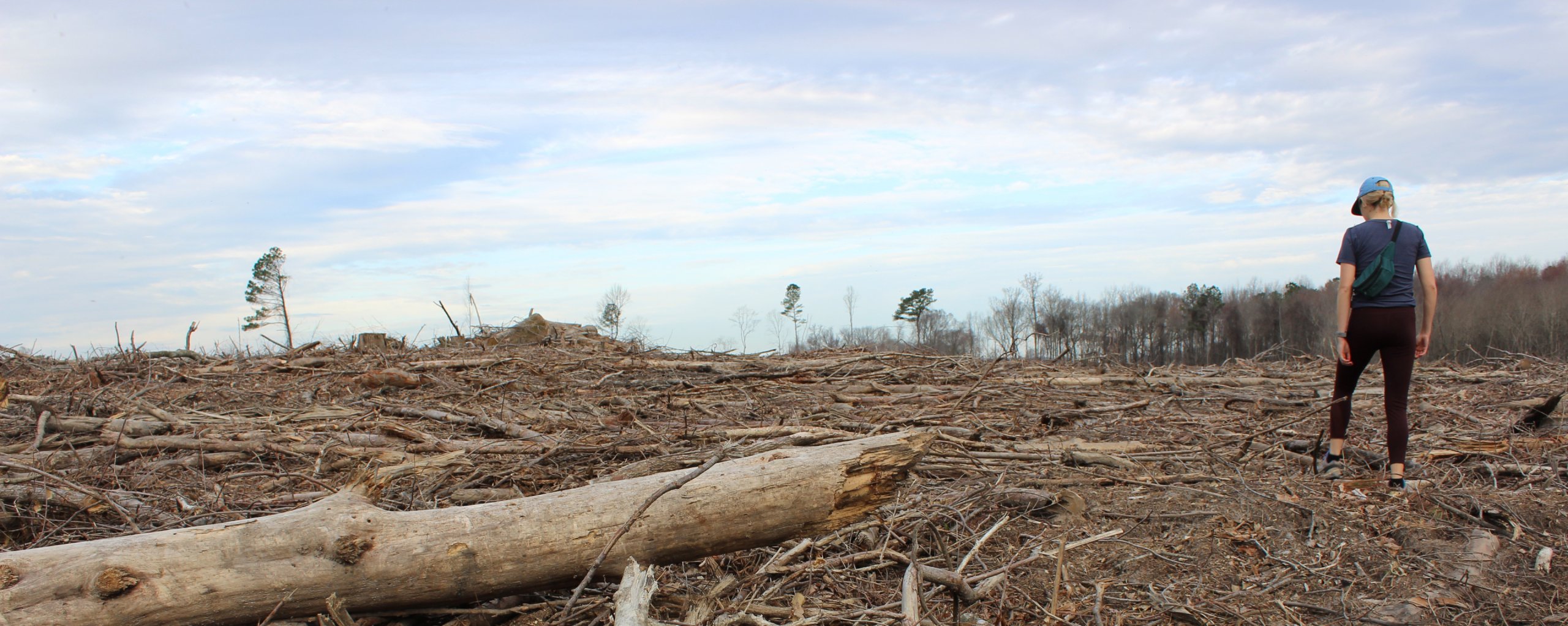
Earlier this year, Mississippi regulators fined the company’s Amite wood pellet production facility $2.5 million for exceeding air pollution limits. Not only does Drax have a history of air pollution violations in the communities where it sources wood, but it also faces prosecution over exposing its UK employees to hazardous conditions as well.
It appears that the S&P is following the advice of scientists and think tanks who challenge the carbon-neutrality claims of the biomass industry. Last week, the think tank Ember found that burning wood for electricity emits more CO2 than coal. According to their findings, Drax is the largest single source of CO2 in the UK and the third biggest in Europe, even though the company’s emissions go uncounted.
While the financial sector is turning its back on biomass due to it being a false climate solution, misguided government subsidies still prop this industry up in the US, UK, EU, and parts of Asia. The UK government relies heavily on biomass-burning at Drax to meet climate targets and subsidizes Drax to the tune of £3 million per day.
The Southern US is a major source of wood pellets for Drax, and our leaders, such as Governor Roy Cooper in North Carolina, have yet to place a moratorium on permits for the production of wood pellets or to address the destructive impacts of the industry. President Biden could also address these impacts by acknowledging and reporting the greenhouse gas emissions of industrial logging while urging state, federal, and international governments to halt subsidies that are destroying US forests to be burned as fuel.
UK, EU, and US governments must take this signal from the financial sector must be taken seriously. At the policy level, we must reckon with doubts over the sustainability of burning forests during a time of climate, biodiversity, and racial justice crises. Otherwise governments will face embarrassment and worse over falsely labeling it as a green source of energy.
You may have heard about carnivorous plants like the Venus flytrap. Let’s admit it, that alien look they have: it’s fascinating and a bit spooky! Perfect for the Halloween season, but luckily only insects need to beware!
Carnivorous plants get most of their nutrients from the insects they consume. That’s why they sometimes grow in extreme or poor nutrient areas. Many cool and deliciously creepy species can be found here in the South.
What you need to know about them:
This is probably the most popular carnivorous plant. Its popularity is in part due to Audrey II, the iconic bloodsucking plant from the musical Little Shop of Horrors. But it’s also because of its fascinating trapping structure.
The Venus flytrap has 4-7 leaves that grow from its short stem. The leaf blade is divided into a pair of terminal lobes and a long heart-shaped petiole that forms the trap. The trap secretes a sweet smelling, sticky nectar that snags the insect before snapping closed. It also has hair-like extensions for sensing prey. They’ll only close if two hairs are touched in quick succession. This way, the plants don’t close for false alarms, as in the case of raindrops. Once the trap is closed, digestive juices are released to break down its prey. Warning: triggering traps just to watch them close can actually hurt the plant.Where to find them:
These amazing carnivorous plants are native to North and South Carolina. They’re even considered North Carolina state carnivorous plants. They only occur naturally within a 75-mile radius around Wilmington in humid areas like the Carolina Bays and some South Carolina counties. Humans have introduced Venus flytraps to other areas like the pine barrens of New Jersey, the pine savannas in the Florida Panhandle, and other locations in California.

Some cool facts:
What you need to know about them:
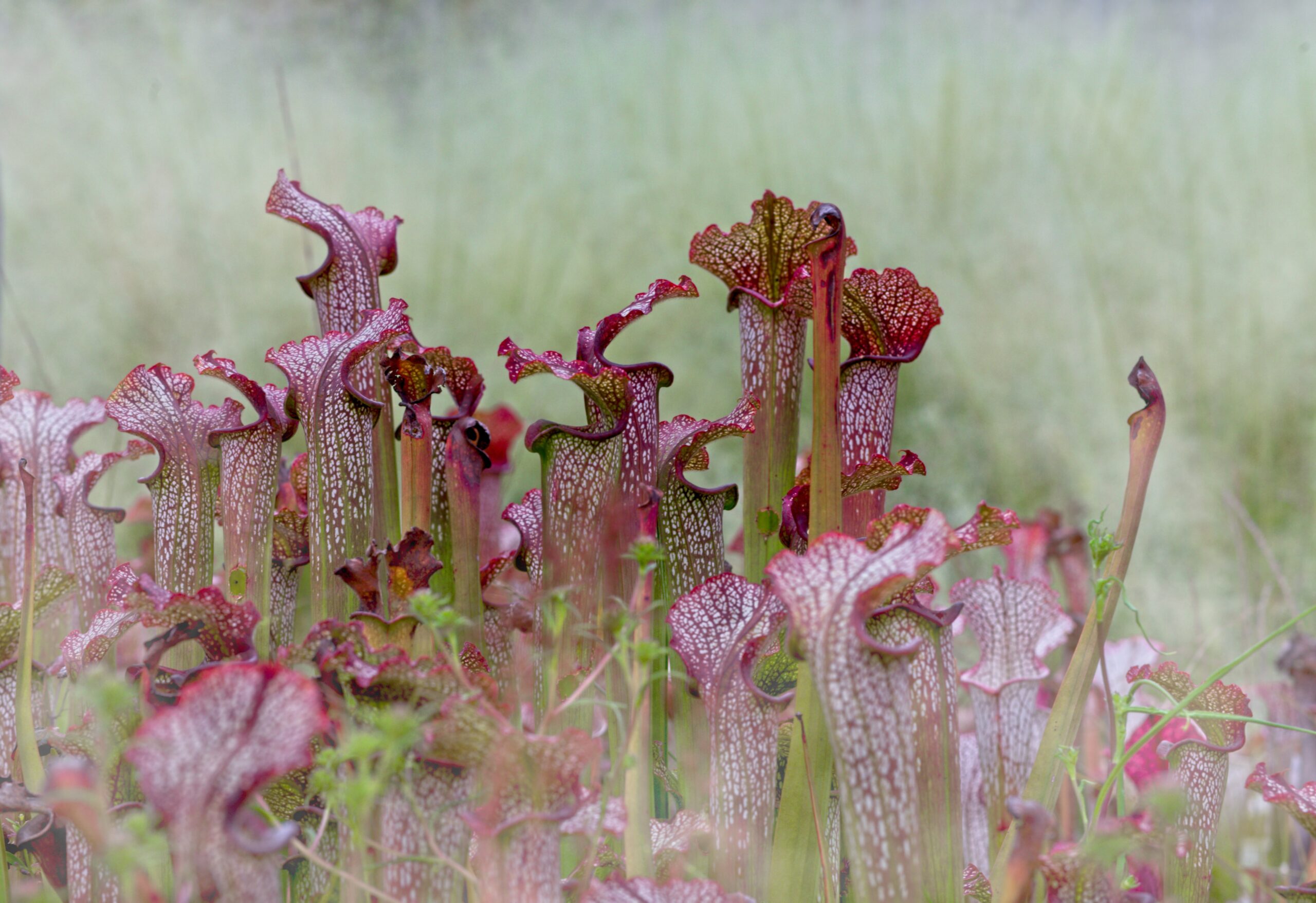
This carnivorous plant stands out for its flaring pitcher-shaped leaves. As interesting and attractive as they are to humans, they’re also tempting to insects.
The sweet nectar and delicious scent attract flying and crawling insects like ants and wasps. Drunk on the smell of the nectar, insects slowly slide down into a slippery tube. Once the insect has fallen inside the tube, it’s trapped and drowns in the rainwater collected at the base of the tube. A lining of hair that points downwards within the pitcher makes sure that the insect can’t crawl out. The plant then secretes enzymes and digestive acids to break down the unlucky insects.
Where to find them:
Pitcher plants can be mostly found in the coastal boggy areas of the Eastern United States, from the Gulf Coast to Canada. Pitcher plants also live in some landlocked states like Illinois and Ohio and in some states on the West Coast like California and Washington.
Some cool facts:

What you need to know about them:
This is a small carnivorous plant. It only grows 2-10 inches high and has a shallow root system. During the summer a small, white, five-petaled flower blooms. The sundew has tentacles. The leaves have a sticky substance that snares small prey. Once something is trapped the sundew folds its tentacles around its prey. The captured insect becomes digested and absorbed into the leaf cells. Small flies are a sundew’s favorite meal.
Where to find them:
You can find them in the Eastern half of the United States from Nova Scotia in Canada, to the South in Georgia, Florida, and Alabama and to the West along the Mississippi River, Iowa, and Minnesota. The sundew prefers muddy zones in the mountains or acidic wetlands along the coast.
Some cool facts:

What you need to know about them:
There are over 220 species of bladderwort worldwide. They have long, horizontal stems that can reach 4-10 inches in height. This plant doesn’t have any true leaves or roots. The stem floats freely on the surface of the water or lays on the mud. The bladderwort does have a solitary flower, and the color of this flower will depend on the species. The stem and the flower emerge from the water.
Bladderworts are unique in that the underwater “leaves” bear small oval “bladders” that trap and digest small aquatic creatures. These “bladders” are like “mini vacuums” equipped with bristles. When small animals touch the bristles, the trap opens automatically and sucks in the prey.
Where to find them:
Bladderwort is native to the Northern hemisphere. In the United States they can be found in all 50 states. They grow in ponds, ditches, and lakes.
Some cool facts:

What you need to know about them:
There is something spellbinding about this plant. Besides its cool name, it has an otherworldly look that reminds me of old horror movies. Its name comes from the fact that it looks like a cobra snake that is just about to strike. The leaves resemble the heads of cobras, but they have a specialized function. The hood secretes sweet-scented nectars that attract insects. Once inside, they have difficulty getting back out, and the cobra lily then secretes enzymes to digest their prey.
Where to find them:
Cobra lilies are native to North America, specifically to northern California and southern Oregon. They grow in wet, boggy soils. Now you know what to look for on your next trip to California!

Illustration by Nonbeenary Designs
Some cool facts:
What you need to know about them:
This carnivorous plant’s anatomy resembles a Venus flytrap. We can even say that the waterwheel is her little sister. It’s a floating aquatic plant that doesn’t have true roots. It has stems with whirls of 6-9 leaves. The leaves are kidney shaped and have bristles on each side (like a tiny version of the Venus flytrap). Unlucky insects land on the leaf, causing it to snap shut.
Where to find them:
In the United States you can find this plant in the wetlands of New Jersey, New York, New Hampshire, and Virginia. Unfortunately, the waterwheel plant is now included among endangered carnivorous species.
Some cool facts:

What you need to know about them:
There are 80 species of butterwort worldwide and 9 grow in the United States. The violet butterwort can be found in the US South. It has one purple/blue flower color. This type of carnivorous plant has leaves covered with tiny hairs that secrete a sticky substance that attracts insects. This substance looks like water droplets. When an insect lands on the leaves, the violet butterwort will bend and trap the insect. The tiny hairs then release more sticky substance to cover its prey. The enzymes secreted then digest the insect.
Where to find them:
Violet Butterwort grows in the US Southeast. It can be found in Florida, Georgia, North Carolina, and South Carolina. They grow in moist, sandy environments. They can be found in sandhills and bogs.
Some cool facts:
A major issue common to all the carnivorous plants here is the increased threat to their conservation. Almost all of them are included in the endangered list, which is mainly due to over-collection of plant specimens and habitat destruction. It’s our responsibility to avoid harvesting these amazing plants from the wild, to conserve them instead, and to maintain their natural habitats.
Out of all carnivorous plants, Venus flytraps and pitcher plants are the ones that attract all the attention. However, as you now know, there are other cool and fascinating species that can be found here in the United States, some even here in the South! And while humans don’t need to be scared, carnivorous plants could very well be some insects’ worst nightmare!
Did you enjoy learning about these carnivorous plants? If so, why not show us?
Share your favorite night sounds videos and tag us on Instagram, Facebook, or Twitter!
Want to do more?
Become a Forest Defender today! Your monthly gift will protect the carnivorous plants and the biodiversity of the South.
Join our email list to get new Biodiversity in Your Backyard sent directly to your inbox!
Las plantas carnívoras obtienen la mayor parte de sus nutrientes de los insectos que consumen. Es por eso que a veces crecen en áreas extremas o pobres en nutrientes.
Es posible que hayas oído hablar de la venus atrapamoscas. Admitámoslo, la apariencia alienígena que tienen: ¡es fascinante! Sin embargo, hay otras especies interesantes y fascinantes que se pueden encontrar aquí en los Estados Unidos. ¡Así que los insectos, tengan cuidado!
Esta es probablemente la planta carnívora más popular. Su popularidad se debe en parte a Audrey II, la emblemática venus atrapamoscas de la película “La tiendita de los horrores”. Pero también se debe a la fascinante estructura de su trampa.
La venus atrapamoscas tiene entre 4 y 7 hojas que crecen de su tallo corto. El limbo de la hoja se divide en un par de lóbulos terminales y un pecíolo largo en forma de corazón que forma la trampa. La trampa segrega una sustancia pegajosa que atrapa al insecto. También tiene extensiones similares a pelos, esto para detectar a una presa. Solo se cerrarán si se tocan dos pelos seguidos, con unos segundos de diferencia. De esta forma, las plantas no se cierran por falsas alarmas, como en el caso de las gotas de lluvia. Una vez que la trampa está cerrada, se liberan jugos digestivos que descomponen la presa. Activar las trampas solo para verlas cerrarse puede dañar a la planta.
Estas increíbles plantas carnívoras son nativas de Carolina del Norte y del Sur. Incluso se le considera la planta carnívora oficial del estado de Carolina del Norte. Solo ocurren naturalmente dentro de un radio de 75 millas alrededor de Wilmington en áreas húmedas como las bahías de Carolina y en algunos condados de Carolina del Sur. Las venus atrapamoscas se han introducido en otras áreas como los pinares de Nueva Jersey, las sabanas de pinos en el Panhandle de Florida y en otros lugares de California.
Esta planta destaca por sus hojas llamativas en forma de jarra. Tan fascinantes y atractivas como lo son para los humanos, también son tentadoras para los insectos.
Los insectos voladores y rastreros como las hormigas y las avispas son atraídos por el dulce néctar y el delicioso aroma que emiten. Embriagados con el olor del néctar, los insectos se deslizan lentamente por un tubo resbaladizo. Una vez que el insecto ha caído dentro del tubo, queda atrapado y se ahoga en el agua de lluvia recogida en la base. Una capa de pelo que apunta hacia abajo dentro de la jarra asegura que el insecto no pueda salir arrastrándose. Luego, la planta secreta enzimas y ácidos digestivos para comenzar a descomponer a los desafortunados insectos.
Las plantas jarra se pueden encontrar principalmente en las áreas costeras pantanosas del este de los Estados Unidos, desde la costa del Golfo hasta Canadá. Las plantas jarra también viven en algunos estados sin litoral como Illinois u Ohio, y en algunos estados de la costa oeste como California y Washington.
Esta es una planta pequeña. Solo crece entre 2 a 10 pulgadas de alto y tiene raíces poco profundas. Durante el verano, florece una pequeña flor blanca de cinco pétalos.
El rocío del sol tiene algunos tentáculos. Las hojas tienen una sustancia pegajosa a la que se adhieren pequeñas presas. Una vez que una presa queda atrapada, la planta dobla sus tentáculos alrededor de su presa. El insecto capturado se digiere en materiales solubles que son absorbidos por las células de la hoja. Las moscas pequeñas son la comida favorita de los rocío de sol.
Puedes encontrarlos en la mitad oriental de los Estados Unidos, desde Nueva Escocia en Canadá al sur hasta Georgia, Florida y Alabama y al oeste hasta el río Mississippi, Iowa y Minnesota. Los rocío de sol prefieren zonas fangosas en las montañas o humedales ácidos a lo largo de la costa.
Hay más de 220 especies en todo el mundo. Tienen tallos largos y horizontales que pueden alcanzar de 4 a 10 pulgadas de altura.
Esta planta no tiene hojas ni raíces verdaderas. El tallo flota libremente en la superficie del agua o se apoya en el barro. La bladderwort tiene una flor solitaria, el color de esta flor dependerá de la especie. El tallo y la flor emergen del agua.
Las bladderworts son únicas en el sentido de que las “hojas” que están bajo el agua tienen pequeñas “vejigas” ovaladas que atrapan y digieren pequeñas criaturas acuáticas. Estas “vejigas” son como “mini aspiradoras” equipadas con cerdas. Cuando los animales pequeños entran en contacto con las cerdas, la trampa se abre automáticamente y succiona a la presa.
La bladderwort es originaria del hemisferio norte. En los Estados Unidos se pueden encontrar en 50 estados. Crecen en estanques, acequias y lagos.
Hay algo hechizante en esta planta. Además de su genial nombre, tiene un aspecto de otro mundo que puede recordarnos a las viejas películas de terror. Su nombre proviene del hecho de que parece una serpiente cobra que está a punto de atacar. Las hojas se parecen a las cabezas de las cobras, pero estas tienen una función especializada. La capucha secreta néctares perfumados que atraen a los insectos. Una vez dentro, es difícil para ellos volver a salir, entonces el lirio cobra secreta enzimas que digieren a su presa.
Los lirios cobra son nativos de América del Norte, específicamente del norte de California y el sur de Oregón. Crecen en suelos pantanosos húmedos. ¡Ahora ya sabes qué planta buscar en tu próximo viaje a California!.
Su anatomía se asemeja a una venus atrapamoscas. Incluso podemos decir que la noria es su hermana pequeña. Es una planta acuática flotante que no tiene raíces verdaderas. Tiene tallos con remolinos que tienen de seis a nueve hojas. Las hojas tienen forma de riñón y tienen cerdas a cada lado (como una versión diminuta de la venus atrapamoscas). Los insectos desafortunados aterrizarán en la hoja, haciendo que la hoja se cierre de inmediato.
En los Estados Unidos puedes encontrar esta planta en humedales de Nueva Jersey, Nueva York, Nueva Hampshire y Virginia. Desafortunadamente, la planta de la rueda hidráulica ahora se incluye entre las especies carnívoras en peligro de extinción.
Hay 80 especies de pinguiculas en todo el mundo y 9 crecen en los Estados Unidos. La pinguicula violeta se puede encontrar en el sur de los Estados Unidos. Tiene una flor de color violeta/azul. Este tipo de planta carnívora tiene las hojas cubiertas de diminutos pelos que segregan una sustancia pegajosa que atrae a los insectos. Esta sustancia es similar a las gotas de agua. Cuando el insecto aterriza en las hojas, estas se doblarán y atraparán al insecto. Los pequeños pelos liberarán más sustancia pegajosa y cubrirán a su presa. Las enzimas secretadas digerirán al insecto.
Las pinguiculas violeta crecen en el sureste de Estados Unidos. Se pueden encontrar en Florida, Georgia, Carolina del Norte y del Sur. Crecen en ambientes húmedos y arenosos. Se pueden encontrar en dunas y pantanos.
Un problema común de todas las plantas carnívoras mencionadas en este artículo es la creciente amenaza hacia su conservación. Casi todos ellas están incluidas en la lista de especies en peligro de extinción, lo que se debe principalmente a la recolección excesiva de estas plantas y a la destrucción de su hábitat. Es nuestra responsabilidad evitar extraer estas increíbles plantas de la naturaleza, y enfocarnos en conservarlas y mantener sus hábitats naturales.
The climate crisis is killing coastal forests at an alarming rate and leaving watery graves behind. We’re in a race against time. As the climate warms, sea levels are rising. Storms, droughts, flooding, and fires are growing in frequency and intensity. One of the clearest indicators that we’re in trouble is the rapid deforestation happening along the North American Coastal Plain. From the Gulf of Mexico to the Upper Atlantic, coastal upland forests are dying at a rapid pace. What was once lush, healthy forests, are becoming salt marshes filled with limbless, barkless pale tree trunks. The dead trees resemble tombstones –like grave markers of where the land once was.
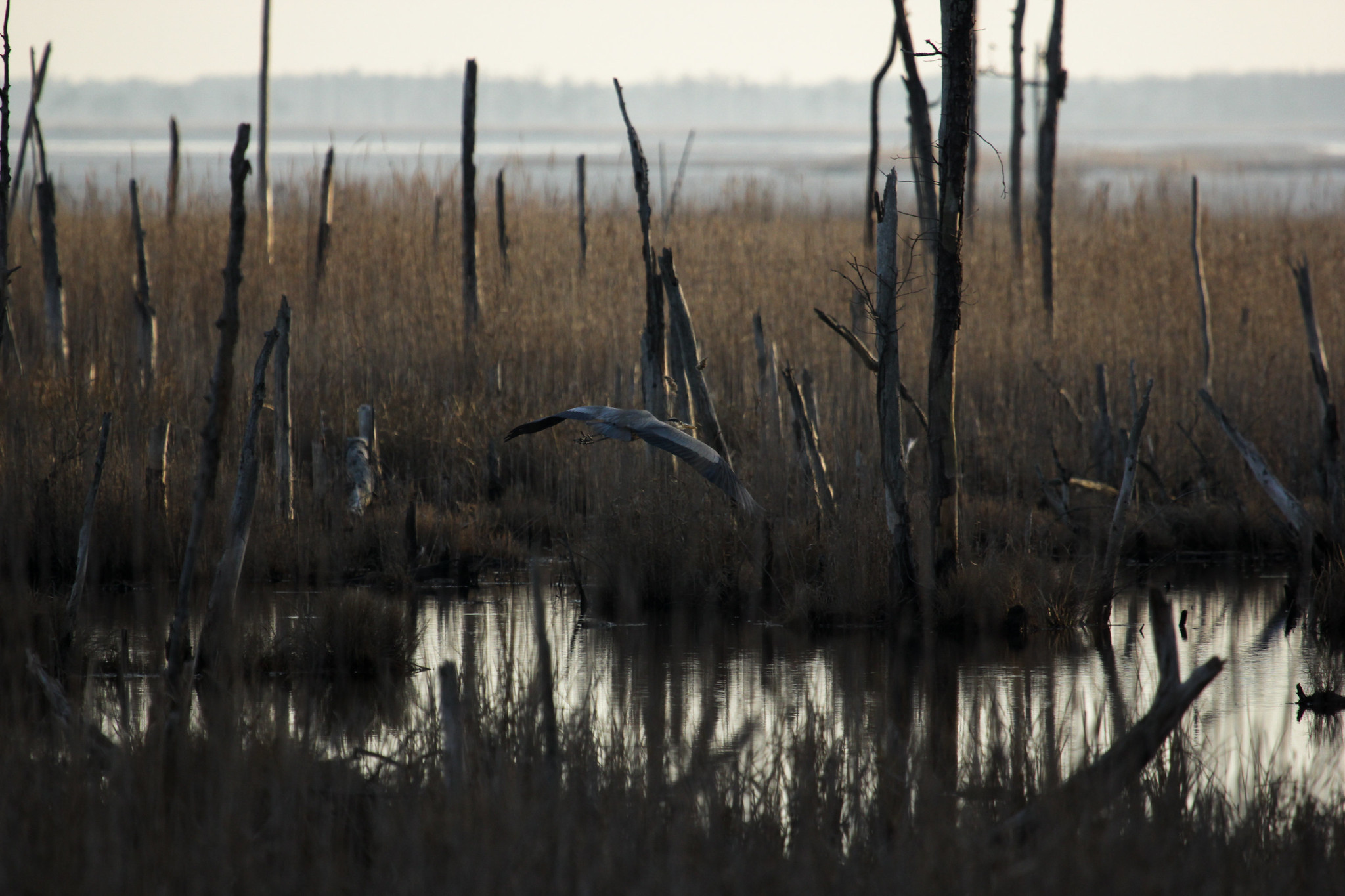
Blackwater National Wildlife Refuge Ghost Forest Image by Will Parson, Chesapeake Bay Program.
Rising seas, frequent major storms, storm surge, and flooding are pushing saltwater from the ocean deep into the interior landscape. The saltwater travels inland through canals, ditches, and drains to seep into the soil. More frequent droughts means there’s less rain to wash out the excess salt in the ecosystem.
Too much salt isn’t just bad for humans. Many tree saplings are intolerant of salinated soil, so they’re usually the first to die off. Salt tolerant plants like shrubs and grasses begin to replace the understory. As the saltwater intrusion becomes more frequent, mature trees stop growing and eventually die, too. Without saplings to replace them, all that’s left is large swaths of dead forests unable to regenerate. With the overstory gone, the saltwater marsh takes over. And while this transition alone isn’t necessarily detrimental, the process doesn’t end at the marsh phase. Over time, the marsh is overtaken as well. Huge areas of healthy forests are lost to the sea within just a few decades.
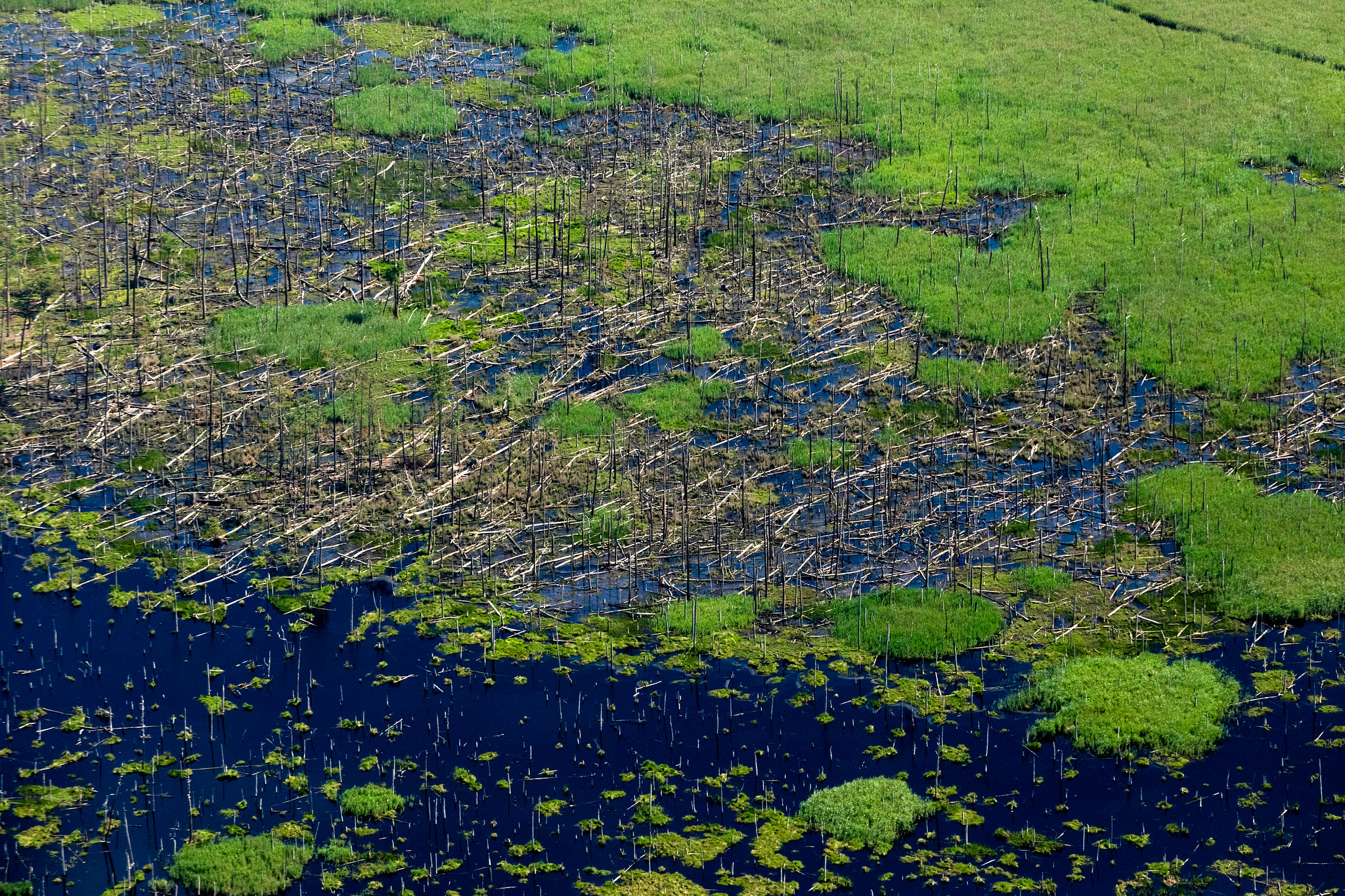
Blackwater National Wildlife Refuge Ghost Forest Image by Will Parson, Chesapeake Bay Program. Flight by SouthWings.
This massive tree death results in a loss of carbon storage and biodiversity, and it also affects local communities. Saltwater intrusion from sea level rise can damage crop viability, drinking water safety, and can cause residents to flee to higher ground. When ecological systems collapse, agricultural systems can collapse, and then the affected area can also suffer from economic collapse.
Matthew Kirwan, a professor at the Virginia Institute of Marine Science (VIMS) who studies ghost forests, believes:
“Ghost forests are the most striking indicator of climate change anywhere on the Atlantic coast.”
In places like the Alligator River National Wildlife Refuge in NC, a recent study found that nearly 47,000 acres of forest have transitioned to marsh or shrubland in just the last 35 years. Dr. Emily Ury, an ecologist at Duke University who authored the study, concluded that 32% of the refuge has changed classification, and 11% of all forested cover in the refuge has transitioned to ghost forests. Ury’s study also shows that ghost forests expand largely after extreme weather events. This rapid transition has implications for ecosystem functions, wildlife habitat, and carbon cycling.
Scientists and conservationists are racing against time to develop solutions. Science has only recently documented how fast the forest is retreating. Some fear we might not fully understand this problem before it’s too late.
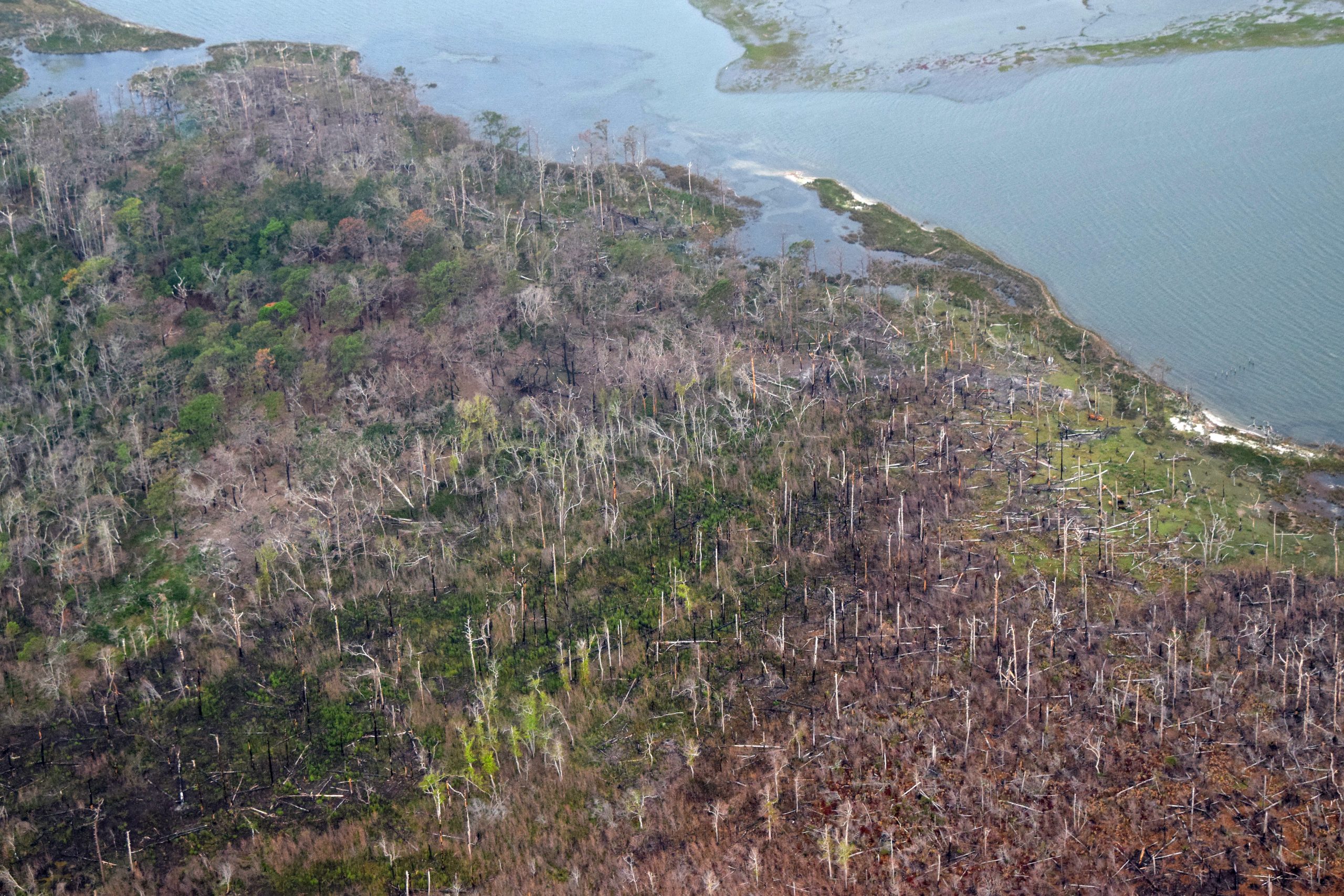
Ghost Forest on the North Carolina Coast Image by Mark Hibbs, NC Coastal Federation. Flight by SouthWings
One potential solution includes coastal resiliency and restoration projects. Building living shorelines made up of plants, sand, and rock could slow erosion and help prevent coastal surges. Some areas have installed water control structures. These allow freshwater to flow out but prevent saltwater from flowing inland. Introducing salt tolerant plant species in threatened areas could also help to keep forests alive. Protecting standing forests from development and logging is also key. Most affected land is privately owned. That means education and collaboration with landowners is vital.
La crisis climática está matando los bosques costeros a una velocidad alarmante y dejando atrás tumbas acuáticas. Estamos en una carrera contra el tiempo. A medida que el clima se calienta, el nivel del mar aumenta. Las tormentas, sequías, inundaciones y fuegos están aumentando en frecuencia y intensidad. Uno de los indicadores más claros de que estamos en crisis es la deforestación rápida que se está produciendo a lo largo de la llanura costera de América del Norte. Desde el Golfo de México hasta el Atlántico superior, los bosques de las tierras altas costeras están muriendo a una velocidad acelerado. Lo que alguna vez fueron bosques frondosos y saludables, se están convirtiendo en marismas llenas de troncos de árboles pálidos sin miembros y sin corteza. Los árboles muertos se parecen a lápidas como tumbas marcando donde estuvo la tierra anteriormente.
Este fenómeno se conoce como bosque fantasma y los científicos coinciden en que el cambio climático está provocando su propagación.
El aumento del nivel del mar, el crecimiento de grandes tormentas, las marejadas ciclónicas y las inundaciones están empujando el agua salada del mar hacia las profundidades del paisaje interior. El agua salada viaja al interior a través de canales, zanjas y desagües y satura la tierra. Las sequías más frecuentes resultan en menos lluvia para eliminar el exceso de sal en el ecosistema.
Demasiada sal no solo es mala para los humanos. Muchos árboles jóvenes no toleran la tierra salinizada y son los primeros en morir. Plantas tolerantes a la sal, como arbustos e hierbas, comienzan a reemplazar el sotobosque. A medida que la intrusión de agua salada se vuelve más frecuente, los árboles maduros dejan de crecer y, finalmente, también mueren. Sin árboles jóvenes para reemplazarlos, todo lo que queda son grandes franjas de bosques muertos que no pueden regenerarse. Con el bosque desaparecido, el pantano de agua salada toma el control. Y aunque esta transición no es necesariamente perjudicial, el proceso no termina en la fase de pantano. Con el tiempo, el pantano también se ve superado por el mar. Grandes áreas de bosques saludables se pierden en el mar en solo unas cuantas décadas.
Esta muerte masiva de árboles resulta en una pérdida de almacenamiento de carbono y biodiversidad, y también afecta a las comunidades locales. La intrusión de agua salada por el aumento del nivel del mar puede dañar la viabilidad de los cultivos, la seguridad del agua potable y puede hacer que los residentes huyan a terrenos más altos. Cuando los sistemas ecológicos colapsan, los sistemas agrícolas pueden colapsar, entonces el área afectada también puede sufrir un colapso económico. Los bosques fantasmas a veces dejan pueblos fantasmas a su paso.
Matthew Kirwan, profesor del Instituto de Ciencias Marinas de Virginia (VIMS) que estudia los bosques fantasmas, cree que “los bosques fantasmas son el indicador más llamativo del cambio climático en cualquier parte de la costa atlántica“. Kirwan establece la conexión entre bosques fantasmas y glaciares en retroceso. Uno revela dónde estaba el hielo, el otro dónde estaba la tierra seca.
En lugares como el Refugio Nacional de Vida Silvestre Alligator River en Carolina del Norte, un estudio reciente encontró que casi 47,000 acres de bosque se han convertido en pantanos o matorrales en solo los últimos 35 años. La Dra. Emily Ury, ecóloga de la Universidad de Duke y autora del estudio, concluyó que el 32% del refugio ha cambiado de clasificación y el 11% de toda la cobertura boscosa del refugio ha pasado a ser bosques fantasmas. El estudio de Ury también muestra que los bosques fantasma se expanden en gran medida después de eventos climáticos extremos. Esta rápida transición tiene implicaciones para las funciones de los ecosistemas, el hábitat de la vida silvestre y el ciclo del carbono.
Los científicos y conservacionistas corren contra el tiempo para desarrollar soluciones. La ciencia ha documentado recientemente qué se está retirando el bosque tan rápido. Algunos temen que no comprendamos completamente este problema antes de que sea demasiado tarde.
Una posible solución incluye proyectos de restauración y resiliencia costera. La construcción de costas vivas compuestas de plantas, arena y piedra podría ralentizar la erosión y ayudar a prevenir las marejadas costeras. Algunas áreas han instalado estructuras de control de agua. Estos permiten que el agua fresca fluya pero evitan que el agua salada fluya hacia el interior. La introducción de especies de plantas tolerantes a la sal en áreas amenazadas también podría ayudar a mantener vivos los bosques. La protección de los bosques que quedan contra la urbanización y explotación forestal es muy importante. La mayor parte de la tierra afectada es propiedad privada. Eso significa que la educación y la colaboración con los propietarios de tierras es vital.
The Amite biomass wood pellet plant in Gloster, Mississippi that UK-based Drax owns was recently fined $2.5 million dollars for breaking environmental rules. After learning of the fine that Drax received for dumping more than three times their allotment of air pollutants and particulate matter, I had to go to Mississippi to see for myself the impact those violations were having on the ground.
It was a very small town that was evidently economically depressed while facing many other challenges. Main Street didn’t have many cars or open stores. Because of COVID there weren’t many people out. With no major stores or retailers in sight, I stopped at unpaved gas stations and storage buildings that took the place of restaurants to speak with the people of the community. I met Ms. Janie who lived in low income elder housing who pointed me in the direction of what was known as the “projects”.
I drove closer to the plant and the Blackmon Hole community, a neighborhood of mobile aluminum-siding homes over about an acre and a half. The road was gravel with very little grass covering the small yard spaces. The area was very compact with no designated area for children. I was truly disheartened to witness two young children playing in the shadow of the Amite Mill in what was supposed to be their yard. Adam Lynch of The Lighthouse: Black Girl Projects describes, “[The] community and the plant are so close together I can’t tell which one is sitting in the other’s backyard.”
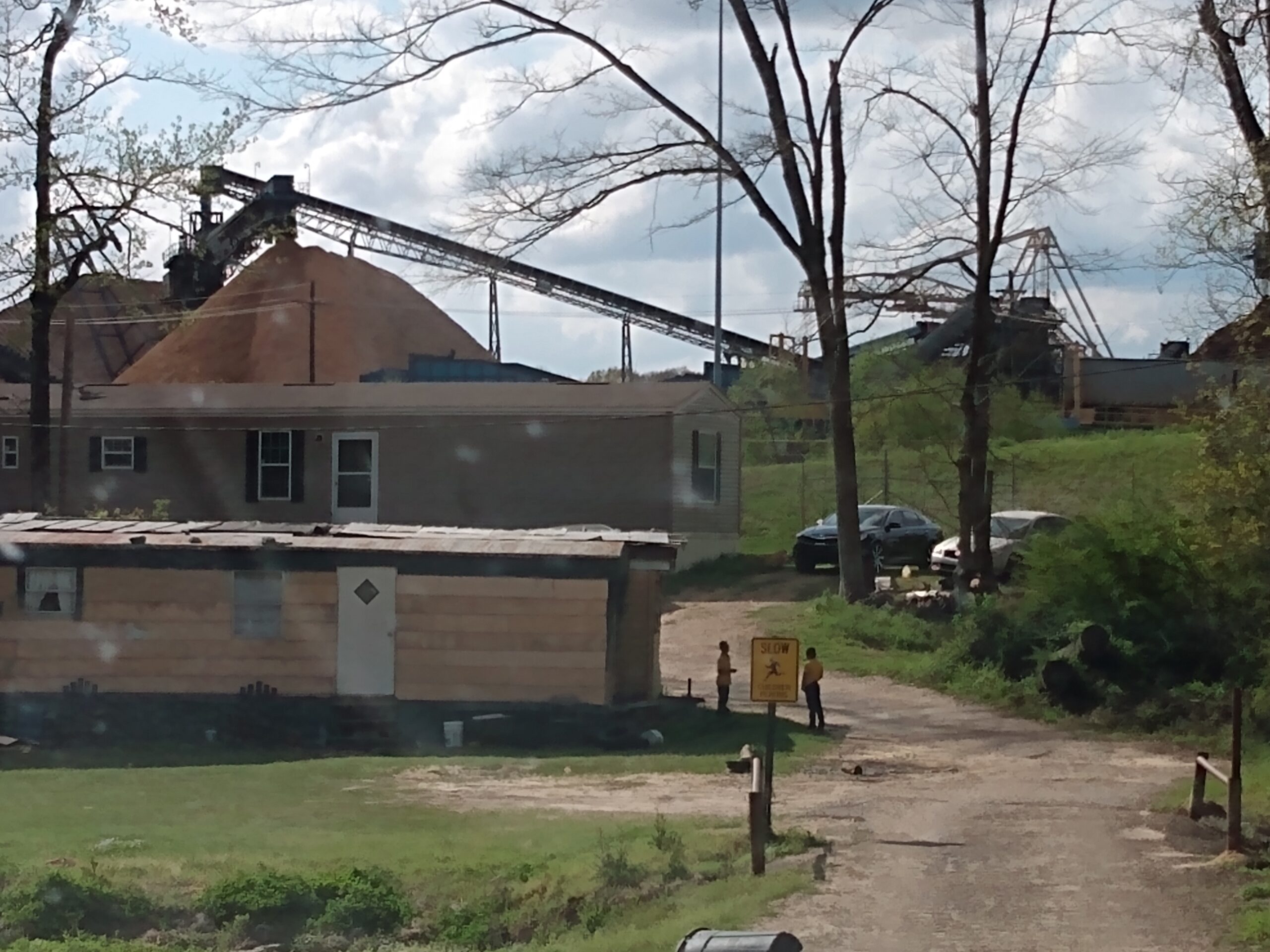
Children playing in the shadow of the Drax Amite wood pellet facility in Gloster, MS
What was even more horrific was the fact that there was a sign that acknowledged “Children Playing”. The only thing that separated these children from the mill was a chain link fence that was less than a hundred yards from them and their home. As I watched them play, I couldn’t help but feel anxiety because at that fence, I could see enormous wood chip piles and equipment. There was nothing to keep these kids out of harm’s way. Not only that, but whenever the wind blows, those children, their families, and their neighbors are exposed to harmful particulate matter that can result in respiratory issues.
My eyes and nose were burning as I attempted to have conversations with the residents. Many only knew that the plant existed and said “it just showed up.” One resident applied for a position with Drax directly but was denied. He applied through a temp agency and was able to work there only via contract, so I question how many jobs Drax created for the local community. Not many people I spoke with knew about the health impacts that this plant could cause them or their families. Many were even unaware of the $2.5 million fine on the Amite Mill. These residents were concerned about their health and livelihood, though.
The Drax Amite wood pellet facility squats too close to the Gloster, Mississippi community for comfort. Image by The People’s Justice Council
When I spoke to Ms. Janie about the plant, she wanted to know more. She, like so many others, didn’t know about the harmful health effects of having a wood pellet plant in her neighborhood because no one had informed the community of the health risks. As soon as I shared the negative impacts of the wood pellet plant and the information about the fine, she was ready to spring into action. She felt people needed to know what was going on because they live there, and they can’t afford to just up and move. Of the $2.5 million fine, she said her community “could use that money to do something to make it better”, but she knew they would never see a dime because “these folks just do whatever they want to do.” Sadly, she’s right. Even still, Ms. Janie supported me by spreading the word and making sure everyone in her community knew about it. She galvanized people to learn what they can do to advocate for the best solutions for their own community.
These plants are preying on communities for their resources and giving false hope at the expense of our trees, our air, and our lives.
The Southeastern region has become a sacrifice zone. As we battle for climate justice, we must understand there’s a war fighting environmental racism that we need to face. Please join us, uniting as one South to deal with our regional climate crisis by opposing the wood pellet industry and taking action.
Welcome to Part Four of our four-part forest documentary series. We’ve scoured the land to bring you a curated list of the best documentaries about forests! Not sure what to watch this weekend? Don’t worry; we’ve got you covered.
Humanity and forests are interconnected. Communities rely on forests for protection from storms and flooding, for water and air purification, for recreation and healing. When a community’s forests are destroyed, it has devastating and wide reaching impacts. Here you’ll find moving and powerful documentaries that tell the stories of the connections between people and forests and of the communities who fought to keep their precious forests standing.
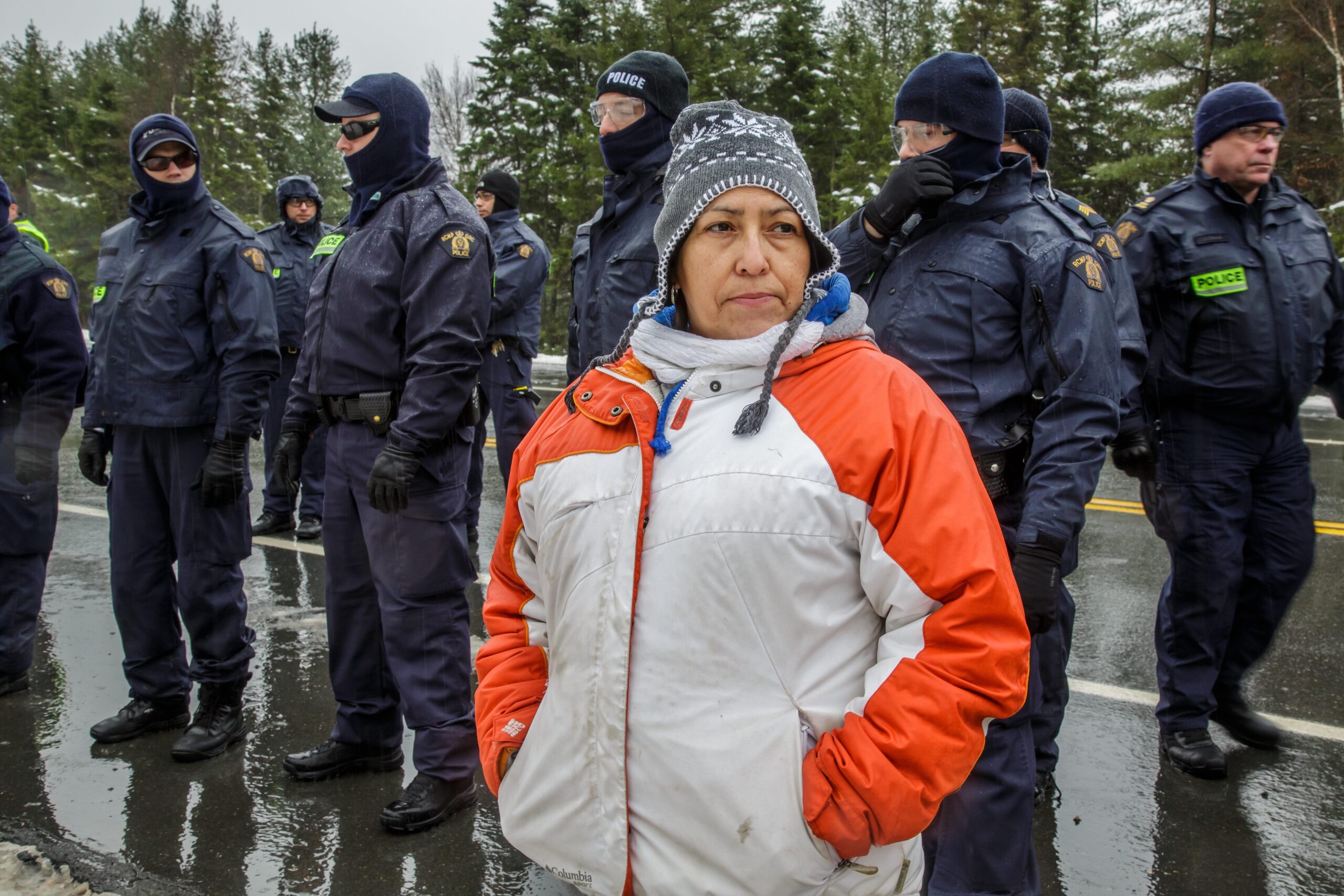
Each morning, Candi Simon and other citizens of the Elsipogtog First First Nation set out to disrupt or stop trucks exploring for Natural Gas, resulting in confrontations, with the company and police. Photo credit: Michael Premo
This documentary takes us to Mossville, Louisiana. 14 petrochemical plants surround the town. Mossville is the future site of apartheid-born South African-based chemical company Sasol’s newest plant. A $21.2 billion project and the largest in the western hemisphere. Here we find Stacey Ryan, the only resident of Mossville. Ryan has lost both parents to cancer and seen the neighborhood he grew up in demolished to make way for Sasol’s new multi-billion dollar project. He is the last man standing in the way of the plant’s expansion, and he is refusing to leave. Where to watch: Available on Amazon Prime, iTunes, and Google Play.
During 2015, Everett Custom Homes purchased a property in Portland’s Eastmoreland Neighborhood. On the lot stood three giant sequoias, which the developer planned to cut down. Giants details the efforts and challenges neighbors of Eastmoreland confronted in their attempts to save these unique trees. The film brings a fresh look into local activism and the importance of community organizing.
Water Warriors is the story of a community’s resistance against the oil and natural gas industry. When a Texas-based energy company began searching for natural gas in New Brunswick, Canada, a multicultural group of Indigenous and white families united to drive out the company in a campaign to protect their water and way of life. Where to watch: Streaming on PBS.
This documentary is an intimate portrait of a group of landowners and activists in East Texas who tried to stop the construction of the Keystone XL pipeline. A $7 billion project slated to carry tar sands oil from Canada to Texas Gulf Coast refineries. Risking financial ruin, personal safety, and family security, these people’s stories of resistance and direct action explore the human spirit and how social change happens in America. Where to watch: Available on Amazon Prime and Google Play.
12 people. In the woods. Telling their stories. Dogwood Alliance’s own Amanda Rodriguez hiked out into the forests of the Southeast to listen. What she found in the power of story and in our connections to forests is more important now than ever. Forests hold our stories. Our history. Our dreams. Our strength. Our future. Humanity happens in forests. Stories happen in forests. Where to watch: Available to screen worldwide in Fall of 2021.
Part 1: Top 5 Forest Preservation Documentaries Part 2: Top 5 Forest Restoration Documentaries Part 3: Top 5 Old Growth Forest Documentaries
Guest post by Emma DawsonHave you ever wondered how much a total ecosystem is worth? How much value do trees give us in timber and food? What about air purification and carbon sequestration? How about flood protection, erosion control, or even natural beauty? It’s hard to imagine all the benefits that nature provides humans. These questions are tricky, but the concept of ecosystem services was created to try and answer them. While this idea has some flaws, it can be a useful way to think about our relationship with the natural world. Let’s take a closer look at ecosystem services to try to better understand what they are.
Ecosystem services are the positive benefits that nature provides to people. These benefits can be big or small. They may be recognized or fly under the radar. Think about a river. It can provide fresh water for drinking, irrigation, and food (by way of fish and other freshwater life). It also may be a fun place to swim or canoe.
Most people can recognize these benefits coming from a river, but there are many others, too. A river can also be important for controlling floods, cycling nutrients, and filtering water. After all, rivers provide a home not only to fish but tons of other critters in aquatic food webs, some of which are so small we can’t even see them. Who knew a river had so many important roles to play?!
The benefits nature provides to people tend to be sorted into four classes of ecosystem services:
Provisioning services are the raw materials that nature provides us. These are pretty easy to recognize. They include food, water, timber, fibers, and even medicine.
Regulating services control other natural processes and materials. Bees, butterflies, and birds all help control the growth of plants through pollination. Wetlands help control floods because they act like sponges that soak up extra water. Trees control how much carbon is in the air by storing it. They can also improve air quality by acting like filters.
Supporting services are the most basic natural cycles that nature needs to function. These include the water cycle, photosynthesis, and the cycling of nutrients between organisms and the soil. None of the other services would be possible without supporting services.
Cultural services are the non-material benefits that nature provides people. They are a part of cultures, activities, and the development of who we are. This can include tourism and recreation. It also includes music, art, and stories inspired by nature. Many of the world’s cultures and religions use nature to find meaning for life’s experiences.
Ecosystem services are vital for our wellbeing. However, those making important decisions often ignore or forget about these services. Most examples of ecosystem services are not bought and sold. After all, you don’t go to a forest to buy clean air and water! This can make it hard for services to be taken into account since they don’t have a price. Climate change, deforestation, and other threats are also depleting these services. Without a way to communicate the value of ecosystem services, they may be harmed beyond repair. This is a scary thought because these services are vital for our existence.

To make sure that ecosystem services are recognized, decision-makers and scientists work together to assign them value. This is expressed in dollars. How can we figure out a price for things that we don’t usually pay for? There are several ways:
Avoided cost is the amount of money that people avoid paying because of the ecosystem service. For example, wetlands help to reduce the impact of flooding by soaking up water. This helps avoid millions of dollars of damage that major storms can cause.
Replacement cost is the cost that people would pay if the service did not naturally exist. If wetlands didn’t exist along coastlines, reservoirs and flood control systems would be required to control floods. These are very expensive to build. It costs a lot of money to replace natural systems.
Travel cost is the amount of money people willingly pay in order to travel to use an ecosystem service. This is usually applied to areas such as parks and recreational activities.
Contingent values are a way to understand how much we’re willing to pay to maintain a service. People are presented with hypothetical scenarios where they express how much they would pay to keep or increase a service. This helps determine how much these ecosystem services are valued.

These methods help scientists estimate the value of ecosystem services. Valuations fall across a wide range and are frequently updated. Some scientists say that the value of global ecosystem services is between 16 and 54 trillion US dollars per year! Compare that to the global gross national product, the total value of all of the world’s goods and services, of 18 trillion dollars per year. There is a lot of value in our natural environment, and it is important that we not take it for granted.
While this method is useful for valuing important services, it isn’t perfect. There are many criticisms of the concept that are important to take into account when thinking about ecosystem services.
This method has been criticized as anthropocentric. This means that humans, rather than nature, are at the center. Ecosystem services can be seen as ignoring nature’s intrinsic value. Some argue that nature should be valued for its own sake rather than because humans value it. The ecosystem services concept is utilitarian, defined for practical purposes to be used by people. But some believe that nature should be the central focus and that human use is less important.
Others think that the ecosystem services concept can lead to overexploitation. They think that this allows people to become consumers of nature rather than protectors and stewards. Putting a price on nature’s goods and services means that they can be bought and consumed. This could lead to overconsumption by people who have enough money and resources. This argument holds that we should not put a price on nature because it’s priceless and vital to our survival.

Cultural ecosystem services can be difficult to assign value to. There has been lots of research focused on tourism and recreation because they are easier to price. Cultural services, especially in non-Western contexts, have been neglected in studies. This is especially true of the cultural value of nature in traditional and Indigenous communities.
Different cultures have different relationships with the environment. Many cultures use nature as a central part of identity. Ignoring this diversity does a disservice to these different cultures, especially marginalized and underrepresented groups. I’s very important to understand cultural contexts when using ecosystem services valuation.
Another criticism is that this method ignores important power relationships. Individuals, institutions, and power structures all play a part in determining how ecosystem services are distributed and managed. Simply assigning a dollar value to these services can be seen as an oversimplification. Black, Indigenous, and People of Color (BIPOC) communities often lack equitable access to ecosystem services. This is typically not reflected in valuations.
Assigning monetary value to nature can also be viewed as imposing Western values on spaces with Indigenous origins. This has been noted as a continuation of Western exploitation of indigenous land and resources without respect for their views. Valuation in itself is an expression of power. It’s important to consider who is benefitting from services, how we can remove barriers that block access, and the historical context behind our valuation of nature.

The idea of ecosystem services is complicated but also interesting. There are many different ways it can be used and lots of points to consider.
Check out Dogwood’s report, Treasures of the South, to learn about ecosystem services in wetlands.
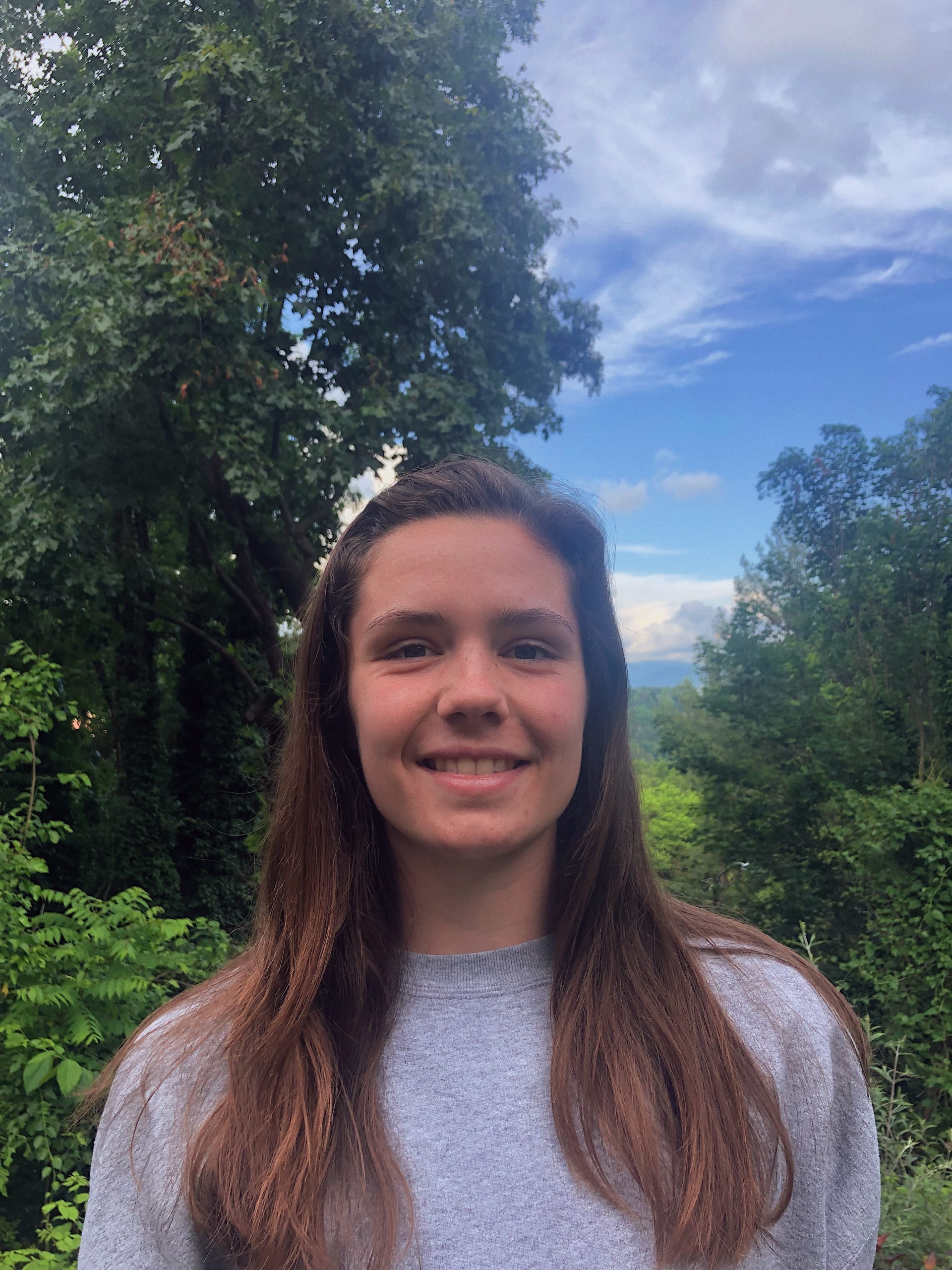
Emma Dawson is a rising third year at the University of Virginia and summer intern at Dogwood Alliance. She is currently pursuing a Bachelor of Science degree in Environmental Science, which she hopes to apply to research opportunities in graduate school and beyond. Emma loves watching and playing soccer, cooking, and spending time outdoors with friends and family.
Guest Post By Brianna Cunliffe
There are growing gaps between rural and urban Americans in terms of economic opportunity, access to resources, and political orientation. This is often referred to as a “rural-urban divide”. Americans who rely on the land to make their living have an enormous stake in keeping it healthy for generations. But conversations about conservation and the environment often leave out rural communities. This is one way in which we see the serious problem of the rural-urban divide. In this rapidly-changing world, people from different communities face starkly different challenges. There’s a lack of empathy and dialogue between urban and rural Americans. We can’t pursue solutions together unless we understand one another’s perspectives.
Forests are a bridge between what can seem like two different worlds. A new forest economy can arise based not on extraction, but on protection and innovation. Conservation gives rural communities the opportunity to shape their own destinies and help the planet at the same time.
People who work in trades, factories, and on the land see a widening gap between themselves and city-dwelling “elites” – those who work at desks, often with advanced degrees. The farmers, ranchers, and blue-collar workers who have called rural areas home for generations face unprecedented challenges. Traditional economic structures are shifting. Consolidation threatens small family farms. Outsourcing threatens to send towns’ biggest employers overseas. Technology displaces human workers and makes good-paying jobs even harder to find. Meanwhile, popular culture tends to ridicule rather than sympathize with rural challenges, like lack of access to healthcare and education. People are left to face a changing and precarious future alone. All of these things make it hard for rural and urban folks to align on the direction our nation is heading.
Rural Americans see resources going to big cities while rural communities struggle to make ends meet. Many urban people discount rural people as uneducated and stuck in the past. Politicians exploit these resentments and rifts for their own benefit, worsening things further. Often politicians claim to be on the side of the “little guy” to win votes in struggling communities. But once in office, they sell their constituents out. But, some would say, at least they pay attention to the issues that matter to rural voters.
Unfortunately, other politicians totally ignore large swaths of the country to focus on what they frame as “the future.” They claim that the future is all about cities and technology and leave out rural voices. This ignores the suffering of rural communities and deepens resentment. Already for many rural Americans, it’s difficult to believe in a government that has failed so many for so long.
From coal mines to lumber mills, the industries which rural communities rely on have one thing in common: they’re extractive. Because of this, companies get away with treating people like they’re expendable. The logging industry is a prime example. Logging is the second most dangerous job in the world. The average age of workers ranges from 50-60, and health coverage and benefits are subpar at best. Folks in timber towns work until their bodies give out and get no loyalty from the industry in return. The livelihoods of whole communities hang in the balance of international market forces.
Rural Americans deserve better. They deserve fair compensation for their hard work. They shouldn’t have to sacrifice their health or the natural beauty around them to make a living. They deserve the chance to shape their own future and that of their children. A new forest economy can offer this and more.
A better future requires a shift away from extractive economies. This means phasing out industries that rely on resource extraction, like logging. Replacing these industries with sustainable alternatives has positive consequences in many ways. First, communities would no longer have to endure the boom and bust cycle. In a boom and bust cycle, companies arrive, become a large employer, and leave when business becomes cheaper elsewhere. This pattern devastates entire towns, leaving many unable to provide for their families.
Second, the health of communities would improve. Extractive industries generate harmful pollution that affects large areas. Pollution causes enormous negative health impacts often leading to premature death. It’s not only the chronic long-term issues like higher rates of asthma and cancer. Hazardous and poorly-managed industrial sites can cause devastating fires and catastrophic explosions. One just happened at a wood pellet plant in Brunswick, Georgia. Pollution makes rural communities less desirable places to live, work, and visit. This drives property values down and discourages tourism, limiting growth and suppressing opportunity.
The protection of our forests promises multiplying, cascading benefits for everyone involved. Sequestering carbon in standing forests will ease the devastation of global climate change. Non-extractive alternatives will improve peoples’ lives and incomes. Tourism, recreation, and research will bring much-needed opportunities to rural communities. This is the new forest economy, and it’s the way to a better future.
Our leaders need to move to enact these win-win solutions on a large scale. There is no time to waste. Biden’s 30-by-30 goal (a commitment to conserve 30% of land area by 2030) is a good start. But industrial forestry and the dirty biomass industry have accrued too much power. Even those who proclaim to be on the side of conservation, like Governor Cooper, are all too often silent. But corporate interests can’t outweigh the needs of struggling rural communities nationwide.
Protecting forests sends a clear message to rural communities that they matter. Stopping exploitative logging and biomass production opens another path forward. It ends the generations of harm and neglect that have entrapped people in vicious cycles. Because of extractive industries, so many hard-working Americans live in poverty and isolation. They are forced to rely on polluting corporations that cut and run with no warning, leaving entire towns stranded. Holding these industries accountable is the first step to breaking the cycle.
Vibrant, thriving forests nurture thriving communities. Government support for a transition away from extractive industries can right generations of wrongs. Conservation can begin to heal the wounds that divide us. The new forest economy is a bridge to a better future. It starts with bold, courageous action to protect the land we rely on and love.
Brianna Cunliffe grew up reading books tucked in the branches of a Carolina pine a few miles away from the sea. Now a rising senior Government and Environmental Studies major and department fellow at Bowdoin College, she seeks to blend passionate activism on behalf of the natural world with innovative, justice-centering policy solutions. Brianna previously worked with elected officials on Protect America, organizing state and local leaders to take action to fight the climate crisis. She’s thrilled to join Dogwood Alliance as an intern to work on the issues closest to her home and her heart.
Hurricane Ida made US landfall on Sunday, August 29th as a Category 4 storm directly impacting Southern Louisiana and Mississippi. The destructive winds, devastating flooding, and deluge of rain were a reminder of why we do the work that we do. The climate crisis is accelerating and making storms of this magnitude more frequent and intense. We recognize that this past weekend was also the 16th Anniversary of Hurricane Katrina.
As the Regional Partnership Engagement Manager for Dogwood Alliance, I understand the impact that these recurring natural disasters have on families, communities, and livelihoods.
Our work is committed to supporting our frontline partners and the environmental justice communities that continue to face compounded injustices. It takes a community to build where we are broken and not where it’s beneficial for one organization.

So, let’s build community. Dogwood Alliance pledges to support the Gulf Coast Center for Law and Policy (GCCLP) Rapid Response Fund led by those at the frontline of recovery to best move resources quickly to the ground.


 Donate
  April 5, 2026