


The corporate responsibility and sustainability movement has lost a true leader with the passing of Ray Anderson, founder and leader of Interface, based in Atlanta, Georgia. I did not know Ray personally, but, like many people working in the environmental field, I had seen him present at various events and conferences, read his books and followed the amazing progress made by his company towards sustainability.
Interface supports Dogwood Alliance’s work on the Carbon Canopy, a project working to transform the business as usual exploitation of Southern forests by developing markets for carbon sequestered by well-managed forests. Over the years I have developed a relationship with sustainability leadership at the company and its foundation which respectively have joined and generously supported this crucial work.
Through this relationship I have learned some valuable lessons about how Ray was such a winning businessman and such an effective and important corporate leader on sustainability issues. Briefly, be creative – like his vision for a zero waste company, be transparent and honest about your progress, and insist on rigorous analysis and a data driven strategy for making progress towards sustainability goals.
Here is Ray’s inspiring talk at TED from a few years ago.
Our sympathies go out to the Interface family. He will be missed.
On May 12, 2011, 35 people representing several of the nation’s top companies, including publishing giants Hearst, McMillan, Scholastic and Hachette, along with financial mega-companies Citigroup and JP Morgan Chase, gathered for a Carbon Canopy Corporate Roundtable in New York City. The result? More potential members for this groundbreaking concept in fighting climate change.
“Our goal was to get representatives from the publishing and banking sectors there to learn about the work of the Carbon Canopy, and they turned out in considerable numbers,” says Andrew Goldberg, Dogwood Alliance’s Director of Corporate Engagement. The event was hosted by Citigroup at their headquarters in lower Manhattan.
“We talked about the opportunity created by Carbon Canopy to invest in the protection of forest carbon sinks in the South as a strategy to achieve their goals for corporate social responsibility in a way that truly makes a difference on the ground for our forests and subsequently for our climate as a whole,” Andrew says. “Our hope in convening these roundtables is to drive major corporate investment in forest conservation in the South.”
In addition to finance and publishing companies, the Roundtable also welcomed attendees from newsprint company AbitibiBowater, office products and paper distributor Unisource, and the nonprofit groups Open Space Institute and Forest Stewardship Council, among others.
In another exciting first, the president of the National Woodland Owners Association (NWOA), Keith Argow, attended and spoke at the Roundtable about the need to find new ways to help woodland owners conserve their land. NWOA recently joined the Carbon Canopy and Argow has begun developing a Carbon Canopy project on his own property. There will be an article about the Carbon Canopy coming up soon in the National Woodland Owners Association magazine that is distributed to more than 30,000 forest landowners.
Many of Dogwood’s corporate and nonprofit partners spoke to the group. Mark Buckley, VP of Environmental Affairs at Staples, explained why the Carbon Canopy is a win-win for corporations, forest landowners and environmental groups. Paula Swedeen, Ph.D., Director of Ecosystem Service Programs at Pacific Forest Trust explained how the Carbon Canopy’s rigorous carbon accounting and forest management standards lead to high-quality credits and support critical greening of the forest products industry.
Kent Gilges, Managing Partner, Conservation Forestry, LLC; Kaarsten Turner Dalby, Sr. Director of Ecological Services , The Forestland Group, LLC; and Rene Taylor, Forest Manager, Columbia Forest Products each shared details of the projects they are developing in the South. “In hearing the discussion and questions, it became even more clear that a big part of the Carbon Canopy will be figuring out how to do carbon sequestration on lands that are primarily pines instead of hardwoods,” Andrew says. “That’s another goal to work toward as we develop these projects.”
In the meantime, Andrew will be pushing forward with the momentum created by the Roundtable.
“It’s very gratifying to know that people and the companies they represent are really interested in what we’re doing with the Carbon Canopy,” he says. “I’m looking forward to following up with them and bringing new partners into the group.”
 Recently, the US Environmental Protection Agency decided not to regulate greenhouse gas emissions from biomass energy plants for the next three years while the agency studies the issue. At a time when science suggests that burning wood for energy could actually result in accelerated (rather than reduced) carbon emissions, this decision sets us on the wrong path to a clean energy future. In response to this decision by the EPA, Dogwood Alliance quickly issued a statement opposing large-scale, wood-based bioenergy and called on the EPA to stop the further expansion of large-scale biomass projects while the agency studies the environmental impacts.
With no CO2 regulation, insufficient smoke stack regulations and no regulation of forest management practices, the government has just opened the floodgates on yet another environmentally destructive, unregulated and unaccountable industry — all in the name of clean, renewable energy. While there is an undeniable need to reduce carbon emissions and reduce our dependence on fossil fuels, burning forests is not the answer. We should look to truly “clean” alternatives like solar and wind power, and leave our forests intact to help combat climate change.
Send a letter to the EPA telling them not to stand by while energy companies destroy our forests for fuel. Rather than giving this industry a free pass to pollute the air and destroy our forests, ask the agency to institute a three-year moratorium on new large-scale biomass projects while they assess the impacts to climate, human health and forests.

John Beal discovered Dogwood Alliance shortly after moving to Atlanta in 1997.
“I was at Music Midtown, trying to find a shortcut from one stage to another when I wandered down a small side path where nonprofits had booths. I saw Dogwood’s information, and I felt an instant kinship. I liked their progressive approach. I stopped. I chatted. I joined.”
Since then, John has been an invaluable volunteer, first as a member of the Fundraising Committee, then joining the board in 2006 and finally becoming chair in 2010.
“I’ve learned a lot about the challenges of leading a small organization like Dogwood. The ratio of our effectiveness to budget has always impressed me. I feel like even the smallest contribution really does make a big impact on our forests.”
Dubbed “John the Baker” years ago while living in Boulder, Colorado, John is an avid cyclist and fundraiser and a former tennis coach at his alma mater, the University of Massachusetts. He’s also tended bar at Atlanta’s historic East Lake Golf Club for nearly 15 years and organizes the Decatur Green Fest every year that benefits Dogwood Alliance.
“Dogwood means a lot to me and being actively involved is something I really want to do,” he explains, noting the importance of providing vigilant protection for forests in this part of the country. “Dogwood creates meaningful opportunities for people to engage in strategies that are transformative. We’ve made huge progress transforming the paper industry, though there is still a lot of work to be done. Large-scale use of forests for bioenergy could reverse that progress and create an even bigger disaster on the landscape. Dogwood’s voice in the debate regarding a clean energy future is critical right now, and it’s a key time for raising awareness about Dogwood, its successes and the importance of its work.”
Thanks, John, for your leadership, passion and dedication to Southern forests!
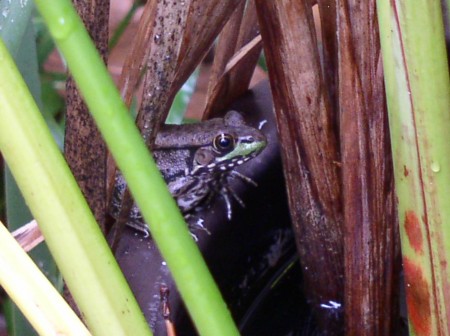
Standing in deep woods after a long satisfactory rain, I can feel the trees breathe and expand. I am being quiet not to disturb the young bunny grazing near my feet. Red-bellied woodpeckers are working the trees along with sapsuckers while the passerines shoot by in short bursts of color and wings. I can see five nests from my vantage point, all different. Down by the creek this morning I found three different species of frogs and a perfect mud turtle making her slow way upstream. The woods are alive.
I stop for a second and try to imagine all the activity around me as forms of embodied energy. The cottontail which will nourish the hawk or the feral cat is fed by a miraculous combustion of sun and water and carbon dioxide in the form of plants which will create excess matter and feed the forest floor, each process or death an expression of the transformation of matter into energy.
Above me is the rammed-earth house we live in, and its hive of books and chairs and appliances and art, also forms of embodied energy. The difference is that many of these forms of embodied energy were purchased and transported at great cost to the ecosystem, involving the dangerous combustion of ancient irreplaceable fossil fuels. My house is lovely and sheltering, but it is not alive. It will not replenish the forest floor except in geologic time.
Here at Dogwood we are deeply involved in conversations about energy. With biomass plants proposed throughout the South and the burning of trees supported even by some of our allies as a “renewable source”, we can see the potential for increased industrial logging of our native forests to feed the maw of big power companies. The South already leads the world in the percentage of forest cover loss, and this could be another deadly extraction with its usual losses: degradation of local ecologies and communities, pollution, increased carbon emissions.
We believe that forests have an intrinsic value in and of themselves which is greater than their use as a cheap energy source. We believe that we cannot effectively address climate change without protecting, restoring and improving the management of the world’s forests.
I have a definition of biomass which is scientific and spiritual, gathered from such diverse teachers as Starhawk and Wendell Berry. Biomass is the energy embodied in the living things around me, all the biological life in a given environment. It’s a relationship filled with wonder and reciprocity.
Let us respect it in all that we do.
EPA’s Decision Not to Regulate Carbon Emissions from Biomass Puts Climate, Forests and Human Health at Risk
Further Expansion of Industrial Scale Wood Burning Facilities Needs to Be Stopped While EPA Studies the Environmental Impacts
Asheville, NC – Today, Dogwood Alliance, an organization focused on protecting Southern forests, called on utility companies, investors, and federal, state, and local governments to halt the further expansion of large-scale bioenergy projects, including burning whole trees in existing coal-fired power plants while the EPA studies the environmental impacts. This comes in response to the agency’s recently announced decision to allow biomass-burning facilities to avoid regulation of carbon emissions for the next three years. Citing the absence of CO2 and forest management regulation as well as insufficient smokestack pollution controls, the organization is concerned that the government has just opened the floodgates on yet another environmentally destructive, unregulated, and unaccountable industry all in the name of clean, renewable energy.
“While there is a real and urgent need to reduce our dependence on coal and foreign oil, burning forests is not the answer,” said Danna Smith, Executive Director of Dogwood Alliance. “Allowing this industry to run rampant while mounting science is documenting that industrial-scale burning of bioenergy for electricity will accelerate carbon emissions, threaten human health, and destroy forests, is a major mistake.”
Biomass-burning facilities, which burn organic matter such as wood to produce energy, are increasing throughout the United States. For the next three years while the EPA studies the issue, biomass facilities will be spared from new federal laws that regulate the release of harmful greenhouse gases that lead to climate change. These facilities will not be required to attain permits before beginning construction and will not need Title V operating permits.
Forests remove and store carbon – a critical service that is compromised when they are degraded by industrial logging. Carbon is not only released when forests are logged but also when the trees are burned to produce energy. Worldwide, forest loss and degradation already account for 20% of global carbon emissions. Just last week, a study published in Science concluded that that the protection of forests as carbon sinks should be even more at the forefront as a strategy to protect our climate. Beyond carbon, forests protect water resources, prevent flooding, protect wildlife and support the well-being of our rural communities.
“At a time when forest loss and degradation already account for a significant share of global carbon emissions, we need to reduce rather than accelerate industrial logging,” says Smith. “We must focus on protecting our forests as carbon sinks while devoting resources to energy efficiency as well as clean sources of renewable energy, such as solar and wind power.”
The Southern US is already the world’s largest wood and paper producing region. Dogwood Alliance believes increased demand from large-scale bioenergy facilities could push the region’s forests “over the edge”. Currently there are no laws in place to ensure sustainable forestry practices. Destructive practices, such as large-scale clearcutting and the conversion of natural forests to plantations, are widespread. According to a recent report published by the US Forest Service, Southern Forest Futures Project report, increased demand on forests in the South from the bioenergy industry could trigger a near doubling of industrial logging as well as the further replacement of millions of acres of natural forests with industrial pine plantations, causing significant and wide-spread negative impacts to water resources, wildlife habitat, and biodiversity.
.# # #
Dogwood Alliance is increasing protection for millions of acres of Southern forests by transforming the way corporations, landowners and communities value them for their climate, wildlife and water benefits. Dogwood Alliance has revolutionized the environmental practices of some of the world’s largest corporations. For more information on the organization please visit, www.dogwoodalliance.org.
EPA’s Decision Not to Regulate Carbon Emissions from Biomass Puts Climate, Forests and Human Health at Risk
Further Expansion of Industrial Scale Wood Burning Facilities Needs to Be Stopped While EPA Studies the Environmental Impacts
Asheville, NC – Today, Dogwood Alliance, an organization focused on protecting Southern forests, called on utility companies, investors, and federal, state, and local governments to halt the further expansion of large-scale bioenergy projects, including burning whole trees in existing coal-fired power plants while the EPA studies the environmental impacts. This comes in response to the agency’s recently announced decision to allow biomass-burning facilities to avoid regulation of carbon emissions for the next three years. Citing the absence of CO2 and forest management regulation as well as insufficient smokestack pollution controls, the organization is concerned that the government has just opened the floodgates on yet another environmentally destructive, unregulated, and unaccountable industry all in the name of clean, renewable energy.
“While there is a real and urgent need to reduce our dependence on coal and foreign oil, burning forests is not the answer,” said Danna Smith, Executive Director of Dogwood Alliance. “Allowing this industry to run rampant while mounting science is documenting that industrial-scale burning of bioenergy for electricity will accelerate carbon emissions, threaten human health, and destroy forests, is a major mistake.”
Biomass-burning facilities, which burn organic matter such as wood to produce energy, are increasing throughout the United States. For the next three years while the EPA studies the issue, biomass facilities will be spared from new federal laws that regulate the release of harmful greenhouse gases that lead to climate change. These facilities will not be required to attain permits before beginning construction and will not need Title V operating permits.
Forests remove and store carbon – a critical service that is compromised when they are degraded by industrial logging. Carbon is not only released when forests are logged but also when the trees are burned to produce energy. Worldwide, forest loss and degradation already account for 20% of global carbon emissions. Just last week, a study published in Science concluded that that the protection of forests as carbon sinks should be even more at the forefront as a strategy to protect our climate. Beyond carbon, forests protect water resources, prevent flooding, protect wildlife and support the well-being of our rural communities.
“At a time when forest loss and degradation already account for a significant share of global carbon emissions, we need to reduce rather than accelerate industrial logging,” says Smith. “We must focus on protecting our forests as carbon sinks while devoting resources to energy efficiency as well as clean sources of renewable energy, such as solar and wind power.”
The Southern US is already the world’s largest wood and paper producing region. Dogwood Alliance believes increased demand from large-scale bioenergy facilities could push the region’s forests “over the edge”. Currently there are no laws in place to ensure sustainable forestry practices. Destructive practices, such as large-scale clearcutting and the conversion of natural forests to plantations, are widespread. According to a recent report published by the US Forest Service, Southern Forest Futures Project report, increased demand on forests in the South from the bioenergy industry could trigger a near doubling of industrial logging as well as the further replacement of millions of acres of natural forests with industrial pine plantations, causing significant and wide-spread negative impacts to water resources, wildlife habitat, and biodiversity.
.# # #
Dogwood Alliance is increasing protection for millions of acres of Southern forests by transforming the way corporations, landowners and communities value them for their climate, wildlife and water benefits. Dogwood Alliance has revolutionized the environmental practices of some of the world’s largest corporations. For more information on the organization please visit, www.dogwoodalliance.org.
Business Leaders, Local Community and Environmentalists Join Together to Ask the Company to Stop Destroying Southern Forests for Its Packaging
Louisville, KY – This morning, representatives from the local community, sustainable business leaders, and environmentalists were on hand at the Yum! (parent company of KFC) Annual General Meeting to serve up corporate social responsibility and environmental leadership to the executives and shareholders of the company. They were there to demand the company stop destroying Southern forests for the company’s paper packaging and challenged KFC to be a leader on environmental and sustainability issues.
“While stock prices climb, our forests continue to fall as KFC continues to buy paper packaging from endangered forests in the Southern US,” said Andrew Goldberg, Corporate Engagement Director at Dogwood Alliance. “We are here today asking KFC to meet with us and begin the process of becoming an environmental leader rather than laggard. Now is the time for change.
Building on the momentum of the Kentucky Fried Forests campaign, Dogwood Alliance along with business leaders and disappointed local community members felt the time was right to deliver a strong message directly to the leaders of the company. Whereas companies like McDonald’s have adopted strong leadership environmental policies that ensure its packaging does not come from the worst of the worst practices in the woods, KFC continues to lag behind.
The group was there to ask the company to meet with them to discuss the issues and begin the development of an industry leading policy. The campaign calls on KFC to use less packaging, use more post-consumer recycled fiber in its packaging, and ensure that it does not originate from the most destructive practices like logging of endangered forests, large-scale clearcutting, and conversion of natural forests and forested wetlands to plantations.
“KFC’s iconic bucket and other packaging are made from endangered forest from the Green Swamp in Southeastern NC,” said Haiz Oppenheimer of Dogwood Alliance. “Following our successful day of action, we are here today with local communities who want the company to be good stewards in their own backyard.”
On April 27th, KFC customers and concerned citizens from around the South and across the United States, delivered letters to over 200 KFC store managers asking them to push their parent company to green its paper packaging. On the heels of this, the organization decided it was time to take that momentum to the boardroom for the shareholder meeting. Representing thousands of concerned citizens across the South they challenged the company to be real leaders in the fast food industry.
Though Dogwood Alliance has been attempting to engage with KFC for many years now, the company has refused to take meaningful action. Instead, KFC has chosen to greenwash its packaging by adopting the Sustainable Forestry Initiative (SFI) certification label. A vast majority of conservation organizations endorse the Forest Stewardship Council (FSC) certification standard as the gold-standard identifying responsibly sourced forest products, while adamantly opposing the SFI because it allows large-scale clearcutting, logging of endangered forests, conversion of natural forests to plantations, and widespread use of toxic chemicals.
KFC’s largest supplier in the South, (IP) has long been associated with these types of destructive practices. Notable has been the impact the company has had on the southeastern coast in places like North Carolina’s Green Swamp, where forested wetlands have been ditched and drained and converted to monoculture pine plantations, impacting endangered species such as the Venus Flytrap and causing flooding in nearby communities. As a major purchaser of paper products from , KFC has the ability to influence industry-wide change by committing to only using FSC certified products for the company’s needs throughout its supply chain, from shipping to stores.
# # #
Dogwood Alliance is increasing protection for millions of acres of Southern forests by transforming the way corporations, landowners and communities value them for their climate, wildlife and water benefits. Dogwood Alliance has revolutionized the environmental practices of some of the world’s largest corporations. To support Dogwood Alliance’s call for KFC to adopt sustainable packaging practices send a letter to KFC leadership via www.kentuckyfriedforests.com, for more information on the organization visit www.dogwoodalliance.org.
Click here to see a side by side comparison of the SFI and FSC
To read more about McDonald’s recently announced environmental paper packaging policy, visit: http://www.dogwoodalliance.org/2011/03/mcdonalds-adopts-industry-leading-forest-standards-for-its-packaging/
Fast Food Customers and Concerned Citizens Join a National Day of Action Calling on KFC to Stop Destroying Southern Forests
Letters Delivered to Over 200 Store Managers at KFC Restaurants Across the Country; Actions Targeting KFC Will Continue Until the Company Greens Its Packaging
Asheville, NC – Today, KFC customers and concerned citizens from around the South and across the United States, delivered letters to over 200 KFC store managers asking them to push their parent company, YUM! Brands, to green its paper packaging. The iconic KFC bucket, and other paper packaging used at KFC restaurants across the country comes from critical wetland forests and some of the last remaining special places on the southeastern coast.
The letter delivery is part of a national campaign, Kentucky Fried Forests, launched last April by North Carolina-based Dogwood Alliance, an organization that protects the forests and communities of the Southern US. The organization is challenging KFC to use less paper, increase the use of post-consumer recycled paper in all of its packaging, recycle more and to adopt a sector-leading policy that ensures its packaging is not coming from endangered forests or the worst of the worst practices in the woods.
“Today, hundreds of concerned citizens are calling out KFC and asking them to be a leader in the fast food industry,” said Scot Quaranda, Campaign Director at Dogwood Alliance. “KFC’s fast food packaging is destroying our forests but it doesn’t have to be that way. Many companies, including fast food giant McDonald’s have changed their policies to ensure their paper products are not destroying forests. It’s time for KFC to do its part to end the rampant destruction of the special forests in the South to make its chicken buckets.”
Though Dogwood Alliance has been attempting to engage with KFC for many years now, the company has refused to take meaningful action. Instead, KFC has chosen to greenwash its packaging by adopting the Sustainable Forestry Initiative (SFI) certification label. A vast majority of conservation organizations endorse the Forest Stewardship Council (FSC) certification standard as the gold-standard identifying responsibly sourced forest products, while adamantly opposing the SFI because it allows large-scale clearcutting, logging of endangered forests, conversion of natural forests to plantations, and widespread use of toxic chemicals.
KFC’s largest supplier in the South, (IP) has long been associated with these types of destructive practices. Notable has been the impact the company has had on the southeastern coast in places like North Carolina’s Green Swamp, where forested wetlands have been ditched and drained and converted to monoculture pine plantations, impacting endangered species such as the Venus Flytrap and causing flooding in nearby communities. As a major purchaser of paper products from , KFC has the ability to influence industry-wide change by committing to only using FSC certified products for the company’s needs throughout its supply chain, from shipping to stores.
The Southern US is the largest paper producing region in the world providing 20% of the globe’s paper. Every year an area larger than the state of New Hampshire is clearcut. Yet the region is home to a large number of endangered plants and animals which hang in the balance. While other fast food companies, including a recent announcement from McDonald’s, have introduced standards for sustainably sourced paper products from suppliers, KFC and its’ parent company, YUM! Brands, have been a slow mover in adopting practices despite years of engagement from Dogwood Alliance.
# # #
Dogwood Alliance is increasing protection for millions of acres of Southern forests by transforming the way corporations, landowners and communities value them for their climate, wildlife and water benefits. Dogwood Alliance has revolutionized the environmental practices of some of the world’s largest corporations. To support Dogwood Alliance’s call for KFC to adopt sustainable packaging practices send a letter to KFC leadership via www.kentuckyfriedforests.com, for more information on the organization visit www.dogwoodalliance.org.
To read the letter delivered today to store managers, click here.
To see the original letter sent to KFC corporate in 2006, click here.
To read more about McDonald’s recently announced environmental paper packaging policy, visit: http://www.dogwoodalliance.org/2011/03/mcdonalds-adopts-industry-leading-forest-standards-for-its-packaging/


 Donate