


This past week and a half I’ve had a whirlwind tour through Dogwood’s new focal area, the unique swamps and forests of coastal North Carolina and southeast Virginia.
I’m here doing a listening project, speaking with folks about life in this neck of the woods, their experiences with the land, the area’s diverse ecosystems, and local struggles to protect threatened areas.
My journeys began in the Great Dismal Swamp outside Suffolk, Virgina, which was quite striking despite the drought. I walked the 4.5 mile Washington Ditch trail to Lake Drummond, one of just two natural lakes in the state of Virginia, located in the middle of the swamp. The trail follows an old cart road with a canal dug along side it that George Washington had built by slave labor in the mid-1700s.Washington built the canal to transport timber out of the swamp, beginning a long saga of European pillaging that continues to this day.As I walked along the grassy trail beside the canal, I watched red-headed woodpeckers fly from tree to tree and tried to wrap my head around the mind-boggling amount of labor that must have gone into the construction of such a massive canal by hand.
In colonial days, the swamp was regarded as an almost insurmountable obstacle to the white settlers (thus the desire for a canal).As such, it also provided a safe haven for runaway slaves on the underground railroad.Historians actually regard the Dismal Swamp as one of the largest maroon colonies (hidden communities of escaped slaves) in the US.
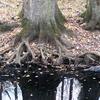 Today, the swamp is a sanctuary for over 200 species of birds
and other wildlife such as bobcats, deer, bears, otters, foxes and snakes,
whose habitat has largely been subdivided by sprawl, agriculture and
monoculture pine plantations that feed the paper industry.For part of my hike I was accompanied by a
great blue heron, who would land on the trail a few dozen feet up from me, and
fly a bit further down each time I approached.
I’ll be returning to the Dismal Swamp
again next week, hoping to talk more with the park biologist and education
coordinator.
Today, the swamp is a sanctuary for over 200 species of birds
and other wildlife such as bobcats, deer, bears, otters, foxes and snakes,
whose habitat has largely been subdivided by sprawl, agriculture and
monoculture pine plantations that feed the paper industry.For part of my hike I was accompanied by a
great blue heron, who would land on the trail a few dozen feet up from me, and
fly a bit further down each time I approached.
I’ll be returning to the Dismal Swamp
again next week, hoping to talk more with the park biologist and education
coordinator.
Check out the next update from the Zuni Pine Barrens…
Louisville is home to Yum! Brands, the parent company of Taco Bell, Long John Silvers, Pizza Hut, KFC and more. They are buying paper for packaging from Southern forests, and we can help to change that.
Last week I had a great time visiting with the lovely folks in Louisville, Kentucky–home to Yum! Brands. Yum! brands is parent company of Taco Bell, KFC, Long John Silvers, Pizza Hut and more. This huge mega brand company is buying paper for their packaging from endangered forests in the Southern US!
I had a great time meeting with lots of new and old activists, Greenthumb Student group in Lexington, Kentuckians for a Commonwealth, Sierra Club volunteers and even a new Dogwood Alliance donor about the beautiful forests we’re working to protect, the Packaging campaign, and the fast food industries impacts on our forests from their packaging decisions. We’re looking forward to a fun filled year in 2008 to transform the fast food packaging industry.
After the Sierra Club meeting, I had lots of great questions and interest about the campaign. Below is a photo of me talking to one of the Sierra Club members after the meeting.
To send a message to Yum! Brands CEO David Novak click here .

Till next time,
Eva Hernandez
Protected! 127,000 woodland acres on the northern Cumberland Plateau adding acreage to Frozen Head State Park. This important conservation action in a Dogwood Alliance focal area builds off of our work highlighting the ecological importance of the region with large paper consumers as well as Bowater’s 2005 commitments resulitng in improved forest practices on the ground. Happy holidays! This is a wonderful gift to our region.
For Immediate Release – October 2nd, 2007 Contact – Scot Quaranda, Dogwood Alliance, 828.251.2525 x18, [email protected] Kathi Petersen, KP Communications, 828.712.1286, [email protected] Change is on the Horizon: Environmental Paper Revolution has Begun New Report Details State of the Paper Industry; Calls for Transformation of Forest Practices, Paper Production, and Smarter Purchasing and Consumption Decisions Asheville, NC – Today, the Environmental Paper Network, a diverse group of environmental organizations joined together to support socially and environmentally sustainable transformations within the pulp and paper industry, released a report detailing the environmental impacts of the paper industry. The State of the Paper Industry is the first comprehensive report addressing fiber sourcing, recycling, consumption, paper production, and the paper industry’s impact on communities and the climate crisis. A green wave is sweeping North America and more and more companies are scrutinizing their impact on the planet and taking action to reduce their footprint. This transformation has even impacted the paper industry where companies from all sectors including the magazine, book and catalog industries, office supply retailers, apparel stores and the financial service sectors have adopted green paper policies. From Victoria’s Secret and Williams Sonoma to Staples and FedEx-Kinkos to Raincoast Books and Random House, companies are increasing their use of recycled paper, scrutinizing the forest practices associated with paper production, and examining their impact on the global climate. “This report is a comprehensive environmental review of an industry that continues to be one of our planet’s most significant environmental challenges,” said Joshua Martin, Environmental Paper Network Coordinator. “The good news is that a shift within the paper industry has begun, and corporate leaders are emerging across every sector to embrace new tools for responsible choices, responsible production and major climate, health and forest benefits. This report offers a broadly supported Vision and a challenge to the industry while documenting a baseline of environmental data for monitoring real progress and identifying real leaders in years to come.” The report finds: The industry continues to have far-reaching, negative environmental impacts: • The paper industry is the fourth largest contributor to greenhouse gas emissions among United States manufacturing industries. • Paper accounts for 25% of landfill waste, the largest of any single component. • Paper production accounts for over 40% of the world’s industrial wood harvest • Paper production is one of the world’s largest consumers and polluters of fresh water • Paper production continues to come into conflict with indigenous and other communities around the world over land rights, culture, human health, and livelihoods Innovation and a cultural shift are providing many environmental opportunities: • Growing market demand for environmentally responsible paper products • Growing acreage of Forest Stewardship Council certified sustainable forestry • Cleaner production and alternatives to chlorine bleaching • Increasing recovery of waste paper • The emergence of innovative, corporate leaders. The “State of the Industry” report details how an industry known for forest degradation, toxic pollution, and resistance to change is starting to shift. Though the shift has begun, there is a critical need for improvement across the boards. Responsible Forestry – every day more companies embrace Forest Stewardship Council (FSC) certification, but unsustainable forestry practices still prevail around the world and are getting worse in places like the global South. Recycling – more companies continue to increase the use of recycled paper in their products, but improvements in paper recovery and investments in infrastructure are sorely needed. Reduction – more companies getting savvier about reducing paper use, but at the same time, some heavy paper consuming sectors continue to drastically over-consume paper. Clean production – there is a greater emphasis on reducing chlorine bleach and toxic emissions, but the paper industry as a whole has not embraced many of the best practices. Global warming – there is a greater awareness of the climate crisis, but in general, there has been a lack of movement from industry to address this critical issue. Human impacts – some First Nations and progressive paper companies are working together, but exploitation of native people around the world continues at a dizzying pace. “From continual logging of the world’s endangered forests to a de-emphasis of recycled paper, many companies within the paper industry continue to hide behind business as usual practices or pawn off new practices as ‘green’,” said Nicole Rycroft, Executive Director of Markets Initiative. “We challenge these companies to embrace a truly sustainable paper industry that protects forests and ensures clean water, clean air and a stable climate for future generations.” The report calls on companies to minimize paper consumption, maximize recycled content, source fiber responsibly, and employ cleaner production methods to reduce their impact on the climate crisis. Additional recommendations include, greater investment in recycling infrastructure, seeking FSC certification, and greater attention to supply chain in order to reduce overall consumption. “Simple solutions are available for paper companies, retailers, and consumers to create a socially and environmentally responsible paper system,” said Sid Cullipher, Executive Director of Dogwood Alliance. “Make informed purchasing decisions, focus on solutions that advance social and environmental sustainability, and embrace better manufacturing practices.” # # # To download a copy of the report or executive summary visit: www.environmentalpaper.org/stateofthepaperindustry The Environmental Paper Network is a diverse group of environmental organizations joined together to support socially and environmentally sustainable transformations within the pulp and paper industry. The Network developed the Common Vision as a framework to guide necessary shifts in production and consumption. The Steering Committee of the EPN includes: As You Sow, Borealis Centre, Conservatree, Co-Op America, Dogwood Alliance, Environmental Defense, ForestEthics, Green Press Initiative, Markets Initiative, and National Wildlife Federation. To contact report authors or spokespeople at the above groups, please call or email Scot Quaranda at 828.251.2525 x18 or [email protected].
For the last several months we’ve been talking with people in the music industry about how packaging choices impact endangered forests when there are readily available alternatives.
While there are indeed people that have been making major headway in greening the music industry, I want to take a moment to highlight The Good Life’s latest album, Help Wanted Nights out on Saddle Creek Records.The Good Life is Led by Cursive’s Tim Kasher (vocals, guitar), the band–featuring Stefanie Drootin (bass), Roger Lewis (drums), and Ryan Fox (guitar, keys)–“creates bold songs that are not afraid of the mixed up emotions they describe, sometimes in vicious, heart-battering detail.”
Last Spring I met with Ryan Fox in Omaha who works with Saddle Creek and plays in The Good Life to talk about their packaging options and what they can do to help green the music industry. Ryan was already very interested in going this route, and his main interest was finding packaging options for their upcoming release that is both environmentally friendly and economical as well.
Smart man…
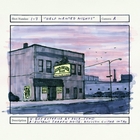
The Good Life – Help Wanted Nights
The Good Life succeeded, not only in creating the ideal packaging for a CD release but also in creating an album you’ll want to listen to time and time again.The CD topspine, booklet and CD sleeve are all made from 100% post-consumer recycled materials and the recording is carbon offset thanks to partnering with Native Energy. Check out their website and some reviews of the album.
In a recent aricle I wrote for Musicians Atlas , Ryan was also quoted:
Cutting-edge indie labels are also committed to reducing waste. Says Ryan Fox of The Good Life/Saddle Creek Records, “It’s a little disheartening to think that bands, artists, musicians can unknowingly have goods manufactured in their names part of which are the product of old-growth forests or unsustainable practices or that contribute unnecessarily to waste. It’s not uncommon for these CDs and their packaging to turn out to be discarded ephemera for many of the people who buy them. So our thought was “why not seek out the option for bands to choose packaging from recycled and more easily recyclable materials if they’re available and affordable?”
Over half of the forests that are cut down in the US goes to packaging many different types of products. Think about all the millions of CD booklets and sleeves that are sold that are coming directly from endangered forests when there are readily available alternatives. As a lover of music and the environment, it’s ever so important to me and others in the same boat that musicians do all they can to lighten their impact.
What is the greatest thing about greening the music industry? Bands like The Good Life and others on Saddle Creek have an impact that is multiplied by all their fans, press, and friends. As a musician, the impact they have goes above and beyond what any one person can do.
Working together with non-profits like Dogwood Alliance and other bands and labels to green the industry and reduce the overall amount of packaging they use, we can transform the packaging problem, ensure the protection of endangered forests and slow global climate change.
Check out the other albums, Art in Manila and Two Gallants, recently released on Saddle Creek that also have made great choices when it comes to their packaging.It looks like, feels good, and is good for the future.

Art in Manilla – Set the Woods on Fire
Art in Manila and Two Gallants self-titled release, also 100% Post-consumer recycled content and whose production is carbon neutral came out this year on Saddle Creek records.It looks like Saddle Creek Records is becoming a leader in the music industry when it comes to representing what can be done a with a little research and a lot of heart.
Thanks from all of us to Ryan Fox, The Good Life, and Saddle Creek.
This evening I will raise a glass and light a candle…
This evening I will raise a glass and light a candle to celebrate the life of Anita Roddick, founder of The Body Shop. What a contribution she made to the earth and to livelihoods of women and families the world over! An innovator who refused to waste forests for packaging beauty products, Anita believed in the potential of commerce and business to benefit communities, families and the earth. Decade after decade we saw her continuing to aspire to her highest vision for herself and her company. I am proud to consider myself one of the heirs to Anita’s legacy and to her inspiring life and action. Anita Roddick was a woman who lived till she died and made a huge positive difference. Much gratitude to Anita.
For immediate release – September 5, 2007 Contacts – Tom O’Leary, ForestEthics: 415-420-6934 Scot Quaranda, Dogwood Alliance: 828-242-3596
Office Supply Industry Leaders Shift Toward Environmental Responsibility Environmental groups report significant progress with Staples, FedEx Kinko’s and Corporate Express; OfficeMax still lags behind
Asheville, NC – As the back-to-school shopping season comes to a close, environmental groups ForestEthics and Dogwood Alliance released a “report card” today on the forest-related paper practices of the five major office supply companies: Staples, Office Depot, Corporate Express, FedEx Kinko’s and OfficeMax. Each of the five companies has been engaged in discussions with the two environmental groups, which have resulted in several new advances: a new environmental policy and increased recycled paper use (Corporate Express), a commitment to sustainable logging (Staples), and the elimination of sourcing from endangered mountain caribou habitat (FedEx Kinko’s).
“The office supply sector has finally begun to make its paper supply more environmentally friendly,” said Andrew Goldberg, Director of Corporate Engagement at the Dogwood Alliance. “Where just a few years ago you could not find paper with recycled content, now it’s readily available. That’s a good first step, but these companies must sharpen their pencils and use their purchasing power to reform business-as-usual industrial logging and bring about improved management practices on the ground in the Endangered Forests of the Southern US, Canada’s Great Boreal Forest and other parts of the world.”
Dogwood Alliance and ForestEthics have been working to reform the environmental practices of the office supply industry since 2000, and their successful campaigns have resulted in record-high production at recycled pulp mills in 2005, and increased demand for environmentally preferable papers. The new report, titled Green Grades: A Report Card on the Paper Practices of the Office Supply Sector, updates the progress made by the industry according to five categories, each of which is crucial to forest protection. They include the use of post-consumer recycled content; commitment to sustainable forest management; Endangered Forest protection; establishing chain-of-custody to determine where paper products originate; and prohibiting the conversion of native forests into tree farms or other non-forest land uses.
“We gave each company a chance to improve their grades before we released our report, and Staples, FedEx Kinko’s, and Corporate Express all responded,” said Aaron Sanger, director of ForestEthics’ Corporate Action Program. “The progress we’ve made represents a significant shift toward environmental responsibility, but there’s still work to be done. Some of the companies are clearly doing better than others, and all of the companies have room to improve.”
The overall grades for the companies were as follows:
• Staples: B. Staples scored well due to an average 30% (50% projected) post-consumer recycled content, as well as a new commitment (subject to market conditions) to have the majority of their product content certified by the Forest Stewardship Council (FSC), the only credible forest certification standard, by 2010. • FedEx Kinko’s: B. FedEx Kinko’s did well thanks to strong action taken to eliminate Endangered Forest sources in their supply chain, a preference for FSC certification over substandard systems, and 30-100% post-consumer recycled content. • Office Depot: C+. Office Depot boasts an excellent chain-of-custody system, but has not kept pace with leadership demonstrated by Staples and FedEx Kinko’s on the type of sustainable forest management represented by FSC standards. • Corporate Express: C. Corporate Express unveiled an entirely new environmental policy that is promising—including 30% post-consumer recycled catalog content—but many practices are yet to be implemented. • OfficeMax: D. OfficeMax announced a new policy early this year but has taken no genuine action yet to require its suppliers to comply with this policy, which is weaker in many respects than those of its competitors.
Additionally, all of the companies still need to address their purchases from Asia Pulp & Paper, which is continuing to destroy Endangered Forests and generate greenhouse gases through its operations in Indonesia. The industry’s demand for paper has also long had a major impact on the forests of the Southern US, the largest paper-producing region in the world, and Canada’s Boreal Forest. The size of 13 Californias, the Boreal plays a major role in reducing global warming, as well as providing clean air, clean water and critical species habitat. The forests of the Southern US are the most biologically diverse in North America and in terms of freshwater aquatic species and tree species, the world.
To read the report, visit www.forestethics.org/greeengrades.
Dogwood Alliance is the only organization in the South holding corporations accountable for the impact of their industrial forestry practices on our forests and our communities. To learn more, visit: http://www.dogwoodalliance.org
ForestEthics, a nonprofit with staff in Canada, the United States and Chile, recognizes that individual people can be mobilized to create positive environmental change—and so can corporations. Armed with this unique philosophy, ForestEthics has protected more than seven million acres of Endangered Forests. Visit www.ForestEthics.org for more information.
We visit Louisville, KY, home of fast food giant Yum! Brands, parent of Taco Bell, Pizza Hut, KFC and more…
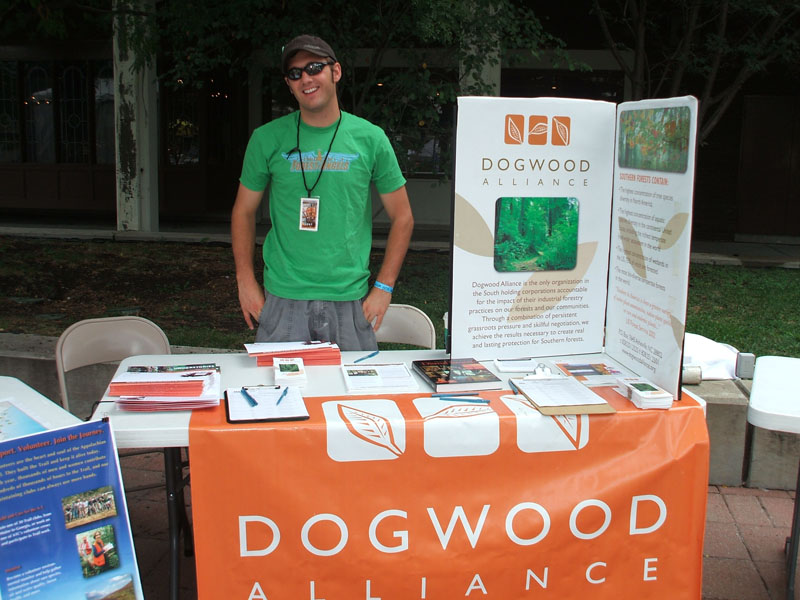
Trevon and I ventured out to Louisville to do outreach at the Forecastle Festival, a place for music, arts and activism in downtown Louisville. We had a great time giving people information about the horrible packaging decisions of Yum! foods which are having a major impact on Southern forests. It seems like everyone knows who Yum! brands is in Louisville, which makes sense since that is where the HQ is.
We met some fantastic people–there are many organizations in Louisville doing great work like Kentuckians for the Commonwealth , The Kentucky Resources Council, Sierra Club Louisville Chapter, and Community Farms Alliance to name a few. I’m looking forward to our next trip to Louisville–I plan to set up a presentation or two highlighting the packaging problem and the major role Yum! brands plays in forest destruction.
I facilitated a panel about green business in which we covered why it’s important to shop locally to the impacts that large corporations have on the environment and how we, as consumers, can hold multi-billion dollar corporations like Yum! brands accountable for that impact. Joining me on the panel were Sierra Club, Community Farms Alliance, and Heine Brothers Coffee (who you should definately check out).
I also had a great time getting to know the Forecastle activism organizers, Kate and Megan, who got almost 50 organizations together all doing great work! Thanks Kate and Megan. Oh, and we did happen to catch some good music–my favorites where Girl Talk and Todd Coyle...
Here are a few of the photos from the weekend, enjoy!

Response to ‘s forest certification announcement, including a summary of the long history of unsustainable practices in the region…
FOR IMMEDIATE RELEASE – June 28, 2007
Contact: Scot Quaranda, Dogwood Alliance, 828.251.2525 x18, [email protected]
Statement from Dogwood Alliance on IP’s Third-Party Certification of its US Paper Mills
Asheville, NC – ‘s long history of unsustainable forestry practices have scarred the Southern landscape for decades. Practices such as large-scale clearcutting, logging of endangered forests, intensive use of toxic chemicals in forest management and the conversion of native forests to monoculture pine plantations have had a detrimental impact on the quality of life of local communities, wildlife habitat, water quality and our forests ability to store and sequester carbon to reduce the impact of global climate change.
For over ten years, Dogwood Alliance and our broad-based network have called on IP to change these practices and join the effort to protect our local communities and forests in the region. Today’s announcement of intent to pursue Forest Stewardship Council (FSC) chain of custody certification is a positive first step towards greater protection of the forests and communities that define our region. However, it is not clear from today’s press release to what extent that certification will reach and anything short of all of their mills in unacceptable.
Some of the most unique and special places in the South, from the Great Dismal Swamp in Virginia to the Green Swamp of North Carolina to the Cumberland Plateau of Tennessee and Alabama have been irreparably harmed by the company’s practices. Endangered forests have been logged, swamps have been ditched and drained to make way for plantations, and tens of thousands of acres have been sprayed with toxic chemicals all in the name of paper production.
The number one paper product originating from Southern forests is packaging. IP is the largest producer of packaging in the region and prominent mills along the Atlantic Coast, including the Riegelwood Mill in NC and the Franklin Mill in VA have led to countless acres of endangered forests being logged to produce a product that is used once and thrown away. The time is ripe for IP to declare and end to these destructive practices and embrace a truly sustainable future.
Large customers of paper products from the Office Supply Industry, the Book Industry, the Catalog Industry and more have embraced FSC as a positive solution for reducing their companies’ impacts on Southern forests and forests worldwide. Companies embracing FSC as the only legitimate certification system include Williams Sonoma, the Limited Brands, Home Depot, and more. FSC is the only certification system also embraced by the wider environmental community.
While we support ‘s stated intent to pursue FSC certification, it is important to point out that today the company is still focused on its Sustainable Forestry Initiative (SFI) certification. The SFI is an industry founded certification system that continues to allow for such egregious practices as logging of endangered forests, large-scale clearcutting, and conversion of native forests to sterile pine plantations. It is not endorsed by the broader environmental community.
Dogwood Alliance is pleased that our work to improve ‘s business practices in the Southern US has resulted in today’s announcement and we will continue our work to convince even more of IP’s largest corporate customers to phase out products originating from endangered forests and instead to purchase products made with high recycled and FSC certified content. We call on the company to aggressively pursue FSC certification for all of its fiber sourcing in the Southern US and make a greater effort to end all logging of endangered forests and instead start the important process of restoration of these forests.
# # #
For further info on Dogwood
Alliance and its work to transform the paper industry, visit: http://www.dogwoodalliance.org/
For more info on FSC and its
certification system, visit: http://www.fscus.org/
For more info on the shortcomings of the SFI, visit: http://credibleforestcertification.org/home/


 Donate