


Editorial from the Wilminton Star
Published: Sunday, October 12, 2008 at 5:10 p.m. Last Modified: Sunday, October 12, 2008 at 5:10 p.m.

It seems only fitting that in a place called Cape Fear we have plants that eat flesh, albeit insect flesh.Sure, we can lay claim to Michael Jordan. But nowhere else in the world will you find naturally occurring Venus’ flytraps except within 100 miles of Wilmington.These hungry herbs like bogs and damp savannas. Not too wet. Not too dry. These areas can be sparse in nutrients, so the plant has evolved to get nutrition via the insects and spiders that may land on its leaves.They thrive in areas such as the Green Swamp in Brunswick and Columbus counties. You’ll also find them in the woods near Alderman Elementary School in Wilmington. But don’t dig one up – it’s against state law.Interestingly, the flytraps prosper in wooded areas that have had fires. A few seasons with no fire activity, and the habitat becomes less hospitable.The biggest threat to flytraps is the booming development in Southeastern North Carolina and across the state line into South Carolina. In fact, The Associated Press recently reported that in the Palmetto State the plants are now almost entirely confined to Horry County.For years, Wilmington horticulturist Stanley Rehder has been the flytrap’s best friend, working to preserve habitat and to educate the public about the unique plant. Let’s hope there will be people to take up his cause.Meanwhile, it would help if the state raised the status of the plant from “special concern” to “threatened.” Currently there are enough populations to keep it off the threatened list, but not many of those populations are in good condition. With a plant this unique to our area, adding it to the “threatened” list seems like a reasonable move.No matter the status, with a staff of only three, the N.C. Plant Conservation Program would find it difficult to enforce regulations. So it’s ultimately up to the people of the Cape Fear region to preserve this mysterious part of our ecosystem.Education efforts and the identification and protection of habitats are the best options. Areas such as the Green Swamp Preserve are off limits to development, but the plant needs a wider range of habitat to survive and flourish.And who knows? Maybe one day the plants will develop an insatiable appetite for mosquitoes.
Interesting fact! By Katie Speights.
Around 50% of paper produced globally is used for packaging and second largest market for paper is printing and writing.
is the leading company that produces paper and packaging and generates the most profit for the global industry value, according to the Datamonitor Industry Profile on Global Paper and Forest Products.
IP has major mills in Brazil, Russia and China where unsustainable forest practices are also occuring! The problem is not only with our southern forests but global!
More to come,
Katie
Sarah gives up the scoop
Working to promote environmental awareness and activism in hopes of making a positive change in our society can be a daunting task.
But this year we are kicking off the Wendy’s campaign here at Ohio State in Columbus in effort to change their purchasing practices in order to help promote the protection of the Southern US forests. I’m super excited to know that Wendy’s is going to hear what we want, they’re headquartered right here in Columbus!
The CEO, the big-wig, sits just a near 20 minutes away from the University where he can make a huge impact in protecting our forests. It’s awesome that Free the Planet, an environmental justice group at OSU, is teaming up with Dogwood Alliance for this Wendy’s campaign.
We’ve already collected hundreds of signatures saying we, the people, don’t want our forests being destroyed in order to wrap hamburgers and chicken nuggets, and they will soon be arriving to Wendy’s CEO.
Till next time,
Sarah
Free The Planet
McDonald’s can lead…on responsible paper packaging
From Crains Business Journal Oct. 06, 2008

The facts are staggering: Domestically, 300 pounds of packaging waste are generated per person annually. Containers and packaging equal 32% of the domestic waste stream. Diners on the run generate 1.8 million tons of fast-food packaging per year, constituting 20% of all litter.
McDonald’s Corp., among the largest purchasers of fast-food packaging, has been working on its latest corporate social responsibility report and hopefully leading the way on forest protection, because better choices on boxes, bags and cups can protect forests and biodiversity and help buffer us from climate change.The innovations of the fast-food industry have given us more and cheaper dining options. Their economies of scale and drive for efficiency have transformed agriculture, meat processing and the labor market. But the negative impact of fast-food chains’ insatiable demand for paper packaging on the forests of the Southern United States — the world’s largest paper-producing region — is just as staggering. According to the U.S. Forest Service, between 5 million and 6 million acres of forests, an area greater than the size of Delaware, are clear-cut each year. Often, the forests are replaced by pine plantations, which now cover 43 million acres across the South. Recent science confirms that these plantations do not absorb and sequester carbon as well as the natural forests.Fast-food industry giants are big buyers of paper packaging from those forests. With nearly 100 paper-packaging mills in the South, corporations have a tremendous impact on U.S. forests. Despite the desire of many companies, including Oak Brook-based McDonald’s, to go green, fast-food companies continue to source packaging from mills using outmoded forestry practices.Instead of supporting large-scale clear-cutting, conversion of natural forests to industrial pine plantations, habitat loss and degradation, fast-food companies could move toward more responsible practices, including reduced usage and increased use of post-consumer recycled content fiber to make paper packaging.McDonald’s has made big strides in packaging efficiency and in increasing the post-consumer recycled content of packaging. Now, post-consumer recycled content makes up 23% of its consumer packaging.But as the leading global food-service retailer with more than 30,000 restaurants serving 52 million people each day, McDonald’s consumption of virgin fiber is supersized. With its soon-to-be released corporate social responsibility report, the company can reiterate its commitment to environmentally responsible paper-packaging practices, and reduce the impacts of its consumption of virgin fiber by adopting procurement practices, including Forest Stewardship Council certification, recognized by both the environmental and business communities as the international gold standard of forest practices certification.SOUND OFF: Send a column for the Opinion page to [email protected]. Please include a telephone number for verification purposes, and limit submissions to 425 words or fewer.©2008 by Crain Communications Inc.
Through VA and NC
Forest in the Mid-Atlantic Coastal forest region are amazing. I traveled along the coast last week through SE Virginia and SE North Carolina to meet with activists, members, and other organizations concerned with s forestry practices in the region.
It’s a shame that some of the biggest paper packaging mills in the world (of course owned by ) are being fed by endangered ecosystems that cannot be found anywhere else in the world!And, for fast food packaging of all things.
I was lucky enough to be in Wilmington as the same time as Lawernce Earley, the author of Looking for Longleaf.He talks so passionately about these incredible forests! Check out his website http://larryearleyphotography.com/. It was inspiring to watch his presentation and to meet him afterwards and talk about Dogwood Alliance’s work to protect and restore this ecosystem.
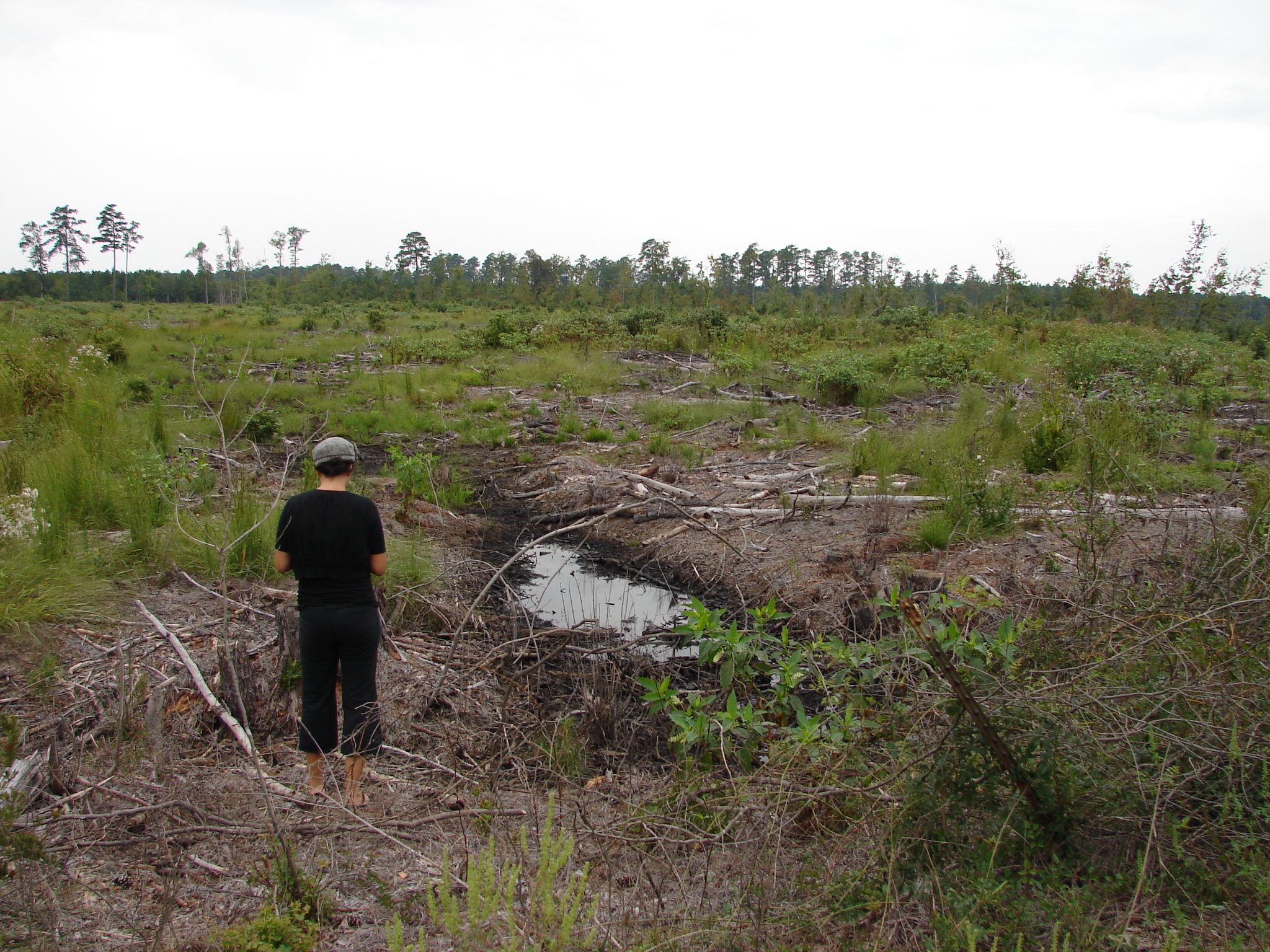 I went to some of the forests he talked about, and it was an awe-inspiring moment.I also went
through many clearcuts along the way, which was sad and astonishing. Here’s a photo of me in a clearcut we walked through that is in the sourcing area of the mill in
Franklin, Virginia.
I went to some of the forests he talked about, and it was an awe-inspiring moment.I also went
through many clearcuts along the way, which was sad and astonishing. Here’s a photo of me in a clearcut we walked through that is in the sourcing area of the mill in
Franklin, Virginia.
It was fun meeting with all of the activists, talking about the campaign, and hearing all of the awesome ideas and sharing the passion people have for our forests! I’m looking forward to Ruth, our new organizer who starts on the ground full time in November.
Till next time,
Eva
A look start to finish…
To learn more about how you can help save Southern forests and communities from the impacts of the paper industry, sign up for our e-action list here . http://dia.dogwoodalliance.org/da/signUp.jsp.
Forests for fuel…?
First, I’d like to give a big huge “Thank you!” to all the volunteers who came out this weekend to help spread the word about protecting southern forests!
We talked to hundreds of people about McDonalds packaging policy, and at the same time we had volunteers doing outreach at Music on the Mountain in Boone and on campuses in Norfolk, VA. (Take action here)
While we were telling people about the impacts of McDonalds packaging practices on our forests, we were also letting people know about the looming threat of biofuels.
The up and coming so called solution to climate change is… forests for fuel! It doesn’t make sense. It add an increased burden to our forests, cause further ecological devastation in the South, exacerbate climate change, and it’s not even commercially viable! To learn more, check out the factsheet about forests and fuel–another false solution.
Leaders or Laggards…
Now is our chance to tell McDonald’s that Southern forests are too important to be wasted for fast food packaging!
Check out the video message from Dogwood’s Andrew Goldberg, Director of Corporate Engagement. His message to McDonald’s is loud and clear!
McDonald’s CEO Jim Skinner can and should:


 Donate