


Why should you care about wetlands?
February 2 is World
Wetlands Day
There are people all over the world working for wetlands. On World Wetlands Day, celebrated on February 2 each year, these people collectively stand up and proclaim the benefits of wetlands.
Why should you care about wetlands?
There is a connection between a healthy wetland eco-system and human health. In the developing world, 1 in 5 people do not have access to clean drinking water. Poor management strategies that support the health of wetland eco-systems can affect the health of humans, with wetland-related diseases claiming the lives of 3 million people each year and bring suffering to many more. It is estimated that 1.4 billion people live in water basins where water uses exceed sustainable levels.
From the cypress swamps, pine bogs, pocosins and longleaf pine savannas to the alligators and the unique Venus fly trap, the Middle Atlantic Coastal Forests are home to a rich and diverse swath of the natural world. Indeed this diversity of life is of national and global significance.
Make your own connection by learning the facts about the benefits of wetlands. In the United States, the Cypress Swamps (swamps are one of many wetland types) in Florida can remove 98% of the nitrogen and 97% of the phosphorus pollution preventing contamination in the groundwater
“The wetlands provide a low-cost way to treat the community’s wastewater, while simultaneously functioning as a quality wildlife sanctuary, with public access, as is done at the successful and popular Arcata Marsh & Wildlife Sanctuary.” (City of Petaluma, California)
WOODY AND HERBACEOUS WETLANDS
Perhaps the most important special community across the region is the forested wetlands which are extremely important ecological communities. Home to such a rich diversity of species, according to the most recent satellite based mapping eff orts, approximately 30 percent of the ecoregion is in either woody or herbaceous wetlands.
However, the National Wetlands Inventory, which is based on more detailed aerial photography and ground mapping, puts the ecoregion percentage closer to 42 percent. Many of the larger, more intact wetlands are in public ownership, and wetland cover diff ers among the three mill sourcing zones. Th e Franklin sourcing region contains the most wetlands (5,671,194 ac) according to the National Wetlands Inventory. Riegelwood was second with 4,440,712 ac and Augusta last with 2,881,871 ac. While according to the US Forest Service industrial forestry and the conversion of these forested wetlands into pine plantation has been the leading cause of the loss of these systems, important examples remain. These extremely important communities should be included in a High Conservation Value or Endangered Forest assessment.
BOTTOMLAND OR WETLAND FORESTS

Bottomland or wetland forests historically dominated the ecoregion with species such as Atlantic white cedar, bald cypress, and swamp tupelo. Logging interests for many decades targeted forests dominated by bald cypress and Atlantic white cedar, and few old-growth forests of this type remain. Bald cypress is a very slow growing species but long-lived (e.g., trees that are hundreds of years old or more are common in pristine bald cypress forests). White cedar has been all but eliminated in Virginia (the Great Dismal Swamp was once a stronghold for this important species) and approximately 90 percent has been lost in
North Carolina. Most of the remaining bottomland (or swamp) forests are associated with the numerous and extensive tidal river systems or in a few larger, non-linear areas (e.g., Great Dismal Swamp) even though most of those have been seriously degraded.
THREATS TO THE MIDDLE ATLANTIC COASTAL FORESTS
 The
impacts of industrial forestry on the region are longstanding and severe.
Indeed according to the US Forest Service Southern Forest Resource Assessment,
the leading cause of the loss of forested wetlands across the region and the
South has been conversion of those natural forests into industrial pine
plantations. This process of “ditching and draining” results in the total loss
of that habitat.
The
impacts of industrial forestry on the region are longstanding and severe.
Indeed according to the US Forest Service Southern Forest Resource Assessment,
the leading cause of the loss of forested wetlands across the region and the
South has been conversion of those natural forests into industrial pine
plantations. This process of “ditching and draining” results in the total loss
of that habitat.
TAKE ACTION! Send a message to the companies buying their paper packaging from Southern forests, including forested wetlands. Instead of using Southern forests for disposable packaging, these companies can make better decisions including: 1. Post-consumer recycled content should be maximized in all paper products, because multiple life-cycle analyses clearly show that recycled fiber saves resources and limits pressure on natural forests. 2. Southern Forests are too important to waste in packaging. Increase packaging efficiency and reduce overall packaging. 3. Avoid sourcing paper originating from endangered forests-those remaining natural areas with extremely high conservation values must be avoided. 4. Avoid sourcing paper originating from the conversion of natural forests to plantations. 5. Source paper from lands certified by the Forest Stewardship Council – the only certification that limits large-scale clear-cutting, prohibits the conversion of forests to plantations and requires the protection of high conservation value forests.
Click here to send your message.
Four of the rare birds, once almost extinct…
By Jack Horan Special to the Observer Posted: Sunday, Jan. 25, 2009 South Carolina’s coast for eons has been a wintering home for thousands of migrating birds: ducks, geese, bald eagles and even tundra swans from the Arctic.
Now, one of America’s rarest birds, the endangered whooping crane, has joined the feathered extravaganza.
The whoopers first showed up in the ACE Basin, a wetlands and uplands preserve south of Charleston, in the winter of 2004-05. That marked the first S.C. sightings of the snowy-white birds with black wing tips since before the Civil War.
“It was something totally unexpected,” said Jennifer Koches of the U.S. Fish and Wildlife Service in Charleston.
Where did the cranes come from? The best guess is that a thunderstorm blew them off course as they left Florida in the spring of 2004. Nine months later, as they migrated south, seven birds veered east rather than going south to Florida.
“They may have wanted to avoid the place that had the bad thunderstorm,” said whooping crane biologist Richard Urbanek, and thus headed for South Carolina.
However they got here, the 5-foot-tall red-crested whoopers so liked the Lowcountry marshes that they’ve been coming back ever since. This winter, four whoopers spend their days foraging for crawfish, crabs and aquatic plants in the 350,000-acre basin where the Ashepoo, Combahee and Edisto rivers flow into the Atlantic.
Whooping cranes almost went extinct because of hunting and habitat destruction. Their numbers plummeted to 16 in 1941, all in a tiny Western flock that summered in Canada and wintered in Texas.
The U.S. Fish and Wildlife Service began breeding the cranes in captivity. With abundant captive birds, the agency in 2001 set out to reintroduce migratory whoopers to the East with a Wisconsin-to-Florida flock. The cranes would summer in Necedah National Wildlife Refuge in Wisconsin and winter in Chassahowitzka refuge in Florida.
But captive-raised cranes from the Western flock lack the instinctive road map to navigate the East. So, pilots flying ultralight aircraft led the first group of yearling birds to Florida. Once they learned the aerial highway, the cranes migrated on their own.
Cranes historically wintered along the Carolinas coast. The last whooper sighting in South Carolina occurred on the Waccamaw River about 1850.
That is, until the wayward Class of 2003 came along. They, too, were led by ultralight aircraft to Florida.
In early 2004, the cranes split into two groups to head north. Urbanek, the biologist, said one group hit strong westerly winds. Off course, three birds spent the winter near New Bern in Eastern North Carolina.
A thunderstorm scattered the other group. The following fall, seven birds spurned Florida for the ACE Basin.
Of the seven, two males, known as 10-03 and I, have returned each year. They’ve found mates and brought them as well. One of the females, WI-06, is the only surviving wild-born crane in the East.
Urbanek said while it’s good the cranes are doing well, their non-Florida location presents problems. When the S.C. cranes have flown north in spring, most won’t cross Lake Michigan. So biologists must capture them and take them back to Wisconsin. Radio transmitters allow biologists to track the birds.
The ACE Basin could become an avian Palm Beach for cranes. “If the Eastern population continues to grow, you’ll continue to get more whooping cranes in your area,” said Tom Stehn, recovery coordinator for the species. “If the birds start reproducing, they will bring their offspring to the ACE Basin.”
The target population for the Eastern migratory population is 100-125 birds with 25 nesting pairs that produce young.
For birders eager to see the ACE Basin cranes, Koches said the chances are small. Their foraging and roosting areas have been closed to the public. Those who see whoopers are asked to stay 600 feet away to avoid disturbing the birds, which could cause them to flush and burn up energy reserves they may need to wing their way back north.
See where paper packaging comes from…
These images from Coastal North Carolina tell the story of the impact of insutrial forestry on the landscape. These images were taken last week.
A picture is worth a thousand words and here are four doozies.
Note the deep ditches keeping the pine plantation drained


When you know to look for them, you suddenly find that mass-clearcuts in the Southern Swamplands region of North Carolina and Virginia are rife on the landscape. Though the paper companies seem to have figured out that a thin veil of pines, three or four trees deep, can fool the average 70 mph passerby on the highway, to the residents of this area – clearcuts are not easily overlooked.
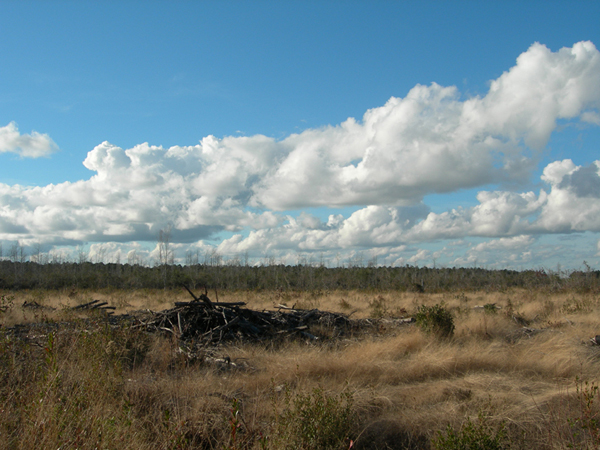
On my most recent trip down to Wilmington, I was tipped off by one such savvy North Carolinian. Just miles north of town – a new and massive clearcut. A leader from the North East New Hanover Conservancy pointed it out to me on a map – “just turn right off the exit ramp. You won’t miss this one,” she said. And I didn’t.
Ditching and draining in all its full blown horrific glory was on full display in this tract that my car wasn’t even able to fully traverse without running the risk of an empty tank. But I was able to snap a few photos from a once-useful hunting blind – now just a ghost on the landscape.
Continuing to document the paper companies’ clearcutting and landscape blighting was an ironic highlight of the trip, but on a more heartening note – there are a lot of folks mobilizing to oppose this kind of mass destruction. Some of them are the hunters who had such a sub-par deer season this past year – habitat fragmentation seem plausible to anyone else after seeing these photos? Some of them are the students and community activists that are jumping on board to plan forest tours and consumer action with us. And some of them are even in local government. These fast food companies sourcing their paper packaging from these kinds of clear cuts are all based in Ohio, based in NY, based anywhere but where their behavior is most impactful. So, we’re responding with a clear message – we live here and we’re demanding better!
Packaging Campaign—
Southern Forests Roundtable—What?! New York City? That’s right, Southern forests took center stage in front of a Who’s Who of corporate responsibility leaders at the Southern Forest Roundtable held at Random House headquarters in NYC. People who represent millions of dollars worth of corporate buying power, including Staples, McDonald’s, Starbucks, Johnson & Johnson, convened to hear about the treasure of Southern forests and to learn how to use their buying power to drive change in these beautiful forests that are so important to the health of this region and the planet.
The Roundtable showcased the effect our work has in creating demand for better paper choices and more responsible forestry practices in the South.
Southern Forest Carbon Project—A ground-breaking collaboration between Dogwood Alliance and office supply giant Staples, is designed to provide landowners with incentive to manage their forests sustainably through certification by the Forest Stewardship Council (FSC).
AbitibiBowater—formerly Bowater, Inc., has taken leadership position on one of the most important issues in the South—an end to the conversion of native and natural forests to sterile pine plantations. Most exciting of all—16,000 acres of high conservation value were transferred to the state of Tennessee for conservation. Further, the study of forests of ecological and historical significance within the Gulf and Coves of Bowater ownership in Cumberland Plateau region was completed. New colonies of large-flower skullcap—a globally imperiled species—as well as other threatened plant species were found along with a prehistoric pictograph. We are using satellite imagery to monitor the company’s operations. Stay tuned for the latest report.
Office Supply—Alll of the major office supply retailers have environmental paper policies in place and our Green Grades report created competition between them to turn those policies into meaningful action for Southern forests. To see the Green Grades Report, click here.
Biofuels Report—”Don’t Log the Forest For the Fuel”
Thanks to everyone who helped out making phone calls, signing and collecting petitions, sending emails, generating media, and contributing time or dollars to protect Southern forests. Here’s to an even more successful 2009.
2009 is going to be another exciting year for Dogwood Alliance and Southern forests.
Send a message to the Fast Food Junkies…
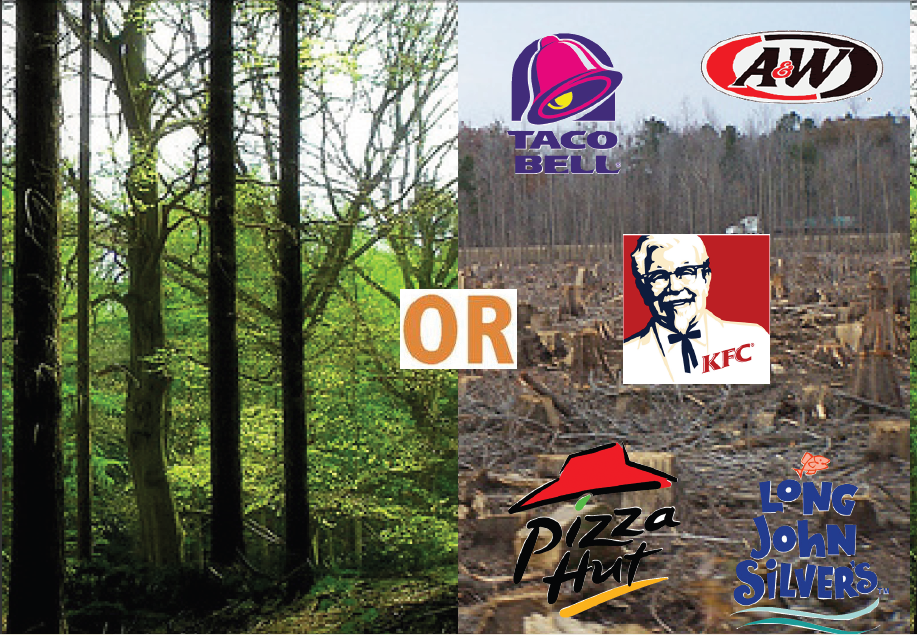
It’s pretty clear that people all across the country agree–Southern forests are too important to be wasted for fast food packaging! To make your own sign, click here.


Instead of using Southern forests for disposable packaging, Wendy’s/Arby’s and the other 11 Fast Food Junkies should:
1. Post-consumer recycled content should be maximized in all paper products, because multiple life-cycle analyses clearly show that recycled fiber saves resources and limits pressure on natural forests. 2. Southern Forests are too important to waste in packaging. Increase packaging efficiency and reduce overall packaging. 3. Avoid sourcing paper originating from endangered forests-those remaining natural areas with extremely high conservation values must be avoided. 4. Avoid sourcing paper originating from the conversion of natural forests to plantations. 5. Source paper from lands certified by the Forest Stewardship Council – the only certification that limits large-scale clear-cutting, prohibits the conversion of forests to plantations and requires the protection of high conservation value forests.
Much to our surprise, fast food giant Yum! Brands just released their first ever Corporate Social Responsibility (CSR) report. Unfortunately, they are still buying their paper packaging from Southern forests, and other endangered forests around the world.
Yum! Brands is huge. When it comes to their paper packaging decisions they are contributing to large scale clearcutting and conversion of natural forests to sterile pine plantations which has disastrous impacts on the biodiversity of Southern forests and communities.
Send a message to Yum! Brands CEO David Novak here.
Taking these steps would not only save forests but also help reduce greenhouse gas emissions that contribute to global warming.
The Fast Food Junkies are still at it – trashing our forests to make their throw away packaging! And during the holidays even more so…
This is a busy season for food on the go, and all that food is still being wrapped in Southern forests. Before Thanksgiving we made over 500 calls to the CEO of Wendy’s/Arby’s, Mr. Roland Smith, to make sure he took some Dogwood Alliance activism with him to the turkey table. Now this week, before Christmas, we can send him another message loud and clear –
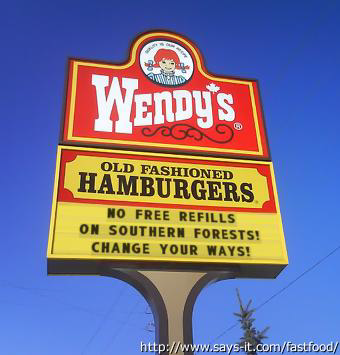
Click here to send a message on your own fast food billboard!
We’ve whipped up a very special holiday gift for Mr. Smith and we need you to deliver it to him. Take a few minutes out of the hussle and bustle to put your own thoughts on a fast-food billboard.
Use your creativity and humor to let him know that our forests should not be used for fast food packaging!
We’ll create a forum with the photos, and we want to be sure to include yours. If you can do more than one, that’s great! http://www.dogwoodalliance.org/wendys-sign-generator/
We look forward to seeing your fast food billboard.
This holiday season, the Dogwood Alliance is thankful for –GRASSROOTS ACTION!
Last Tuesday, November 25th, right before most of the country departed for dinner tables and family homesteads far and wide, our No Free Refills campaign turned up the heat on some of the biggest fast-food junkies – Wendy’s & Arby’s.
So, picture this – you’re the newly appointed C.E.O. of this mega-huge fast-food corporation that owns and operates two tasty hamburger joints. You’re moving up in the world, you’re feeling good, you’re even getting ready to take a vacation and hang out with your family for Thanksgiving. But – ! Not. So. Fast. You’re office is getting flooded by calls from the public. They’re coming in from Ohio, they’re calling from Virginia and North Carolina, they’re dialing out of Georgia, Pennsylvania, and Florida. And they’re all demanding that your company Change! Its! Ways!
Man, what a rush! On the ground in SouthEast Virginia, I had the pleasure of helping to facilitate a handful of these calls going in to C.E.O. Roland Smith. We were talking to people about Mr. Smith’s corporation turning entire square miles of our local forests in Virginia into one-time use paper packaging trash and people were getting antsy to do something about it! Seemed simple enough to just give them Mr. Smith’s number directly.
Throughout the day hundreds of calls were made from all over the country. The message most people left was pretty basic – Wendy’s & Arby’s have no excuse for using our forests for their trash. All they have to do is switch to using more recycled material, more sustainably certified paper, and downsize the amount of trash they’re generating in the first place. And these customers were always right!
So, this Thanksgiving the Dogwood Alliance wants to thank all the committed and engaged activists out there helping to send a message loud and clear to Roland Smith- No Free Refills for the Forest!
And we hope that Mr. Smith took their voices with him to the Thanksgiving table. Some dark meat, some light, a side of broccoli, and a whole lotta Grassroots Action!
Our strategy is working friends! A report released by Office Depot yesterday announced that even with the economic slowdown statistics continue to support the claim that “green” is important for today’s business professionals and consumers. Apparently sales from the company’s Green Book continue to rise.
Office Depot began selling and marketing green products because Dogwood Alliance activists, volunteers, donors and staff challenged the company to stand accountable for the impacts of their business practices on Southern forests. We also helped build consumer demand for environementally responsible paper products. We knew these changes were vital to the protection of our forests but we also believed that making public commitments and acting on those commitments would prove to be a wise business decision as well.
We don’t expect Office Depot to thank us. But you can thank us, if you like by donating now. Then when we announce our next big victory or accomplishment you can say “Hey, I did that!”
Very best,
Michelle Smith
Development Director


 Donate