Enviva’s solution to our climate crisis involves cutting down mature hardwood forests in the Southern US, turning them into pellets, placing them on huge ships, and sending them across the Atlantic to Europe to be burned for industrial electricity.
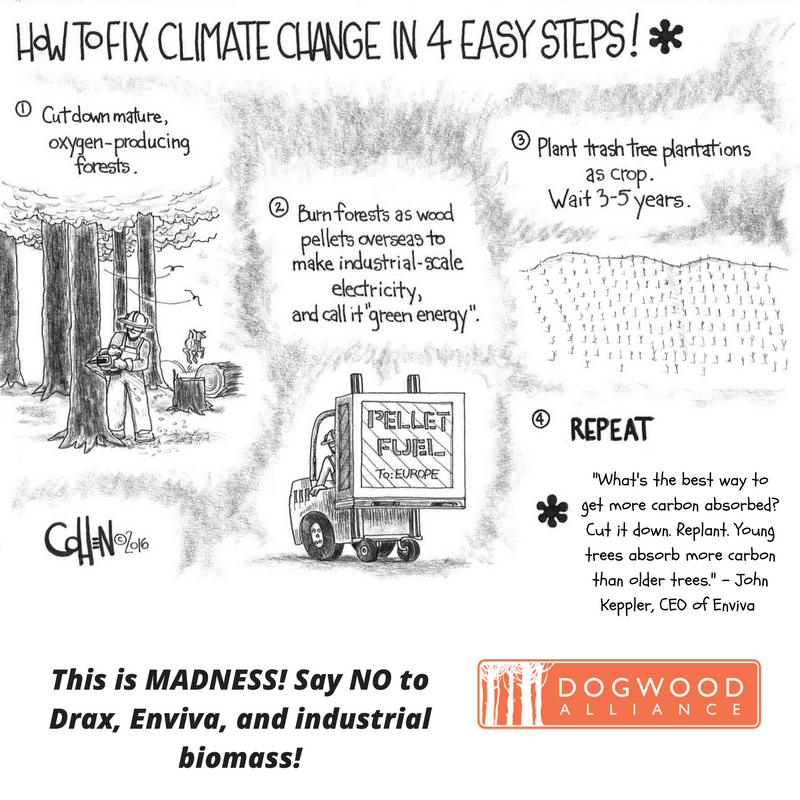
Enviva’s method of solving climate change is laughable.
Burning forests for fuel releases more heat-trapping carbon dioxide for every megawatt of electricity produced than coal.
Scientists have recognized this, Southerners have recognized this, over 100 international organizations have recognized this, and governments are recognizing this increasingly.
###
To download a high-resolution, print ready version of the cartoon for use, go here. The editorial cartoon was commissioned by the Dogwood Alliance and created by David Cohen has been the editorial cartoonist for the Asheville (NC) Citizen Times since 2006, and has been involved with many other publications over the years. His Facebook cartoon page is www.facebook.com/Cohencidents.

Nicole Townsend playing in the snow.
Nicole grew up in rural Missouri. “My family moved to Missouri in the 40s because of the land, my grandfather was a sharecropper. We grew up growing our own food and really having this appreciation and love for the land,” she explained. It was also how her family made money, by selling produce they grew, helping others take care of their land, and teaching people about the land.
Nicole moved to Asheville 11 years ago when she started high school. “It was definitely a culture shock,” she said. Nicole explained that what she likes most about this area is the diversity in activities, whether it’s going for a peaceful hike or going downtown to listen to music with crowds of people.

Nicole with her dog, Roscoe.
Prior to working at Dogwood Alliance, Nicole worked in youth development as an Education Director at The Cindy Platt Boys & Girls Club in Transylvania County. She was the bridge between families and school, being a mediator and creating success plans for youth who were struggling in school. She set students up with tutors, after school help, and other support systems.
Part of Nicole’s work as an Education Director was working with kids on gardening and healthy habits. The organization produces 1000-2000 pounds of fresh produce every summer, which they share with the kids while teaching them how to grow their own food. She also coordinated a youth program, teaching kids about water quality and policy as it relates to climate change and environmental sustainability. This work lead her to pursue the Administrative Assistant job at Dogwood.Of Dogwood Alliance, Nicole said:
One thing that stands out is the culture of Dogwood. I really feel that this is an organization that wants to take care of the people that work here, and I think very often, working in the nonprofit sector, that’s not always the case because everyone is so focused on the list of things that need to get done that they can sometimes forget about the people who are actually doing the work. It’s nice to be in an environment where everyone is kind of taking care of eachother.
Nicole likes hiking and kayaking, live music, and art. She also loves going to art galleries in Asheville and is planning a few road trips across the Southeast to find out more about this region.
How can you help kids learn more about how amazing wetlands are?
The wildly popular animated series The Magic School Bus made one of their fun, educational episodes about swamps! In it, Ms. Frizzle takes her class and their magic school bus on an adventure to explore all the wonders of wetlands. They learn about the plants, animals, and the importance of wetlands for giving us clean air, water, and storm protection.
If this Magic School Bus episodes teaches us anything, it’s that wetlands are more than just rainy, muddy swamps. They’re full of life and are worth protecting.
In late July, the Pellet Fuels Institute held their annual conference in Asheville, NC. Biomass industry representatives, including the biggest enemies to Southern forests, Drax and Enviva, gathered to discuss, network, and celebrate their industry.
I attended the conference, and here are three things that I learned:
It’s no secret that our world is facing challenging environmental problems. The well-documented and scientifically proven threats of global climate change – mass species extinction, pollinator collapse, and increased impacts from storms – show us that we urgently need to value and protect the natural systems that sustain life on our planet.
While taking part in the presentations and discussions at the Pellet Fuels Institute conference, it was very clear that the definition of sustainability used by the industry was not only outdated, it failed to recognize the reality of the environmental and social challenges we all face. Put another way, biomass companies like Drax and Enviva define “sustainability” not as it relates to climate or environmental concerns, but throw it around because they believe it will appeal to consumers as part of their marketing schemes.
Sustainability for the biomass industry is focused on the forest’s ability to provide industrial-scale facilities with wood and profit over a short period of time. For example, the biomass industry speaks at length about the amount of “forests” that are growing and how these figures prove they are a “sustainable” industry.
From 1950 to 2010, pine plantation acreage in the Southeastern US skyrocketed from 1.8 million acres to 40 million acres. During that same time period, 33 million acres of natural forest If a natural forest is replaced with a pine plantation, there is a severe loss of the critical natural services that we urgently need. Famed Harvard biologist, E.O. Wilson found that a pine plantation is 98% less biodiverse than a natural forest, and science shows us that they are much less equipped to sequester carbon.
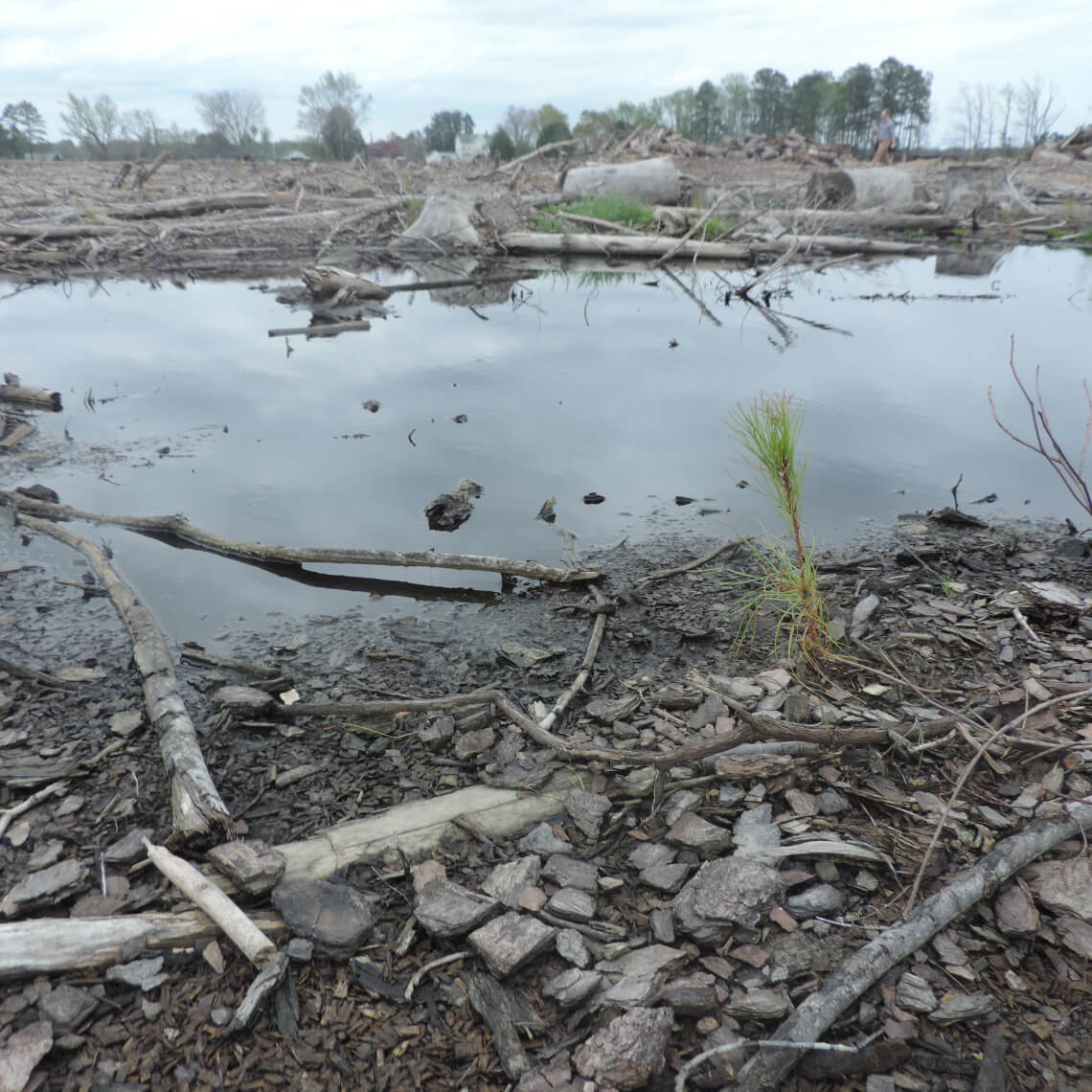
A clear-cut native forest being converted to a pine plantation near Enviva’s Ahoskie facility in Eastern North Carolina. These tiny pine trees will take 20-40 years to reach maturity, when they’ll be clear-cut again. The carbon stock and native habitat of this forest will likely never recover.
We simply can’t afford to let this industry operate under these outdated definitions that have contributed to our current situation and call it sustainable forest management. If the emerging bioenergy industry wants to truly be sustainable, it must acknowledge these inconvenient truths.
Carbon emissions are one of the most heavily debated issues within bioenergy policy. In the past two years, multiple government agencies and peer reviewed studies have made it very clear that if we are going to truly meet any local, national, or global commitments to address climate change and reduce carbon emissions, then burning forests to produce energy moves us in the wrong direction. Even when we consider hypothetical regrowth scenarios, the “carbon bomb” emitted from burning forests will remain in the atmosphere for decades – time that we simply don’t have if we want to halt the worst impacts of climate change.
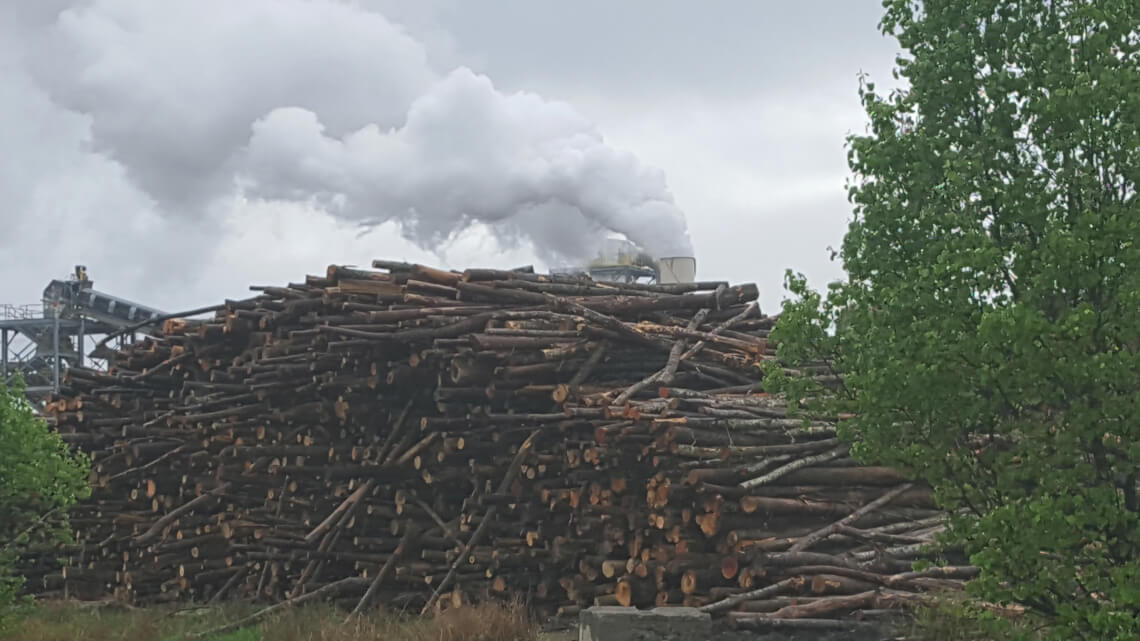
Enviva facility in Ahoskie, NC. Photo taken April, 2016.
At the Pellet Fuels Institute, this central issue of carbon emissions and the emerging scientific consensus around it is merely an afterthought. Conference presenters only mentioned carbon as if carbon neutrality in their industry was a forgone conclusion. They briefly cited risky and unproven complicated economic models (which are mostly industry-funded) that ignore historical trends. Yet, when I spoke one-on-one with attendees, many acknowledged that when you burn whole trees and large diameter residuals for electricity it is not carbon neutral (more on this industry rift in my third point). Climate impacts from deforestation are well acknowledged and widely accepted, but the emergence of the bioenergy industry has presented us with a new player that is dramatically exacerbating these impacts.
Industrial bioenergy is not carbon neutral, and while it seems that many in the industry would privately acknowledge this, their firm and well-funded public “stake in the ground” around carbon neutrality continues to delay necessary and urgent action to protect our forests, communities, and global community.
The Pellet Fuels Institute conference primarily focuses on smaller scale wood pellet systems used for home and commercial heating. While air quality and community issues stemming from this type of bioenergy production are a clear and present danger, by far the greatest and most urgent issue is the large-scale, industrial-use of bioenergy. Leading bad actors, Enviva and Drax, continue to drive devastating impacts to the forests, climate, and communities. All while hiding behind faulty science and inadequate certifications.
Many conference attendees are seemingly shocked and awed at the fact that communities and organizations across the world are standing up in opposition to this industry. At the same time, they welcome and celebrate companies like Enviva and Drax – who were prominently featured at the conference.
It’s an issue of scale. The most severe impacts to forests and the climate are simply unavoidable when you’re operating at the scale of companies like Drax and Enviva.
At this scale, the question isn’t whether or not this industry can operate in a “sustainable” manner. The question should be, “Why are we heading in this direction in the first place?”
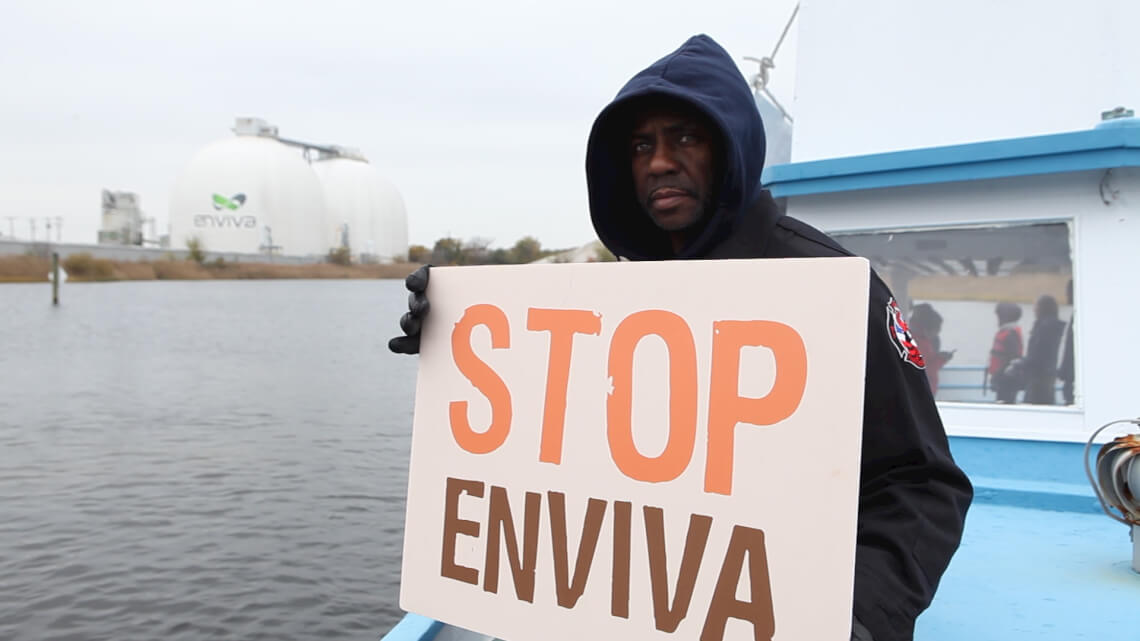
A Forest Defender protesting in front of the Enviva export facility in Norfolk, VA. Every year millions of tons of Southern forests leave this facility on a long journey to be incinerated in European power stations.
Drax and Enviva sell themselves to the public as relying on “leftovers” from existing logging operations. This paints a picture that they’re only picking up the scraps after a forest has been cut, attempting to wipe their hands clean of any wrongdoing. But the fact is that when this industry operates at its current scale (in 2015 Enviva produced 1.39 million tons of wood pellets, which require harvesting approximately 27,000 acres of forest), the only way to meet that demand is through an increase in industrial logging. That is the last thing we need, as urgency to protect Southern forests has never been greater. A recent report from the EU Commission notes that,
“[L]ogging residuals (tops and limbs) are generally poorly suited for industrial wood pellets, and its share of total feedstock volume is insignificant.”
Increasingly I hear from foresters, landowners, and even those within the Pellet Fuels Institute, that they do not support this inefficient and backwards use of forests. If the Pellet Fuels Institute wants to avoid a bunch a forest critters “flash mobbing” their conference, I would suggest that they separate themselves from these bad companies.
As the days get hotter, the number of Southerners standing up to protect and fight for forests increases steadily: it’s almost as if unrest is in direct proportion to the degrees on a thermometer. Summertime in the South conjures up images of being sleepy and slow-moving; and yet, the opposition to burning forests for fuel is livelier than ever.
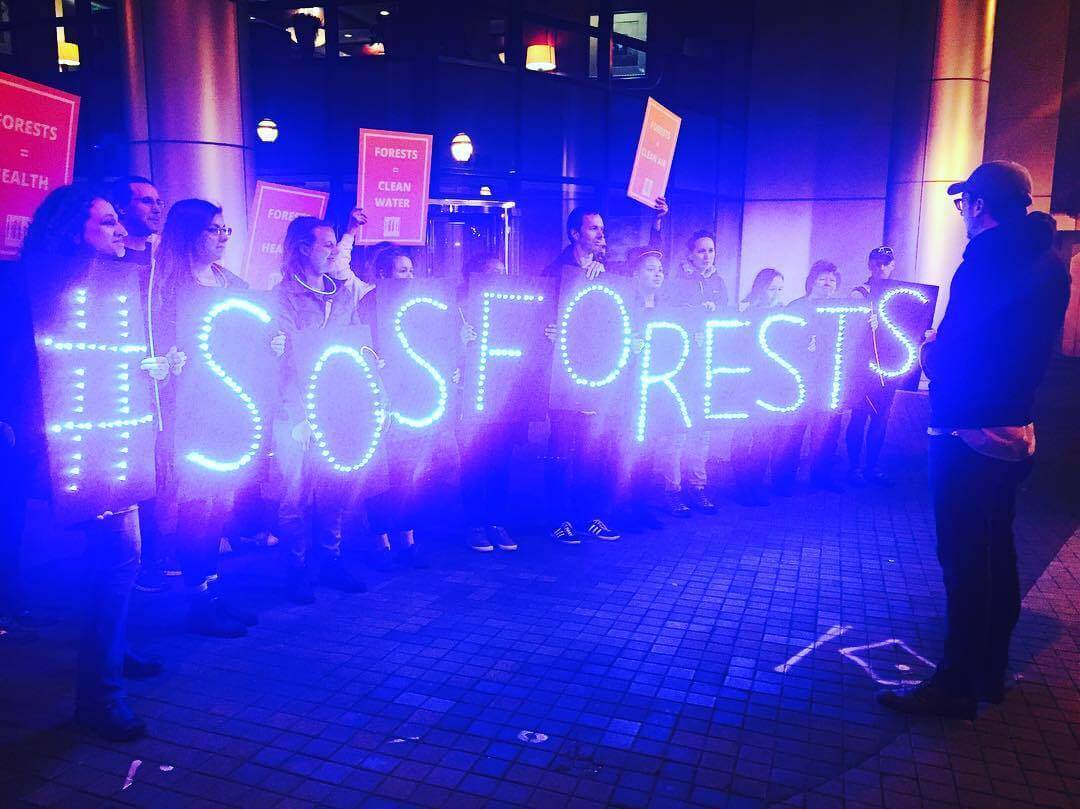
#SOSforests Vigil in Atlanta
We all enjoy forests to the fullest in the summertime. Fathers and daughters dot streams and shorelines, fishing for trout and bass in the cool water. Families and young couples set up camp on the forest floor and string hammocks in the shade. Hiking groups set out looking for berries, mushrooms, and other treasures. The abundance of activity afforded by a forest in the summer is threatened by industrial-scale wood pellet companies which are chopping our forests down at an increasing rate and sending them to Europe.
Southerners are tired of an exploitative and mechanized landscape which misses the forests for the trees and only views these magnificent places as a commodity.
Southerners are tired of being told that forests are growing now more than ever when, in reality, it’s monoculture pine plantations that are being grown at the expense of our natural forests. In the last 60 years, the US Forest Service shows us that 33 millions acres of natural forests have been lost while plantations have grown from 0 to 40 million acres in that same time period.
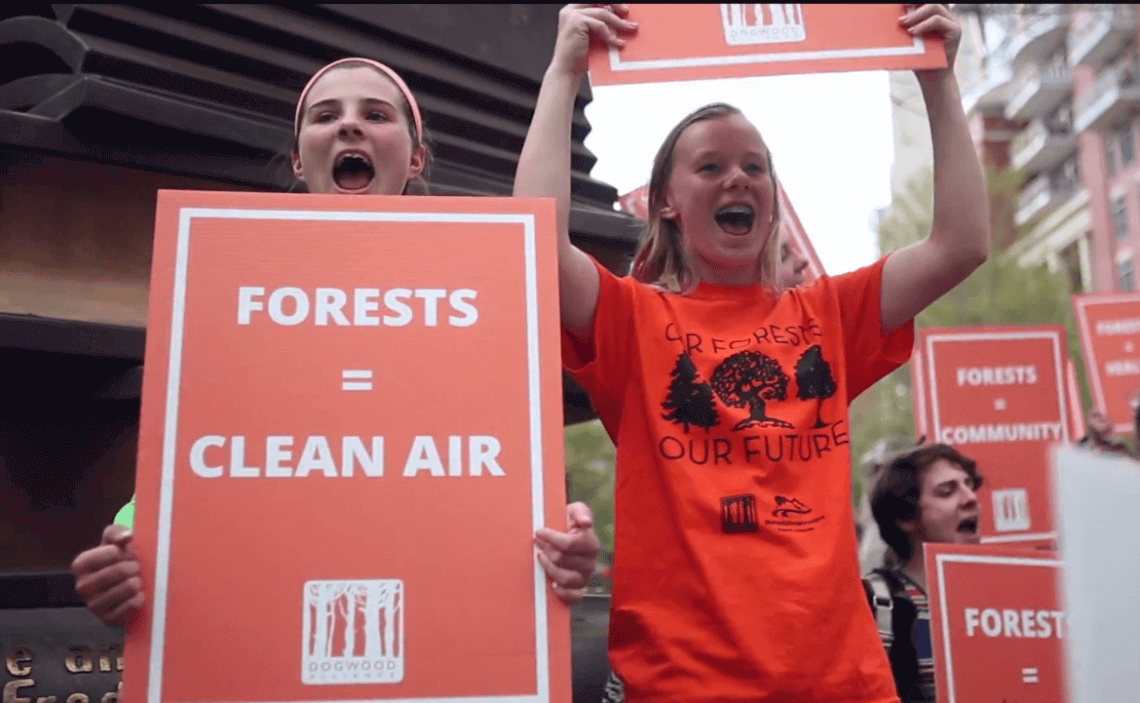
Stand for Forests rally in Charlotte
With the charge being led by frontline communities facing the impacts of industrial-scale wood pellet biomass facilities in their own backyards, Southerners are making it clear: burning forests for electricity is bad for our quality of life, environment, and economies. Our region can do and must do better. Southerners are mobilizing by the thousands to send this message: holding vigils in Atlanta for the forests we’ve lost, rallying in Charlotte to protest the International Biomass Conference, blocking a wood pellet facility in a rural town in South Carolina, and just last Sunday, dozens of concerned citizens held a spontaneous flashmob at a Pellet Fuels Institute Conference in North Carolina to shame Enviva and Drax for their role in logging and damaging precious forests across the Southern U.S.
While we should be investing in protecting Southern forests for the clean water, carbon storage, wildlife habitat, recreation, quality of life, and many other benefits they provide, Enviva and Drax are selling them off to the highest bidder in the European Union. These short-sighted corporations are the careless stakeholders of our forests. Standing forests are our best defense against climate change, protect us from storms, and ensure clean water for millions of Americans. Corporations do not respect the long-term value of forests, and are not going to protect our forest treasures in the South.
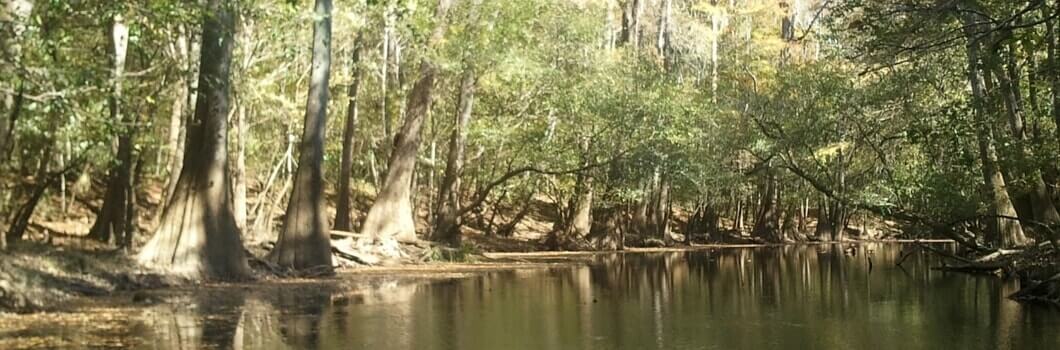
Beautiful wetland forests we must protect.
Keep those forest-protection actions coming in hot, y’all.
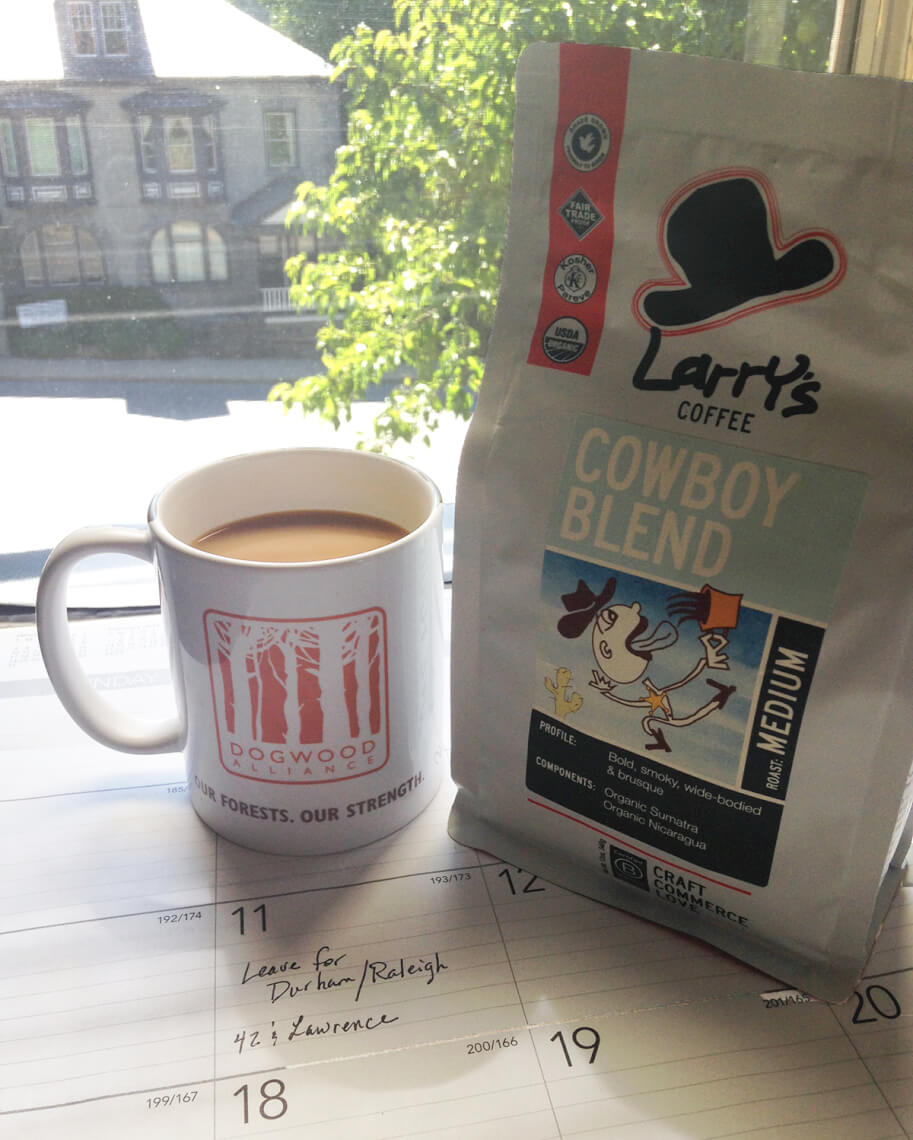
Sleepy activism doesn’t work. We really have to be awake around here, and I don’t mind making the coffee, as everyone knows. Last week I almost embarrassed myself by asking for the autograph of a guy who owns a coffee company. Almost. That guy is Larry Larson, owner of Larry’s Coffee, based in Raleigh, North Carolina. Why would I want his autograph? Pour yourself a cup of joe and I’ll tell you.
I moved to West Asheville from the mountain town of Franklin, North Carolina in 2005. West End Bakery on Haywood Rd was open back then and they carried this tasty fix called Larry’s Cowboy Blend. I’ve been drinking it religiously ever since. It’s no frills, you see. Medium roast, but bold as heck. Not for dainty types at all. Perfect for game-changers and those who like to get it done.
Take a moment to read a bag of Larry’s Coffee. It’s brilliant. Sure, lots of coffee companies are more local to Asheville, and are also Fair Trade, Shade Grown and Organic just like Larry’s is. But Larry’s goes further. A lot further. They’re a certified B-Corp–the first B-Corp coffee company in North Carolina. Their hip facilities in Raleigh have been green-rigged with solar, rainwater catchment (what their bathrooms run on), and vermiculture (worm composting). They’ve known most of their farming families for years, and as founding member of Cooperative Coffees, they are passionate about true Fair Trade (they were the first Fair Trade coffee company in NC too). Is it any wonder then why we would love them?
Back to the autograph. So I got to meet Larry last week at their new coffee bar 42 &Lawrence in downtown Raleigh. Maybe I was a little zinged off the cappuccino AND the cold draft latte (yes, you read that right—draft latte), but shaking Larry’s hand was a little like shaking the hand of a hero who, unbeknownst to him, helped fuel my work for a decade. It’s nice to know the people who keep you awake are awake too.
So pour yourself another cup and stay tuned for more Dogwood Alliance/Larry’s Coffee storytelling.
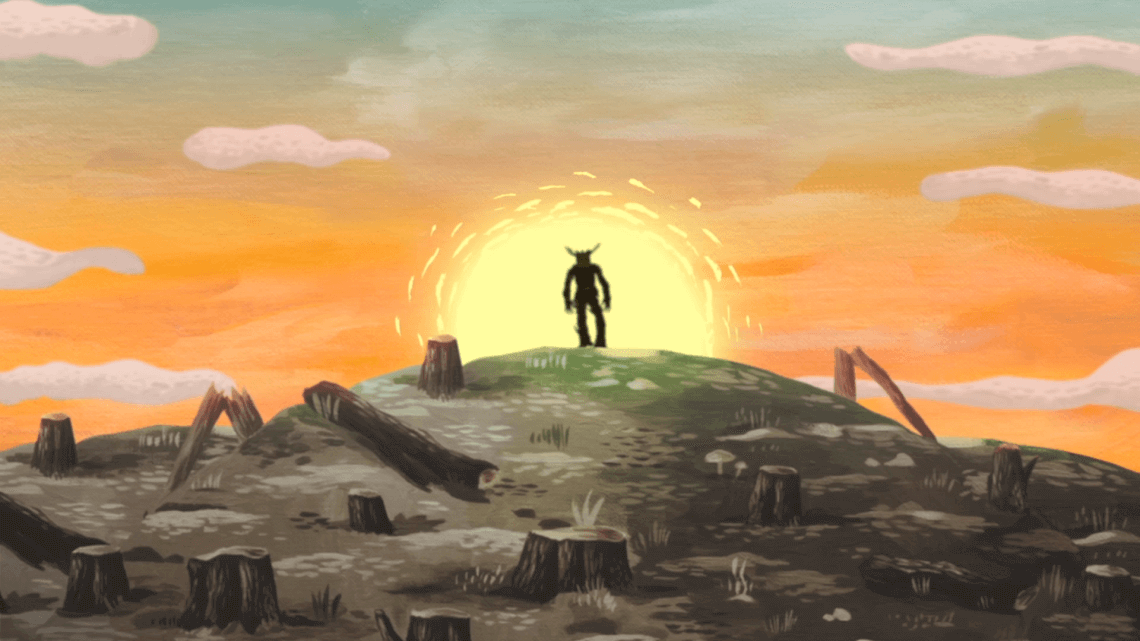
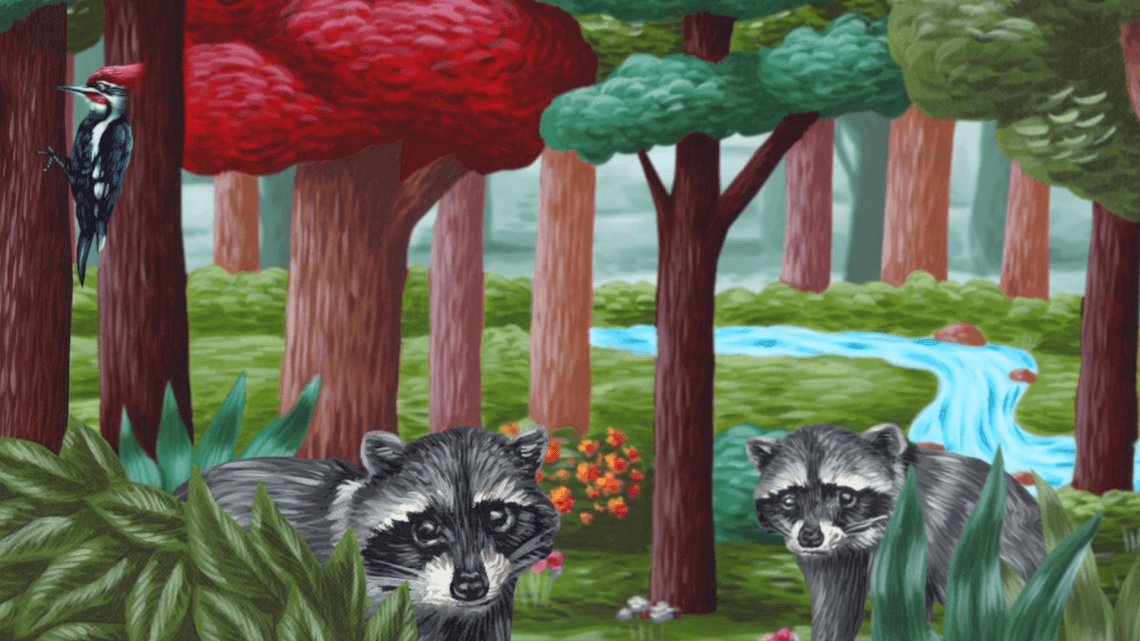
FOR IMMEDIATE RELEASE: July 27, 2016Southern Forests Just Got a New Protector, and Its Name is the BolalaNew Dogwood Alliance and Free Range Studios Animation Celebrates the Forests of the Southern United StatesAsheville, NC – The forests of the Southern US are an oft overlooked national treasure. In addition to providing opportunities for hunting, fishing, recreation and spiritual renewal, the region’s forests provide clean drinking water to millions of Americans, are the nation’s largest storehouse for carbon, and provide refuge for hundreds of species of plants and animals found nowhere else on the planet.To honor and highlight these magnificent forests, Asheville-based conservation organization Dogwood Alliance teamed up with the award-winning Free Range Studios to produce a new animation, “A Forest Fable,” which celebrates the woods and the wilds of the South and hopes to inspire a new generation of forest protection here and around the world.“For the past 20 years, Dogwood Alliance has worked tirelessly with communities, non-profit partners, and corporate sustainability leaders to highlight the critical importance of Southern forests and stop the worst industrial forestry impacts in our region,” said Danna Smith, Co-Founder and Executive Director at Dogwood Alliance. “We believe the time is right to inspire forward-thinking corporate executives, elected officials, and Southerners to preserve, protect and restore our forests so they can continue to sustain our region for generations to come.”“A Forest Fable,” illustrates the sometimes hidden values our forests provide us like clean air, clean water, and a place to unwind. It then shifts to expose the constant threats to the forests of the region from industrial forestry, especially paper, lumber and electricity. Emerging from a deep slumber, an ancient forest protector, the Bolala, magically restores the woods and the wilds of the region. Though the Bolala only exists in fairy tales,the viewer is reminded that they too are the Bolala.Over the last 50 years, the forests of the Southern US have been the epicenter of industrial logging worldwide. In addition to being one of the largest paper and lumber producing regions in the world, in the past few years there has been a dramatic increase in logging to feed the rapidly growing wood pellet industry in which trees are cut down, processed into pellets and shipped to Europe to be burned for electricity. The South is currently the largest wood pellet exporter in the world and is expected to remain so into the foreseeable future.“The time is ripe to shift away from the old paradigm of forests as a resource to be exploited, to a 21st century view that puts a greater value on all our forests provide,” said Scot Quaranda, Communications Director at Dogwood Alliance and Executive Producer of The Forest Fable. “The Bolala lives inside of each and every one of us, and together we can make a huge difference for the communities, wildlife and our climate that depend on these special places.”You can view “A Forest Fable,” here and join in on the conversation with thousands of people around the world.# # #Based in Asheville, North Carolina, Dogwood Alliance (www.dogwoodalliance.org) is the leading nonprofit focused on protecting Southern forests and the communities that rely on them. The organization has been responsible for helping companies including Staples, McDonalds, and KFC transform their paper-buying policies, and it has also worked with the paper industry to develop new, sustainable forest management practices. The group’s Our Forests Aren’t Fuel is part of an international coalition opposing industrial-scale forest biomass energy. Contact: Scot Quaranda, Dogwood Alliance, 828.242.3596, [email protected]Images and Video for Press Release
Images: Bolala, Racoons, BearsFull Animation on Youtube
Blog with further background HERE
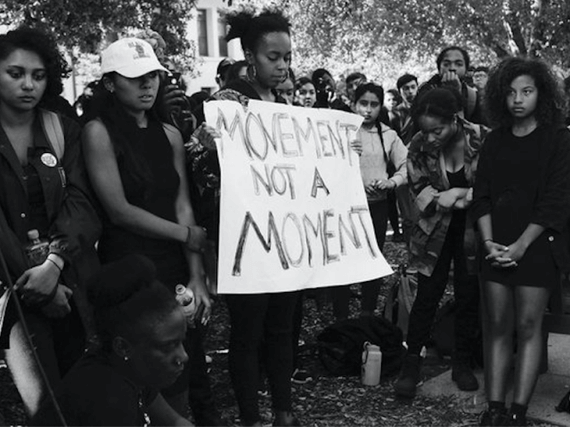
These last few weeks have been riddled with multiple new incidents of police shootings of black men, a horrific reminder, once again, of the need for us to stand up, speak out and unquestionably assert that Black Lives Matter. Even here in our own hometown of Asheville, NC, we pour our hearts out to the Williams family who lost Jerry last weekend.
We have great respect for most police officers, who serve and protect honorably, and along with Black Lives Matter, we condemn the violent acts committed by an individual against the Dallas police forces. However, the shootings last week represent only a small fraction of the unlawful and unjustified killings of black Americans by a small number of law enforcement personnel that has been going on for too long.
The rampant police violence against black people is a manifestation of a broader societal culture of institutionalized racism, where African Americans and other people of color continue to be consistently marginalized throughout our political, economic and justice systems. It is impossible to remain silent in the face of such injustice.
As an organization rooted in a belief that everyone deserves to live in a safe, healthy environment we stand in solidarity with the #BlackLivesMatter movement in calling for an end to police brutality and racism in America and for economic, social and environmental justice for all.
During our last spring semester, six fellow students and I worked together on a UNC Capstone course project with Dr. Andrew George, focused on bioenergy in the Carolinas. Though we were all students of the same program, we had varying sub-interests within the bioenergy umbrella. Some of these included life-cycle analysis, water and air quality effects, and landscape level changes. This presented our team with a challenge. Bioenergy production has so many hot conversation topics related to it—with seven different angles for approaching the bioenergy issue, how could we find a research question that was not only relevant, but as also the most feasible due to our inherent limitations of being a semester long class?
We looked into North Carolina’s Environmental Justice history. Beginning back in 1982 with the Warren County PCB case and continuing on through the work of Steve Wing, a UNC professor who focuses on the implications of hog farming within North Carolina, the rich dataset began to shape our project. Though our search led us to several examples of hazardous waste affecting underrepresented communities, we could not seem to find a lot of information linking environmental justice and bioenergy. This gap within the literature, to all of us, seemed like an open door just ready to be entered, so we took the first steps.
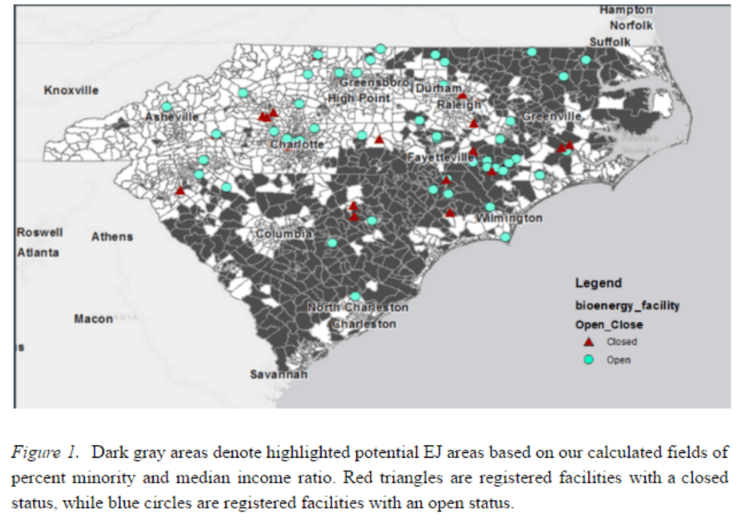
For scope, we kept it close to home looking at North and South Carolina. To discover what bioenergy facilities producing energy were present, we used the North Carolina Utilities Commission (NCUC) docket search. On the NCUC website, there is a compiled list of registered open and closed facilities. We limited our project search to those registered with the NCUC to gather a non-biased population size, as all of these projects obtained their operational status through the same process. In order to determine whether or not bioenergy facilities are contributing to potential environmental injustice within the Carolinas, we had to define what constitutes an environmental justice area. We mimicked a study completed by the Massachusetts State Government, as their project seemed rather progressive in the Environmental Justice field. They calculated Environmental Justice areas based on 3 fields: >25% non-white, average median income < the state average, and >25% English language isolation. Due to limitations of acquiring the English language isolation data, our EJ Areas are calculated using the first two fields.
What we found intrigued us; after sifting through information about all the projects, we had a compiled list of 76. Of these 76, about 74% (56) of facilities were within a 2-mile buffer of one of our calculated Environmental Justice areas. Of those projects, 68% (38) of them were located directly within a highlighted EJ area. With percentages that high, we eagerly wanted to learn more about the scale of this local Environmental Justice issue by incorporating some of our initial sub-interests—how many times have these facilities been non-compliant with the Clean Water Act? How about the Clean Air Act?
While enthusiastic to answer these pressing questions, the data available about each of the facilities that were located within our potential EJ areas was scarce, if not non-existent. However, from the limited data available, we found that some of the plants within our 2-mile buffer of an EJ area had high levels of pollution, one facility totaling 11 Clean Air Act high priority violations in the past 3 years and another being non-compliant with the Clean Water Act for 11 of the past 12 quarters.
These findings lead us to believe that there is much more information about the environmental injustice centered around bioenergy production in the Carolinas. Our project is just one of the first steps through the open door I mentioned earlier; with many more projects not registered under the NCUC to examine, along with the greater effects of the energy’s production from the entire lifecycle of creation to combustion, there is great opportunity to understand the issues, and prevent and further injustice that could come from the expanding industry.
Alysa Delgado is a new graduate student at the University of Alabama’s Department of Geography.
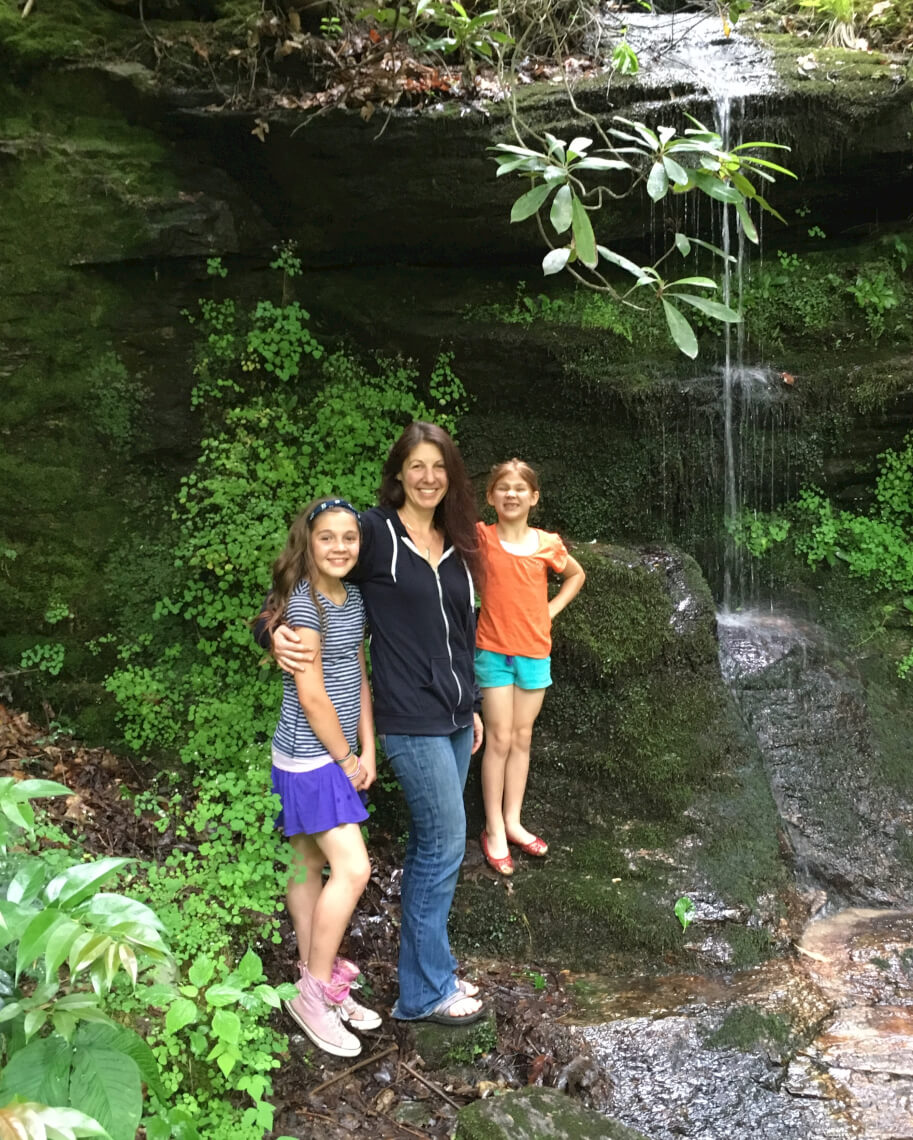
Kelly Ball with her daughters, Anathea and Clementine.
Kelly Ball has lived in Asheville since 2008. Before moving to Asheville, she lived in Moab, Utah working at Arches National Park after finishing a degree in Geology at University of Massachusetts at Amherst. Kelly led guided tours and worked in programs at the park.
When she moved to Asheville, she began working at the North Carolina Arboretum where she worked with their database, The Raiser’s Edge, which is the same database system that Dogwood uses.
Kelly was at the Arboretum for 4 years before transitioning into the Advancement Department at Warren Wilson College in Swannanoa. She worked in their Advancement Department for about a year–again working with their database system–before deciding to return to school to earn her Master’s degree in business while maintaining her position at the college.
When asked what attracted Kelly to Dogwood the most, she said:
“It sounds so nerdy, but the database attracted me most at first, just the opportunity to dive full-in, and then once I got here, the culture–everyone–seems really passionate and caring. People are spending every day working for a cause they believe in and doing good things.”
Kelly is mostly looking forward to increasing awareness of the organization and “the need for funding to keep doing this work that everyone is passionate about,” she says.
Kelly has two daughters, Clementine, 6, and Anathea, 10. “One is in first grade and the other is in fifth grade and they are both wild Leos. Very sassy and fun,” Kelly says. They recently adopted a dog named Bertie.
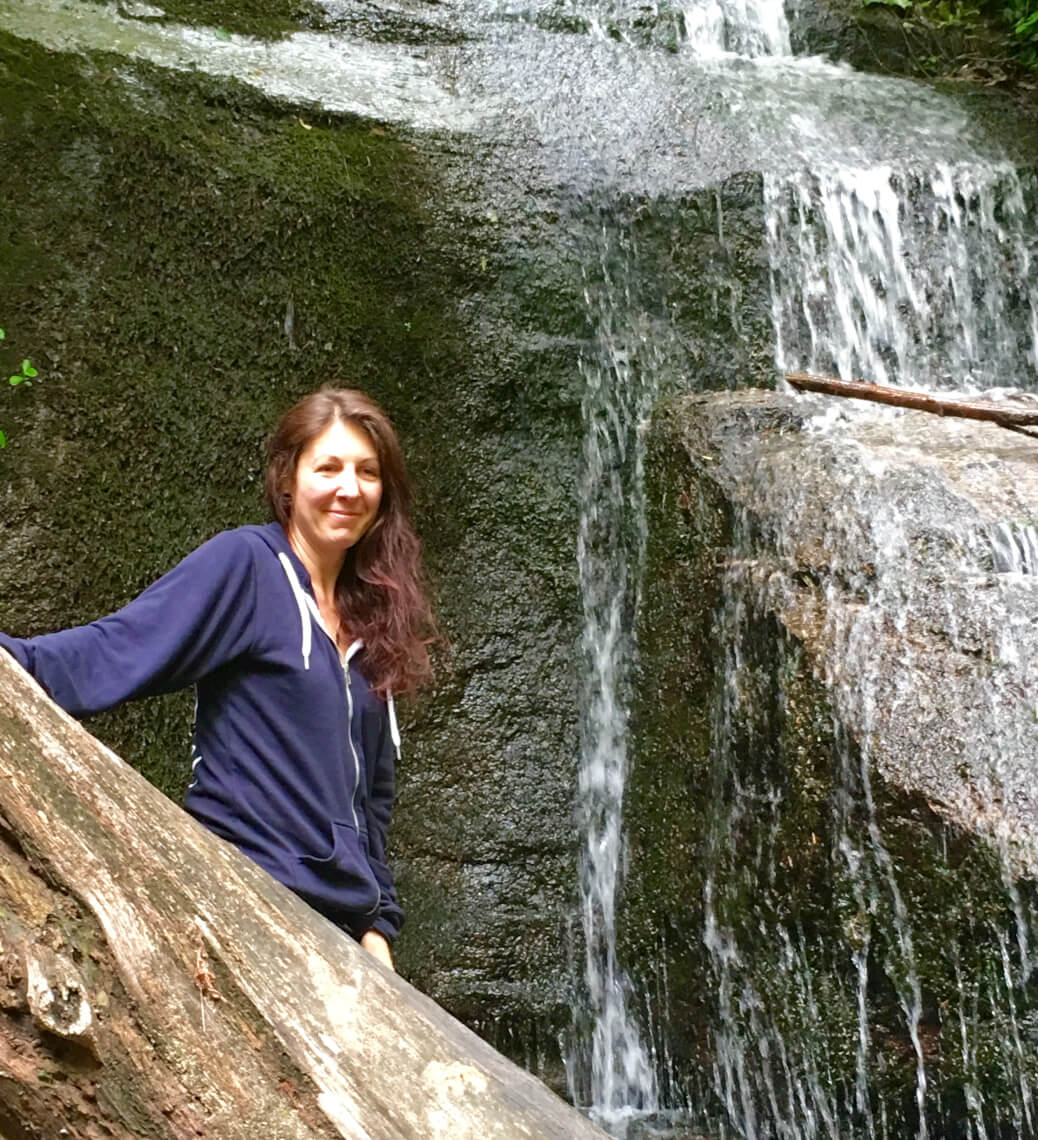
Kelly Ball out in the woods.
An avid trail runner, Kelly says, “I’m out there pretty much every day and I’ve been running for 10 years now. I’ll be doing my sixth marathon this fall. If I couldn’t do that I would go crazy.” She explains that growing up in Massachusetts, she would often go for walks and sit outside. “It was just nice to have my spot and go out and read.”
Besides running and liking the outdoors, her other hobbies include reading, dabbling in the fiddle, guitar and piano. Kelly finished her Master’s in Business two days before starting her position at Dogwood Alliance, so she feels like she’s getting used to having a life again. She’s looking forward to sewing, playing music, gardening and being crafty.


 Donate