


Culture is the backbone of any social justice effort. It includes values, norms, and practices. These guide the ways people interact in organizations. It shapes how people relate to each other and the communities they serve. The anchors of social justice spaces are:
Healthy organizational cultures amplify everyone’s voices. This is especially true for those with marginalized identities.

An effective culture values and empowers its members. It encourages transparency and open communication. It allows honest discussions about challenges and strategies. This is important in social justice organizations. The work involves challenging systems of oppression. Difficult conversations are necessary in these spaces. Black, feminist scholar, bell hooks, spoke on this. She said:
“Honesty and openness is always the foundation of insightful dialogue.”
The culture must support and protect those who speak out. It must ensure that all voices get respect and consideration.
Organizations must focus on inclusivity. Inclusivity is essential to a culture with social justice goals. It’s not an ideal. It’s a daily practice. This means creating belonging for people from diverse backgrounds. It encourages participation. It also means always reflecting on and challenging the organization’s own practices. We don’t want to replicate the injustices we seek to dismantle.
The culture of an organization impacts its ability to build and sustain movements. It can drive movement building. It fosters unity, purpose, and resilience. Members are more likely to stay engaged when they feel supported. Members remain committed to the cause, even in the face of setbacks, when they share values.
Community and shared purpose sustained the Civil Rights movement. Even through its most challenging times. Dr. Martin Luther King Jr. led the Southern Christian Leadership Conference. He emphasized nonviolent resistance and mutual support. This created a culture that was resilient and adaptive to changing needs.

Yet a toxic or ill-defined culture can derail movement building. Organizations risk fracturing from within. Especially when they fail to address internal conflicts. Or when organizations lack a clear and inclusive vision. Members become disengaged. This weakens the movement. Organizational psychology research supports this. Teams with high levels of trust and psychological safety innovate and succeed more. Members must feel safe to take risks and express their ideas.
Building a strong movement is not easy. Social justice organizations must focus on three things:
This involves listening to all members. Leaders must especially listen to those who are marginalized. Everyone must have an appropriate role in decision-making processes.
We can look to the writings and teachings of Black, Indigenous, and leaders of color. These are people who’ve long advocated for social justice. These thinkers provide invaluable insights. They examine how culture shapes the effectiveness of movements. Audre Lorde emphasized intersectionality in social justice work. She urged organizations to recognize diverse experiences. She says:
“There is no such thing as a single-issue struggle because we do not live single-issue lives.”
Organizational culture must be skilled in understanding:
Indigenous scholar-activist, Winona LaDuke, spoke to the importance of cultural resilience. She highlights the role of Indigenous traditions and knowledge. This wisdom can long sustain movements. She stresses that culture isn’t only about practices within an organization. It’s also about the broader connection to community and heritage. That the strength of a movement lies in its cultural roots. Winona LaDuke says:
“We are the people who live in the places you cannot take.”
bell hooks has written about the role of love and care. Both are necessary in building strong, supportive communities. She argues that a culture of care is essential. It’s what nurtures emotional and spiritual well-being. hooks writes:
“Love is an action, never simply a feeling.”
She points to the need for a culture that supports the growth and healing of its members.
A strong organizational culture is crucial to building movements.

Here are some ways organizations can build such a culture.
Make sure a team values all voices. Particularly those from marginalized communities. You can achieve this by:
Openly discuss goals, challenges, and decision-making processes. This builds trust within the organization. Share how the team distributes power. Make the invisible, visible. This allows members to feel more connected to the mission. Then there’s greater investment in the movement.
Create an environment where members feel safe. Allow them to express their ideas and take risks without fear. Psychological safety is critical. It encourages innovation and a healthy organizational culture.
Recognize the emotional toll of social justice work. Focus on the well-being of all members. Encourage practices for mental and emotional health. This can include:
The culture of an organization is powerful. It can propel a movement forward. Or it can hold it back. The stakes are high in social justice spaces. The work is challenging. A strong organizational culture builds and sustains effective movements. Social justice organizations can create a supportive environment. One that allows members to thrive and their movements to grow. As long as they foster these principles:
The success of social justice movements depends on more than strategy. It also depends on the cultures they cultivate. It’s vital to center the voices of Black, Indigenous, and leaders of color. Teams must integrate insights from organizational psychology. Social justice organizations can build cultures that are resilient and transformative. Together, we can create movements grounded in love, care, and a deep commitment to justice.
Joint Statement from Greater Greener Gloster and Dogwood Alliance.
Mississippi Department of Environmental Quality (MDEQ) reached a recent settlement agreement with Drax Biomass. Greater Greener Gloster and Dogwood Alliance condemn this settlement. Drax has released harmful chemicals, like methanol, into the air at its plant in Gloster, MS. They broke pollution laws. Drax also failed to follow testing rules. The deal includes a $150,000 fine paid to MDEQ. It also includes $75,000 in funding for a small project to reduce dust. This is nowhere near enough. It does not fix the damage Drax has caused to the environment and local families.
Dr. Krystal Martin is a Gloster resident. She’s also the Executive Director of Greater Greener Gloster. She said,
“I’m disappointed in MDEQ. This fine does not justify the harm caused to our lives and property, nor does it support the mission of safeguarding the health, safety, and welfare of all Mississippians. This penalty should have been stiffer than the previous one because Drax is a known polluter with a history of violations in Gloster. This is an insult to the many residents who suffer daily from respiratory illnesses.”
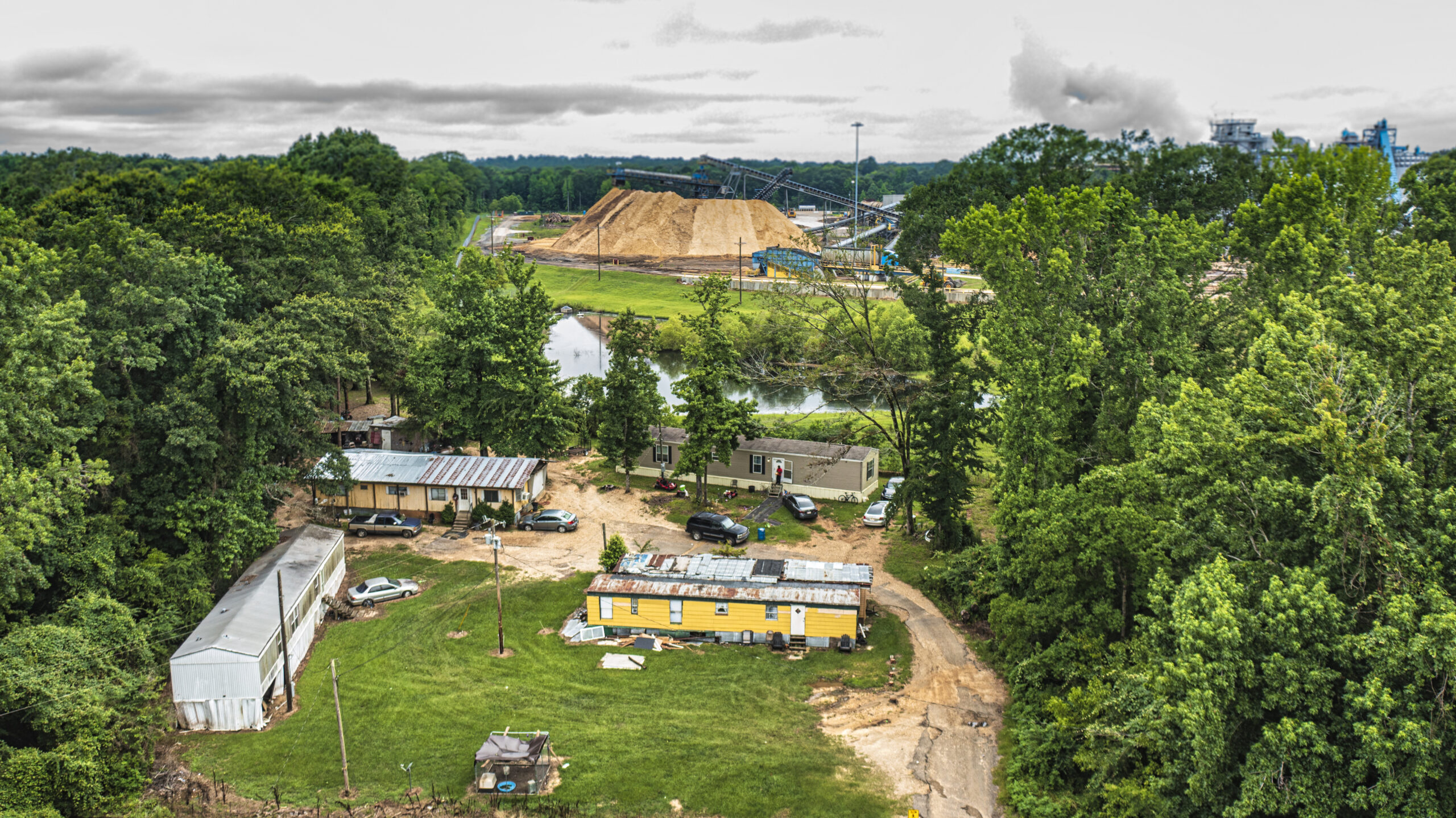
In 2021, MDEQ fined Drax $2.5 million for years of pollution. These fines are a drop in the bucket compared to the $2 million per day the UK government gives Drax in subsidies.
This is a slap on the wrist. Paying a fine and putting up a dust screen doesn’t solve the real problem. This pollution can cause dangerous health problems like cancer. People living near the plant need real protection.
We’re calling for stronger action. Southern forests and the people who depend on them need real solutions. Not empty promises. Biomass energy is not a climate solution. Protecting our forests is.
Drax Amite converts trees into wood pellets. Drax ships them to the United Kingdom. The UK then burns the wood pellets for electricity. Governments subsidize the wood pellets, too. They do this because of a mistaken notion that they’re carbon neutral and good for the climate. This settlement shows that Drax is a bad actor. They not only harm forests, but also communities.
Dr. Krystal Martin, Greater Greener Gloster – 256.665.5046 Scot Quaranda, Dogwood Alliance – 828-251-2525 x18
We all deserve to breathe clean air. Yet, air pollution is the greatest environmental health risk of our time. It can impact us all because air pollution has no boundaries or borders. Air pollution causes 6.7 million premature deaths every year worldwide. Toxic air can cause cancer, stroke, obesity, diabetes, and heart and lung disease. Air pollution is a public health emergency. It can warm the planet, making the climate crisis worse. Air pollution causes huge economic burdens. It harms food and agriculture production. We need individuals, institutions, and governments to take action to ensure clean air for all.
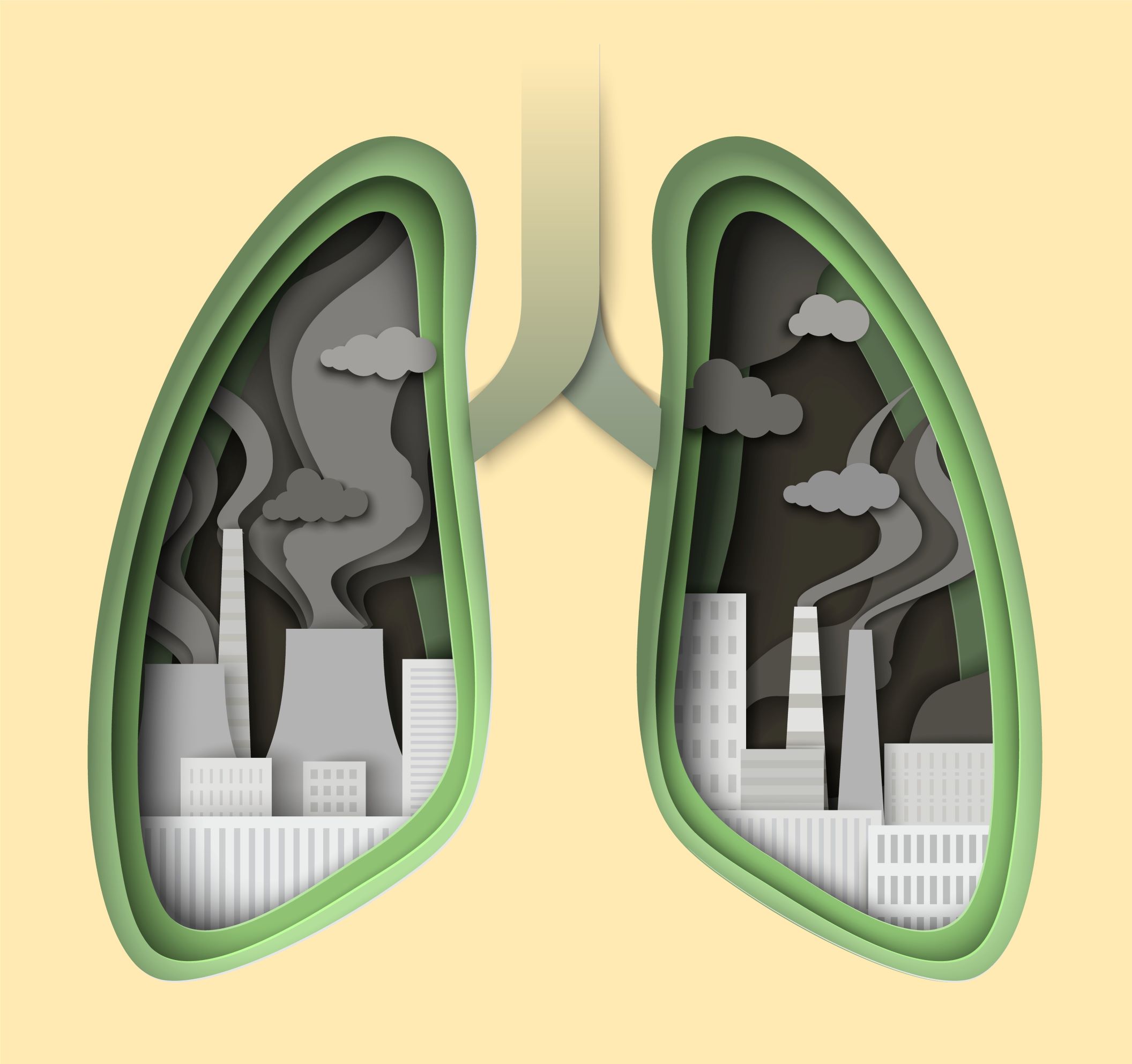
Air pollution is the contamination of indoor and outdoor environments. Chemical, physical, and biological agents can cause air pollution. There are many common sources of air pollution. Some of them are:
The US Environmental Protection Agency (EPA) shares outdoor air quality using the Air Quality Index (AQI). This is a daily report. It measures five major air pollutants that the Clean Air Act regulates. The EPA sets national standards for each of these pollutants to protect public health. It gathers real-time information using measurements from hundreds of air monitors across the US. They use algorithms to convey hourly readings for specific areas based on this data.
The EPA rates air quality using a color and number scale based on the level of concern. This allows the general public to check their outdoor air quality. You can access this information using the EPA’s AirNow desktop or mobile app. Several mobile weather apps also share this information.

We call his atmospheric gas “smog”. When nitrogen oxides and volatile organic compounds (VOCs) come in contact with sunlight, then the gas reacts and produces ozone. Ozone can travel far distances from its source. Motor vehicles, power plants, industrial facilities, etc produce ozone. High ground level concentrations of ozone can cause health issues. Exposure can cause headaches, shortness of breath, wheezing, and coughing. It can aggravate conditions like asthma and bronchitis. Ozone can increase respiratory infections and lung inflammation. Long term exposure can cause respiratory and metabolic illness. It can impact the nervous and reproductive system. Ozone can cause cancer and heart disease.
This fine matter accounts for most of the health impacts from air pollution in the US. Particle pollution can occur in buildings. Or it can enter buildings through windows, doors, cracks, and ventilation systems. It can have chemicals including sulfates, nitrates, carbon, and mineral dust.
What creates it? Vehicle and industrial emissions, burning organic matter, and cigarette smoke. Common household activities create particulate matter. Cooking. Burning candles or incense. Woodworking. Metalworking. And many cleaning and disinfectant products. PM can also have biological sources. PM2.5 are tiny airborne particles 30 times thinner than a human hair. People can inhale these deeply into the lungs, and they can enter the bloodstream. PM2.5 can irritate the eyes, nose, and respiratory system. It can worsen existing lung diseases like asthma and COPD. Long term exposure can cause pneumonia, lung cancer, heart disease, and stroke. PM10 are larger particles that include dust, pollen, and mold spores. PM10 can irritate the eyes, nose, and respiratory system.
CO is an invisible, odorless toxic gas. It’s a byproduct of combustion. What creates this? It’s mainly vehicles and planes with internal combustion engines, gas appliances, home heating elements, charcoal grills, and gas powered equipment. Breathing CO2 reduces your blood’s ability to carry oxygen. Low level exposure can trigger headaches, nausea, dizziness, weakness, and confusion. Regular low level exposure can aggravate heart disease. It may cause permanent mental and physical problems. High level exposure can cause loss of consciousness and death.
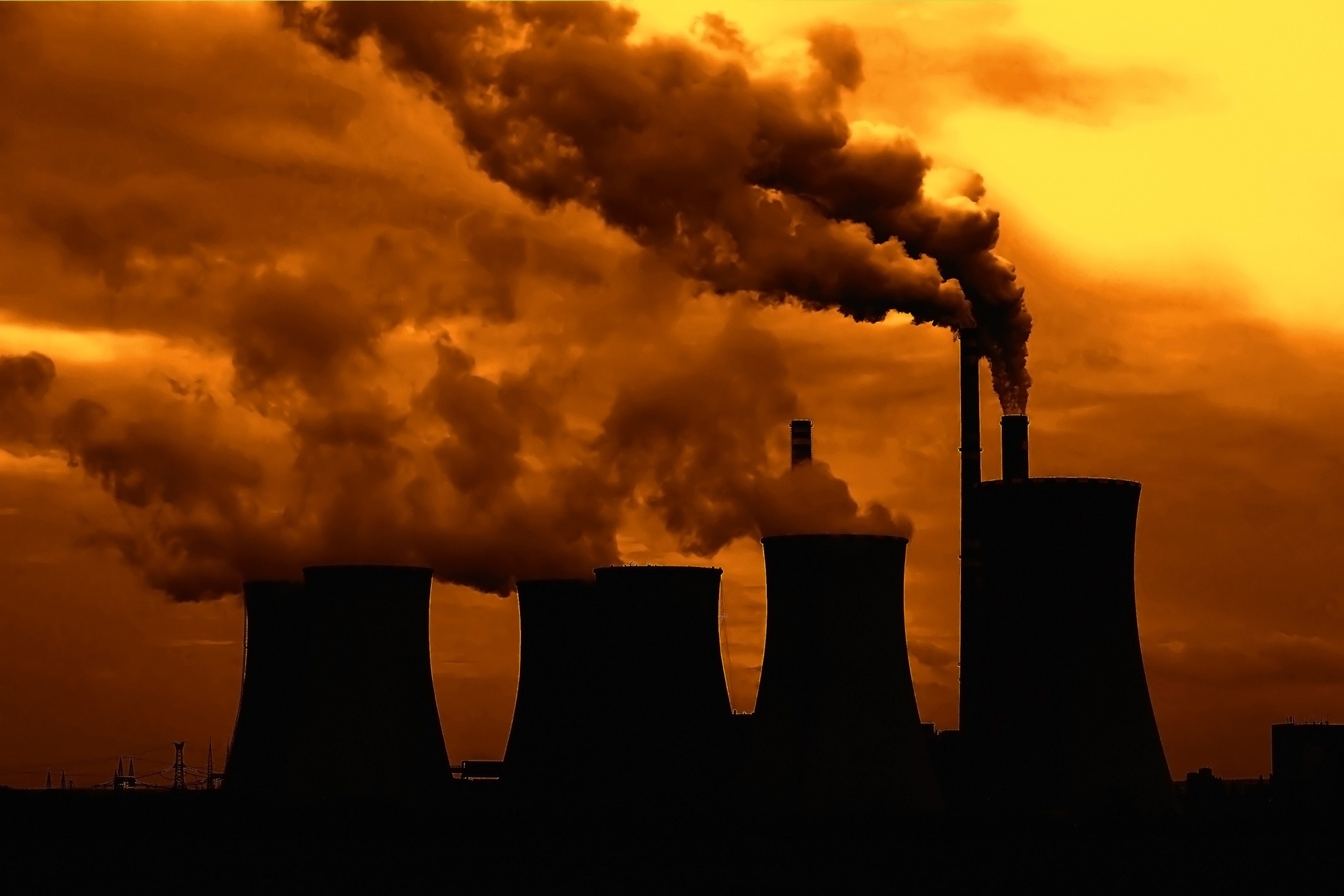
SO2 is a toxic gas from sulfur and oxygen. Large facilities such as coal-burning power plants mainly produce SO2. It can blow hundreds of miles away. Exposure can cause wheezing, shortness of breath, and tightness in the chest. Long term exposure can degrade lung function.
NO2 is a toxic gas from nitrogen and oxygen. Burning fossil fuels produces NO2. It can form indoors from burning wood or gas. It can form outdoors from motor vehicle emissions, oil and gas production, and power generating plants. NO2 inflames the lungs and can cause coughing and wheezing. It increases vulnerability to lung infections. It can also worsen asthma, making attacks more intense and frequent.
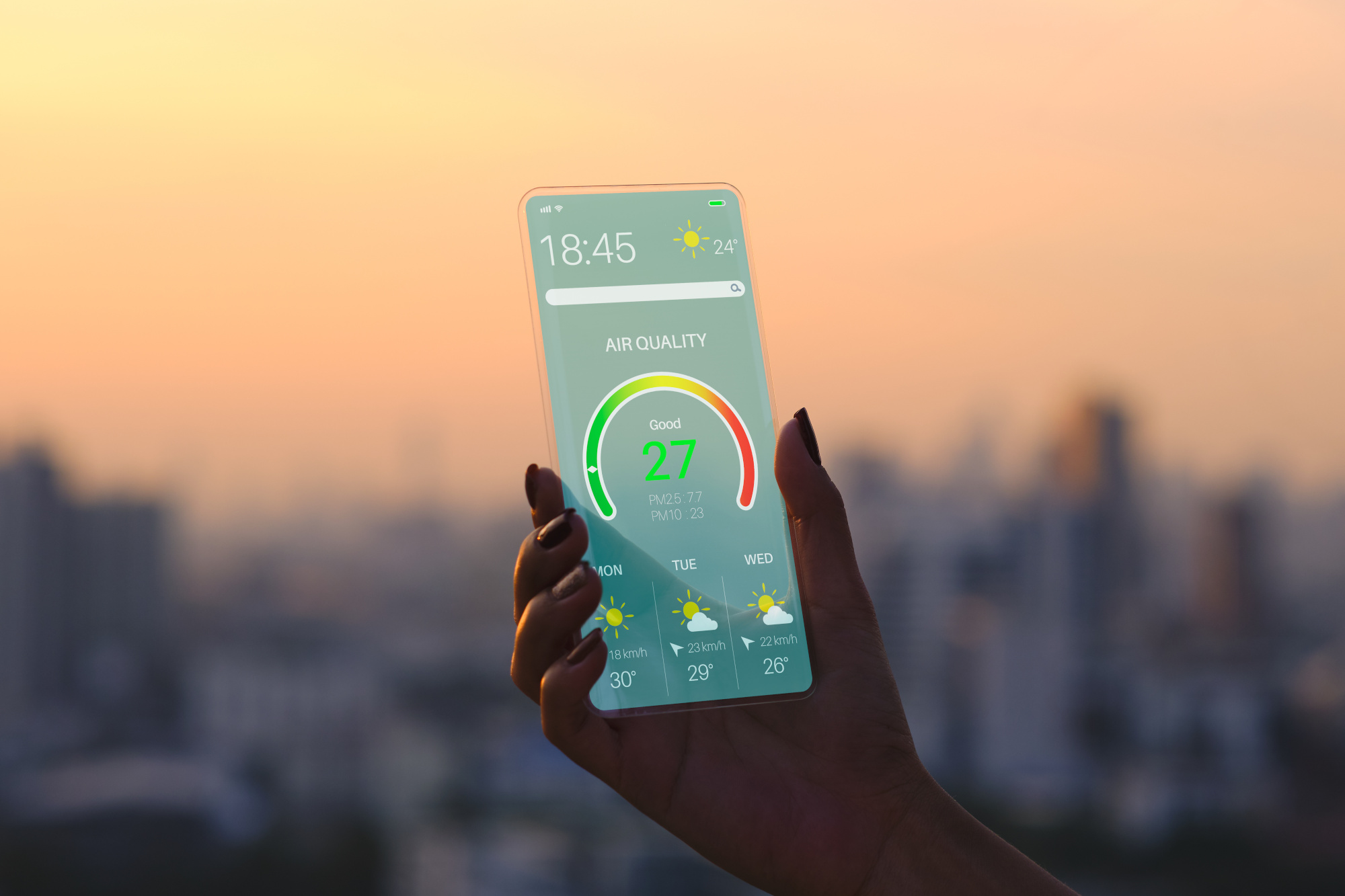
The AQI rating scale indicates the level of concern for each of the five major pollutants.
The scale is color-coded. It contains six categories:
The EPA regulates the emissions of 188 hazardous air pollutants (HAPs) under the Clean Air Act. HAPs are pollutants that can cause cancer or other serious health impacts. These pollutants can damage your immune, reproductive, cardiovascular, and respiratory systems. They can also cause neurological or developmental problems. Humans are not the only living things that air pollution impacts. HAPs can also harm wildlife and may impact the food chain. The EPA works with state, local, and Tribal governments to reduce emissions of HAPs in the environment.
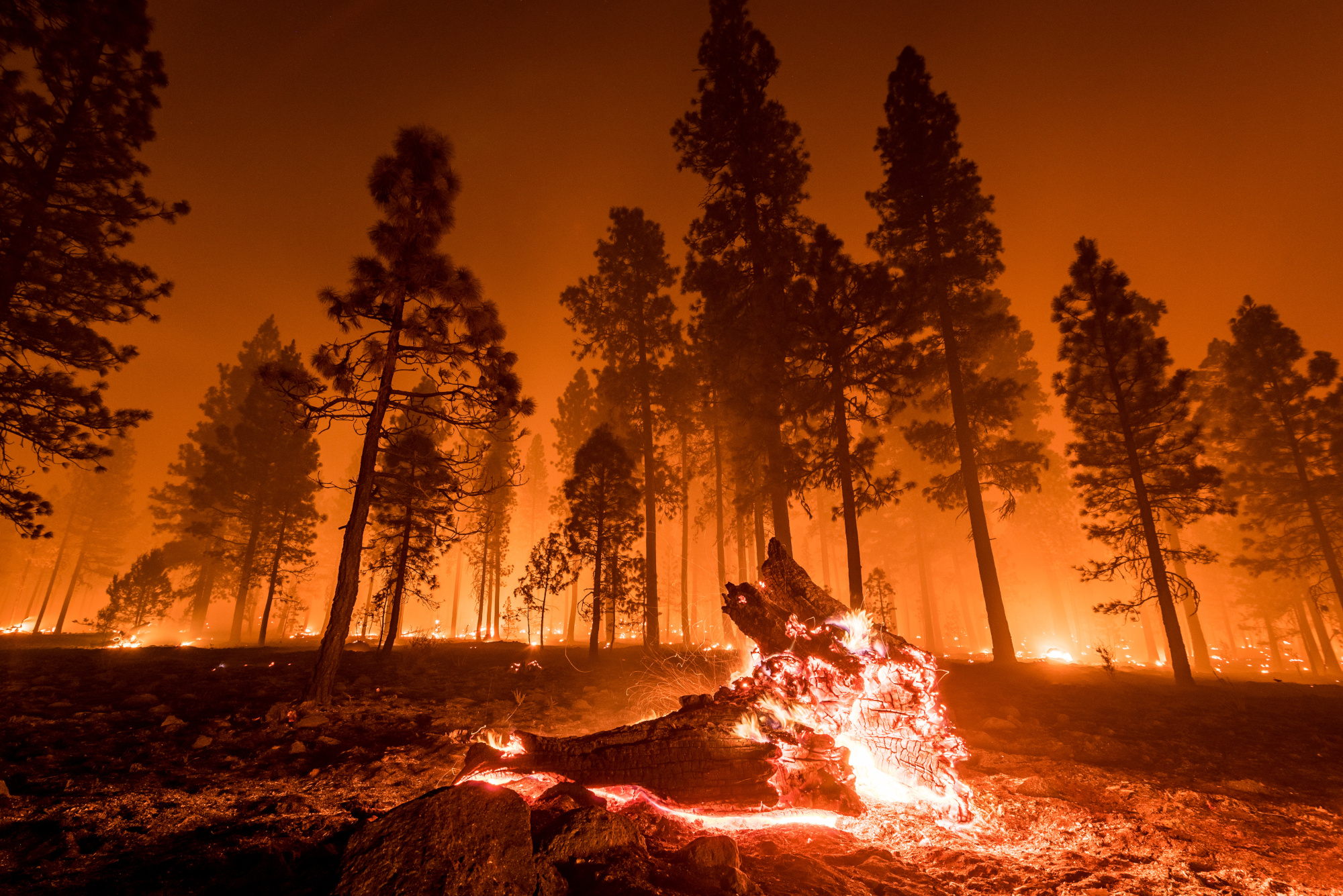
VOCs are chemicals from living organisms. Products and/or processes emit it into the air. In some cases, VOCs are naturally harmful. In other cases, they react with gases or chemicals and become harmful. Like when VOC’s mix with nitrogen oxides and become ozone. VOCs can pollute indoor and outdoor environments. But concentrations of VOCs can be up to 10 times higher indoors.
Many household products produce VOCs. Paints, varnishes, caulks, adhesives, and flooring like carpet or pressed wood. Cleaning supplies and disinfectants, pesticides, air fresheners, aerosols, cosmetics, and deodorants. Gas and wood burning stoves, stored fuels, and gasoline. Tobacco smoke, candles, and incense. Dry cleaned clothing. Arts and crafts supplies like glues, markers, and photographic solutions. Office printers and copiers. All of these sources and more can produce indoor VOCs.
Several other sources can emit outdoor VOCs. Industrial facilities. Oil and gas extraction or processing. Gasoline or diesel emissions. Biomass wood pellet production. Wood burning. Biomass burning is the second largest source of VOC pollutants. This includes wildfires and bioenergy.
Exposure to VOCs can harm your health. VOCs can irritate your eyes, nose, and throat. They can cause breathing difficulty, headaches, dizziness, loss of coordination, and nausea. VOC exposure can damage your liver, kidneys, and central nervous system. Some VOCs can even cause cancer in humans and animals.
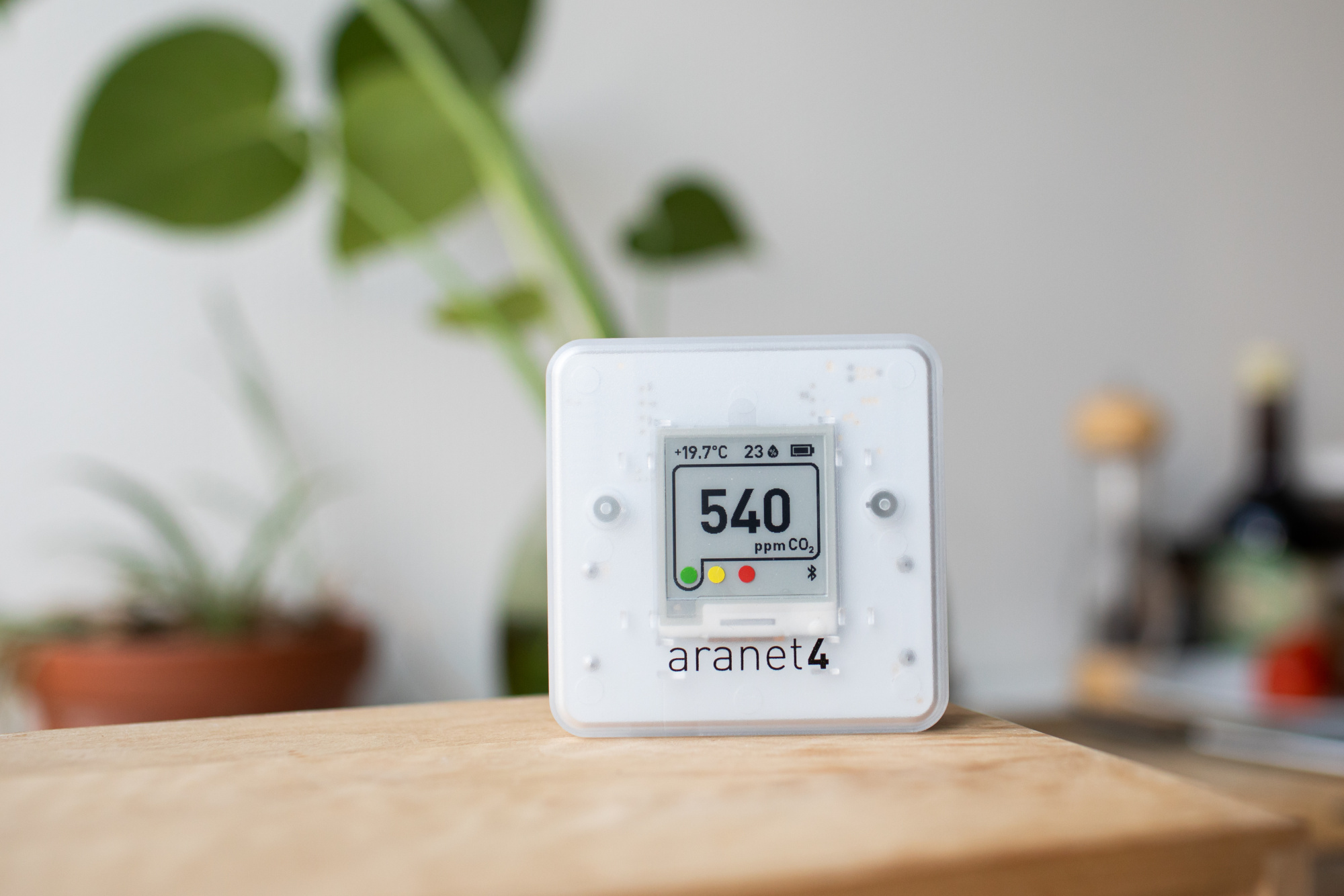
Indoor air is often more polluted than outdoor air. This is a serious concern since on average Americans spend 90% of their time indoors. Polluted air outside can seep into indoor spaces. This can combine with indoor air pollutants. Then you have unhealthy indoor air conditions. Many building codes require smoke and carbon monoxide detectors. But is that enough?
Indoor air pollution monitors are a useful tool. They can give you information about specific air pollutants. They help you understand how safe the indoor air is. However, they don’t work the same as the EPA air monitoring system. They don’t alert you of imminent danger. But they can help you decide to increase ventilation, air filtration, or reduce sources of indoor pollution.
Several air pollution monitors are available on the market. Here are some things to consider:
Cost: Air pollution monitors can range from low cost to high cost depending on your budget. But higher cost does not guarantee better performance or reliability.
Capability: Air monitors use one or more sensors to detect and report on specific air pollutants. They can monitor particulate matter or gases. Such as carbon monoxide, carbon dioxide, radon, formaldehyde, volatile organic compounds. They can also monitor environmental elements like temperature and humidity.
Performance: Ideally, you want a monitor that’s both accurate and precise. What affects air monitor performance? Where you place it. How it processes data. Temperature and humidity. Time in use. Also, air pollution monitor performance can degrade over time. Most manufacturers will provide an estimated lifespan before it needs to be serviced or replaced. Pay close attention to this when purchasing.
Most of us can’t control the air quality of the places we work, learn, shop, or recreate in. But we can use low cost air monitoring devices to help us make more informed decisions.

Most air pollution is invisible, so it’s hard to know when you need to protect yourself. Check the AQI for your area if you plan to spend significant time working, commuting, or recreating outdoors. Install and regularly maintain smoke and carbon monoxide detectors in your home. Use air monitors to check the quality of indoor air.
You also can take these steps to protect yourself and improve air quality:
Is the air quality unhealthy? Do you know you’ll be around air pollution? Wear a respirator. N95, KN95, P100, or full gas masks can prevent toxic air from reaching your lungs. Make sure you have a tight fitting seal when wearing one.
Avoid burning anything indoors. Don’t use heaters, camp stoves, or fuel burning appliances that don’t vent outdoors. Limit the use of high VOC emitting products like paints, pesticides, or air fresheners. Don’t smoke or vape indoors. Choose furniture and materials that are formaldehyde-free.
Get fresh air in and dirty air out. If the outdoor air is better than indoor air quality, then open a door or window. Use ceiling fans to improve air flow. Place a portable fan near an open window to draw clean air in and push unhealthy air out. Point the fan away from people. Turn on the exhaust fans in your kitchen or bathroom.
Most HVAC systems have air filters that need to be changed every three months. Use high quality, pleated air filters. Make sure to install them properly and change them regularly. Set the HVAC system fan to the “on” position. This lets the fan run continuously, even when you turn off the cooling or heating.
Consider adding an air purifier. Portable air purifiers with high-efficiency particulate air (HEPA) filters can remove air pollution and improve air quality. Consider the size of the room when purchasing an air purifier. Check HouseFresh, an independent site that tests and rates air purifiers. Or you can build your own Corsi-Rosenthal air filter box. A study from Brown University shows they’re effective at reducing indoor air pollution.
The production and burning of gasoline, oil, diesel, and wood causes the worst air pollution. Organize your community to end fossil fuels and large scale biomass. Advocate to transition our economy from endless extraction to nature-based solutions.
Forests and wetlands clean our air and store climate warming carbon.
People around the world celebrate the first Sunday in May as Dawn Chorus Day. It’s a day to set aside time to listen to nature’s sweetest symphony: birdsong. But you can and should enjoy the sweet melodies of birds any time of year. Listening to birdsong can reduce stress and promote health and well-being.
Birdwatchers can learn to identify birds with their eyes and ears. In most cases, you can hear a bird before you can see them. I’ll introduce you to how to listen for some of the most iconic songbirds of the Southeast. Using mnemonic devices can help you remember a bird’s unique pattern of sounds. But first, do you know what makes a songbird a songbird?
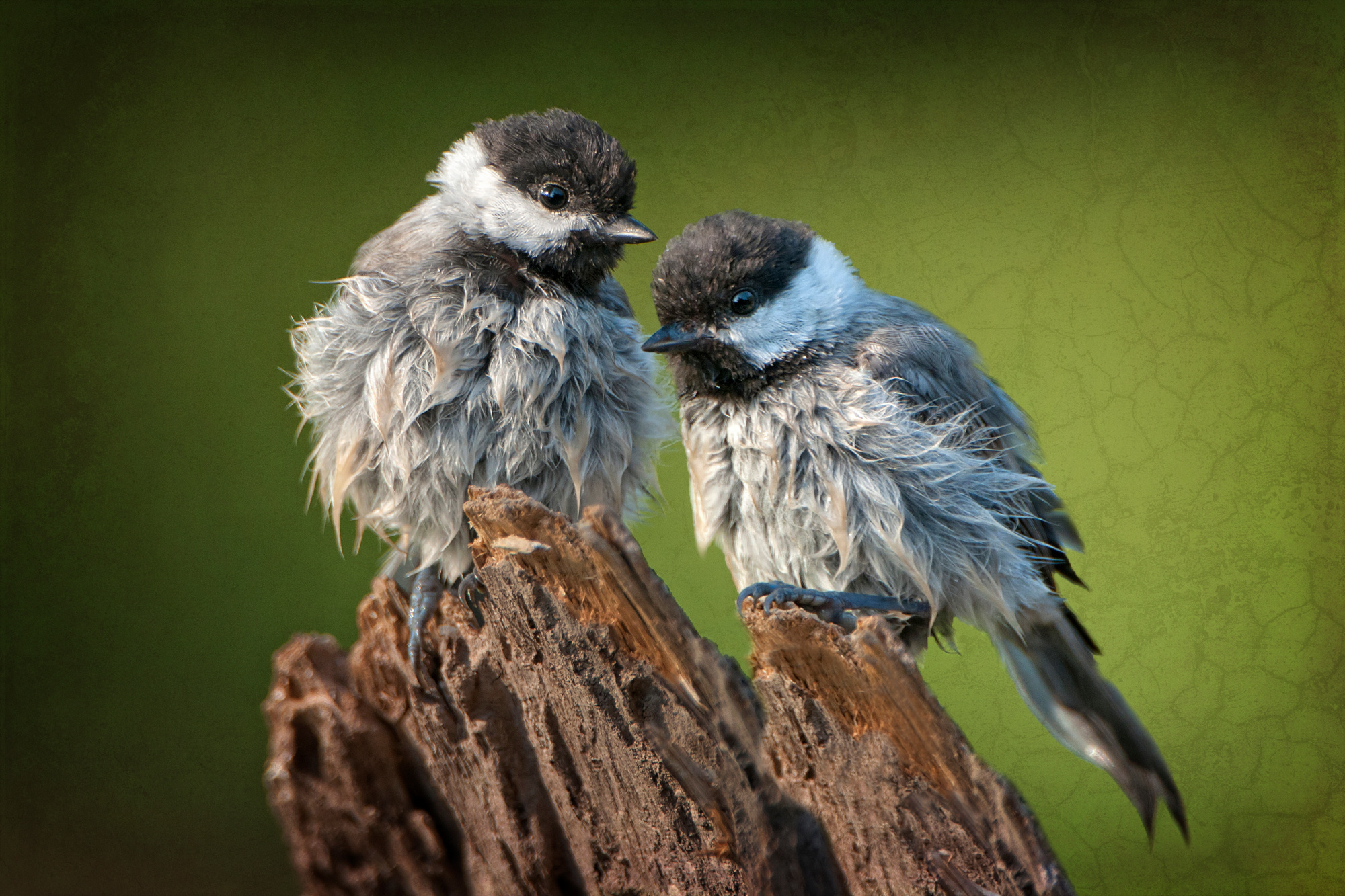
Songbirds are a unique suborder of birds called oscines. There are more than 4,000 birds in this suborder, but they have a couple of common traits. Songbirds are perching birds. They have distinctive toes that allow them to grasp branches. All birds have an organ that allows them to produce sound called a syrinx. But songbirds have exceptional control of the muscles around the syrinx. They can create specific tunes with every exhale. Songbirds learn their distinct songs usually from their parents and other adult birds. They can continue to add to their list of songs, while other birds have limited vocalizations. But not all songbirds sing. Experts believe that birds sing to defend their territory. They also sing or call to bond with or attract a mate.
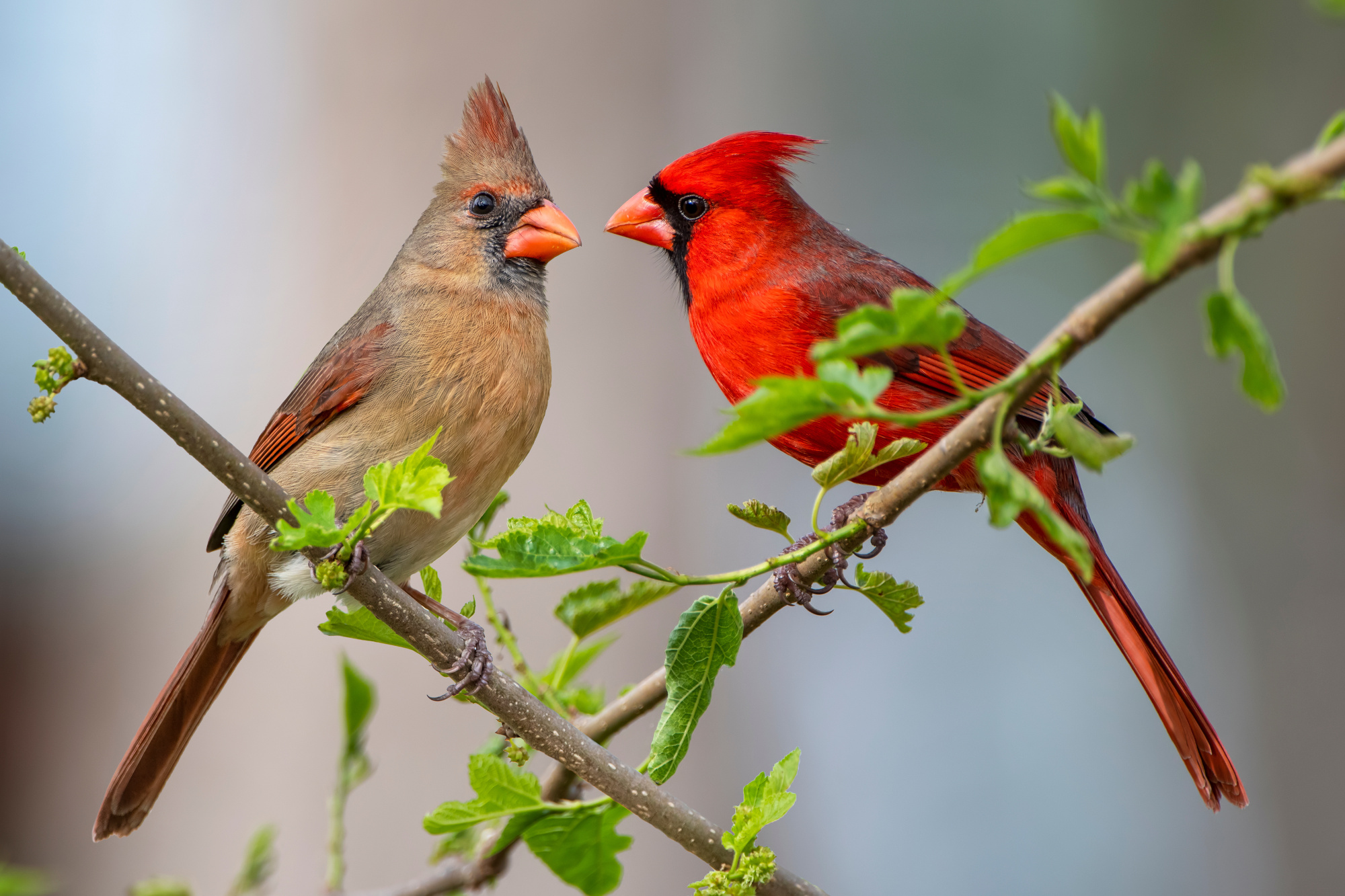
Female Northern cardinal on the left, and male Northern cardinal on the right.
Cardinals are one of the most striking and recognizable birds of North America. They’re the official state bird of seven states including North Carolina and Virginia. Males are bright, crimson red. Females are a ruddy taupe with crimson highlights in the crest, wings, and tail. In very rare cases, a genetic mutation has led to a golden yellow cardinal. Northern cardinals have a dramatic crest that they can raise or lower and a thick, blood-orange beak. They also have black mask-like markings around the eyes and bill. They’re medium-sized birds between 8-9 inches in length (21-23 cm).
Male northern cardinals will sing all year long. Females will usually sing when on their nest. They sing a longer and more intricate tune than their male partners. Cardinal songs often last 2-5 seconds, but they can sing for 15 seconds or more. They sound like a loud string of whistles that speed up and end in a slow trill. It can sound like they’re saying “cheer-cheer-cheer”. Or sometimes it sounds like “tweet-tweet-cheer-cheer-cheer-joy-joy-joy”. Cardinals have more than a dozen calls. They’ll make a metallic chip sound when calling to their mate or to warn that predators are in the area.
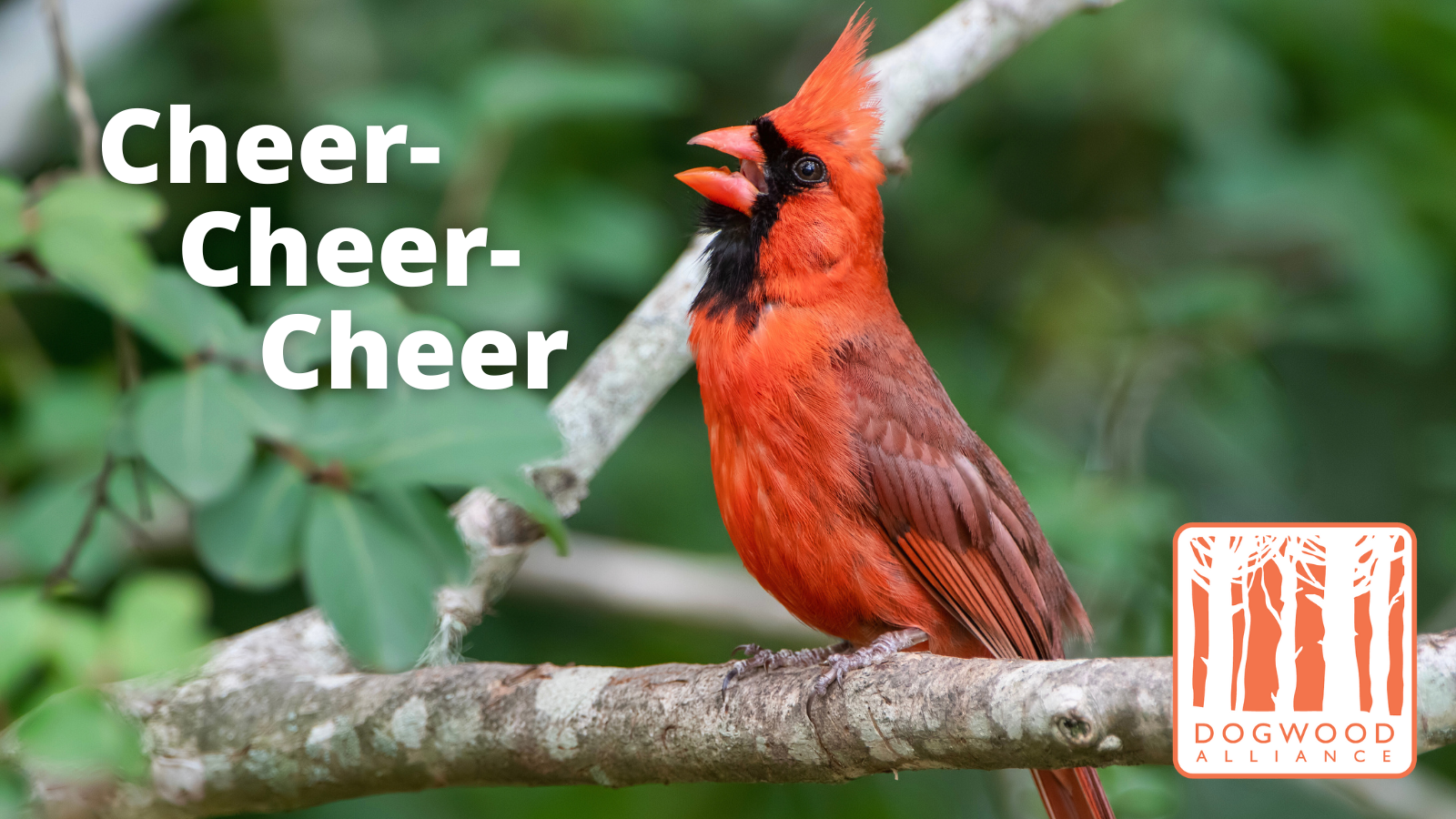
The cardinal’s natural habitat is open woodlands. But they’re often found in backyards, parks, and shrubby areas. Their main diet includes seeds, fruits, and the occasional insects. They love when I leave mealworms out for them, too. It’s very easy to attract these songbirds with a bird feeder. Otherwise, they usually forage for food on the ground. Cardinals get their red plumage from their diet. These feisty birds are very territorial and will chase other birds away. They’re also known to fight their own reflection, believing it to be a competing cardinal. Paired cardinals feed one another to deepen their bond, and they perform courtship dances, too.

Carolina wren
Carolina wrens are very small in stature, but the sound they create is enormous. Their songs can reach a whopping 90-110 decibels. That means they can be as loud as a train or a jackhammer. Male and female Carolina wrens look similar. Their bodies are stout and round and their tails point up. They’re a warm cinnamon brown from their bill to their tail feathers with light and dark spots and stripes. Their beak is long, thin, and curved downward. This can make the Carolina wren look like they have a disapproving smirk. These wrens have a distinctive white stripe above their brown eyes. Their underside is a ruddy tan. They’re small birds between 4.5-5.5 inches in length (12-14 cm).
When a Carolina wren sings, they often lift their head and voice. They’re known for throwing their heads back and belting out a resounding bright song. Only males sing, and their song usually lasts only a couple of seconds. Some describe the sound as “teakettle-teakettle-teakettle”. But some people say it sounds like “cheeseburger-cheeseburger-cheeseburger”. And they’ll repeat this for up to 15 times in a row. When I first realized that big sound was coming out of that small bird, I became a lifelong fan.
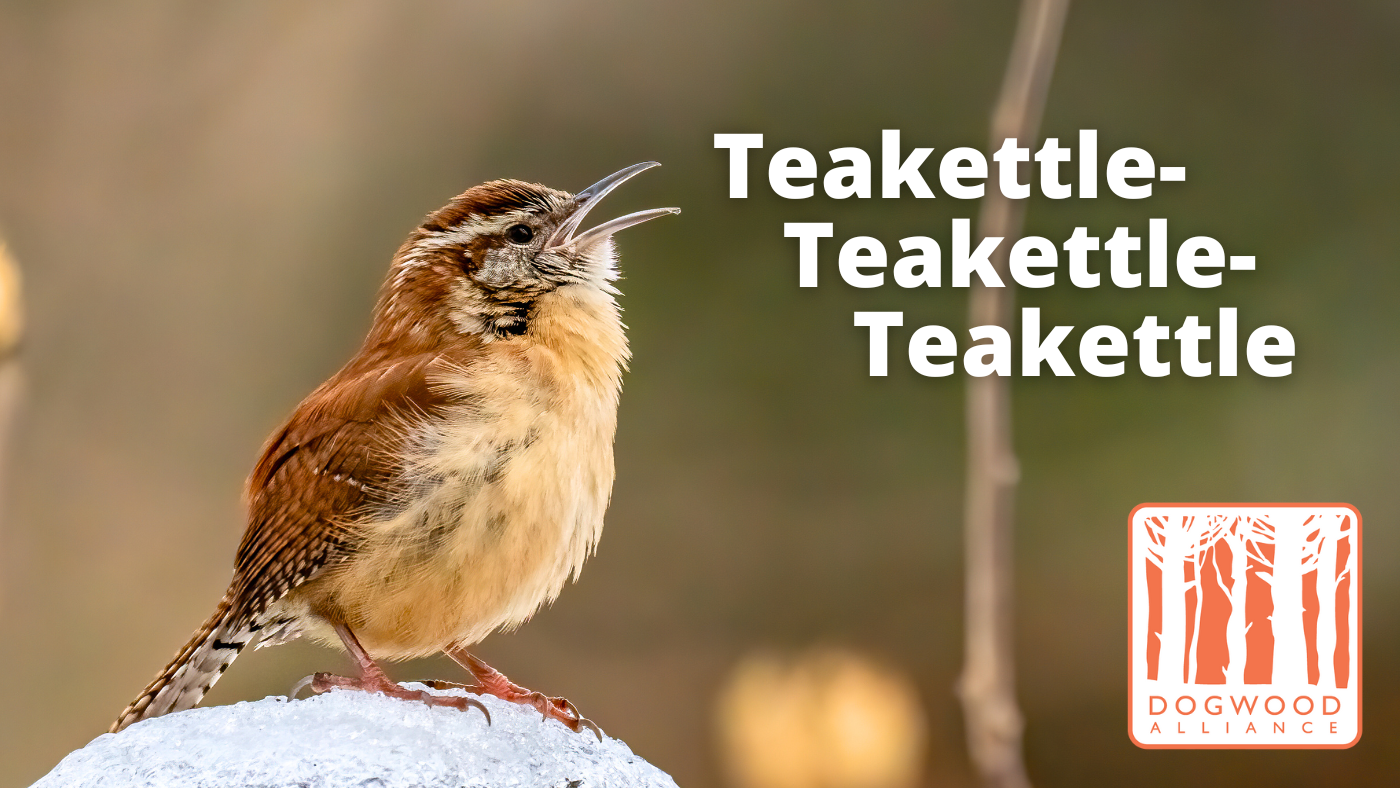
Carolina wrens live year round in the Eastern US. Their natural habitat is open woodlands. They prefer shrubby, wooded overgrown areas. But they’ll visit your backyard if food or suet is available, especially in the winter. I see them regularly on my deck, foraging in and around my planters. Carolina wrens mostly eat spiders and insects, but they’ll also eat lizards, frogs, or snakes. They forage on or near the ground hopping through leaf litter and vegetation. Once paired, these charming birds mate for life.

Male Eastern towhee on the left, and female Eastern towhee on the right.
Eastern towhees are strikingly beautiful sparrows with a distinctive song. Males have a black cape that covers their head, chest, wings, and tail. Whereas females have a russet brown cape. Both have tawny feathers under their wings and white underbellies. They have a thick black beak. Depending on the region, some have dark red or white eyes. They’re small to medium-sized and measure between 6.5-8 inches in length (17-21 cm).
Eastern towhees are very vocal, and their song is one of the easiest to identify. Males sing a song that sounds like “drink-your-tea-ee-ee-ee-ee”. The first note is sharp and sometimes doubled and the final notes end in a repetitive trill. Both males and females will call to one another. This helps them stay in contact or alert each other of danger. Their two-part calls vary from region to region. But they usually sound like “tow-hee” or “che-wink”.
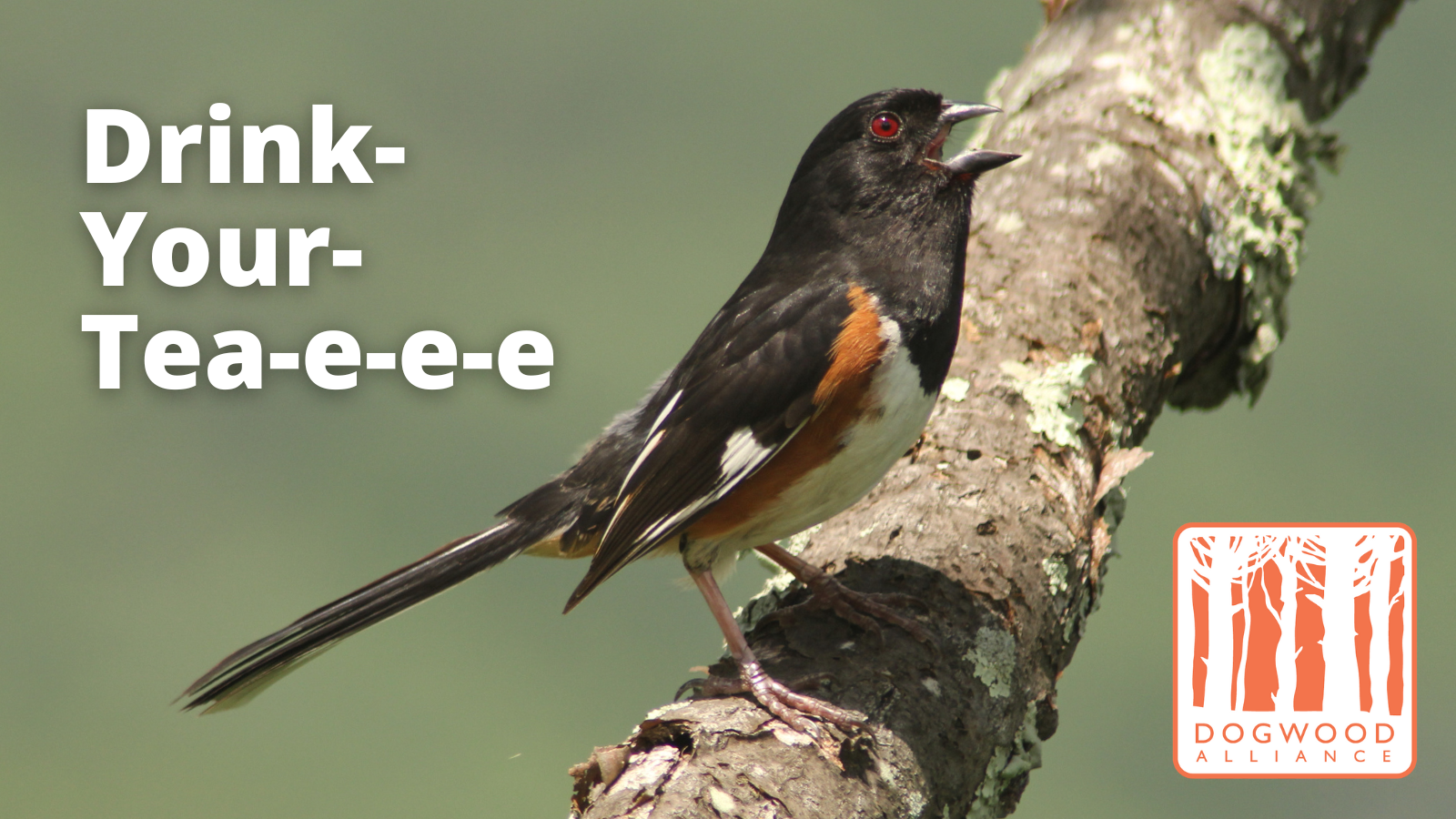
Eastern towhees live year round in the Southeastern US, but they’ll migrate north to breed. Their range overlaps with their cousins, the spotted towhee, in the Great Plains. Sometimes these two distinct species will interbreed. They prefer thick shrub-covered habitats in forest edges or woodlands. They nest and forage for food on the ground. They’re known to scratch with both their feet to turn over leaves in a back and forth hop. Then they’ll eat anything edible that they uncover. They’re omnivores and will eat seeds, fruits, insects, spiders, flower buds, and more. I only see them at my bird feeder in the winter. But I hear them almost every day year round.
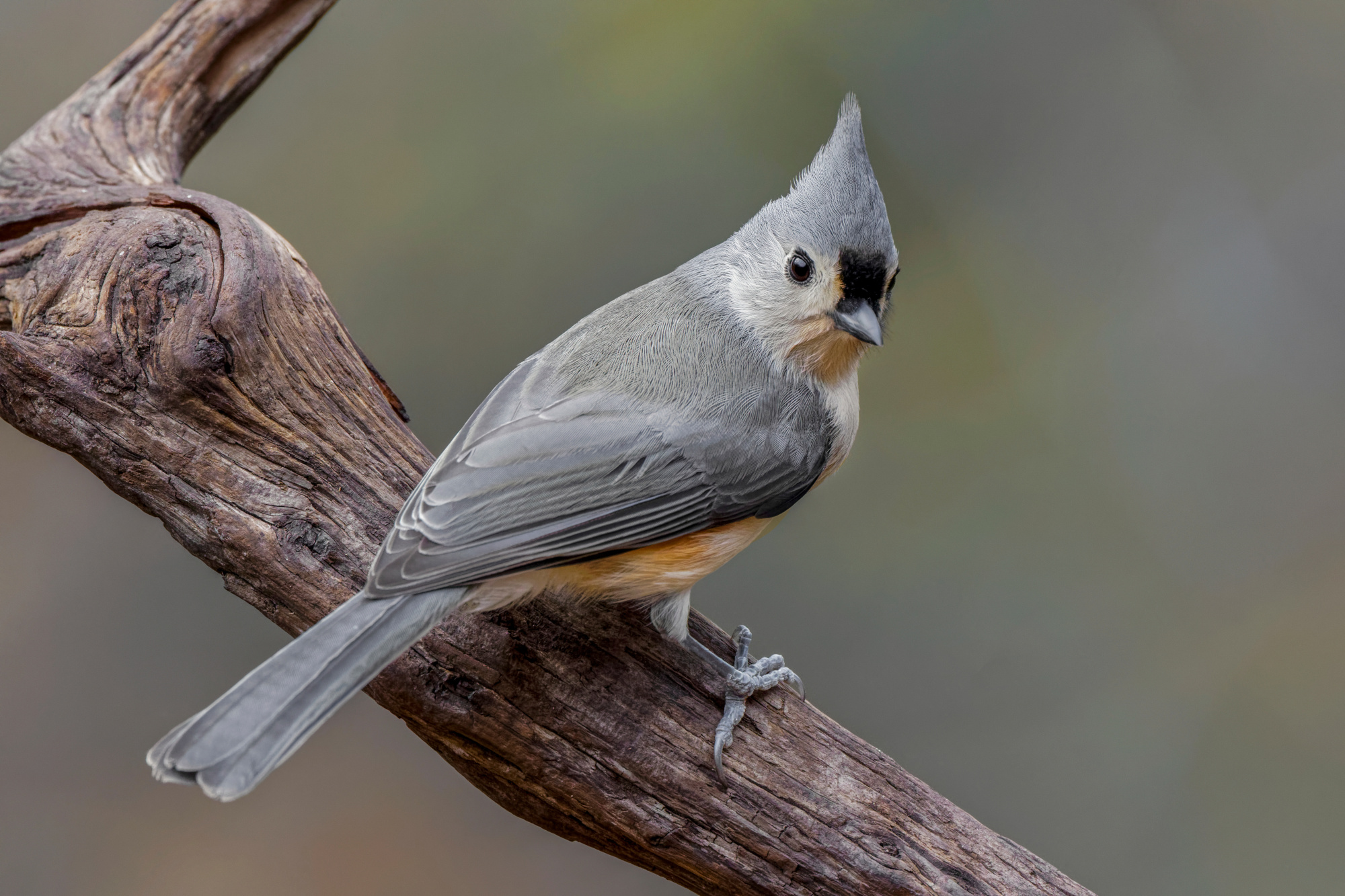
The tufted titmouse is one of my favorite birds of all time. They’re the epitome of cute with soft, mouse-like features. Male and female titmice look similar. They’re mostly gray on their crest , wings, and tail. Tufted titmice have a white face and underside with a splash of rust beneath their wings. With a patch of black above their black beaks. Their eyes are big, black, and endearing. They’re on the small side at about 5-6.5 inches in length (14-16 cm).
Tufted titmouse males do most of the singing, but females will sometimes sing a softer version. Their songs are a clear whistle that sounds like “peter-peter” or “peter-peter-peter”. They will repeat this up to 11 times a minute. My favorite thing about them is their calls. They can sound like a robot going haywire with a short burst of whistles at the end. It sounds like “see-see-see-day-day”. Maybe they’re telling us to seize the day!
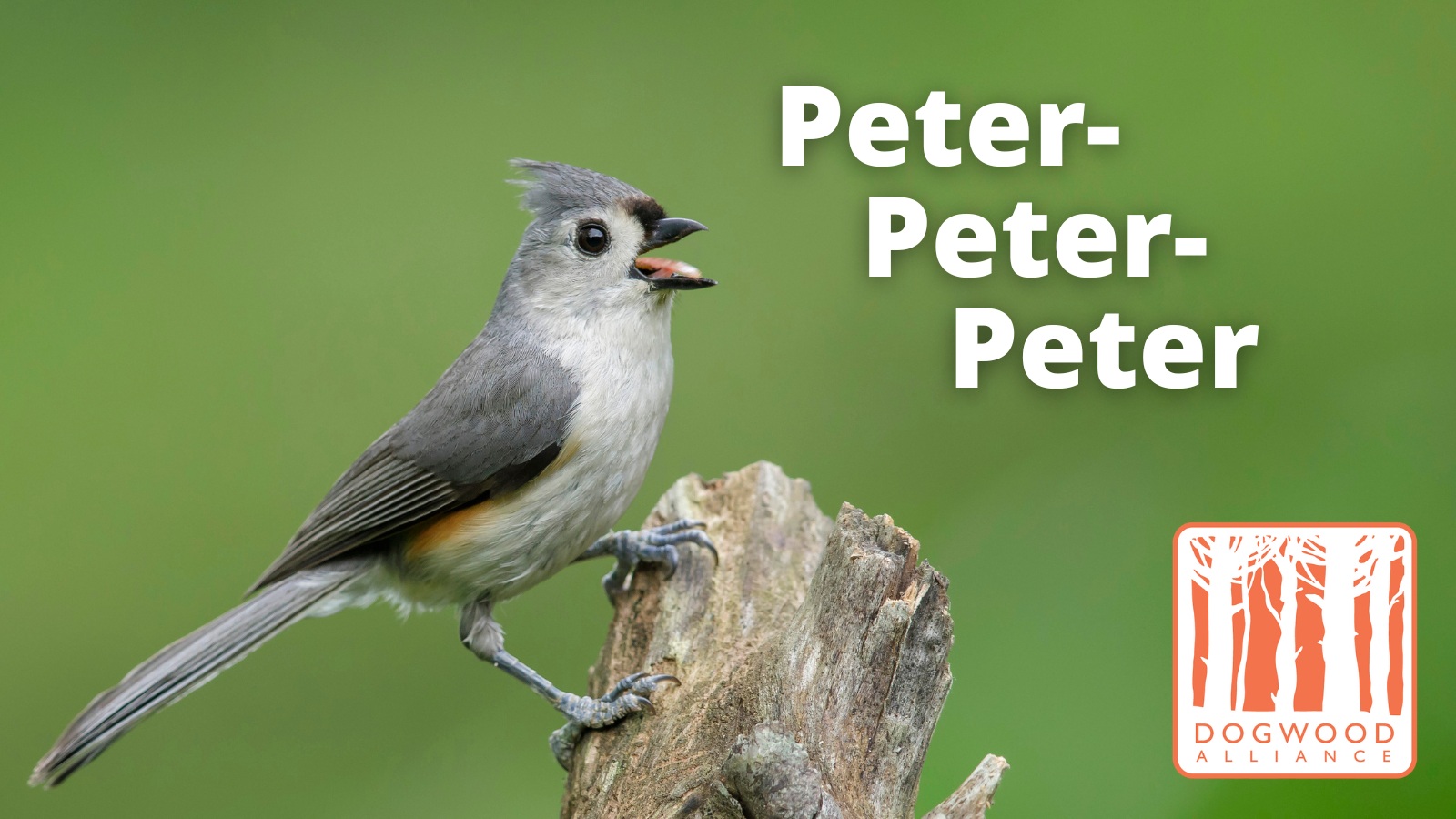
These songbirds live year round in the Eastern US. They inhabit deciduous woods or mixed woods with a thick canopy. But they’re also common in parks, gardens, and suburban areas. They forage in tree foliage, but it’s very easy to attract these songbirds with a bird feeder. They love black sunflower seeds. I’ve seen them fly off with whole peanuts in the shell. The tufted titmouse is a little acrobat. They’ll often swoop in and hang upside down or sideways when looking for food. Once they have a seed, they’ll hold it between their feet and hammer it open. I usually see them foraging in pairs. Double the cuteness!
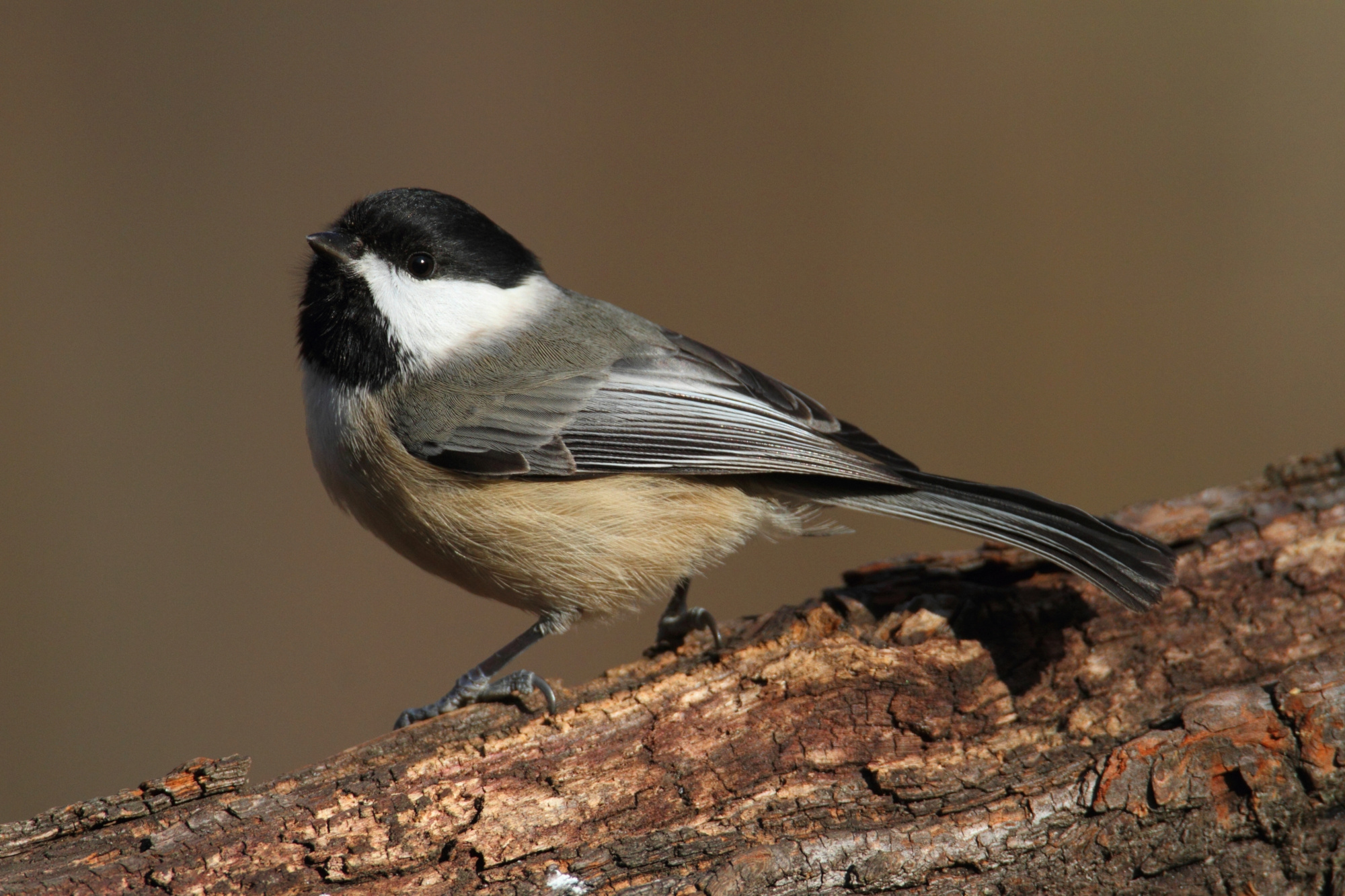
Carolina chickadees look very similar to their cousin, the black-capped chickadee. They’re small, adorable songbirds with a rounded head, short neck, and stout body. The top of their head and throat is black. These chickadees have bright, white cheeks. Their back and wings are a mottled gray. This distinguishes them from the black-capped variety that has more white in their wings. They have a short, rounded, black bill and dark eyes. Their underside has a sepia hue that fades into white on their belly. Male and female Carolina chickadees look similar. They’re very small and average 3.9-4.7 inches in length (10-12 cm).
Carolina chickadees sing more than 35 different songs. Their most characteristic tune sounds like “fee-bee-fee-bay”. The “fee” is very high-pitched. The following note is in a lower register. Their distinct call sounds like “chickadee-dee-dee”. Chickadees can also sound like a robot going haywire with lots of chatter and shrill whistles.
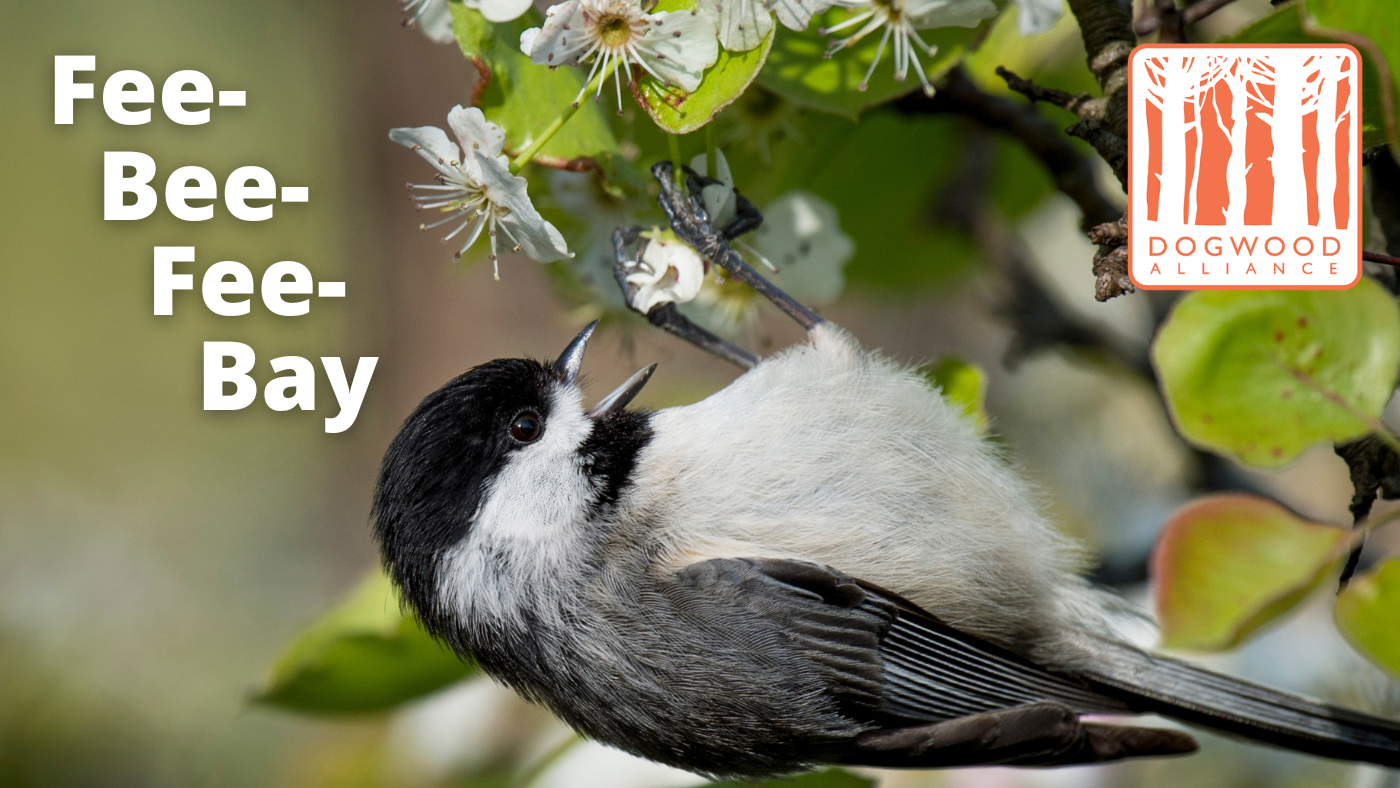
Carolina chickadees live primarily in the Eastern US. This makes them unique from black-capped Chickadees that are found in the Northern US and parts of Canada. They have some range overlap in North Carolina, Virginia, and West Virginia. Their preferred habitat includes forests, woodlands, and swamps. But you can also find them in urban and suburban areas, parks, and in your own backyard. Chickadees’ diet includes insects and spiders most of the year. But they will visit backyard bird feeders. They’re also acrobatic foragers like their cousin, the tufted titmouse. You can find them hanging upside down, sideways, and diagonally to find food.
Backyard bird watching is a great way to relax and enjoy nature. It can remind you that you’re part of an entire ecosystem that needs to be cared for. I hope this guide helps you identify the birds in your own backyard. If not by sight, then by sound. If you love songbirds as much as I do, then you know how important it is that we protect their habitats. When we protect forests, we’re also protecting the sweet songbirds that depend on them.
If you enjoyed learning how to identify songbirds of the Southeast, please share this on your favorite social media channels.
[share-buttons]
If you’d like to learn how to identify more songbirds, leave us a comment below.
Community organizer, Debra David, passed away on July 10, 2024. The world has lost an environmental justice champion. She was a bright light and a dedicated community leader. The Dogwood movement is poorer for her loss.
It’s hard to imagine Dogwood Alliance without Debra David. Her work and her voice have been central to everything Dogwood has done over the past decade. From rallies and legislator meetings in North Carolina to press conferences in Washington. Debra’s presence and her story have left a mark on the movement for environmental justice.
She never backed down. Never gave up. She was humble, and did everything from a place of love and community. She was quiet, but when she spoke, she commanded the room. Her words were simple and truthful. The stories she shared from her community moved people to action. Then she’d slip in a joke that would have even government officials struggling not to laugh! To this day, I don’t know how she did it, but she could feed a room of 100 people like it was a regular homecooked meal. She made the best banana pudding I’ve ever eaten.

I first met Debra in 2015. Enviva planned to build a wood pellet facility in Richmond County. Enviva is the world’s largest wood pellet manufacturer. The proposed site was a few miles from Debra’s home. When I reached out, she invited me to join a meeting of the Concerned Citizens of Richmond County. There was no question in her mind about the necessity of this fight. Though it meant a small group challenging a major corporation, Debra knew we had to try. And she never wavered.
It’s not easy to be the one to speak out. When others would’ve felt intimidated, Debra was always steady. At county commissioner meetings, Debra exposed how county policies silenced local residents. And how those policies favored corporations. There was an Enviva public hearing. And Debra went against local elected officials who supported Enviva. She publicly opposed the pollution and environmental destruction that Enviva would cause. She never apologized, and she didn’t do it for the recognition.
In 2019, there was a lawsuit on behalf of the Concerned Citizens of Richmond County. It resulted in Enviva reducing pollution by 95%. She worked with residents to push for stronger dust controls. That work is forcing government agencies to scrutinize Enviva’s dust pollution. Her community health impact testimonies moved the NC Environmental Justice Advisory Board. They hosted a special session on wood pellets. Debra met with countless reporters. Her words influenced policies and decision-makers in the US and abroad.
I hope Debra knew the impact she had on me and on Dogwood Alliance. I will forever be grateful for the years I knew and worked with her. The world has lost a hero, but her legacy will live on.
Gloster is a small, rural, mostly Black community in Amite County, Mississippi. It spans 1.8 square miles with around 900 residents. Residents are facing the harsh reality of a median income below $15,000 in 2021.
In 2015, Amite BioEnergy, a part of the UK’s Drax Group, started making wood pellets in Gloster. Industry markets wood pellets as eco-friendly. They get big subsidies from the EU to supposedly fight climate change. Drax has a permit to emit up to 25 tons of harmful air pollutants and 249 tons of volatile organic compounds (VOCs) per year. But since 2016, Drax has consistently gone over these limits. Drax even paid a $2.5 million fine for it.

Ms. Mabel Williams and Ms. Janice Lyons
The community is angry and afraid. Gloster resident, Betty Ravencraft, said:
“I see my county dwindling away. It is ludicrous to be destroying our assets and shipping them overseas to be burned for fuel. I have never been an activist in my whole life. But now I am being forced to stand up for my town because of the amount of citizens popping up with heart disease and cancer. I am scared to live here. I cannot understand how the UK is allowing Drax to be here. To destroy our way of life, the air that we breathe, and our health; while the citizens in their country are fine.”
Greater Greener Gloster is a community group fighting back against Drax. They’re fighting for their health and their future.
Biomass wood pellets are compressed dried wood chips and sawdust. They’re created by drying the wood with intense heat, usually from burning. This releases harmful air pollutants. Then the dried wood is crushed and compressed into pellets at high pressure.
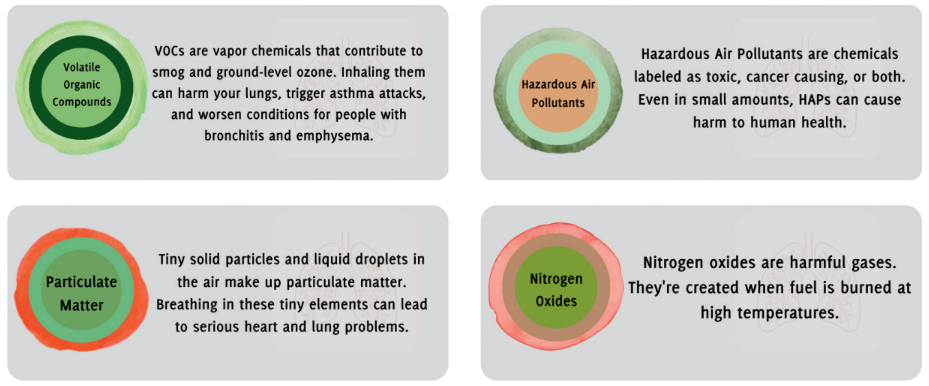
Wood pellet plants emit many air pollutants, including:
Sleep is critical to health, so 24/7 noise pollution is also a concern.
These air pollutants are harmful to residents breathing them in. They can cause:
The long-term effects of air pollution are chronic. They’re also much worse than the short-term effects. Some are even life-threatening. Added to the short-term effects, the long-term effects can be:
The community is suffering these effects now. Mabel Williams is a Gloster resident. She said:
“I’ve started coughing inside and outside. The plant might be helping people make a living, but we want a clean environment so we can breathe. That’s what we need. I had a friend that stayed with me, and she died because of this environment that was around here. It was cancer. We need the plant to clean up its act. I think I would feel better if they did. At night, something heavy comes out of that plant. I have to sleep with my ventilator to try to stay alive.”
In 2024, students from Brown University and Tougaloo College started a study. Dr. Erica Walker and Dr. Cristina Nica are the lead scientists. The project partnered with Community Noise Lab. They investigated the environmental impacts of the wood pellet plant on Gloster. The research analyzed air pollution and noise levels in Gloster and Mendenhall, MS. They used this data to assess health risks.
There was a lot of community involvement in the research. Participants shared health details. They shared their age, height, weight, race, sex, and distance from Drax. This helped assess respiratory health and other factors. The study revealed new information. It showed more about wood pellet plants’ relationship to the environment and health.

Greater Greener Gloster community members demanding change at the Mississippi capitol
It’s important to continue to get more information. This will give us a more complete picture of this industry’s health effects. So the study will go on. The team will:
The community of Gloster is tired of waiting for action. We’re taking the communities’ demands to the source.
Dogwood Alliance and our partners have long been raising the biomass alarm worldwide. Educating elected officials about the dangerous biomass industry. Now US Congress is finally taking meaningful action. We welcome the new Forest Biomass Emissions Act.
The Forest Biomass Emissions Act is an important step. It protects forests and communities from this dirty industry. We want to thank the legislators leading the way.

These senators have sponsored the Senate bill:
These representatives have sponsored the House resolution:
This Act requires the Environmental Protection Agency to:

The biomass industry has destroyed over two million acres of Southern US forests. They have plans to increase production. They want to expand west. Biomass wood pellet plants produce dangerous air and noise pollution. Biomass pollution can cause cancer. It can also cause cardiovascular and respiratory illnesses.
Communities near biomass plants are often low wealth communities of color. Local residents must wear masks or leave their windows closed to keep dust out. Industrial noise keeps them up at night. This is a grave environmental injustice.

We should be protecting forests around environmental justice communities. Not burning them for energy.
We must build support and pass this legislation. We need you to take action.
We have learned that scammers are using the Dogwood Alliance name and logo on social media to falsely claim we are hiring for data entry jobs.
The scam involves soliciting people to do freelance work. Once the work is complete, they solicit the freelancer for money. The platforms where we know this impersonation has occurred are:
These may not be the only platforms on which the scammers are operating, so please beware.
Dogwood Alliance will never ask for money in exchange for freelancing. All independent contracting work with Dogwood Alliance happens only after our team issues an official contract.
Dogwood Alliance is NOT hiring through any third party at this time. All job openings are posted on our official website: www.dogwoodalliance.org. Please report any scammers directly to the social platform. Please let us know as well so that we can take proper action.
We are reaching out to customer support to stop the scammers across these platforms.
Did you know that our planet is facing a crisis? It’s called climate change, and it’s something we all need to take seriously. The Earth’s climate is changing, and it’s having a big impact on our planet and our lives.
But what exactly is climate change? Something called the greenhouse effect causes it. It’s like when a greenhouse traps heat from the sun. In climate change, some gases in our atmosphere trap heat instead of releasing it into space. This trapped heat causes the Earth’s temperature to rise, leading to a lot of problems. Increasing carbon emissions from fossil fuels are responsible for this trapped heat.

The impact of climate change is far-reaching. We can see these impacts in:
These changes not only affect the environment. They also pose serious risks to our communities, economies, and the future of our planet.
Why this is such a big deal? Imagine a world where your favorite coastal towns are underwater. This is already happening in some areas of the world.
Picture a future where heatwaves make it impossible to go outside. This is already happening in some parts of the world.
Think about the devastation of losing precious wildlife and beautiful natural landscapes. This, too, is already happening all over the world. Every year that we release carbon into the atmosphere, we make it worse. Have no doubt about it: we are in a climate crisis.
We can’t simply let our planet suffer. We must take action against climate change, and we must do it now. Our future depends on it.
To combat the climate crisis, we must understand the science. We must understand the greenhouse effect, which contributes to global warming. The greenhouse effect happens when gases in the atmosphere trap heat from the sun. This causes the planet to warm up. These greenhouse gases include:
Human activities play a big role in increasing greenhouse gas emissions. Burning fossil fuels releases a lot of carbon emissions into the atmosphere. Common fossil fuels include:
Carbon emissions happen when we use these fuels. We usually use them for transportation, electricity generation, and heating our homes.
Changes in land use, like logging, also contribute to increased greenhouse gas emissions. Trees absorb carbon pollution and store it in their roots and leaves. When we log trees, that carbon goes into the atmosphere. We must reduce emissions using every tool in our climate solutions toolbox. This includes a hard look at logging across the world.

Global warming is a pressing issue that has major consequences for our planet. As temperatures continue to rise, we’re witnessing the devastating impacts. Climate change is impacting both our environment and our communities.
One of the most noticeable effects of global warming is the rise in temperatures. This increase in global temperatures has many implications. It leads to the melting of ice caps and glaciers. This causes rising sea levels. Then coastal communities face the imminent threat of flooding and erosion. We’ve already seen these devastating impacts in low-lying coastal areas.
Bad weather has also become more frequent and intense. This, too, is because of climate change. Hurricanes, droughts, heatwaves, and floods are becoming more severe. These events are causing widespread destruction and endangering human lives. In the US, recent hurricanes have been stronger than they used to be. They serve as reminders of the destructive power of climate change.
Another consequence of climate change is the loss of biodiversity. As habitats change, ecosystems are disrupted. Many species struggle to adapt or survive. Coral reefs, for example, are highly sensitive to temperature changes. Rising ocean temperatures lead to coral bleaching and mass die-offs. This threatens the incredible biodiversity found in coral reefs. It also impacts the livelihoods of people that depend on them for tourism and fishing.
The Australian bushfires in 2019 and 2020 were some of the most destructive in history. They resulted in the loss of millions of acres of forests. They killed 34 people and over a billion animals. These fires had a profound impact on both ecosystems and human communities. They displaced people from their homes. They caused irreparable damage to cherished natural landscapes.
The loss of beloved natural landscapes is heart-wrenching. Unfortunately, it’s a consequence of climate change. Imagine a world where iconic places no longer exist. Places like the Great Barrier Reef, the Amazon rainforest, and the Arctic. Do you want to live on an Earth like that?
Climate change has wide-ranging impacts. It affects both ecosystems and human communities. Rising temperatures, extreme weather, sea-level rise, and loss of biodiversity continue to happen. These real-life examples highlight the devastating effects on our planet. We need to take action now to reduce the impacts of climate change. Let’s protect our planet for future generations.
You may think that you have limited influence on company decisions. But, there are still important actions you can take on climate change.
Collective action has the power to drive change. We can advocate for better policies that:
Start conversations with friends about the urgency of climate change. Share information on social media platforms. Engage in educational discussions. By spreading awareness, we can inspire more people to take action.
We need to support clean energy initiatives. Renewable energy sources, like solar, wind, and hydroelectric power, offer many benefits. We can get cleaner energy from things like solar panels and wind turbines. Advocating for the transition away from fossil fuels is crucial. Dirty energy includes coal plants, oil, and gas. These all contribute to both carbon pollution AND air pollution.
We reduce greenhouse gas emissions by choosing renewable energy for our homes and communities. This is called “reducing our carbon footprint.” There are many success stories of communities who install solar panels. They’re embracing renewable energy solutions. You can share stories like these to inspire others.
Reducing our personal carbon footprint is essential in combating climate change. Simple changes in our daily lives can make a significant impact. You can reduce your personal carbon footprint by:
While these are all important, companies need to do their part, too. Most carbon emissions come from the business decisions of oil and gas companies. NOT from individual citizens. So we need to pressure companies to act responsibly.

Forests play a vital role in stopping climate change. This is because they absorb carbon dioxide from the atmosphere. Preserving existing forests can reduce carbon emissions. This is called proforestation. So can restoring degraded areas through reforestation efforts. Forests provide habitats for wildlife, protect biodiversity, and support local communities. Join or support organizations (like ours!) dedicated to forest conservation and reforestation initiatives. Let’s safeguard these valuable ecosystems for future generations.
Together, we’ve explored the science behind climate change. We’ve looked at both the consequences and how to fix it. But why do we need to act now? Why is it so urgent?
The effects of climate change are already harming us. We can’t afford to wait.
Taking action against climate change is necessary. We’ve seen the evidence, felt the impacts, and heard the warnings from scientists. It’s our responsibility to protect our planet for future generations.
So, what can you do? You can be an advocate. Raise your voice for better policies. Support clean energy initiatives. Make sustainable choices in your daily life. You can make a difference.
But we can’t do it alone. We must come together as a global community. We must unite in our efforts to combat climate change. Every one of us has a role to play. We can all be environmental stewards, working towards a sustainable future.
Are you ready to join the fight against our changing climate? Our planet is counting on us. The time for action is now.
North Carolina DEQ Forcing Enviva to Capture Dust at Port of WilmingtonNo action taken at the company’s pellet mills. Frontline communities have demanded pollution controls for years.
The North Carolina Department of Environmental Quality made an announcement. They are requiring two wood products companies to install fugitive dust controls. This action is at the Port of Wilmington. This was after receiving many complaints from the Sunset Park community. The historic community is next to the port. The complaints led to an investigation. This investigation focused on Enviva Pellets and Basaga International, a wood chip exporter.
Danna Smith is the Executive Director of Dogwood Alliance. She said:
“The Sunset Park community has suffered from wood dust since Enviva began operations. We’re glad that the DEQ has finally taken action. We hope they won’t stop here. We hope they’ll take action at all Enviva wood pellet operations across the state. Communities have demanded it. And it’s time for the state to take action.”
Enviva is the largest wood pellet manufacturer in the world. It is undergoing Chapter 11 bankruptcy proceedings. Enviva has facilities in Hertford, Richmond, Sampson, and Northampton counties. The company has a long history of polluting these communities. Impacted communities have called on state and local officials to take action. These demands align with recommendations from the North Carolina Environmental Justice Advisory Board.
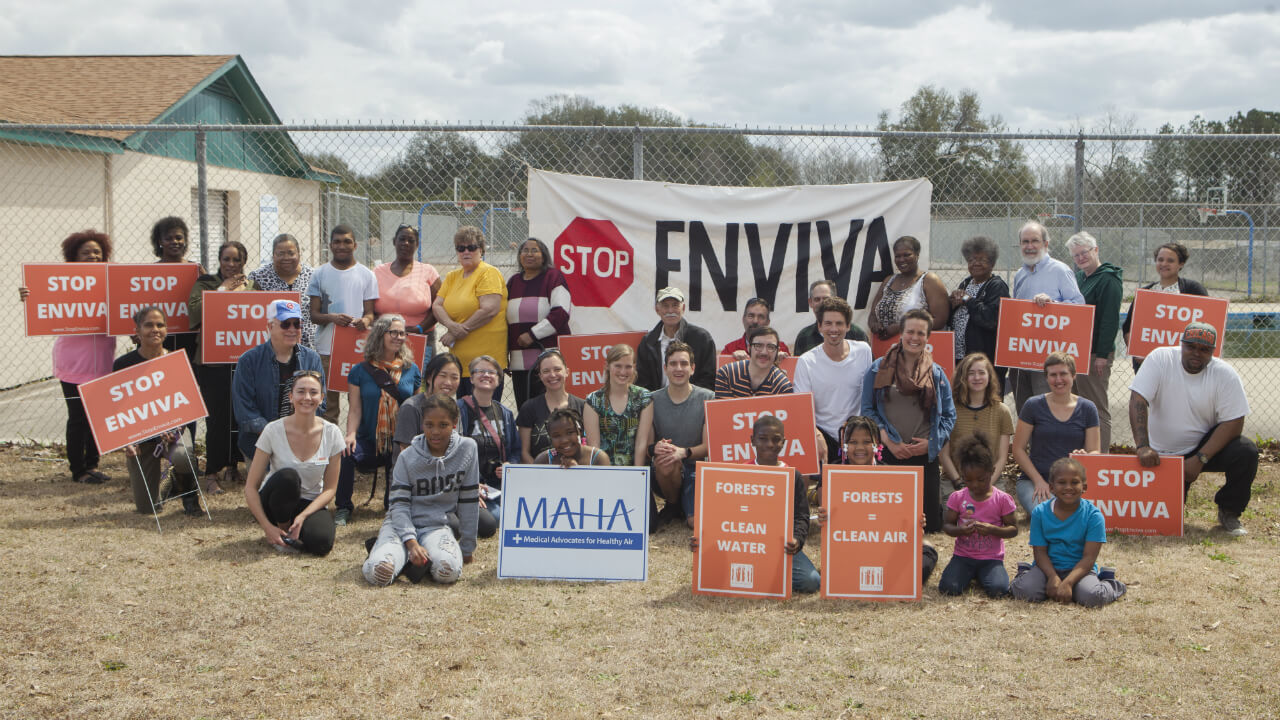
Ruby Bell is an educator and organizer from Sampson County. She said:
“By not investing in the best available control technologies, Enviva has profited from pollution since day one. Will the state finally hold the company accountable at all its facilities? Let’s hope Governor Cooper does the right thing before the end of his administration.”


 Donate
  April 5, 2026